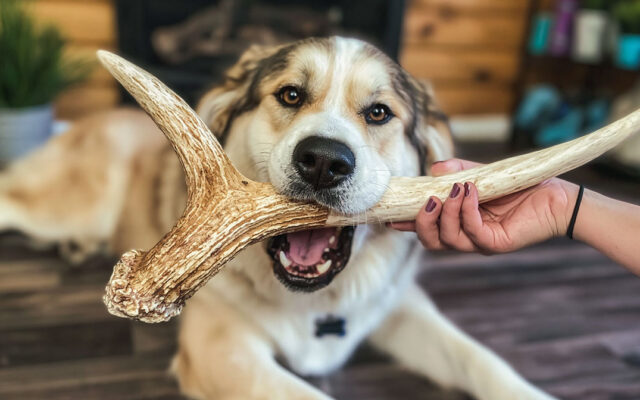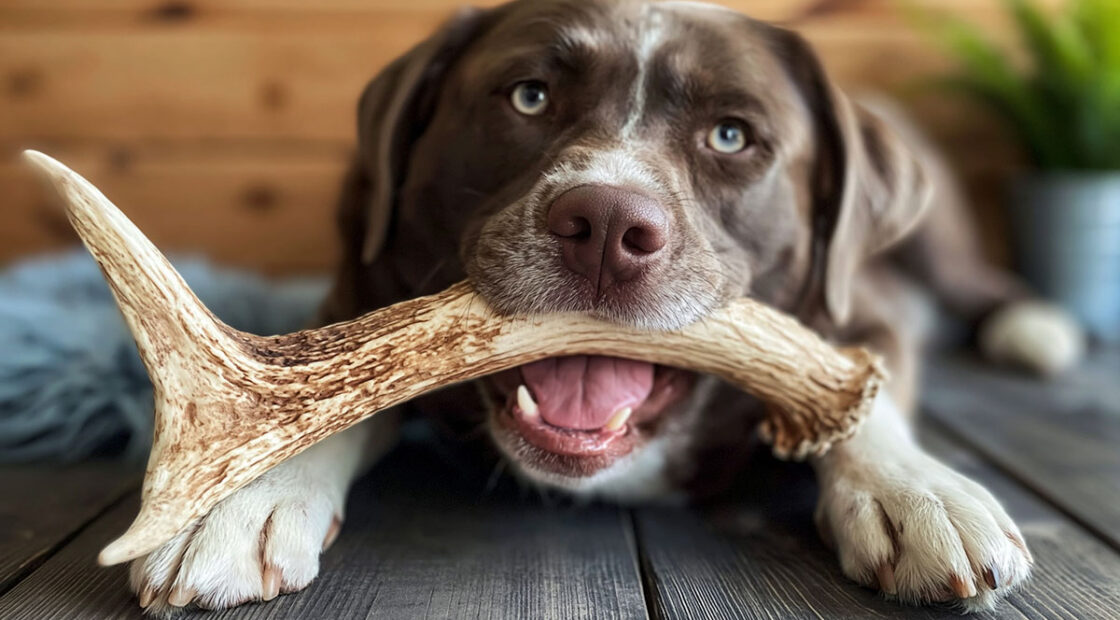
My dog once cracked a tooth on a deer antler I bought him as a weekend treat. That single chew session cost me over $1,200 at the vet. So, are antlers safe for dogs? The answer is more complicated than most pet stores would have you believe.
Antler chews are marketed as natural, long-lasting, and packed with minerals like calcium and phosphorus. But veterinary dental specialists are raising serious concerns about fractured teeth, choking hazards, and digestive blockages.
This article breaks down the real risks, what vets actually recommend, which dogs should never chew antlers, and safer alternatives that still satisfy your dog’s need to gnaw.
What Are Antlers as Dog Chews
Antlers sold as dog chews come from elk, deer, moose, and caribou. They’re naturally shed each year, collected off the ground, then cut and graded by size before hitting pet store shelves.
Unlike rawhide or nylon bones, antlers are actual bone tissue. Dense cortical bone wraps around a softer, spongy marrow center. That structure is what makes them last so long, and also what makes them risky.
Types of Antler Chews Available
Elk antlers are the most popular option. They’re large, slightly softer than deer antlers, and have a thicker marrow core that dogs tend to go after first.
Deer antlers are denser and harder. Whitetail deer antlers in particular have a thinner outer shell, which means less marrow access and more force needed to chew through them.
Moose antlers are the softest of the bunch, with the thinnest outer wall and the most accessible marrow. They wear down faster but tend to be gentler on teeth.
You can also find them sold as whole antlers or split antlers, which are cut lengthwise to expose the marrow directly.

Nutritional Profile of Antler Chews
Antlers contain 15-20% calcium and 10-15% phosphorus, plus trace amounts of zinc, magnesium, iron, and manganese. The calcium-to-phosphorus ratio sits close to 2:1, which actually matches the ideal balance for canine bone health.
They’re also low in fat and calories. The marrow inside contains protein, glucosamine, and chondroitin.
| Nutrient | Approximate Content | Role |
|---|---|---|
| Calcium | 15–20% | Bone and teeth strength |
| Phosphorus | 10–15% | Energy metabolism |
| Zinc | Trace | Immune support |
| Protein | ~38% | Muscle maintenance |
Sounds great on paper. But here’s the thing: your dog would need to consume a significant amount of antler material to get any real nutritional benefit. And consuming antler material is where the problems start.
Are Antlers Safe for Dogs
The short answer? Most veterinary dental specialists say no.
A poll of veterinarians found that fewer than 1% were comfortable with dogs chewing on antlers. Several vets who initially supported antler chews changed their stance after their own dogs fractured teeth on them (Dr. Buzby’s ToeGrips).
That’s not a number you can brush off. And I get the appeal. My dog will ignore every rubber toy in the house but lose his mind over an antler. But the risks are real, documented, and expensive to fix.
The Core Problem: Hardness
Antlers rate around a 5 on the Mohs hardness scale. That’s comparable to iron. Dog tooth enamel also rates around a 5, but enamel is just a thin coating. A study published in the Journal of Veterinary Dentistry found that dog enamel varies from only 0.1mm to 1mm thick, far thinner than human enamel, which reaches up to 2.5mm.
According to Pedigree UK, a dog’s enamel is up to six times thinner than human enamel, with nerves sitting much closer to the tooth surface.
Antlers are a solid mass. No layers, no give, no hollow root. Your dog’s teeth have all of those structural vulnerabilities. When something equally hard meets something structurally weaker, the weaker thing breaks. Simple physics.
Why Veterinary Opinion Has Shifted
The American Veterinary Dental College and veterinary dental specialists have increasingly spoken out against hard chews, including antlers for dogs. The reason is straightforward: they’re seeing more fractured carnassial teeth than ever, and antlers keep showing up as the cause.
Veterinary Practice News reported that a 2009 study in the Journal of Anatomy found dog bite forces can reach as high as 3,417 Newtons at the molars. That’s over 750 pounds of pressure concentrated on teeth with paper-thin enamel. It only takes one bad chomp in the wrong spot.
Research from the University of Pennsylvania School of Veterinary Medicine confirmed that a dog’s jaws are powerful enough to break their own teeth when allowed to chew on products that are too hard.
Tooth Fractures and Dental Damage from Antlers
Dental injury is the most common and best-documented risk of antler chews. A veterinary study found that one in four dogs presented for a dental cleaning had a traumatic dental injury, and 50% of those injuries involved fractured teeth (Dr. Buzby’s ToeGrips).
The tooth that breaks most often is the upper fourth premolar, also called the carnassial tooth. It’s the large, pointy cheek tooth near the back of your dog’s mouth. Dogs instinctively move hard chews to this area and bite down with maximum force.
How the Fracture Happens
Veterinary dental specialists describe the typical injury as a “slab fracture.” When your dog positions the antler between the upper fourth premolar and the lower first molar, the pointed cusps of those teeth create concentrated stress points.
Because antlers don’t give or flex at all, that stress has nowhere to go except into the tooth itself. A chunk of enamel and dentin shears off the side, sometimes exposing the sensitive pulp (nerve) underneath.
VCA Animal Hospitals classifies five levels of tooth fractures in dogs, ranging from enamel-only chips to fractures that extend down into the root. The worst ones expose the pulp cavity, leading to infection, pain, and eventual tooth death if left untreated.
Signs Your Dog Has Cracked a Tooth
Visible signs: Fracture lines on the tooth surface, a chip or missing piece, discoloration (grey or pink tint), bleeding at the gum line.
Behavioral signs: Chewing on only one side of the mouth, dropping food, pawing at the face, excessive drooling, sudden refusal of hard treats, facial swelling.
Here’s what makes this tricky. VCA Animal Hospitals notes that dogs often show no signs at all, because they’re hardwired to hide pain. Some fractures go unnoticed for weeks or months until a routine dental exam catches them.
What Treatment Looks Like
Once the pulp is exposed, the options are root canal therapy or extraction. Neither is cheap.
PetMD reports that dog tooth extractions cost between $500 and $2,500 per tooth, depending on the complexity. Root canals tend to run even higher. A vital pulp therapy procedure, which preserves the tooth’s function, costs $1,500 to $3,000 per tooth and must be done within 24-48 hours of the injury (GoodRx).
Compare that to the $15-25 you paid for the antler. The math doesn’t work out in your favor.
Choking and Digestive Risks with Antler Chews

Broken teeth get most of the attention, but choking and gastrointestinal issues are the second major category of antler-related injuries. And they can turn life-threatening fast.
How Antlers Become a Choking Hazard
As your dog grinds down an antler over days or weeks, it gets smaller. At some point it becomes small enough to slip past the back teeth and lodge in the throat or esophagus.
Unlike softer chews that compress or dissolve, antler fragments keep their rigid shape. They can wedge in places where smoother objects would pass through. Emergency vets report seeing dogs with antler pieces stuck in the esophagus, requiring sedation and endoscopic removal.
This is why knowing when to take an antler away from your dog matters so much. If the remaining piece is small enough to fit behind your dog’s molars, it needs to go in the trash.
Intestinal Blockage from Swallowed Antler Pieces
The risk: Antler chunks that make it past the throat can lodge in the stomach or intestines, blocking food and fluids from passing through normally.
The debate: Some vets believe stomach acid can eventually dissolve antler material. Others point out that even if dissolution eventually happens, an intact piece can cause a dangerous obstruction in the meantime.
The treatment: Gastrointestinal blockages often require emergency surgery. You’re looking at imaging, anesthesia, the surgical procedure itself, and recovery costs. It adds up to thousands of dollars, and the longer a blockage sits, the more dangerous it becomes.
For comparison, bully sticks are fully digestible and break down in the stomach. Collagen chews dissolve relatively quickly too. Antlers don’t share that characteristic.
Which Dogs Should Not Chew Antlers
Some dogs face higher risk than others. If your dog falls into any of these groups, antlers aren’t worth the gamble.
Power Chewers and Aggressive Chewing Breeds
Dogs that bite down hard and fast, rather than slowly gnawing, are the most likely to fracture teeth. Breeds known for powerful jaws and aggressive chewing include Labrador Retrievers, American Pit Bull Terriers, German Shepherds, Rottweilers, and Bullmastiffs.
A pilot study in the Journal of Veterinary Dentistry measured bite force across 22 dogs and found forces ranging from 13 to 1,394 Newtons. Larger breeds with wide skulls generated the highest forces, especially at the carnassial teeth where antlers typically sit during chewing.
If your dog destroys a Kong Extreme in under an hour, antlers might not crack their teeth, but the odds go way up.
Puppies and Senior Dogs
Puppies have developing teeth that are softer and more vulnerable to fractures than adult teeth. Their permanent teeth are still mineralizing, and the enamel hasn’t fully hardened yet. Giving a puppy an antler is like handing them a chew that’s specifically designed to be harder than their teeth can handle. There are much better options, like chew bones made specifically for puppies.
Senior dogs face the opposite problem. Years of wear have thinned their enamel further. They may have existing dental issues (weakened roots, early periodontal disease) that make fractures more likely and harder to treat. You might also be dealing with breed-specific health problems that complicate dental surgery.
Small Breeds and Dogs with Dental History
For smaller breeds like Chihuahuas, Pomeranians, or Shih Tzus, the antler-to-mouth size ratio creates additional problems. Chunks that break off are proportionally larger relative to their airway, making choking more dangerous.
Dogs that have already fractured a tooth should not be given antlers. Period. One fracture means the remaining teeth are under the same stress, and a second fracture doubles your vet bill and your dog’s pain.
How to Reduce Risks If You Still Give Antlers
Look, some people are going to give their dogs antlers regardless. I understand that. My own dog acted like I’d given him the greatest gift of his life the first time he got one. If you decide the risk is acceptable, at least take steps to lower it.
Size and Type Selection
Size rule: The antler should be large enough that your dog cannot fit the entire thing past their back molars. If they can get it back there and chomp down fully, it’s too small.
Type matters: Moose antlers are the softest option. Elk antlers fall in the middle, while deer antlers are the hardest. Split antlers give immediate access to the softer marrow, which means less force applied to the dense outer shell.
| Antler Type | Hardness | Marrow Access | Best For |
|---|---|---|---|
| Moose (whole) | Softest | Moderate | Gentle chewers |
| Elk (split) | Medium | High | Most adult dogs |
| Deer (whole) | Hardest | Low | Not recommended |
Supervision and Time Limits
Every single chew session needs to be supervised. No exceptions. You wouldn’t leave a toddler alone with something they could choke on, and the same logic applies here.
Vets generally recommend limiting antler chew sessions to 15-20 minutes at a time. Shorter sessions reduce cumulative stress on teeth and give you a chance to inspect the antler for sharp edges, cracks, or size changes. You can learn more about how long dogs should chew on hard chews to dial in the right timing.
Rotate antlers with softer chew options. Don’t let your dog grind on hard material day after day. My vet’s advice was blunt: treat antlers like dessert, not the main course. Something like a healthier treat alternative should fill most of the gaps.
When to Throw the Antler Away
Use the fingernail test: press your thumbnail into the antler. If you can’t leave even a slight dent, it’s too hard and still carries full fracture risk.
Use the kneecap test: smack the antler against your kneecap. If it hurts, it’s too hard for your dog’s teeth. Veterinary dentists point to this as a quick, reliable way to judge any chew’s safety.
Throw the antler away when it’s worn down small enough to swallow, when sharp edges develop, or when you see cracks forming in the structure. Keeping safe dog chews on rotation means you always have a backup ready when an antler needs to be retired.
What Veterinarians and Dental Specialists Say About Antlers
The professional consensus has moved firmly against antler chews over the past decade. Not unanimously, but the trend is clear, especially among board-certified veterinary dentists who see the consequences firsthand.
The American Veterinary Dental College Position
Pet Dental Specialists, referencing AVDC guidance, states directly that antler is “one of the toughest biological materials known” and that its fracture toughness is roughly 50% higher than bovine femur bone.
Their position is blunt: if antler is pitted against a dog’s teeth and jaw, the dog will lose. The AVDC-affiliated Veterinary Oral Health Council recommends chews with proven dental benefit from their accepted products list at vohc.org, and antlers are not on it.
The Kneecap Rule and Fingernail Test
Kneecap rule: Hit your kneecap with the chew. If it hurts, it’s too hard for your dog’s teeth.
Fingernail test: Press your thumbnail into the chew surface. If you can’t leave a dent, your dog shouldn’t be chewing it.
Antlers fail both tests. Every time. Veterinary dentists at the Hospital for Veterinary Dentistry and Oral Surgery specifically list antlers, hooves, and bones as known tooth-fracture causes and recommend only chews with “give” or flexibility.
Why Some General Practice Vets Still Sell Antlers
This is the confusing part. You’ll find antlers on the shelf at some vet clinics right next to the dental chews. Took me a while to understand why.
General practice vets may not have seen enough dental fracture cases to flag the risk. Board-certified veterinary dentists, who handle the referrals and emergency repairs, see a very different picture. The disconnect between what’s sold at the front desk and what’s treated in the surgical suite is real.
Pet Dental Specialists notes that some animals chew appropriately while others chew too aggressively, making blanket recommendations tricky for general practitioners who see a wide range of chewing behaviors.
Safer Alternatives to Antlers for Dogs
You still need to give your dog something to chew. Chewing is a natural behavior that supports dental health, reduces anxiety, and keeps your dog from turning your furniture into a project.
The good news: plenty of options satisfy that instinct without the tooth-fracture risk.
Rubber Chew Toys
Kong Classic is the most universally recommended chew toy by veterinarians and trainers. It’s been around since the 1970s and is made from natural rubber that has enough give to protect teeth while still holding up to aggressive chewers.
West Paw Zogoflex toys are BPA-free, phthalate-free, non-toxic, and recyclable. The Zogoflex material strikes a balance between durability and tooth safety that veterinary dental specialists specifically endorse.
Both brands pass the fingernail test. Both pass the kneecap test. Neither will show up on your vet’s dental X-ray as the cause of a slab fracture.
Digestible Chew Alternatives
| Chew Type | Digestible | Lasts | Tooth Risk |
|---|---|---|---|
| Bully sticks | Yes | 30–60 min | Low |
| Himalayan yak chews | Partially | 1–3 hours | Low–moderate |
| Beef tendons | Yes | 15–30 min | Very low |
| Lamb ears | Yes | 10–20 min | Very low |
Thick bully sticks are a strong pick for power chewers who need something that lasts longer than standard sizes. They’re single-ingredient, fully digestible, and won’t crack a tooth.
If you’re curious about how bully sticks compare on cost and longevity, it helps to know how long bully sticks typically last before you commit to a bulk purchase.
VOHC-Approved Dental Chews
The Veterinary Oral Health Council maintains a list of products that have been scientifically proven to reduce plaque and tartar. These aren’t marketing claims. Each product on the VOHC list went through controlled clinical trials before earning the seal.
Some of the accepted products for dogs include Greenies dental chews, Hill’s Prescription Diet dental products, and Purina DentaLife treats.
Antlers are not VOHC-approved. They never have been. For natural dental chews that actually clean teeth, the VOHC list is the place to start. You can also look at chews specifically designed to support dental health without the fracture risk.
How to Pick the Right Chew for Your Dog’s Size and Style
Match chew hardness to jaw strength. A Golden Retriever and a French Bulldog need completely different chew products, even if they weigh roughly similar amounts.
Start with softer options and observe. If your dog gnaws gently along the side, you have more flexibility. If they chomp straight down with their back teeth, stick with the softest chews you can find.
For dogs with sensitive stomachs, look for single-ingredient treats or specifically formulated treats for sensitive stomachs that won’t cause digestive upset on top of everything else.
Antler Recalls and Product Quality Concerns
Here’s something that doesn’t get talked about enough. The antler chew market in the U.S. operates with minimal standardized regulation.
The Regulation Gap
The FDA oversees pet food safety and has the authority to inspect manufacturing facilities and initiate recalls. STAT News reported there were 17 pet food recalls in 2024, mostly for salmonella and listeria contamination.
But antler chews exist in a grey area. The FDA does not approve specific pet treat brands or products. It approves individual ingredients and can act when contamination is found, but there is no pre-market approval process for antler chews specifically.
No hardness standard exists for dog chews in the U.S. No required testing for dental safety. No mandatory labeling about fracture risk. A company can collect antlers, cut them to size, and sell them with almost no regulatory hurdles.
Quality Variation Between Sources
Wild-shed antlers: Collected after natural shedding cycles. Generally considered the highest quality because the antler had time to fully mineralize before dropping.
Farm-raised or imported antlers: May be cut prematurely, affecting structural integrity. Some imported products have been flagged for inconsistent processing and potential bacterial contamination.
The difference matters. A poorly processed antler is more likely to splinter unpredictably. And since there’s no industry-wide grading system that consumers can verify, you’re largely trusting the company’s word on sourcing and quality.
Evaluating an Antler Product
If you still want to buy antlers, at least ask the right questions.
- Where were the antlers sourced? (U.S. wild-shed is the baseline standard)
- Were they heat-treated or chemically processed?
- Does the company provide size guidelines matched to dog weight?
Companies that can’t answer these questions clearly probably aren’t worth your money. Or your dog’s teeth. The cost of owning a dog is already high enough, as anyone who’s looked at what a dog can actually cost over its lifetime already knows. Adding an avoidable dental emergency to that total doesn’t make sense.
If you’re looking for chew options you can feel genuinely good about, consider browsing through long-lasting dog chews or chews built specifically for heavy chewers that don’t carry the same dental risk profile as antlers.
FAQ on Antlers For Dogs
Can antlers break a dog’s teeth?
Yes. Antlers rate around a 5 on the Mohs hardness scale, which matches tooth enamel but exceeds the thin enamel layer dogs actually have. The upper fourth premolar (carnassial tooth) fractures most often. Slab fractures from antlers frequently require extraction or root canal therapy.
Are elk antlers safer than deer antlers for dogs?
Elk antlers are slightly softer with a thicker marrow core, making them a marginally better option. Deer antlers are denser and harder. But both carry real fracture risk. Deer antlers in particular demand extra caution with aggressive chewers.
What age can puppies start chewing antlers?
Most veterinary dentists recommend avoiding antlers for puppies entirely. Their developing teeth haven’t fully mineralized, making fractures more likely. Softer chews like rubber toys or puppy-specific options are much safer during this stage. Learn more about what age puppies can chew antlers.
How long should I let my dog chew an antler?
If you choose to give antlers, limit sessions to 15-20 minutes and always supervise. Longer sessions increase cumulative stress on teeth and raise the chance of a piece breaking off. Rotate with softer chews between sessions.
Are split antlers safer than whole antlers?
Split antlers expose the softer marrow center, which means your dog spends less time grinding on the hard outer shell. They’re a lower-risk option compared to whole antlers, but they still carry dental and choking concerns. They wear down faster too.
What should I do if my dog swallows a piece of antler?
Watch for vomiting, loss of appetite, lethargy, or straining to pass stool. Small pieces may pass naturally, but larger chunks can cause gastrointestinal obstruction. Contact your vet immediately if symptoms appear. Don’t wait to see if it resolves on its own.
What do vets recommend instead of antlers?
Veterinary dental specialists recommend rubber chew toys like Kong and West Paw Zogoflex. Yak chews, turkey tendons, and VOHC-approved dental chews are also popular alternatives that don’t carry the same fracture risk.
Can antlers cause intestinal blockage in dogs?
Yes. Swallowed antler pieces don’t dissolve easily and can lodge in the stomach or intestines. Emergency surgery is sometimes required to remove them. This is why supervised chewing and timely disposal of small remnants matters so much.
Are antlers good for cleaning dog teeth?
The chewing action can scrape some plaque off, but the dental fracture risk far outweighs any cleaning benefit. Antlers are not VOHC-approved for plaque or tartar control. Purpose-built dental chews clean teeth without threatening to break them.
How do I know when to throw an antler away?
Discard it when it’s small enough to fit entirely behind your dog’s back molars, when sharp edges form, or when cracks appear. If you’re second-guessing whether it’s still safe, it probably isn’t. Always err on the side of replacing it early.
Conclusion
So are antlers safe for dogs? For most dogs, the risk outweighs the reward. The veterinary dental community has been clear: hard chews like elk and deer antlers lead to slab fractures, emergency extractions, and vet bills that dwarf the cost of the chew itself.
Your dog doesn’t know the difference between a $20 antler and a frozen Kong stuffed with peanut butter. But their carnassial teeth definitely know the difference.
Stick with VOHC-approved dental chews, rubber toys from trusted brands, or digestible options like bully sticks and beef tendons. Supervise every chew session regardless of what you choose.
If you do give antlers, match the size to your dog’s breed, pick the softest type available, and watch closely. The moment you see cracks, sharp edges, or a piece small enough to swallow, throw it out.
Your dog’s oral health isn’t worth gambling on a trendy chew product. There are better ways to keep them happy, busy, and safe.