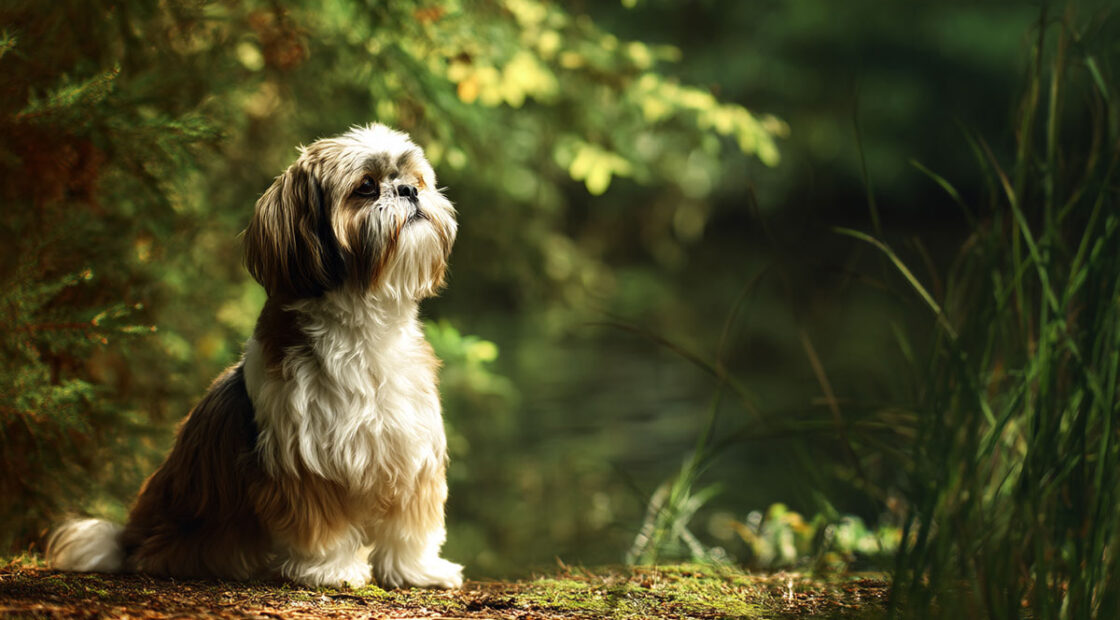
Shih Tzus have lived indoors with people for centuries, first in Tibetan and Chinese imperial courts and now mostly in apartments and small homes. Owners keep them for the friendly temperament and the low exercise demand. The coat is where the work is, since it needs attention every day.
The flat face makes people expect trouble. The recorded health picture sits closer to dogs overall than to French Bulldogs or Pugs, though, with a median age at death of 12.7 years in UK veterinary records (Royal Veterinary College, VetCompass, 2024). Periodontal disease is the most common recorded condition, diagnosed in 9.5% of dogs in a year.
What is a Shih Tzu?
Registries file it as a toy dog, and companionship has always been the job. The long double coat and the short-muzzled, flat face give it away.
The name comes from the Chinese word for lion, pronounced roughly “sheed-zoo”. Owners also call the dog a Chinese Lion Dog, which is just the translated form of the Chinese name, or a Chrysanthemum Dog, after the way hair grows outward around the face. Most people shorten it to Tzu.
It is a separate breed from the Lhasa Apso, its look-alike Tibetan relative. The historical summary in FCI Breed Standard No. 208 says people confuse the two even though several distinct differences exist.
| Registry | Group | Recognized |
|---|---|---|
| AKC | Toy Group | 1969 |
| The Royal Kennel Club (UK), formerly The Kennel Club | Utility Group | 1940 (separate register) |
| Canadian Kennel Club | Group VI, Non-Sporting | 1952 |
| United Kennel Club | Companion Dog Group | 1966 |
The group label reflects each registry’s show system, not a different dog.
Every standard describes the same companion, and the AKC names companion as the breed’s sole purpose.
Where does the Shih Tzu come from?
Tibetan lion dogs kept in the Chinese imperial court are the ancestors, and every modern dog traces back to a small group saved before the breed vanished from China.
Sources agree on the court connection and disagree on the ancestry. The AKC says historians believe the Shih Tzu descends directly from the Lhasa Apso, that the breed lived with royalty throughout the Ming Dynasty (1368 to 1644), and that court artists portrayed the dogs on palace wall hangings for several hundred years. Pedigree’s history goes the other way. It treats the breed as distinct from the Lhasa Apso, and from the Pug and Pekingese too, developed by Tibetan monks who gave temple dogs to the emperors of China.

Dowager Empress Tzu Hsi, who ruled from 1861 to 1908, is the ruler most associated with the breed (Pedigree).
The breed’s age shows up in DNA work. The AKC says testing ranks the Shih Tzu among the 14 oldest dog breeds, and Parker et al. (Science, 2004) separated ancient-origin breeds from modern European ones across a large panel of breeds.
Then it nearly ended. After the 1949 Communist revolution, every Shih Tzu in China was killed because of the dogs’ association with wealth (AKC).
Dogs that had already left the country rebuilt it. The AKC says modern Shih Tzu descend from 13 dogs imported into England and Scandinavia between 1928 and 1952, plus one black and white Pekingese added in England in 1952, which is how sources arrive at the commonly cited 14 founders.
The Pekingese is the one non-Shih Tzu founder (AKC; VCA Animal Hospitals). The AKC dates the cross to 1952 and notes that it was controversial among fanciers. Dogs NSW names the breeder as Elfreda Evans, who introduced the Pekingese under Kennel Club control to improve various points in the breed.
The recognition timeline runs like this:
- In 1934, Britain recognized the breed as separate from other Oriental breeds (FCI Breed Standard No. 208 history).
- The Kennel Club (now the Royal Kennel Club) granted a separate register in 1940.
- The American Shih Tzu Club formed in 1963 to seek AKC recognition.
- By 1969 the breed was in the AKC Stud Book (AKC). AKC archives show Chumulari Kennels’ Ch. Chumulari Ying-Ying as the first Shih Tzu to win Best in Show, around the same year.
How big does a Shih Tzu get?
Under the AKC standard an adult stands 9 to 10.5 inches at the withers and weighs 9 to 16 lb. Pet dogs in UK veterinary records come in heavier than that, averaging 7.9 kg (about 17.4 lb).
| Standard | Height | Weight |
|---|---|---|
| AKC | 9 to 10.5 in ideal, 8 to 11 in range | 9 to 16 lb |
| The Royal Kennel Club (UK) | Up to 27 cm (10.5 in) | 4.5 to 8 kg, ideal 4.5 to 7.5 kg |
| United Kennel Club (2017 revision) | Ideally up to 10.5 in | Ideal 9 to 16 lb |
VetCompass data from the Royal Veterinary College (Dale et al., 2024) covers 11,082 UK Shih Tzus and puts mean adult weight at 7.9 kg. Males average 8.5 kg and females 7.3 kg.
The AKC ceiling of 16 lb is about 7.3 kg, so the average dog in the study is heavier than the AKC ideal. The average male is heavier than even the UK limit of 8 kg.
Worth remembering that these are pet dogs seen by vets, not show dogs. The Royal Kennel Club notes that its measurements describe an ideal, and individual dogs can fall outside them.
Portions are easier to control with a feeding chart set by age and weight than by eye.
Teacup and miniature Shih Tzu claims
Neither the AKC nor the UK Royal Kennel Club standard describes a teacup or miniature Shih Tzu. Each gives one size range, and the Royal Kennel Club standard says breed type must not be sacrificed to size alone.
A puppy sold as teacup is a small Shih Tzu. Nothing more.
Shih Tzu coat, colors and shedding
The coat is long and dense, any color is accepted, and the Royal Kennel Club lists the breed as non-shedding.
Its standard calls for a long, dense outer coat with a moderate undercoat, not woolly, and permits a slight wave. Puppies are born with a single short coat, and the second coat grows in with age.
On color, the AKC standard says all colors and markings are permissible and to be considered equally. Merle is the one color the Royal Kennel Club standard excludes. Hair on the face and head must not impair sight, so that standard recommends tying head hair up without adornment.
Non-shedding is the Royal Kennel Club’s wording. Taste of the Wild’s breed guide uses the softer label, low-shed.
Are Shih Tzus hypoallergenic?
No breed has been shown to qualify as hypoallergenic, and low shedding does not change that.
Vredegoor and colleagues at Utrecht University measured the major dog allergen Can f 1 and found higher levels in hair and coat samples from supposedly hypoallergenic breeds than from control breeds (Journal of Allergy and Clinical Immunology, 2012). Airborne levels did not differ between breeds.
A separate study of 173 single-dog homes in Detroit found no difference in Can f 1 in floor dust between homes with hypoallergenic and non-hypoallergenic dogs (Nicholas et al., American Journal of Rhinology and Allergy, 2011). The researchers identified 190 one-dog families and excluded 17 where the dog was not allowed indoors.
Neither study isolates the Shih Tzu, and the homes study lacked the sample size to judge single breeds. Anyone with allergies should spend time with the individual dog before committing.
Shih Tzu temperament and energy level
Friendly, affectionate and moderately energetic describes most of them, and the Royal Kennel Club puts exercise at up to 1 hour a day.
The AKC standard describes an outgoing, happy, affectionate dog that is friendly and trusting toward everyone. The Royal Kennel Club standard reads differently: friendly and independent, intelligent, active and alert, with a distinctly arrogant carriage. That independence fits Petfinder’s description of a dog that can be aloof yet mentally agile.
For exercise, Bil-Jac’s breed library suggests one or two walks a day plus indoor play. The breed does poorly in hot temperatures (Bil-Jac), so summer walks belong in the early morning or evening.
Taste of the Wild calls the dog playful with kids, but young children need supervision around something this small. Toward other dogs and cats, Shih Tzus are generally friendly.
In the VetCompass records for 11,082 UK Shih Tzus, aggression was recorded more often in males than in females (3.2% versus 1.5%), though overall prevalence of 2.4% was comparable to dogs in general (Dale et al., 2024).
That finding comes from dogs presented to vets, so it does not describe every household.
How long do Shih Tzus live?
Shih Tzus in UK veterinary records die at a median age of 12.7 years (Dale et al., 2024). Breed profiles quote anything from just over 10 years to 18 years, and the figures measure different things.
| Source | Figure | Basis |
|---|---|---|
| VetCompass, Royal Veterinary College (2024) | 12.7 years median age at death | 85 deaths with a recorded age, UK primary-care records |
| Teng et al., Scientific Reports (2022) | 11.05 years life expectancy at birth | UK life tables, where all UK dogs average 11.23 years |
| Breed profiles (Royal Kennel Club, PDSA, Bil-Jac, WebMD) | Over 10 years, or 10 to 18 years | No dataset stated |
A median age at death describes the dogs that died during the study window. Life expectancy at birth comes from age-specific mortality across the whole population, so the two numbers need not match.
The sources also split on the verdict. RVC calls the breed relatively long-lived against earlier dog-wide reports, while the life-table estimate sits just under the figure for UK dogs overall.
The 12.7-year median rests on a small number of deaths, and the authors advise reading the mortality data with caution. Enteropathy, heart disease and poor quality of life tied as the leading recorded causes of death. Periodontal disease, dry eye and ulcerative keratitis all turn up more often in older dogs.
Against other flat-faced breeds the Shih Tzu holds up well. RVC puts French Bulldogs, English Bulldogs and Pugs under 8 years on average, though the paper warns that part of that comparison rests on young study populations.
Plan around 12 to 13 years, not 18.
Common Shih Tzu health problems and how often they occur
In UK Shih Tzus the breed’s overall pattern sits closer to dogs in general than to other flat-faced breeds, and the most recorded conditions are fairly ordinary ones.
Periodontal disease leads at 9.5% of dogs in a year. Anal sac impaction follows at 7.4%, with ear disorders at 5.5% (one-year prevalence, 2016, VetCompass, Royal Veterinary College, 2024).
Anal sac impaction, umbilical hernia and eye problems ran higher than in dogs overall, which the authors read as breed predispositions. Periodontal disease did not, though it climbs with age.
An owner survey of Kennel Club registered dogs (Wiles et al., 2017) adds intervertebral disc disorder to the list of excesses over dogs overall.
RVC’s practical advice is oral hygiene from an early age, meaning regular dental check-ups and toothbrushing. Natural dental chews can supplement brushing but do not replace it.
Young dogs need a different check. Retained baby teeth were most common under 2 years in the study, and they feed plaque build-up if no one removes them.
Breathing, eyes and heat tolerance
Brachycephalic obstructive airway syndrome (BOAS) has been reported in the breed, but RVC judges the Shih Tzu much less severely affected by its flat-faced conformation than French Bulldogs, English Bulldogs and Pugs. That judgment rests on overall disorder patterns, since the study did not measure BOAS directly.
There is also a grading scheme. The Kennel Club and University of Cambridge respiratory function grading scheme launched in February 2019 for Bulldogs, French Bulldogs and Pugs. In August 2026 the Royal Kennel Club recognised the scheme as a Best Practice test for Shih Tzu, to be added formally to its Health Standard and Find a Puppy service from January 2027. Ask the breeder whether the parents have been graded.
Shallow eye sockets leave the eyes more exposed, which brings corneal ulceration, dry eye (keratoconjunctivitis sicca) and prolapse of the nictitating membrane gland.
Heat is the other worry. In Vets Now emergency clinic data for 2022, brachycephalic dogs had 4.21 times the odds of heat-related illness compared with mesocephalic dogs (Beard et al., Veterinary Record, 2024). Earlier VetCompass work found exertion, not hot cars, triggered most cases (Hall et al., 2020).
Health testing and screening
Screening is still limited on both sides of the Atlantic.
In the UK, the Royal Kennel Club places the Shih Tzu in Breed Watch category 1, meaning no points of concern specific to the breed have been identified for special attention by judges. When Dale et al. wrote, the Kennel Club recommended no breed-specific screening scheme or DNA test. Its breed page now lists the BVA/KC/ISDS eye scheme as Good Practice for breeders and the BOAS respiratory grading as Best Practice.
In the US, the American Shih Tzu Club takes part in the Orthopedic Foundation for Animals (OFA) Canine Health Information Center (CHIC) program, and DogWellNet lists hip evaluation as recommended but optional for CHIC.
Dale et al. say the predispositions they found, including eye problems tied to conformation, make it worth considering a move to Breed Watch category 2 or 3. The same study produced RVC’s upbeat press framing, so the authors and the headline pull in different directions.
A CHIC number shows that the required tests were done and published, not that the results were normal, according to OFA documentation. Ask the breeder for the results themselves.
How to groom a Shih Tzu
A long coat needs combing to the skin every day, a bath about every 3 to 4 weeks, and a professional clip every 4 to 8 weeks if the coat is kept clipped (Petful). The Royal Kennel Club also lists grooming as an every-day task for the breed.
Brushing and bathing routine

- Feel the whole dog for lumps, redness, moisture and tight mats before any brushing.
- Lightly mist one small section with a dog-safe detangling spray.
- Part the hair and line brush from near the skin outward, one section at a time.
- Run a metal comb from root to tip, and stop at any catch rather than pulling through it.
- Comb before bathing, since water tightens tangles, then wash with dog shampoo and conditioner.
- Blot with towels instead of rubbing, then dry to the skin with a pet dryer. Flat-faced dogs should never sit in a heated cage dryer.
- Finish with a face wipe, a nail check and toothbrushing.
Loose hair stays trapped in this coat instead of dropping to the floor, so mats form close to the skin before they show on the surface (Petful).
Ear and tooth care cover two of the three most common conditions in the VetCompass data. Gentle ear wipes made for dogs handle surface debris, while redness, odor or head shaking needs a vet.
Tight mats against the skin, painful skin and scissor work near the eyes are the points where home grooming should stop.
Haircut styles
Keeping the long coat means daily sectioning, full drying and topknot upkeep, and it only makes sense if that routine is reliable. A puppy cut shortens combing and drying time but still needs face care and professional reshaping.
The teddy bear cut is an informal name for a rounded face and plush outline, not one standard length, so bring photos to the groomer. A senior clip is an easy-care length that makes skin, lumps and mobility simpler to monitor.
The common Shih Tzu haircut styles differ mainly in upkeep, not in breed identity. Pick the longest coat the household can comb to the skin every day, and go shorter without guilt when mats keep returning.
How much does a Shih Tzu cost?
A breeder puppy typically costs $1,000 to $3,000 and an adoption $100 to $300 in the US, according to Insurify’s February 2026 cost guide. Other guides disagree at the edges, with iHeartDogs (2026) listing $500 to $2,000 for a breeder puppy.
Ongoing costs matter more than the sticker price.
- Food runs $240 to $600 a year.
- Vaccination and routine vet visits come to $423 a year.
- Professional grooming can reach $700 a year.
- Insurance averages $396 a year, with monthly quotes from $21 (ASPCA) to $58 (Pumpkin).
Lemonade’s breed page shows premiums rising from $25 to $30 a month at age 1 to $50 to $55 at age 7, so the insurance line grows as the dog ages.
iHeartDogs (2026) estimates lifetime ownership at $13,870 to $40,490 before the purchase price. That spread is why it pays to understand how quickly dog ownership costs stack up before committing.
The lowest sticker price is not the lowest cost. A rescue fee can bundle vaccines, a microchip and neutering that a puppy buyer pays for separately (Petful).
Breeder or rescue: what to verify
Whichever route you take, ask to see these things before paying:
- Health test results for both parents, shown as documents
- A written contract and registration paperwork
- Exactly which medical work a rescue fee covers
- Veterinary records for any dog advertised well below market price
- In the UK, the Puppy Contract and Puppy Information Pack promoted by the UK Brachycephalic Working Group with the Royal Kennel Club
A $500 adoption of a medically prepared dog and a $500 puppy from an unknown seller with no records are not the same purchase (ThePricer, 2026).
Is a Shih Tzu the right dog for your home?

It suits people who are home most of the day, live somewhere cool, and can commit to daily coat care for 12 or more years.
On the plus side, RVC data gives it a healthier overall profile than other popular flat-faced breeds. Petfinder considers it workable for first-time owners who are home a lot and accept regular grooming, and the Royal Kennel Club says it adapts to flats and apartments.
The downsides are real, though. The coat means daily work and recurring salon bills, the teeth, ears and eyes need attention for life, and heat-illness risk is higher than in long-muzzled dogs. Some UK bodies also want buyers to weigh flat-face welfare concerns before anything else.
The UK Brachycephalic Working Group urges people to stop and think before buying any flat-faced dog (as cited by Dale et al.). The same RVC data shows the Shih Tzu faring better than French Bulldogs, English Bulldogs and Pugs, and both statements can stand together.
When a Shih Tzu is a poor fit
A hot region with no cooled space or flexible walking times is a bad match. So is a schedule with no room for daily combing, or no way to keep to a clip every 4 to 8 weeks.
Anyone hunting for a running or hiking partner should look elsewhere, since exertion is the main heat-illness trigger for flat-faced dogs. And an owner who wants to avoid flat-faced breed concerns altogether should pick a longer-muzzled small dog instead.
Shih Tzu FAQ
How is a Shih Tzu different from a Lhasa Apso?
Size is the quickest tell. The Lhasa Apso is slightly bigger, at 10 to 11 inches and 12 to 18 lb (Dogster, 2026). It also carries a heavy, straight, hard coat against the Shih Tzu’s soft, flowing one (AKC), and Dogster describes it as more independent and aloof with strangers.
At what age does a Shih Tzu stop growing?
Growth is fastest in the first year, but weight keeps climbing until about 3 years old (VetCompass growth curves, Dale et al., 2024).
Track body condition through that stretch instead of treating the 12-month weight as final.
Do male and female Shih Tzus differ?
In some health patterns, yes. In lifespan, no.
Males were more likely to be diagnosed with skin and musculoskeletal disorders, and females with hernias, while median age at death was 12.7 years for males and 12.6 for females (Dale et al., 2024).
Do Shih Tzus bark a lot when left alone?
Some do, and loneliness is the usual trigger. Dogster notes that companion dogs like the Shih Tzu are more likely than some breeds to develop separation anxiety when left alone for long periods.
PDSA calls severe separation anxiety a behavioural problem that calls for a vet or professional behaviourist.
Are Shih Tzus hard to house train?
Yes, harder than most. Showsight Magazine’s breed coverage calls the Shih Tzu often difficult to housebreak, and Zoom Room’s breed guide adds that small bladders shorten the gap between trips.
Dogster reports that experts recommend crate training to speed the process.
How often and how much should a Shih Tzu eat?
Adults do well on two meals a day, with treats capped at 10% of daily intake (WebMD).
Portion size depends on weight, age and activity, so ask the vet to set a daily target instead of copying a generic cup measure.
Priorities for a New Shih Tzu Owner
Book a baseline veterinary exam first, then pet insurance, and start the daily comb and toothbrush routine third. The exam should include a dental and eye check.
Insurance ranks above the routine because policies can exclude pre-existing conditions (Dale et al., 2024), while dental disease, dry eye and ulcerative keratitis all turn up more often in older dogs and premiums rise with age.
The trade-off is paying premiums through years without a claim.
Adopted adults change the order. Known conditions arrive on their record and insurers can exclude them, so read the policy exclusions before buying.