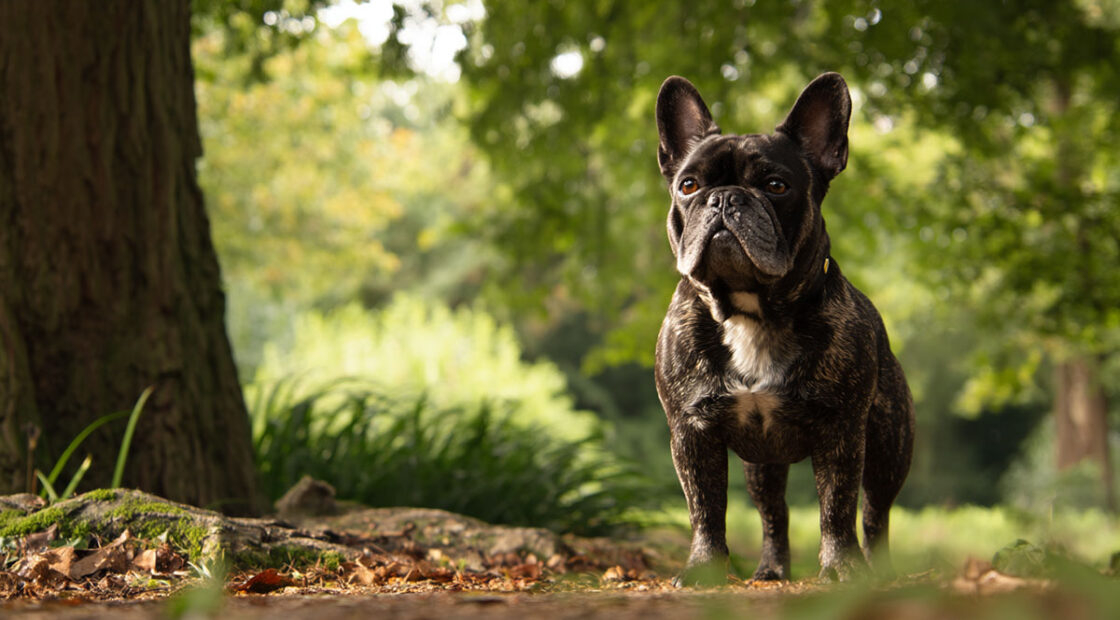
The AKC caps the French Bulldog at 28 pounds (13 kg), and the breed has held first place in US popularity for four consecutive years through its 2025 data. It’s a small, flat-faced dog with upright bat ears.
The health numbers are less flattering. A 2021 Royal Veterinary College VetCompass study in Canine Medicine and Genetics found the breed at higher risk for 20 of 43 common disorders than other dogs, and at lower risk for 11. Narrowed nostrils topped the list at 42.14 times the risk.
What Is a French Bulldog?
Owners call it the Frenchie, and the French name is Bouledogue Francais. It has a compact, muscular body and a flat face, and nobody bred it to work. It was developed as a house dog, and the Federation Cynologique Internationale (FCI) lists its use as companion and toy dog.
Registries can’t agree on where to file it. The FCI puts it in Group 9, Companion and Toy Dogs. The American Kennel Club (AKC) and Canadian Kennel Club both call it Non-Sporting, while The Kennel Club (UK) goes with the Utility Group.
The AKC standard names two hallmarks, a square head with bat ears and a roach back, meaning a spine that rises gently over the loin.
The French Bull Dog Club of America adds a medical label. The breed is both short-faced (brachycephalic) and a dwarf breed (chondrodystrophic), and Royal Veterinary College researchers link many of its health differences from other dogs to that extreme body shape.
French Bulldog vs English Bulldog
Both breeds have a short face and a shared ancestor. Size and ear shape tell them apart quickly.
| Feature | French Bulldog | English Bulldog |
|---|---|---|
| Weight, AKC standard | Up to 28 lb (13 kg) | About 50 lb dogs, 40 lb bitches |
| Ideal weight, Kennel Club (dogs) | 12.5 kg (28 lb) | 25 kg (55 lb) |
| Ears | Upright bat ears | Folded rose ears |
Survival data tells a different story. In the 2024 Scientific Reports study from Dogs Trust and Liverpool John Moores University, covering 584,734 UK dogs, the French Bulldog and the English Bulldog both landed on a median survival of 9.8 years.
Origin and History of the French Bulldog
The breed took shape in the second half of the 1800s from small bulldogs and local French dogs. Whether the key work happened in Nottingham or in Paris depends on which source you read.

Founding Breeds and First Owners
The FCI standard (2023) credits enthusiasts in the working-class quarters of Paris in the 1880s, where the dogs belonged to market porters, butchers and coachmen before high society and artists took them up. Britannica describes crosses between small native French dogs and toy-sized Bulldogs.
Purina’s breed profile gives the credit to English lace makers in Nottingham instead, who bred toy-sized bulldogs as lap pets. The Kennel Club’s breed page tells a similar story, with Nottingham lace makers taking their toy bulldogs to northern France.
The Royal Veterinary College’s VetCompass paper on the breed sidesteps the argument and calls it a breed of both British and French origin.
Early dogs carried both rose ears and bat ears, according to the AKC. The bat ear won out and is now the only accepted shape.
Breed Recognition and Clubs
- France registered the first dogs of the breed in 1885 (FCI).
- The French Bull Dog Club of America (FBDCA) formed in 1897.
- In 1898 the French Kennel Club recognized the breed and wrote its first standard (FCI), and the AKC recognized it the same year (AKC).
- The French Bulldog Club of England came along in 1902 (The Kennel Club).
- Official recognition from The Kennel Club followed in 1906.
The dates don’t all line up. The FBDCA calls itself the first club in the world devoted to the breed, while the FCI standard places a first breed club in Paris in 1880.
How the French Bulldog Became the Most Popular Breed in the US
The AKC ranked the French Bulldog No. 1 for the fourth year running in its 2025 data, after it ended the Labrador Retriever’s 31-year run at the top in 2022.
The AKC credits small size and adaptability to city living. Registration is voluntary and the ranking covers only the club’s roughly 200 recognized breeds, so it measures registered litters, not every dog in the country (Associated Press).
Some animal welfare activists argue the rankings drive fads that fuel puppy mills. The AKC says its list documents ownership trends and does not promote them.
French Bulldog Size, Weight, and Coat Colors
A French Bulldog stands 11 to 13 inches (28 to 33 cm) at the withers (Britannica) and weighs up to 28 pounds (13 kg) under the AKC standard. Registries enforce that ceiling differently, and their color lists differ too.
Height, Weight, and Conformation
| Registry | Weight rule | Enforcement |
|---|---|---|
| AKC | Up to 28 lb (13 kg) | Over 28 lb is a disqualification |
| The Kennel Club | Ideal 12.5 kg dogs, 11 kg bitches | A guide to the ideal, not a limit |
| FCI | Males 9 to 14 kg, 27 to 35 cm tall | 500 g over tolerated if the dog is typical |
| Canadian Kennel Club | Not to exceed 12.75 kg (28 lb) | Over 12.75 kg (28 lb) is a disqualification |
The AKC standard asks for a large, square head, bat ears carried erect, a roach back and a short tail. Any ear other than a bat ear is a disqualification.
On the face and airway, the Kennel Club standard (updated on 1 August 2025) calls for a muzzle visible in profile and visibly open nostrils. It rejects dogs with respiratory distress or excessive respiratory noise.
Standard Colors
The AKC standard, approved June 10, 1991 and effective July 31, 1991, accepts all brindle, fawn, white, brindle and white, and any color except those that disqualify. The disqualifying colors are solid black, mouse, liver, black and tan, black and white, and white with black. Black means black without a trace of brindle.
The Kennel Club (updated August 1, 2025) accepts brindle, fawn and pied, with whites classed as pieds. Cream and red shades are ranked less desirable.
The lists overlap on fawn, brindle and pied dogs. After that they split on breadth, since the AKC accepts every color except six named disqualifications and the Kennel Club accepts only three colors.
Non-Standard Colors and What They Mean for Health
Mouse (the AKC’s term for the grey-blue dilution that sellers market as blue) and liver are named disqualifications under the AKC standard. The standard does not name merle. The Kennel Club rejects every colour outside its short list, and its registration list tags blue, blue fawn, brown, sable, red and cream as non-breed-standard.
Breed-club guidance on fad colors explains the genetics.
- Blue and lilac come from a recessive dilution mutation in the melanophilin gene.
- Merle is absent from the purebred gene pool, so merle “Frenchies” trace to outcrosses to merle breeds.
- Double merle dogs face higher odds of deafness and serious eye abnormalities (UC Davis Veterinary Genetics Laboratory).
Registries also judge eye color differently. The AKC standard asks for dark eyes and accepts lighter eyes in lighter-colored dogs, with no eye-color disqualification, while the Canadian Kennel Club disqualifies any eye color other than dark, brown or approaching black.
Breed clubs say ads for “rare” or “designer” colors describe dogs outside the standard, not exotic purebreds.
French Bulldog Temperament and Behavior

French Bulldogs are affectionate, adaptable companions with a playful side and a stubborn one. Britannica notes the grumpy face hides a cheerful disposition.
The AKC standard asks for an even-tempered, affectionate dog that is active and playful without being boisterous. The Kennel Club standard uses vivacious, deeply affectionate and intelligent, and adds courage and clown-like qualities.
A temperament line in a standard describes a tendency, not a guarantee. A 2022 Science study of 18,385 purebred and mixed-breed dogs found that breed explains just 9% of behavioral variation in individuals (Morrill et al.).
Training takes patience, since the dog is willing to please but stubborn about it (Britannica). It does well with children who understand its low tolerance for heat and exercise (Britannica). Bred purely for companionship, it bonds closely, and breed profiles flag separation anxiety when it is left alone for long stretches. Alert and valued as a watchdog despite the small size, it will also tell you when someone is at the door (Britannica).
Breed club guidance pairs the temperament profile with a physical warning. Keep the dog cool in warm weather and avoid strenuous exercise (French Bull Dog Club of America).
How Long Do French Bulldogs Live?
Published figures run from 4.53 to 12 years, and the spread comes from what each source measured. The studies and the breed profiles answer different questions.
- The RVC VetCompass life tables put life expectancy at birth at 4.53 years, the lowest of 18 breeds, with a 95% confidence interval of 4.14 to 5.01 (Scientific Reports, 2022).
- Median survival among 584,734 UK dogs was 9.8 years (Dogs Trust and Liverpool John Moores University, Scientific Reports, 2024).
- The median for all dogs in that same 2024 dataset was 12.5 years.
- Breed profiles such as Embark’s and Healthy Paws’ print 10 to 12 years.
A life table turns age-specific death rates from a given period into a remaining-years estimate for each age. Median survival is the age at which half of a studied group has died, so the two numbers can’t be swapped.
A breed that grew quickly adds a second problem. It has many young dogs and few old ones, which can pull an estimate built from recent deaths downward.
For planning, 9.8 years is the more useful figure, since it rests on more than half a million UK dogs. No average predicts one dog, though, because weight, airway status and veterinary care move the outcome.
What Health Problems Do French Bulldogs Have?
Breathing gets the most research, and the prevalence figures from different sources don’t agree. Spine, skin, eye and birth problems are well documented too.
Brachycephalic Obstructive Airway Syndrome
Brachycephalic obstructive airway syndrome (BOAS) happens when excess soft tissue in the nose and throat, often combined with narrow nostrils, restricts airflow. Heavy panting and noisy breathing are the signs, according to The Kennel Club.
Britannica adds that the breed tends to snore and sometimes wheeze.
How common it is depends on who you ask.
- VetCompass records show upper respiratory tract disorders in 20.0% of French Bulldogs under UK primary care (cited in Frontiers in Veterinary Science, 2025).
- In the Kennel Club health survey of 2020, BOAS made up 30.1% of the breathing conditions owners reported (853 of 2,832), and 24.6% of respondents (1,794 of 7,285) said a dog of theirs had a breathing condition.
- Kennel Club grading data to December 2024 shows 16% of the 1,831 graded French Bulldogs scoring Grade 2 or 3, the clinically affected grades.
The gap comes from who gets counted. VetCompass samples dogs seen in ordinary practice, the survey draws on owners who chose to respond, and the graded dogs are registered animals whose owners opted into testing.
Cambridge researchers add a second caution. Their 2017 PLOS ONE study of pugs, French Bulldogs and bulldogs found no external feature that predicts breathing trouble reliably, though nostril opening came closest.
In that same VetCompass comparison, the Pug came in higher than the French Bulldog, and the English Bulldog came in slightly lower.
Spine, Skin and Eye Conditions
Intervertebral disc disease (IVDD) is by far the most common spinal disorder in the breed, per the Royal Veterinary College neurology team, and it can start suddenly with severe pain. Hemivertebrae show up on imaging in most French Bulldogs, including dogs with no signs, but hemivertebra with kyphosis changes gait and raises the risk of disc disease in the thoracolumbar region.
Skin folds hold warmth and moisture, which feeds bacteria and yeast and leads to infection and itching (The Kennel Club). Shallow sockets leave the eyes prominent, so ulcers, trauma and dry eye follow. A shortened jaw still holds a full set of teeth, and the crowding causes dental and gum problems.
Most of these conditions are manageable when caught early. The spine is the exception, because a sudden disc event rarely gives a warning.
Reproduction: Why Cesarean Birth Is Common
French Bulldog bitches are 15.9 times more likely to suffer dystocia, or difficult birth, than crossbred bitches, according to Royal Veterinary College research in Veterinary Record (2017) that used Vets Now emergency clinic records.
When a birth went wrong, cesarean surgery followed more often than in crossbreds. A 2019 follow-up paper found French Bulldogs 2.4 times as likely to have one. RVC epidemiologist Dan O’Neill read the results as evidence that breed shapes had been pushed past what basic biological functions tolerate.
The Kennel Club asks vets and breeders to report every cesarean to it, and breeders often add artificial insemination to the process (Pets4Homes breeder guidance). Both procedures end up in the price of a puppy.
How to Care for a French Bulldog
A French Bulldog needs up to an hour of exercise a day and a weekly brush (The Kennel Club), plus close control of heat, weight, skin folds and ears. The short coat makes grooming the easy part.
Keep the skin folds dry and clean them regularly (AKC). Crowded teeth need brushing and routine dental checks. Redness or squinting in the eyes means a vet visit, because prominent eyes ulcer easily. The breed is also sensitive to anesthesia, so surgery belongs with a vet who knows flat-faced dogs (Britannica).
Heat is the care problem with the highest stakes. French Bulldogs carry several times the heatstroke risk of Labrador Retrievers (Royal Veterinary College and Nottingham Trent University, Scientific Reports, 2020), and exercise is the most common trigger across UK dogs.
Schedule outings for the cool hours and carry water.
Weight ties the heat risk to the airway risk. Dogs heavier than their breed average ran a higher heatstroke risk in the RVC data, and Cambridge researchers link a thicker neck to BOAS in French Bulldogs.
Start from a French Bulldog feeding chart for portions by age and weight, then let the vet adjust. The French Bull Dog Club of America (FBDCA) warns that an obese dog faces a far higher risk from the breed’s health issues.
Ears need a weekly look. Ear discharge and skin fold dermatitis both ranked among the breed’s largest relative risks against other dogs in the 2021 VetCompass comparison (Canine Medicine and Genetics).
Routine cleaning with dog ear wipes covers normal wax. Discharge that keeps returning needs a vet.
How Much Does a French Bulldog Cost?
In the UK, a French Bulldog puppy averages about £1,800 in 2026 asking prices, and health-certificate litters and non-standard colors cost more. US prices vary too widely for one honest national figure.
Puppy Price by Country and Breeder Type
Nimblefins puts the 2026 UK average asking price at £1,800, drawn from Pets4Homes listings. Puppies sold with health-check certificates cost more.
Price in the US is harder to pin down. Petful’s 2026 guide says no single trustworthy national price exists, because geography, demand, pedigree, health screening and included puppy care all move the number.
Rescue is the cheaper route. The FBDCA keeps a list of French Bulldog rescue organizations, and adoption fees run well below breeder prices (Petful).
Why Colors Change the Price
The Kennel Club lists French Bulldogs in Colour Watch Category 4, defined as breeds with more than 30% of registrations in non-breed-standard colors or more than 1,000 such registrations a year. It refuses to register merle puppies, because the merle gene in this breed raises the risk of impaired hearing and sight.
Its registration list also goes further than the standard on one point. It tags cream and red as non-breed-standard, where the standard calls those shades less desirable.
The market looks very different. UK breeders asked an average of £2,700 for merle puppies in 2026 (Nimblefins), a premium over the overall average, for dogs the Kennel Club will not register.
Pay for health testing, not for color.
Veterinary and Insurance Costs
Vet bills pile up in a few predictable places. Airway grading comes first, along with treatment for dogs that score as clinically affected. Spinal workups and surgery follow a disc event, skin and ear treatment is ongoing, and a crowded mouth adds dental work.
MoneySuperMarket’s 2026 UK quote data puts French Bulldog premiums well above the average dog policy.
Buy cover before the first diagnosis. Policies generally exclude conditions that already exist.
How to Choose a Healthy French Bulldog Puppy
Judge a puppy by its parents’ test results, not by its looks. Ask for breathing grades, eye, heart, hip and knee records, and a color that matches the standard.
- Ask for both parents’ breathing grades. The Kennel Club and University of Cambridge Respiratory Function Grading Scheme (RFGS) scores BOAS from Grade 0 to Grade 3 by checking breathing at rest and after a brisk walk, and the Kennel Club advises breeding ideally only from two graded dogs.
- Read the grade correctly. Grades 0 and 1 count as clinically unaffected, and Grades 2 and 3 are the clinically affected ones.
- Request the CHIC records. The FBDCA requires hip, eye (a CAER exam by a board-certified ophthalmologist), patellar luxation and cardiac results registered with the Orthopedic Foundation for Animals (OFA), and recommends tracheal hypoplasia, elbow, cataract DNA, RFGS and cystinuria type 3 tests.
- Check which cataract test was run. The FBDCA says to order the juvenile hereditary cataract test reported as HSF4-1 on OFA certificates, while the Kennel Club lists its DNA test as HC-HSF4-2, so ask for the lab report, not a verbal “clear.”
- Look at the nostrils and muzzle, but don’t stop there. The Kennel Club standard asks for visibly open nostrils and a muzzle visible in profile, yet Cambridge found nostril opening only a moderate predictor of BOAS.
- Meet the dam and ask how this litter was born, since the Kennel Club asks vets and breeders to report cesareans.
- Compare the price against what it includes. A color premium pays for nothing the tests measure.
The same breathing test gets treated differently depending on who you ask. The Danish Kennel Club made BOAS grading mandatory for French Bulldogs, English Bulldogs and Pugs used for breeding in August 2023, and only Grades 0 and 1 are accepted for breeding (Danish Veterinary and Food Administration).
The Kennel Club lists it as a minimum recommended test, and the FBDCA lists it as recommended but not required for a CHIC number.
Buyers can check claims on the Kennel Club’s Health Test Results Finder or by searching the breeder’s kennel name on the OFA site.
When a French Bulldog Is the Wrong Choice

A French Bulldog is the wrong choice if the home can’t keep the dog cool or the budget can’t absorb airway or spine care. Breeding plans are a poor fit too.
Heatstroke can be fatal, and RVC researchers advise owners of predisposed breeds to change the timing and level of outdoor activity in warm weather. Anyone planning to run or hike with a dog should note that the RFGS itself tests breathing after a brisk walk, and dogs that fail it are clinically affected.
On breeding, the FCI standard (2023) says only functionally and clinically healthy dogs with typical conformation should be bred, and dystocia and cesarean risk raise the cost of every litter. The UK Brachycephalic Working Group, formed in 2016 by academics, vets, breed clubs, The Kennel Club and animal charities, urges buyers on a thin vet budget to “stop and think” before choosing a flat-faced dog.
Owner satisfaction tells a different story. About two thirds of the Danish owners surveyed (300 of 452) wanted to reacquire a French Bulldog (Frontiers in Veterinary Science, 2025), even though the same survey recorded widespread health problems: allergies (36.7%), breathing problems (29.6%) and back problems (19.0%).
The breed needs a cool home and a vet budget for airway and spine care, and the parents need test results. Miss one and pick a different breed.
French Bulldog FAQ
How easy is a French Bulldog to train?

Moderately easy, once the owner accepts the stubborn streak. The breed wants to please but weighs each request, so short, rewarding sessions work better than repetition.
Harsh corrections backfire.
Do French Bulldogs shed?

Yes, but lightly. The Kennel Club lists the breed as a shedder and recommends a weekly brush, and PDSA says Frenchies are not known for shedding lots.
Either way, a weekly pass with a brush keeps loose hair under control.
Can French Bulldogs swim?
Most can’t. Britannica warns that owners must take extreme care to keep the breed from falling into pools or other water.
Fence or cover water, and never leave the dog alone near it.
How much should a French Bulldog puppy weigh?
No registry publishes a puppy weight chart. Breed standards set adult limits only, and The Kennel Club states that its figures describe the ideal, not a prediction for any individual dog.
Track growth with your vet and adjust portions by body condition, not by age alone.
Is an XL French Bulldog a recognized size?
No. The AKC standard sets a single ceiling of 28 pounds (13 kg), and dogs above it are disqualified in the show ring.
Ask for the parents’ weights and registration papers before paying for a size label.
Where can you adopt a French Bulldog?
Breed-specific rescues place most adoptable dogs. Healthy Paws lists the French Bulldog Rescue Network, SNORT Rescue in the Northeastern US and the New Mexico French Bulldog Rescue.
Shelter mixes are common too, but most shelters don’t run DNA tests, so a mix’s breed heritage is a guess (AKC).
When should a French Bulldog be spayed or neutered?
No breed-wide age exists, so the decision belongs with your veterinarian. The French Bull Dog Club of America tells pet owners to ask their vet about timing.
VetCompass life tables found that neutered UK dogs outlived entire dogs overall, which informs the conversation but doesn’t set a date.
What to Do When a French Bulldog Breathes Noisily
A French Bulldog whose breathing is audible without a stethoscope already sits in Grade 2 or Grade 3 under the Respiratory Function Grading Scheme definitions the Orthopedic Foundation for Animals (OFA) publishes.
Noise an owner can hear without equipment justifies a veterinary grading exam.
Rest the dog and cancel exertion first, then book the grading exam. Treatment gets agreed by grade after that.
Exertion stops first because the grading protocol skips the exercise check for dogs in respiratory difficulty, and OFA places dogs showing respiratory difficulty, cyanosis or dyspnea already in the Grade 3 range.
Treatment follows the grade. OFA says dogs in Grades 2 and 3 should be monitored and may need veterinary treatment, and the Kennel Club advises further veterinary examination for Grade 3.
The Kennel Club lists graded French Bulldogs by quarter, and the Q2 2026 edition was current in October 2026. A falling share of Grade 2 and 3 dogs there would show breeding selection working.