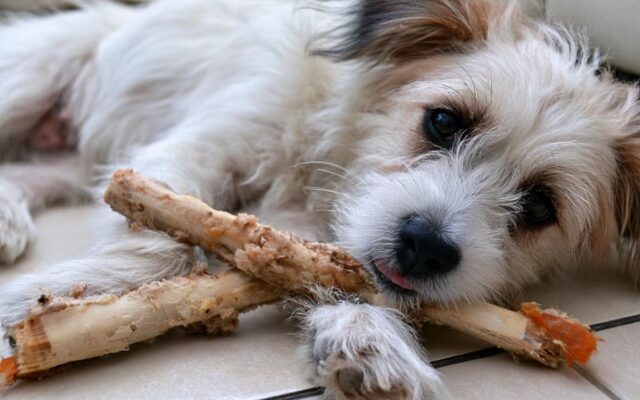
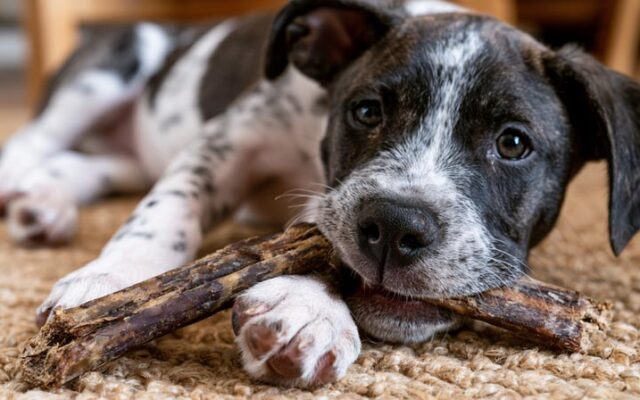
You picked up an antler at the pet store, your puppy is eyeing it, and now you’re not sure if this is a good idea.
Knowing what age puppies can chew antlers is not a minor detail. Get it wrong during the teething phase and you risk fractured deciduous teeth, permanent tooth bud damage, and a vet bill you didn’t plan for.
The answer depends on breed size, jaw development, and antler type. Not just a number on a label.
This article covers the safe starting age by breed, the difference between split and whole antlers, dental risks, supervision rules, and what veterinary dentists actually recommend.
What Age Can Puppies Safely Start Chewing Antlers?
Puppies can start chewing antlers at 6 months minimum, once adult teeth have fully erupted and the roots are set. Before that point, the combination of thin deciduous enamel, shallow tooth roots, and underdeveloped jaw bone density makes antler hardness a real dental risk.
That said, 6 months is not a universal green light. Breed size changes the timeline significantly.
| Breed Size | Safe Starting Age | Recommended Type |
|---|---|---|
| Toy breeds (under 10 lbs) | 7-8 months minimum | Split elk only |
| Small to medium breeds | 6 months | Split elk antler |
| Large breeds (50+ lbs) | 9-12 months | Split first, whole from 12 months |
| Giant breeds | 12 months minimum | Whole elk with supervision |
A Labrador Retriever at 7 months is a different situation from a Chihuahua at 7 months. Jaw muscle mass, tooth root depth, and bone density all develop at different rates depending on body weight.
Why Puppy Teeth Cannot Handle Antlers Before 6 Months
Deciduous teeth have thinner enamel and shallower roots than permanent teeth. A hard antler chew can displace or fracture a baby tooth before the root has fully resorbed.
According to VCA Animal Hospitals, permanent tooth eruption in dogs is complete by 6 months in most breeds, with deciduous teeth beginning to fall out from 12 weeks onward. Antler hardness against an incompletely rooted deciduous tooth creates direct risk to the permanent tooth bud developing underneath.

The thumbnail test, recommended by veterinary dentists at Cornell University College of Veterinary Medicine, is the clearest practical guide: if you cannot dent the chew with your fingernail, it is too hard for a puppy.
Antlers fail that test completely.
How Breed Size Changes the Safe Starting Age
Small breed growth plates begin closing from about 3 months and typically finish by 12 months. Large breed growth plates start closing around 5 months but can remain open until 18 months (AnimalTalk, veterinary research).
Jaw bone density follows the same timeline. A puppy whose skeletal structure is still actively developing carries higher risk from the sustained pressure of antler chewing than one that is closer to skeletal maturity.
For a Great Dane or similar giant breed, 12 months is a more responsible minimum than 6. For a Miniature Schnauzer, 6-7 months with close supervision and a split elk antler is workable.
What Are Antler Chews and What Types Are Available for Dogs?
Antler chews are sections of naturally shed deer, elk, or moose antlers processed into chewable pieces. No animals are killed to produce them. Deer and elk shed antlers annually, and collectors harvest them from forests before cutting, sanding, and sizing them for dogs.
There are 3 main types, and the differences between them matter a lot for puppy safety.
Whole vs. Split Antlers: Hardness and Risk Comparison
Whole antlers retain their full cortical bone matrix with no exposed marrow. They are the hardest format and carry the highest fracture risk. Veterinary dentistry specialists have cited antlers as one of the most common causes of carnassial tooth fractures in dogs (Veterinary Practice News, 2024).
Split antlers are cut lengthwise to expose the softer marrow channel inside. Dogs tend to lick and scrape the marrow rather than bite down on the hard exterior, which reduces direct bite force against enamel.
Many veterinarians who accept antler use at all prefer split versions for exactly that reason. Once the marrow is consumed, though, the same hard outer cortical bone remains. Supervision matters throughout, not just at the start.
For puppies at the 6-month threshold, split elk antler is the only format worth considering. Whole antlers, whole deer antlers especially, belong in the adult category.
Elk, Deer, and Moose Antlers: Which Is Safest for Puppies
Hardness varies by species, and the differences are real.
- Deer antlers: Densest and hardest. Recommended for experienced adult chewers only. Not appropriate for puppies or dogs with sensitive teeth.
- Elk antlers: Moderately dense with better marrow access, especially when split. The most commonly recommended starting point for dogs new to antler chews.
- Moose antlers: Higher proportion of spongy interior material, making them the softest option. Often sold in slices or splits to maximize access to the softer core.
For a puppy at the 6-month mark, split elk antler is the starting point. Deer antler is not.
The elk vs deer antlers for dogs comparison matters most here because the hardness gap between the two is the difference between a manageable risk and a near-certain dental problem for a young dog.
What Happens to Puppy Teeth and Jaws During the Teething Phase?
Puppy dentition develops in 2 distinct stages. Understanding both explains why the 6-month threshold exists.
Puppies are born without teeth. Deciduous teeth begin erupting at 3-4 weeks, and all 28 baby teeth are typically in place by 6 weeks (VCA Animal Hospitals). At around 12 weeks, permanent teeth begin pushing through, and the process of deciduous tooth loss begins.
By 6-7 months, most puppies have their full set of 42 permanent teeth, with eruption of all adult canines, premolars, and molars complete between 4 and 7 months of age (PetMD, 2024).
The Active Teething Window: 3 to 6 Months
The 3-to-6-month window is when antler chew risk is highest. Deciduous teeth are actively falling out. Permanent teeth are mid-eruption with incomplete root development. Jaw bone density is still building.
A study of 61 Yorkshire Terrier puppies published in a peer-reviewed veterinary journal found that persistent deciduous teeth affected 69% of puppies, with smaller body weight dogs having a higher proportion and greater need for surgical extractions. Hard chew pressure during this period can complicate normal tooth loss and eruption.
The takeaway: this window is for soft chews and rubber toys, not antlers. A Beagle at 4 months needs a puppy-safe rubber chew. A German Shepherd Dog at 5 months is in the same category despite the size difference.
Jaw Bone Density and Growth Plates
Jaw strength development tracks with overall skeletal maturation. Growth plates in small breeds typically finish closing around 6-8 months. In large breeds, full skeletal maturity can take 14-18 months (Lynbrook Vet).
Rapid growth phase: 2-6 months. This is the window where bone tissue is most vulnerable to abnormal stress. Sustained hard chewing during this period puts pressure on jaw structures that are still mineralizing from cartilage into dense bone.
Dr. Jerry Klein, Chief Veterinarian for the American Kennel Club, notes that growth plates are soft and flexible during puppyhood when new tissue is being formed. Overexertion, including repetitive jaw stress from hard chewing, can affect this process.
What Are the Dental Risks of Giving Antlers to Puppies Too Early?
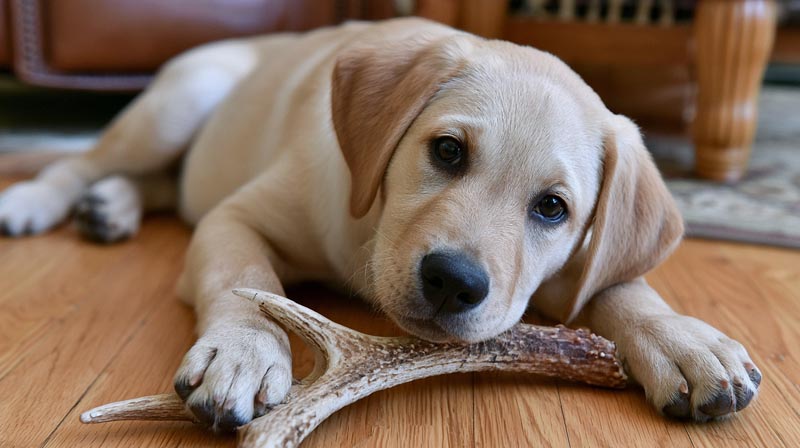
Tooth fracture in dogs has a reported prevalence of 20% to 27% in the general canine population, with antlers identified as one of the most common causes of carnassial tooth fractures (Veterinary Times, 2024). That figure applies to adult dogs. For puppies with developing dentition, the risks are compounded.
Slab Fractures: Why the Thumbnail Test Matters
A slab fracture occurs when the side of a tooth, usually the upper fourth premolar (the large carnassial cheek tooth), shears off under pressure against an unyielding surface.
Antler fracture toughness is roughly 50% higher than bovine femur bone (Pet Dental Specialists, AVDC). When a dog’s teeth apply force against antler, the teeth lose. This is not a risk that disappears with supervision.
The thumbnail test is the clearest practical filter: if you cannot press your fingernail into the surface of a chew, it exceeds the safe hardness threshold for dog teeth. Antlers fail this test at every age. The question for adult dogs is whether the risk is acceptable. For puppies under 6 months, the answer is no.
A survey of over 1,000 veterinarians found that 93% did not recommend antler chews for dogs, with slab fractures as the primary concern (Heartland Antlers, citing veterinary survey data).
How a Broken Baby Tooth Affects Permanent Teeth
This is the part most owners don’t know about.
A fractured deciduous tooth does not just cause surface pain. The permanent tooth bud sits directly beneath the baby tooth root in the jaw. Damage to the deciduous tooth, whether through fracture, displacement, or premature loss from hard chew pressure, can cause enamel defects in the permanent tooth developing below it.
A 2024 study published in Frontiers in Veterinary Science found that 17.5% of dogs who had deciduous tooth extractions showed enamel defects affecting the permanent canine teeth that erupted afterward. Hard chew-related fractures of baby teeth carry the same developmental risk.
The safe dog chews for this age group are rubber, soft nylon rated for puppies, or appropriately sized dental chews from VOHC-approved brands. Not antlers. Not raw bones.
How Do You Pick the Right Antler Size and Type for Your Puppy’s Breed?
For puppies cleared to start antlers at 6 months or later, sizing is the second most important variable after age. An antler that is too small for the dog’s jaw creates more risk than one that is proportionally matched.
Core sizing rule: the antler diameter must exceed the width of the dog’s back molars. If the antler can fit fully crossways in the dog’s mouth, it is too small and creates a choking and full-molar-pressure fracture risk.
Sizing by Breed and Body Weight
| Breed Weight | Antler Type | Minimum Age | Session Limit |
|---|---|---|---|
| Under 10 lbs (toy breeds) | Split elk, small cut | 7-8 months | 10 minutes max |
| 10-25 lbs (small breeds) | Split elk | 6 months | 15 minutes |
| 25-50 lbs (medium breeds) | Split elk, graduate to whole at 12 months | 6 months | 15-20 minutes |
| 50+ lbs (large breeds) | Split elk first, whole elk from 12 months | 9-12 months | 15-20 minutes |
Toy breeds like the Yorkshire Terrier and Pomeranian have inherently more fragile dentition regardless of antler size, and this is a permanent characteristic, not just a puppy issue. Even in adulthood, the smallest of these breeds often do better with softer alternatives.
A Golden Retriever or Labradoodle at 9 months has significantly more jaw development and tooth root depth than a toy breed at the same age. The same antler affects them very differently.
Matching Antler Density to Jaw Strength
Not all antlers within the same species are identical in hardness. Grade A antlers from fresh shed cycles are more consistent and less likely to splinter than older, lower-grade stock that has dried and become more brittle.
- Deer antler: hardest, for experienced adult chewers only
- Whole elk antler: moderate hardness, for adult dogs past 12 months
- Split elk antler: safest starting point for puppies past 6 months
- Moose antler (split or sliced): softest option, best for sensitive mouths
The are split antlers safe for dogs question comes up a lot for new puppy owners. The answer is context-dependent: split elk in the right size with close supervision is the most defensible antler choice for a puppy past 6 months. Everything harder is for later.
What Supervision Practices Reduce Antler Chew Risks in Puppies?
Getting the age and size right is necessary but not complete. How you supervise the first several sessions determines whether the risk stays manageable or becomes a vet bill.
Watch the first 3-5 sessions closely. You are looking for one specific behavior: whether the puppy gnaws along the side of the antler or bites straight down on it. Side gnawing distributes force across more tooth surface. Straight-down biting concentrates force on a single point, and that is how molars crack.
Session Length and Removal Rules
Limit chew sessions to 10-15 minutes for puppies. Sustained chewing builds jaw fatigue, and a tired jaw increases the chance of awkward bite angles and harder contact. The antler also gets smaller over sessions, and a smaller piece creates more concentrated bite pressure per session.
Remove the antler when it reaches muzzle width. Once the piece is small enough to fit fully in the mouth, the risk of swallowing or applying full molar force multiplies. This applies at every age, not just in puppyhood.
The when to take antler away from dog decision is straightforward when you know the signs: antler approaches swallowable size, surface develops cracks or sharp edges, or the dog shows any reluctance to continue after previously engaging with it. That last one is a pain signal.
Session Warning Signs That Require Action
Stop the session immediately if you observe any of these:
- Drooling more than normal during chewing
- Pawing at the mouth or face
- Dropping the antler repeatedly without losing interest in it
- Visible blood on the antler surface beyond light gum contact
- Attempts to swallow large pieces rather than gnaw them down
Digestive signs can show up 6-12 hours after a session: vomiting, constipation, or blood in stool from swallowed fragments. If any of these appear after an antler session, withhold further access and contact your vet.
The how long can dogs chew on hard chews question has a clear answer for puppies specifically: shorter than for adults, with active supervision throughout the session rather than a passive check-in approach.
What Nutritional Value Do Antlers Provide for Growing Puppies?
Antlers contain calcium, phosphorus, zinc, magnesium, and manganese within the cortical bone matrix. Third-party lab testing on elk antlers shows roughly 22% calcium and 11% phosphorus, with the calcium-to-phosphorus ratio sitting near the 2:1 balance associated with canine bone health (Devil Dog Pet Co lab data).
That sounds meaningful. In practice, the nutritional contribution from chewing an antler is minimal compared to a balanced puppy diet.
What Puppies Actually Get from Antler Chewing
Antlers are not digestible. The mineral content is absorbed slowly through grinding action that produces fine mineral dust over time, not through digestion of large pieces. A puppy on a complete puppy food formula already receives sufficient calcium and phosphorus in the correct ratios. The antler contribution is supplementary at best, and negligible in the context of daily nutritional needs.
Split antlers expose marrow, which contains higher fat content than the cortical bone. For puppies on calorie-restricted or low-fat diets, this is worth noting. The marrow provides some protein-adjacent content, but the amino acid intake from a chew session is not nutritionally significant.
Glucosamine and chondroitin appear in antler cartilage portions. For growing large breed puppies, joint support compounds are relevant, but the amounts available through chewing are far below therapeutic levels.
Antlers vs. Other Chews: Nutritional Comparison
The honest framing is that antlers function primarily as a chew activity with incidental mineral exposure, not as a nutritional supplement. Their value to a puppy is behavioral and dental, not dietary.
- Bully sticks: high protein, minimal mineral content, digestible
- Himalayan yak chews: calcium and protein from compressed cheese, softer and digestible
- Antlers: mineral-rich cortical bone, not digestible, very low protein contribution
- VOHC-approved dental chews: designed to dissolve, no fracture risk, minimal minerals
For puppy-specific nutrition, the puppy food brands your vet recommends will cover calcium and phosphorus requirements completely. The antler is not filling a nutritional gap. Knowing that changes the risk-benefit calculation a little: if the nutritional contribution is minimal, the decision to introduce antlers rests almost entirely on whether the chewing activity itself is worth the dental risk at that age and size.
For most puppies under 6 months, it isn’t. After 6 months with the right type and size, it becomes a judgment call based on the individual dog.
How Do Antlers Compare to Other Chew Options for Puppies?
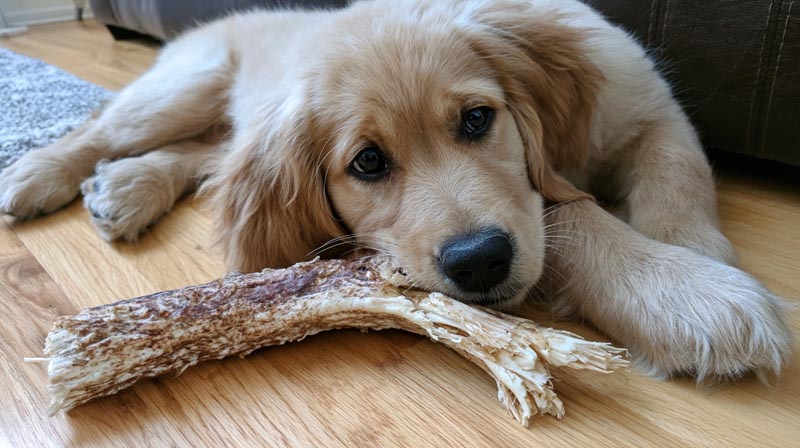
Antlers are among the hardest natural chews available, harder than bully sticks, harder than most yak chews, and far harder than rubber or dental chews.
That hardness is the source of both their appeal and their primary risk.
For puppies specifically, the hardness ranking matters more than for adult dogs because developing teeth and incompletely rooted molars have less tolerance for concentrated bite pressure.
| Chew Type | Hardness | Safe Under 6 Months? | Digestible? |
|---|---|---|---|
| Whole antler | Very hard | No | No |
| Split elk antler | Hard | No | No |
| Bully stick | Firm, with give | With supervision, 6+ months | Yes |
| Himalayan yak chew | Moderate | With supervision, 6+ months | Partially |
| VOHC dental chew | Soft, dissolves | Yes (breed/size appropriate) | Yes |
Safer Chew Alternatives for Puppies Under 6 Months
Before adult teeth are fully in, the right chew is one that softens under pressure or dissolves.
3 options that work:
- Rubber puppy chews (Kong Puppy, Nylabone Puppy range): specifically rated for puppy jaw strength, with enough give to pass the thumbnail test
- VOHC-approved dental chews sized for puppy weight: the VOHC Seal of Acceptance requires at least a 15% reduction in plaque or tartar in controlled trials, with no fracture risk
- Frozen Kong stuffed with puppy-safe food: zero hard-chew risk, addresses teething discomfort through cold contact
Bully sticks sit in a gray area. They are firm but not rock-hard, and they soften as the puppy works on them (Bully Sticks Direct, 2024). Most vets accept them for puppies past 6 months, not before, and with a 10-minute session limit.
When Antlers Become the Better Choice Over Other Options
Longevity is the practical argument for antlers over everything else.
A bully stick lasts minutes to an hour for a determined chewer. A medium whole elk antler keeps a 40-pound moderate chewer busy for 3-5 weeks of intermittent sessions (Devil Dog Pet Co, third-party lab data).
The case for antlers makes sense when:
- The dog is past 12 months with confirmed healthy adult dentition
- Chewing style is moderate gnawing, not aggressive straight-down biting
- A split elk antler in the correct size is used, not whole deer
For best chew bones for puppies, antlers are not the right answer under 6 months. After 6-12 months, with the right type and proper supervision, they become a defensible option for the right dog.
The are antlers safe for dogs question for puppies specifically comes down to one filter: has the puppy completed adult tooth eruption and been cleared by a vet at the 6-month dental exam?
What Do Veterinary Dentists Say About Antlers for Puppies?
The professional consensus is clear, and it is not enthusiastic.
In a survey of over 1,000 veterinarians, 93% did not recommend antler chews for dogs (Heartland Antlers, citing veterinary survey data). Board-certified veterinary dental specialists are even more direct.
The AVDC Position on Hard Chews
The American Veterinary Dental College lists antlers alongside bones and hooves as chews to avoid.
The AVDC’s primary concern is the carnassial slab fracture, where the upper fourth premolar shears under direct bite pressure against an unyielding surface. Antler fracture toughness is roughly 50% higher than bovine femur bone (Pet Dental Specialists, AVDC). A dog’s teeth cannot win that contact.
DVM360’s 2024 guide to veterinary dental home care states explicitly that deer antlers, among other hard chews, can result in tooth fracture with pulp exposure and that clients should be cautioned against any product that does not easily bend, compress, or dissolve.
What the VOHC Seal Means for Puppy Chew Decisions
The Veterinary Oral Health Council awards its Seal of Acceptance only to products proven to reduce plaque or calculus by at least 15-20% in controlled clinical trials (VOHC, 2024).
Key fact: Antlers do not hold and will never qualify for the VOHC seal.
The VOHC Council consists of nine veterinary dentists and dental scientists. Their accepted product list is the clearest available filter for puppy-safe dental chews with actual evidence behind them.
Over 80% of dogs over age three show signs of active dental disease (VCA Animal Hospitals). Starting a puppy on VOHC-approved chews from the beginning, rather than high-risk hard chews, builds better long-term oral health habits from the start.
What a 6-Month Veterinary Dental Exam Checks Before Antler Introduction
A board-certified veterinary dentist examining a 6-month-old puppy looks for 4 specific things before any hard chew can be considered appropriate:
- Full adult tooth eruption: all 42 permanent teeth present and accounted for
- No retained deciduous teeth: baby teeth that didn’t fall out as adult teeth came in, which create crowding and increased fracture risk
- Root depth assessment: newly erupted adult teeth have shallower roots than fully mature ones; vital pulp therapy is only viable for dogs under 18 months
- No existing enamel defects: compromised enamel from the teething phase means hard chews are off the table entirely
Cornell University College of Veterinary Medicine’s canine dental team recommends the thumbnail test as the practical at-home check. If you cannot dent the chew surface with your fingernail, it is too hard, regardless of what the packaging claims.
What Are the Warning Signs That an Antler Is Causing Harm to a Puppy?
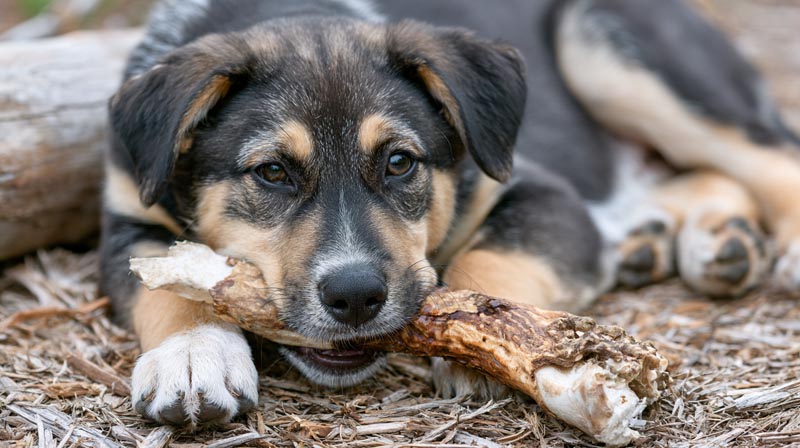
Dogs frequently mask dental pain. Many fractured teeth are found incidentally during routine veterinary exams, not because the dog showed distress (VCA Animal Hospitals, Vetster 2025).
That makes active owner observation during and after chew sessions the only reliable early detection method.
Oral Signs During and After a Chew Session
A puppy chewing normally is engaged, focused, and gnawing sideways along the antler surface.
Stop the session and examine the mouth if you see:
- Dropping the antler repeatedly while still showing interest (pain signal, not boredom)
- Pawing at the face or mouth
- Excessive drooling beyond normal chewing moisture
- Blood on the antler surface beyond faint gum contact
- Visible chip, dark spot, or red dot on a tooth surface (pulp exposure)
PetMD notes that a red or brown dot visible on a fractured tooth surface indicates pulp exposure, which requires same-day veterinary contact, not a wait-and-see approach.
Behavioral Signs in the Hours After a Session
Most chew-related dental complications appear within 6-12 hours of the session.
Behavioral shifts are often the first indication something went wrong, because puppies rarely stop eating even when in dental pain (Vetster, 2025).
Watch for:
- Reluctance to chew kibble or hard treats the puppy previously enjoyed
- Favoring one side of the mouth
- Sudden avoidance of the antler that the puppy was engaged with the session before
- Facial swelling, especially below the eye (tooth root abscess indicator)
Digestive Warning Signs from Swallowed Fragments
Antlers are not digestible. Small fragments worn down gradually over long sessions usually pass without issue.
Larger fragments from aggressive chewing are a different situation entirely.
Signs requiring veterinary contact within 24 hours: vomiting after a chew session, constipation lasting more than a day, blood in stool, or visible distress when the abdomen is touched.
Breeds with narrower GI tracts, including Dachshund and Basset Hound, face higher intestinal blockage risk from swallowed fragments than larger breeds with wider digestive pathways.
For context on the full range of chew-related risks and how to assess them by product type, the antlers for dogs overview covers what owners need to evaluate before introducing any antler format.
The short version: if a puppy shows any of the signs above, pull the antler, check the mouth as thoroughly as the puppy allows, and call your vet. Dental fractures caught within 48 hours have significantly better treatment outcomes than those discovered weeks later (North Bay Veterinary Dentistry, 2025).
FAQ on The Age When Puppies Can Chew Antlers
What is the minimum age for puppies to chew antlers?
6 months minimum, once adult teeth have fully erupted. Before that, deciduous enamel is too thin and tooth roots are too shallow to handle antler hardness safely. Toy breeds should wait until 7-8 months.
Can a 3-month-old puppy chew an antler?
No. At 3 months, puppies are in the active teething phase with baby teeth still erupting. Antler chew pressure can fracture deciduous teeth and damage the permanent tooth buds developing underneath. Stick to soft rubber chews.
Are split antlers safer than whole antlers for puppies?
Yes. Split elk antlers expose the softer marrow channel, which encourages licking and scraping rather than direct biting force. For puppies past 6 months, split elk is the only antler format worth considering.
Which antler type is safest for a puppy’s first chew?
Split elk antler in the correct size for body weight. Deer antlers are the hardest available and not appropriate for puppies at any age. Moose antler slices are the softest option for dogs with sensitive dentition.
How long should a puppy chew an antler per session?
Limit sessions to 10-15 minutes maximum for puppies. Sustained chewing builds jaw fatigue, which increases the chance of awkward bite angles and harder molar contact. Remove the antler between sessions and supervise throughout.
Does breed size affect when puppies can start chewing antlers?
Yes, significantly. Large breed growth plates stay open until 18 months, meaning jaw bone density develops later. A Golden Retriever puppy needs to wait until 9-12 months. A small breed can start at 6-7 months with supervision.
What should I do if my puppy cracks a tooth on an antler?
Remove the antler immediately. Check the mouth for a visible chip or red dot on the tooth surface, which signals pulp exposure. Contact your vet the same day. Dental fractures caught within 48 hours have significantly better treatment outcomes.
Do veterinary dentists recommend antlers for puppies?
Generally no. In a survey of over 1,000 veterinarians, 93% did not recommend antler chews. The American Veterinary Dental College lists antlers alongside bones and hooves as chews to avoid due to slab fracture risk.
What are safer chew alternatives for puppies under 6 months?
Rubber puppy chews rated for developing jaws, frozen Kong toys stuffed with puppy-safe food, and VOHC-approved dental chews sized for puppy weight. These pass the thumbnail test and carry no tooth fracture risk during the teething phase.
Can antler chews provide nutrition for growing puppies?
Minimally. Antlers contain calcium, phosphorus, and zinc, but the contribution is negligible compared to a complete puppy diet. The mineral content from chewing is absorbed as fine dust over time, not through digestion of large pieces.
Conclusion
This conclusion is for an article presenting what age can puppies chew antlers, and the answer comes down to one threshold: 6 months minimum, with breed size and antler type determining everything after that.
Deciduous enamel is thin. Tooth roots are shallow. Jaw bone density is still building. None of those conditions mix well with cortical bone matrix hardness.
Split elk antler in the right size, introduced after adult tooth eruption is confirmed, is the most defensible starting point.
Whole antlers, deer antlers especially, belong in the adult chew category.
Apply the thumbnail test to every chew you hand a puppy. If your fingernail leaves no dent, put it back on the shelf until the dog is older.