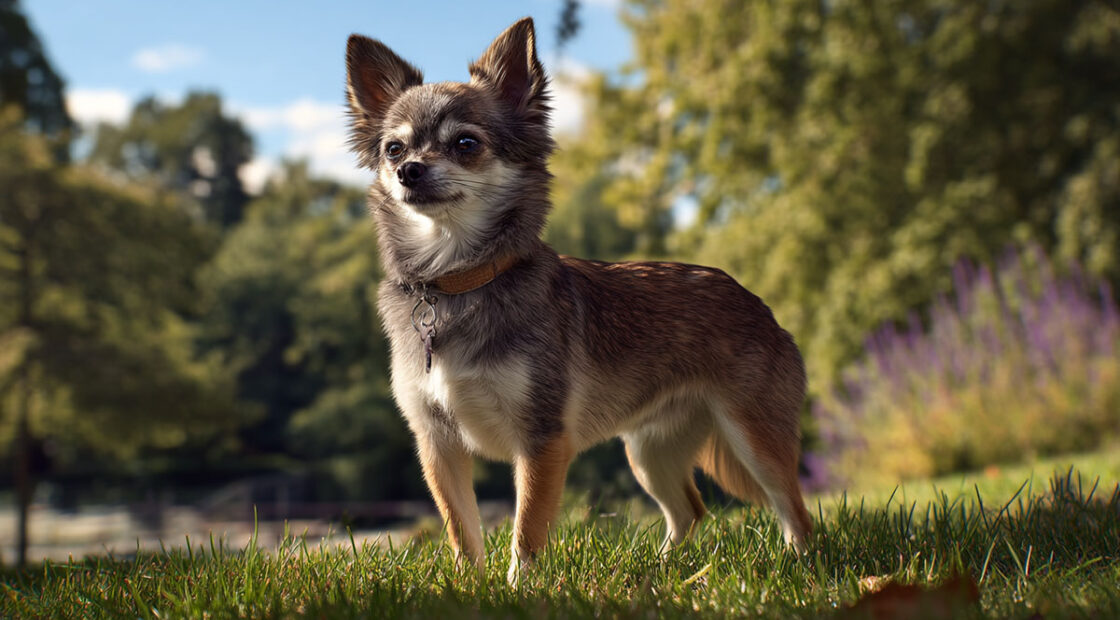
The Chihuahua takes its name from Mexico’s largest state, and the Federation Cynologique Internationale (FCI) regards this toy breed as the smallest pedigree dog in the world.
The American Kennel Club (AKC) caps show weight at 6 pounds and recognizes smooth and long coats.
Popularity has climbed fast, at least where anyone has measured it. In UK veterinary records, the breed’s share of annual puppy births rose from 1.01% in 2005 to 5.35% in 2016 (Royal Veterinary College VetCompass study, 2020).
The small size has documented health costs. Periodontal disease and patellar luxation are both well recorded, and so is hypoglycemia in puppies.
How Big Is a Chihuahua, and What Should It Weigh?
Standards judge weight and ignore height. The American Kennel Club (AKC) caps the breed at 6 pounds, and Federation Cynologique Internationale (FCI) Standard No. 218 sets a range of 1 to 3 kg.
Each registry publishes its own weight rule, and the real-world median sits above every one of them.
- The AKC standard, approved in 2008, says a Chihuahua must not exceed 6 pounds. Any dog over 6 pounds is disqualified.
- FCI (2019) allows 1 to 3 kg with an ideal of 1.5 to 2.5 kg, and dogs under 1 kg or over 3 kg are disqualified.
- The United Kennel Club (UKC, 2017 revision) wants an ideal weight of 3 to 6.5 pounds. A dog over 6.5 pounds carries an eliminating fault.
- The Royal Veterinary College (RVC) VetCompass study (2020) found a median adult bodyweight of 3.4 kg in UK dogs under primary veterinary care. That sample mixes pedigree and non-pedigree dogs.
Show standard weight versus pet weight
The median adult in UK veterinary records weighs 3.4 kg, according to the RVC’s VetCompass study (2020).
That sits about 0.7 kg above the AKC ceiling and 0.4 kg above the FCI limit. Standards describe show specimens, while the VetCompass sample mixes pedigree and non-pedigree dogs. Its authors read the gap as a sign that the general public prefers a larger type than the standards allow.
The gap still deserves attention, because the same RVC study lists obesity among the breed’s main health concerns.
Are teacup and ultra mini Chihuahuas a real size?
No. Teacup is a sales term and not a size class.

The Chihuahua Club of America (CCA) says in its Teacup Statement that the breed standard does not sort the dog by size. It rejects teacup, pocket size, tiny toy, miniature and standard alike. The club’s worry is that buyers read these words as rarer and worth more, and it does not endorse or condone any of them.
The registries cut off the extreme end too. FCI disqualifies any dog under 1 kg in the ring, and VCA Animal Hospitals notes that very small puppies are prone to hypoglycemia, a serious drop in blood sugar.
Apple Head, Deer Head, Coat Types and Colors

The AKC, FCI, UKC and The Kennel Club all describe a rounded apple dome skull and two coat varieties, smooth and long. They split on deer-type heads, open fontanels and merle.
| Feature | AKC | FCI |
|---|---|---|
| Open fontanel (molera) | Accepted, skull “with or without molera” | Disqualifying fault |
| Deer-type head | Calls for an apple dome, no deer-type clause | Disqualifying fault |
| Merle color | Any color accepted, no merle clause | Disqualifying fault |
The AKC column reads the 2008 standard. The FCI column reads Standard No. 218 (2019).
Apple head versus deer head
Under the AKC standard, an apple head is a well-rounded dome with a well-defined stop, and the skull meets the muzzle at close to 90 degrees.
Deer head is FCI’s term for an atypical, extremely stylized build, with a refined head, long neck, slender body and long limbs. Only FCI names it. The AKC and The Kennel Club simply ask for a rounded skull, and the UKC lists a flat skull as a serious fault.
The molera is the soft spot on top of the skull, the same thing as a fontanel in a human baby, according to the CCA.
The CCA’s molera statement says a domed head with a molera does not predispose the breed to hydrocephalus, and it cites veterinary neurology sources for that position. FCI and the UKC still disqualify an open fontanel.
Smooth coat versus long coat
- Smooth coats are soft, close and glossy, and the AKC permits heavier coats with an undercoat.
- Long coats are soft and flat or slightly wavy, with fringed ears, a plumed tail and feathering on the feet and legs.
- A long coat so thin it resembles bareness is an AKC disqualification, while FCI disqualifies a very long, fine, billowing one.
Both varieties count as one breed. VCA Animal Hospitals notes they compete in separate classes but can be interbred.
Accepted colors and the merle exclusion
The AKC accepts any color, whether solid, marked or splashed, and its standard has no merle clause.
Elsewhere merle is out. FCI lists it as a disqualifying fault, and The Kennel Club phased out registration in stages.
- From 1 March 2007, no merle puppies from matings on or after that date.
- From 1 March 2009, no puppies from a merle parent mated on or after that date.
- From 1 January 2013, no puppies from merle to merle matings born on or after that date.
The Kennel Club’s stated reason is that the merle gene in this breed carries an increased risk of impaired hearing and sight.
So a coat the AKC standard allows is a disqualification under FCI rules, and Britain stopped registering new merle litters in 2007.
Where Did the Chihuahua Come From?
The name is Mexican, but the ancestry is unsettled. FCI’s own breed summary rests on Techichi statues from Tula and calls the Toltec link an assumption.
The Westminster Kennel Club lists Mexico and the Aztecs, Egypt, the Sudan and Malta among the guesses, yet it has no doubt the Chihuahua is an ancient breed.
The Toltec Techichi theory has the most paper behind it. FCI cites the Tula statues, and the AKC history page quotes breed historian William Miller on a heavy-bodied Toltec dog with large ears like a Chihuahua’s.
VCA Animal Hospitals says the breed likely descends from the Techichi crossed with Chinese dogs brought to Central America by Spanish conquistadors, and the AKC notes that others speculate on a Chinese origin. Westminster adds Egypt, the Sudan and Malta as other proposals.
DNA gives a partial check. A 2018 Science study of ancient American dog genomes (Leathlobhair et al.) found that European dogs almost completely replaced native lineages after colonization.
In its mitochondrial survey of modern dogs, one Chihuahua carried a pre-contact haplotype, alongside a mixed-breed dog from Nicaragua.
That is real evidence of a New World strand in at least one Chihuahua. It is also a single maternal marker, which is thin support for a breed-wide origin story, and the authors describe the overall pre-contact signal in modern American dogs as limited.
The long coat has its own theory. VCA Animal Hospitals reports that some sources credit crosses with other toy breeds, including the Papillon, once the breed reached American fanciers.
Registration came late. The AKC’s breed history names Midget as the first registered Chihuahua in 1904 and Beppie as the first champion, while Purina’s profile calls Beppie the first AKC-registered Chihuahua, in 1908.
The Chihuahua Club of America formed in 1923 and held its first specialty show in 1928. The United Kennel Club recognized the breed in 1948.
What Is a Chihuahua’s Temperament Like?

Chihuahuas are bold, alert and usually tied to one person. The AKC standard asks for terrier-like self-importance, confidence and self-reliance, and FCI describes the breed as quick, alert, lively and very courageous.
Barking and alertness
The Westminster Kennel Club scores the breed 5 out of 5 for barking.
That is a watchdog trait doing its job. The GreatPetCare breed guide calls the Chihuahua an excellent watchdog for its size that turns yappy unless it is taught to moderate its voice.
Expect noise from the first week, and treat it as a training task, not a defect.
Separation anxiety
The UKC standard credits the breed’s devotion to its owner for its popularity as a companion dog. That same devotion is the reason time alone deserves planning.
A large Finnish owner survey (Salonen et al., Scientific Reports, 2020) found big breed differences in every anxiety-related trait it measured, which points to a strong genetic contribution.
It also linked separation-related behavior with hyperactivity and inattention. Smithsonian Magazine reported the lead author’s view that keeping dogs active and well trained might help, with more research needed to confirm it.
Children and other household members

Small children and Chihuahuas are a poor default pairing.
Westminster rates the breed 1 out of 5 for being good with children, and the GreatPetCare guide calls it too small and fragile for even gentle children’s games.
The aggression data points the same way. Duffy, Hsu and Serpell (Applied Animal Behaviour Science, 2008) found Chihuahuas scored above average for aggression toward both people and dogs, and the RVC’s 2020 VetCompass study recorded aggression in 4.2% of Chihuahuas, a higher share than in other small breeds studied with the same method.
There are caveats. The National Canine Research Council points out that the 2008 survey relied on owner reports and verified breed for only a minority of dogs, and a 2014 review by Mehrkam and Wynne found meaningful differences within breeds as well as between them.
Showsight magazine’s breed profile takes the opposite view, saying the dogs are often good with children, especially when raised with them.
FCI lists aggressive or overly shy dogs as disqualifying faults, so the ring rejects the trait the surveys flag. Socialization decides more than the breed label does.
How Long Do Chihuahuas Live?
It depends on who is counting. UK veterinary records put median age at death near 8 years, while The Kennel Club cites a lifespan of over 12 years.
The Kennel Club’s figure is cited in the VetCompass paper. The paper’s own number is a median age at death of 8.2 years among UK Chihuahuas under primary veterinary care, and its authors say that should not be mistaken for breed lifespan. Teng et al. (Scientific Reports, 2022) put life expectancy at birth at 7.9 years in UK life tables. The Chihuahua Club of America takes the other view and says healthy, well-cared-for dogs live well into their teens.
Kennel club and breed club figures describe what a healthy dog can reach. The VetCompass figures describe dogs in veterinary records, where heart disease, lower respiratory disorders and traumatic injury led the recorded causes of death.
Growth skews the numbers too. The VetCompass authors describe a youthful UK Chihuahua population (median age 2.8 years) after a steep rise in ownership, so deaths recorded in a single year skew young.
Life tables correct for this by reporting life expectancy at specified ages. The Teng tables are the better source for anyone adopting an adult Chihuahua, because remaining life expectancy at a later age is a different number from expectancy at birth.
None of these figures is wrong. They answer different questions.
Which Health Problems Affect Chihuahuas?
The veterinary literature keeps coming back to periodontal disease, patellar luxation, mitral valve disease, tracheal collapse, hydrocephalus and puppy hypoglycemia.
The table below covers all of them except hydrocephalus, which gets its own section further down. It pairs each condition with warning signs and prevention, including screening through the Orthopedic Foundation for Animals (OFA) and its Canine Health Information Center (CHIC) program.
| Condition | Warning signs | Prevention or screening |
|---|---|---|
| Periodontal disease | Bad breath, bleeding gums, loose teeth, drooling | Daily brushing, regular dental exams |
| Patellar luxation | Skipping gait, leg kicked out to the side | OFA patella evaluation, lean body weight |
| Mitral valve disease | Heart murmur found at a routine exam | Yearly auscultation, CHIC cardiac exam |
| Tracheal collapse | Dry, honking cough that worsens with excitement | Weight control, vet-directed treatment |
| Hypoglycemia | Lethargy, wobbliness, seizures in puppies | Small, frequent meals, warmth |
Dental disease and retained baby teeth
Periodontal disease was recorded in 1.6% of Chihuahuas under 2 years old and 34.0% of those over 7, according to the RVC’s VetCompass study (O’Neill et al., 2020).
Retained baby teeth ranked first among recorded disorders in dogs under 2, and the authors conclude the breed should be considered predisposed to dental disease.
Iowa State University’s veterinary college blames crowding, since the teeth are often packed together or never erupt through the gum.
The paper cites The Kennel Club’s 2019 Breed Watch listing, which put the breed in category 2 with incorrect dentition flagged for judges. It also concludes that the breed’s unique care needs suggest vets should consider advanced training in small-dog anaesthesia and dentistry.
Patellar luxation
The kneecap slips out of its groove, usually toward the inside of the leg, and vets grade the slip from 1 to 4.
- Grade 1 means the kneecap can be pushed out by hand and returns when released.
- In grade 2 it pops out on its own at times and stays out until the leg is rotated back.
- Grade 3 sits out of the groove most of the time, though it can be pushed back.
- At grade 4 the kneecap stays out permanently and cannot be repositioned by hand.
Many affected dogs learn to kick the leg out sideways to snap the kneecap back, per VCA Animal Hospitals.
The VetCompass sample ranked the condition among the ten most common disorders in every age band.
Heart and airway conditions
Both of these show up in middle and later age, and one of them gets worse with extra weight.
The American College of Veterinary Internal Medicine (ACVIM) consensus guidelines say mitral valve disease is more prevalent in smaller dogs and that progression in small breeds is generally slow but at times unpredictable. A murmur at a routine exam is usually the first sign, and the guidelines call for yearly auscultation in small breeds.
The same VetCompass study found a murmur in 12.35% of Chihuahuas over 7 years old, against 0.26% of those under 2.
Tracheal collapse is on the textbook list of Chihuahua predispositions cited in the VetCompass paper. The Merck Veterinary Manual describes a dry, honking cough in toy and miniature breeds, a cause that remains unknown, and more frequent cases in obese dogs and those with heart or lung disease.
Weight loss is critical to managing it, the Merck manual says, and Cornell’s veterinary college adds that there is no cure and signs tend to progress, though ongoing medical management improves quality of life.
The molera and hydrocephalus
Lay owners and some vets link the two, but they are separate risks.
Hydrocephalus appears on the textbook predisposition list cited in the VetCompass paper, and brain disorders show up among the recorded causes of death in that sample.
A molera, on the other hand, leaves a gap in the skull, and the GreatPetCare breed guide notes that dogs with one are more prone to head injuries. A dog can live a normal life with a molera and still be a poor match for rough play with large dogs or boisterous children.
Hypoglycemia
Cold, stress, activity and a missed meal can each drain a small puppy’s blood sugar between meals, according to an AKC health article quoting veterinarians.
Watch for extreme lethargy, poor coordination, collapse and seizures. A puppy that goes limp needs a vet.
The AKC’s veterinary source says light corn syrup or honey given orally can stabilize a small puppy temporarily. FirstVet adds that a conscious puppy should be offered tasty food and wrapped in a blanket.
Emergency treatment is intravenous glucose, so those steps only buy time. Prevention comes down to the feeding schedule covered under daily care.
What Daily Care Does a Chihuahua Need?
Care comes down to small scheduled meals, short daily exercise, a regular coat routine, daily tooth brushing and warmth in cold weather. Each task takes little time, and skipping any of them costs more than doing it.
How often and how much should you feed a Chihuahua?
FirstVet’s veterinarians recommend three to four meals a day for small-breed puppies, because puppies under three months cannot yet regulate blood sugar well. Adults still do better on small, frequent meals, according to PetMD’s veterinary guidance for toy breeds.
The amount on the bag is a starting point based on ideal weight, not current weight, says Gene Pavlovsky of the University of Illinois veterinary college.
A feeding chart by age and weight turns those starting points into daily portions. Check the result against body condition. The WSAVA nine-point score puts ideal at 4 or 5, and Pavlovsky says the ribs should be easy to feel without pressing firmly.
Puppies need a food labeled for puppies and adults an adult diet, Pavlovsky adds, so comparing puppy food brands starts with the life-stage label.
A lean dog also protects the airway and the knees covered in the health section.
Exercise and cold weather
Exercise demands are modest, and cold is the bigger constraint.
PDSA, the UK veterinary charity, sets a daily minimum of 30 minutes, while the Merck Veterinary Manual lists exercise restriction as part of managing tracheal collapse.
A University of Illinois veterinarian recommends clothing and footwear for short-haired and small breeds if the dog tolerates them. Even a typical dog, the university notes, should spend only enough time outside to eliminate in extreme cold.
Colorado State’s teaching hospital says a dog lifting its feet, shaking or searching for shelter should come inside. Illinois lists tiredness, shivering, pale skin, shallow breathing and muscle stiffness as signs of hypothermia, and any of them means a call to the vet.
Grooming by coat type
- Smooth coats need a weekly brushing with a soft brush or rubber mitt.
- Long coats want brushing two to three times a week to hold off tangles.
- Nails need regular trims on both varieties, and a tapping sound on hard floors means they are overdue.
PDSA’s breed guide sets the brushing schedule, and Tesco Pet Insurance’s guide supplies the nail-tapping test.
Dental care
Brushing is the gold standard for preventing periodontal disease in dogs, according to a USDA Animal Care aid, which rates it the most effective and least expensive option.
Use a small, soft-bristled brush and dog toothpaste. Have a vet examine the mouth first so an existing problem is found before brushing starts, as Iowa State University’s veterinary college advises. FirstVet recommends an early first dental exam for small and toy breeds.
Chews are the weaker substitute. The same USDA aid lists a risk of broken teeth and gastrointestinal obstruction.
Consistency decides whether brushing works, and veterinary dentist Jan Bellows names daily plaque control as the most important step in an AKC Canine Health Foundation interview.
How Do You Train and Socialize a Chihuahua Puppy?
House training starts the day the puppy comes home, and socialization should begin inside the first three months. The AKC says house training rests on consistency, supervision, a predictable schedule and positive reinforcement.
The usual sequence looks like this.
- Choose a crate just large enough for the puppy to stand, turn around and lie down, since a roomier one lets it use a corner as a toilet.
- Fix a feeding and potty schedule, so potty times follow meals predictably.
- Supervise the puppy, carry it to the same spot, and reward the moment it finishes.
- Meet accidents with a clean-up, not a scolding, because positive training is associated with fewer behavioral problems than punishment.
- If accidents persist, rule out a physical cause with a vet.
Puppy pads add a decision to the routine, and the AKC quotes a trainer who calls pads and paper training tricky. Read up on how puppy pads work before committing to them.
On socialization, the American Veterinary Society of Animal Behavior (AVSAB) calls the first three months the primary window and says puppies should be socialized before they are fully vaccinated.
Puppy classes can start at 7 to 8 weeks, with at least one vaccine set given 7 days before the first class. The AVSAB steers owners away from dog parks and other areas where dogs of unknown vaccination status gather.
The same statement recommends scheduled time alone with toys or in a crate, which teaches a puppy to amuse itself and may help prevent over-attachment.
The VetCompass authors observe that stiffening, staring and growling may be ignored in miniature breeds, which lets the dog escalate to snaps and bites. Treat a growl from a Chihuahua the way you would treat one from a Labrador.
Barking responds to the same early start. PDSA says Chihuahuas can be taught not to bark excessively, ideally from a young age before the habit forms.
How Much Does a Chihuahua Cost, and Where Should You Get One?
No kennel club or breed club sets a puppy price, so the seller does. Chihuahua Rescue & Transport, a group that has placed Chihuahuas and mixes through foster homes since 1996, lists $300 for dogs over a year old and $350 for younger ones on its Petfinder profile.
| Source | Cost signal | What to ask for |
|---|---|---|
| Breeder | Set by the breeder, no standard price | CHIC number and public OFA results for cardiac, patella and eye |
| Breed rescue | $300 to $350 at Chihuahua Rescue & Transport | Application, vet check, reference check and home visit are standard there |
| Local no-kill rescue | Per-dog fee plus a microchip fee at Coryell County Pet Rescue | An approved application before contact |
The purchase price is only the first bill, because owning a dog gets expensive over a lifetime, and the VetCompass authors single out dentistry and anaesthesia as this breed’s distinctive care needs.
The Chihuahua Club of America (CCA) ties its CHIC participation to a cardiac exam, a patella evaluation and an eye exam by a board-certified ophthalmologist.
Under OFA’s CHIC rules, as summarized in Showsight magazine, results need not be normal, only publicly listed in the OFA database. A CHIC number therefore records that the tests happened, so ask to see the results.
Seller type shapes behavior, too. A 2017 paper by McMillan, discussed in the VetCompass paper, found that Chihuahuas from less-responsible breeders showed more aggression toward familiar dogs, unfamiliar dogs, strangers and owners.
The same paper argues that when demand spikes, most puppies come from outside Kennel Club registered breeders, and it warns against impulse purchases by owners with limited dog experience.
Is a Chihuahua the Right Dog for Your Household?

A Chihuahua fits adults in small homes who can commit to dental care, weight control and early training. It fits poorly where small children, large rough-playing dogs or long empty days are part of the routine.
Sources disagree on the first-time-owner question. Purely Pets Insurance calls the breed a good choice for first-time owners because exercise and care needs are manageable.
The VetCompass authors counter that small size makes buyers think these dogs are easy, when they are full of energy, strong-willed and need exercise and mental stimulation like any other dog.
Pros and cons
On the plus side, the iDog breed database describes a mostly indoor dog that does well in apartments, so the footprint is small. The smooth coat takes little grooming, and the bond between dog and owner is strong.
Against that, the list is longer.
- Dental and anaesthesia costs climb with age.
- Cold sensitivity complicates winter walks.
- There is a thin margin for rough handling.
- The temperament needs early, consistent training.
Attachment cuts both ways. Sandoe et al. (PLOS ONE, 2017), discussed in the VetCompass paper, found that Chihuahua owners report closer attachment than Cairn Terrier owners, with more health and behavior problems linked to closer attachment.
When a Chihuahua is a poor fit
- Toddlers or rough play leave little margin for accidents, given a small body and a possible skull gap.
- Long solo days are a problem because the AVSAB ties over-attachment to puppies never practicing time alone, and the UKC standard calls the breed devoted to its owner.
- In cold climates, University of Illinois advice for short-haired and small breeds is clothing and brief outings in extreme cold, which turns winter walks into a chore.
- Tight vet budgets run into the VetCompass data, where periodontal disease prevalence rises with age, so the bills grow rather than shrink.
If two of those four describe your household, a different breed is the safer pick. An adult rescue Chihuahua with a known temperament removes one unknown.
Chihuahua FAQ
Does the Chihuahua go by any other names?
Yes. FCI Standard No. 218 lists the breed under its Spanish name, Chihuahueño, and the iDog breed database adds the shortened common name Chi.
Why do Chihuahuas shake?
Cold is the simplest explanation, because a Chihuahua has little body mass or insulation to hold heat. Excitement and nerves also set off tremors, according to Hill’s Pet Nutrition’s veterinary guide.
Shaking alongside other signs can point to hypoglycemia, distemper or Addison’s disease, and that combination calls for a vet.
Do Chihuahuas shed?
Yes, but lightly. The Westminster Kennel Club rates shedding 2 out of 5 and grooming needs 1 out of 5, and the iDog breed database calls the shedding seasonal.
How does a Chihuahua compare with a Pomeranian or a Yorkshire Terrier?
A Chihuahua has the lowest show-weight limit of the three at 6 pounds under the AKC standard.
The Pomeranian runs 3 to 7 pounds and carries a thick double coat. The Yorkshire Terrier tops out at 7 pounds, and RVC life tables (Teng et al., 2022) give it 12.5 years of life expectancy, well above the Chihuahua’s.
Can a Chihuahua live with cats and other dogs?
Usually, when the introductions start young. PDSA says a Chihuahua lives happily with another pet it has grown up with.
Duffy and colleagues (2008) found dog-directed aggression the most severe type across breeds, so supervise meetings with unfamiliar dogs.
What a New Chihuahua Owner Should Do First
Rank the first 30 days by how fast each risk acts. Feeding and warmth come first, the veterinary exam second and socialization third.
Hypoglycemia strikes between meals, while the AVSAB names behavioral problems, not infectious disease, as the leading cause of death in dogs under three years old.
Dental and heart disease build across later years, so the first exam sets a baseline.
- Meal schedule and warmth from day one
- Veterinary exam for weight, heart, knees and teeth
- Puppy class after the first vaccine set
This order accepts a small infection risk in early classes, which the AVSAB judges smaller than the behavioral risk. A puppy that shows fear in class needs veterinary guidance before further exposure.
Verified October 2026, the ranking stands until a cohort study following Chihuahuas from birth to death replaces today’s age-skewed clinic data, the design the VetCompass authors call most robust.