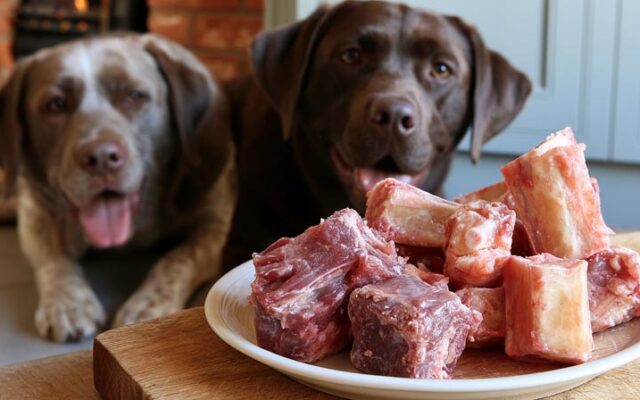
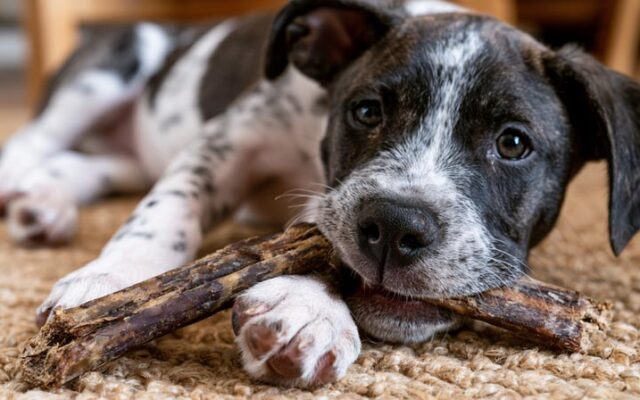
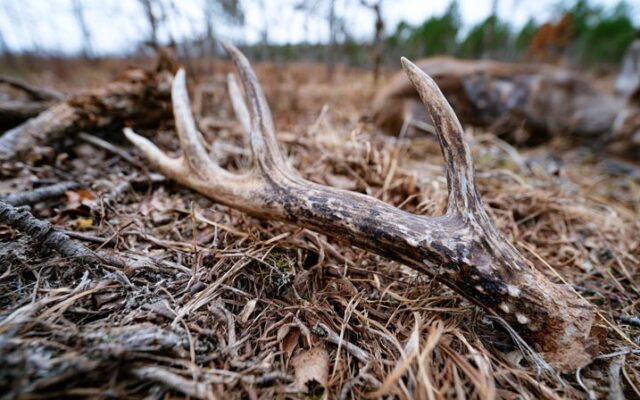
Most dog owners have no idea there’s a time limit on hard chews. And that gap in knowledge is exactly how a relaxed chew session turns into an emergency vet visit.
How long can dogs chew on hard chews safely depends on the chew type, your dog’s size, breed, and bite force. There’s no single answer, but there are clear guidelines backed by veterinary dental research.
This article covers safe chewing session lengths, which hard chew materials carry the highest dental fracture risk, how dog size and age change those limits, and what signs to watch for after a session ends.
By the end, you’ll know exactly how to give your dog a satisfying, safe chewing session without risking a slab fracture or a trip to the vet.
How Long Can Dogs Chew on Hard Chews?
Most dogs can safely chew on hard chews for 15 to 30 minutes per session, supervised, before dental fracture and jaw fatigue risks climb significantly. That window is not arbitrary.
After roughly 30 minutes, the repetitive bite pressure on the carnassial tooth (the large upper 4th premolar) reaches a point where cumulative stress starts to matter. The chew session length depends on three things: the hardness of the chew, the dog’s size and bite force, and how aggressively the dog chews.
Tooth fracture in dogs has a reported prevalence of 20% to 27% in the general population, with hard chews and bones cited as a leading cause (Veterinary Times, 2024). Many owners have no idea it’s happened until an abscess forms weeks later.
This is not a reason to ban chews entirely. Supervised, time-limited chewing supports plaque removal, jaw exercise, and behavioral enrichment. The goal is getting the duration right.
| Chew Type | Hardness Level | Recommended Session Cap |
|---|---|---|
| Deer/elk antlers | Extremely hard | 15 minutes max |
| Cooked bones | Hard, splinters | Avoid entirely |
| Raw bones | Hard | 15-20 minutes |
| Nylon chews (Nylabone) | Hard | 20-30 minutes |
| Himalayan yak chews | Medium-hard | 20-30 minutes |
The table above reflects general safe chewing time guidance from veterinary dental sources. Individual dogs may need shorter sessions depending on breed, age, and chewing style.

What Are Hard Chews for Dogs?
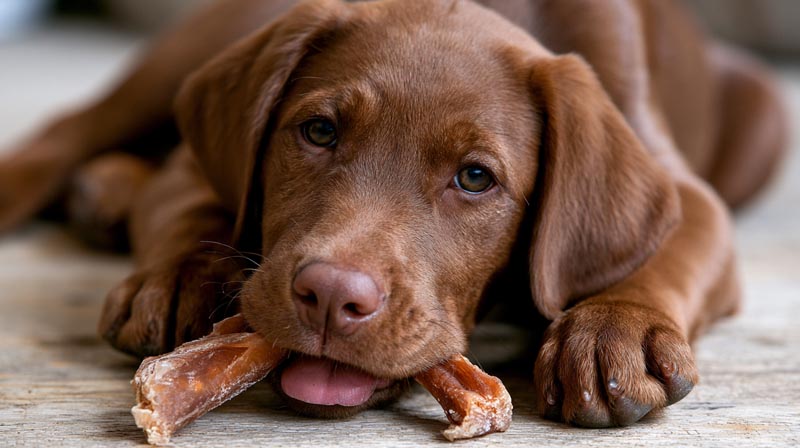
Hard chews are any chew product that does not bend, compress, or dent when you press your thumbnail firmly into the surface. That’s the thumbnail test, and it’s the single most practical field test veterinary dentists use to assess chew safety.
If you press your nail into a chew and leave no mark, it’s harder than what most dogs’ teeth can safely handle for extended sessions. The chew will outlast the tooth enamel.
What Counts as a Hard Chew?
There are 4 main categories that fall under “hard chew” by the thumbnail test standard.
- Antlers (deer, elk, moose): Among the densest natural chews available. Whole deer antlers are harder than elk, which are harder than moose. Split antlers are marginally softer because the inner marrow section is exposed.
- Raw and cooked bones: Raw bones are hard but have some give. Cooked bones are harder, drier, and splinter into shards. Most veterinary dental specialists advise against cooked bones entirely.
- Nylon chews: Synthetic polymer chews like safe chew options marketed under the Nylabone brand. Durable but not digestible.
- Himalayan yak chews: Compressed dried yak and cow milk. Medium-hard hardness. Softer than antlers and bones but still fails the thumbnail test when fresh.
What Gets Mistaken for a Hard Chew?
Bully sticks pass the thumbnail test — they compress under pressure and are fully digestible. They are not hard chews by the veterinary definition.
Same for beef tendons, pig ears, and collagen chews. These are categorized as soft to medium chews. The risks are different (primarily caloric density and contamination) rather than dental fracture.
The distinction matters because safe chewing time recommendations differ significantly between hard and soft chews. Soft chews can generally be given for longer, supervised sessions without the same slab fracture risk.
What Dental Risks Come from Chewing Hard Chews Too Long?
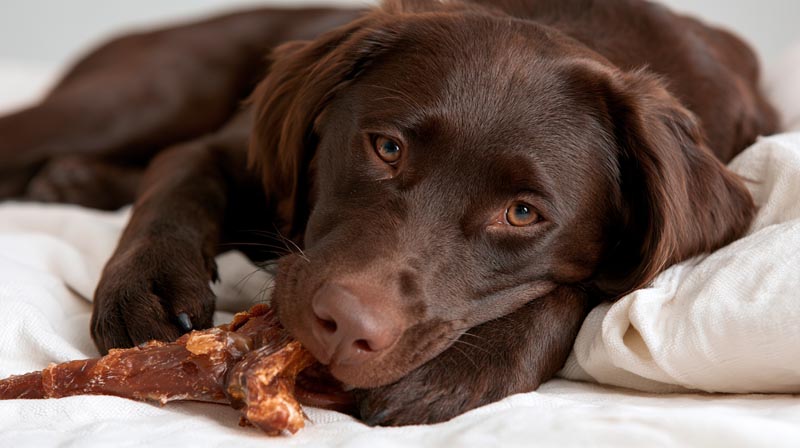
Slab fracture is the primary dental injury from extended hard chew sessions, and it’s more common than most owners realize. The tooth doesn’t crack cleanly — a slab of enamel and dentin shears off the side, often exposing the pulp underneath.
Periodontal disease is already the most common clinical condition in adult dogs. By the time dogs reach age 3, 80% show signs of dental disease (American Veterinary Medical Association). Hard chews used incorrectly add fracture injuries on top of that baseline.
Which Teeth Are Most at Risk During Hard Chewing?
The upper 4th premolar (carnassial tooth) is the most frequently fractured tooth in dogs from hard chew use, according to the American Veterinary Dental College.
It’s the largest chewing tooth in the upper jaw and sits far enough back that owners rarely spot a fracture until infection sets in. The tooth’s pointed cusp concentrates bite force in a way that creates the ideal conditions for a slab fracture when a dog bites down on something that doesn’t yield.
Dog enamel is also thinner than most people assume. Human enamel measures 2 to 3 mm thick. Dog enamel ranges from just 0.1 mm to 1 mm (Capital Area Veterinary Oral Surgery). That is up to 6 times thinner. Antlers and raw bones do not compress — the tooth does.
What Happens After a Fracture?
A fracture with pulp exposure creates a direct pathway for bacteria into the tooth root. Left untreated, this produces:
- Tooth root abscess
- Apical granuloma (chronic infection at the root tip)
- Systemic infection risk in dogs with compromised immunity
Treatment runs from $500 to $2,500 depending on whether the tooth can be saved with a root canal or requires surgical extraction. Most owners don’t catch slab fractures early because dogs continue eating normally despite significant pain.
How Does Dog Size and Breed Affect Safe Chewing Time?
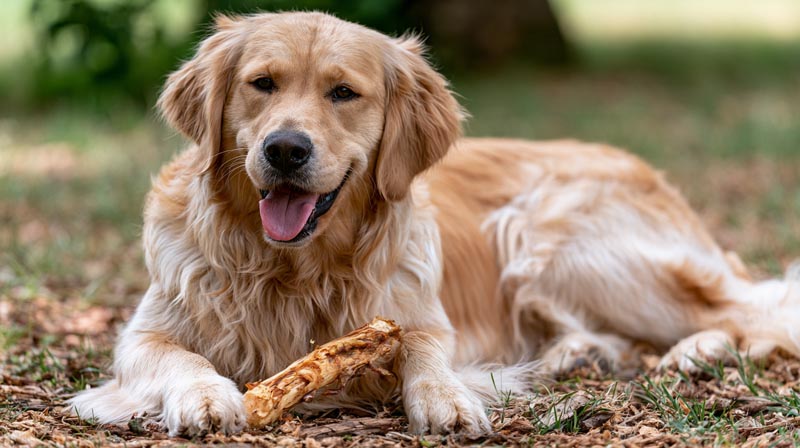
Bite force varies dramatically across breeds, and higher bite force accelerates both dental wear and fracture risk during hard chew sessions. A dog that generates 500+ PSI chewing force treats an antler very differently than a 20-pound dog does.
Size and breed affect the safe chewing duration in 3 specific ways: jaw muscle mass, tooth size relative to chew hardness, and skull structure.
Large and Giant Breeds
Rottweilers generate a bite force of 328 PSI. English Mastiffs reach 552 PSI. Cane Corsos hit 700 PSI (Rosenfeld Injury Lawyers, 2023).
At those force levels, a dog can create enough pressure on a single bite to fracture the carnassial tooth in one session, not through extended wear but through the sheer force of a single hard bite on the wrong angle. For these breeds, the 15-minute session cap on antlers and raw bones is a ceiling, not a target.
Breeds like the Rottweiler and Mastiff should be assessed individually before any hard chew session. A hard chew that a 25-pound dog can manage safely for 20 minutes may fracture a large-breed dog’s tooth in half that time.
Small Breeds
Recommended session cap for dogs under 20 lbs: 10 to 15 minutes.
Small dogs have proportionally smaller teeth relative to the chews sold for their size category. Their jaw musculature also fatigues faster. The fracture risk is lower in absolute bite force terms, but the tooth-to-chew-hardness ratio is often worse because many small-breed owners underestimate how hard the chews they’re buying actually are.
Brachycephalic Breeds
Bulldogs, Pugs, French Bulldogs, and other flat-faced breeds have a compressed jaw structure that alters how bite force distributes across the teeth. The abnormal occlusion (tooth alignment) means force doesn’t land where it’s supposed to.
Hard chews carry a higher fracture risk for brachycephalic dogs even at short session durations. The Bulldog is one of the breeds most frequently cited in veterinary dental literature for hard chew-related tooth fractures. For flat-faced breeds, VOHC-approved softer dental chews are the more practical alternative.
| Breed Category | Approximate Bite Force | Recommended Hard Chew Cap |
|---|---|---|
| Small breeds under 20 lbs | Under 100 PSI | 10-15 minutes |
| Medium breeds 20-50 lbs | 100-200 PSI | 15-20 minutes |
| Large breeds 50-100 lbs | 200-350 PSI | 15 minutes max |
| Giant/high-force breeds | 350+ PSI | 10-15 minutes, vet-assessed |
| Brachycephalic breeds (all sizes) | Variable | Soft chews preferred |
How Does Chew Type Change the Safe Duration?
Not all hard chews carry the same risk at the same session length. The chew material determines how much dental stress accumulates per minute of chewing, which is why duration recommendations differ significantly across chew types.
Antlers
An informal poll of over 1,000 veterinarians found that 93% do not recommend antler chews for dogs (Dr. Julie Buzby, DVM). The reason is simple: antlers are harder than dog tooth enamel. When the two make contact, the tooth loses.
Whole deer antlers are the hardest variety. Split antlers are softer because the dense outer cortex is partially removed, exposing the spongy marrow interior. If antlers are given at all, split versions with a 15-minute cap are the less risky choice. Most veterinary dental specialists prefer to skip them entirely.
For dogs whose owners want to keep antlers in rotation despite the risks, consistent supervision and strict session limits are non-negotiable. You can read more about the specific safety considerations for whether antlers are safe for dogs and how elk vs deer antlers compare in terms of density and fracture risk.
Raw and Cooked Bones
Cooked bones: avoid entirely. The cooking process removes moisture, making bones drier, harder, and far more likely to splinter into sharp shards. Even short sessions carry a high risk of creating bone fragments that can perforate the gastrointestinal tract.
Raw bones have more give than cooked and carry less splintering risk, but they are still hard enough to cause tooth fractures and carry Salmonella and E. coli contamination risk. The FDA has issued guidance against feeding raw bones to dogs due to bacterial contamination. If raw bones are used, 15 to 20 minutes with direct supervision is the standard recommendation, and the bone should be refrigerated between sessions and discarded after 3 to 4 days. Those considering bone marrow specifically should note that marrow bones are among the most likely to cause slab fractures due to their cylindrical shape and how dogs position them between their back teeth.
Nylon Chews
Nylon-based chews like Nylabone are designed for extended sessions, but “long-lasting” is not the same as “unlimited.”
The risk is not fracture — it’s ingestion. Nylon chews degrade over time into small shavings and fragments. A dog that chews past the point where visible surface degradation begins is ingesting nylon material that is not digestible and can accumulate in the GI tract. Sessions of 20 to 30 minutes are reasonable for most dogs, and the chew should be inspected and replaced once surface wear becomes significant.
Himalayan Yak Chews
Yak chews sit at medium-hard on the hardness scale, which makes them one of the more practical hard chew options for dogs that need durable enrichment without the extreme dental risk of antlers.
They soften slightly with heat and saliva during chewing, which reduces the fracture risk compared to antlers. Sessions of 20 to 30 minutes are appropriate for most adult dogs. The remaining stub, once it gets small enough to swallow, can be microwaved for 45 to 60 seconds to puff it into a softer, digestible treat. More on what yak chews are made of and whether Himalayan dog chews are safe covers the production process in detail. If you want to find the right size for a larger dog, the Himalayan dog chew XL options are worth reviewing separately.
What Are the Choking and Digestive Risks of Hard Chews?
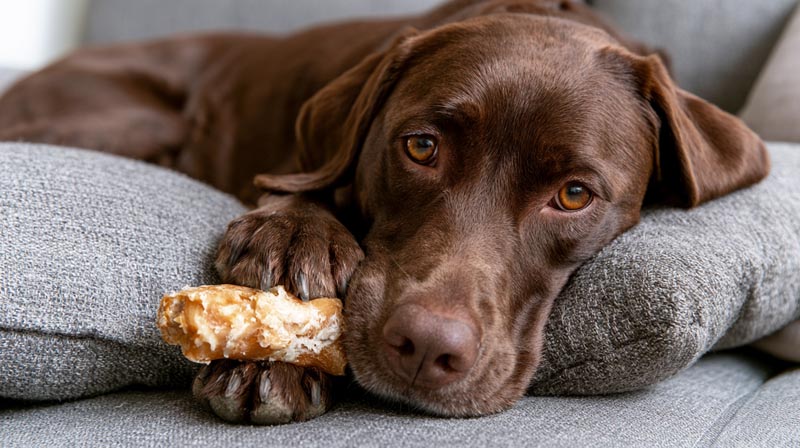
The longer a dog chews, the more material comes off the chew — and the more likely that material is to be swallowed in pieces that are too large to pass safely. Chewing duration and ingestion volume are directly linked.
The ASPCA states clearly that aggressive chewers who consume large chunks face a risk of intestinal obstruction requiring surgical intervention. The risk is not theoretical — it’s one of the more common reasons dogs end up in emergency veterinary care after chew sessions.
The Chunk Break-Off Problem
Hard chews don’t wear down evenly. They develop stress fractures and weak points that eventually release as chunks. A dog that has been chewing for 40 minutes on an antler or raw bone is more likely to be chewing near one of those stress points than a dog 10 minutes into a session.
Chunk ingestion risk by chew type:
- Antlers: Can fracture into irregular shards with sharp edges. Gastrointestinal perforation risk.
- Cooked bones: Splinter into needle-like fragments. High perforation risk — the reason most vets advise against them entirely.
- Nylon chews: Shavings accumulate in the GI tract. Not acutely dangerous but can cause obstruction over time.
- Yak chews: Break into softer pieces that are generally digestible, but the last stub can be swallowed whole if not taken away.
The Fist-Size Rule
Remove any chew the moment it becomes small enough to fit inside the dog’s mouth as a single piece. For most breeds, that’s roughly fist-size. This applies regardless of how much time has passed in the session.
A chew that starts at 8 inches and gets chewed down to 3 inches is a choking hazard, full stop. The dog doesn’t know to stop — that’s the owner’s job. Bully stick safety guides often reference this same rule, and it applies equally to hard chews.
Bone Splinter Perforation
Bone fragment perforation of the esophagus, stomach, or intestine is a genuine surgical emergency. Symptoms include vomiting, bloody stool, abdominal pain, lethargy, and loss of appetite.
A dog showing these signs after a bone or antler chew session needs same-day veterinary evaluation. Waiting 24 hours to see if symptoms resolve is not appropriate when perforation is possible. For owners with dogs prone to aggressive chewing, looking at the best dog chews for heavy chewers offers options that carry lower perforation risk for dogs that won’t pace themselves.
How Do You Supervise a Dog During Hard Chew Sessions?
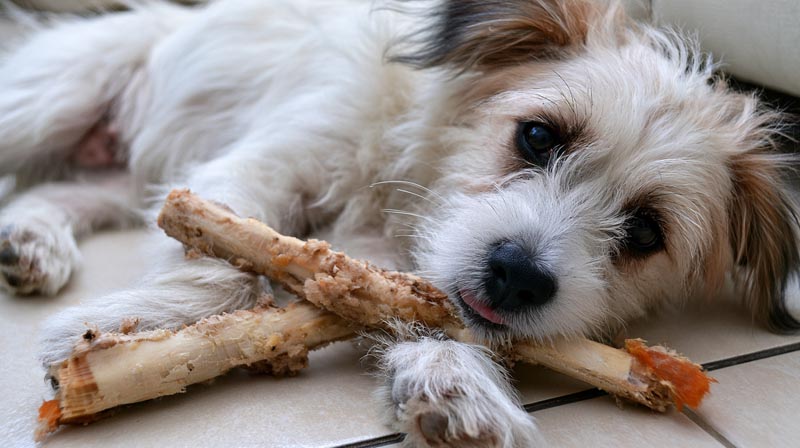
Supervision during a hard chew session is not passive presence in the same room. It means actively watching the dog’s chewing behavior, checking the chew condition, and being ready to intervene. Most hard chew injuries happen when owners leave the room.
The ASPCA’s position statement on dog chews is direct: rapid consumption of any chew product can lead to intestinal obstruction and intestinal perforation requiring immediate life-saving veterinary intervention. Supervision is the primary prevention mechanism.
The 3-Check Method
For a 30-minute session, check at these 3 points:
- Minute 10: Check chew condition for any cracks, splinters, or loose pieces. Check dog’s mouth and gum line for bleeding.
- Minute 20: Re-inspect chew size. Assess whether it has worn down enough to become a swallowing hazard. Watch for gagging, drooling, or pawing at the mouth.
- Session end: Full inspection before storing. Discard if the chew has developed sharp edges, fracture lines, or has worn to fist-size.
Stop-Immediately Signs
End the session the moment you see any of these:
- Gagging or coughing mid-chew
- Excessive drooling beyond normal chewing moisture
- Pawing at the mouth or face
- Sudden change in chewing behavior (head tilting, switching sides aggressively)
- Swallowing a large piece visibly
Between-Session Storage
Natural chews (antlers, raw bones, yak chews) accumulate bacteria between sessions. Raw bones should be refrigerated and discarded after 3 to 4 days. Yak chews can be stored at room temperature but should be inspected for mold if used over multiple days.
Nylon chews can be stored dry between sessions indefinitely, but the chew should be replaced once the surface has developed any significant fragmentation or thin sections that could break off. Dogs like the Labrador Retriever, a breed known for heavy chewing, can reduce a nylon chew to fragmentation territory faster than owners expect. Same goes for power chewers like the American Pit Bull Terrier — checking the chew condition between every single session matters more for these dogs than for lighter chewers.
Tracking session length across days helps you spot cumulative wear patterns. A chew that looked fine on Monday may have developed hairline fractures by Wednesday that aren’t visible until it’s under pressure.
How Often Can Dogs Have Hard Chew Sessions?
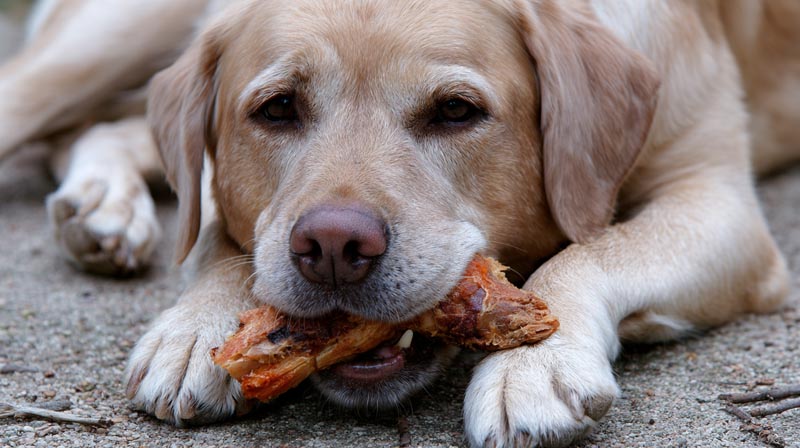
Hard chew frequency should follow a 2 to 3 sessions per week model for most adult dogs, not a daily schedule.
Daily hard chewing accelerates cumulative enamel wear over time, even when individual sessions stay within the 15 to 30 minute window. The teeth don’t fully recover from bite stress overnight, so spacing sessions out gives the jaw and enamel a break between uses.
Dental disease is present in over 80% of dogs by age 3, according to the American Veterinary Dental College. Adding hard chew injuries on top of existing periodontal disease creates compounding problems that are both painful and expensive to treat.
Chewing for Dental Health vs. Behavioral Enrichment
These are two different goals with different frequency rules.
For dental health benefits, VOHC-approved softer dental chews given once daily are more practical and evidence-backed than hard chews. Greenies, Purina DentaLife, and Hill’s Dental Chews all carry the VOHC Seal of Acceptance and reduce plaque and tartar without the fracture risk of antlers or raw bones.
Hard chews serve behavioral enrichment better. They satisfy a dog’s instinct to gnaw, reduce boredom, and provide mental stimulation. For this purpose, 2 to 3 sessions per week on rotation with rubber toys and softer chews gives the enrichment benefit without daily dental stress. Comparing options like Whimzees vs Greenies and reviewing the best natural dental chews for dogs can help owners find the right balance between enrichment and dental safety.
How Age Changes the Frequency
Three distinct age-based rules apply:
- Puppies under 6 months: No hard chews. Baby teeth are not built for hard chew stress. Chew bones for puppies should be soft and specifically sized for developing jaws.
- Adult dogs (1 to 7 years): 2 to 3 hard chew sessions per week, supervised, with session length matched to breed and chew type.
- Senior dogs (7+ years): Reduce to once or twice per week maximum, switch to softer chew types, and shorten sessions to 10 to 15 minutes. Jaw muscles fatigue faster in older dogs, and worn or compromised enamel fractures more easily.
Chew Rotation Schedule
Rotating between hard and soft chews across the week reduces cumulative enamel stress while still providing daily enrichment.
| Day | Chew Type | Purpose |
|---|---|---|
| Monday | Rubber toy (Kong) | Enrichment, no dental stress |
| Wednesday | Hard chew, 20-minute session | Behavioral satisfaction |
| Friday | VOHC dental chew | Plaque/tartar reduction |
| Weekend | Hard chew or rest day | Owner discretion |
This rotation gives the carnassial teeth 2 to 3 recovery days between hard chew sessions, which is roughly what most veterinary dental sources recommend for minimizing cumulative wear.
What Are the Signs a Dog Has Chewed Too Long or Too Hard?
Most dogs hide dental pain well. A dog with a fractured tooth will often keep eating, playing, and chewing, which is exactly what makes post-session observation important.
Tooth fractures in dogs have a prevalence of 20% to 27% in the general population, and many owners have no idea their dog has a fractured tooth until an abscess forms (Veterinary Times, 2024). Early detection changes the treatment options significantly.
Observable Signs After a Hard Chew Session
These 5 signs indicate the session caused injury or overchewing damage:
- Reluctance to eat or preference for soft food after the session
- Pawing at the mouth or face
- Bleeding gums or blood-tinged saliva on the chew
- Chewing noticeably on one side of the mouth only
- Excessive drooling that continues after the session ends
Behavioral Signs That Develop Over Days
Delayed signs are often more reliable indicators of a fracture than immediate post-session behavior, since acute pain tends to subside as nerve inflammation peaks.
Watch for changes like head shaking without an ear problem, increased irritability when the mouth area is touched, jaw chattering at rest, or a tooth with a reddish-brown, purple, or gray discoloration (Merck Veterinary Manual). These are signs of pulp exposure and dying tooth tissue, not just surface bruising.
A dog that suddenly loses interest in hard chews after previously enjoying them is also showing a reliable pain signal. Dogs don’t decide hard chews are boring. They decide they hurt.
When to See a Vet vs. When to Monitor
| Sign Observed | Action |
|---|---|
| Blood on chew, mild gum redness | Monitor for 24 hours, reduce session length |
| Reluctance to eat hard food | Vet visit within 48 hours |
| Pawing at mouth, jaw chattering | Same-day vet evaluation |
| Visible tooth discoloration or fracture line | Same-day vet evaluation |
| Facial swelling | Emergency veterinary care immediately |
Tooth fractures with pulp exposure are diagnosed through dental X-ray under anesthesia, since surface examination alone misses root and sub-gum damage.
Treatment costs run from $500 for extraction to $2,500 for a root canal depending on the tooth and severity. Catching it early, before abscess formation, typically keeps it at the lower end. Dogs like the German Shepherd, whose high bite force and enthusiastic chewing style make them prone to carnassial tooth fractures, benefit especially from regular post-session checks.
What Do Vets Recommend Instead of Hard Chews?
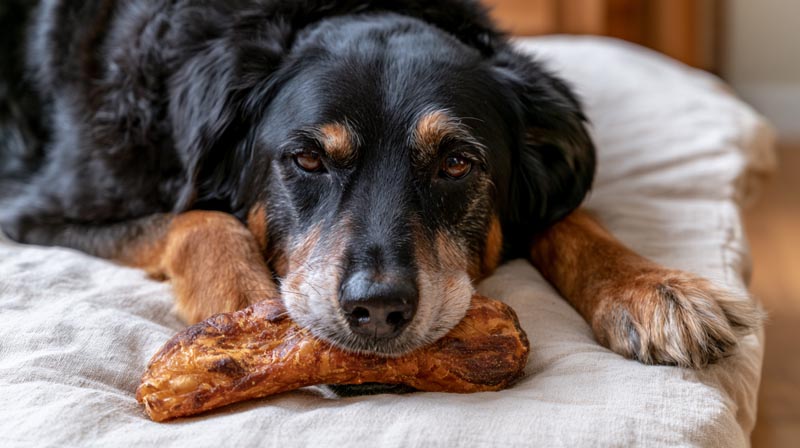
Vets who advise against hard chews are not saying dogs shouldn’t chew. They’re recommending chews that give without fracturing.
The core criterion from the Veterinary Oral Health Council and the American Veterinary Dental College is the same as the thumbnail test: any chew given to a dog should compress or dent under pressure. If it doesn’t, it can fracture the tooth before the chew gives way.
VOHC-Approved Dental Chews
The VOHC Seal of Acceptance is awarded to products that have been tested in controlled trials for plaque and tartar reduction. It is the closest thing to a clinical endorsement a dog chew can receive.
VOHC-accepted options include Canine Greenies (5 sizes), Purina DentaLife Daily Oral Care Dog Treats, Hill’s Prescription Diet Dental Chews, and Virbac C.E.T. Enzymatic Oral Hygiene Chews (VOHC accepted products list, 2025). These are softer than hard chews, fully digestible, and provide mechanical plaque disruption without slab fracture risk. For a detailed comparison, the guide on the best natural dental chews covers which products perform best across breed sizes.
Rubber Chew Toys
Kong Extreme and West Paw Zogoflex are the most widely recommended rubber chew alternatives for dogs that need durable enrichment without dental risk.
Rubber chews flex under bite pressure, which means the jaw absorbs the force rather than the tooth. They don’t wear away the enamel surface the way hard chews do during extended sessions.
The enrichment value is comparable. Stuffing a Kong with frozen food extends the chewing session naturally and gives the dog a goal-directed activity without any fracture risk. Dogs with a strong destructive chewing drive, like the Siberian Husky or the Australian Shepherd, tend to accept Kong-type toys as a hard chew substitute when introduced early.
Natural Low-Risk Chews
A few natural options are both genuinely low-risk and satisfying for most dogs:
- Raw carrots (frozen): Crunchy, digestible, and zero dental fracture risk. The frozen texture extends chew time significantly.
- Collagen chews: Soft to medium hardness, digestible, and lower fracture risk than yak chews or antlers. Collagen chews for dogs have grown in popularity as a middle-ground option between soft dental treats and hard natural chews.
- Beef tendons: Pass the thumbnail test (they compress), are fully digestible, and provide a satisfying chewing experience. Beef tendons are safe for dogs that tolerate single-protein chews.
Dental Diets
For dogs that have already fractured a tooth, or for breeds where hard chew risk is too high to justify (brachycephalic dogs, senior dogs with known dental disease), therapeutic dental diets are the strongest clinical option.
Hill’s Prescription Diet t/d and Royal Canin Dental both carry the VOHC seal for plaque and tartar claims.
The kibble shape and fiber structure mechanically disrupt plaque during normal eating, so the dental benefit comes from every meal rather than a separate chew session. These are veterinary-only products and require a prescription, but for dogs with significant dental risk or post-fracture recovery, they remove the hard chew question entirely.
Chewing should always remain part of a dog’s routine. The goal is not to eliminate it but to match the chew type and session length to what the individual dog’s teeth can actually handle. For most dogs, that means softer options more often, with supervised hard chew sessions kept short and spaced out across the week.
FAQ on How Long Can Dogs Chew On Hard Chews
How long can dogs chew on hard chews per session?
Most adult dogs can safely chew for 15 to 30 minutes per session. Beyond that, jaw fatigue increases and dental fracture risk climbs, especially on the carnassial tooth. Always supervise and end the session if the dog chews aggressively.
Can dogs chew on antlers every day?
No. Daily antler chewing accelerates enamel wear and raises slab fracture risk significantly. Most veterinary dentists advise limiting antler sessions to 2 to 3 times per week at most, with sessions capped at 15 minutes. Many vets recommend avoiding antlers entirely.
What is the safest hard chew for dogs?
Himalayan yak chews are generally the least risky hard chew option. They are medium-hard, soften during chewing, and are fully digestible. Split antlers are safer than whole antlers. Nylon chews are durable but not digestible.
How do I know if a chew is too hard for my dog?
Use the thumbnail test. Press your nail firmly into the chew surface. If it leaves no dent, the chew is too hard for safe use. Antlers, cooked bones, and cow hooves all fail this test and carry a high dental fracture risk.
How long should puppies chew on hard chews?
Puppies under 6 months should not have hard chews at all. Their baby teeth and developing jaw cannot handle the bite stress. After 6 months, short supervised sessions of 10 minutes maximum on softer chew options are appropriate.
Can large breed dogs chew longer than small breeds?
No. Large breeds like Rottweilers and Mastiffs generate bite forces of 328 to 552 PSI, which actually increases fracture risk per minute of chewing. Bigger dogs need shorter sessions, not longer ones, especially on antlers and raw bones.
What happens if a dog chews a hard chew too long?
Extended sessions raise the risk of slab fracture of the carnassial tooth, chunk ingestion, gastrointestinal obstruction, and pulp exposure leading to tooth root abscess. Treatment costs range from $500 for extraction to $2,500 for a root canal.
How often should dogs have hard chew sessions each week?
Veterinary dental sources recommend 2 to 3 hard chew sessions per week for healthy adult dogs, not daily. Rotating between hard chews, rubber toys, and VOHC-approved dental chews reduces cumulative enamel wear and keeps chewing safe long-term.
Should I take a hard chew away from my dog?
Yes, immediately, once it reaches fist size or smaller. A chew small enough to fit fully in the mouth becomes a choking hazard. Also remove any chew that shows visible cracks, sharp edges, or splinter lines, regardless of how much time has passed.
Are hard chews good for dog dental health?
Partially. Hard chews provide mechanical plaque disruption, but the fracture risk often outweighs the dental benefit for high-hardness options like antlers. VOHC-approved dental chews like Greenies deliver the same plaque-reduction benefit with significantly lower dental injury risk.
Conclusion
This conclusion is for an article presenting the real risks behind chew session length, and the core takeaway is straightforward: most dogs should not chew on hard chews for more than 30 minutes per session.
Chew material hardness, breed bite force, and dog age all shift that window. A senior dog and a Mastiff are not working with the same dental tolerance as a healthy adult Labrador.
The thumbnail test remains the fastest field check for any chew you’re considering. If it doesn’t dent, it’s too hard for extended sessions.
Rotate between hard chews, rubber toys, and VOHC-approved dental chews across the week. Your dog gets the enrichment. The carnassial teeth get a break.
When in doubt, shorter sessions, softer chews, and direct supervision prevent most hard chew injuries before they start.