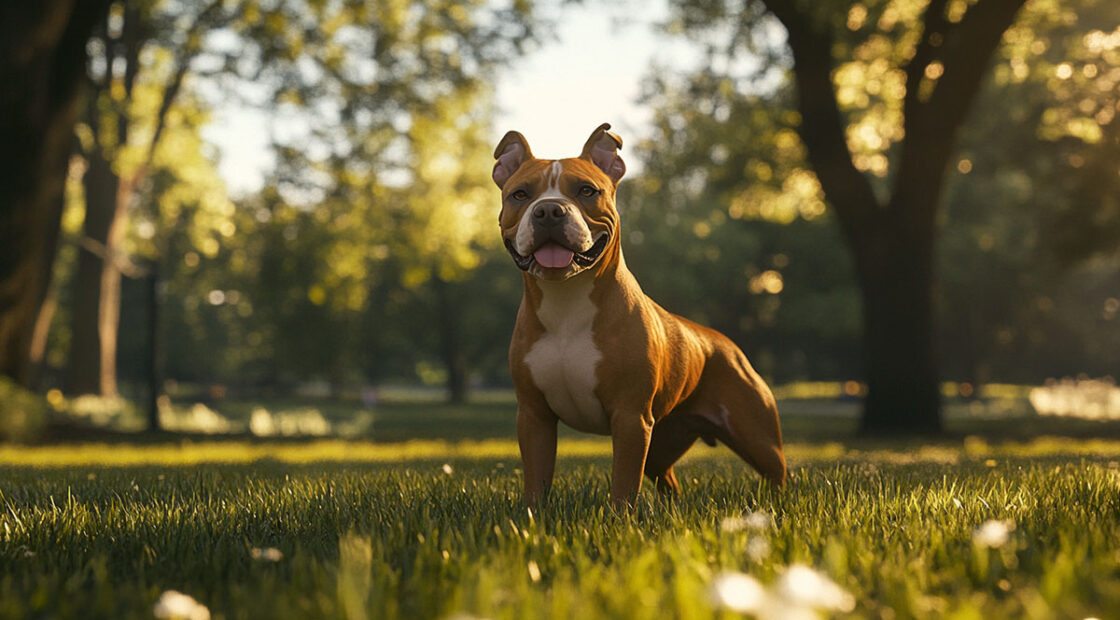
The American Pit Bull Terrier is a medium-sized, short-coated terrier that the United Kennel Club (UKC) and the American Dog Breeders Association register as its own breed. The American Kennel Club doesn’t.
“Pit bull” is a wider label that also takes in the American Staffordshire Terrier and the Staffordshire Bull Terrier, so registry papers define the breed, not appearance.
Dog fanciers in 19th-century England, Ireland and Scotland built it from Bulldog and terrier crosses. American farmers and ranchers later put it to work catching semi-wild cattle and hogs, and the UKC breed standard, revised in 2017, says the breed has held its type for over 150 years.
What Is the American Pit Bull Terrier?
The UKC files the American Pit Bull Terrier (APBT) under the Terrier Group, and it was the first registry to recognize the breed. The American Dog Breeders Association (ADBA) registers it too and keeps its own conformation standard. The American Kennel Club (AKC) has no APBT listing at all, though it does register the American Staffordshire Terrier as a separate breed.
The wider “pit bull” label is looser. Wisdom Health, the company behind Wisdom Panel, states that the term covers a genetically diverse group of breeds with similar physical traits, so no single DNA profile identifies every dog that fits the look.
The APBT is one registered breed inside that wider pit bull type.
Where Did the American Pit Bull Terrier Come From?
According to the UKC breed standard, the breed traces to 19th-century crosses between Bulldogs and Terriers in England, Ireland and Scotland. Fanciers wanted a terrier’s gameness with a Bulldog’s strength and athleticism. The Bulldog in those crosses was the Old English Bulldog, which no longer exists.
Immigrants brought the bull-and-terrier dogs to the United States. Farmers and ranchers used them as catch dogs for semi-wild cattle and hogs, and also for hunting, for driving livestock and as family companions.
Pit fighting belongs in the record too. The ASPCA traces the roots of American dog fighting to England’s 1835 ban on bull-baiting, a chapter the history section of the UKC breed standard leaves out.

That 1835 Cruelty to Animals Act outlawed bull-baiting and the keeping of pits for animal fights. In 1898 the UKC gave registration number 1 to C. Z. Bennett’s dog, Bennett’s Ring, and the ADBA started in September 1909 with breeder John P. Colby’s dogs as its mainstay (ADBA history).
The AKC route split the lineage. In the early 1920s, owners who wanted distance from the fighting scene petitioned the AKC, which accepted the breed in 1936 as the Staffordshire Terrier (Showsight Magazine).
That show-ring branch is today’s American Staffordshire Terrier, renamed in 1972 to separate it from the Staffordshire Bull Terrier.
How Big Is the American Pit Bull Terrier, and What Does the Breed Standard Require?
The UKC standard, revised May 1, 2017, gives each sex its own size range and ranks balance above the numbers. Males run 35 to 60 pounds and 18 to 21 inches at the withers. Females run 30 to 50 pounds and 17 to 20 inches. The coat is glossy, smooth, close and moderately stiff, and any color or pattern is fine except merle.
The height figures are a rough guide. Dogs above or below the ranges aren’t penalized unless they look disproportionately massive or rangy.
Profile pages that list one band of 17 to 21 inches and 30 to 60 pounds (Hepper, 2025) merge both sexes. That hides the fact that a 55-pound female sits above her desirable range.
From the front, the head is a broad, blunt wedge, with skull and muzzle parallel in profile. An overly large, heavy head counts as a very serious fault. Any eye color is acceptable except blue, which is a serious fault, and the teeth meet in a scissors bite.
Disqualifying faults are merle, long coat, albinism, deafness, dwarfism, screw tail, cryptorchidism, and viciousness or extreme shyness.
The UKC also cautions judges against rewarding exaggerated specimens. A bulky, muscle-bound look draws the same warning as a fine-boned, rangy one.
How Do You Tell an American Pit Bull Terrier From Similar Breeds?
Registry papers and written standards separate these breeds more reliably than a photo does.
| Breed | Main registry | Male height | Marker |
|---|---|---|---|
| American Pit Bull Terrier | UKC, ADBA | 18 to 21 in | Not recognized by AKC |
| American Staffordshire Terrier | AKC | About 18 to 19 in (preferred) | Standard approved 1936 |
| Staffordshire Bull Terrier | AKC | 14 to 16 in | Dogs 28 to 38 lb |
| American Bully | UKC | 17 to 20 in (Standard) | Heavier build, three sizes |
The American Staffordshire Terrier is the hardest one to tell apart from the APBT. The height ranges overlap, and Whole Dog Journal reports that the UKC registers AmStaffs as American Pit Bull Terriers, so a single dog can hold both names.
The Staffordshire Bull Terrier is easy by comparison. The AKC standard, effective September 30, 2025, sets dogs at 14 to 16 inches and 28 to 38 pounds. That weight only touches the bottom of the APBT male range of 35 to 60 pounds, and the height sits well below the APBT’s 18 to 21 inches.
The American Bully is the newest. The UKC recognized it on July 15, 2013 and calls it a natural extension of the APBT. It comes in Pocket, Standard/Classic and XL sizes.
Build is the quickest visual tell, since the Bully carries the bulk that the APBT standard warns against.
Do DNA Tests Confirm an American Pit Bull Terrier?
Not reliably. In a Whole Dog Journal comparison, one dog got two different answers on its top breed. Embark reported 42.0% American Pit Bull Terrier and 29.1% American Staffordshire Terrier, while Wisdom Panel reported 36% American Staffordshire Terrier and 29% American Pit Bull Terrier.
Wisdom Panel explains the flip. The two breeds are so closely related that each keeps a considerable share of the other’s DNA, and the company says its tests aren’t built to validate whether a dog is purebred.
What a test can do is show which breeds contribute to a mixed dog’s ancestry, with percentages. What it can’t do is tell you whether a dog is a registered APBT or an AmStaff, or whether it “is a pit bull,” since that label covers several breeds.
Shelter labels are weaker still. A 2018 PLOS ONE study of 919 dogs at two US shelters (Gunter et al.) found that only 4.9% were genetically single-breed.
What Is the American Pit Bull Terrier’s Temperament Like?
The UKC describes the breed as showing “strength, confidence, and zest for life,” and calls it eager to please and fond of children. It also rates the APBT a poor guard dog, because the breed is friendly even with strangers.
Behavior Around People and Children
The American Temperament Test Society (ATTS) reports an 87.6% pass rate for the APBT, with 841 of 960 tested dogs passing as of January 2023. Here is how it sits against the neighbors.
- Staffordshire Bull Terrier: 91.9% (160 tested)
- American Pit Bull Terrier: 87.6% (960 tested)
- American Staffordshire Terrier: 85.7% (770 tested)
- All breeds combined: 84.0% (36,333 tested)
The test covers reactions to strangers, sudden noise, unusual footing and a threatening stranger. A dog fails on unprovoked aggression, panic without recovery or strong avoidance.
Owners choose to enter their dogs, so the figures describe tested dogs and not the whole breed.
On bite risk, the AVMA’s literature review finds that most serious injuries in the US involve a young child and an un-neutered dog the family or a neighbor owns. The AVMA also calls it inappropriate to predict a dog’s aggression from breed alone.
Breed labels in bite reports shift over time. A systematic review of US peer-reviewed literature from 1958 to 2016 found that German Shepherds accounted for 68.4% of attributed bites before 1980.
Behavior Around Other Dogs and Small Animals
Dog aggression is the documented weak point.
The UKC says most APBTs show some level of it, which is why the breed needs careful socialization and obedience training. UKC event handlers also have to follow the registry’s dog temperament policy.
The ATTS pass rate says nothing on this, because there are no other dogs in the test. The two sources describe different things.
The breed’s documented jobs, catching semi-wild hogs and cattle and hunting, involved chasing and gripping other animals. Cats, rabbits and small dogs need to be kept separate until a dog has a proven record around them.
How Should You Train and Exercise an American Pit Bull Terrier?

Socialize early, train with rewards only, and give the dog a daily job. The UKC standard sets no minimum exercise time, so structure matters more than a stopwatch.
- Socialize inside the first three months, which the American Veterinary Society of Animal Behavior (AVSAB) calls the primary window. Puppy classes can begin at 7 to 8 weeks, once the puppy has had one set of vaccines at least 7 days before the first class.
- Use rewards. AVSAB’s 2021 statement on humane dog training backs reward-based methods only and finds no evidence that aversive training is necessary.
- Keep the exposure going into adulthood. AVSAB says varied experiences should continue past puppyhood to keep a dog outgoing and sociable.
- Test it with the AKC Canine Good Citizen evaluation, a 10-skill test open to any dog, purebred or mixed, at any age.
- Add a sport. The UKC lists obedience, rally, tracking, agility, lure coursing, dock jumping and weight pulls among the events the breed does well in.
The ADBA runs its own Top Dog athletic events for the breed, which gives the dog an outlet beyond walks.
Punishment is where most owners go wrong. AVSAB’s 2007 statement warns that it can cause aggression and can suppress the signals a dog gives before it escalates.
Waiting for full vaccination is another mistake. AVSAB rates the infection risk of early classes as small next to the risk of a behavior problem. Dog parks are a different story, because you can’t know the vaccination status of the other dogs there.
And check the fence. The UKC calls the breed one of the most capable canine climbers and says good fencing is a must.
How Long Does an American Pit Bull Terrier Live, and Which Health Problems Affect It?

No longevity survey of the APBT itself sets a lifespan figure. Breed guides disagree by several years at both ends of the range, and Hepper’s profile lists no longevity study among its sources.
The closest peer-reviewed benchmark comes from the related Staffordshire Bull Terrier. A 2022 Scientific Reports study built on VetCompass records put its life expectancy at birth at 11.33 years. VetCompass uses life tables, which BBC coverage of the study describes as a more nuanced measure than a plain average age at death.
Hip dysplasia is the orthopedic one to screen for. The Orthopedic Foundation for Animals (OFA) certifies hips from 24 months, on the consensus of three board-certified radiologists. It’s a complex, multi-factor disorder (Hou et al., PLOS ONE, 2013), so a DNA swab doesn’t replace the radiograph.
Eyes are the other concern. A 2016 Veterinary Ophthalmology study described an inherited, autosomal dominant retinal dysplasia in American pit bull terriers, with lesions from retinal folds to detachment and affected dogs shorter in stature. No causal variant has been identified, so it has to be caught on an eye exam.
Paw Print Genetics lists DNA tests for cone-rod dystrophy and cerebellar ataxia in its APBT breed panel, and those two are the only conditions here with a DNA test. Skin allergies get treated as the common minor complaint in breed guides such as Hepper’s, though no prevalence study stands behind that.
Is the American Pit Bull Terrier Banned?
Yes in England and Wales and in Ontario, and in some US cities and counties. The United States has no federal ban, and many states stop local governments from passing one.
| Place | Rule | Owner position |
|---|---|---|
| England and Wales | Dangerous Dogs Act 1991 prohibits the pit bull terrier type | Court-ordered exemption only |
| Ontario | Dog Owners’ Liability Act ban since August 29, 2005 | Dogs owned before that date (or born in Ontario within 90 days of it) are grandfathered |
| United States | Local ordinances, no federal ban | Varies by city, county and state |
Section 1(1)(a) of the Dangerous Dogs Act 1991 prohibits the pit bull terrier, and the law covers a type rather than a registered breed. Under Crown Prosecution Service guidance, a court decides type as a question of fact and may use the American Dog Breeders’ Association standard for pit bull terrier.
Exemption is possible. A court can place the dog on DEFRA’s Index of Exempted Dogs when it poses no danger and the owner is a fit and proper person. Indexed dogs must be neutered and microchipped, and the owner needs third-party insurance. The old tattoo requirement was dropped in 2015.
The Act also covers the Japanese Tosa and the Fila Brasileiro, and the Dogo Argentino is on the list too. XL Bully type dogs were added in 2023. Breeding or selling them became an offence on December 31, 2023, and so did rehoming one, while owning one without a certificate of exemption has been an offence since February 1, 2024.
Ontario’s Dog Owners’ Liability Act has banned pit bulls since August 29, 2005. The definition names the pit bull terrier, Staffordshire bull terrier, American Staffordshire terrier and American pit bull terrier, plus any dog with a substantially similar appearance and physical characteristics. The owner carries the burden of proving a dog is not one.
Dogs owned in Ontario before the ban date, or born there within 90 days of it, are grandfathered as restricted pit bulls, which must be sterilized and kept muzzled and leashed in public. The Ontario Court of Appeal upheld the ban on October 24, 2008 (2008 ONCA 718).
The Animal Legal and Historical Center at Michigan State University counts about 22 US states with some form of preemption law: 10 covering all animal regulation and 16 covering dangerous-dog laws, with Delaware, Illinois and Virginia in both groups. Other counts differ slightly, so check your state’s current statute.
Whether bans reduce bites is disputed. The AVMA’s literature review says it has not been demonstrated that a breed-specific ban lowers the rate or severity of bite injuries, and its policy opposes breed-specific legislation. The 1958 to 2016 systematic review of US bite literature points the other way, suggesting such laws may cut bites attributed to regulated breeds, with Denver, the largest US jurisdiction with a pit bull ban, as its test case.
The gap is partly one of measurement. The review counts bites attributed to a breed, while the AVMA notes that breed-specific laws often target a dog’s look rather than its actual breed.
Insurers set the other restriction. Triple-I counted 28,450 dog bite and related injury claims against homeowners policies in 2025, up 25.6% from 22,658 in 2024, at a cost of $1.862 billion. Triple-I also notes that some insurers neither ask a dog’s breed nor track it in bite claims, so breed exclusions are set insurer by insurer.
At least eight states (Arizona, Colorado, Illinois, Michigan, Minnesota, Nevada, New York and Pennsylvania) bar insurers from acting on breed alone, according to Best Friends Animal Society, usually with an exception for dogs designated dangerous. The National Council of Insurance Legislators adopted a model act in 2022 that restricts breed as an underwriting factor.
Breed restrictions can sit in an attached list rather than the policy text, so read the whole contract.
When Is the American Pit Bull Terrier the Wrong Fit?
When the lease, the insurance policy or the weekly schedule can’t support the breed, whatever the individual dog is like.
Renters get hit first. Pit bull types were the most commonly restricted breed in PetScreening’s 2024 survey of 1,715 rental property professionals, and among operators with breed restrictions who don’t use PetScreening, 94% list pit bulls. PetScreening’s own write-up of the survey in Multifamily Executive notes that it found no direct link between restricted breeds and damage or on-site incidents, and ties the restrictions to perception.
A policy with a breed exclusion leaves a bite claim with the owner, so the wording gets checked before the puppy is chosen.
Skipping structured training is the third way this goes wrong. AVSAB names behavior problems as the leading cause of relinquishment to shelters, and classes and socialization are its remedy.
A lookalike with different papers doesn’t escape the problem. The UK Act and Ontario’s law both judge physical characteristics rather than pedigree.
Get the landlord’s and the insurer’s breed policies in writing, naming the APBT, before choosing a puppy.
How Do You Find a Real American Pit Bull Terrier?
A real APBT comes with UKC or ADBA registration papers, and a shelter dog labeled “pit bull” is a guess until the dog proves otherwise. Judge the individual, not the label.
Buying From a Breeder
Registered parents are the proof of breed, so start there.
A breeder worth buying from should hand over UKC or ADBA registration and a pedigree for both parents. They should also have evidence of the parents’ behavior, such as an ATTS certificate or UKC performance titles, plus hip and eye results and DNA panel results.
- Ask how the puppies are handled before going home, since AVSAB says handling should start at birth.
- Read the papers closely. The UKC registers the American Bully as its own breed, so a Bully pedigree doesn’t describe an APBT.
Adopting From a Shelter or Rescue
In a study of 120 dogs at four Florida shelters (Olson et al., The Veterinary Journal, 2015), DNA failed to confirm pit bull-type breeds in more than half of the dogs staff had labeled pit bulls. Staff also missed 1 in 5 dogs that did carry pit bull-type DNA, so the label errs in both directions.
Some shelters have dropped it. Fairfax County Animal Shelter in Virginia stopped using breed labels in 2015 and lists its dogs as mixed breed, according to a City of Austin commission recommendation.
Rescue after fighting cases follows the same logic. Best Friends Animal Society took in 22 dogs from Michael Vick’s Bad Newz Kennels in 2008 and reports that most became family pets, with some working as therapy or service dogs. Best Friends says the case persuaded the Humane Society of the United States to evaluate fighting-case dogs one at a time.
Without UKC or ADBA papers, treat the breed label as noise. Ask for the shelter’s behavior notes and meet the dog more than once, with any resident dog along for at least one visit.
American Pit Bull Terrier FAQ
Does an American Pit Bull Terrier have a locking jaw?
No. University of Georgia researcher Lehr Brisbin reports that studies of the breed’s skull, mandibles and teeth show a jaw structure no different from any other dog’s, with no evidence of a locking mechanism.
The stubborn grip people describe is behavior, not anatomy.
Is an American Pit Bull Terrier hypoallergenic?
Not at all. The AKC states that no dog breed is truly hypoallergenic, and a short coat doesn’t change that.
A 2011 American Journal of Rhinology and Allergy study found no difference in the main dog allergen, Can f 1, between homes with dogs labeled hypoallergenic and homes with other dogs.
How much grooming does an American Pit Bull Terrier need?
Very little. The UKC describes a short-coated dog, and Tasmanian government breed guidelines list a high-gloss single coat with no undercoat.
A regular brush and a bath when the dog is dirty cover most needs.
What does a red nose mean on an American Pit Bull Terrier?
A red nose is a pigment variation, not a separate breed, and the UKC standard allows any nose color.
Tasmanian government guidelines list a red nose with red eye pigment among the traits that set this breed apart from the American Staffordshire Terrier and Staffordshire Bull Terrier, though color alone doesn’t prove a pedigree.
Why did the San Francisco SPCA rename pit bulls “St. Francis Terriers” in 1996?
To make the dogs more adoptable.
ANIMAL PEOPLE reported in 2004 that about 60 renamed dogs were placed before the SF/SPCA, then led by Richard Avanzino, suspended the program after several of them killed cats.
What Owning an American Pit Bull Terrier Requires
An American Pit Bull Terrier requires a lawful, insurable home before the puppy arrives, socialization inside the first three months, and reward-based training for life. Only the socialization step carries a deadline, which is why the order matters.
Confirm legality, lease and insurance in writing. Then verify the papers or assess the individual dog, and enroll in puppy classes at 7 to 8 weeks.
The home check comes first because a failed lease or policy later means rehoming. Classes open at 7 to 8 weeks and the primary socialization window closes near 12 weeks, which leaves about 4 to 5 weeks of class time.
The paperwork check can cost the owner a specific litter or a particular shelter dog. That’s the price of doing it in this order.