Not every dog chew deserves the hype. Most dissolve in minutes, carry questionable ingredients, or end up a choking hazard before the session is over.
Thick bully sticks for dogs are different. Made from single-ingredient dried bull pizzle, they deliver real chew time, high crude protein, and full digestibility without the risks that come with rawhide.
But thickness, sourcing, and size all matter more than most labels admit.
This guide covers what thick bully sticks actually are, how to size them correctly, what the safety research shows, and how they compare to antlers, Himalayan yak chews, and pig ears so you can make the right call for your dog.
What Are Thick Bully Sticks for Dogs?
Thick bully sticks are single-ingredient dog chews made from bull pizzle, the dried muscle tissue of a bull or steer’s penis. They are fully digestible, naturally high in protein, and contain no artificial additives, fillers, or chemical preservatives.
The word “thick” refers to diameter. A standard bully stick measures roughly 0.5 inches (1.3 cm) across. A thick bully stick starts at 0.75 inches and goes up to 1.25 inches or more. At that width, the chew resists jaw pressure long enough to give medium and large dogs a real workout.
Honestly, when I first started buying bully sticks, I had no idea there were that many size tiers. I grabbed whatever was on the shelf. My dog demolished it in under 10 minutes. That was the moment I realized diameter actually matters.
How Thick Bully Sticks Are Made
The bull pizzle is cleaned, stretched, and then dried. Two main processing methods exist:
- Slow air-drying or dehydration: Low-temperature process that preserves collagen structure and nutrient density, producing a denser, harder chew
- Oven-baking: Faster method, often used for odor-free variants, involving extended drying cycles at controlled temperatures
Processing time directly affects density. Sticks slow-dried for 20+ hours are harder and last longer than rush-processed alternatives. The moisture content of a properly dried thick bully stick sits around 8-12%.

Thick vs. Standard vs. Jumbo: Size Differences Explained
Diameter is not just a comfort preference. It is a safety factor. A stick too thin for a large dog can be swallowed whole or bitten off in large chunks.
| Type | Diameter | Best For | Average Chew Time |
|---|---|---|---|
| Standard | 0.5 inch | Small to medium dogs and light chewers | 15-30 minutes |
| Thick | 0.75-1.25 inches | Medium to large dogs and moderate chewers | 45-90 minutes |
| Jumbo / Monster | 1.5+ inches | Large breeds and power chewers | 90-180 minutes |
Braided bully sticks are a separate category. Three pizzle strands are woven together, which creates 40% more chew material than a single straight stick of equivalent length (Devil Dog Pet Co.).
Beyond straight and braided, thick bully sticks also come in curled and ring shapes. The irregular form of a curled stick prevents dogs from grinding in one continuous spot, which can actually extend chew time compared to a straight version of the same thickness.
What Nutrients Do Thick Bully Sticks Contain?
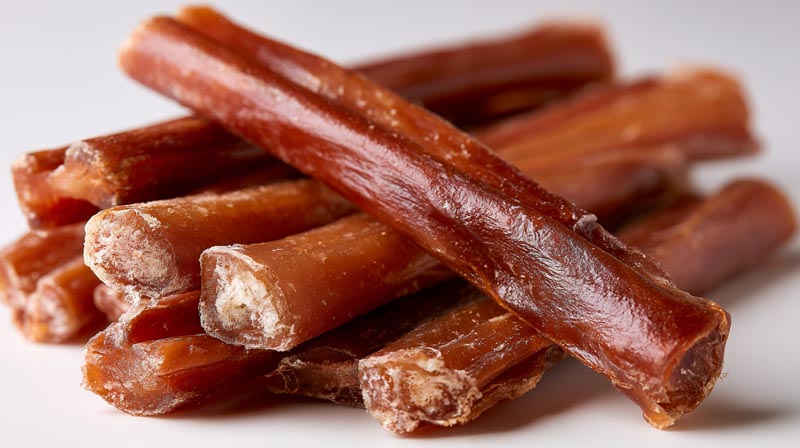
Thick bully sticks are almost entirely protein. Because they are pure dried bovine muscle tissue, dehydration concentrates the nutrient profile significantly during processing.
A 2022 Merieux NutriSciences lab analysis commissioned by Bully Bundles found that a standard 6-inch bully stick (25.5 grams) averages 16.4 grams of protein, 1.1 grams of fat, and 87 total calories. Crude protein on a dry matter basis consistently falls in the 80-90% range across multiple brands.
Protein and Amino Acid Profile
Crude protein: 80-90% on a dry weight basis (Bully Sticks Direct, 2026).
That protein comes from bovine muscle collagen, which is rich in glycine and taurine. Both amino acids support connective tissue repair and, in the case of taurine, cardiac function. The caloric density breaks down cleanly:
- Protein: primary calorie source (4 cal/gram)
- Fat: 2-5% of total composition
- Carbohydrates: zero
- Moisture: 6-8% in properly dried sticks
No grains, no starches, no artificial preservatives. For dogs on a limited-ingredient or grain-free diet, thick bully sticks fit without complication.
Caloric Density by Stick Size
The thicker the stick, the more calories per inch. That is just math. Tufts University research (Canadian Veterinary Journal, 2013) found a range of 9-22 calories per inch across 26 bully sticks, with the average 6-inch stick carrying 88 calories.
A thick 6-inch stick sits toward the upper end of that range. For a 50-pound dog, one stick represents roughly 9% of daily caloric needs. For a 10-pound dog, it can reach 30%.
The WSAVA and AAHA both recommend that treats stay within 10% of a dog’s daily caloric intake. On days your dog gets a thick bully stick, reduce kibble by the equivalent calorie amount. This is the part most people skip, and then wonder why their dog gained weight on “healthy” treats.
What Size Dog Is a Thick Bully Stick Right For?
Thick bully sticks are best matched to dogs 30 pounds and above. Below that weight, the diameter can exceed what a small dog’s jaw comfortably handles, leading to frustration or poor chewing mechanics.
That said, weight is not the only variable. A 35-pound terrier with strong jaw muscles may need a thick stick for safety, while a 40-pound gentle chewer does fine on standard. Chew intensity matters as much as body weight.
Thick Bully Sticks for Large and Giant Breeds
Testing across more than 50 power chewers found that 12-inch monster braided bully sticks delivered 45-90 minutes of chew time for aggressive chewers, while standard straight versions lasted only 10-15 minutes (Bully Sticks Direct).
Breed-specific recommendations from veterinary sizing guides:
- Labs, Golden Retrievers, German Shepherds (50-80 lbs): 12-inch thick or braided sticks, 90-180 min engagement
- Rottweilers, Dobermans, Boxers: Jumbo grade regardless of lower weight-range placement, high bite force
- Mastiffs, Great Danes (80+ lbs): Jumbo or braided, 2-4 hours of chewing capacity
If you have a Bullmastiff or similar giant working breed, the standard sizing guidance rarely holds. These dogs need sticks at least 12 inches long with a minimum 1-inch diameter. Anything smaller is a choking hazard, not a chew.
Similarly, breeds like the Cane Corso or Boerboel have bite forces that demolish thin sticks in minutes. For these dogs, thick or jumbo is the starting point, not the upgrade.
Thick Bully Sticks for Puppies: Age and Weight Thresholds
Puppies can safely start with bully sticks around 12-16 weeks, when adult teeth begin emerging. But thick options are not appropriate for puppies under 6 months.
Developing jaw muscles and softer tooth enamel during early growth make the resistance of a thick bully stick a mismatch. Start with a thin or standard 4-inch stick and limit sessions to 10-15 minutes. Scale up to thick once the dog has full adult dentition and is above 6 months old.
If you are working through Bullmastiff puppy training, bully sticks can serve as a focused chew distraction during crate settling. Just keep the puppy on a size-appropriate stick until the jaw is fully developed.
Are Thick Bully Sticks Safe for Dogs?
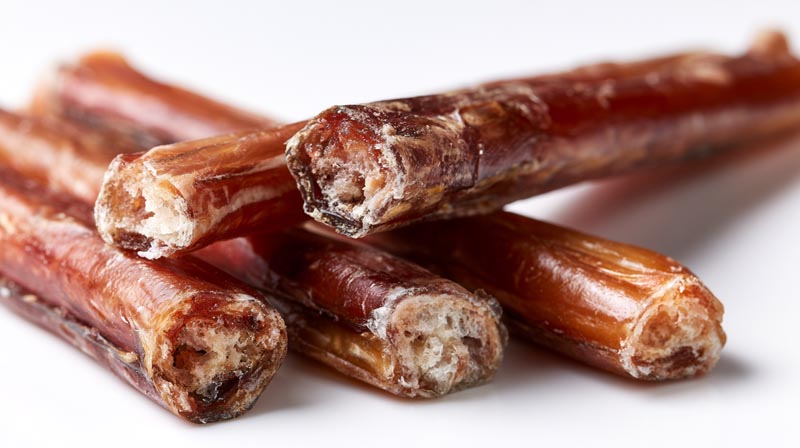
Thick bully sticks are considered among the safest natural dog chews available when properly sized and supervised. They are fully digestible, do not splinter, and break down in stomach acid without causing the kind of intestinal blockages associated with rawhide.
That does not mean zero risk. 3 core safety concerns apply to every bully stick regardless of thickness.
Choking and Gulping Risk Management
Remove the stick when it reaches 2-3 inches. At that length, most dogs can fit the entire nub in their mouths and attempt to swallow it whole.
A bully stick holder addresses this directly. It grips the end of the stick so the dog cannot access the last 2 inches without human intervention. For large breeds and power chewers, this is worth the $10-15 it costs.
For large dogs like American Pit Bull Terriers or American Staffordshire Terriers with strong jaw mechanics, thick sticks slow down the chewing pace compared to thin sticks. That extra diameter is what buys you time to monitor the session before the nub stage arrives.
Bacterial Contamination: What the Research Shows
A 2013 study published in the Canadian Veterinary Journal (Freeman et al., Tufts University and University of Guelph) analyzed 26 bully sticks from multiple manufacturers. Among those tested for bacterial contamination, 1 stick (4%) tested positive for Clostridium difficile, 1 for MRSA, and 1 for tetracycline-resistant E. coli.
That 4% contamination rate is low, but not zero. Contamination risk correlates with processing quality, not the bully stick itself as a product category.
Practical steps to reduce bacterial exposure:
- Buy from USDA-inspected or FDA-approved facilities
- Wash hands after handling
- Do not let immunocompromised people handle bully sticks
- Store partially chewed sticks in the refrigerator, not on the floor
You can also check out the broader research on whether bully sticks are safe for dogs for a full breakdown of the clinical evidence.
How Are Thick Bully Sticks Sourced and Processed?
Country of origin and processing facility standards are the two biggest variables affecting thick bully stick quality. The product is simple. What varies is everything that happens before it reaches your dog.
USDA-Inspected vs. Non-Inspected: What It Means for Quality
The 3 primary sourcing regions are the USA, Brazil, and Argentina. Processing standards differ significantly between them.
| Source Region | Typical Standard | Notes |
|---|---|---|
| United States | USDA-inspected facilities | Highest processing oversight; typically the highest cost (approximately $3-$8 per 6-inch stick) |
| Brazil | Variable; grass-fed cattle are common | Free-range sourcing is prevalent, but processing standards vary by brand |
| Argentina | Variable | Strong grass-fed supply chain; processing standards depend on the manufacturer |
A “USDA-inspected” label means the facility was inspected, not that every individual stick was tested. It signals minimum processing hygiene, not a quality guarantee. Worth having. Not a substitute for checking the brand’s sourcing transparency.
Significantly lower prices, say under $1.50 per 6-inch stick, often signal offshore sourcing with reduced processing oversight. That does not always mean lower quality, but it means you cannot assume.
Odor-Free Thick Bully Sticks: How They Are Processed
Natural bully sticks have a distinct smell. Most people describe it as strong. A few find it unbearable indoors.
Odor-free versions undergo extended washing cycles and longer drying times to reduce the natural beef scent. The odor-free process does not change the caloric content or protein profile. The nutritional value stays the same.
What can change is density. Some odor-free processing methods produce a slightly harder stick because of the extended drying time. For power chewers, this can mean a longer session. For puppies or senior dogs, a harder texture may be less appropriate.
Grass-fed and free-range claims on the label reflect cattle sourcing, not processing. Free-range cattle develop denser pizzle muscle structure than grain-fed alternatives, which does translate to a harder, longer-lasting chew. Hormone-free and antibiotic-free certifications relate to cattle husbandry standards, not the chew product itself.
How Long Do Thick Bully Sticks Last Compared to Thinner Options?
Thick bully sticks last 3-5 times longer than standard versions for the same dog. That is not marketing. It is a function of the additional material the dog has to work through.
Testing from Bully Sticks Direct confirmed that 12-inch monster braided bully sticks delivered 45-90 minutes for aggressive chewers, while standard straight versions lasted 10-15 minutes for the same dogs.
Chew Duration by Dog Size and Intensity
Power chewer (Lab, Pit Bull, German Shepherd at 60+ lbs): A standard stick disappears in 10-20 minutes. A thick 6-inch stick lasts 30-45 minutes. A thick 12-inch stick extends to 60-90 minutes.
Moderate chewers get considerably more time from the same stick. A 40-pound moderate chewer can spend 45-90 minutes on a thick 6-inch stick across one or two sessions (Bully Sticks Direct, 2026).
The shape also affects duration. Curled and ring-shaped thick bully sticks outlast straight sticks of the same diameter because the irregular form changes the chewing angle constantly. Dogs cannot settle into one grinding rhythm.
Cost-Per-Minute Comparison
Thick sticks cost more upfront. They are worth it on a per-minute basis.
- Standard 6-inch stick at $2.00, lasts 15 min: $0.13 per minute
- Thick 6-inch stick at $4.50, lasts 60 min: $0.075 per minute
- Braided jumbo at $7.00, lasts 90 min: $0.078 per minute
For dogs that chew aggressively, thin sticks are genuinely a waste of money. The economics flip quickly once you factor in how many standard sticks you burn through per week.
What Are the Dental Benefits of Thick Bully Sticks?
Thick bully sticks clean teeth through mechanical abrasion. As a dog chews, the fibrous beef texture scrapes against the tooth surface, dislodging soft plaque before it hardens into tartar.
A Rutgers University study found bully sticks reduced oral bacteria by 60.92% in canine plaque samples. A separate Rutgers analysis found bacteria reductions of 60.2% specifically from bully stick chewing, compared to 79% for raw bones and 70.3% for brushing.
How the Chewing Mechanism Affects Plaque
The fibrous structure of dried bull pizzle frays into microscopic fibers as the dog chews. Those fibers act like dental floss between teeth, removing soft plaque before mineralization. Extended chewing also increases saliva production, which neutralizes the oral bacteria that drive periodontal disease.
Periodontal disease affects approximately 80% of dogs over age three (Bully Sticks Direct, citing veterinary dental data). Regular chewing on thick bully sticks, which require more sustained jaw contact than thin versions, increases the total contact time between the stick and the tooth surface.
Thick sticks have a practical advantage here. Because the chew session runs longer, the mechanical cleaning period runs longer too. A dog that finishes a thin stick in 12 minutes gets far less abrasive contact than one working through a thick stick for 60 minutes.
VOHC Certification and What It Means
The Veterinary Oral Health Council does not currently certify bully sticks. VOHC certification requires controlled clinical trials showing a measurable reduction in plaque or tartar to a specific percentage threshold.
This does not mean bully sticks have no dental benefit. It means the category has not been put through the formal trial process that VOHC requires. The Rutgers data supports real plaque reduction. Just understand that bully sticks complement dental care, they do not replace brushing, dental diets, or professional cleanings.
For more on how bully sticks specifically support oral health, the dedicated resource on whether bully sticks are good for dogs teeth covers the clinical comparison in detail.
For dogs that already have good natural dental chew routines in place, thick bully sticks slot in well as a 2-3 times per week complement to brushing. They are not a standalone dental solution, but they are a meaningful part of one.
Can Thick Bully Sticks Cause Digestive Problems in Dogs?
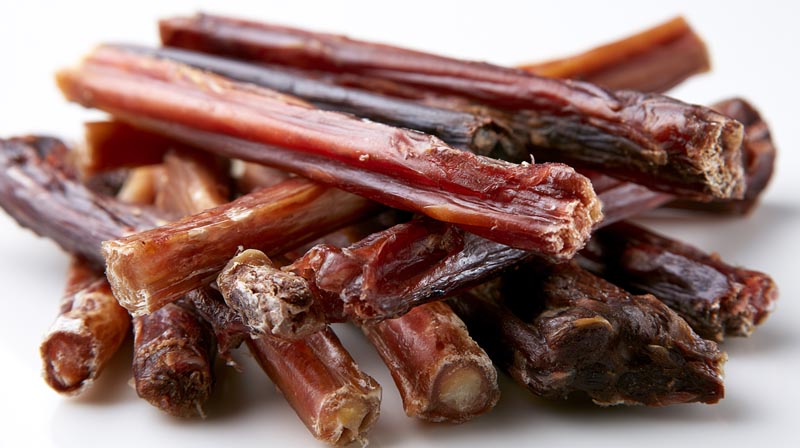
Thick bully sticks are fully digestible. Clinical digestibility studies report naturally dried single-ingredient beef muscle tissue at 95-99% digestibility, compared to approximately 85-90% for rawhide (Bully Sticks Direct, 2026).
That does not mean they are consequence-free in every dog. 3 GI concerns apply specifically to high-frequency use.
Protein Sensitivity and GI Adjustment
First-session loose stool is common. A dog not accustomed to dense, high-protein beef chews can experience digestive upset simply from the richness of the material, not from anything harmful in the product.
The fix is straightforward: limit early sessions to 10-15 minutes, 2-3 times per week for the first 2 weeks. Once the GI tract adjusts, frequency can increase.
Dogs with a confirmed beef protein allergy should not receive bull pizzle chews. Signs of beef sensitivity include:
- Itchy skin or paw licking after consumption
- Loose stool or vomiting that resolves only when beef is removed
- Recurrent ear infections alongside GI symptoms
Weight Gain from Daily Use
The Association for Pet Obesity Prevention’s 2022 survey found 59% of dogs in the US are overweight or obese. Daily thick bully sticks without meal adjustments contribute directly to that number.
A thick 6-inch stick carries 88-130 calories. For a 20-pound dog needing 400-500 calories per day, that one stick consumes 20-30% of the daily budget.
WSAVA and AAHA guidelines cap all treats at 10% of daily caloric intake. On thick bully stick days, reduce kibble proportionally. Dogs with pancreatitis or active weight management needs should have lower-fat alternatives like collagen chews or turkey tendons.
Frequency Guidelines
2-3 times per week is the standard recommendation for most adult dogs on thick bully sticks.
Daily use is manageable only for large, active dogs (70+ lbs) where the caloric contribution stays within the 10% guideline. For smaller dogs, daily use is almost always too much. Watch for greasy stool or loose stool as the first indicators to reduce frequency.
How Do Thick Bully Sticks Compare to Rawhide?

This comparison is not close. Rawhide and thick bully sticks are fundamentally different products in how they are made, how they digest, and what safety risks they carry.
Approximately 40-50% of veterinary foreign body obstruction cases involving chews trace back to rawhide ingestion, with surgical interventions costing between $3,000-$7,000 (Bully Sticks Direct, 2026).
Digestibility and Blockage Risk
Key difference: Bully sticks break down in 2-4 hours in stomach acid. Rawhide can sit undigested for 24-72 hours and may never fully break down.
Today’s Veterinary Practice journal confirms that rawhide digestibility in the stomach is poor, and obstruction risk is directly higher with less digestible chews. Bully stick pieces that are swallowed process like meat protein. Rawhide pieces can swell up to 3-4 times their dry size and form dangerous masses.
Surveys indicate approximately 95% of veterinarians recommend highly digestible, single-ingredient chews over chemically treated products when dog owners ask about safe options (Bully Sticks Direct, 2026).
Manufacturing and Chemical Processing
Rawhide is the inner layer of bovine hide. It is processed with chemical agents including lye and hydrogen peroxide to clean and preserve it. In 2018, a major rawhide manufacturer issued a voluntary recall after a quaternary ammonium compound was identified in production.
Bully sticks made from bull pizzle are cleaned with water and dried. No chemical treatment is required because the muscle tissue itself is shelf-stable when properly dehydrated.
| Factor | Thick Bully Sticks | Rawhide |
|---|---|---|
| Ingredient | 100% beef pizzle | Processed bovine hide |
| Digestibility | 95-99% | 85-90%; poorly absorbed |
| Blockage risk | Low (primarily a choking risk) | High (can swell and does not readily dissolve) |
| Chemical processing | None (typically water-cleaned) | Often processed with lye and hydrogen peroxide |
| Protein content | 80-90% crude protein | Minimal nutritional value |
Rawhide’s only advantage is lower cost and longer chew duration due to being indigestible. That trade-off is not worth the obstruction risk for most dogs.
How Do Thick Bully Sticks Compare to Other Long-Lasting Chews?
Thick bully sticks are the benchmark for digestible, protein-rich natural chews. They do not win every comparison on every metric. Knowing where they fall short helps you build a smarter rotation.
Thick Bully Sticks vs. Antlers
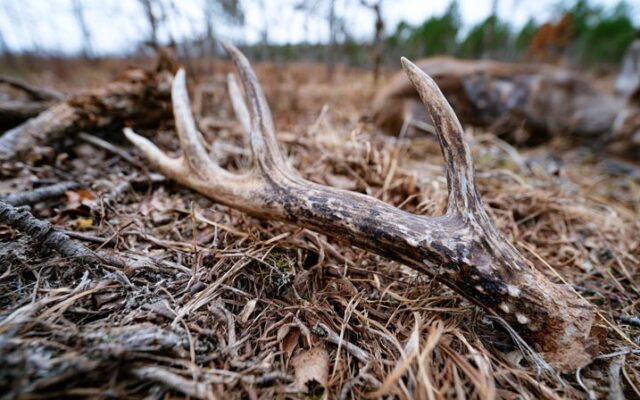
The American Veterinary Dental College explicitly warns against antlers due to tooth fracture risk. Veterinary dentists regularly treat slab fractures in dogs given antlers regularly, as antler material is harder than tooth enamel (Bully Sticks Direct, 2026).
The thumbnail test is the standard guideline: if you cannot leave a fingernail indent in a chew, it is hard enough to fracture a tooth. Antlers fail this test. Thick bully sticks pass it.
Antlers win: longevity, no odor, no mess.
Thick bully sticks win: digestibility, tooth safety, 60.2% oral bacteria reduction (Rutgers), protein nutrition.
For breeds like the Rottweiler, Doberman Pinscher, or German Shepherd Dog, antlers pose a real fracture risk given their jaw pressure. Thick bully sticks are the safer everyday choice for these breeds.
Thick Bully Sticks vs. Himalayan Yak Chews
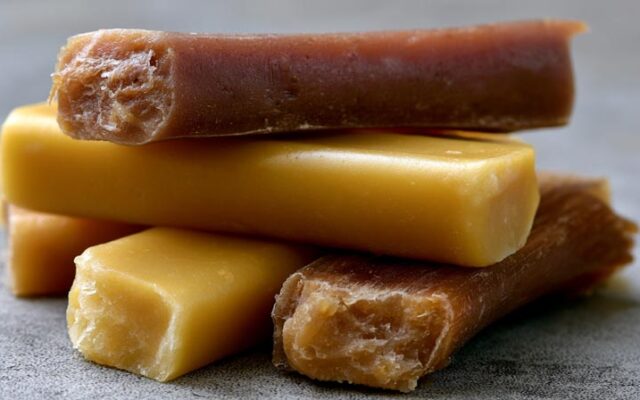
Himalayan yak chews are made from dried yak and cow milk, pressed and smoked over 4 weeks. They are lactose-free by the end of that process, averaging 3.5 calories per gram.
Protein: Bully sticks at 80-90% crude protein significantly outperform yak chews in amino acid density.
Duration: Yak chews last longer for extreme power chewers. A dog that finishes thick bully sticks in under 15 minutes will get multi-day sessions from a yak chew.
Well. The thing is, neither wins universally. Rotating both makes sense for medium-to-large dogs. Yak chews for marathon sessions; thick bully sticks for protein value and dental benefit. You can read more about Himalayan yak chews or check whether Himalayan dog chews are safe before adding them to a rotation.
Thick Bully Sticks vs. Pig Ears
Pig ears carry roughly 15-20% fat content versus 2-5% for bully sticks. For dogs prone to pancreatitis or weight gain, that gap matters. Whether pig ears are safe for dogs depends heavily on the individual dog’s health status.
Pig ears also carry a higher bacterial contamination record. The FDA issued multiple Salmonella-related alerts for pig ear products between 2019-2020. No equivalent alert history exists for properly sourced bully sticks.
How Should Thick Bully Sticks Be Stored?
Proper storage extends an unopened thick bully stick’s shelf life to 2-3 years. Improper storage can make a partially chewed stick unsafe in under 48 hours (Bully Sticks Direct, 2026).
The reason comes down to moisture. Quality thick bully sticks leave the processing facility at 8-12% moisture content. That low moisture is what makes them shelf-stable. Anything that raises the moisture reactivates bacterial and fungal spores.
Storing Unopened Sticks
Temperature range: 60-80 degrees F. Above 80 degrees accelerates bacterial metabolism and fat oxidation.
Keep sticks in a sealed container away from direct sunlight. Do not store in a garage, shed, or car. Temperature swings cause condensation inside packaging, which introduces moisture and can produce mold.
If buying in bulk, check the expiry date printed on packaging. Most products are dated 2 years from packing date. USA-sourced thick bully sticks typically hold well for the full duration when kept cool and sealed.
Storing Partially Chewed Sticks
Dog saliva introduces moisture directly into the stick surface. A partially chewed bully stick left at room temperature can develop bacterial growth within hours.
After each session:
- Let the stick air-dry for 10-15 minutes before sealing
- Store in an airtight container in the refrigerator
- Use within 1-2 weeks of the first chew session
- For longer storage between sessions, freeze in a resealable bag (up to 3 months)
Discard the stick immediately if you see white, green, or black fuzzy patches (mold), smell a sour or ammonia-like odor, or notice slimy texture. How long bully sticks last depends almost entirely on how they are stored between sessions.
How Do You Choose a High-Quality Thick Bully Stick?
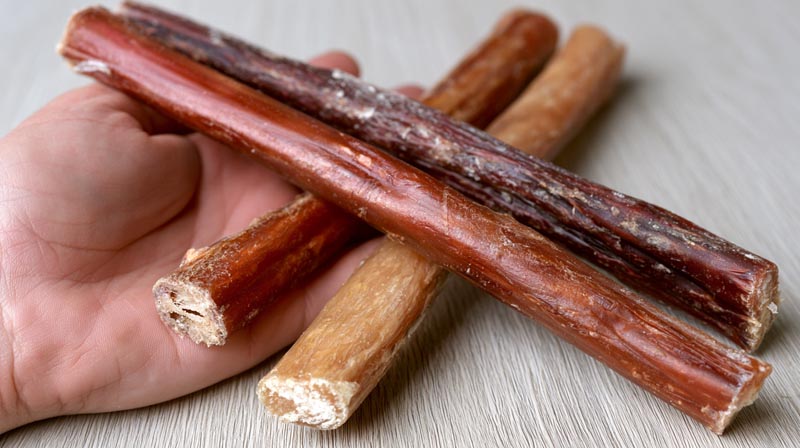
The safest thick bully sticks meet 6 criteria: single ingredient (100% beef), USDA-inspected facility, third-party pathogen testing, grass-fed source, natural odor-free processing, and a clear country of origin (Natural Farm, 2026).
Most products at rock-bottom prices miss at least 2 of those 6. That is not a budget concern. It is a safety concern.
Reading the Label: What to Look For
Single ingredient means “100% beef pizzle” or “100% beef.” Not “made with real beef.” That phrasing signals a multi-ingredient product.
Country of origin must be explicitly stated. If a label does not say where the product was made (not packaged, made), that absence is a red flag. “Made in the USA” can legally mean “packaged in the USA” if the raw material was imported.
Diameter specification matters for thick sticks specifically. Look for brands that state the diameter in inches or centimeters. A product described only as “thick” without measurement gives you nothing to compare.
USA-sourced thick bully sticks typically cost $3-8 per 6-inch stick. Prices significantly below $1.50 per stick almost always signal offshore sourcing with lower processing standards (Bully Sticks Direct, 2026).
Red Flags That Signal Low Quality
Smell is the fastest quality indicator you have before purchase. A fresh thick bully stick should have a mild, natural beef scent. An ammonia-like or rancid smell signals improper drying or bacterial activity during processing.
Bleached appearance is a hard stop. Naturally dried bully sticks are tan to dark brown. Unnaturally white sticks have been chemically treated to mask poor quality or inadequate cleaning of the raw material.
“Smoke flavored” on the label is another warning. Quality processing removes odor through extended drying time, not by masking it with smoke. Smoke flavoring is used when the base product was not processed long enough to eliminate natural odors naturally.
For owners considering the broader cost picture of owning a large dog, the full lifetime cost of dog ownership puts premium chew spending in perspective. Choosing higher-quality, longer-lasting thick bully sticks actually reduces cost over time compared to buying cheap sticks that disappear in minutes.
If you are building a full chew rotation, the resources on longest lasting dog chews, safe dog chews, and one-ingredient dog treats cover complementary options worth pairing with thick bully sticks.
For dogs with specific dietary needs, best dog treats for sensitive stomachs and best chew bones for puppies narrow down the options based on tolerance and age.
FAQ on Thick Bully Sticks For Dogs
What are thick bully sticks made of?
Thick bully sticks are made from 100% dried bull pizzle, the penis muscle of a bull or steer. Single ingredient. No fillers, no artificial preservatives. Just cleaned, stretched, and slow-dried bovine muscle tissue.
How long do thick bully sticks last?
A thick bully stick lasts 45-90 minutes for most moderate chewers. Power chewers finish them faster, sometimes under 30 minutes. Standard sticks last only 15-20 minutes for the same dog, making thick the better value.
Are thick bully sticks safe for dogs?
Yes, with supervision. They are fully digestible and do not splinter like bones. The main risks are choking on the nub and bacterial contamination from low-quality processing. Remove the stick when it reaches 2-3 inches.
What size dog needs a thick bully stick?
Thick bully sticks suit dogs 30 pounds and above. Below that, standard diameter is usually safer. Chew intensity matters too. An aggressive 25-pound terrier often needs thick more than a gentle 40-pound retriever.
How many calories are in a thick bully stick?
A 6-inch thick bully stick carries roughly 88-130 calories, depending on diameter and brand. Treats should not exceed 10% of daily caloric intake per WSAVA guidelines. Reduce kibble on days your dog gets one.
How do thick bully sticks compare to rawhide?
Thick bully sticks are 95-99% digestible. Rawhide sits at 85-90% and can cause intestinal blockages. Bully sticks use no chemical processing. Rawhide is treated with lye and hydrogen peroxide. Most veterinarians recommend bully sticks over rawhide.
Can puppies have thick bully sticks?
Not before 6 months. Puppies with developing teeth and jaw muscles need standard or thin sticks, not thick. After 6 months with full adult dentition, thick is appropriate. Limit sessions to 15-20 minutes and supervise closely.
How should thick bully sticks be stored?
Store unopened sticks below 80 degrees F in a sealed container. Refrigerate partially chewed sticks immediately after sessions. Use within 1-2 weeks of the first chew. Freeze for longer storage. Discard if mold, sour smell, or slimy texture appears.
Do thick bully sticks help clean dogs’ teeth?
Yes. The fibrous texture creates mechanical abrasion against tooth surfaces, scraping plaque before it hardens. A Rutgers University study found bully sticks reduced oral bacteria by 60.92% in canine plaque samples. They complement brushing but do not replace it.
Why are thick bully sticks expensive?
USA-sourced thick bully sticks cost $3-8 per 6-inch stick because USDA-inspected processing, grass-fed cattle sourcing, and slow-drying methods all carry higher production costs. Rock-bottom prices almost always signal offshore sourcing with lower processing standards.
Conclusion
This conclusion is for an article presenting thick bully sticks for dogs as one of the most practical, protein-dense chew options available for medium to large breeds.
Diameter is not cosmetic. It directly affects chew duration, choking risk, and how much mechanical abrasion your dog’s teeth actually get per session.
Sourcing and processing separate safe chews from risky ones. USDA-inspected facilities, grass-fed beef, and third-party pathogen testing are not marketing extras. They are the baseline.
Pair thick bully sticks with proper caloric tracking, a bully stick holder for power chewers, and a 2-3 times per week frequency. Your dog gets a long-lasting digestible chew. You get peace of mind.
Size right. Source well. Supervise always.