Ask four registries what a Belgian Tervuren is and you get two answers. The AKC has registered it as a separate breed since 1959. The FCI, The Kennel Club in the UK and the UKC all file it as one coat variety of the Belgian Shepherd Dog, and the FCI counts four varieties in that family.
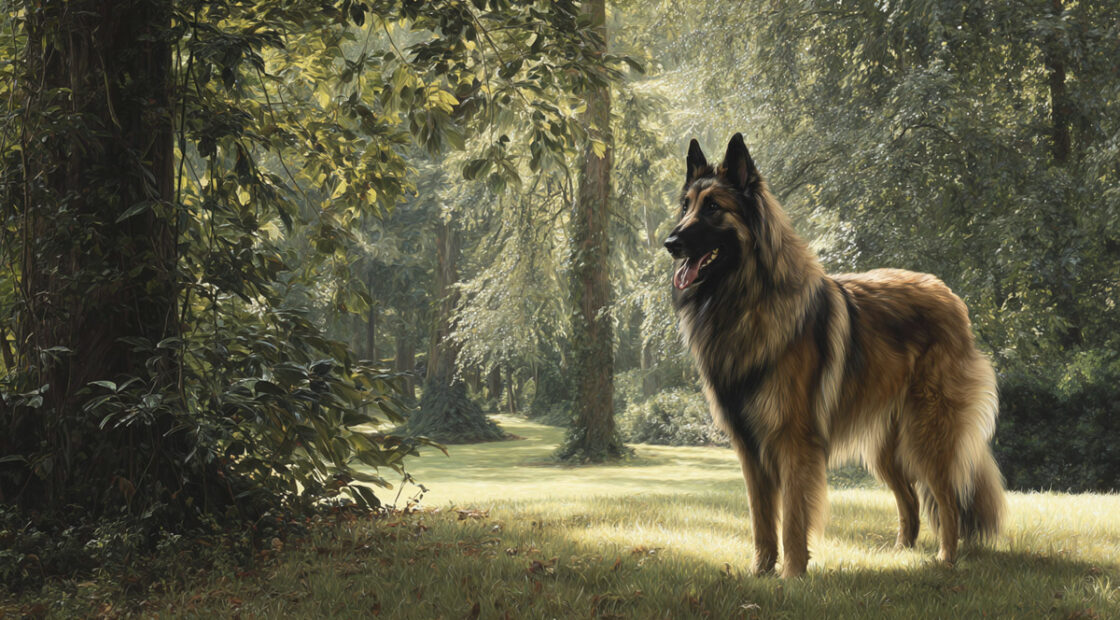
The dog itself is a herder with a long fawn-to-mahogany double coat, black overlay and a black mask. Its working drive was built for livestock herding, though it suits guard and sport jobs too. Owners call it the Terv, and it competes in agility, herding trials, tracking and search and rescue.
Inherited epilepsy is the breed’s best-documented health risk. A 2024 UC Davis study in Genes followed risk alleles from 1985 to 2015. The chromosome 14 haplotype stayed unchanged, and the chromosome 37 allele turned up more often in unaffected dogs. Decades of breeder selection have not lowered the risk.
What Is the Belgian Tervuren and Where Does It Come From?
Owners call it the Tervuren or the Terv. In Belgium the whole family of four goes by Chien de Berger Belge, and the Tervuren is the one with the long double coat, fawn to mahogany with black-tipped hairs, and the black mask.
Breed or Variety? How Registries Classify It
The answer depends on who keeps the register. The AKC counts the Tervuren as a separate breed. The FCI, The Kennel Club in the UK and the UKC treat it as one coat variety of a single Belgian Shepherd Dog.
The FCI accepted the Belgian Shepherd Dog on a definitive basis on 1 January 1956 and lists Groenendael, Laekenois, Malinois and Tervueren as its four varieties (FCI breeds nomenclature).
| Registry | Treats the Tervuren as | Group |
|---|---|---|
| AKC | Separate breed since 1959 | Herding |
| FCI | Variety of the Belgian Shepherd Dog (standard 15) | Group 1, Sheepdogs |
| The Kennel Club (UK) | Belgian Shepherd Dog (Tervueren), one standard for four varieties | Pastoral |
| UKC | Variety of the Belgian Shepherd Dog | Herding Dog |
The AKC registers each variety on its own, and the black long-coated Groenendael appears there as the Belgian Sheepdog. So the same dog is a Belgian Tervuren at an AKC show and a Belgian Shepherd Dog (Tervueren) under FCI or Kennel Club rules.
Spelling follows the registry too. It’s Tervuren at the AKC and Tervueren at the FCI and The Kennel Club.
Origin in the Village of Tervuren
The name comes from Tervuren, a village in Flemish Brabant, where breeder M. F. Corbeel lived and bred the dogs credited as the foundation stock.

Vetstreet names that foundation pair as Tom and Poes. Milsart, a fawn Tervuren, became the breed’s first Belgian show champion in 1907, according to Purina.
The club came first, though. The Club du Chien de Berger Belge formed in Brussels in 1891 and drafted the first Belgian Shepherd standard, per the FCI breed standard document.
From 1912 to AKC Recognition
The AKC’s own breed history gives the US side of it. In 1912 the AKC registered all three varieties then in the country as Belgian Sheepdogs. The breed nearly disappeared in the 1930s after the Great Depression, the American Belgian Sheepdog Club dissolved, and the AKC moved it to the Miscellaneous class.
Tervuren were imported into the United States again in 1953 (Vetstreet). Then in 1959 the AKC established three Belgian herding breeds, the Belgian Sheepdog, the Belgian Malinois and the Belgian Tervuren.
The fourth variety, the rough-coated Belgian Laekenois, was not part of that 1959 group.
How Big Does a Belgian Tervuren Get, and What Does the Coat Demand?
Males stand 24 to 26 inches at the withers and females 22 to 24 inches (AKC standard). The coat is a medium to long double coat that needs brushing about twice a week.
Height and Weight
The standard text fixes height, a square outline and medium bone. Weight numbers come from breed guides, and they disagree. Purina gives 60 to 75 pounds for males and 40 to 55 pounds for females, while Vetstreet gives 40 to 65 pounds for the whole breed, which overlaps Purina’s figures only partly. I’d treat any single weight figure as a rough guide.
People often mistake the Tervuren for a long-haired German Shepherd Dog. The build is lighter and the head more refined, according to Purina UK.
Color, Overlay and Mask
The standard wants a rich fawn to russet mahogany, with the black overlay coming from black-tipped hairs, plus a black mask. A predominantly pale, washed out cream or gray body counts as a fault. Solid black, solid liver, or white beyond the chest, toe tips, chin and muzzle disqualifies a dog.
Color deepens with age, and the blackening shows more in males, writes breeder-judge Deb Eldredge in Showsight. The mask counts as part of correct type.
The AKC standard’s color wording changed in 2007 after a two-thirds vote of the American Belgian Tervuren Club, so older descriptions of the ideal color may not match the current text.
Brushing and Shedding
The coat looks like a grooming project and is lighter work than it looks.
Purina puts the routine at brushing twice a week. Orvis agrees for most of the year and moves to daily brushing during seasonal shedding.
A correct outer coat is harsh, so it dries quickly and picks up less plant material in the field (Showsight). That’s a working-coat trait, and it explains why soft, overgrown coats are penalized in the ring.
Orvis says plainly that the breed is not hypoallergenic, and a double coat with a seasonal blowout means loose undercoat around the house.
Belgian Tervuren Temperament and Trainability

Intelligence and alertness come with real devotion to the family, and the breed is sensitive enough that harsh training backfires.
What the Breed Standard Describes
The standard describes intelligence and fast learning, courage and alertness, devotion to the owner, and a dog that is approachable but not forward with strangers.
Read that as a tendency, not a guarantee. A 2022 Science study of 18,385 dogs found that breed explains just 9% of behavioral variation, so most of what a given Tervuren does comes from other factors.
Children, Other Pets and Strangers
The breed is loyal to children, though Orvis says it pays more attention to adults, and WebMD rates it only moderately good with young kids.
Other pets can be a problem. The herding instinct can show up as an attempt to herd children and smaller animals such as cats, PetMD notes.
With strangers, the standard asks for a dog that stands its ground and does not make the first approach, and Purina adds a strong protective instinct.
Training and Socialization

Vetstreet says to start training the day the puppy comes home, using food rewards plus praise and toys.
Your Dog’s breed profile adds that the breed responds poorly to negative techniques and gets bored repeating simple tasks. Before vaccines are finished, socialize the puppy at home with family and friends (Vetstreet).
PangoVet calls the breed quick to learn and quicker to outsmart you. Consistency is the main requirement.
How Much Exercise Does a Belgian Tervuren Need?

Plan on at least 60 minutes of hard exercise a day, up to 2 hours for a fit adult, plus mental work on top.
Where the Guides Disagree on Daily Minutes
Canine Journal sets 60 to 90 minutes a day, which is the low end. Orvis recommends about 2 hours of vigorous exercise, and Lemonade says 90 to 120 minutes.
No study fixes the number, and Orvis adds that it varies with age and activity level. The AKC standard describes a dog “always in motion unless under command,” as Vetstreet quotes it.
Activities That Use the Herding Drive
Purina lists agility, herding trials, obedience and rally, tracking, search and rescue and therapy work as the breed’s usual outlets. A walk around the block isn’t on that list, and Vetstreet says the breed needs much more than that.
What Happens When the Work Runs Short
A bored Tervuren makes its own jobs, and Puppy In Training warns that destruction follows. Mental work helps, which can mean training sessions, plus activity toys and other enrichment.
Fencing matters. Vetstreet recommends a securely fenced yard and says a shock will not stop a dog set on leaving. It also wants the dog with the family when they are home.
Lifespan and Common Health Problems of the Belgian Tervuren

Most breed guides give the Belgian Tervuren 12 to 14 years, and the main documented risks are joint dysplasia, eye disease, thyroid disease and epilepsy.
Where Sources Disagree on Lifespan
Published lifespan ranges split into two camps. Dogster, PetMD and WebMD say 12 to 14 years, while Eukanuba says 10 to 12 years.
The Dogs Trust paper in Scientific Reports 2024 is a different kind of number, a median of 12.7 years across all purebreds in a dataset of 584,734 UK dogs.
Set side by side, the 12 to 14 year range sits at or above the UK purebred median and the 10 to 12 year range sits below it. The Dogs Trust paper keeps its breed-level medians in a supplementary table and limits its findings to UK dogs, which makes the guides’ Tervuren figures hard to check against it.
Vetstreet adds one lever owners control. Keeping a Terv at an appropriate weight is one of the easiest ways to extend its life.
Conditions Documented in the Breed
| Condition | Affects | Screening |
|---|---|---|
| Hip and elbow dysplasia | Joints | OFA or PennHIP hips, OFA elbows |
| Progressive retinal atrophy, cataracts, pannus | Eyes | Ophthalmologist exam |
| Autoimmune thyroiditis | Thyroid, coat, weight | OFA thyroid panel |
| Gastric carcinoma | Stomach | Not part of CHIC testing |
WebMD lists weight gain, dry skin, hair loss and behavior changes as thyroid warning signs. Chewy reports that the breed is more prone to gastric carcinoma than dogs in general.
Epilepsy is the breed’s best-documented inherited condition and gets its own section next.
Health Tests a Breeder Should Show
The American Belgian Tervuren Club takes part in the Canine Health Information Center program. CHIC certification covers hips (OFA or PennHIP), elbows (OFA), thyroid (OFA) and an eye exam by an ophthalmologist, registered with the OFA Companion Animal Eye Registry (listed as CERF in older guides).
Vetstreet notes that breeders must agree to publish all results, positive or negative, in the CHIC database. Check the OFA’s current list before relying on this one, since parent clubs set the requirements.
A CHIC number proves the tests were done and made public, not that the results were normal (AKC). Obviously, read the actual scores.
Epilepsy in the Belgian Tervuren and Whether Breeding Helps
Roughly one in four Belgian Tervuren has idiopathic epilepsy by the latest estimate, meaning recurrent seizures with no identifiable structural defect. Breeder selection has not reduced it.
The AKC Canine Health Foundation puts current prevalence at 27.1%, against 18% in an owner survey from the 1980s.
A Danish population born 1995 to 2004 came in lower, at 9.5% (49 epileptic dogs among 516 dogs with owner responses, drawn from 1,248 registered Groenendael and Tervueren), with a mean onset of 3.3 years (Acta Veterinaria Scandinavica, 2008).
Heritability was 0.77 across 997 dogs (Famula et al., Journal of Small Animal Practice, 1997).
Why the Numbers Differ
Each figure comes from a different population and method. The Danish team mailed a questionnaire to owners of two varieties, so its 9.5% is not a Tervuren-only number.
The Canine Health Foundation sets its 27.1% against the 1980s 18%, which makes those two the pair to compare.
Late onset makes the problem worse. Dogs that develop epilepsy late are often bred before any sign appears, the Danish authors note, and intact dogs with epilepsy faced a significantly higher risk of euthanasia than neutered ones.
What the Genetics Show
The Canine Health Foundation’s grant record describes a trait involving more than one gene, with one major contributor.
UC Davis researchers confirmed risk variants on chromosomes 14 and 37, one near the ADAM23 gene, and dogs carrying both face higher risk. Between 1985 and 2015, risk allele frequency on chromosome 14 stayed flat, and on chromosome 37 it rose in dogs without epilepsy (UC Davis longitudinal analysis).
The UC Davis authors concluded bluntly that breeders know epilepsy is inherited and selection against it has not worked.
Can Breeders Reduce It?
In the 1990s, Famula and colleagues concluded that breeders could win this fight by using unaffected dogs, especially from families with no seizure history. Their 1998 follow-up in Preventive Veterinary Medicine predicted that two non-epileptic parents almost always produce a dog that never seizes.
The later data points the other way. Prevalence rose and risk allele frequencies did not fall. Both positions stand, and they disagree.
The Canine Health Foundation offers one explanation: new risk variants may have appeared, and genetic testing only helps once all contributing variants are known. Late onset is a second.
Buy from a seizure-free line. Ask about seizures in parents, siblings and grandparents, and treat any variant test as partial information. The CHIC list has no epilepsy test, which makes the pedigree conversation the main screen.
Belgian Tervuren vs Malinois vs Groenendael: Which Variety Fits?
The Tervuren gives you a long coat on a dog that can settle. The Malinois is the pick for peak working drive and minimal coat care. If you want the long coat in solid black, that’s the Groenendael.
| Variety | Coat | What sets it apart |
|---|---|---|
| Belgian Tervuren | Long, fawn to mahogany with black overlay | Driven, but able to switch off |
| Belgian Malinois | Short, straight, weather resistant | Intense working drive |
| Belgian Sheepdog (Groenendael) | Long, solid black | Closest in type to the Tervuren |
Coat, Size and Registry Differences
The Kennel Club in the UK judges all four varieties to one standard, differentiated only by coat colour, texture and length. Its Malinois profile adds that Malinois parents can produce Tervueren puppies in the same litter.
Some comparison pages, CitizenShipper and A-Z Animals among them, say the Malinois grows larger. The AKC standards for the two breeds set the same height bands for males and females, so coat is the reliable visual tell.
Drive and Temperament
Hill’s Pet calls the Malinois a working breed with needs only an experienced owner can meet, and Orvis says dog parks are not in the cards.
The Tervuren is less intense than the other Belgian varieties and can relax when the work stops, according to Purina UK.
VCA Animal Hospitals group the Groenendael with the other two Belgians for intelligence and protectiveness, and note it needs a lot of exercise and daily brushing through its two yearly sheds.
For sport and protection work the Belgian Malinois stays the sharper pick, and Dogster calls it the more assertive option.
One caution on health. The Danish epilepsy study covered Groenendael and Tervueren only, so it says nothing either way about the Malinois.
Choosing Between Them
Pick on energy and handler experience first. Looks are the cheapest tiebreaker.
A long coat and a dog that can relax at home points to the Tervuren. Short coat, sport or protection work and an experienced handler? That’s the Malinois. And if you want black instead of fawn with similar demands, look at the Groenendael.
How Much Does a Belgian Tervuren Cost, and How Do You Find a Good Breeder?

A puppy from a breeder runs $2,000 to $2,500 nationally in the US (Good Dog), and Embrace notes the breed is uncommon enough that you should expect a wait for a litter.
Feeding comes to $34 to $45 a month (Healthy Paws). Adoption fees run $500 for dogs under 7 and $350 at 7 or older (Texas Malinois Alliance Rescue, which places Tervuren among other Belgian Shepherds).
The purchase price is the smaller number. Paction, a breeder platform, makes the same point about this breed, and the lifetime bill for any dog runs far past what you pay on pickup day.
How to Vet a Breeder
- Start with the American Belgian Tervuren Club, which lists breeders on its website (Embrace).
- Ask for CHIC numbers for both parents and check the OFA database yourself.
- Ask about seizures across the pedigree, meaning parents, siblings and grandparents.
- Meet both parents, and near relatives if possible (Vetstreet).
- Get a health guarantee, and walk away from any breeder who calls the breed 100 percent healthy (Embrace).
Rescue and Adult Adoption
Belgian Tervuren Rescue posts dogs through Rescue Me!, and the ABTC lists rescue among its club activities.
Embrace argues that adopting an adult rules out most health problems, since many do not show in puppyhood. Epilepsy weakens that argument, because the Danish data above show it can first appear years into adulthood.
An adult lowers the risk but does not clear it. The Rescue Me! page also warns that the breed suits an owner experienced in training.
Spotting Puppy Scams
The BBB advises against buying a pet unseen, so see the dog in person. A reverse image search is worth running too, since the same photo on several sites points to fraud (BBB).
For online pet purchases the BBB recommends paying by credit card. And Paction lists breeders who resist showing health tests and push quick deposits as red flags.
When the Belgian Tervuren Is the Wrong Dog

The Belgian Tervuren does badly in homes that sit empty most of the day, and with first-time owners who want a low-effort dog. It also goes wrong for buyers who skip health screening.
Long Workdays Away From Home
Orvis says the breed adjusts poorly to time alone and develops separation anxiety.
Its guidance is to leave a Tervuren for an hour or so, ideally in a crate trained as a den. A full workday is outside that range, and Healthy Paws gives the same warning.
First-Time Owners
Puppy In Training advises against the breed for novices, and Omlet says the same unless you can give it the time it needs. Purina UK describes the ideal owner as fit and energetic, but calm and sensible.
Buyers Who Cannot Accept the Health Risk
CHIC testing does not screen for epilepsy, and the risk can appear in a litter from careful breeders.
Dogs with repeated severe seizures are treated with medication to control frequency and severity, per the genetics literature. That commitment runs for life.
Fit Check
The breed fits a sport or working home that uses the herding drive, an owner who is home most of the day, and someone with experience in positive-reinforcement training.
It fails with an empty house across a full workday, a first-time owner expecting an easy dog, a buyer unwilling to ask about seizure history, or a trainer who relies on harsh correction.
Belgian Tervuren FAQ
Is the Belgian Tervuren a good guard dog?
Vetstreet calls it an excellent watchdog with the size to protect when needed, and training teaches it to judge when to escalate.
Orvis warns that a Terv turns aggressive if it senses its people are in danger, so early socialization matters.
Does a Belgian Tervuren bark a lot?
Moderately to often. Purina UK calls the breed chatty and vocal, barking at visitors and anything unusual, and Lemonade ties some of it to herding instinct.
Solid fencing helps, since it blocks the sights that set off fence-running and reactive barking (FurryCritter).
Can a Belgian Tervuren live in an apartment?
It’s difficult. Lemonade rates apartment living hard because of the breed’s energy, while FurryCritter says it works if the owner commits to several vigorous outings a day.
A house with a securely fenced yard remains the ideal.
How well does a Belgian Tervuren get along with other dogs?
Moderately well. Dogster says the breed shows the same wariness toward other dogs as toward strangers, and WebMD reports the AKC rates it three out of five on dog sociability.
Purina UK notes it copes better with dogs it already knows, so introduce other dogs early.
What should I feed a Belgian Tervuren, and how often?

Healthy Paws puts an adult at two to three cups of high-quality food daily, split into two meals.
PetMD notes that twice-daily meals help prevent bloat and GDV, and puppies eat three or four times a day. Your vet and the food label set the exact amount.
Why shouldn’t you shave a Belgian Tervuren in summer?
Shaving removes the layer that insulates against heat and shields the skin from sunburn, and the AKC warns it can leave long-term damage to the coat.
Brush out the shed undercoat instead. It clears dead hair and improves airflow.
Is the Belgian Tervuren a rare breed?
In the US, yes. Embrace calls it not a common breed, and the AKC’s 2025 rankings place it 115th of 202 breeds. The older figures cited by Dogster (104th) and Vetstreet (108th) also sit outside the top 100, though they come from different years.
Planning the First Year With a Belgian Tervuren
A Belgian Tervuren puppy should start socializing before anything else, because the American Veterinary Society of Animal Behavior (AVSAB) puts the primary window in the first three months of life.
A puppy that goes home at 8 weeks has about four weeks of that window left, so the first class gets booked before pickup day.
That deadline sets the order of the first year.
- Socialization and classes, weeks 8 to 12
- Crate and alone-time practice, before adolescence
- Sport or herding work, once the frame matures
Only socialization has a deadline. The other two steps can wait.
The catch is in step one. AVSAB says classes can start at 7 to 8 weeks, before vaccination finishes, accepting a small infection risk to avoid the behavioral cost of missing the window, so choose classes that require health records from every puppy.