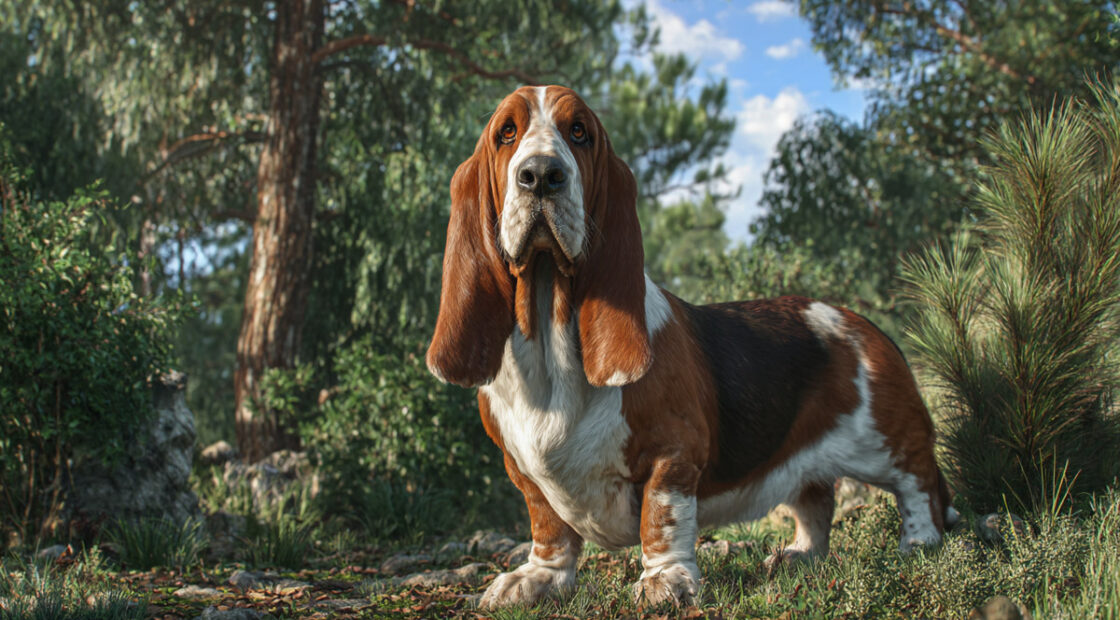
A Basset Hound follows a ground scent slowly and for a long time, which is exactly what the breed was built to do. The AKC places it in the Hound Group. Heavy bone, long ears and loose skin keep the dog low and on the trail. It’s a short-legged scent hound through and through.
Hunters still use it on rabbit and hare, though most Bassets now live as calm family dogs.
Ask where the breed comes from and most sources say France. The FCI disagrees. Its standard no. 163 (2010) lists Great Britain as the country of origin, even though the same document traces the breed to monks in France.
What Is a Basset Hound?
The AKC lists the breed in the Hound Group (recognized in 1885). French hunters originally developed it to trail small game they could keep up with on foot, and it still works at that pace, slowly and for a long time.
The build serves that job. Heavy bone, a low body and long ears keep the dog close to the trail, and Britannica ranks its nose second in keenness only to that of the Bloodhound.
People mix it up with other dogs fairly often. The Bloodhound shares its scenting ancestry but is a much larger dog. A Beagle is longer in the leg and lighter in the frame. Dachshunds are short-legged through related genes, yet they’re a separate breed.
Short legs, big bones, and a nose that overrides everything else.
How Big Does a Basset Hound Get?
Adults stand up to 15 inches at the shoulder and weigh 40 to 65 pounds (Britannica).
That makes it a medium-sized dog on a very short frame. And it carries more bone for its size than any other breed, according to the AKC standard.

Breed standard measurements
The AKC standard text measures height and chest clearance rather than weight.
- Height should not exceed 14 inches, and anything over 15 inches is a disqualification (AKC standard).
- The deepest point of the chest sits no more than one-third of the withers height above the ground (AKC standard).
- Weight runs 40 to 65 pounds (Britannica).
Weight is where sources split. Hill’s Pet lists 40 pounds for a small female and up to 80 for a large male.
Each publisher reports its own range, so use 40 to 65 as the working figure. A dog above it is a reason for a vet body-condition check.
How the physical features work
Nearly every oddity in the build has a job. The Dogs NSW breed guide explains that the loose skin moves with the dog and protects it when it snags on brush, and that a fold of skin on the head drops forward to shield the eyes while the nose is down. Enough rib length protects the organs of a body this low to the ground.
The long ears and dewlap add to the droop, and the flews are heavy too.
The AKC standard asks for a well-domed skull and wrinkled skin over the brow. A dry head and tight skin count as faults.
The short legs are genetic, not only a matter of selective breeding. The UC Davis Veterinary Genetics Laboratory ties the breed’s leg length to an FGF4 retrogene insertion on chromosome 18, a trait called chondrodysplasia.
Any recognized hound color is accepted, and the standard says marking distribution does not matter. Tricolor and red and white are the most common (Hill’s Pet).
The tail stays undocked.
Basset Hound Temperament and Behavior

Mild and devoted, with a stubborn streak that shows up the moment a scent is in the air.
The AKC standard describes a dog that is never sharp or timid, with great endurance in the field. Dogs NSW adds that it suits families with an active lifestyle who take the dog along.
Dogs NSW calls it a great watch dog, thanks to a deep, melodious bark. As a guard dog it’s a poor choice. Burke’s Backyard describes it as neither excitable nor aggressive, which doesn’t do much for protecting a home or property.
So it announces visitors, then greets them. Plan accordingly.
Baying comes with the breed. Dogs NSW notes it is very vocal in play, and PDSA tells anyone who wants a quiet dog to pick something else.
Pack-hound ancestry means it wants company. Dogs NSW suggests pairing a Basset that spends long stretches alone with another Basset or a suitable companion dog.
Children are rarely a problem, since Burke’s Backyard describes it as not particularly territorial and not inclined to snap at them. Smaller pets need a careful introduction (PDSA), because the AKC describes a breed that will willingly chase a scent.
Once the nose is down, the recall command loses. That is the breed, not a training failure.
Basset Hound Lifespan and Common Health Problems

Most Bassets live somewhere around 10 to 13 years. The health problems that matter come mostly from the spine, the ears, the deep chest and a handful of inherited disorders.
| Condition | Build-related cause | Warning signs | Screening or prevention |
|---|---|---|---|
| Intervertebral disc disease | Short legs, long back, early disc degeneration | Back pain, nerve deficits | Weight control, vet exams |
| Otitis externa | Long pendulous ears | Head shaking, odor, discharge | Daily ear checks |
| Gastric dilatation-volvulus | Deep chest | Swollen abdomen | Split meals, ask about gastropexy |
| Thrombopathia | Inherited platelet defect | Prolonged bleeding after injury | DNA test before breeding |
Lifespan
Published lifespan figures conflict. PDSA, the UK veterinary charity, says over 10 years. WebMD puts the average at 12 to 13.
Most pages do not say whether their number is an average or a median, or which dogs it came from. Plan around 10 to 12 years and count 13 as a good outcome.
Conditions linked to body shape
Intervertebral disc disease
Short legs and a long back carry a spinal cost.
UC Davis researchers (Brown et al., 2017) tied a second FGF4 retrogene, on chromosome 12, to chondrodystrophy and disc disease. It carried an odds ratio of 51.23 for IVDD across the breeds studied.
Paw Print Genetics notes that Bassets typically carry both the chromosome 12 and chromosome 18 insertions. A DNA test exists. UC Davis notes that breeders can use the results to reduce chondrodystrophy while keeping the short-legged look conferred by the chromosome 18 variant, though dogs with both insertions show a more drastic reduction in leg length.
The same short-leg and disc pairing appears in Dachshunds, which had the highest lifetime IVDD prevalence in a 2025 JAVMA analysis of Dog Aging Project data.
Otitis externa
Basset Hounds had 5.87 times the odds of otitis externa compared with crossbred dogs, the highest of 16 breeds with raised risk, in a sample of 22,333 UK dogs (Royal Veterinary College VetCompass, 2021).
Pendulous ear carriage raised the risk across breeds too. Head shaking, scratching and a foul smell are the usual first signs.
Gastric dilatation-volvulus
Gastric dilatation-volvulus (GDV), or bloat, is an acute, life-threatening emergency.
A GDV review published through IVIS notes that Basset Hounds may carry a higher risk than their size suggests, and that the depth-to-width ratio of the chest correlates with risk. The same review lists prophylactic gastropexy as an option for high-risk dogs.
Eyes, hips and elbows
Loose eyelids predispose the breed to entropion and ectropion (Burke’s Backyard).
Hip dysplasia, a malformed ball-and-socket joint, is hereditary but shaped by nutrition and environment. Elbow dysplasia is the same story in the elbow joint.
Inherited disorders
Basset Hound thrombopathia is an inherited platelet function disorder, and the clots do not form properly.
Owners often find out only after an injury or surgery causes prolonged bleeding. That is why the DNA test matters before breeding, not after.
Health screening
The AKC lists the thrombopathia DNA test as the national breed club recommendation for Basset Hounds.
In the UK, the Kennel Club’s former Assured Breeders scheme required eye testing for PLA (gonioscopy) in Basset Hounds, but the Kennel Club closed that scheme on 31 December 2024. Its breed page now groups health tests into Good Practice and Best Practice categories, and its Health Test Results Finder shows results for dogs on its registers.
The Orthopedic Foundation for Animals runs the public database where hip and elbow evaluations are registered, and its site lists recommended tests by breed (Purdue Canine Welfare Science Center, 2024).
Screening lowers risk without removing it. The Kennel Club points out that some inherited conditions cannot be tested for, so breeders should weigh results against temperament and conformation.
How to Care for a Basset Hound: Exercise, Grooming and Diet
Most of the work is walking, ears and portion control. The coat barely asks for anything.
Exercise
PDSA sets the minimum at one hour a day, which surprises people who read “low energy” on a breed card.
Keep it low-impact and unhurried, with walks that let the nose work. Britannica describes the breed as low-energy and prone to obesity, so skipped walks show up on the scale fast.
Coat, shedding and drool
The coat is short and tight, with no long hair on the legs or tail (Hill’s Pet). Mud and dirt come indoors on big feet and a low belly, and drooling happens mostly in warm weather (Britannica).
Grooming is the easy part of this breed.
Ear care
Daily checks beat occasional deep cleans.
Breed guides advise a daily look, while the VetCompass authors warn against overzealous cleaning. The working rule is to inspect daily and clean only when the ear is dirty.
- Lift each ear flap and look inside once a day
- Check for redness, warmth, discharge, odor or head shaking
- Wipe visible dirt from the folds with a dry paper cloth
- Use a cleaner only if your vet approves it
- Dry the ears after baths and wet walks
- Book a vet visit if infections keep coming back, since allergies are a common cause
The VetCompass team backs a dry cloth and cautious use of cleaners with antimicrobial properties. Ear wipes made for dogs vary in what they contain, so ask your vet which type suits a Basset with recurring problems.
Feeding and weight

Puppies do better on large-breed puppy food, which slows growth and lowers the risk of hip dysplasia (Britannica). Adults need moderate feeding plus exercise to head off the obesity the breed leans toward (Britannica).
Meal size matters too. The IVIS GDV review (2007) reports higher bloat risk in dogs fed a large volume per meal, highest with one big daily meal, so split portions.
Weight is the one health lever the owner fully controls.
How to Train a Basset Hound

Training works when it is consistent and starts early, and it never fully beats the nose.
Burke’s Backyard calls the breed difficult to train because of its stubborn nature, and rates housebreaking a real challenge. PDSA says socialisation with people and other dogs should start young, once the puppy is fully vaccinated.
Housebreaking goes best with fixed outings after meals and naps, and a reward the moment it works. Start leash manners while the dog is small, since a grown Basset pulls with real weight. Recall gets built on a long line, and it’s a bonus, not a guarantee.
Food is the reward that can compete with a scent trail. Count small, healthy treats for dogs toward the daily allowance so training does not add weight.
The AKC Canine Good Citizen test has 10 items, all done on leash, and the come-when-called item uses a 20-foot line (AKC).
The title never asks for off-leash reliability, which suits this breed. Pass it, and fence the yard anyway.
The nose also needs a job. The AKC says the breed excels in tracking, field trials and pack hunting.
About 20 Basset clubs hold 38 field trials a year. Most are run in braces of two dogs, and entrants must be AKC-registered hounds at least six months old, according to the AKC.
Basset Hound Cost: Breeder, Rescue and Ongoing Expenses
Rescue fees sit in the low hundreds of dollars. Puppy prices depend on the breeder, and upkeep ends up deciding the real total.
Puppy price
No registry publishes puppy prices, and online price guides disagree on the range.
Compare written quotes instead, and ask what each one includes.
PDSA warns that unusually cheap puppies can come from puppy farms. Its page still recommends Kennel Club Assured Breeders, but the Kennel Club closed that scheme on 31 December 2024, so ask any breeder for the parents’ health-test results and check them in the Kennel Club’s Health Test Results Finder.
Rescue and rehoming
Ohio Basset Hound Rescue lists $250 for puppies, $200 for dogs aged 1 to 8 and $100 for dogs 8 and older, while North Texas Basset Hound Rescue lists $175 to $375.
That’s a fraction of typical puppy prices. North Texas dogs are spayed or neutered, vaccinated and microchipped before adoption, and breed-specific rescues know the breed well enough to match dogs to homes.
The catch is paperwork. An application, approval and a signed adoption agreement come first (Ohio Basset Hound Rescue), and some adult listings note a dog is not housetrained.
Ongoing costs
After purchase and set-up costs, PDSA puts the monthly floor at £80 and the lifetime ceiling at up to £13,000 across the dog’s life. A practice health care plan spreads the cost across the year (PDSA), and reputable rescue centres often vaccinate, with some neutering before rehoming (PDSA).
Spread over a decade, the long-term expense of keeping a dog dwarfs the purchase price. A breed with ear, spine and bloat risks makes the unplanned bills likelier.
Where Does the Basset Hound Come From?
The AKC and Britannica credit France, while the FCI lists Great Britain as the country of origin.
Both are defensible. French hunters developed the low hounds, and British breeders turned them into the heavier type seen today.
The name comes from the French bas, meaning low, and Merriam-Webster dates the first known use of “basset hound” to 1851.
Lineage
Dogs NSW traces the breed to the St. Hubert Hound, a Bloodhound type bred by Benedictine monks at the St Hubert monastery in Belgium. The Kennel Club’s standard is vaguer and says only that monks in France reputedly bred it in the Middle Ages.
Early French Bassets closely resembled the Basset Artesien Normand, a regional type the FCI still lists as a separate breed (no. 34).
Then there’s the Bloodhound cross. Breed histories credit Sir Everett Millais with adding Bloodhound blood to build the heavier British type, and the AKC notes the American standard described a “Bloodhound head” until it was rewritten in 1956.
The sources agree on the French base and the British refinement. They disagree on which monastery gets the credit.
Registries, clubs and the standard
Recognition dates differ by source, so each line below names who says what.
- In 1866, Comte de Tournon gave Lord Galway a pair of hounds, the usual starting point of the breed’s history in England (AKC)
- The Kennel Club first provided a class in 1880 per the period book Dogs and All About Them, while other histories say it accepted the breed in 1882
- The AKC breed page gives 1885 as the recognition year, but its field-trial history says Bassets were registered in 1885 and recognized as a breed in 1916
- The Basset Hound Club of America formed in 1935, gained AKC recognition in 1937, and held its first AKC-sanctioned field trial at Hastings, Michigan on October 24, 1937
- The current AKC standard was approved on January 14, 1964, and the FCI accepted the breed on a definitive basis on April 28, 1955 (standard no. 163, Group 6)
The Kennel Club’s current Basset Hound standard carries an effective date of January 1, 2026.
Basset Hounds in popular culture
Fred Basset debuted in the Daily Mail on July 8, 1963, and became one of the longest-running comic strips (Britannica).
Hush Puppies, the footwear brand introduced in 1958, took the breed as its inspiration and mascot.
That exposure explains why a short-legged scent hound is recognized far beyond hunting circles.
Is a Basset Hound the Right Dog for Your Home?
It fits a patient owner with a fenced yard, time at home and room in the budget for ear and spine care. It fits poorly with almost everything else.
Homes where the breed struggles
Some household setups just break the match.
- Unfenced, off-leash routines such as trail runs and open-field walks
- Shared walls, because low energy suits an apartment but the bay carries
- Steep interior stairs with no ramp
- Owners who want a brisk jogging partner
- Eight-hour absences with no second dog or midday visitor
- No cushion for an unplanned vet bill
Two or more of those is the line. Pick a different breed.
Basset Hound or Beagle
The Hound Group offers few alternatives at this size. The nearest match is the Beagle.
Judge Jacquelyn Fogel notes in the AKC Gazette (2012) that only Beagles and the Petit Basset Griffon Vendeen stand about as tall as a Basset.
| Attribute | Basset Hound | Beagle |
|---|---|---|
| Build | Heavy-boned, low-slung | Foxhound in miniature (AKC) |
| Size classes | One standard | 13-inch and 15-inch varieties (AKC) |
| Back | Long | Relatively short (AKC standard) |
| Ear infection risk | Higher than the Beagle | 2.54 times crossbred odds (VetCompass, 2021) |
A Beagle is the pick if you want a brisker, lighter hound. The Basset makes sense when slower walks and heavier ear and spine care suit you.
Basset Hound FAQ
Are Basset Hounds smart?
Yes, but they spend their intelligence on their own agenda. The AKC says the breed competes in obedience and tracking, so the stubborn reputation reflects scent drive and independence more than low ability.
Can a Basset Hound climb stairs?
Occasionally, yes. Steep stairs and repeated jumps load a long back that is already prone to disc disease.
Use a ramp for the sofa and the car, and carry puppies up and down.
Do Basset Hounds smell?
Often, when the ears or skin folds go uncleaned. Seborrhea and Malassezia yeast overgrowth are the usual skin causes, and ear infections add their own odor.
A smell that persists after cleaning is a reason to see the vet.
Are Basset Hounds sensitive to cold weather?
Somewhat. The short, tight coat gives little insulation (Hill’s Pet).
Dry the body and ears after wet walks.
What are the most common Basset Hound mixes?
The best known include the Bagel Hound (Basset and Beagle), the Bassador (Basset and Labrador Retriever) and the Basschshund (Basset and Dachshund).
Mixes are not recognized breeds, so size, coat and health vary. A Basschshund doubles up on the short-leg, long-back build.
What to Set Up Before a Basset Hound Comes Home
A fenced yard, a baseline vet exam and an ear and weight routine should be in place before a Basset Hound arrives, in that order.
The fence comes first because a hound on a scent trail ignores recall, and training cannot remove that risk on day one.
The exam comes second, so the vet records a starting weight and ear condition and a thrombopathia result is on file before any surgery.
The trade-off is flexibility. Fencing and daily ear checks tie the household to a schedule most breeds do not demand.
For a puppy, food is the next decision, and comparing puppy food brands belongs on the same shopping list.
This was checked in October 2026. A Basset-specific longevity study built on clinic records would replace the conflicting lifespan ranges and change how long the plan runs.