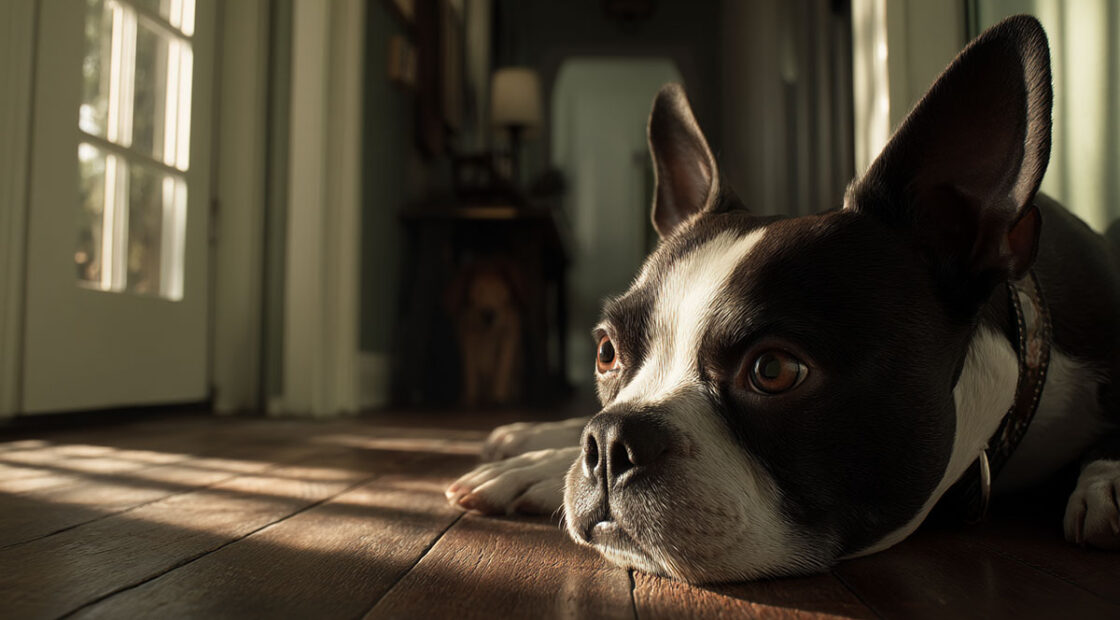
Boston Terriers came out of Boston, Massachusetts in the 1800s, and the AKC files them under the Non-Sporting Group. The head is square, the muzzle short, and the smooth coat comes marked like a tuxedo.
Weight tops out at 25 pounds under the AKC standard, which is why the breed does fine in apartments and family homes. The flat face is the catch. It brings breathing and eye trouble along with it.
The breathing numbers are better than most people expect, though. A University of Cambridge study reported by the Kennel Club in January 2025 found that about 73% of the Boston Terriers tested were clinically unaffected by brachycephalic obstructive airway syndrome (BOAS). Bulldogs and French Bulldogs carry a heavier burden.
What Is a Boston Terrier?
Breeders in Boston, Massachusetts developed this small American companion dog in the 1800s, and the AKC places it in the Non-Sporting Group. It has a short muzzle, a square head and a smooth coat with tuxedo-style markings.
Nicknames run long. American Gentleman, Boston Bull, Boxwood and Roundhead all get used. The “gentleman” tag comes from the white markings, which read like formal wear, and from the manners too.
The name misleads. The breed descends from bull-and-terrier fighting stock, but the United Kennel Club standard calls it a down-sized version of those types, and it lives as a companion rather than a working terrier.
People mix it up with the French Bulldog because both are flat-faced. They are separate breeds, each with its own standard.
The AKC ranked the Boston Terrier 23rd on its 2025 list of most popular breeds.
Origin and History of the Boston Terrier
The Boston Terrier began in Boston in the late 1800s with a dog named Hooper’s Judge, and the AKC admitted the breed in 1893.

Foundation stock and the Hooper’s Judge lineage
Judge is the patriarch of the breed, per the AKC.
He was a cross between an English Bulldog and a White English Terrier, a breed that is now extinct. Robert C. Hooper of Boston owned him, and he was bred to a female called Burnett’s Gyp, also recorded as Kate. Boston breeders then needed roughly ten years to fix a consistent type (Show Sight Magazine).
Sources disagree on when Judge arrived. VCA Animal Hospitals puts it around 1865, while Wikipedia’s breed entry says around 1870.
They also disagree on ancestry. The AKC names two parent breeds, and the UKC breed standard lists five influences, among them the Boxer and the French Bulldog.
Recognition and breed group
The name settled before the registry did. The New England Kennel Club showed the dogs in 1888 as the Round Head Bull and Terrier, and fanciers formed the American Bull Terrier Club in 1889.
Breeders of the established Bull Terrier objected. The Boston Terrier Club of America formed in 1891 under the name the breed carries today.
AKC officers first refused to enter the breed in the stud book, citing inconsistent type. Admission came on February 27, 1893, on condition that each dog have an approved three-generation pedigree (Show Sight Magazine).
| Registry | Group | Recognition detail |
|---|---|---|
| AKC | Non-Sporting | Stud book admission, 1893 |
| Canadian Kennel Club | Group VI, Non-Sporting | Recognition listed as 1889 |
| The Royal Kennel Club (UK; formerly The Kennel Club) | Utility | Standard last updated November 2025 |
| FCI | Group 9, Companion and Toy Dogs | Standard No. 140 |
The Canadian Kennel Club’s own standard lists 1889, four years ahead of the AKC date.
AKC history lists the breed as the first member of the Non-Sporting Group when that group formed in 1923. From 1905 until 1935 it ranked first or second in AKC registrations, according to Show Sight Magazine.
How Big Does a Boston Terrier Get?
Expect 25 pounds at the very most, with a height of about 15 to 17 inches at the withers, according to AKC breed data. The AKC sorts show dogs by weight class and ignores height for that.
Anything under 15 lb (6.8 kg) is lightweight. From 15 lb up to 20 lb (6.8 to under 9.1 kg) is middleweight, and 20 lb to 25 lb (9.1 to 11.4 kg) is heavyweight. The Royal Kennel Club standard, updated November 2025, sets the maximum at 25 lb (11.5 kg).
Height figures conflict across sources. Wikipedia’s breed entry lists 9 to 15 inches, which sits below the AKC range and overlaps it only at the top end.
The Royal Kennel Club adds a caution for buyers. Its size figures describe the ideal, and an individual dog can run larger or smaller. The standard also calls for a square build, with body length from shoulder point to buttock equal to height at the withers.
Males run heavier and taller than females, according to Hill’s Pet.
Boston Terrier Coat Colors, Markings and Shedding
Brindle, seal and black are the accepted coat colors, and each one has to come with white markings.
Accepted colors and markings
Brindle mixes brown and black in a way that shows distinctly across the body, and it is the Royal Kennel Club’s preferred color. Seal looks black until bright light brings out a red cast. Black is accepted as long as white markings go with it.
Ideal markings are a white muzzle joined to an even blaze between the eyes, plus a white collar and breast, with white on the forelegs and on the hindlegs below the hocks.
Registries treat missing markings differently. The UKC requires a white muzzle band, a white blaze between the eyes and a white forechest, and it disqualifies a solid seal, black or brindle dog.
The Royal Kennel Club takes the milder line. A representative dog is not penalized for lacking ideal markings, though any other color is unacceptable.
Gray and liver coats are disqualified under both the AKC and UKC standards.
Shedding and grooming

The coat is short, smooth and fine, and it sheds little. A brush or a grooming mitt handles most of the upkeep, with a bath every so often. Check the eyes daily for redness or irritation.
Hill’s Pet describes shedding in this breed as minimal but present, so a mitt session keeps loose hair off the furniture. The standard also calls for a skull and muzzle free from wrinkles, which means no facial folds to clean, a chore that comes with some other short-muzzled breeds.
Eye checks matter more than coat care here.
Boston Terrier Temperament and Trainability

Boston Terriers are friendly and lively, and they stick close to their people. There is a determined streak in there too, so training turns into a patience exercise. The Royal Kennel Club standard lists the temperament as lively, intelligent, determined and strong willed.
With children and other pets
The Westminster Kennel Club’s breed ratings give 5 out of 5 for good with children and 4 out of 5 for good with other dogs.
Hill’s Pet says the breed enjoys romping with kids who treat it well. VCA Animal Hospitals adds that Bostons are usually good with strange dogs, though one may challenge a newcomer at first.
Children need to learn gentle handling. New dogs go best when introduced on neutral ground, and small pets should always be supervised around a Boston.
Training and time alone
Intelligence and stubbornness arrive together. Westminster’s ratings give trainability 4 out of 5 and barking 2 out of 5, and Orvis’s breed guide adds a stubborn, mischievous side.
Reward-based training with praise and gentle correction works best, since the breed is sensitive (Purina). Bostons also move fast, so a secure fenced yard or a leash is the rule outdoors (Hill’s Pet). Bark Busters trainers report that worry over time apart shows up as barking, destructive behavior or toileting accidents.
Keep rewards small, because the breed leans toward slightly overweight, per VCA Animal Hospitals. Cutting healthy dog treats into small pieces keeps the calories down.
Build time apart gradually. Calm, consistent sessions suit a sensitive dog better than long drills.
Which Health Problems Affect the Boston Terrier?

Brachycephalic obstructive airway syndrome (BOAS), eye disease, patellar luxation and congenital deafness make up the main health risks. Each has its own screening route, and a buyer can ask a breeder for results on every one.
| Condition | What it affects | Screening or test |
|---|---|---|
| BOAS | Breathing, exercise and heat tolerance | Respiratory function grading, Grades 0 to 3 |
| Corneal ulcers, dry eye | Cornea and tear production | Ophthalmologist eye exam |
| Cataracts | Lens clarity and vision | Ophthalmologist eye exam |
| Patellar luxation | Kneecaps and hindlimb movement | Patella evaluation |
| Congenital deafness | Hearing | BAER hearing test |
Sources split on the verdict. The AKC lists patella, ophthalmologist and BAER hearing tests as the ones its national breed club recommends, while PDSA strongly recommends that owners consider a healthier breed, crossbreed or mongrel.
Airway disease (BOAS)
In a University of Cambridge study funded by the Kennel Club Charitable Trust, 104 Boston Terriers were graded for BOAS. Of those, 37.5% (39 dogs) were Grade 0, 35.6% were Grade 1, 26.0% were Grade 2 and one dog (about 1%) was Grade 3. That puts about 73% in the clinically unaffected Grades 0 and 1, while 62.5% showed some airway noise (Grades 1 to 3). The study appeared in PLOS One on December 31, 2024, and the Kennel Club reported it in January 2025.
The Respiratory Function Grading Scheme, run by the University of Cambridge and the Kennel Club, scores airway signs from Grade 0 to Grade 3. Grades 0 and 1 count as clinically unaffected, according to OFA’s overview of the scheme.
Boston Terriers also out-scored their bulldog-type relatives. Grade 0 dogs made up 37.5% of the Boston Terrier sample, against 15.2% of Bulldogs and 10% of French Bulldogs (University of Cambridge).
Within the breed, BOAS tracked with stenotic (narrowed) nostrils, facial foreshortening, abnormal scleral show, meaning visible white of the eye, and a higher neck-to-girth ratio.
A later University of Cambridge multi-breed study of 14 breeds (PLOS One, 2026) placed the Boston Terrier in a moderate-risk band, with 25 to 50% of dogs at Grade 0 and half to three-quarters affected.
The grading scheme launched for French Bulldogs, Bulldogs and Pugs. On February 18, 2026, the Royal Kennel Club announced an expansion to 14 additional breeds, including the Boston Terrier, and it recognised the Boston Terrier BOAS test in August 2026. The test will be added formally to the Royal Kennel Club Health Standard and to Find a Puppy from January 2027. OFA’s April 2026 update lists the Boston Terrier as eligible for exams and certification, though the rollout of approved examiners is slow.
Eye conditions
- Corneal ulcers are open sores on the cornea, and they ranked among the most common diagnoses in a referral-hospital study of seven brachycephalic breeds (cases seen 2008 to 2017) that included Boston Terriers.
- Too few tears cause dry eye, which leads to infections and ulcers (PDSA).
- When the third eyelid slips out of place you get cherry eye, usually in younger dogs, and surgery corrects it (PDSA).
- Cataracts come in early-onset and late-onset forms, per the Royal Kennel Club.
RVC VetCompass work in 2017 found brachycephalic breeds predisposed to corneal ulcers, so a clear eye exam on both parents carries real weight.
Joints, hearing and anesthesia
The remaining problems are less talked about, but they are not minor.
- Hemivertebrae are spinal bone deformities that can cause weakness, loss of hindlimb function and incontinence.
- Atopy is an allergy that causes itching and skin damage.
- Cushing’s syndrome means an excess of cortisol.
- Birth can be difficult, because large shoulders and a small pelvis often force a caesarean (PDSA).
Anesthesia needs planning too. Basepaws advises discussing it with a vet before any procedure, because the breed is sensitive to anesthetic.
How Long Do Boston Terriers Live?
WebMD’s breed profile gives 11 to 14 years, but no published clinical life table measures the breed directly. The 2022 VetCompass life tables in Scientific Reports covered 18 common breeds, and the Boston Terrier was not among them.
The closest reference point is the Kennel Club Utility group, at 10.1 years at birth. That was the second-lowest of the seven groups reported, ahead of only the Working group at 9.1 years (VetCompass, 2022). In the same study the French Bulldog came in at 4.53 years at birth, the shortest of the 18 breeds.
The group number cannot isolate the Boston Terrier, because the Utility group also holds the French Bulldog and the Bulldog. That makes it a reference point, not an estimate.
Cambridge found Boston Terriers less severely affected by BOAS than Bulldogs or French Bulldogs, so a lifespan well above the French Bulldog’s is plausible. No life table confirms the exact figure, so treat the WebMD range as a general profile estimate.
The BVA cautions that the VetCompass study does not prove a direct link between flat-faced welfare problems and shorter lives.
Exercise Needs and Heat Tolerance of the Boston Terrier
PDSA says up to an hour of exercise a day, and none of it belongs in the heat of the day. The short muzzle makes panting an inefficient way to cool down, so heat builds faster than in longer-nosed dogs.
In UK VetCompass records, exertional heat-related illness was the most common type, and brachycephalic dogs had greater odds of all three types compared with mesocephalic dogs (RVC, 2020).
The emergency team at Tufts’ Cummings School of Veterinary Medicine lists these warning signs:
- Lethargy
- Heavy panting and rapid breathing
- Bright red gums and tongue
- Drooling
- Vomiting or diarrhea
Tufts also gives a hand test. If you cannot hold your hand on the pavement for 5 to 7 seconds, it is too hot for the dog.
Walk in the early morning or evening and skip hot, humid days. Allow frequent rest breaks. When outdoor time is unsafe, swap in indoor games and mental work, which PDSA says the breed enjoys.
Never leave the dog in a parked car, even briefly.
Who Should and Should Not Get a Boston Terrier?

Owners with a cool place for the midday hours and room in the budget for eye and airway care are the best match. Hot climates, runners and anyone who cannot absorb vet bills are the poor ones.
Pros and cons
On the plus side, the size is sturdy and portable, which suits city living (Purina). The breed also responds well to training and enjoys mental work (PDSA).
The downsides are heavier. Heat limits every outdoor plan, and snoring and wheezing come with the short muzzle (iHeartDogs). Eye and airway problems can bring recurring vet costs, and PDSA advises prospective owners to consider a healthier breed.
A good fit for a calm, cool home. A risky one for nearly everything else.
When a Boston Terrier does not fit
The breed is a poor match in a few situations.
- You live in a hot climate with no cool indoor space for the midday hours.
- You want a running or hiking partner, since BOAS can impair a dog’s ability to exercise (OFA).
- Your budget cannot absorb eye or airway treatment.
- The breeder cannot produce health-test records.
Price the lifetime before the puppy, because how expensive dog ownership gets over a dog’s life depends heavily on breed-linked vet bills.
If two or more of those describe your situation, choose a longer-muzzled breed.
How to Find a Boston Terrier Puppy From a Responsible Source
Start with the Boston Terrier Club of America, then ask for patella, eye, hearing and airway results for both parents before you pay a deposit. The AKC lists the club as the breed’s parent club.
- Contact the parent club, since member breeders are the first calls to make.
- Request patella evaluation, ophthalmologist evaluation and BAER hearing test records for each parent, the set the AKC lists as the breed club’s recommendation.
- Look each parent up in the OFA database instead of trusting a summary. A CHIC number from OFA’s Canine Health Information Center program shows the required tests were registered, not that every result was normal.
- Inspect the parents’ faces. The Cambridge study tied BOAS to stenotic nostrils, facial foreshortening, abnormal scleral show and a thicker neck, so avoid parents with those traits.
- Ask for each parent’s Respiratory Function Grade, because the grading scheme now covers the breed. Grade 0 or 1 means clinically unaffected. Approved examiners are still being rolled out, so if no grade exists yet, ask whether a vet has assessed the parents’ breathing under exercise.
Rescue is the other route. Orvis’s AKC-based breed text names shelters and breed-specific rescues as the first contacts.
Price guides disagree by several multiples, and none cites registry data. Treat any quoted range as a market quote, not a standard.
Boston Terrier FAQ
Which is the better pick, a Boston Terrier or a French Bulldog?
Neither wins outright, because the two are separate breeds with separate standards. For the French Bulldog, the AKC’s breed-club test list adds hip and cardiac exams to the patella and eye checks. The Boston Terrier’s list runs patella, ophthalmologist and BAER hearing.
Compare the health records of the individual dog’s parents, not the breed names.
What breeds are Boston Terriers commonly mixed with?
Shelter and rescue mixes include the French Bulldog, Jack Russell Terrier, Beagle, Boxer and Corgi, according to Orvis’s AKC-based breed text.
A mix may share the breed’s looks, but its temperament can differ from the standard.
What should I feed a Boston Terrier?
Go for a measured portion of high-quality food sized to weight and activity. Orvis’s breed guide gives a general range of half a cup to 1.5 cups of dry food a day, and VCA notes the breed tends to run slightly overweight.
Puppies need a growth formula, so weigh up the brands of puppy food before the first bag.
Is snoring normal in a Boston Terrier?
Light snoring is common, because the short muzzle narrows the airway (iHeartDogs).
Loud, constant noise, exercise intolerance or regurgitation points to BOAS instead, and OFA notes that many owners dismiss those signs as normal for the breed.
Are Boston Terriers hypoallergenic?
No. The breed sheds minimally, but low shedding does not make a dog hypoallergenic, because allergens also come from dander and saliva.
Anyone with dog allergies should spend time around the dog before committing.
Can a Boston Terrier have blue eyes?
Some dogs do, but blue eyes fall outside the standard. The Royal Kennel Club standard calls for relatively large, round, dark eyes, and WebMD notes that blue eyes do not meet the official standard.
WebMD adds that a blue-eyed dog can still suit a family home.
What a Boston Terrier Costs to Keep Healthy
PDSA’s breed page puts the cost at at least £70 a month. Treat that as a floor for routine care, not a forecast of what treating airway, eye or joint disease would add.
Verify both parents’ test records first, including their Respiratory Function Grade. After that, set aside a reserve above the monthly minimum and book a baseline vet exam in the first weeks.
Parent records come first because they are the only item that costs nothing and acts before the purchase.
The airway part of that check has become easier. The Royal Kennel Club recognised the Boston Terrier BOAS test in August 2026 and will add it to its Health Standard and Find a Puppy from January 2027, so a formal airway grade on the parents can now stand in for the earlier vet assessment of breathing under exercise (position verified October 2026).