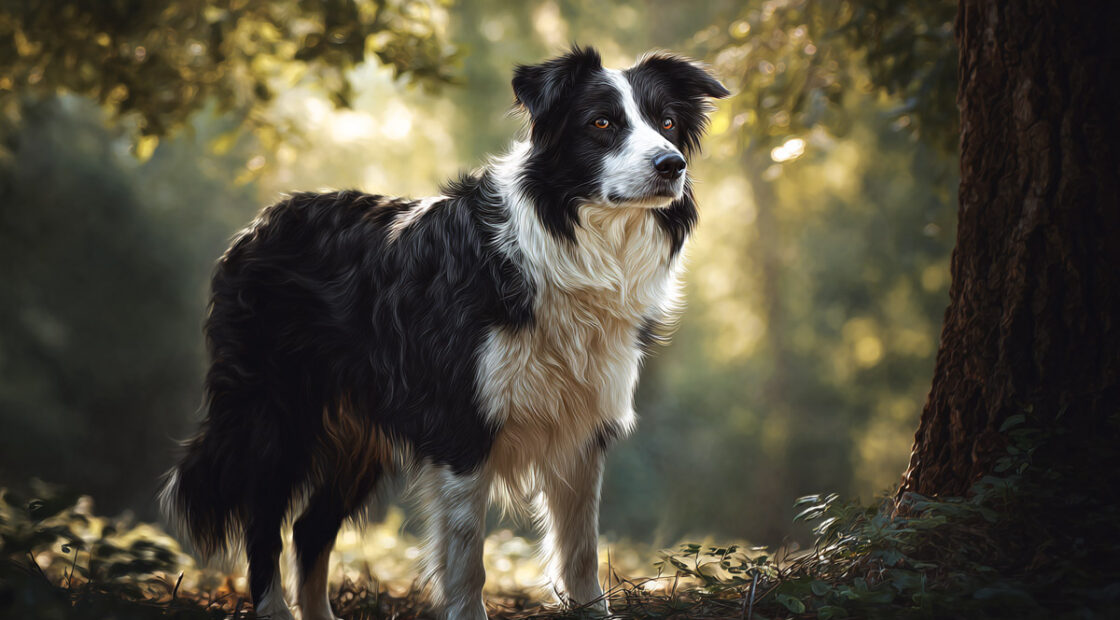
Border Collies work sheep. This medium-sized British herding dog controls livestock with a fixed stare called the eye, then a stalking approach that ends in a low crouch.
Shepherds on farms worldwide still use the breed, and handlers also compete with it in obedience, agility and sheepdog trials.
The Federation Cynologique Internationale files the breed under Group 1, Sheepdogs and Cattle Dogs. It lists it as subject to a working trial (FCI standard No. 297, 1987), and the same standard names sheepdog as its utilization.
What Is a Border Collie?
Registries can’t agree on where the breed belongs, which says a lot about it.
It’s a collie-type herding dog from the Anglo-Scottish border, and according to the AKC breed standard it still works sheep on farms worldwide.
Where it sits depends on who you ask:
| Body | Classification | Detail |
|---|---|---|
| AKC | Herding Group | Fully recognized in 1995 |
| The Royal Kennel Club (UK) | Pastoral Group | Standard last updated January 2025 |
| FCI | Group 1, Sheepdogs and Cattle Dogs | Standard No. 297, subject to a working trial |
| ISDS | Working registry, no show group | Registers dogs on working ability |
That split runs through the whole breed. Show registries describe an appearance. Working registries such as the International Sheep Dog Society (ISDS) and the American Border Collie Association (ABCA) care about what the dog does with stock, and not much else.
The ABCA treats looks as irrelevant and identifies a working Border Collie by attitude and ability. A show standard wants a keen, alert expression and brown eyes, though the FCI text allows blue in merles.
It also helps to know the Border Collie is a separate breed from the show-ring Collie. Both grew out of the same working stock. Once the Royal Kennel Club’s Rough and Smooth Collies reached the show ring in 1860, they took on a standardized appearance.

Same ancestors, different job.
Where Does the Border Collie Come From?
Most registered pedigrees trace back to one dog, Old Hemp, born in Northumberland in September 1893. Before him, the ancestors were landrace sheepdogs of the Anglo-Scottish border.
Shepherd Adam Telfer bred Hemp from a black and tan sire, Roy, and a strong-eyed black dam, Meg.
Hemp was a quiet, powerful tricolor dog, and sheep moved for him easily. Shepherds used him at stud. His working style ended up as the breed style.
The name pairs the border region with “collie”, a Scots word for a working sheepdog.
Recognition came in stages:
- Old Hemp is born in 1893, bred by Adam Telfer.
- In 1915 James Reid, secretary of the ISDS, uses the term “border collie” to separate ISDS-registered dogs from the Kennel Club’s collie, and the ISDS stud book begins.
- The AKC places the breed in its Miscellaneous class in 1955.
- The FCI accepts it on a definitive basis in 1977 as standard No. 297.
- Full AKC recognition arrives in 1995.
Many working breeders fought AKC recognition. Britannica reports they feared it would encourage dogs bred to look right but unsuited to the breed’s traditional work.
Pet-care sites often add Roman drover dogs and Finnish Spitz ancestors to the story. That lineage is a belief and not a documented record, so the verifiable history starts with border shepherds and Telfer’s breeding.
Border Collie Size, Coat and Colors
The AKC standard sets height at 19 to 22 inches for males and 18 to 21 inches for females, measured at the withers. The coat can be rough or smooth, in any color or combination of colors.
Height and weight
The Royal Kennel Club standard, updated January 2025, gives an ideal height of 53 cm (21 inches) for dogs, with bitches slightly less. Britannica puts weight at 30 to 55 pounds (14 to 25 kg).
The Royal Kennel Club adds that its measurements describe an ideal, and a real dog can be larger or smaller.
The AKC standard says overall balance between height, length, weight and bone matters more than any absolute measurement. It also warns that excess body weight is not to be mistaken for muscle or substance.
Coat types and shedding
Both coats are dense, weather-resistant double coats with a short, insulating undercoat.
The rough coat runs medium to long, feathered, flat to slightly wavy. The smooth coat is short all over the body.
Brushing once or twice a week keeps shedding manageable, depending on coat length, according to VCA Animal Hospitals.
Colors and markings
The AKC standard accepts all colors and combinations of colors and markings.
The FCI standard ties nose color to coat color. Most dogs have a black nose, chocolate dogs a brown one, and blues a slate one. Black and white is the most common pattern, and the breed also turns up in these colors:
- Tricolor (black, white and tan)
- Chocolate and white
- Red and white
- Blue
- Merle
Some working handlers avoid mostly white dogs, believing sheep won’t respect them. The ABCA considers appearance irrelevant when judging a working dog.
How Long Does a Border Collie Live?
About 12 years, give or take. A Border Collie born in the UK can expect 12.1 years, according to the Royal Veterinary College’s VetCompass life tables (Teng et al., 2022).
Other studies and breed clubs publish different numbers because they measure different things.
- The 12.1 years above is life expectancy at birth from the VetCompass tables.
- A separate VetCompass sample of 165 Border Collies, with records from 92 UK practices, gave a median age at death of 13.38 years (interquartile range 11.49 to 14.99) at the Royal Veterinary College (O’Neill et al., 2012).
- The Border Collie Club of NSW, published by Dogs Queensland, gives an average life expectancy of 12 to 15 years.
- The Royal Kennel Club breed profile says average lifespan is over 12 years.
The 12.1 figure is a life-table mean from dogs that died between 2016 and 2020. The 13.38 figure is a median from an earlier record sample, and the breed club range is an estimate and not a measurement.
Read together, the two veterinary datasets put the typical lifespan at roughly 12 to 13.4 years. The Royal Kennel Club’s “over 12 years” fits that range, and the club range of 12 to 15 spans it.
Age changes the answer. Remaining life expectancy does not fall in a straight line with age, so an adult dog’s expected remaining years come from the VetCompass tables by age, not from the figure at birth.
Both veterinary datasets cover dogs under UK veterinary care, so they describe pet Border Collies better than farm dogs. And an average describes a population, not one dog.
How Does a Border Collie Herd, and How Smart Is It?

It stares down livestock, stalks toward it and follows with a chase. That’s an early stage of the predatory sequence, which selective breeding has kept and muted.
The herding sequence
The full sequence runs orient, eye, stalk, chase, grab-bite, kill-bite, dissect, consume. Herding breeds keep the early stages and have the later ones subdued.
In a Border Collie that shows up as the eye, a fixed stare that holds stock in place, followed by a slow stalk with head and body kept low. The crouch is the motionless stance that lets the dog wait and control the distance. Then a burst of speed, the chase, moves the stock.
The Border Collie’s sequence tends to stop at the chase. The Australian Cattle Dog, a heeler, carries on to the grab and bite, per the AKC.
The same sequence shows up at home. Without training, dogs fix on children and bicycles, even cars, according to Vetwest’s breed notes in Australia.
Sheepdog trial tasks

The ISDS runs sheepdog trials at three levels of difficulty, and each level tests the sequence under rules.
A run opens with the outrun, where the dog leaves the handler and reaches sheep some distance away. Next comes the lift and fetch, taking control of the sheep and bringing them to the handler. Driving sends them away again through gates. The dog also has to shed, which means separating one or more sheep from the flock, and it finishes by placing the sheep in the pen.
What the intelligence evidence shows
Stanley Coren, author of The Intelligence of Dogs (Free Press, 1994), reported in Psychology Today in 2009 that 190 of the 199 judges he surveyed placed the Border Collie in their top 10 for working and obedience intelligence.
That ranking measures how quickly a dog learns commands from people. It rests on judges’ impressions, not on cognitive tests.
Chaser, a Border Collie trained by psychologist John Pilley, learned the names of 1,022 objects over three years of training (Pilley and Reid, Behavioural Processes, 2011). She also learned category words, and she worked out the name of a new object by excluding names she already knew.
One intensively trained dog shows what the breed can reach, not what a typical pet does.
How Much Exercise Does a Border Collie Need?

The Royal Kennel Club lists more than 2 hours of daily exercise for the breed, and the PDSA sets two hours as the minimum.
The PDSA recommends spreading it over several walks, with off-lead time in a secure area.
Mental work comes on top of the walks. The PDSA adds play and training sessions to the daily routine, plus puzzle feeders.
Agility and flyball suit the breed because they mix running with problem-solving in fast, structured sessions (PDSA). Herding classes are the original outlet for the eye, stalk and chase. City dogs without stock can try Treibball, which means “herding” large fitness balls around an arena (AKC). Obedience is another good fit, since the breed is a leading competitor, according to VCA Animal Hospitals.
The PDSA’s line is that more exercise is better. Veterinary research complicates that.
Border Collie collapse, an episodic nervous system disorder, follows strenuous exercise, and heat, intensity and excitement seem to be triggers (University of Saskatchewan veterinary college). The AKC Canine Health Foundation reports it in working stock, agility and flyball dogs, and pets that retrieve balls repeatedly.
Falling short has its own cost. The PDSA says a Border Collie left alone or under-exercised will chew whatever is in reach.
Compulsive staring and chasing of lights or shadows also show up more often in the breed than in others, per a University of Helsinki survey (Salonen et al., Scientific Reports, 2020). A dog that fixates is worth a vet conversation.
Puppies and older dogs need shorter, gentler sessions.
How to Train a Border Collie

Reward-based training works best for the breed, and the PDSA says it has to start early and continue for the dog’s whole life.
In practice, the order goes roughly like this.
- Socialize inside the first three months. The American Veterinary Society of Animal Behavior (AVSAB) names that window as the primary one, and puppy classes are possible from 7 to 8 weeks of age.
- Teach the basics with rewards. Sit, down, stay and recall, paid with food, play or praise.
- Build self-control and two redirect cues. Ask for a calm sit or down before every ball throw or tug game, then teach “Watch Me” and “Leave It” for the moments when something moving sets off the stare (AKC).
- Interrupt the eye early. Agility trainers writing in Clean Run (2012) advise breaking the stare before it becomes a stalk, because a dog locked into eye and stalk has trouble switching out.
- Give the drive a job. Herding, Treibball, flyball, disc and agility all channel it, per the AKC.
- Work toward the Canine Good Citizen test. The AKC program checks loose-lead walking, coming when called, reaction to another dog and supervised separation.
Food rewards can be healthy dog treats, though play and praise do the job too. The PDSA says to count training treats toward the daily food allowance.
Punishment backfires. In a PLOS ONE study of companion dogs at training schools in Porto, dogs trained mostly with aversive methods showed more stress-related behavior and bigger cortisol rises after sessions than dogs trained with rewards (Vieira de Castro et al., 2020).
Separation trouble tends to travel with impulsivity. In the Helsinki survey, hyperactivity and compulsive behavior clustered with separation-related behavior, so self-control work pays off before problems start.
Which Health Problems Affect Border Collies?

Border Collies carry a short list of inherited conditions, and most have a DNA or screening test. That covers collie eye anomaly, hip dysplasia, neuronal ceroid lipofuscinosis (NCL), trapped neutrophil syndrome (TNS) and MDR1 drug sensitivity.
Epilepsy and Border Collie collapse do not.
Breed profiles disagree on the overall picture. Some call the breed generally healthy, while veterinary neurology literature describes a high prevalence of idiopathic epilepsy.
Conditions with a test
| Condition | Test | Detail |
|---|---|---|
| Collie eye anomaly | DNA test, eye scheme exam | Listed in The Royal Kennel Club’s pre-breeding screening |
| Hip dysplasia | X-ray scoring | BVA/KC Hip Dysplasia Scheme, with a matching elbow scheme |
| NCL | DNA test (CLN5 gene) | Autosomal recessive, carriers show no signs |
| TNS | DNA test (VPS13B gene) | Mutant allele seen at 7 to 8% worldwide (UC Davis VGL); results can go to the Orthopedic Foundation for Animals |
| MDR1 sensitivity | DNA test | Approximate frequency under 5% in Border Collies, about 70% in Collies (Washington State University) |
Two carriers of a recessive condition such as NCL or TNS can produce affected puppies, which is why breeders test before pairing dogs.
The PDSA lists a few more. Intestinal cobalamin malabsorption is an inherited disorder of vitamin B12 absorption. Sensory neuropathy is a nerve disease affecting mobility, and it has a DNA test. Goniodysgenesis is a predisposition to glaucoma, with BVA/KC screening.
Conditions with no test
Epilepsy is the biggest gap. In a Frontiers in Veterinary Science study of 116 Border Collies seen at veterinary referral hospitals, the median age at first seizure was 33.5 months, and the authors report that quality of life can be heavily affected (Santifort et al., 2022).
Border Collie collapse has no test either, and neither does discoid lupus (collie nose), per Dogs NSW.
Some breed guides recommend a DNA test for exercise-induced collapse. That test targets the DNM1 mutation behind collapse in Labrador Retrievers, and University of Minnesota researchers did not find it in a large group of collapsing Border Collies.
Is a Border Collie a Good Family Dog?

It depends on the household. A Border Collie fits an active home with teenagers or adults better than one with young children, according to the PDSA, which does not recommend the breed where smaller children live.
Other profiles are friendlier. Purina Australia calls it an affectionate pet for active families, so the real dividing line is the children’s ages and the household’s energy.
Herding sometimes means bumping into kids, and the PDSA says that can knock a small child over. Running and squealing keep the behavior going. The AKC notes that when kids flee a dog that nips at their feet, the herding continues.
With other pets, a socialized Border Collie usually gets along with other dogs, and the PDSA says it prefers human company. It may try to herd smaller animals, so supervision stays on.
Time alone is the other sticking point. The PDSA says the breed does not do well on its own and ideally lives where someone is around most of the day.
When a Border Collie Is the Wrong Choice

When the household can’t supply daily exercise and company, along with ongoing training, this breed is the wrong pick.
| Situation | Why it fails | Workaround |
|---|---|---|
| Small flat, no garden | PDSA asks for a large, secure garden | Treibball, agility, several long outings |
| Out more than 4 hours a day | Chewing and boredom when left alone | Dog walker or day care |
| First dog, no training plan | The PDSA says the breed is not the best choice for first-time owners | Classes from puppyhood |
| Toddlers at home | Herding bumps can knock children over | Wait until the children are older |
Apartments are not an absolute no. The AKC points to Treibball as an option for city dogs, so the limit is the daily outlet and not floor area.
Guides split on training difficulty. Purina Australia calls the breed easy to train, while the PDSA says it suits experienced owners.
Both hold. The dog learns quickly, and it needs a handler who can run consistent reward-based sessions for life.
If the week can’t hold about two hours of daily activity plus training, and someone at home most of the day, pick a lower-drive breed.
Border Collie FAQ
How much does a Border Collie puppy cost?
Breeders set their own prices. The PDSA puts the ongoing cost of owning one at a minimum of £80 a month, over £13,000 across the dog’s lifetime.
The PDSA warns that unusually cheap puppies can come from puppy farms and recommends Assured Breeders registered with the Royal Kennel Club, who must do extra health tests.
Is a Border Collie hypoallergenic?
No. The double coat sheds, and the PDSA says shedding increases in spring and autumn.
Brushing a couple of times a week keeps dead hair under control, but it does not make the coat low-shedding.
What should a Border Collie eat?
A complete, balanced commercial dog food, split into two meals a day, according to the PDSA.
Keep the dog slim and hold treats under 10% of daily calories. A breed-specific feeding chart helps with portions, and the vet confirms the amount.
Do Border Collies bark a lot?
Depends on the dog. The PDSA says Border Collies usually go one of two ways, with some vocalizing a lot and others staying fairly quiet.
More exercise and mental stimulation tends to mean a quieter dog. Persistent barking calls for an accredited behaviorist.
Can you adopt a Border Collie from a rescue?
Yes. The PDSA lists general rehoming centres and breed-specific Collie rescues, and says adopting an adult can cost less than buying a puppy.
Ask about the dog’s history. A good centre reports any known health and behavior problems.
How does a Border Collie differ from an Australian Shepherd?
Herding drive and high energy are shared. Origin and MDR1 risk are not.
The Australian Shepherd was developed in the United States despite its name, and Washington State University puts MDR1 mutation frequency near 50% in the breed. Ask a vet about an MDR1 test before sedation or certain drugs.
Choosing a Border Collie From a Breeder or Rescue
Go for a dog whose parents have recorded DNA and screening results, and whose background matches the daily workload your home can supply.
The Royal Kennel Club’s Health Test Results Finder lists DNA and screening results for any dog on its Breed or Activity Register.
Look up both parents’ results first, since a missing result ends the search before any time goes into a visit. After that, ask about seizure and collapse history among relatives, and about how the breeder socializes puppies.
The panel has limits. Epilepsy and collapse have no test, and the Royal Kennel Club revises its Assured Breeders requirements twice a year (Kennel Club, 2022), so a litter tested last year can miss today’s list.
Color brings one restriction too. The Royal Kennel Club will not register puppies from merle to merle matings born on or after 1 January 2013.