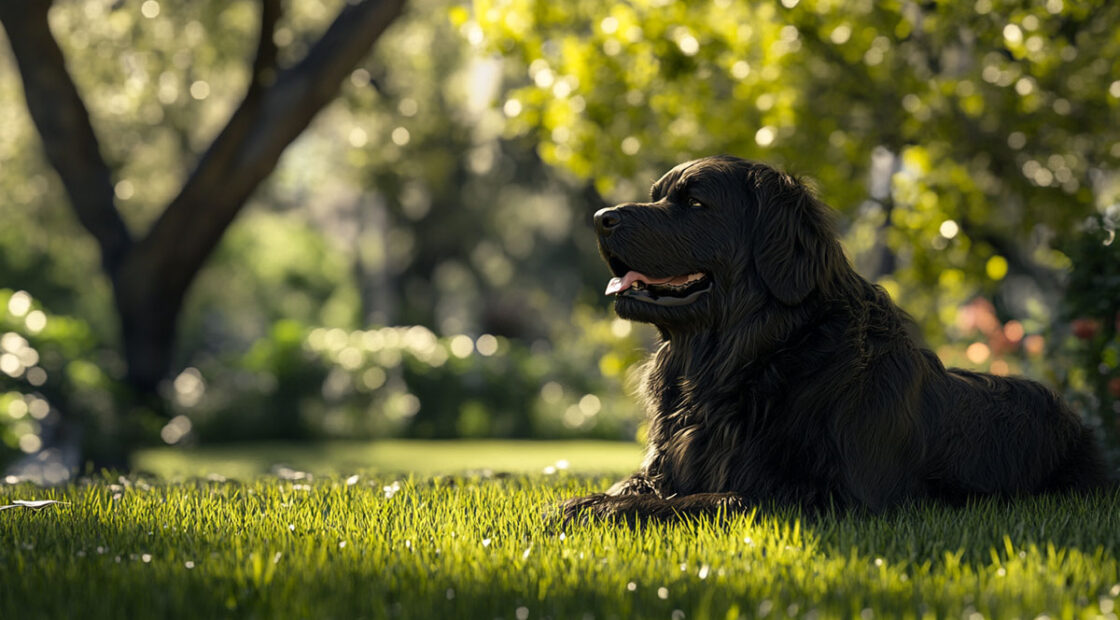
Fishermen on the island of Newfoundland bred this dog to haul fishing gear and pull people out of cold water. Today the Newfoundland is a giant working breed, and the American Kennel Club places it in the Working Group.
Most owners keep one as a family companion, and some train theirs for water rescue and draft tests. Cool climates suit the breed best. Brushing is a weekly job at the very least, and you need the floor space that comes with a giant dog.
The AKC ranked it No. 46 of 202 breeds in its 2025 popularity list, which puts it in the top quarter.
What Is a Newfoundland Dog?
Newfoundlands pull swimmers out of cold water and haul heavy loads, and the build for the job shows up close. The feet are webbed and the coat is dense and water-resistant. A calm temperament does the rest.
Owners shorten the name to Newf or Newfie. “Gentle giant” is the nickname that stuck.
The AKC and The Kennel Club (UK) both file the breed under the Working Group. The Canadian Kennel Club, which recognized it in 1889, lists it in Group III (Working Dogs). It comes from the island of Newfoundland and is one of five dog breeds native to Canada. The original work was hauling nets and pulling people and objects out of rough seas, as well as drawing carts and ploughs on land.
Don’t confuse it with the St. John’s water dog. That smaller fishermen’s dog is extinct, but it became the founding stock of modern retrievers, the Labrador among them.
According to the Canadian Encyclopedia, most Newfoundlands today live as companions and watchful family members rather than working dogs.
How Big Does a Newfoundland Get?

An adult male averages 28 inches at the shoulder and 130 to 150 pounds. Females average 26 inches and 100 to 120 pounds, according to the Newfoundland Club of America standard.
The UK standard, last updated 1 July 2024, asks for heavier dogs at the same height.
Side by side, the two standards read like this.
- US males, 28 in (71 cm) and 130-150 lb
- US females, 26 in (66 cm) and 100-120 lb
- UK males, 28 in (71 cm) and 141-152 lb (64-69 kg)
- UK females, 26 in (66 cm) and 110-120 lb (50-54.5 kg)
These are averages, so individual dogs land outside them. Still, the UK range starts 11 pounds above the US range for males and 10 pounds above it for females. It’s an easy gap to miss when two breed pages quote different weights.
Both standards rank balance above bulk. The US text accepts large size only when structure and gait stay correct, and it expects males to look more massive throughout than females.
Britannica advises large-breed puppy food. The breed is prone to hip dysplasia, and that kind of food slows the rate of growth.
Newfoundland Coat Types and Colors, and Where the Landseer Fits
The Newfoundland wears a flat, water-resistant double coat in black, brown, gray or Landseer (white with black markings), though only the US standard accepts all four.
| Registry | Accepted colors | Not accepted |
|---|---|---|
| AKC and Newfoundland Club of America | Black, brown, gray, Landseer | Any other color (disqualified) |
| The Kennel Club (UK) | Black, brown, Landseer | Gray |
| Canadian Kennel Club | Black, Landseer | Brown, gray |
The US standard ranks color below type and structure, and below soundness too. No color is rarer or worth more than another.
How the double coat is built
The outer coat is coarse, moderately long and full, straight or wavy. The UK standard adds that it is oily, which is what repels water.
Underneath sits a soft, dense undercoat that gets thinner in summer or in warmer climates. Feathering is longest on the backs of the legs and on the tail.
The Kennel Club breed profile rates both moulting and grooming needs as heavy.
Is the Landseer a color or a separate breed?
It depends on the registry. The AKC, The Kennel Club and the Canadian Kennel Club treat the Landseer as a color pattern of the Newfoundland, while the FCI lists the Landseer (European Continental Type) as its own breed.
The continental dog is taller and narrower than the Newfoundland, with black markings on white. The pattern takes its name from Sir Edwin Landseer, the 19th century painter who put white and black Newfoundlands in many of his canvases.
The Canadian Kennel Club calls the Landseer of historical significance to the breed.
Newfoundland Temperament With Children, Strangers and Other Pets
Breed standards describe a calm, patient dog. The Newfoundland Club of America names sweetness of temperament as the hallmark of the breed and its most important single characteristic.
The UK standard asks for an “exceptionally gentle, docile nature.” The AKC’s own breed page repeats the reputation of a patient, watchful nanny dog around kids.
With children
Temperament is the good news. Patience and tolerance come with it, and Burke’s Backyard describes the breed as very good with children.
Size is the catch, because it leaves very little margin for error. The same fact sheet says a dog this large and strong should not be left unsupervised with young children, and Britannica adds that children and the elderly can struggle to manage one.
Strangers and other pets
The Kennel Club breed profile says protection comes from presence and a warning bark.
Cats and small dogs get hurt by accident, not intent, so Dog Academy suggests watching early interactions closely. PangoVet makes a related point: wide socialization with people and animals prevents a fearful 130-pound adult.
Training and socialization
Purina rates early, consistent training and socialization as crucial for a well-mannered Newfie. ShowSight goes further and steers novice owners away from the breed, because the size demands a handler who is confident with a large dog.
A habit left alone at 20 pounds is a much bigger problem at 130.
How Long Do Newfoundlands Live, and Which Health Problems Affect the Breed?
Newfoundlands live roughly 9 to 10 years. Heart disease and joint dysplasia lead the list of health risks, and bloat belongs on it too.
Much of that risk can be screened before a puppy is bought, which makes the breeder’s paperwork the most useful thing a buyer can check.
Lifespan
The Kennel Club’s 2018 Breed Health and Conservation Plan for the Newfoundland reports a median age at death of 9 years 8 months in the 2004 purebred dog health survey and a median longevity of 10 years in the 2014 survey.
Pet-information sites quote wider ranges, from 7-11 up to 10-12 years, mostly without naming a study. I’d trust the survey medians over those.
Inherited conditions
Subvalvular aortic stenosis (SAS)
A fibrous ridge forms below the aortic valve and narrows the outflow of blood from the heart. Newfoundlands are among the most overrepresented breeds.
The numbers depend on who is counted. Bellumori and colleagues (2013) found SAS in 6.80% of Newfoundlands at a university teaching hospital in California, against 0.15% of mixed breeds. A 14-year French screening program covering 921 dogs found 99.1% free of aortic stenosis (Chetboul et al., PLoS ONE, 2025).
A referral hospital sees sick dogs, while a screening program tests dogs regardless of symptoms. Both figures are real, and they answer different questions.
Dilated cardiomyopathy (DCM)
The heart muscle weakens in DCM, which also appears among the breed’s predisposed conditions. Atrial fibrillation, a heart rhythm disorder, is over-represented too, per the Kennel Club plan’s review of North American case series.
Cystinuria
Dogs with this inherited disorder form cystine stones in the urinary tract. It is autosomal recessive, caused by a nonsense mutation in the SLC3A1 gene (Henthorn et al., 2000), and a DNA test identifies carriers. Breed representatives report no carrier-to-carrier matings since the test became available.
Hip and elbow dysplasia
Witsberger and colleagues (2008) diagnosed hip dysplasia in 17.16% of Newfoundlands in a veterinary database. A 2016 OFA and NCA Charitable Trust survey put it at 9.5%. Both figures appear in the Kennel Club plan, and the gap fits the same pattern as before, since clinic records run higher than owner surveys.
Gastric dilatation-volvulus (GDV)
The stomach swells and twists. Evans and Adams (2010) attributed 5.6% of deaths in the 2004 survey to GDV, a mortality ratio of 2.3 against all breeds.
| Condition | What it affects | Screening on the AKC list |
|---|---|---|
| Subvalvular aortic stenosis | Heart outflow | Cardiac exam |
| Dilated cardiomyopathy | Heart muscle | Cardiac exam |
| Cystinuria | Urinary tract | DNA test |
| Hip and elbow dysplasia | Joints | Hip and elbow evaluation |
| GDV (bloat) | Stomach | No test listed |
Health clearances to ask for
- Get the registered names and numbers of both parents.
- Open the public hip and elbow results for each parent.
- Confirm a cardiac exam, preferably by a cardiologist.
- Check the cystinuria DNA status of both parents.
Screening reduces risk without removing it. The OFA’s Keller (2011) stresses that the CHIC program is about health consciousness, not normal results. A CHIC number proves testing happened and says nothing about the outcome.
Grooming, Exercise and Feeding Needs of a Newfoundland
Weekly brushing is the minimum, and about half an hour of exercise a day is enough. Heat and bloat are the two things to plan around.
The coat takes the most time, but feeding takes more care.
Grooming and shedding
The Newfoundland Club of America sets the floor at weekly brushing. PetGuide recommends several sessions a week, with the undercoat shedding in spring and fall. A stiff-bristled or pin brush works best, since the thick double coat mats easily (PetGuide).
Regular grooming cuts hot spots and ear infections and lets you catch fleas and skin problems early, according to the same club.
Drool and loose hair come with the breed, so keep towels where the dog lives.
Exercise and heat
Moderate and steady beats long and hard. Burke’s Backyard puts the daily minimum at 30 minutes. Growing puppies get light play only, because ball and stick chasing strains young bones. Swimming is a bonus, not a requirement, since the club says Newfoundlands do not need to swim.
Heat is the standing risk. PetGuide says the breed does poorly in warm weather, tells owners to watch for heat stroke, and advises against long exercise sessions in the first two years.
Feeding and bloat prevention
Here is the routine for a dog at risk of bloat.
- Split the daily ration into several small meals.
- Keep exercise away from mealtimes, before and after.
- Feed from floor level.
- Ask the breeder about bloat in the pedigree.
- Learn the warning signs, which are panting, restlessness, drooling, and retching that brings up nothing.
The first two steps come from the British Columbia government’s GDV fact sheet (updated February 2024), which also names eating a large meal rapidly as a trigger. A slow feeder bowl takes the speed out of mealtime for a dog that gulps.
Raised bowls backfire on giants. Buckley’s evidence review in Veterinary Evidence (2017) found giant-breed dogs more likely to develop GDV when fed from bowls above one foot, and no study showed a raised feeder lowering risk.
First-degree relatives of a dog that has bloated carry a 63% greater risk, according to Glickman and colleagues (2000).
Once the stomach twists, the same fact sheet calls GDV a life-threatening emergency that needs immediate surgery. Gastropexy, which tacks the stomach to the abdominal wall, is an option for high-risk dogs.
How Newfoundlands Perform Water Rescue and Draft Work
The rescue drive is instinct, and the Newfoundland Club of America tests that instinct through formal water and draft titles. Italy’s canine lifeguard school builds on the same trait for beach rescue.
Physical adaptations
The club’s standard describes feet that are proportionate to the body, webbed and cat-footed. Lung capacity is large, which lets the breed swim long distances (Canadian Encyclopedia), and ShowSight magazine credits the harmonious proportions of the build for endurance swimming.
Working tests and titles
Club members drew up a water trial of 12 exercises in 1971, six each for a junior and a senior division, and held the first official test two years later in Michigan, per the AKC.
| Title | Test | Division |
|---|---|---|
| WD (Water Dog) | Junior water exercises | Junior water |
| WRD (Water Rescue Dog) | Senior water exercises | Senior water |
| WRDX (Water Rescue Dog Excellent) | Six advanced rescue exercises | Elite water |
| DD (Draft Dog) | Completes a draft test | Draft, solo |
| TDD (Team Draft Dog) | Draft test with two or more dogs | Draft, team |
WRDX is the newest division. Its exercises include rescuing two drowning victims from behind a boat.
Documented cases and limits
Roberto Gasbarri, who coordinates the Italian School of Canine Lifeguards, counted 300 fully trained dogs in reporting by the Portland Press Herald.
Training length depends on the stage. Gasbarri said expert status takes three years, while another published account describes 12 to 18 months of intensive training.
The school’s founder, Ferruccio Pilenga, started it with his own Newfoundland, Mas, who had rescued his daughter from a lake.
Then there is Gander, a 65 kg regimental mascot of the Royal Rifles of Canada. He was awarded the PDSA Dickin Medal on 27 October 2000 for the Battle of Lye Mun in December 1941. Veterans Affairs Canada says Gander died carrying an enemy grenade away from wounded soldiers, which saved seven of them.
Instinct only gets a dog so far. Ocean Navigator notes that the breed’s lifesaving skills were mostly instinctual until Italy’s program began formalizing the training.
Where Did the Newfoundland Come From?
The breed took shape on the island of Newfoundland as a fishermen’s working dog. Its deeper ancestry is still debated.
Timeline of the breed
- European fishing crews brought dogs to the island after John Cabot’s voyage in 1497, and crossbreeding there produced the St. John’s water dog (Canadian Encyclopedia)
- The Oxford English Dictionary records “Newfoundland dog” in the journal of Joseph Banks in 1766
- A law protecting sheep limited each household on the island to one dog in 1780
- Lord Byron’s Boatswain was born in Newfoundland in May 1803 and lived at Newstead Abbey until he died of rabies on 18 November 1808
- By the early 1900s the breed was nearly extinct on the island, and Harold Macpherson of St. John’s helped restore it
- The Newfoundland Club of America was founded in 1930
Ancestry theories
The Canadian Encyclopedia calls the origins speculative. One theory points to Scandinavian bear dogs that Vikings could have brought more than 1,000 years ago.
Another holds that the bear dog and the Newfoundland both descend from the Tibetan mastiff, which looks very similar to the Newfoundland.
Heritage NL adds Basque and Norse settlers as possible importers of the large dog. The Pyrenean mountain dog and the Portuguese water dog are among its candidates for the St. John’s water dog, and so is the Saint Bernard. European mastiffs were crossed in later for size and strength.
British breeders gave the smaller type the name Labrador to tell the two dogs apart, per Heritage NL.
How Much Does a Newfoundland Cost to Buy and Keep?
A Newfoundland costs more than most dogs at every step, and no single current price is reliable. The most authoritative figures are old, and current price guides disagree.
The Newfoundland Club of America’s owner FAQ (copyright 2000, prices undated) put a puppy from a reputable breeder at $1,500 to $2,000 and food at about $30 a month.
Treat both as floors. Current commercial price guides quote wider ranges that differ from site to site.
Everything costs more with a large dog, food, drugs and boarding included, per Britannica. Surgery runs higher because giant breeds need more anesthesia (Newfoundland Club of America). Bedding and gear have to be sized for a dog of 100 pounds and up. And the puppy’s own price reflects what the breeder spent testing the parents.
Petful makes the point that a Newfoundland puppy price is a dated local quote. Verifiable screening records and a clear contract matter more than the number on it.
A suspiciously cheap puppy usually means skipped clearances. That kind of saving gets expensive.
When a Newfoundland Is the Wrong Dog
A Newfoundland is the wrong dog for a hot climate, a tight budget, a home too small to turn around in, or an owner who dislikes drool and hair.
If a household fails any of the checks below, pick another breed.
- The climate has to be cool enough for the dog to live indoors in comfort.
- The budget has to cover giant-breed veterinary bills, including surgery, and not only the purchase price.
- The home and the vehicle have to fit a 28-inch, 130-pound dog.
Apartments split the sources. Dog Academy says the size typically rules out apartment living even though the breed is quiet, while Ask a Vet says apartments work if the dog gets ample exercise.
A big yard alone doesn’t fix it either. The club’s FAQ says a Newfoundland should never be tied out in a backyard or chained to a porch or dog house.
How the Newfoundland differs from the Saint Bernard and Great Pyrenees
| Breed | Bred for | Temperament cue |
|---|---|---|
| Newfoundland | Water rescue and draft work | Sweet-dispositioned, devoted |
| Saint Bernard | Working giant of the Swiss Alps | Watchful, patient with children |
| Great Pyrenees | Guarding flocks from wolves on snowy mountaintops | Mellow companion, vigilant guardian |
For a family that wants a giant, patient dog, the Saint Bernard is the closer match in temperament.
The Great Pyrenees sits further away, since a guarding job shaped it. That suits an owner who wants watchfulness more than a dog that works beside people.
Newfoundland Dog FAQ
Do Newfoundlands drool a lot?
Yes. The Newfoundland Club of America lists drooling as a normal trait of the breed.
Keep towels where the dog eats and rests, and expect it on furniture and clothes.
Does a Newfoundland have to swim?
No. The club’s owner FAQ says Newfoundlands do not need to swim, and its water test works as a training ground rather than a requirement.
For a pet, swimming is a bonus.
Can a Newfoundland live outside in a yard?
Not as a yard dog. The club says a Newfoundland should never be tied out or chained to a porch or doghouse, and the breed handles heat poorly.
Plan on an indoor life in a cool part of the house.
Which dog group does the Newfoundland belong to?
The American Kennel Club lists it in the Working Group. The FCI places it in Group 2, which covers Pinscher and Schnauzer types along with molossoid breeds and Swiss mountain dogs.
Is a Newfoundland a trained rescue dog by nature?
No. The rescue drive is instinct, and Ocean Navigator notes the breed’s lifesaving skills were mostly instinctual until Italy’s school formalized the training.
Titles such as the Water Rescue Dog show whether a dog performs on command.
When does a Newfoundland shed the most?
In spring and fall, when the undercoat sheds heavily, according to PetGuide.
Brush more often in those seasons, and keep the weekly minimum the rest of the year.
Checks to Run Before Bringing a Newfoundland Home
Climate and space come first, then the giant-breed vet budget. The breeder’s records follow, and the contract comes last. A Newfoundland puppy from the wrong home or the wrong litter cannot be corrected afterward.
The order follows what a buyer can still change. A hot climate or a small house stays fixed, while the choice of breeder is open until the deposit is paid.
- Climate, living space and giant-breed vet budget
- Parent screening results and bloat history in the pedigree
- A written contract covering health and return terms
A buyer who reverses the first two steps often falls for a litter before checking the house. That is the pattern to avoid.
Waiting for a screened litter means a waiting list and a higher purchase price. Skipping the wait buys a lower price now and unscreened parents later.