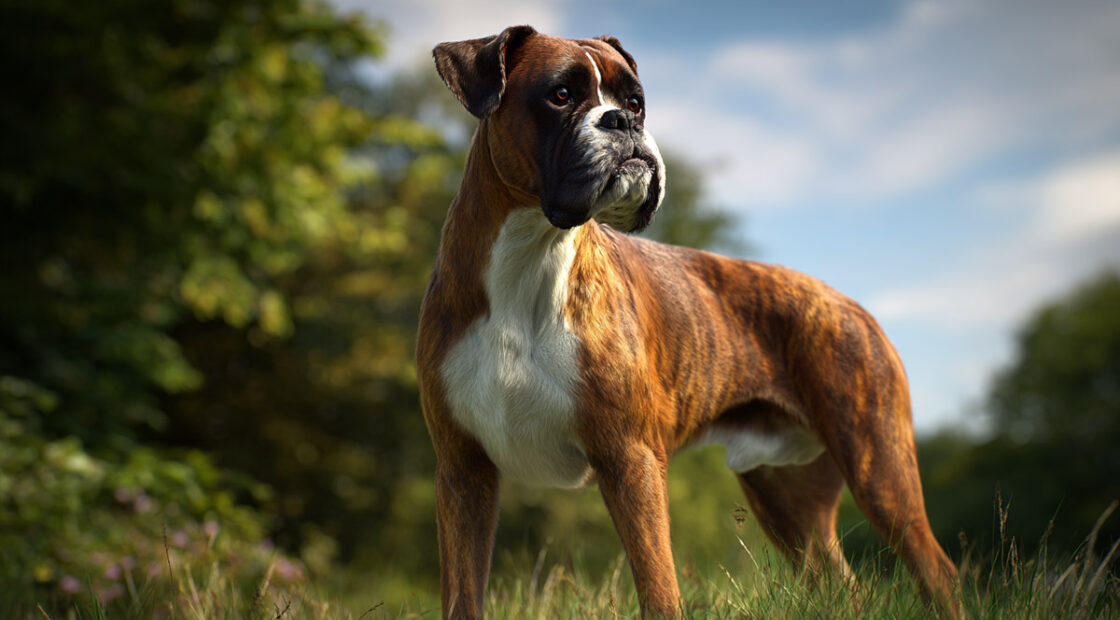
Munich breeders crossed the Bullenbeisser with the Bulldog in the 1890s and ended up with the Boxer, a medium-to-large, short-coated working dog meant for guard, police and military duty. The AKC and The Kennel Club both file it under the Working Group. The FCI puts it in Group 2.
These days most Boxers are family dogs with a lot of energy. UK veterinary records show a median lifespan of 10.46 years across 346 Boxers that died, and neoplasia was the leading identified cause of death (RVC VetCompass, 2023).
What Is the Boxer Dog Breed?
Germany developed the Boxer in the late 19th century from the extinct Bullenbeisser and the Bulldog. Guard, police and military work was the original job. Now it’s kept mostly as a high-energy family companion, and you’ll also see it called the German Boxer or Deutscher Boxer.
The AKC and The Kennel Club (UK) both class it in the Working Group. The Federation Cynologique Internationale (FCI) lists it in Group 2, Molossian type, under Standard No. 144.
The name itself is disputed. The UKC standard calls “boxer” a British term and ties it to the way the dog strikes with its front legs. Vetstreet notes that a corrupted form of “beisser” is the other candidate, and no source settles it.
The AKC’s 2025 registration rankings place the Boxer 18th among the 202 breeds listed.
Where Did the Boxer Come From?
The breed took shape in Munich in the 1890s. Breeders there crossed the Brabant Bullenbeisser with the Bulldog, and the first Boxer club followed in 1895.
The Bullenbeisser was a hunting dog of Mastiff descent, and the FCI standard names the small Brabant type as the Boxer’s immediate ancestor. Huntsmen used it to seize game flushed by hounds and hold it until they arrived, which is how the wide jaws and the broad, upturned muzzle got selected for.
Roberth, Konig and Hoepner stabilized the type and organized the first show, according to the Boxer-Klub e.V. chronicle. Muhlbauer’s Flocki became the first registered Boxer in 1904 (AKC). The dates get muddy, though. The AKC’s breed history puts the club in 1895 and the St. Bernard show with a Boxer class in 1896, while older accounts reverse that order.

Germany picked the Boxer as one of its first police-training breeds in 1904, and the AKC registered its first Boxer that same year.
The American Boxer Club formed in 1935. The United Kennel Club says the breed was largely ignored in the US until World War II, when servicemen brought dogs home, and it recognized the Boxer in 1948.
Boxers then won Best in Show at Westminster in 1947, 1949 and 1951, the last of them Bang Away, according to the American Boxer Club.
Bang Away retired with 121 Best in Show wins, and Canine Chronicle reports Boxer registrations climbing 26 percent from 1951 to 1952.
How Big Is a Boxer, and What Do the Breed Standards Say?
Under the AKC standard an adult male stands 23 to 25 inches at the withers. The Kennel Club’s range starts a little lower, at 22.5 inches. Weight is where the registries part ways, with 65 to 80 pounds for the AKC and 66 to 70 pounds for The Kennel Club.
Females are smaller on every registry.
Height and Weight by Registry
The major standards mostly agree on height. Weight, ears and tail are where they split.
| Registry | Male | Female | Ears and tail |
|---|---|---|---|
| AKC | 23-25 in, 65-80 lb | 21.5-23.5 in, 50-65 lb | Cropped ears customary, docked tail expected |
| The Kennel Club (UK) | 57-63 cm, 66-70 lb | 53-59 cm, 55-60 lb | Natural ears, no docking |
| FCI (Standard 144) | 57-63 cm, over 30 kg | 53-59 cm, about 25 kg | Natural ears and tail described |
The AKC ceiling for males sits 10 pounds above the UK range. The AKC states no size disqualification, and The Kennel Club says its figures describe an ideal, not a guarantee.
German Boxer and American Boxer are not separate breeds. Each registry publishes a single Boxer standard, and the labels really just reflect differences in wording and in the ear and tail rules.
Head, Bite and Build
The outline is square. The Kennel Club and the FCI both say body length, measured from forechest to rear of thigh, equals height at the withers. The brisket reaches the elbows and its depth is half the height at the withers (AKC, FCI).
The AKC describes the bite as undershot, meaning the lower jaw protrudes past the upper and curves slightly upward. The head is chiseled, and the forehead wrinkles when the ears are erect.
All that shortening of the skull makes the Boxer a brachycephalic breed. The RVC VetCompass study calls its skull moderately flat-faced, a shape it shares with breeds such as the French Bulldog.
Ear Cropping and Tail Docking
Registries disagree here more than anywhere else.
In the United States, the AKC standard says Boxer ears are customarily cropped but accepts uncropped ears. It describes the tail as set high and docked, and says an undocked tail should be severely penalized.
The UK went the other way. Ear cropping is illegal there, and The Kennel Club has barred cropped-ear dogs from its events for over 100 years. The Animal Welfare Act 2006 prohibits docking except for medical treatment or certified working dogs no more than 5 days old, and it restricts showing docked dogs.
Same breed, opposite rules.
What Colors and Coat Do Boxers Have?
The coat is short, smooth and tight to the body, and it comes in two standard colors. Fawn is a reddish-brown base with a black mask. Brindle is black stripes over that same fawn base.
White markings usually show up on the chest and feet. The AKC lets white replace part of the black mask on the face, but not to an excessive degree.
Mostly white Boxers fall outside the AKC color standard. They are not rare, though. RVC VetCompass (Canine Medicine and Genetics, 2023) found that 10.71% of 3,219 UK Boxers under primary veterinary care were white.
None of the most common disorders differed in prevalence between white and non-white dogs. White Boxers had higher rates of dental and brain disorders, and median lifespan was the same for both groups.
Deafness was recorded in only two of the 3,219 dogs, one white and one non-white. The authors still describe white Boxers as thought to carry a higher risk of congenital deafness and note that little research has measured it in the breed.
Grooming is minimal, and Purina says the short coat sheds only on occasion. It also gives little insulation, so Boxers handle freezing weather poorly (Wisdom Panel).
What Is a Boxer’s Temperament Like?
Boxers play hard and stay close to their families, and they tend to eye strangers with suspicion. The AKC standard puts character and temperament at the top of its priorities for the breed.
Maturity comes late. Burke’s Backyard says to expect up to two years before a Boxer settles.
Family and Children
The AKC lists the breed’s desire for human affection, especially from children, among its most notable traits. Burke’s Backyard goes further and calls the Boxer an ideal family dog for households with older kids.
Toddlers and frail adults are a different story. Britannica says the breed can be too boisterous for older individuals or the very young, and Wisdom Panel advises caution in homes with either.
Supervise play in every case. A Boxer’s bounce knocks small people over without any bad intent.
Other Dogs and Strangers
Friendly, but not with everyone.
Britannica rates the Boxer as moderately friendly toward other dogs, strangers and pets, and extremely affectionate toward its own family. Burke’s Backyard describes the breed as wary of strangers, with strong guarding instincts. Wisdom Panel recommends starting socialization and puppy classes early to channel the energy.
Guarding Behavior
The Kennel Club standard describes the Boxer as lively, strong and loyal to owner and family, but distrustful of strangers. Wisdom Panel calls the breed an excellent watchdog and family guardian.
Aggression depends mostly on upbringing, training and socialization, according to the American Boxer Club as cited by Dogster. Britannica adds that these traits are generalizations and that individual Boxers vary.
A socialized Boxer watches the door. An unsocialized one is the real risk.
How Much Exercise and Training Does a Boxer Need?

Plan on 1 to 2 hours of daily exercise for an adult, split across the day, plus short training sessions and some real mental work. The hottest hours are off limits.
Published guidance varies more than the breed does.
- Atlanta Boxer Rescue suggests 45 to 60 minutes of walking, twice a day if possible.
- Pet Care Corner (Blue Buffalo) recommends two 30-minute walks plus room to run in a fenced area.
- BorrowMyDoggy (vet-reviewed, 2023) says about 2 hours for adults, and 5 minutes per month of age for puppies.
- PetsRadar (Dr Hannah Godfrey) gives a minimum of 2 hours, mixing on-lead and off-lead time.
I’d treat the low end as a floor for walking and the high end as the target for a young, healthy adult.
Dr Godfrey warns that under-exercised Boxers get harder to control around the house, and Vetstreet adds that a bored or lonely Boxer can do a lot of damage.
For training, Pet Care Corner suggests sessions of about 10 minutes, a few times a day. Atlanta Boxer Rescue points to agility, frisbee and tracking as outlets. Wisdom Panel describes the breed as quick to learn but sensitive and stubborn, so harsh corrections backfire.
Heat needs its own attention. A short muzzle makes panting a poor cooling system, which Britannica ties directly to the breed’s brachycephalic skull. Splitting sessions across the day helps (PetsRadar), and so does exercising at the start or end of the day.
Stop at the first sign of heavy panting, noisy breathing or weakness, per Bow Wow Meow Pet Insurance. Never leave a Boxer in a parked car, and fit a jacket for long winter walks (Blue Buffalo).
Exercise is the cheapest behavior fix this breed has.
Which Health Problems Are Common in Boxers?

Most of the documented problems come from cancer, inherited heart disease and a handful of joint, airway and bowel conditions. The RVC VetCompass study lists ear infection, periodontal disease, gum mass (epulis) and corneal ulceration as the four most common disorders recorded in UK Boxers.
Epulis and corneal ulceration point to a real breed predisposition. Earlier VetCompass work also found a high Boxer predisposition to hypothyroidism.
Heart Disease
Boxer cardiomyopathy (ARVC) is an inherited disease of the right ventricle that causes ventricular arrhythmias, fainting and sudden death. VetHelpDirect notes that sudden death is sometimes the first sign.
Subaortic stenosis is the other big one. Most published reports call it the most common congenital heart disease in the breed. Boxers have a high rate of murmurs and naturally higher aortic velocities, which makes mild cases hard to confirm.
A US study of 301 clinically normal Boxers found that 23% had raised ventricular ectopic beat counts on a 24-hour recording (Stern, 2010, as reported by Vet Times).
That figure probably understates prevalence, because the study excluded clinically affected dogs. The Online Mendelian Inheritance in Animals entry states that true prevalence is unknown since many dogs die undiagnosed.
Cancers
RVC VetCompass recorded neoplasia in 14.2% of Boxers in a single year. Among deaths with a recorded cause, cancer was the most common (12.43% of deaths; 21.10% had no cause recorded) (RVC, 2023).
Mast cell tumours are the best-documented type. A VetCompass analysis of English practices (Canine Genetics and Epidemiology, 2015) gave the Boxer the highest breed-specific prevalence at 1.95%.
An NC State study reported by dvm360 found Boxers at higher risk of mast cell tumours of every grade, with low and intermediate grades predominating in the breed.
Any new lump needs a vet’s look.
Joints and Spine
Hip dysplasia is a developmental joint disease. Signs usually appear between 4 months and 1 year of age, though some dogs show none until later in life.
Degenerative myelopathy is a progressive spinal disease that begins in the hind limbs. It has been definitively documented only in Boxers that test as at-risk or homozygous, and the odds of signs rise the longer an at-risk dog lives (Purina Pro Club).
Airway and Digestive Problems
The shortened skull narrows the airway. Owners see noisy breathing, snoring and reduced exercise tolerance (Bow Wow Meow Pet Insurance).
Bloat (GDV) is the digestive worry. A deep chest raises the odds of the stomach dilating and twisting, and Glickman’s 2000 JAVMA breed table gives the Boxer a risk ratio of 3.7 (Weimaraner: 19.3), as summarized in Cornell critical care teaching notes.
Feed adults two meals a day and slow the pace with a slow feeder bowl. Glickman’s Purdue work also found that raised food bowls increased risk, which overturned older advice.
Boxer colitis, formally histiocytic ulcerative colitis, is a chronic large-bowel inflammation seen mostly in young Boxers and linked to invasive E. coli in the colon wall. Enrofloxacin brings remission in most cases, but resistant strains respond poorly (Journal of Veterinary Internal Medicine, 2009; dvm360).
How Do Breeders Screen Boxers for Heart Disease and Other Inherited Conditions?
Responsible breeders follow American Boxer Club guidelines. That means a 24-hour Holter monitor and echocardiogram for the heart, hip radiographs, a thyroid panel, and DNA tests for ARVC and degenerative myelopathy.
| Test | Screens for | When | Known limit |
|---|---|---|---|
| Holter monitor (24-hour ECG) | Ventricular arrhythmia from ARVC | From 12 months, yearly for breeding dogs | A normal reading covers that day only |
| ARVC DNA test | Striatin deletion | Any age, once | Negative does not rule out ARVC |
| Echocardiogram with Doppler | Subaortic stenosis | From 24 months, once | Murmurs make mild cases hard to confirm |
| Hip radiograph | Hip dysplasia | From 24 months, once (OFA or PennHIP) | OFA data skip many obvious cases |
| Degenerative myelopathy DNA test | Associated mutation | Any age, once | At-risk dogs do not all show signs |
No single test clears a dog.
The ARVC DNA test is the weakest link. Among UK Boxers with ARVC, only 71% carried the striatin deletion and 29% did not (Meurs, as reported by Purina Pro Club).
Sources split on what that means. A University of Glasgow pedigree study (Cattanach and others, 2015) found the deletion in both affected and normal dogs and concluded it is not the cause itself, only linked to the responsible gene on the same chromosome.
Breed-club guidance still tells breeders to pair DNA results with Holter testing. A second variant, ARVC2, came out of a study funded by the American Boxer Charitable Foundation and administered by the AKC Canine Health Foundation, and not every dog that tests positive develops the disease.
As of October 1, 2020, the OFA’s Advanced Cardiac Exam requires an echocardiogram, and Boxers need a Holter ECG within 3 months of the exam for final clearance (OFA and ACVIM announcement).
The CHIC program, run by the OFA with the American Boxer Club, issues a number once the required tests are completed. The number records that testing happened, and results do not have to be normal.
Any breeder you’re considering should be able to hand over the following.
- Holter dates and results for both parents
- ARVC and degenerative myelopathy DNA results (A/A, A/N or N/N)
- The echocardiogram or Doppler result for subaortic stenosis
- An OFA hip number
- A CHIC number
A breeder who offers a DNA result and no Holter is showing half the picture.
How Long Do Boxers Live, and What Does One Cost?
The largest UK veterinary-record study of the breed puts the median Boxer lifespan at about 10.5 years. Cost across that decade swings with health events.
The numbers differ by source.
- The median age at death was 10.46 years across 346 UK Boxers that died (RVC VetCompass, 2023).
- The middle half of deaths fell between 9.00 and 11.98 years (RVC VetCompass, 2023).
- The recorded extremes were 2.76 and 18.00 years (RVC VetCompass, 2023).
- ShowSight’s breed guide says 10 to 12 years.
- An Australian fact sheet from Burke’s Backyard says 8 to 9 years.
Sources disagree on whether that is short. RVC VetCompass calls Boxer longevity typical for dogs of similar body size, while the Preloved UK breed guide places the breed toward the bottom of median lifespan rankings for its size.
Any guide that sets 12 years as the floor describes the longest-lived quarter of Boxers, because 11.98 years marks the 75th percentile.
No registry publishes a Boxer purchase price. Retail price guides put breeder puppies from the high hundreds into the low thousands of US dollars, with Australian and Canadian guides running higher.
Price tracks health testing, because Holter, echocardiogram and DNA work cost the breeder money before the litter exists. The cheapest listing usually saves money on exactly those tests.
Food, routine veterinary care and insurance make up the steady spend, and insurers price cancer and cardiac risk into Boxer premiums, according to Spot Pet Insurance. The large bills come from cardiology workups, cancer treatment and bloat surgery, and owning a dog gets expensive fast once one of them lands.
When Is a Boxer the Wrong Fit?

Households that can’t supply daily exercise, put up with a long adolescence or absorb serious veterinary bills should skip this breed.
Low-activity homes are the obvious mismatch. A vet quoted by AOL puts Boxers at 1 to 2 hours a day and the English Bulldog at about 30 minutes, so the Bulldog is the simpler flat-faced choice. Hot climates shrink the cool-hours exercise window, and the daily total still has to fit inside it.
Tight budgets are a problem too, since cardiac and cancer care can arrive in mid-life. And if you can’t source a screened puppy, the heart risk is a guess, because you’d have no Holter or DNA results to go on.
On the plus side, Boxers are playful and affectionate with family, need little grooming, and learn well in short sessions. They’re watchful without turning into a guard-dog project.
The downsides are high daily exercise needs, limited heat tolerance, documented cancer and heart risk, slow maturity and a median lifespan near a decade.
Boxers reward an active owner who has money set aside for vet bills. Everyone else should look at a calmer breed.
Boxer Dog Breed FAQ
Is a male or female Boxer healthier?
Neither sex is clearly healthier. UK veterinary records show equal median longevity for males and females.
Females were diagnosed more often with mass lesions, dental disorders and urinary disorders, while males received more behavioral diagnoses (RVC VetCompass, 2023).
How does a Boxer compare with a pit bull?
Compared with the American Pit Bull Terrier, the Boxer needs more exercise and carries a narrower airway.
A vet quoted by PetsRadar puts Boxers at a minimum of two hours a day against one to two hours for many pit bulls, and ties the Boxer’s flat face to a higher heatstroke risk.
What is the best food for a Boxer?
Adult Boxers do well on a high-protein formula built for active dogs, while puppies need a complete and balanced puppy food (Purina).
BorrowMyDoggy advises four meals a day for puppies at first, dropping to three and then two by six months.
How often does a Boxer need a bath?

Only occasionally. Pet Care Corner says the short coat needs an occasional bath and brush-out, with nails trimmed and teeth brushed regularly.
The vet reviewer at BorrowMyDoggy recommends brushing teeth ideally twice a day with dog-specific toothpaste.
Where New Boxer Owners Should Start
Before any other project, a new Boxer needs health cover and a vet murmur check. RVC VetCompass (2023) puts the median age of Boxers with neoplasia at 8.15 years and of those with heart disease at 7.93 years.
Those medians sit roughly 2.3 to 2.5 years below the median age at death, so coverage that predates diagnosis carries the most value.
Insure before any diagnosis. Have the vet auscultate the heart at the first visit. Then add an annual Holter once guidelines allow it.
Spot Pet Insurance says enrolling a puppy before ARVC or cancer appears gives the broadest coverage window. The American Boxer Club sets no minimum age for auscultation.
The catch is paying premiums for about eight years before the typical diagnosis arrives.
This sequence holds as of October 2026. A published consensus on ARVC diagnostic criteria, which does not yet exist, would change it.
Feeding is the next decision, and a comparison of puppy food brands covers it.