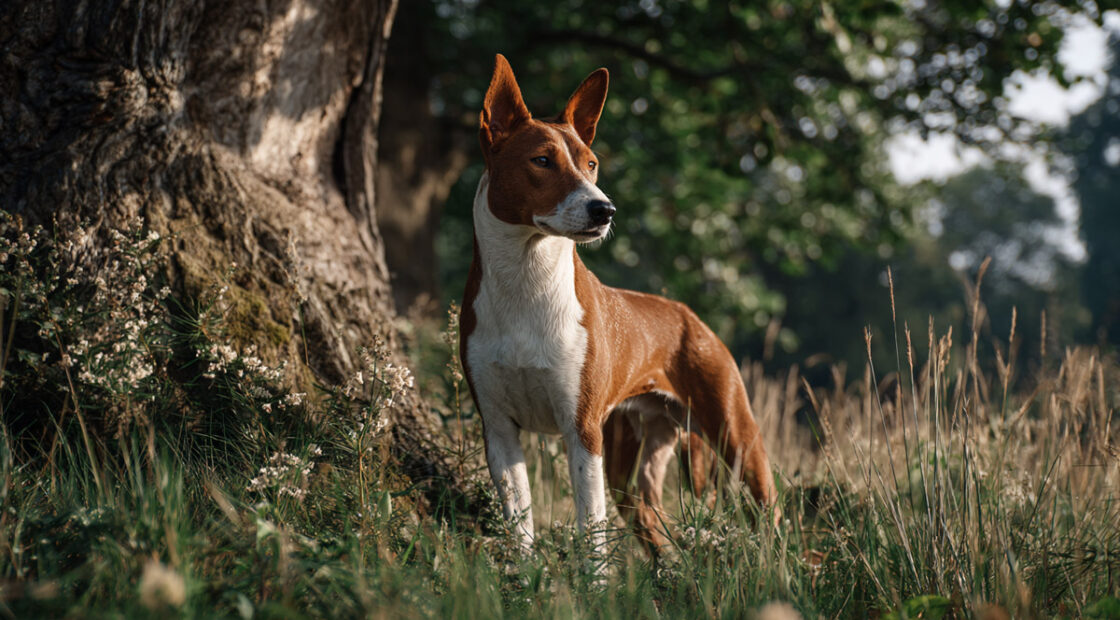
Everybody knows the Basenji as the dog that doesn’t bark. It’s a small hunting hound from central Africa, it yodels when it has something to say, and it usually comes into season once a year.
Registries can’t agree on what kind of dog it is. The AKC places the breed in the Hound Group, while the FCI files it under Group 5, Spitz and primitive types.
Breed profiles tend to blame the larynx for the missing bark, but that explanation rests largely on one peer-reviewed anatomical study. Ashdown and Lea (Journal of Small Animal Practice, 1979) examined two aged bitches, found shallow laryngeal recesses, and wrote that a link to barklessness was not yet established.
What Is a Basenji?
A Basenji won’t bark the way most dogs do. It yodels. It isn’t mute, though, and the American Kennel Club (AKC) standard says as much.
It’s a small, short-haired hound from central Africa. Older sources call it the African barkless dog or the Congo dog, and African bush dog turns up too.
Merriam-Webster’s etymology points to the Lingala phrase mbwa na basenji, literally dogs of the bushland people.
The AKC lists the breed in the Hound Group. The Federation Cynologique Internationale (FCI) puts it in Group 5, Spitz and primitive types, Section 6 (primitive type), Standard No. 43, accepted on a definitive basis on 26 March 1964, with Great Britain as patron country.
The hound label stays contested because the AKC standard says the Basenji hunts by both sight and scent.
That’s why breed profiles still debate whether it belongs with the sighthounds or the scenthounds, even though the American Sighthound Field Association accepted it for lure coursing in 1979, according to the Basenji Club of America (BCOA).

Where Did the Basenji Come From?
Villagers in the forests and wooded savannas of central Africa have hunted with Basenjis for thousands of years, according to the BCOA.
The historic range runs from the western coastal rainforest eastward through former French Equatorial Africa into southern Sudan, and south to the Ituri forest (BCOA, 1989). Hunters there still use the dogs to flush small game into nets.
Tomb art gives the breed a long paper trail. The BCOA’s timeline cites a First Dynasty game table from the tomb of Hemaka as an early depiction of a Basenji-type dog.
That record keeps the Basenji in any conversation about other ancient dog breeds. Whether a tomb dog and the modern breed are really the same line is a fair question, and the club’s reading is just that, a reading, not a confirmed lineage.
When the first Basenjis reached the West
Sources disagree on when Basenjis first reached Europe, and each date marks a different event.
| Date | Source | What it documents |
|---|---|---|
| 1843 | BCOA timeline; Edwards et al. (2021) | Painting of Queen Victoria and Prince Albert’s dogs shows a Basenji |
| 1895 | BCOA history | Pair shown at Crufts as African Bush Dogs or Congo Terriers, then lost to distemper |
| 1930 to 1937 | Westminster Kennel Club; BCOA | Founding imports arrive and the English Kennel Club recognizes the breed in 1937 |
The dates diverge because the early dogs didn’t survive. Lady Helen Nutting brought six Basenjis to Britain in the 1920s and all of them died from the after-effects of then-new distemper injections.
Olivia Burn’s imports of 1936 became the foundation stock, so the breed’s living lines trace to the 1930s and early 1940s imports, not to 1843 or 1895.
Recognition and a small founder base
- Burn showed Bongo and Bokoto of Blean at Crufts in 1937, and the first live Basenjis reached the United States that September.
- A stowaway named Congo landed in Boston in 1941, and Kindu and Kasenyi arrived in cages alongside a shipment of gorillas.
- The BCOA formed in 1942 and the AKC accepted the breed in 1943.
- Breeders imported dogs from Zaire in 1987 and 1988, and the AKC registered them as foundation stock in 1990.
The AKC Gazette ran its first Basenji column in January 1944, which may be why some profiles give 1944 as the recognition year.
Walter Philo’s September 1958 breed column in the AKC Gazette counted a founder base of only 12 African Basenjis (7 dogs and 5 bitches), with 8 imported into England and 4 sent straight to the United States.
Concern over that small gene pool drove the BCOA’s Native Stock Project, started in 1988. The AKC board voted in August 2008 to open the stud book to African imports, initially for 2009 through 2013, and has since extended the window to the end of 2030. The club approved another African import, Avongara Manu, in 2026.
How Big Is a Basenji, and What Does It Look Like?
Expect a dog that stands 16 to 17 inches at the shoulder and weighs 22 to 24 pounds, which is small for a hound (BCOA).
Height and weight
The AKC standard (1990) sets the ideal height at 17 inches for dogs and 16 inches for bitches. Weight runs to approximately 24 pounds for dogs and 22 pounds for bitches, lightly built within that ratio (AKC standard, 1990).
The FCI ideal height is 43 cm (17 in) at the withers for dogs (FCI Standard No. 43, 2000).
In the ring, dogs two inches over the standard are frequently seen, and the standard has no size disqualification (BCOA Illustrated Standard, 2012).
Proportion counts as much as the numbers. The standard asks for a square dog, with height equal to length.
The BCOA’s commentary describes a moderate build, neither heavy and boxy like a pulling breed nor as narrow as a specialized sighthound such as the Greyhound.
Coat, colors and grooming
The coat is short, fine and smooth. It comes in red, tricolor, black and brindle, and every color carries white on the feet, chest and tail tip (BCOA).
The 1990 AKC standard was the first to include brindle and white. Brindles were not uncommon on the BCOA’s 1988 Zaire trip, even though the British standard excluded the color as of 1989.
Fine wrinkles show on the forehead when the ears prick up, and they are less visible on tricolors because of the lack of shading (FCI Standard No. 43). The tightly curled tail sets the silhouette.
Grooming needs stay low. The Westminster Kennel Club rates grooming needs and coat length at 1 out of 5 and shedding at 2 out of 5.
Why Can’t a Basenji Bark?
The usual answer is a shallow laryngeal ventricle, but the anatomical study behind it examined only two dogs and stopped short of proving cause.
Ashdown and Lea at the Royal Veterinary College examined two aged Basenji bitches and found the lateral laryngeal saccules absent or reduced and the laryngeal recesses (ventricles of Morgagni) shallow compared with other dogs. They wrote that it was not yet established whether those features cause barklessness (Journal of Small Animal Practice, 1979).
Behavior is a separate line of evidence. Scott and Fuller’s Genetics and the Social Behavior of the Dog (1965) recorded Basenjis barking in 20% of dominance-test opportunities, against 68% for cocker spaniels. The barks were usually one or two low woofs.
Read together, the two sources describe a breed that rarely barks and has a larynx unlike other dogs. No study has tied the two together.
The AKC standard sits right in that gap, saying the breed should not bark but is not mute. Per the BCOA and the FCI standard, what it does instead is yodel, growl, whimper, whine and scream. The FCI describes the yodel as a mix of chortle and yodel.
Many owners call the yodel a baroo. A barkless dog is not a silent one.
What Primitive Traits Set the Basenji Apart From Other Dogs?
Several features back up the FCI’s primitive label, and the genome study is the newest of them.
An annual heat cycle tied to the season
In the Northern Hemisphere, most Basenji estrus falls in September and October, with a smaller peak in March through May, according to the BCOA’s estrus article (revised 2002).
The same article calls the Basenji the only AKC-recognized breed with an annual cycle. That claim comes from the 2002 revision, before the registry added more breeds, and it no longer holds. Cornell’s veterinary college also lists the Tibetan Mastiff as a once-a-year breed.
The pattern is a strong tendency, not a rule. Many English Basenjis have a second estrus (Burns, 1952), and an American Basenji imported into Rhodesia shifted its annual cycle to spring (Ford, 1997).
Wolves and dingoes also cycle once a year, per dvm360’s canine estrous cycle proceedings.
Self-grooming and low odor
A Basenji washes itself with its tongue, which is why Hill’s Pet Nutrition’s breed profile says owners call it catlike.
The UKC breed standard (revised 2008) calls the breed exceptionally clean, and a late-1980s AKC Gazette breed column, quoted in a BCOA paper, describes it as virtually odorless.
Where the genome study places the Basenji
Edwards and colleagues (BMC Genomics, 2021) assembled two Basenji genomes, a female named China and a male named Wags. They found the breed closely related to the Asian Spitz clade and sitting at the base of the dog family tree.
The AKC sees a hound that hunts by sight and scent. The FCI files it as a spitz and primitive type, Group 5, Section 6, and the genome result sits closer to that grouping than to the AKC’s hound label.
What Is a Basenji’s Temperament Like?
Both the AKC and FCI standards describe the Basenji as intelligent, independent, affectionate and alert, and the FCI standard adds that it can be reserved with strangers.
The Westminster Kennel Club rates the breed 2 out of 5 for trainability and 4 out of 5 for energy, with children, other dogs and strangers each at 3 out of 5.
Independence is the one that catches people off guard. A Basenji can outsmart and out-train an owner who lets it, and positive reinforcement works where harsh methods do not (BCOA).
Then there’s the prey drive. It chases squirrels and rabbits on sight, cats too, so the club’s advice is leash or secure fencing, and it warns that Basenjis will not reliably fetch a stick.
Owners soon learn to stash the remote and close the garbage away. A tired dog is a well-behaved one.
A 2006 This American Life segment, listed in the BCOA timeline, followed a family that chose a Basenji because it does not shed or slobber. They rehomed it on a farm 30 miles away, and the dog found its way back within days.
That mix is why the BCOA calls the Basenji a challenging dog whose temperament may not be what people expect.
How Much Exercise Does a Basenji Need?
Daily sprinting and sniffing is the need, and the BCOA frames it by activity, not by a minute count.
Daily outlets, weather and weight
The BCOA names lure coursing, tracking, conformation, agility and obedience as sports the breed enjoys, and its Activities pages add racing, nose work and flyball.
Orvis’s breed guide says a Basenji without daily exercise may turn destructive and that it gains weight easily. It also dislikes rain enough to refuse to go outside in wet weather.
Few owners hunt with Basenjis today, and most Basenjis would still like to, according to the BCOA. A sanctioned chase is the closest substitute.
Escape and containment
Orvis describes a breed that jumps high, scales fences and gets into surprising spaces, so judge a fence by what a climber can do, not by the dog’s size.
The BCOA’s Fast CAT safety list calls for a collar or harness the dog cannot slip out of, because dogs get very excited at events. Its stray-dog guidance starts with a chip scan, which most veterinary clinics and shelters run free.
Coursing outlets: CAT, Fast CAT and trials
The AKC’s Coursing Ability Test (CAT) sends dogs over about 600 yards when they stand more than 12 inches at the withers, and a Basenji at 16 to 17 inches falls in that group.
| Event | Distance | Format |
|---|---|---|
| Coursing Ability Test | About 600 yards for dogs over 12 inches | Pass or fail, dog runs alone, CA title after three passes under at least two judges |
| Fast CAT | 100 yards | Timed dash, dog runs alone, points from speed and a height handicap |
| Lure coursing trial | 600 yards minimum | Scored, two runs per hound, up to three hounds per draw |
Fast CAT points equal 204.545 divided by the run time in seconds, multiplied by a handicap. Dogs from 12 up to 18 inches at the withers take a 1.5 handicap (BCOA Activities page, 2022).
A hypothetical 8-second run earns about 38 points, so four runs clear the 150-point threshold for the BCAT title.
The BCOA says no prior training is needed, and dogs must be over 1 year old to compete. The AKC began offering lure coursing events and titles in 1992, per the BCOA’s lure coursing history.
How to Train a Basenji
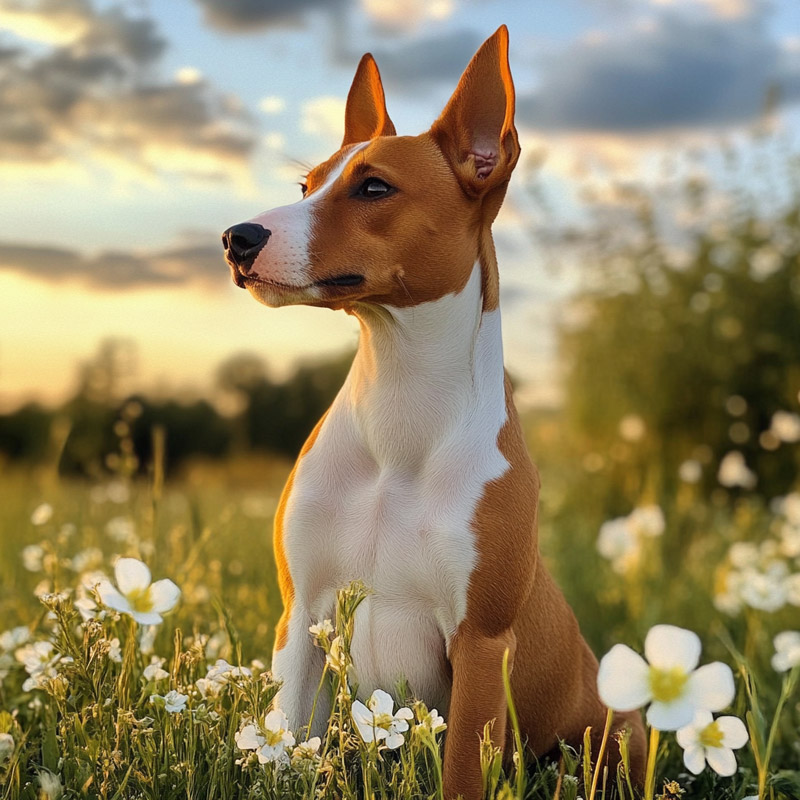
Short reward-based sessions and an early class do most of the work. The whole process takes months, not weeks.
- Enroll in puppy kindergarten and a basic obedience class early, as the BCOA strongly encourages, and ask any facility point blank whether it is reward-based or correction-based.
- Find a reward the dog will work for. Food suits most dogs, but breed preference can make a chase game or a tug worth more.
- Lure the dog into the behavior and reward at that moment, because a reward one second late can teach the wrong lesson.
- Add a marker word such as “okay” to bridge the gap to the reward, and a different word to signal that no reward is coming.
- Keep sessions to five minutes, several times a day, starting in a room with no distractions.
- Add distractions one step at a time, and expect the behavior to slip when you move from the living room to the garden.
Steps 2 to 6 follow a principle-based training guide by behavior consultant David Ryan (2009), which the BCOA reproduces with permission. Step 1 follows obedience advice from Linda Siekert in the same BCOA material.
Small pieces of healthier treats keep a five-minute session rewarding without piling on calories.
Where Basenji training breaks down
Ryan’s guide names the failure mode. What a dog was bred for is easy to train and very hard to train out.
Generalization is the longest stage, often months. It’s where a sit that works in the kitchen has to work at the vet’s.
A recall that holds at home is not a recall that holds near a squirrel.
The BCOA’s reading list for owners includes Leslie Nelson’s Really Reliable Recall and Jane Killion’s When Pigs Fly, a title aimed at impossible dogs.
Basenji Health Problems, Screening and Lifespan
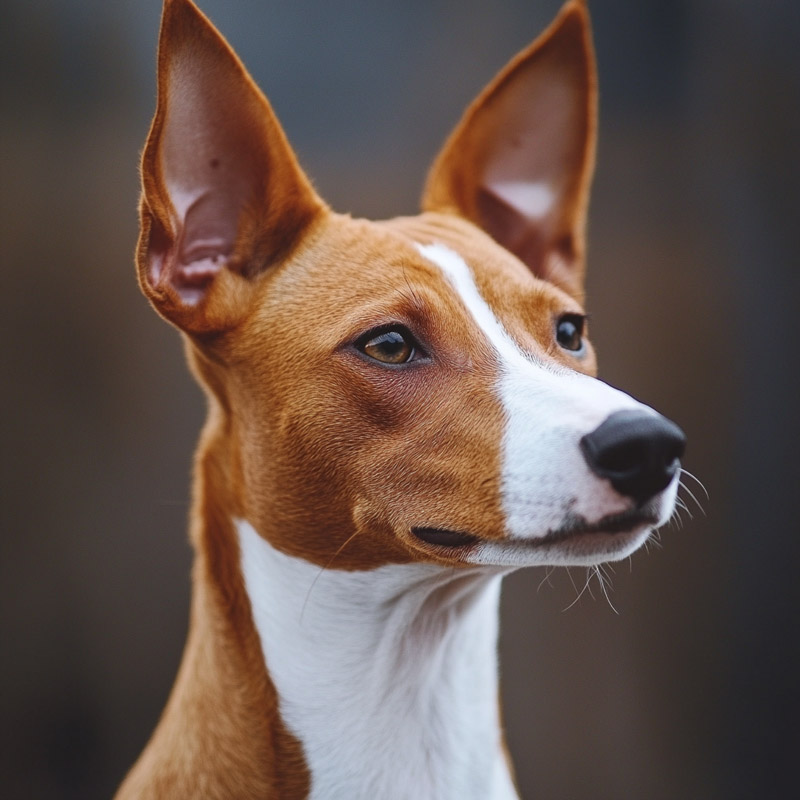
Screening in Basenjis has been shaped mostly by Fanconi syndrome and progressive retinal atrophy (PRA), according to the BCOA health statement effective 15 August 2017.
The same statement calls the breed very healthy as a whole and credits careful breeding and DNA testing with reducing both diseases.
The Orthopedic Foundation for Animals (OFA) hosts the open results database, and the Basenji Health Endowment, the club’s research fund, has supported the Fanconi test and PRA-BJ1 research.
| Condition | Affects | Screening |
|---|---|---|
| Fanconi syndrome | Kidney tubules | Direct DNA test through OFA, since 2011 |
| Progressive retinal atrophy | Retina | PRA-BJ1 DNA test plus a yearly exam by a board-certified eye specialist |
| Pyruvate kinase deficiency | Red blood cells | DNA test available, inherited form now extremely rare |
| Immunoproliferative small intestinal disease (IPSID) | Small intestine | No DNA test, biopsy after ruling out pancreatic insufficiency |
Fanconi syndrome
Abnormal kidney function typically appears around 4 to 8 years of age, according to UC Davis’s Veterinary Genetics Laboratory, which is why the BCOA says a Fanconi dog can reach breeding age before it shows signs.
Dr. Gary Johnson and Fabiana Faria at the University of Missouri found the mutation in August 2011. The direct DNA test reports Clear, Carrier or Affected through OFA and replaced the 2007 Linked Marker Test.
Dr. Steve Gonto’s treatment protocol, developed in 1990 and updated in 2003 and 2012, uses supplements to neutralize acid and replace lost electrolytes. The BCOA says affected dogs caught early have, on average, the same lifespan as non-Fanconi Basenjis.
Misdiagnosis is a real risk. Glucose in the urine can point to diabetes, so Fanconi is often missed. Urine glucose with normal or low blood glucose strongly suggests Fanconi.
Results from the Linked Marker Test, used from 2007 to August 2011, should not guide breeding decisions. The BCOA asks owners of those dogs to retest because that test carries a built-in chance of misclassification.
OFA’s clear-by-parentage policy covers only first-generation offspring of two registered clear parents, and all three dogs need DNA identity profiles.
Progressive retinal atrophy
PRA appears in at least two forms in Basenjis, and only one has a gene test.
The PRA-BJ1 form accounts for about 50% of cases, and its DNA test has been available since March 2013 through OFA and OptiGen.
Signs usually begin at 5 to 8 years or later, starting with trouble seeing at night and moving to daytime vision loss. There is no cure, though the BCOA says Basenjis adapt well to a stable, predictable home.
The other forms have no test, so the BCOA recommends a yearly exam by an ophthalmologist certified by the American College of Veterinary Ophthalmologists for breeding stock. Its health statement gives 7 weeks as the first exam age and its eye reference gives 9, so ask a breeder when each litter was examined.
Pyruvate kinase deficiency and IPSID
Pyruvate kinase deficiency was first diagnosed in Basenjis in the 1960s and causes hemolytic anemia. Affected dogs typically die by age 2, with 4 the outside limit (BCOA). The inherited form is now extremely rare, and every recent African import was DNA tested before AKC registration.
IPSID is an inflammatory bowel disease with an inherited predisposition, and stress may aggravate it. Intestinal biopsy is the only reliable diagnosis, made after a TLI blood test rules out exocrine pancreatic insufficiency (EPI), which mimics it but needs different treatment.
How long does a Basenji live?
The BCOA says 13 to 14 years, a breed-club estimate.
Dogs Trust (2024) found a 12.1-year median for Basenjis in UK records, against 12.7 years for purebred dogs overall (Scientific Reports, volume 14, article 531).
The two sources measure different things. The club gives a typical lifespan, while Dogs Trust calculated a median from registry, veterinary and insurance records of UK dogs.
A planning window of 12 to 14 years covers both.
When Is a Basenji the Wrong Dog?
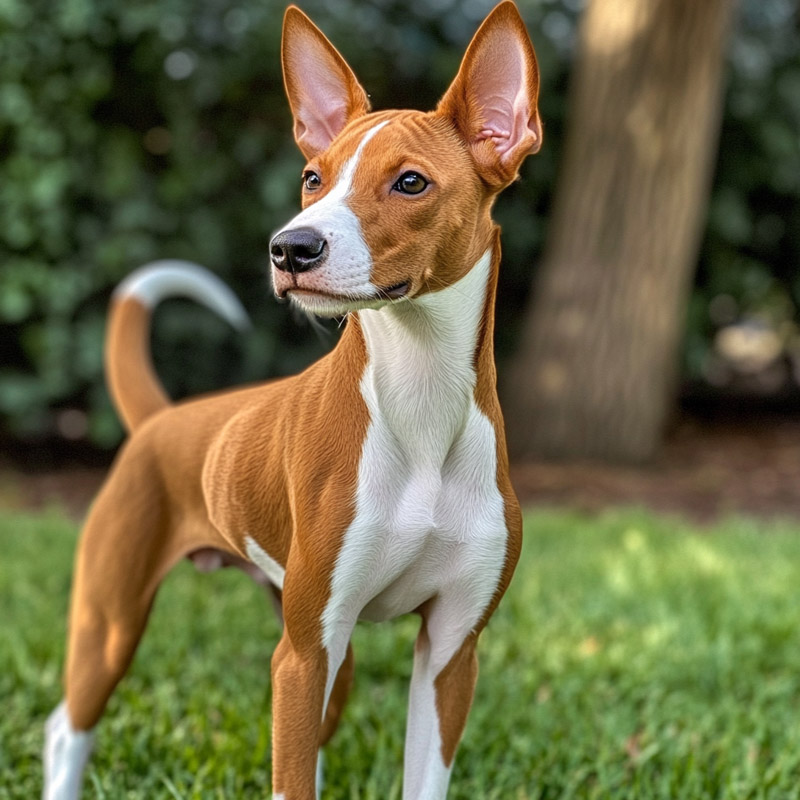
The AKC says the Basenji is best for owners who can meet its exercise needs and the challenge of training a catlike canine, so a household that cannot do both should look elsewhere.
Households and owners that do not fit
- Homes with cats, rabbits or other small pets. Orvis says they are not ideal companions, though a Basenji raised with cats may live with them.
- Owners who want an eager-to-please dog. Linda Siekert’s obedience guidance for the BCOA warns that expecting a Basenji to respond like a Border Collie or Golden Retriever is a recipe for disappointment.
- First-time owners without a trainer lined up, since Orvis calls the breed not an ideal choice for a first dog.
- Anyone planning off-leash freedom without fencing.
A decision rule before you start looking
If puppy chaos is what worries you, look at a young adult or older dog. The BCOA says most Basenjis adapt well to a new family and bond as strongly as a puppy raised from eight weeks.
If it’s the chase instinct, pick another breed. A bred-in instinct is the hardest thing to train out of a dog.
The BCOA’s rescue page says mismatches are among the most common reasons a Basenji needs a new home, often because families did not grasp the time and effort the breed takes.
How Much Does a Basenji Cost, and Where Do You Find One?
The BCOA publishes no standard Basenji puppy price, saying only that prices vary by area.
Online cost guides quote ranges that contradict each other, so none are repeated here. The club’s price signals are more useful.
Per the BCOA, a price well below market can mean a breeder is producing too many litters and selling fast, while a price well above market needs an explanation.
Finding a breeder and timing the wait
The BCOA’s directory lists member breeders who chose public listing, grouped by state. The club states that it does not inspect or monitor their facilities or practices and gives no endorsement.
Timing follows the annual heat cycle. Many breeders add buyers to a waiting list in spring for a fall breeding, and a careful search can take months and mean travel (BCOA).
Green flags and red flags
Some things point to a careful breeder.
- A written contract that covers AKC registration, a health guarantee and a lifetime take-back clause, and no puppy going home before eight weeks.
- Buyer screening, such as references, a landlord’s name for renters, and a visit if you are within reach.
Walk away from sales to pet shops or commercial brokers, and from shipping a puppy with no screening. Many litters a year is a bad sign, and so is every litter coming from in-house dogs. Papers from an alternative registry belong on the list too.
Breeder puppy, adult dog or rescue
| Route | What it offers | What to expect |
|---|---|---|
| Puppy from a member breeder | Parent health documentation, contract, take-back clause | Waiting list tied to one fall breeding season |
| Adult from a breeder | May already know basic commands and be past the chew phase | Availability depends on the breeder |
| Basenji Rescue and Transport (BRAT) | Foster-based matching across the US and Canada | Mandatory application, interviews, home visit, adoption fee |
The BCOA calls BRAT the largest network of Basenji rescue volunteers in North America, handling intake, foster care, transport and adoption matching as an independent 501(c)(3). BRAT’s adoption page lists no fee amount.
Purchase price is one line item, because owning a dog is expensive over its whole life, so weigh a breeder’s price or a rescue fee against vet bills and class fees.
Basenji FAQ
How do you pronounce Basenji?
Say buh-SEN-jee, with the stress on the second syllable and a soft j at the end (Dictionary.com).
Is a Basenji hypoallergenic?
No. The BCOA says Basenjis are not hypoallergenic, and some allergic people tolerate them while others don’t.
There is no safe way to know without spending time around the dog.
Can a Basenji live in an apartment?
Yes, if the owner covers noise and exercise. The breed is small and does not bark, but the BCOA lists a scream and a yodel among its sounds.
Daily outlets have to come from leash walks, coursing or similar activities.
Can a Basenji be left alone all day?
Only with planning. No breed club publishes an hours-alone limit, and the BCOA calls puppies a handful.
An adult dog is the safer choice, since the BCOA says adults are often past the chew-everything stage.
Which breeds are most similar to the Basenji?
No AKC breed matches it closely. The nearest comparison is the dingo, which also cycles once a year (dvm360) and, per the 2021 genome study, shares the Basenji’s tendency toward howls and yodels.
That same study places the Basenji near the Asian Spitz clade.
Do Basenji mixes bark?
Not reliably silent. Walter Philo wrote in 1958 that when interbreeding was tried, the offspring were neither distinctive nor barkless.
The BCOA reprinted that statement in its 1989 stud book paper.
How popular is the Basenji?
The Basenji ranked 92nd of 202 breeds in the AKC’s 2025 registration rankings, published in 2026.
The BCOA’s 1989 paper put it 58th, so its rank has fallen.
Setting Up a New Basenji in the First 30 Days
Containment comes first, because a lost dog is the one problem that training cannot reverse. Check the fence, buy a harness the dog can’t slip out of and get the microchip done before it arrives.
Book a reward-based class in week one. At home, do five-minute sessions every day.
Fast CAT practice runs are open to dogs under 1 year, per the BCOA, so a young Basenji can rehearse the chase long before it can compete.
Expect a leash-only routine for a while, since generalization takes months and off-leash freedom stays closed well past day 30.
This order reflects BCOA guidance verified in October 2026, and it changes if the club revises its training or containment advice.