The AKC ranked the Siberian Husky 30th of 202 breeds in its 2025 registration statistics, down from 26th the year before. Four places isn’t much of a slide for a dog this recognizable.
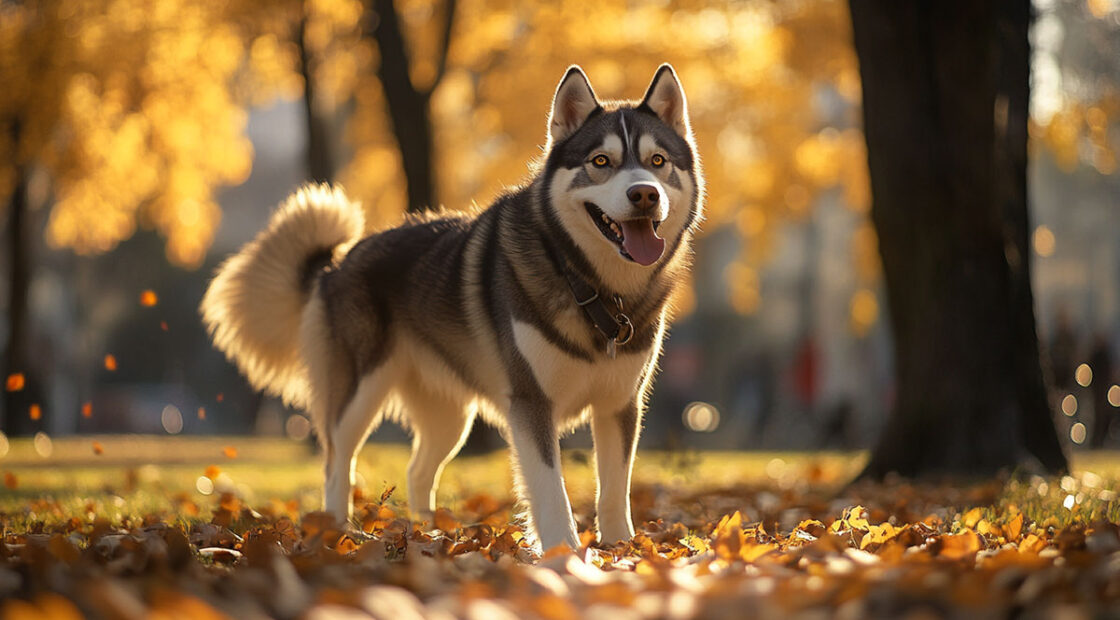
Chukchi people in northeastern Asia bred it as a medium-sized, spitz-type sled dog for long distances. Most people notice the dense double coat and the brown or blue eyes first. The friendly, outgoing temperament comes later, along with the endurance and strong prey drive left over from its Arctic past.
It’s kept both as a working sled dog and as a household companion.
What Is a Siberian Husky?
Not a wolf hybrid. The Siberian Husky Club of America (SHCA) opens its own breed overview with that point, so it’s worth settling early. This is a purebred domestic dog, developed by the Chukchi to pull sleds over long distances and to live with the family.
The AKC files the breed in the Working Group. Under FCI Standard No 270 it sits in Group 5 (Spitz and primitive types), and that standard, published 14.11.2022, lists the United States as the country of origin.
The word “husky” traces back to “Esky,” a nickname once applied to Arctic peoples and then to their dogs, according to the SHCA. No other recognized breed carries the word in its proper name. Owners usually just say “Sibe.”
How Does It Differ From the Alaskan Malamute and the Alaskan Husky?
People mix these dogs up constantly, though only two of the three are actual breeds.
The freight-hauling Alaskan Malamute is a separate AKC breed, and the SHCA keeps the Siberian Husky apart from it and from the crossbreds sold as Alaskan huskies. “Alaskan husky” is a collective name for various crossbreds. The AKC does not recognize it as a breed.
| Trait | Siberian Husky | Alaskan Malamute | Alaskan Husky |
|---|---|---|---|
| Status | AKC breed, Working Group | AKC breed, Working Group | Crossbred sled dogs |
| Male size | 21 to 23.5 in, 45 to 60 lb | Ideal 25 in, 85 lb | Varies by cross |
| Sled role | Light loads, moderate speed, long distances | Heavy freighting | Varies by cross |
| Origin | Chukchi, northeastern Asia | Alaska | Northern dogs crossed with other breeds |
The Malamute numbers come from the UKC Alaskan Malamute standard (revised January 2, 2024) and reflect ideal freight size. For the Siberian Husky, the source is the AKC standard approved in 2021.

That standard describes a dog suggesting neither a heavy freighter nor a sprint racer. Somewhere in the middle, basically, and that middle position is what defines the breed.
How Big Does a Siberian Husky Get?
Males stand 21 to 23.5 inches at the withers and weigh 45 to 60 pounds, while females come in smaller at 20 to 22 inches and 35 to 50 pounds.
Those are the AKC limits, as revised in the standard approved 5/12/2021. FCI Standard No 270 (published 14.11.2022) carries the same extreme-limits wording. Males over 23.5 inches and females over 22 are disqualified.
The standard treats the numbers as outer limits and gives no preference to either end. Any appearance of excess bone or weight gets penalized.
Plenty of breed profiles print one blended range instead, usually 20 to 24 inches and 35 to 60 pounds. That hides a 10-pound gap between the sexes at both ends of the weight range.
Oversize is a disqualification in the show ring, so “giant” Siberians are not a recognized variant. In profile, the body runs slightly longer than it is tall.
The Kennel Club in the UK adds that its listed sizes describe an ideal, and no individual dog is expected to match them exactly.
What Coat and Eye Colors Does a Siberian Husky Have?
Medium-length double coat, with accepted colors running from black through to white. The eyes can be brown, blue, one of each, or parti-colored.
Double coat structure
The undercoat is soft and dense, and long enough to support the outer coat. The guard hairs on top lie straight and fairly smooth. They should never feel harsh or stand off the body.
Length stays medium. The standard faults a long, rough or shaggy coat because it hides the clean outline of the dog.
Colors and markings
Black, gray, agouti, sable, red and white are all accepted, either solid or in multiple shades.
White markings and piebald are common, along with a range of symmetrical or asymmetrical patterns. No color or pattern gets preference.
Merle and brindle are disqualified from the show ring. The standard tells merle’s marbled dark patches apart from the banded guard hairs seen in allowable piebald dogs.
Eye colors
Blue eyes have a genetic explanation now. Embark Veterinary researchers tested 6,070 dogs and traced blue eyes in huskies to a 98.6-kilobase duplication on chromosome 18, near the ALX4 gene (PLOS Genetics, 2018).
The duplication is largely restricted to Siberian Huskies and highly penetrant, but not completely. Some carriers have brown eyes, so other factors still play a part.
The authors’ data point to a dominant effect, which fits the breed’s frequent blue eyes and heterochromia (two different eye colors in one dog).
The AKC standard accepts brown or blue eyes, one of each, or parti-colored eyes. Whatever the color, they’re almond-shaped and set slightly oblique.
How Much Does a Siberian Husky Shed, and How Do You Groom One?
A lot, mostly in bursts. The dense undercoat comes out in clumps during seasonal coat blows.
Sources disagree on how often that happens. The SHCA says at least once a year, while the AKC describes two big sheds a year. I’d plan for two, and some breed guides count three.
The standard calls an absent undercoat during shedding season normal, so a thin-looking coat mid-blow isn’t a coat problem.
The routine itself is short.
- Brush weekly to keep loose hair under control (AKC)
- Rake the undercoat with a comb during a blow
- A few baths a year are plenty, since the coat stays clean on its own
- Trim whiskers and the fur around the feet, and nothing else
Skip the clippers on the body. The standard penalizes trimming beyond whiskers and feet, and the SHCA says the breed needs no clipping at all.
If someone in the house reacts to dogs, this coat won’t help. Petfinder lists the breed as not hypoallergenic.
What Is the Temperament of a Siberian Husky?
Friendly and gentle, alert and outgoing, according to the AKC standard. The SHCA adds an independent streak that tests new owners.
Mature dogs show some reserve and dignity. The standard rules out guard-dog possessiveness.
With people and other dogs
Strangers get a cordial greeting, with no fear or suspicion, which makes the breed a poor watchdog (SHCA). At home the dog is affectionate without fawning, and it’s not usually attached to just one person.
The SHCA reports a special appeal between huskies and children, and ties it to the Chukchi habit of housing dogs with the family.
Other dogs get friendly interest, though a husky that is attacked can defend itself.
Prey drive and small animals
Predatory instinct is strong.
The SHCA names squirrels, rabbits, birds, guinea pigs, hamsters and cats as potential victims, and calls the dogs swift, cunning and patient hunters.
A household with small pets should treat this as a deciding factor, not a training detail.
Howling and digging
Huskies are vocal. They howl and sing, and bark when they feel like it, according to PetMD.
Digging comes with a special proclivity in the breed, and the SHCA suggests indulging it in a suitable area. In warm weather, many dogs dig hollows to lie in because the soil below the surface is cooler.
I wouldn’t call either habit a flaw. They’re working-dog behavior, and they need somewhere to go.
How Much Exercise Does a Siberian Husky Need?
An adult needs at least one to two hours a day, according to Britannica. The UK charity Blue Cross sets the bar higher, at upwards of two hours.
Daily exercise
The SHCA accepts leashed walks and runs under control, or a large enclosure with room to run away from traffic. Its first choice is a harness.
Blue Cross recommends cycling or running with the dog regularly, provided the weather isn’t too hot. Owners who can’t supply the hours end up with a bored, frustrated dog, the charity warns.
Heat and cold limits
Britannica says the breed relishes cold weather and overheats easily in hot conditions.
That cold tolerance puts it among the best-known winter dog breeds, and VCA Animal Hospitals rate it at the top of the scale for cold weather and the bottom for warm weather.
The working side documents the same pressure. The FCI Sledge Dog Commission says racing’s spread into warmer climates created challenges for the registered sled dog breeds.
The 2024 genomic survey by Smith, Srikanth and Huson (Genome Biology and Evolution) adds that Alaskan sled dog or European breed crosses may have been used to bring in faster, more heat-tolerant dogs.
Containment and escaping

The SHCA says no Siberian Husky should have unrestrained freedom, because one dash across a busy road can be its last run. Blue Cross reports that many need to stay on lead at all times, given their strong desire to run and high chase drive.
Plan for a leash outdoors and a secure enclosure at home. The SHCA treats that as part of owning the breed, not an optional extra.
What Health Problems Do Siberian Huskies Have, and How Long Do They Live?
Hip dysplasia and hereditary eye disease top the list of breed-associated problems. As for lifespan, the median in the largest UK dataset is 11.9 years.
Common conditions
Hip dysplasia is polygenic and inherited. The OFA notes that environmental factors such as caloric intake and exercise during growth affect how severe it gets.
Cataracts in young dogs are thought to be inherited, with onset anywhere from a few months to 6 years of age (PetMD).
Then there’s progressive retinal atrophy, an inherited, degenerative retinal disease. PetMD reports research suggesting it is sex-linked in the breed and more common in males.
Corneal dystrophy leaves an opaque patch at the center of the cornea, and it needs treatment only if it advances to ulceration.
Health screening
Screening runs through the Orthopedic Foundation for Animals (OFA), a not-for-profit founded in 1966. Its Canine Health Information Center (CHIC) program sets breed-specific test lists with each parent club.
| Test | What it checks | Result or validity |
|---|---|---|
| Hip evaluation (OFA) | Hip dysplasia | Graded excellent, good or fair |
| Eye exam (CAER or SHOR) | Hereditary eye disease | Valid for 1 year only |
| DNA tests | Shaking Puppy Syndrome type 1, Siberian Husky Polyneuropathy type 1 | Clear, carrier, or clear by parentage |
SHOR is the SHCA’s own eye registry, and the OFA accepts it as an alternative to CAER. Because an eye certification is valid for one year, breeding dogs need a repeat exam every year.
Lifespan figures and why they differ
McMillan and colleagues (Scientific Reports, 2024) report a median of 11.9 years for the Siberian Husky in a UK dataset of 584,734 dogs. Purebreds overall came in at 12.7.
Breed profiles tend to print 12 to 14 years, and some print 12 to 15.
Those ranges describe a healthy outcome. A median describes the middle dog, and in this dataset the middle Siberian Husky died before reaching 12.
A separate VetCompass life-table study (Scientific Reports, 2022) found Huskies more likely to die before adulthood than dogs overall, at 0.047 between ages 1 and 2 against 0.016. It sampled only 153 Huskies, so treat it as a flag, not a verdict.
From Chukchi Sled Dog to Modern Lines
The breed descends from sled dogs kept by the Chukchi and neighboring peoples of northeast Siberia. It reached Alaska in 1908 and won AKC recognition in 1930. Since then it has split into show, pet, racing and Seppala populations.
Chukchi origins
The 2024 genomic survey cites evidence that the sled dog lineage began in the northeast Siberian Arctic more than 9,500 years ago.
An origin that old explains why the breed turns up on lists of ancient dog breeds.
The progenitors lived east of the Indigirka River among the Chukchi, Koryak, Yukagir and Kamchadal peoples. Foundation stock reached Alaska between 1908 and 1930.
Alaska and the 1925 serum run
William Goosak, a Russian fur trader, brought the first team of Siberians to Nome in 1908. The next year Louis Thurstrop drove that team to third place in the All Alaska Sweepstakes. By then Nome had already nicknamed the small dogs “Siberian Rats.” In 1910, a team from Fox Maule Ramsay’s purchase of about 60 Siberian dogs won the race.
Sources date the arrival to both 1908 and 1909. The SHCA’s history reconciles the two dates. Goosak’s team landed in the fall of 1908, and the first large imports followed in 1909.
Jafet Lindberg’s Pioneer Mining Company bought the best Siberians for Roald Amundsen’s planned North Pole expedition. After Amundsen cancelled in 1914, the company backed Leonhard Seppala’s training, and his teams won the sweepstakes in 1915, 1916 and 1917.
In January 1925, Seppala and his lead dog Togo carried diphtheria serum back across Norton Sound after already running all day. Gunnar Kaasen’s team, led by Balto, ran the final leg into Nome.
The National Park Service says Balto ran 55 miles, while Togo’s leg was the longest and most dangerous. The AKC counts Togo’s total at 264 miles, and other accounts say 261.
Recognition and registries
Paperwork came late. The AKC made the breed eligible for its Stud Book in 1930 and published the first standard in the AKC Gazette in April 1932.
The SHCA formed in 1938 and became an AKC member club in 1946. Every registered dog today traces back to the Seppala-Ricker kennel in Maine or Harry Wheeler’s kennel in Quebec, the SHCA says.
Lines within the breed
About half of the Siberian Huskies that compete in sled races carry recent European breed ancestry, according to the 2024 genomic survey.
The survey found the breed splits into populations by how people use the dogs, namely show, pet, racing and Seppala. Its sample also included a sled-show group.
The registries responded fast. On 30 November 2024 the FCI Sledge Dog Commission met in response to the study and floated full pedigrees only for dogs that test as a single breed. Four days later, on 4 December 2024, the SHCA stated that it condemns all crossbreeding of the Siberian Husky.
For a buyer, the line matters more than the breed name. Ask the breeder which one the litter belongs to.
Who Should Not Get a Siberian Husky?

Anyone who’s out all day, for starters. The SHCA is blunt on its buyer page: if you work all day or have room for only one dog, do not buy a Siberian.
The rest of the bad fits are in the table below.
| Your situation | Failure mode | Source |
|---|---|---|
| Home alone all day | Needs constant company of people or dogs | SHCA |
| No secure confinement | Chases and runs, with traffic risk | SHCA |
| Small pets in the house | Predatory instinct | SHCA |
| Hot climate, no cooling | Overheats in heat | Britannica |
| First dog | Needs extra training and an experienced handler | Petfinder |
One row is enough. Unless the condition can change, pick another breed.
Looks are the usual draw and the worst reason to buy. The SHCA’s rescue page describes owners who bought a beautiful blue-eyed puppy without understanding what the adult dog would be.
The club also reports more Siberians relinquished to shelters and rescues as the breed grew popular, some abandoned when they became too unruly to handle.
How to Find a Healthy Siberian Husky
Start with the parents’ paperwork, not the puppy’s photos. Hip and eye clearances, verified on the OFA database, tell you more than any listing.
- Decide between a breeder and a rescue first, because the checks differ. The SHCA calls rescue an important part of breed preservation and lists resources for adopting and locating a rescue.
- If you go the breeder route, use the SHCA’s referral directory. It names members who pledge to follow the breed standard and the club’s code of ethics.
- Ask for written proof of hips and eyes. The SHCA’s sale guidelines call for proof that both parents were x-rayed and certified clear of hip dysplasia. Both must also have been checked clear of hereditary eye disease by a veterinary ophthalmologist within one year before the breeding.
- Verify it all on the OFA site by searching the dog’s registered name or number and reading the test dates and results. A CHIC number means the required tests were done, not that the results were normal (SHCA).
- Don’t accept DNA-only claims. The SHCA says DNA testing alone is not sufficient, and advises looking elsewhere when “fully health tested” rests on DNA alone.
- Ask which line the litter comes from. Show, pet and racing populations differ genetically, so match the line to your plans.
- Get the contract in writing. SHCA guidelines call for health guarantees in it, and the guarantee normally requires a vet exam within 48 hours, with exchange or refund if the dog proves unsuitable for health reasons.
Shelter labels need care. A 2018 PLOS ONE study of more than 900 shelter dogs, led by Arizona State University researchers, found that shelter staff’s visual breed labels often disagreed with DNA results. A shelter “husky” may therefore not be a Siberian Husky, or match the breed standard’s temperament.
Siberian Husky FAQ
How much does a Siberian Husky puppy cost?
It depends on the source, and no authoritative figure exists. Published ranges come from insurers and listing sites, not a registry. Rescue adoption costs less than a breeder purchase, and a breeder who health-tests both parents prices that work in.
Over a lifetime, what a dog costs dwarfs the purchase price anyway.
Are Siberian Huskies hard to train?
Moderately, and recall is the hardest skill. The AKC standard credits the breed with intelligence and an eager disposition, but Zoom Room trainers call recall the biggest challenge and say reliable off-leash work is unrealistic for most Huskies.
Build recall in controlled settings and put leash manners first.
What should a Siberian Husky eat?
The SHCA calls the breed an easy keeper, needing a relatively small amount of food for its size. The Chukchi developed the dogs to work on the smallest possible intake.
Measured portions, set with a Siberian Husky feeding chart, fit that trait better than free feeding.
When is a Siberian Husky fully grown?
Most vet-reviewed growth guides put full height near the first birthday, with the body continuing to fill out until about 18 to 24 months. They disagree on the exact month.
Final weight lands inside the breed standard’s limits for the sex, and a vet can check whether a puppy is on pace.
Is a white Siberian Husky an albino?
No. White is an accepted color, and the AKC standard allows a flesh-colored nose on white dogs and treats a pink-streaked “snow nose” as acceptable.
A white Siberian Husky keeps its pigment, with dark points possible on the nose, lips and eye rims. An albino has no pigment anywhere, so a pale or snow-streaked nose is not albinism.
Testing Your Household Before Committing to a Siberian Husky
Spend time with adult Siberian Huskies before buying a puppy. An adult shows the energy, noise and strength a puppy only promises, and rescue groups and a breeder’s own dogs both offer that meeting.
Sequence matters, because each step costs more and reverses less than the last. Test the home against empty hours, fencing, small pets and summer heat first. Then meet adult dogs through rescue or a breeder. Choosing the breeder and the line comes last.
A trial run delays the purchase. A mismatch found early, though, costs far less than a later rehoming.
This advice is current as of October 2026. If registries adopt the single-breed pedigree measure the FCI Sledge Dog Commission floated, it changes, since a DNA breed result would then become a practical purchase check.