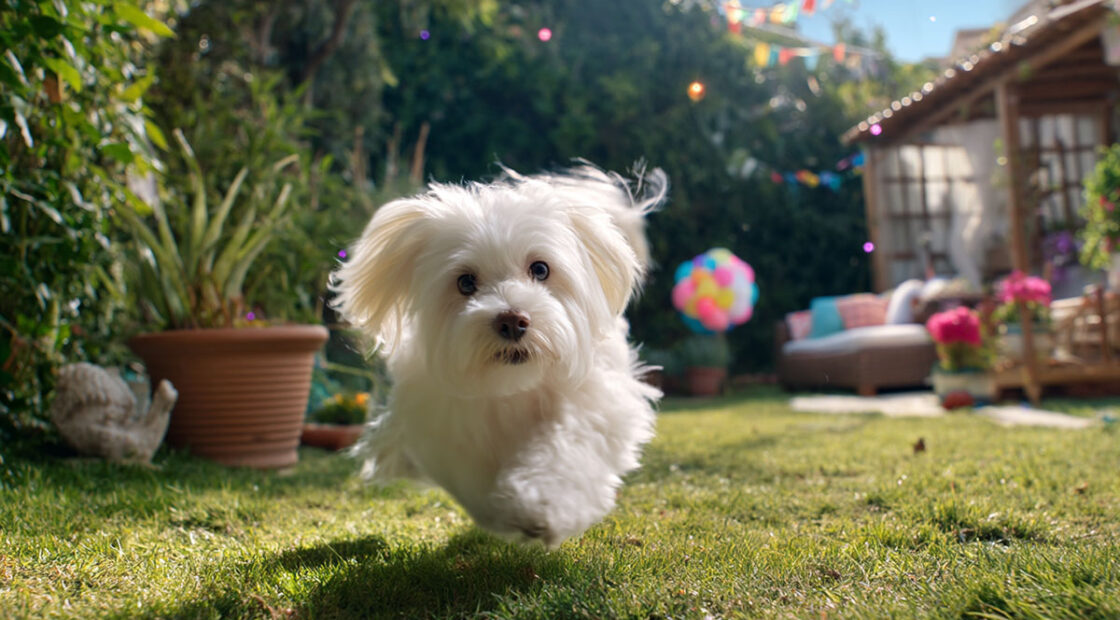
The Maltese is a small white Bichon-type dog with a long, silky, single-layer coat, bred for companionship and not for work.
The AKC and the Canadian Kennel Club place it in the Toy Group, and the FCI files it under companion and toy dogs.
Published weight standards don’t match. The AKC caps adults at under 7 pounds, while FCI Standard No. 65 (2015) asks for 3 to 4 kilograms, or 6.6 to 8.8 pounds, so a healthy 7.5-pound dog meets one standard and exceeds the other.
What Is a Maltese?
Registries sort it into toy or companion groups almost everywhere. Beyond the AKC’s Toy Group, the UKC uses its Companion Dog Group and the Canadian Kennel Club lists it in Group V, Toys. The FCI (Standard No. 65) puts it in Group 9, Companion and Toy Dogs, Section 1, Bichons and related breeds, and gives its use as companion and toy, without working trial.
The AKC standard keeps adults under 7 pounds, and at full length the coat hangs almost to the ground.
Britannica lists older and alternate names, including Maltese Lion Dog, Ancient Dogge of Malta and Roman Ladies’ Dog. The FCI uses the French name Bichon Maltais.
Maltese also names the people and language of Malta. Here it means the dog only.
It isn’t a working dog. Orvis states plainly that it is not a hunting breed, and Britannica calls it an ineffective protection dog.
Maltese Size and Weight by Breed Standard


The AKC and the Canadian Kennel Club cap the Maltese under 7 pounds and prefer 4 to 6. The UKC asks for 6 to 8 pounds, and the FCI wants 3 to 4 kilograms (about 6.6 to 8.8 pounds).
| Standard | Weight | Height at withers |
|---|---|---|
| AKC (approved March 10, 1964) | Under 7 lb, 4 to 6 lb preferred | No figure set |
| Canadian Kennel Club (effective January 2004) | Under 7 lb (3.25 kg), 4 to 6 lb preferred | No figure set |
| UKC (revised May 1, 2017) | 6 to 8 lb | Males 8.25 to 10 in, females 7.5 to 9 in |
| FCI (published November 13, 2015) | 3 to 4 kg | Males 21 to 25 cm, females 20 to 23 cm |
Height is steadier. The UKC and FCI ranges are nearly the same numbers in different units, and Britannica gives 7 to 9 inches with some males reaching 10.
The weight gap has a few causes. The AKC and CKC both say overall quality is to be favored over size, so 4 to 6 pounds is a show preference and not a floor. And the preferred end doesn’t overlap with the FCI at all, since 6 pounds converts to 2.7 kilograms, which sits below the FCI minimum of 3 kilograms.
Body shape differs too. The AKC describes a dog as tall as it is long, while the FCI describes a body about one third longer than the withers height.
Orvis lists an average of 6 to 8 pounds, which matches the UKC range rather than the AKC ideal.
A healthy pet at 7.5 pounds (3.4 kilograms) therefore passes the UKC and FCI standards and runs oversize under the AKC’s.
Smaller isn’t rewarded everywhere either. The FCI treats males under 19 centimeters and females under 18 centimeters as a severe fault, alongside males over 26 and females over 25.
Maltese Coat, Colors and Shedding
There’s no undercoat. The coat is a single layer, long, flat and silky, and white is the base color in all four major standards. The AKC, UKC and FCI texts each describe hair that falls almost to the ground at full length.
Curls and wool are faults. The FCI goes further and disqualifies a frizzy coat, and the UKC lists cosmetic alteration as a ring fault.
The long head hair can be tied into a single or double topknot or left hanging (UKC).
Pure white is the target, but the standards allow small departures. The AKC permits light tan or lemon on the ears, though it isn’t desirable. The UKC allows an ivory tinge or traces of orange and counts either as an imperfection. Under the FCI, pale ivory is permitted, pale orange is tolerated as an imperfection, and any other color disqualifies. The Canadian Kennel Club prefers white but says light beige or lemon markings are permissible.
Retail profiles that list “lemon” as a color are describing a tolerated tint, not a recognized variety.
Shedding runs low, and Hill’s Pet calls the breed a light shedder.
Are Maltese hypoallergenic?
In a 2012 study in the Journal of Allergy and Clinical Immunology, Utrecht University researchers found higher levels of Can f 1, the major dog allergen, in hair and coat samples from 196 dogs of breeds sold as hypoallergenic than in control dogs (Vredegoor et al., 2012).
Airborne allergen levels did not differ between breeds. The authors concluded there is no evidence for classing any breed as hypoallergenic.
The breeds tested were Labradoodle, Poodle, Spanish Waterdog and Airedale Terrier, so the Maltese was never measured. Low shedding keeps hair off the floor, but allergen also travels in saliva and dander, so spend time with the individual dog before committing.
Maltese Temperament and Training

Maltese are gentle and playful, act fearless for their size, and learn fast when rewards are involved. Housebreaking is the slow part.
The AKC standard puts the breed among the gentlest-mannered of all little dogs, yet lively and vigorous.
Britannica adds two traits the standard leaves out. The dog is bold, sometimes brash, with larger dogs, and it stays aloof with strangers.
On children the advice is consistent. The AKC says to supervise any contact with young kids, and Britannica pairs the breed with older, gentle children and seniors while warning that a tiny dog underfoot is a tripping hazard.
Praise and food rewards drive training, according to the AKC and Orvis, so keep a supply of small, healthy treats cut to fit a toy-breed mouth.
Barking and watchdog behavior
Britannica describes an alert, enthusiastic watchdog that barks more than the job needs.
The AKC adds that some bark excessively and may snap at someone they read as a danger, so training should discourage overprotectiveness. Whatever the volume, a Maltese raises the alarm and cannot stop an intruder.
Housebreaking
Orvis calls the Maltese highly trainable but slow to housetrain, and Hill’s Pet notes it can be hard to housebreak. Fixed feeding and potty times plus a reward the moment it finishes outside tend to work, and Orvis suggests a crate for short absences.
Pads can cover the first weeks. Decide early whether they’re a bridge or the permanent setup, and read up on how puppy pads work before you commit.
Separation anxiety
In a Scientific Reports survey of 13,715 dogs across 264 breeds, owners reported separation-related behavior in 5% of dogs, one of the two least common problems measured (Salonen et al., 2020).
Anxiety isn’t a given, then. Rover still warns that a Maltese without training and socialization can turn clingy, anxious and noisy. Building absences up from a few minutes helps, and Rover suggests leaving puzzle toys out to keep the dog busy.
Daily exercise
Twenty to thirty minutes a day covers it, though the sources differ on the exact figure.
Hill’s Pet lists 20 minutes of walking a day, and Purina’s profile says about half an hour. Orvis says a few short walks plus a play session indoors or out keeps the dog fit, even in an apartment.
VCA advises against dog parks unless only small dogs share the space. With no undercoat, a jacket helps in the cold (Orvis), and Britannica notes the breed prefers temperate weather.
How to Groom a Maltese
Brush a Maltese every day (Orvis) and book a professional clip every 4 to 6 weeks (Rover). Skip either and mats form quickly and become painful, according to Petfinder.
- Brush and comb the full coat daily, working in sections down to the skin.
- Wipe under the eyes daily and rinse the beard after meals.
- Bathe with a whitening shampoo, then condition, which Britannica says reduces tangling.
- Dry the coat fully and brush it out before it can knot again.
- Trim nails about every three weeks and brush teeth daily (Rover).
- Clean the ears weekly (Orvis) and keep the clip appointment.
Tear stains
Britannica names saliva and tears as the usual cause of reddish staining on the white coat.
Orvis recommends washing the fur below the eyes daily and the beard after every meal.
Staining that doesn’t respond to daily cleaning is worth a vet check of the eyes.
Puppy cut and show coat
A show coat is a daily project. Britannica notes that show dogs carry much longer hair, wrapped in tissue paper and rubber bands to protect it.
Pet owners usually clip shorter, about every six weeks according to Britannica. The pet clips available for a Maltese run from a trimmed full coat to a short, even puppy cut.
If you won’t brush daily, choose the short clip and book the groomer on a fixed 4 to 6 week cycle.
Maltese Lifespan and Common Health Problems
Maltese live about 11 to 13 years in the most recent published data, a little below the band most breed profiles quote. Health problems cluster around the knees, airway, teeth, liver and heart.
How long Maltese live
In the Dogs Trust analysis of 18 UK data sources (McMillan et al., Scientific Reports, 2024), Maltese had a median survival of 13.1 years, against 12.7 for purebred dogs overall.
Italian records say less. A 2024 study in Preventive Veterinary Medicine (Roccaro et al.) put the median age at death for 73 Maltese at 11.0 years, against 10.0 for all dogs in its dataset.
The two studies measure different things. The UK work models survival across a general population, while the Italian work counts only dogs that had already died, mostly at teaching hospitals and public health institutes, which pulls the median down.
Britannica quotes 12 to 15 years for the breed. Both medians fall below the midpoint of that band, so budget for 11 to 13 years and treat anything beyond it as a bonus.
Common conditions
The kneecap slips out of its groove in patellar luxation. Purdue’s Croney Research Group calls it hereditary and lists the Maltese among the most affected breeds, and Britannica says a dog that hops and holds a rear leg up now and then needs a vet check.
Toy and miniature breeds are the usual victims of tracheal collapse, which brings a dry, honking cough and labored breathing. The cause is unknown (Merck Veterinary Manual). A 2024 Seoul National University study in Frontiers in Veterinary Science counted the Maltese among its four most represented breeds with collapse.
Teeth are another weak spot. In a Banfield Pet Hospital dataset of more than three million records, 25.4% of Maltese had a periodontal diagnosis, against 18.2% of all dogs (Wallis et al., The Veterinary Journal, 2021).
Toy puppies, often under 12 weeks old and newly acquired, can arrive with extreme lethargy, incoordination or seizures, which the AKC describes as hypoglycemia. Limited fat and muscle mass and an immature liver are the cause, and small, frequent meals are the prevention.
Korean clinic records covering Maltese, Miniature Poodles and Shih Tzu put heart disease and cough at the top of the problem list for dogs aged 14 and older (Korean Journal of Veterinary Research, 2023).
White shaker dog syndrome causes head and body tremors. VCA Hospitals describes it as most common in dogs under 30 pounds, though any color and size can be affected, and tremors typically ease within one to two weeks of treatment. Embrace lists the Maltese among the most commonly affected breeds.
Weight is the shared lever. Purdue’s handout says obesity does not cause patellar luxation but can worsen it, and the Merck Manual calls weight loss critical in managing tracheal collapse.
A lean Maltese is the cheapest health measure on this list.
Health testing
According to the AKC, the American Maltese Association recommends a patella evaluation, a cardiac exam and serum bile acids. The association also makes OFA patella certification one of its CHIC requirements.
| Test | Screens for | Note |
|---|---|---|
| Patella evaluation | Kneecap luxation | Definitive diagnosis from 12 months of age (Purdue) |
| Cardiac exam | Heart murmurs and defects | On the AKC breed-club list |
| Serum bile acids | Liver blood-flow anomalies | Merck: screen young small terrier-type breeds at 6 months |
Bile acids are the least familiar of the tests. Merck says raised levels in a young small dog point to microvascular dysplasia or a portosystemic shunt, and that dogs with the milder dysplasia are expected to have a normal lifespan.
Per the AKC and the OFA, a CHIC number means the required results were entered and made public. It doesn’t mean they were good, so read the results behind the number.
Where Does the Maltese Come From?

A small white lap dog existed in the central Mediterranean by Aristotle’s day. The registered Maltese breed is a 19th-century creation.
Sources place the origin in different spots. Britannica says the breed is named for Malta, where it may have originated more than 2,500 years ago, and the AKC says the Phoenicians brought it to Malta. FCI Standard No. 65 names the central Mediterranean with Italy as patron country, while the UKC calls it a Mediterranean Bichon breed as much as 2,000 years old, of spaniel origin.
The FCI standard adds a warning. The name doesn’t prove Malta, because it traces back to a Semitic root meaning refuge or harbour, shared by the Adriatic island of Meleda, the Sicilian town of Melita and Malta itself.
Its harbor-city ancestors hunted the rats and mice in warehouses and ship holds. Aristotle’s list of dogs includes a small breed with the Latin name canes melitenses (FCI).
Scholars still debate whether that name meant Malta, the island of Mljet or a Sicilian town (The New York Times, 2021).
The genetics are less romantic. Heidi Parker of the National Institutes of Health told the New York Times that the Maltese genome is related to those of other Bichon-type breeds, which may have split from a shared ancestor a few hundred years ago, and that no DNA line runs back to Aristotle’s day.
Oxford’s Greger Larson, quoted in the same piece, dates closed breeding lines to the mid-19th century in Britain, while a lineage of tiny, attention-hungry lap dogs clearly existed in Rome. That is why lists of ancient dog breeds that include the Maltese describe a type of dog, not a pedigree.
| Milestone | Year | Detail |
|---|---|---|
| First Westminster show | 1877 | Shown as the Maltese Lion Dog (Rover) |
| AKC recognition | 1888 | American Maltese Association formed 1961, became parent club 1969 |
| Canadian Kennel Club | 1902 | Listed in Group V, Toys |
| UKC recognition | 1948 | Companion Dog Group |
| FCI definitive acceptance | 1955 | Patronage of Italy |
Treat the Maltese as an old type with a young pedigree.
Who Should Not Get a Maltese?

Skip the Maltese if nobody is home for most of the day or if toddlers share the house. Daily brushing that sounds like a chore is another reason to look elsewhere. The sources point the same way on each.
The PDSA advises that most dogs not be left much longer than four hours, so an eight-hour shift is double that. WebMD says the breed can be snippy with small children and gets overwhelmed by their energy.
Yards are a problem when large dogs or wild predators are around, since Britannica says owners must protect the Maltese from both. Orvis calls it a house dog that should not be left alone outside for any length of time.
First-time owners who enjoy the grooming routine do well with it (Petfinder), and apartment dwellers are fine too, since Britannica says the breed’s exercise needs can be met in an apartment.
If the dog would be alone more than four hours on a regular day, pick another breed or hire a sitter or day care. That settles most cases.
Maltese vs Bichon Frise, Shih Tzu and Yorkshire Terrier
The Maltese is the lightest of the four, tied with the Yorkshire Terrier at the 7-pound cap, while the Bichon Frise and Shih Tzu are sturdier dogs.
| Breed | Weight | Coat | AKC group |
|---|---|---|---|
| Maltese | Under 7 lb | Silky single coat, white | Toy |
| Bichon Frise | 12 to 18 lb | Curly double coat, white | Non-Sporting |
| Shih Tzu | 9 to 16 lb | Long coat, any color | Toy |
| Yorkshire Terrier | Not over 7 lb | Long silky coat, blue and tan | Toy |
Health does not separate them. All four appear on the Merck Veterinary Manual’s list of small breeds to bile-acid screen at about six months, and Purdue’s handout names the Maltese, Yorkshire Terrier and Bichon Frise among the breeds most affected by patellar luxation.
The Bichon Frise starts at 12 pounds, five above the Maltese cap, and its curly double coat needs frequent grooming to clear built-up fur and dander (Orvis).
The Shih Tzu sits closer in spirit. The AKC describes it as a companion and house pet, much like the Maltese, but it carries more bone and the AKC accepts any color on it.
Yorkshire Terriers cap near 7 pounds too and share a long, silky coat. The AKC lists the Yorkie as a companion and ratter, though, and it is a terrier, not a Bichon type.
For under 7 pounds and a silky single coat, that points to the Maltese. A terrier background at the same weight points to the Yorkshire Terrier, and anyone who wants a sturdier frame at 9 pounds or more should look at the Shih Tzu or Bichon Frise.
Choose on size and coat. Health will not settle it.
Maltese Puppy Price and Where to Find One
A breeder puppy costs several times what a rescue adoption does, and the gap pays for pedigree papers and health testing. No registry publishes prices, so these figures come from retailer, insurer and rescue sources.
Chewy puts a breeder puppy in the US at $600 to $4,000, depending on the breeder, pedigree papers and the health and temperament screening done. American Maltese Association Rescue charges $250 to $700 for healthy dogs, higher under 12 months and lower over 9 years.
Pet insurance ran $42 to $56 a month for most Embrace customers in 2025. Grooming adds 9 to 13 visits a year, calculated from the 4 to 6 week clip cycle in Rover’s grooming guidance.
American Maltese Association Rescue places dogs through foster homes and will not ship them, so you need to be able to collect the dog in person.
If you buy, ask for the OFA patella result, the cardiac exam and a bile acid result for both parents, the three tests the AKC lists for the breed. Then look the results up in the CHIC database instead of trusting a certificate handed to you.
Rescue is the cheaper way in, with one practical limit. The rescue prefers local or neighboring-state adopters, though it does consider applications from further away.
Maltese FAQ
Is a teacup Maltese a real variety?
No. “Teacup” is a sales term, not a recognized variety. The FCI standard treats males under 19 cm and females under 18 cm as a severe fault, so a dog sold as a teacup falls outside the written standard.
What are a Maltipoo and a Morkie?
A Maltipoo comes from crossing a Maltese with a Poodle. A Morkie has a Yorkshire Terrier on the other side instead. Neither is a recognized breed, so there is no breed standard and size, coat and shedding vary from puppy to puppy.
How often should a Maltese puppy eat?
Three to four meals a day, according to FirstVet, using a puppy food formulated for growth.
Frequent meals protect against the blood sugar drops that toy-breed puppies are prone to.
What should a Maltese owner check before buying pet insurance?
Check how the policy treats hereditary and pre-existing conditions. Patellar luxation is hereditary, and Embrace states that some insurers limit genetic and hereditary illnesses, so read the exclusions before enrolling a puppy.
What a New Maltese Owner Should Set Up First
A new Maltese owner should set a feeding routine and a veterinary baseline in the first month, then book two screenings tied to the dog’s age.
The feeding routine and first vet exam belong in month one. A serum bile acid test follows at month six and a patella evaluation at month twelve.
Parental test results do not replace the puppy’s own bile acid test. Merck notes the trait is polygenic, so parents with normal values can still produce affected puppies.
A baseline taken young also protects later care, because Merck says high bile acids discovered during an illness can trigger invasive, expensive diagnostics.
The downside is paying to screen a dog that looks healthy and waiting a year for a definitive knee result. This schedule was verified in October 2026, and a revised American Maltese Association test list would change it.