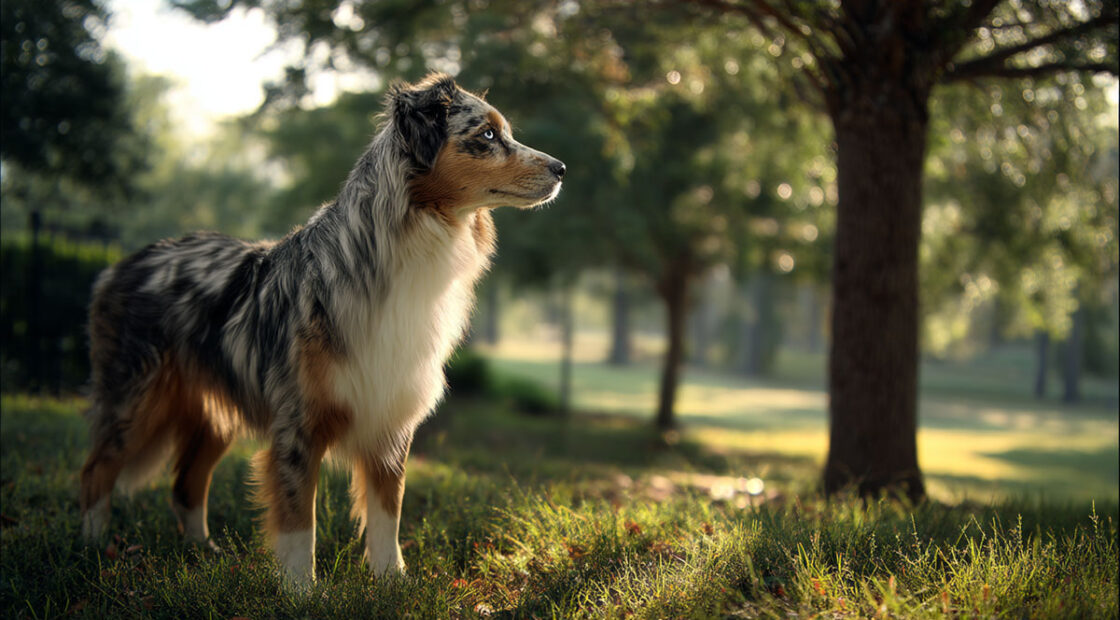
Despite the name, the Australian Shepherd came out of ranch country in the western United States. It’s a medium-sized herding breed, and it needs a daily job to stay settled.
Ranchers, rodeo crowds, agility competitors and search-and-rescue teams all know the Aussie by its merle coat, its frequent natural bobtail and its stamina.
On lifespan, a 2024 Dogs Trust study in Scientific Reports, covering about 585,000 UK dogs, put the breed’s median survival at 13.7 years, against 12.7 years for purebreds overall.
The breed’s genetics lead back to British herding dogs. That’s why it carries the same MDR1 drug-sensitivity mutation found in the Collie and the Shetland Sheepdog.
What Is an Australian Shepherd and Why Isn’t It From Australia?
The breed took shape in California, Colorado, Wyoming and Idaho sheep country, according to the American Kennel Club’s 2026 breed history. The name is where the agreement stops.
Britannica describes mostly British-derived herding dogs that reached the West through the East and Midwest, with some arriving via Australia. The AKC says Americans coined the name after newspaper reports of dogs arriving with Australian sheep, and eventually every merle sheepdog got the label.
Burke’s Backyard finds no evidence the breed began in Australia, and plenty that Basque shepherds never brought sheep from there.
Orvis notes that the Australian Cattle Dog (also called the Blue Heeler) is a separate breed that did originate in Australia.
Basque ancestry is also disputed. Britannica says some forebears may have come with Basque immigrants from the Pyrenees, home of the smaller, similar-looking Pyrenean Shepherd.

The AKC points out that most Basque emigrants left Spain for Argentina, Chile and Paraguay, so whether they carried dogs north is an open question.
Genetics points to Britain. A 2017 Cell Reports study by Parker and colleagues placed the Australian Shepherd in the UK Rural clade, the group that also holds the Collie, Shetland Sheepdog and Border Collie.
Popularity came later. The United States Australian Shepherd Association’s breed history credits Idaho rodeo performer Jay Sisler and his dogs Shorty, Stubby and Queenie with national attention in the 1950s and 1960s.
The Australian Shepherd Club of America was founded in 1957 (Dogs NSW). The United Kennel Club recognized the breed in 1979 (UKC), the American Kennel Club followed in 1991 (Dogs NSW), and the Australian National Kennel Council came last, on 1 January 1994 (Dogs NSW).
Registries file the breed differently. The AKC and UKC place it in the Herding Group, while Dogs NSW lists it under Group 5, Working Dogs.
How Big Does an Australian Shepherd Get?
Expect 18 to 23 inches at the withers and 40 to 65 pounds, with females at the lower end of both ranges and males at the upper end, per the AKC’s 2026 breed profile.
The UKC standard gives a preferred height of 20 to 23 inches for males and 18 to 21 for females. After six months of age, the show cutoffs are under 17 or over 22 inches for females, and under 19 or over 24 for males.
The UKC and AKC size clauses set a height and no weight. Profile pages fill the gap, and they disagree at the top. Orvis lists 55 to 70 pounds for males and 35 to 55 for females, while the AKC stops at 65.
A dog outside these numbers is not automatically a problem. The UKC says quality should not be sacrificed for size, and its cutoffs apply to show placement.
Australian Shepherd Coat, Colors and Shedding
The coat is a medium-length double coat, and it sheds year-round with heavier loss in season.
Colors and Merle
The AKC, UKC and ASCA standards all accept blue merle, red merle, solid black and solid red, each with or without white markings and tan (copper) points.
Pigment follows color. Per the UKC standard, blue merle and black dogs have black noses, lips and eye rims, while red merle and red dogs do not.
Merle comes from a variation in the PMEL gene, and a single copy is enough to produce the pattern.
Two copies make a double merle. Those dogs often have hearing and vision defects, which is why breeders avoid merle-to-merle pairings.
Some dogs carry merle without showing it (cryptic merle), so a dog that looks solid can still pass the gene on. A PMEL (M locus) DNA test identifies the allele.
Natural Bobtail and Eye Color
The bobtail is what people notice first. The AKC and UKC standards allow a tail no longer than four inches, natural or docked.
Not every Aussie is born short-tailed. The AKC’s history traces the half-tail to the English Shepherds that came west, which occasionally produced dogs with half tails or none, and the UKC no longer penalizes a full tail in any of its events.
Eyes can be brown, blue, amber or any combination, flecks and marbling included. The ASCA standard accepts every eye color with every coat color.
Shedding and Brushing
Brushing advice depends on who you ask. PDSA recommends a few times a week, Orvis says daily to weekly, and the AKC says only that frequent brushing is advised because the breed sheds often.
The longer hair on the back legs and tail mats first, so PDSA suggests an extra brush after walks.
PDSA puts the heaviest shedding in spring and autumn, and daily brushing helps then. The UKC standard notes that undercoat quantity varies with climate, so where you live decides when the big shed actually lands.
Some owners want a tidier look, and a few haircut styles that suit an Aussie’s double coat exist. Shaving is not one of them, and Orvis advises against it.
Australian Shepherd Temperament and Energy Level
The Aussie is an intelligent, high-energy working dog. It’s reserved with strangers, devoted to its family, and it invents a job if nobody supplies one.
Temperament Traits

The UKC standard describes an easily trained, versatile dog that is reserved with strangers without being shy. It rejects viciousness toward people or animals outright.
The AKC calls the breed neither overly affectionate nor independent, while Orvis and PDSA describe dogs that follow their person from room to room. Strangers get a slow welcome, though friendly people and dogs are accepted (AKC).
As watchdogs they’re alert and loyal, but Orvis says the guarding rarely goes past an alert.
Both Orvis and PDSA warn that the breed dislikes being left alone. A bored Aussie digs, chews, paces and barks.
How Much Exercise an Australian Shepherd Needs
Published exercise figures for the breed run from 30 minutes to three hours a day.
Burke’s Backyard, citing breeders, says 30 to 60 minutes daily. PDSA wants a minimum of two hours, split into two long walks plus off-lead running in a secure area, and Orvis says at least two to three hours, with mental work counted in the total.
Budget two hours a day, mental work included. Both sources behind the higher figure tie shortfalls to destructive habits, and Orvis adds snappy behavior.
Stamina is not the limit. Orvis puts a conditioned adult at a four- to six-mile run, or a hike of up to 15 miles once it has built up to the distance.
How to Train an Australian Shepherd and Give It a Job

Use positive, reward-based methods from puppyhood, socialize the dog widely, and assign a daily task. A bright, high-energy herder without work finds its own.
Training Approach
The breed learns fast, and that cuts both ways. The AKC notes that Aussies also learn by watching, so behavior you never meant to teach gets picked up.
PDSA and Orvis both set positive reinforcement as the baseline, though Orvis adds that Aussies try to outsmart their owners, so handling needs to be firm.
PDSA recommends exposure to many people, dogs and situations while the dog is young, which helps a reserved breed grow into a confident adult. It also suggests accredited training classes for first-time owners, since the breed’s constant drive to be active makes training a challenge at times.
Herding Behavior at Home
The herding drive points at anything that moves, and the AKC lists birds, children and other dogs as targets.
Nipping at the heels or hands of children needs immediate redirection. Orvis pairs socialization with exercise or a job to reduce it.
A bored Aussie may herd the household cat, so PDSA says to supervise around other pets. Near livestock, keep the dog on a lead.
Sports and Jobs
Britannica lists search and rescue, police work, therapy work and assistance for blind, deaf or otherwise disabled people alongside ranch work.
Pets usually get their outlet through sports such as agility, competitive obedience, herding trials and flyball.
A job can also be small. Orvis suggests teaching an Aussie to pick up its own toys, an easy task that gives it daily work.
Health Problems and Lifespan in Australian Shepherds

The breed is long-lived for a medium dog, with a short list of inherited risks. Those are MDR1 drug sensitivity, eye disease, hip and elbow dysplasia, epilepsy and double merle defects.
Lifespan
A 2024 Dogs Trust study in Scientific Reports, covering about 585,000 UK dogs, put the Australian Shepherd’s median survival at 13.7 years. The purebred median in the same study was 12.7.
Profile pages scatter far more widely. Hill’s says 10 to 12 years, the AKC says 12 to 15, and Orvis says 13 to 15.
Use the measured median, with one caveat. It describes dogs in the UK.
Inherited Eye and Joint Conditions
Collie eye anomaly is an inherited eye defect shared across herding breeds, per the 2017 Cell Reports breed map, and PDSA notes a DNA test exists.
Embark lists the Australian Shepherd variant of the HSF4 mutation, which causes hereditary cataracts, along with MDR1, among the conditions where fewer than 95% of tested Aussies come back clear.
Hip and elbow dysplasia are joint malformations that lead to arthritis. X-ray screening before breeding catches them.
Epilepsy is the murky one. The International Veterinary Epilepsy Task Force’s 2015 review found one dedicated clinical study (50 affected Aussies) and no published prevalence figure.
Chewy’s vet-reviewed guide lists no screening test for epilepsy. The University of Minnesota’s canine genetics lab adds that late onset means many dogs are bred before anyone knows they are affected.
MDR1 Drug Sensitivity
Owners often hear about MDR1 as if it were a disease. It’s a drug-sensitivity mutation, and it stays harmless as long as the owner and vet know the dog’s status.
The Australian Shepherd Health and Genetics Institute (ASHGI) reports that one in two Aussies carries at least one copy (FAQ revised 2013).
Ivermectin at worming doses triggers reactions, while the low dose in heartworm preventives does not. Acepromazine and Imodium are on the list too, and some chemotherapy drugs can react with a single copy.
Reactions show up as seizures and sometimes death, because the drug builds up in the brain. A cheek-swab DNA test settles the status once, through Washington State University in North America.
The mutation is incompletely dominant, so a dog with one copy counts as affected, to a lesser degree. MDR1 seizures are not epilepsy, since they follow a listed drug and stop once it clears.
ASHGI says every Aussie should be tested, rescues of unknown parentage and Aussie mixes included. Dogs that eat feces from recently wormed horses or livestock can react too.
Double Merle
Double merle puppies come from merle-to-merle pairings, and the AKC says about a quarter of the puppies in such litters are double merle. ASHGI notes that white markings are pronounced in most double merle Aussies.
On the eyes, ASHGI says double merles virtually always have abnormally developed eyes, frequently blind. On hearing, one study cited by the AKC found about 56 percent of double merle Aussies deaf in both ears.
Older papers suggested wider heart and digestive problems. ASHGI calls that inaccurate and blames the groups of dogs studied, though it does count sun damage on unpigmented skin as a real risk.
None of this argues against merle Aussies. Single merles are far less likely to have these defects, so the fix is avoiding merle-to-merle litters.
Screening Tests
The expected test panel differs by country. The US CHIC criteria, as ASHGI describes them, make hip, elbow and eye exams mandatory and DNA tests optional, while Dogs NZ accredited breeders must also run DNA tests.
| Test | US CHIC (ASHGI) | Dogs NZ accredited breeders |
|---|---|---|
| Hip dysplasia | Mandatory | Mandatory |
| Elbow dysplasia | Mandatory | Mandatory |
| Eye exam | Mandatory | Mandatory, annual |
| Collie eye anomaly DNA | Optional | Mandatory |
| MDR1 DNA | Optional | Optional |
Dogs NZ also makes hereditary cataract and progressive retinal atrophy DNA tests mandatory. A CHIC number records that the required tests were done and published, not that the results were normal, and ASHGI says breed requirements change, so check OFA’s current listing.
Australian Shepherd vs Border Collie vs Miniature American Shepherd
The Aussie has two close relatives. The Border Collie is a more intense British-line herder, and the Miniature American Shepherd is a separate AKC breed developed from small Aussies.
| Trait | Australian Shepherd | Border Collie | Miniature American Shepherd |
|---|---|---|---|
| Origin | US ranches | Anglo-Scottish border sheepdogs | US, from small Aussies |
| Size | Medium | Medium, 18 to 22 inches | Small, 13 to 18 inches |
| AKC status | Herding Group | Herding Group, regular classes from 1995 | Herding Group, full recognition 2015 |
| Working style | Adaptable, family-oriented | Intense, work-focused | Self-motivated, loyal |
The Border Collie is the closer match in drive, and the AKC warns that it can overwhelm owners without the time and energy to keep it busy.
Health is where they split most. ASHGI’s breed table puts the MDR1 mutation under 5% in Border Collies, against about half of Aussies and Miniature American Shepherds, while Dogs Trust’s 2024 study gives Border Collies a median survival of 13.1 years.
The Miniature American Shepherd took its current name in 2011, when the AKC accepted it into its Foundation Stock Service, and gained full AKC recognition in 2015. Before that, breeders sold these dogs as Miniature Australian Shepherds, and the Miniature American Shepherd Club of the USA says hundreds of AKC Aussies moved into the new registry on its first day.
“Toy” and “teacup” Aussies are a different matter. Orvis says the AKC does not recognize them, they come from crossing Aussies with smaller dogs, and with no breed standard their temperament and health can differ.
The Border Collie suits work-focused homes. Families that want a more adaptable herder do better with the Aussie, and anyone who wants the same drive in a compact dog should look at the Miniature American Shepherd.
Is an Australian Shepherd the Right Dog for You?

An Aussie suits active owners who are home most of the day and can give the dog real work. It fits poorly with long hours alone or very young children, and a first-time owner with no training support will have a harder time.
Alone time is the biggest one. PDSA says never leave an Aussie alone longer than four hours, and that even four may be too long, while Orvis allows four to six hours with crate training.
Sources split on small children. PDSA advises against the breed with smaller children because herding bumps can knock them over, while the AKC calls Aussies fantastic with kids and Chewy says older, responsible children suit them best.
First-time ownership gets the same mixed treatment. The AKC calls it challenging but possible, Orvis calls it not ideal as a first pet, and Chewy says it works for a first-timer who will invest the time.
Orvis says an Aussie will work out how to scale a fence, and also that it can live in a city apartment if properly exercised.
The sources agree on time, though. The breed’s limit is how much attention you can supply, not how much floor space you have.
If nobody is home for most of the day, pick a lower-drive breed.
Buying or Adopting an Australian Shepherd: Costs and Breeder Checks

Buying from a breeder costs several times more than adopting, and the health screening a breeder can document matters more than the price tag.
Price and Ownership Costs
Chewy’s vet-reviewed breed guide (updated December 2025) puts a purebred puppy at $600 to $2,000 or more.
PDSA warns that unusually cheap puppies can come from puppy farms, so a price at the bottom of the range is a question, not a bargain.
The purchase price is only the start, and PDSA’s checklist of ongoing costs is longer than most people expect.
- Vaccines, neutering and equipment
- Food
- Routine vet care or pet insurance
- Training classes
- Boarding or day care when you are away
Adoption and Rescue
Aussie Rescue and Placement Helpline runs a nationwide network of Australian Shepherd rescues. Its application involves reference calls and may include a home check, and it does not ship dogs.
Australian Shepherds Furever, a rescue listed on Chewy, shows an adoption fee of $300 to $450 and says dogs get vaccines, spay or neuter and heartworm treatment first.
Shelter dogs labeled Aussies often have no DNA test behind the label, since Orvis notes most shelters identify breed by appearance. That makes ASHGI’s advice to MDR1-test every rescue and Aussie mix especially relevant.
Working Lines and Show Lines
Lines change the dog. Orvis says working-line Aussies are fantastic herders while conformation-line dogs may be less biddable, and Hill’s says dogs from working lines need to be kept busy.
Ask what the parents do. Match the lines to the job you can offer.
Vetting a Breeder
- Look up both parents in OFA’s public database. A CHIC number shows the required tests were done and published, not that the results were normal.
- Ask for hip and elbow results from OFA or PennHIP radiographs, plus an eye exam by a board-certified ophthalmologist dated within the year before the litter, as Dogs NZ requires.
- Ask for MDR1 status on both parents. If both are Normal/Normal, the puppies cannot carry the mutation.
- Ask for DNA results for collie eye anomaly and hereditary cataracts, the two conditions Dogs NZ and Embark both flag.
- Check the coat colors of both parents to rule out a merle-to-merle pairing, and ask for an M locus result on any parent that looks solid.
- Ask how the litter is socialized before puppies leave, as PDSA advises.
Australian Shepherd FAQ
Do Australian Shepherds bark a lot?
Yes, Aussies are likely to make noise, though the amount depends on the individual dog’s personality and training, per PDSA.
Early training teaches them to bark mainly when strangers are around, and daily exercise and mental stimulation cut the pointless barking.
How much should an Australian Shepherd eat each day?
Orvis recommends 2.5 to 4 cups of high-quality dry food per day, split into two meals and adjusted for weight and activity level.
PDSA caps treats at 10% of daily calories, and your vet can fine-tune the amount.
Do Australian Shepherds get along with cats and other dogs?
Usually yes, when socialization starts early. PDSA says Aussies socialized with other dogs from a young age should be fine.
They also get on well with cats and other pets they have grown up with.
What are the most common Australian Shepherd mixes?
Orvis names Husky, Labrador Retriever and Border Collie mixes as the most common.
Herding behavior almost always carries over, though it may be less prominent. Most shelters do not run DNA tests, so a mix’s breed label usually rests on appearance.
Planning the First Year With an Australian Shepherd
Do the MDR1 cheek swab before the first vet procedure. Get a daily agility or stockdog-style routine going before adolescence. The hip and elbow follow-up can wait until 24 months.
The swab comes first because worming doses and sedatives can appear at the earliest vet visits, before any other task has a deadline.
The hip check comes last because VIN veterinary proceedings on the OFA scheme state that a dog must be at least 24 months old before its hips are evaluated.
That threshold means a puppy’s own hip status stays uncertified through year one, so the parents’ certified results are the only hip evidence available at purchase.