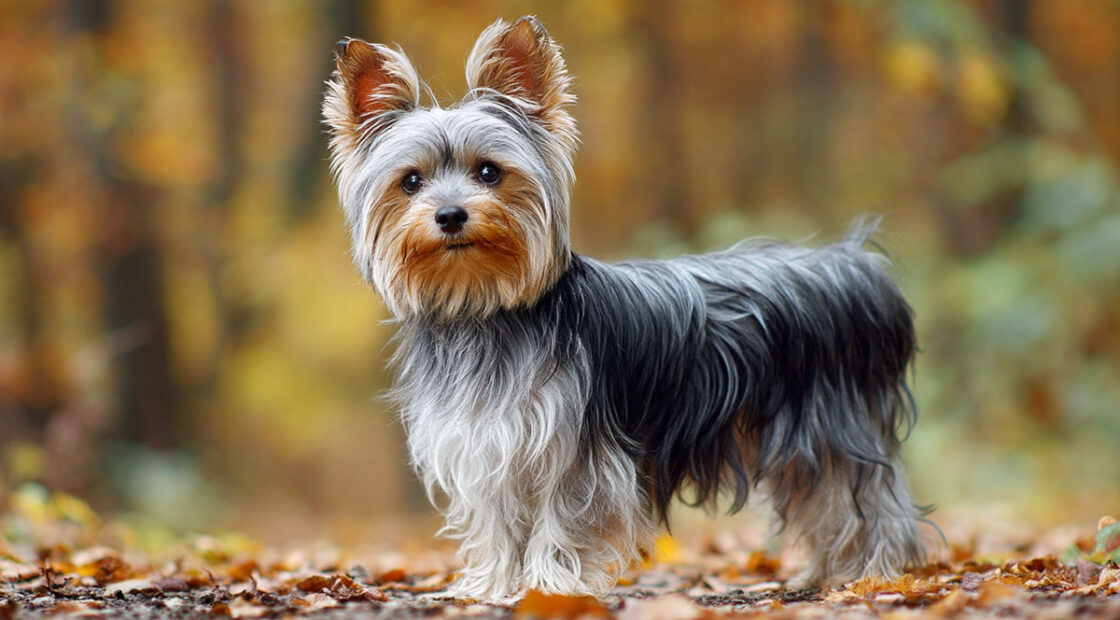
The breed standard caps a Yorkshire Terrier at 7 lb (3.2 kg). Most pet Yorkies never got the memo, and the median adult in a UK study of 28,032 of them weighed 5.06 kg, about 11 lb (RVC VetCompass, 2025).
The standards describe the pedigree show dog, and the typical pet is a larger type.
Underneath the long, silky, single-layer blue and tan coat sits a ratting terrier. The breed was developed in 19th-century Yorkshire, England, to catch rats in mills and mines, and the AKC and the Royal Kennel Club now class it as a toy.
What is a Yorkshire Terrier?
Think of a ratting terrier’s temperament packed into a body of 7 lb or less, then add a long, silky, single-layer blue and tan coat. That’s the Yorkie.
“Yorkie” is just the everyday nickname for the breed. It doesn’t mark out a separate size or variety.
The AKC puts the breed in the Toy Group and registered its first Yorkshire Terrier in 1885. The Royal Kennel Club uses Toy as well. The FCI files it under Group 3, Terriers, Section 4, Toy Terriers, Standard No. 86, and the UKC recognized it in 1956 as part of its Companion Dog Group.
The AKC files the breed under Toy because of its size, not its temperament.
Its own breed profile describes a feisty old-time terrier under the glossy coat, one that earned a living as a ratter in mines and mills.
Where did the Yorkshire Terrier come from?
Scottish workers brought terriers south to the mills and mines of 19th-century Yorkshire, England, and the breed grew out of those dogs. It started as a ratter. It didn’t stay one for long, because it soon became a fashionable lady’s dog.

AKC judges’ education material names the Clydesdale Terrier (a blue and tan, silky-coated version of the Skye Terrier) as one foundation breed, along with the Waterside Terrier and the Old English Terrier.
Both the UKC breed history and the 2025 VetCompass review credit the Maltese with a later contribution. The review dates the fixed breed type to about 1865, built on an outcross from the Black and Tan Terrier.
| Year | Milestone | Source |
|---|---|---|
| 1861 | Shown at an English bench show as the “Broken-Haired Scotch Terrier” | AKC Dogs (LC record) |
| 1870 | Name Yorkshire Terrier comes into use | AKC Dogs (LC record) |
| 1885 | First Yorkshire Terrier registered with the AKC | AKC |
| 1886 | Official breed name Yorkshire Terrier | UKC history |
| 1956 | Recognized by the UKC | UKC |
The two naming dates trip people up. The name was in use around 1870, but the UKC history dates the official name to 1886.
Huddersfield Ben (1865 to 1871), owned by Mary Ann Foster, set the breed type through his show wins and his puppies. Breeders still call him the father of the breed.
Interest dipped in the 1940s. Smoky, a Yorkshire Terrier war dog from World War II, is credited with renewing it.
How big does a Yorkshire Terrier get?
On paper, 7 lb (3.2 kg) is the ceiling, and both the AKC and the Royal Kennel Club say so. Most pet Yorkies weigh more than that.
The RVC VetCompass study (2025) put the UK pet median at 5.06 kg (about 11.2 lb). Males came in at 5.50 kg (about 12.1 lb) and females at 4.67 kg (about 10.3 lb). The sample was 28,032 Yorkshire Terriers among 905,542 dogs seen by UK vets in 2016.
Pedigree dogs tell a different story. They made up 0.93% of Kennel Club registrations in 2013 and only 0.18% in 2022.
The gap has a plain explanation. The standards describe the pedigree show dog, and the RVC team found that the typical pet Yorkie is a larger type than the miniature pedigree.
The Royal Kennel Club says as much in its own standard: a dog might be larger or smaller than the measurements given. The VetCompass figures describe UK dogs only, so US pet averages may differ.
Height depends on who you ask. Purina lists 6 to 9 inches, while VCA Animal Hospitals lists 8 to 9.
“Teacup” is a sales label, not a variety, and the AKC doesn’t recognize it. I’d treat it as a red flag on a breeder’s page. Dan O’Neill, the lead author of the RVC study, points to growing public awareness of the suffering that extreme miniaturisation can cause (VN Online, 2025).
Yorkshire Terrier coat: color, texture and the puppy-to-adult change
Long, glossy and perfectly straight, the standard coat has a single layer and no undercoat. Dark steel blue covers the body, and rich golden tan sits on the head, chest and legs.
Standard coat and color
The official standard (approved April 12, 1966) ranks coat quality, texture and quantity at the top of its priorities.
For the body, it asks for dark steel blue from the back of the neck to the root of the tail. Never silver blue, and never mixed with fawn, bronzy or black hairs. The head fall is rich golden tan, deeper at the sides of the head, the ear roots and the muzzle. Chest and legs get a bright, rich tan that doesn’t reach above the elbow on the forelegs or above the stifle on the hind legs. The hair itself should be glossy, fine and silky, never wavy or woolly.
The Royal Kennel Club standard (updated April 2025) agrees on dark steel blue, not silver blue, and calls any other color or combination unacceptable.
The AKC version adds a disqualification, in force since October 1, 2007, for any solid color or combination other than blue and tan. Any white marking beyond a small forechest spot of 1 inch is also disqualified.
Color change from puppy to adult
Yorkshire Terrier puppies are born black and tan, and the steel blue arrives as they mature.
The standard says puppies are normally darker in body color, with black hair mixed into the tan until maturity. It sets no age for the change.
A breeder and judge writing in Showsight Magazine (2018) describes young dogs with a full coat and good color that still carry dark puppy hair at the ends. Correct steel blue and correct texture, she adds, are hard to achieve.
The Yorkshire Terrier Club of America describes how a coat can miss the standard. A woolly coat is thick, full and very dark, sometimes fading to gray but never reaching the correct colors. A cotton coat is fine and easily matted, with pale blonde tan and a lighter blue-gray. Some dogs carry a double coat in place of the single silky layer.
Parti-color Yorkies and the Biewer Terrier
Parti-color dogs share a root with the Biewer Terrier, which is why people mix the two up.
The Biewer Terrier is a separate breed from Germany. It began in 1984 when two Yorkshire Terriers carrying a recessive piebald gene produced tricolor puppies (AAHA, 2020).
The AKC announced full recognition on January 4, 2021, as its 197th breed, in the Toy Group.
On paper the Yorkshire Terrier is blue and tan only, with a 7 lb maximum, and US show dogs often have docked tails. The Biewer comes in tricolor, either white, blue and black or white, gold and tan, and its tail stays undocked. The AKC puts it at 4 to 8 lb.
The Biewer Terrier Club of America says a parti Yorkie that looks like a Biewer likely traces back to early cross-breeding between the two.
Off-standard color closes the show ring to a Yorkie. It doesn’t make the dog a different breed.
Yorkshire Terrier temperament and training
Yorkies are alert and spirited, with a working terrier’s drive and plenty of confidence packed into a toy-sized body. The Royal Kennel Club standard sums the breed up as an alert, intelligent toy terrier with a spirited, even disposition.
Personality and terrier instincts
The toy label covers size only. The temperament is terrier.
The AKC standard describes a high head carriage and an air of self-importance, and that’s accurate in my experience of how the breed carries itself. The hunting instinct fires on a toy in the living room as readily as on a rodent in the garden.
The AKC profile describes a feisty old-time terrier under the glossy coat. That’s the temperament training has to work with.
Barking and separation anxiety
Separation-related problems rank among the most common behavior disorders in family dogs, according to a 2021 Scientific Reports study.
The same paper explains why the older label “separation anxiety” is fading. Fear, panic or frustration can each drive the behavior, and both genetics and earlier experiences play a part.
It also found anxiety and fear tied more often to whining than to barking. A Yorkie barking at the window isn’t automatically an anxious dog.
Territorial barking comes from doorbells and hallway noise, plus whatever passes the window, and it happens while you’re home. Separation distress only shows up when you’re gone, as whining, house soiling or destruction.
Film the dog on a phone while you’re out. The footage tells you which one you’re dealing with.
How to house train a Yorkshire Terrier
House training starts the day the puppy comes home, according to the AKC’s July 2026 guide, and consistency matters more than the method.
- Start on day one. Puppies arrive around 8 weeks old, when bladder control is at its weakest.
- Set a schedule: first thing in the morning, last thing at night, and after naps, meals, drinks, chewing and play.
- Use a crate sized so the puppy can stand, turn around and lie down, but can’t use one corner as a toilet.
- Take the puppy to the same spot, say a cue such as “go potty” as it goes, and reward at once with praise and a small treat.
- Clean accidents with an enzymatic cleaner and skip the scolding. Lingering odor pulls puppies back to the same spot.
- Widen the puppy’s freedom in stages. Many relapses come from giving too much room too early.
As a rough guide, a puppy can hold its bladder for about as many hours as its age in months, up to around 9 to 12 months. Individual puppies vary.
Toy breeds come with a catch. The AKC lists accidents around the house as a common complaint, and some trainers set up an indoor potty spot for that reason.
Puppy pads can help owners who are away for long hours or live with severe winter weather. AKC trainer Mary Burch cautions that pads teach the puppy two options instead of one.
A dog that stays hard to house train despite steady work needs a vet check before anyone blames the dog.
How to groom a Yorkshire Terrier

Brush every day. Bathe every week or two, and trim the nails at least every two weeks. The Royal Kennel Club lists daily grooming for the breed, and the Yorkshire Terrier Club of America sets the bath and nail intervals.
- Brush with a wide-tooth metal comb and a brush, working from the ends of the hair toward the body.
- Loosen mats with your fingers first, add a little detangler, and never pull.
- Rinse twice after shampooing, then condition. A small sponge works well on the face.
- Trim ear hair about a third of the way down from the tip, and skip cotton swabs in the ear.
- Keep pad hair clipped so the dog doesn’t slip on smooth floors.
- If the dog tears, wipe the eye corners daily.
| Coat style | Look | Upkeep | Trade-off |
|---|---|---|---|
| Show coat | Long, parted nose to tail, fall tied up with bows | Daily brushing, regular baths | Most work, mats fast when skipped |
| Floor-length trim | Same long look, hem trimmed to the floor | Daily brushing | Allowed by the AKC standard, easier to move in |
| Short pet clip | Clipped short all over | Easier brushing | Gives up the standard look |
The Yorkshire Terrier Club of America points owners of cotton or woolly coats toward clipped styles, since a woolly coat otherwise needs brushing once or twice a day. Anyone leaning that way has plenty of Yorkshire Terrier haircut styles to choose from.
My view is simple. If you won’t brush every day, clip the coat. A long coat you skip will mat.
Shedding stays low either way. The Royal Kennel Club lists the breed as non-shedding, which fits the single layer with no undercoat that the Yorkshire Terrier Club of America describes.
Feeding a Yorkshire Terrier from puppy to senior
The AKC’s 2026 feeding guidelines for toy breeds start a puppy at 4 to 6 small meals a day for its first three months. That drops to about 3 meals from four months old, and adults get 2.
FirstVet puts small-breed puppies at three to four meals a day, a gentler schedule than the AKC’s. Ask your vet which end suits your puppy’s weight.
Toy-breed puppies are prone to low blood sugar, and the Veterinary Information Network treats hypoglycemia as a potential emergency. A weak, listless or uncoordinated puppy should be offered food it will eat right away, and the vet should hear about it at once.
FirstVet advises a commercial diet formulated for growth, and comparing puppy food brands with your vet narrows the field quickly.
After puppyhood, the AKC says portion size matters more than meal count, and the right amount shifts with age and health. Reset it with your vet at each check-up.
Adult Yorkies keep gaining weight until about age five in the VetCompass growth curves, and overweight sits among the five most diagnosed disorders. The Royal Kennel Club notes that Toy breeds can be finicky eaters, which tempts owners to leave food down. The AKC says vets generally advise against free-feeding.
Yorkshire Terrier lifespan and health problems

Yorkies outlive most dogs, and the long life comes with a predictable set of problems. Teeth come first, then the kneecaps, the airway and the liver.
In the RVC VetCompass data (2025), the median age at death was 13.56 years, against 12.0 years for UK dogs overall. Periodontal disease was diagnosed in 21.10% of Yorkshire Terriers in 2016, against 12.52% of dogs overall. Patellar luxation showed up in 3.42%, against 1.04%.
The liver numbers come from elsewhere. Of the congenital liver shunt cases diagnosed over 12 years at the University of Tennessee, 35% were Yorkshire Terriers (Tobias, 2003).
How long do Yorkshire Terriers live?
The lifespan number depends on how it was measured.
The VetCompass figure is the median age at death among dogs in its 2016 sample that died, not a life expectancy at birth. The Royal Kennel Club breed page lists a lifespan of over 12 years.
An Italian mortality study (Roccaro et al., 2024) puts the breed’s median longevity at 13.0 years across 67 dogs. That is joint-highest of 38 breeds with at least 20 dogs, tied with the English Cocker Spaniel and the West Highland White Terrier, while the overall Italian dog median was 10.0 years. The number moves between countries, but the breed holds a top spot in the rankings.
One caveat. Small dogs live longer than large ones as a rule, and the VetCompass authors note that a long life isn’t always a long healthy one. Brain and kidney disorders were the leading recorded causes of death.
Common disorders in the UK pet population
Periodontal disease led the 2016 VetCompass records by a wide margin, and it rises with age. Overgrown nails came next, which the two-week trim routine prevents. Then anal sac impaction, since the glands need checking at bath time and a vet can show you how to express them when full. Overweight or obesity and persistent deciduous teeth round out the top group.
Baby teeth that stay after the adult teeth arrive crowd the mouth quickly. Dental literature cited by the VetCompass authors recommends extracting them as early as possible.
Inherited conditions to screen for
Some conditions have a documented breed link, and they show up at very different stages of life. The table lays them out.
| Condition | What happens | Breed evidence |
|---|---|---|
| Patellar luxation | Kneecap slips out of its groove, causing skipping lameness | Third-highest odds of any breed in an English primary-care study (O’Neill et al., 2016) |
| Tracheal collapse | Windpipe rings flatten, causing a dry, honking cough | Mostly middle-aged to senior dogs, with Yorkies over-represented (VCA, UFAW) |
| Portosystemic shunt | Blood bypasses the liver | Mostly dogs under 1 year, with a hereditary basis in the breed (Tobias, 2003) |
Registry and clinic data disagree on how common patellar luxation is. UFAW’s summary of older Orthopedic Foundation for Animals (OFA) records puts the breed at 26% affected, second only to the Pomeranian, while VetCompass counts far fewer diagnosed cases in ordinary practice.
The two measure different dogs, those evaluated through the OFA scheme and those seen by vets. The VetCompass authors add that diagnosed prevalence may undercount the true figure.
Surgery for tracheal collapse is reserved for dogs whose signs medication and management can’t control, per UFAW. Shunts outside the liver, the usual type in small breeds, are typically closed surgically with a constrictor ring (Mehl et al., 2005, summarized by dvm360).
The Royal Kennel Club currently recommends no pre-breeding health screening for the breed and holds it in Breed Watch Category 1. The VetCompass authors point out that the published evidence on predispositions says otherwise.
Dental care
The VetCompass authors encourage daily preventive home care for the breed’s most common disorder.
- Brush or wipe the teeth every day, front and back, with a pet toothbrush or a gauze pad wrapped around a finger (Yorkshire Terrier Club of America).
- If brushing meets resistance, a dental diet is worth adding.
- Once tartar builds up, book a veterinary cleaning.
Small mouths and fussy eating make brushing and chews harder in toy breeds, which may be part of why disease runs high.
How to choose a Yorkshire Terrier puppy or adult dog
A puppy with known parents points to a breed-club breeder. An adult whose size and coat are already visible usually comes through breed-club rescue. Skip wholesale sellers, since the Yorkshire Terrier Club of America says puppy-mill dogs reach buyers through brokers and pet stores.
With a breeder, inspect the premises and meet the parents, as responsible breeders allow.
- Ask for the weight of the same-sex parent, the AKC’s guide to adult size.
- If the parents are UK-registered, check their inbreeding coefficient on the Royal Kennel Club calculator.
- Find out which health checks the parents had, including a kneecap evaluation through a scheme such as OFA.
The Yorkshire Terrier Club of America runs YTCA Rescue, Inc. for the rescue route. Adult size, coat and temperament are visible on day one, though health history is often unknown, so book a dental check early.
The club’s size rule for puppies is to double the weight at 12 weeks. A 3 lb puppy at that age will likely finish near 6 lb, though the club calls it no definite rule.
Placement age is where sources split. The AKC’s housetraining guide assumes puppies arrive around 8 weeks, while the Yorkshire Terrier Club of America says a reputable Yorkie breeder won’t release a family-pet puppy before 12 weeks.
The club’s reasons are vaccinations started, a vet check and a health certificate. Either way, house training begins the day the puppy comes home.
Show prospects take longer. The club says nobody can guarantee a show Yorkie before nine or ten months, when coat texture, color, gait and bite become clear.
With no required screening for the breed, the burden of asking sits with you. A breeder who can’t say what the parents were tested for has answered the question anyway.
When a Yorkshire Terrier is a poor fit

A Yorkie is a poor fit for homes with toddlers and for owners who can’t be around during a puppy’s first months. It’s also a bad match for anyone unwilling to brush a coat and clean teeth every day.
Toddlers and rough play carry the biggest risk. Radius and ulna fractures in toy and small breeds often follow minor trauma and heal late more often than in large dogs, according to a University of Turin retrospective study. A micro-CT study at LMU Munich found lower bone volume and cortical density in toy breeds than in other small dogs.
A puppy’s first three months need meals spread through the day, so a nine-to-five schedule needs a sitter or walker to cover them.
Skip the upkeep and a coat mats, while teeth that aren’t cleaned feed the breed’s most common disorder.
Where it does fit, the Royal Kennel Club rates the breed for a flat or apartment, up to 30 minutes of exercise a day, and a small or medium garden, in town or country.
For a household with a toddler, waiting until the child can be taught to hold a small dog beats gambling on a forearm fracture.
Yorkshire Terrier FAQ
Are Yorkshire Terriers hypoallergenic?
No. The AKC says no breed is completely hypoallergenic, and that dander clinging to hair causes most pet allergies.
Its allergy-friendly breed list names the Maltese and leaves the Yorkshire Terrier off, so spend time around one before you commit.
How much exercise does a Yorkshire Terrier need?
A couple of short walks a day plus play such as fetch covers it, according to Purina’s breed profile, which rates the breed’s energy as high.
Limit jumping height to protect the kneecaps, and keep activity regular, since Yorkies gain weight easily.
Should a Yorkshire Terrier wear a collar or a harness?
Use a harness for walks and keep a flat collar for ID tags. The AKC says a harness may be the best option for smaller dogs and dogs with breathing issues.
That matters for a breed prone to tracheal collapse, because a harness keeps leash pressure off the windpipe.
Can a Yorkshire Terrier do agility and other dog sports?
Yes. Purina lists agility, obedience, rally obedience, tracking and conformation as suitable activities, and AKC agility lets every registered breed compete with adjusted time and jump height.
A Yorkshire Terrier placed fourth in the 8-inch class at the 2026 AKC Agility Premier Cup, with a score of 100.
Where does the Yorkshire Terrier rank among popular breeds?
It ranks 13th of 202 breeds on the AKC’s 2025 most popular list, which the AKC compiles from registration statistics.
Among toy breeds it sits one place behind the Cavalier King Charles Spaniel at 12th, ahead of the Pomeranian (19th), Shih Tzu (21st) and Chihuahua (24th).
What daily life with a Yorkshire Terrier asks of you
Expect daily care for 13 years or more, which works out to about 4,950 brushing sessions, plus a mouth, two kneecaps and a windpipe to watch.
The total multiplies the Royal Kennel Club’s daily grooming rating by the 13.56-year median age at death from VetCompass, and neither source states it.
Teeth deserve the most effort, since dental disease leads the breed’s records and climbs with age. Weight comes second, because extra pounds load the kneecaps and windpipe. Coat is last. A clip solves a coat problem, and nothing replaces a cleaned mouth.
Owners starting with teeth can compare natural dental chews for small mouths next.