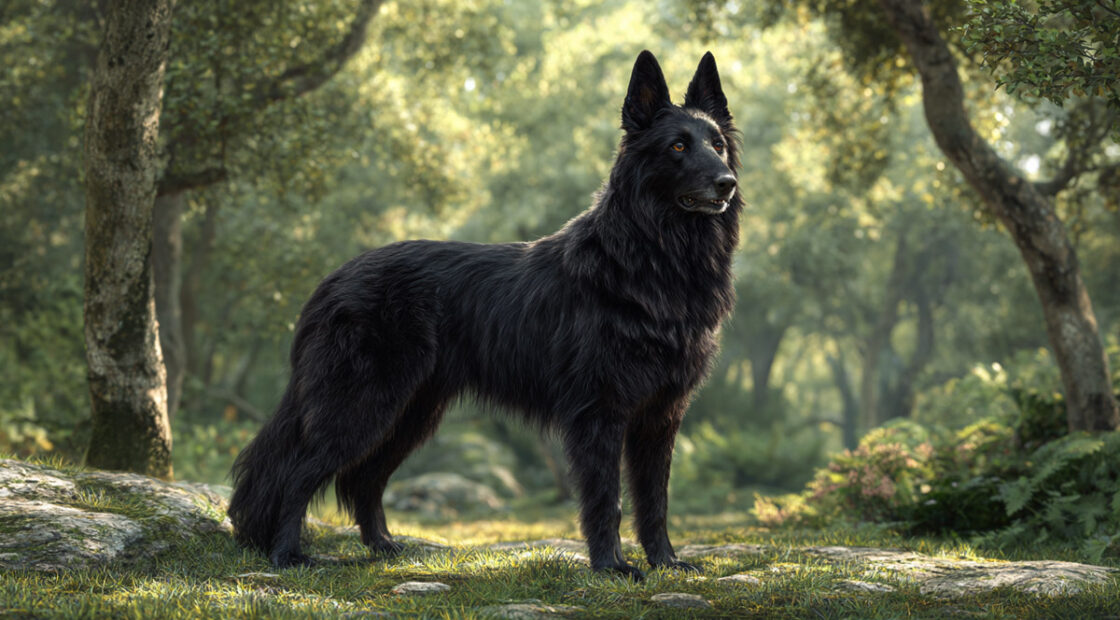
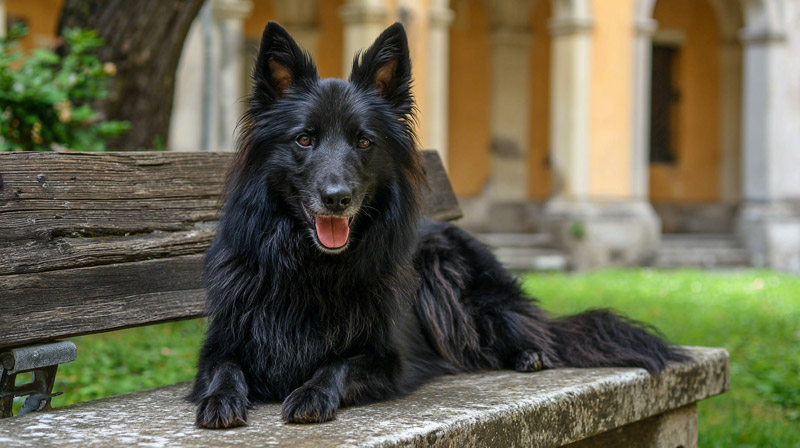
The Belgian Sheepdog is a medium-sized herding breed from Belgium, and the long, solid black double coat is what sets it apart from its relatives. It was bred to herd and guard farm stock. These days you’ll find it in police units, search and rescue, therapy work and dog sports.
The AKC registers this black variety as a separate breed. Most national kennel clubs class the same dog as the Groenendael variety of the Belgian Shepherd (AKC, 2025).
It was popular in the United States early on. The AKC’s breed history (2025) records a ranking as high as fifth in registrations by the end of the 1920s.
What Is a Belgian Sheepdog?
In the United States, the name covers only the black, long-coated dog. The AKC standard describes a breed made to guard flocks and to protect its owner’s person and property.
Outside the US, the same dog is the Groenendael, one of four varieties of the Belgian Shepherd. That name comes from the Belgian village and chateau where the variety started. You’ll also see Chien de Berger Belge and Belgische Herder, which are just the breed name in French and Dutch.
The AKC registers the four Belgian varieties as separate breeds, while most national kennel clubs treat them as one breed with four varieties (AKC, 2025). So a European Groenendael pedigree and an American Belgian Sheepdog pedigree describe the same type of dog.
Beyond herding, breeder Terri Votava’s breed history in Showsight (2014) lists police work, search and rescue, service work and therapy as current jobs.
Where Did the Belgian Sheepdog Come From?
The breed took shape in Belgium between the 1880s and about 1900. A breed club set out to define a native Belgian shepherd, and Nicolas Rose’s kennel fixed the long black type.
The Club du Chien de Berger Belge formed in 1891 to find out whether Belgium had a shepherd dog of its own. The first standard followed in 1892 and recognized three coat types, long, short and rough (Showsight, 2015).

Belgians from European breeding stock, including black Groenendael, were imported and registered with the AKC in 1911, although Belgian police dogs were already working in New York by 1908. In 1912 the AKC registered every coat variety as one breed, the Belgian Sheepdog.
Rose bred the black dogs at his Chateau de Groenendael, and the variety took the name of the place. His foundation pair were Petite and Piccard d’Uccle.
The oldest of the four varieties is the rough-coated Laekenois, which the AKC also calls the rarest.
Belgians were already working for police forces in Belgium, Paris, New York City and Newark, New Jersey in the first decade of the 1900s. In both World Wars they carried messages and served as Red Cross dogs (Showsight, 2014).
Sources disagree on when the black variety began. Britannica dates it to 1885 in Groenendael, while VCA Animal Hospitals say the kennel started breeding long black dogs in earnest around 1900.
The gap probably reflects two milestones, the first black pairing and the later breeding program, rather than a real dispute.
Belgian Sheepdog vs Tervuren, Malinois and Laekenois
Coat type and color separate the four Belgian varieties. Build, herding background and the basic standard are shared.
| Variety | Coat | Color | AKC status |
|---|---|---|---|
| Belgian Sheepdog | Long | Solid black, small white markings allowed | Separate since 1959, first recognized 1912 |
| Belgian Tervuren | Long | Fawn to russet mahogany, black overlay | Separate since 1959 |
| Belgian Malinois | Short | Fawn to mahogany | Separate since 1959 |
| Belgian Laekenois | Rough | Red or fawn to grayish tones, with traces of black on the muzzle and tail | Recognized in 2020 |
Both long-coated varieties carry a double coat, so the fawn Tervuren differs from the Sheepdog mainly in color. On the body that color runs fawn to russet mahogany with blackened hair tips (AKC, 2025).
If the long coat is your sticking point, the short-coated Malinois is the obvious pick. Breeders in Showsight’s 2020 Q&A describe it as more serious than the Sheepdog, with a quicker on-off switch.
Another breeder in that Q&A says the Malinois and Laekenois often carry stronger drives and a bigger need to work. The same breeders see the Sheepdog and Tervuren as very much alike.
Recognition dates for the Malinois vary by source, but the AKC’s own records are consistent. The AKC lists the Malinois as recognized in 1959, in the same separation as the Tervuren, and a Malinois club history says it competed in the Miscellaneous class until it became eligible for championships in 1965. A breed history in Showsight (2014) says it did not gain AKC recognition until the 1970s, which does not match those records.
My advice is to settle the coat question first, then think about how much drive you want in the house. The Sheepdog and Tervuren sit at the milder end. The Malinois and Laekenois sit at the harder-driving end.
How Big Does a Belgian Sheepdog Get?
Males stand 24 to 26 inches at the withers and females 22 to 24 inches under the AKC standard.
The standard calls for a square dog, so body length from breastbone to rump equals height, though bitches may run slightly longer. Bone is moderately heavy, neither spindly nor bulky. Males under 22.5 or over 27.5 inches are disqualified, and so are females under 20.5 or over 25.5 inches.
That disqualification range is wider than the one in the Tervuren and Malinois standards (Showsight, 2020).
The standard text, approved December 11, 1990 and effective January 30, 1991, gives no weight. Weight ranges come from breed profiles, and they disagree.
Purina lists 55 to 65 pounds for males and 45 to 50 pounds for females. Britannica gives a single 50 to 60 pound range for the whole breed, so it appears to blend the sexes.
Long hair hides proportions, so judges feel for the point of the breastbone and the depth of the chest. A dog standing in tall grass or carrying a heavy chest coat can look shorter on leg than it is.
Coat, Color and Grooming
A Belgian Sheepdog needs brushing once or twice a week, and daily brushing while the coat sheds.
Coat and color
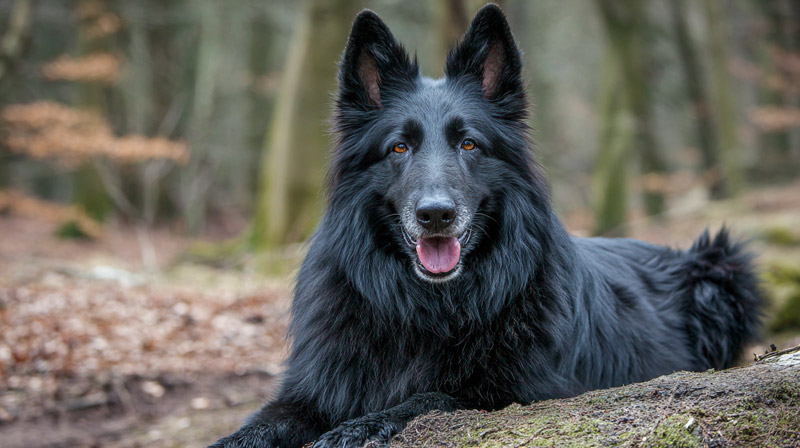
It’s a double coat, built to handle extremes of temperature and climate. The outer coat is long, straight and abundant, medium harsh, never silky or wiry. Under it sits an extremely dense undercoat, scaled to the climate.
The ornamentation includes a collarette at the neck, fringe down the forearms, breeches on the hindquarters and a plumed tail.
Color is black. White is allowed only as a small to moderate forechest patch, between the pads, on hind toe tips, and on the chin and muzzle. White on the tips of the front toes is allowed but counts as a fault, and any other color disqualifies.
Reddish tinges from sun are not grounds for disqualification. They often show on shedding dogs when dead hair is ready to drop (Showsight, 2015).
One breeder in Showsight’s 2020 Q&A ranks texture above length for everyday care. Correct texture keeps the dog cleaner and cuts down on grooming and bathing.
Shedding and brushing schedule
VCA Animal Hospitals say the coat sheds twice a year. Brushing runs daily during those weeks and weekly or twice weekly the rest of the year.
Hill’s Pet Nutrition lists the same twice-yearly shed, with brushing once or twice a week, baths only when the dog is dirty and regular nail clipping.
Wahl’s grooming guide counts one significant shed a year and about 20 minutes of brushing a week. For tools, it recommends a pin brush and a slicker brush, plus a metal rake comb.
Matting is another point of conflict. PetMD calls the coat prone to matting, while a breeder in Showsight (2014) says it does not mat easily and sheds little.
Plan for two heavy sheds and a weekly brushing habit, since weekly sessions are the one recommendation every source shares.
What Is a Belgian Sheepdog Like With Children and Strangers?
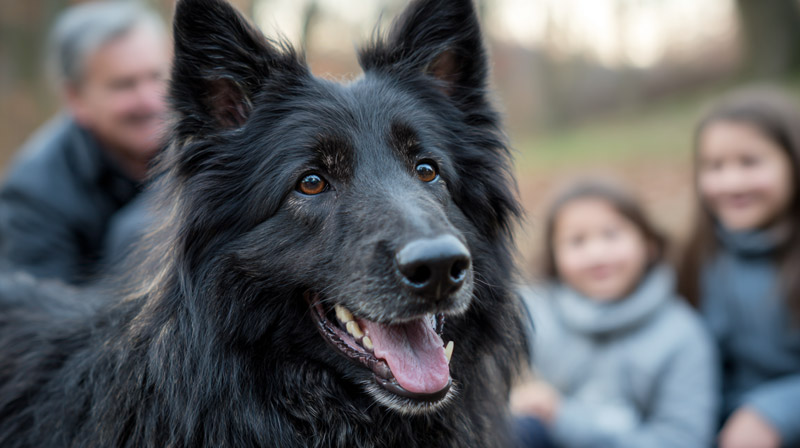
Affectionate and possessive with its own people, watchful with strangers, and usually fine with children it knows. The AKC standard asks for a dog that is observant and vigilant with strangers but never apprehensive.
With family, the standard says the breed is most affectionate and friendly with people it knows well, and very possessive of their attention. Children are a mostly good story. The AKC fit guide (2025) calls the breed good with families and small children, though herding instincts can kick in when kids run around.
Strangers get a neutral reception at first. Plenty of Belgians warm up once they decide to like you, where the standard says vigilant.
The standard also rules out fear and shyness. It disqualifies viciousness, meaning any unwarranted or unprovoked attack.
The breed wants to be at its owner’s side at all times. The AKC’s breed history adds that Belgians are sensitive and do not respond well to isolation.
Socialization decides where a dog lands inside that watchful range. Breeder Lisa Leffingwell notes in Showsight (2014) that a smart Belgian spots what is unfamiliar, and confidence builds through exposure, training and age.
How Much Exercise and Training Does a Belgian Sheepdog Need?
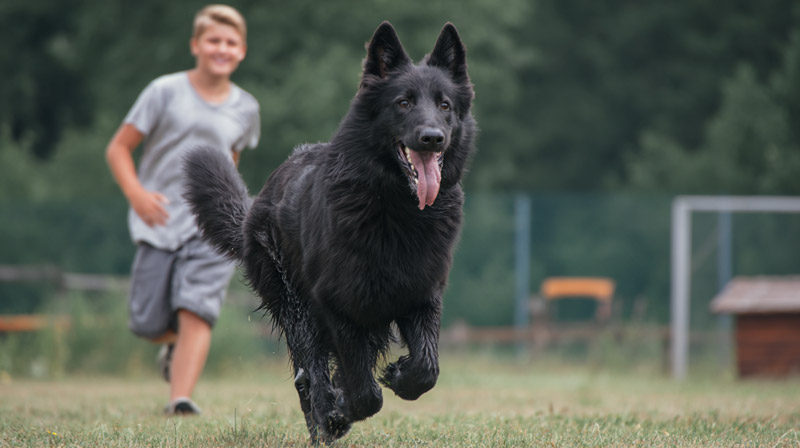
Plan on about an hour of exercise a day, plus real mental work. Orvis’s breed guide treats the hour as a minimum, with more being better.
A breeder interviewed in Showsight (2020) says the physical need varies by line and drops when the dog’s mind stays busy. Repetition bores these dogs quickly.
Purina’s activity list for the breed runs from agility and tracking to herding, obedience and rally, and search and rescue.
The AKC Herding Instinct Test is a non-competitive pass or fail check, open to Belgian Sheepdogs from 6 months old. A dog needs no prior training to enter it.
Competitive herding trials run at started, intermediate and advanced levels. For everyday manners, AKC clubs offer Canine Good Citizen testing and S.T.A.R. Puppy classes.
The AKC calls the breed highly trainable and eager to please. Breeders add that positive methods work, and that these dogs resent unfair corrections.
Expect a long adolescence. Linda Robey’s judging article in Showsight (2015) calls the breed slow maturing, with young dogs herding their owners, jumping up and nipping at sleeves.
A Belgian without a job turns destructive, according to Orvis, and Showsight (2014) says a bored one creates trouble. The dog needs something to do, not just room to run.
Health Problems and Lifespan
Epilepsy is the main health concern, with eye disease close behind, according to the International Partnership for Dogs’ breed health profile for Belgian Shepherds.
The best-known number is a 9.5% prevalence, estimated from owner questionnaires on Danish Groenendael and Tervueren born 1995 to 2004. Owners of 1,248 dogs were contacted and about 520 dogs were analyzed (Berendt and colleagues, Acta Veterinaria Scandinavica, 2008). Average onset in that work was 3.3 years, which is after many dogs have already been bred.
In a 199-dog Belgian Shepherd family, 13.7% of epileptic dogs went into remission (Gullov, Toft and Berendt, Journal of Veterinary Internal Medicine, 2012). Lifespan runs 12 to 14 years (AKC, 2025).
The 9.5% comes from Denmark and covers two varieties together, and it rests on questionnaire responses, so it is a regional estimate, not a breed-wide rate. The study’s authors tie the high prevalence to the late onset, because affected dogs are often bred before the first seizure.
Breed profiles tend to undersell this. VCA Animal Hospitals say the breed has no overwhelming health concerns, yet seizures head the list of problems they report.
Sources split on whether epilepsy shortens life. A 2007 Journal of Veterinary Internal Medicine study of dogs with epilepsy in general found an increased risk of premature death.
The Belgian Shepherd family followed from 2009 to 2011 showed no significant loss of lifespan, though epilepsy was the leading cause of death in that group.
The disease is heritable. A 2003 study in the Journal of Heredity (Oxford University Press) described a polygenic pattern influenced by one recessive locus of large effect. A 2010 genome-wide linkage scan in BMC Genetics found the trait to be highly polygenic and did not support a single major gene, so the genetics are not settled.
Other reported conditions include hip and elbow dysplasia, hypothyroidism, allergies and skin disorders. Eye problems cover progressive retinal atrophy, cataracts and pannus. Breeder Leffingwell (Showsight, 2014) also names cancer, mainly gastric carcinoma, lymphoma and hemangiosarcoma.
The parent club takes part in the Canine Health Information Center (CHIC) program. A CHIC number has required an Orthopedic Foundation for Animals (OFA) hip evaluation (PennHIP is also accepted), an OFA elbow clearance and an eye clearance, per Vetstreet.
None of those three screens tests for epilepsy, which is why seizure history in the pedigree matters as much as the paperwork. Requirements change, so confirm the current list on the OFA’s CHIC page for the breed.
Who Should Not Get a Belgian Sheepdog
Skip this breed if nobody is home most of the day or if the household wants an easy, low-effort dog. The AKC’s breed history says plainly that people who want a dog to lie quietly at their feet should look elsewhere.
- The dog would spend long hours alone, since the breed handles isolation badly.
- You’re picturing a back-yard dog. Belgians do not do well kept outside full time (Showsight, 2014).
- The handler is inexperienced. Hill’s says the breed can be hard to control unless the owner knows how to handle it.
- Small children run through the house all day and the herding instinct is unwelcome.
- Harsh training is the plan.
- A seizure disorder would be a dealbreaker, since epilepsy is the breed’s best-documented risk.
Apartments split the sources. Orvis calls them not ideal for a dog this active, while Hill’s says a Belgian can live in one if it is sufficiently exercised.
The second view holds only if the daily exercise and mental work described above actually happen.
Coat care is the other disagreement. The AKC’s fit guide sets grooming at a few times a month with medium shedding, while other guides ask for weekly brushing and daily brushing in shed season.
Budget for the heavier schedule if loose hair bothers you.
If the answer to “who is home, and what will the dog do all day” is not clear, the breed is the wrong pick.
How to Find a Belgian Sheepdog Puppy or Adult
Start with the Belgian Sheepdog Club of America, which the AKC lists as the breed’s parent club, and expect a wait. Breeders are scattered across the US, according to a breeder interviewed in Showsight (2020).
- Contact the parent club and ask for breeder referrals and rescue contacts.
- Ask for written health clearances. Both parents need hip, elbow and eye results, plus a CHIC number. OFA issues final hip results only at 24 months or older, so a puppy cannot carry its own.
- Ask about seizures in the pedigree. Epilepsy often appears after dogs have been bred, so clean test results alone do not clear a line. Ask about siblings, parents and grandparents.
- Meet the parents. Look for approachable temperaments and early socialization (Vetstreet).
- Check the coat and the papers. The AKC’s breed history says fawn dogs are regularly born to Belgian Sheepdogs that carry the recessive gene, and those pups are indistinguishable from Tervuren. A breeder in Showsight (2023) also warns about black-coated Malinois registered as Belgian Sheepdogs in the US.
- Weigh adoption. The AKC rescue network lists the Belgian Sheepdog Club of America and the Belgian Sheepdog Rescue Trust. An adult shows its temperament, but epilepsy can still appear years into adulthood.
Belgian Sheepdog FAQ
Does a Belgian Sheepdog get along with cats and other pets?
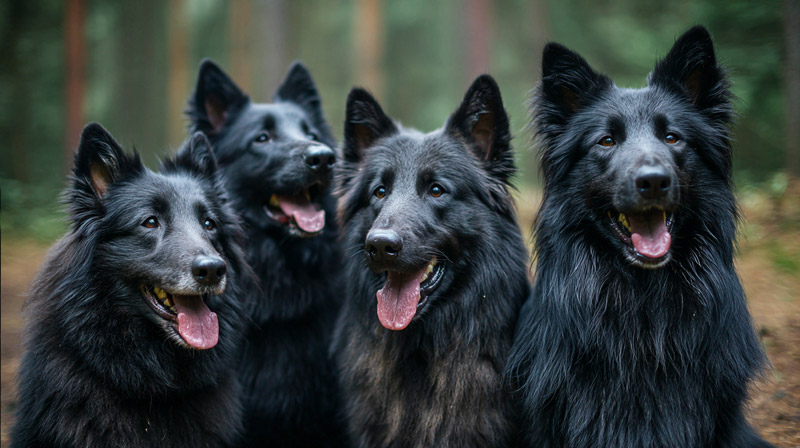
It depends on early exposure. Breeder Lisa Leffingwell says in Showsight (2014) that Belgians generally do well with other dogs, cats and children when raised with them, though they tend to prefer their own breed.
Vetstreet says a Belgian may or may not accept cats.
Is a Belgian Sheepdog the same as a black German Shepherd?
No. Both descend from a common Western European herding type, but they developed as separate breeds, and the Belgian Sheepdog is not a German Shepherd mix, as Orvis states.
Does a Belgian Sheepdog need protection training?
No. Protectiveness comes naturally and is written into the breed standard, and Hill’s says protection training is only needed for protection sports.
Early socialization matters more, since it teaches the dog to tell friends from threats.
How much does a Belgian Sheepdog puppy cost?
Prices vary with the breeder’s reputation, health testing and lineage, and no published survey gives a breed-wide figure. Ask each breeder for a written price and the parents’ health clearances.
Expect a wait, since breeders are scattered across the US.
How much should a Belgian Sheepdog eat?
Orvis recommends two to three cups of high-quality dog food a day, split into two meals, adjusted for weight and activity.
Vetstreet calls keeping a Belgian Sheepdog at a healthy weight one of the easiest ways to extend its life.
Are Belgian Sheepdogs sensitive to anesthesia?
Many owners report a sensitivity to anesthesia and some medications, according to Orvis. The claim rests on owner reports rather than a published study, so tell the veterinarian the breed before any procedure.
Planning the First Weeks With a Belgian Sheepdog
Start socializing right away, across people, places and surfaces. Book the veterinary exam soon after adoption, and fit short, repeatable training sessions around both. Vetstreet advises starting socialization and training early, so the exam slots in around them.
The exam belongs early because many health problems in the breed are not visible in puppyhood, according to Embrace Pet Insurance. The visit documents a starting point for later checks.
The plan runs for years, not weeks. Some Belgian Sheepdogs do not reach full potential until age 5 or later (Showsight, 2015), and formal AKC herding events open at 9 months.
The trade-off is scheduling: outings and sessions must be booked before the dog’s routine settles.