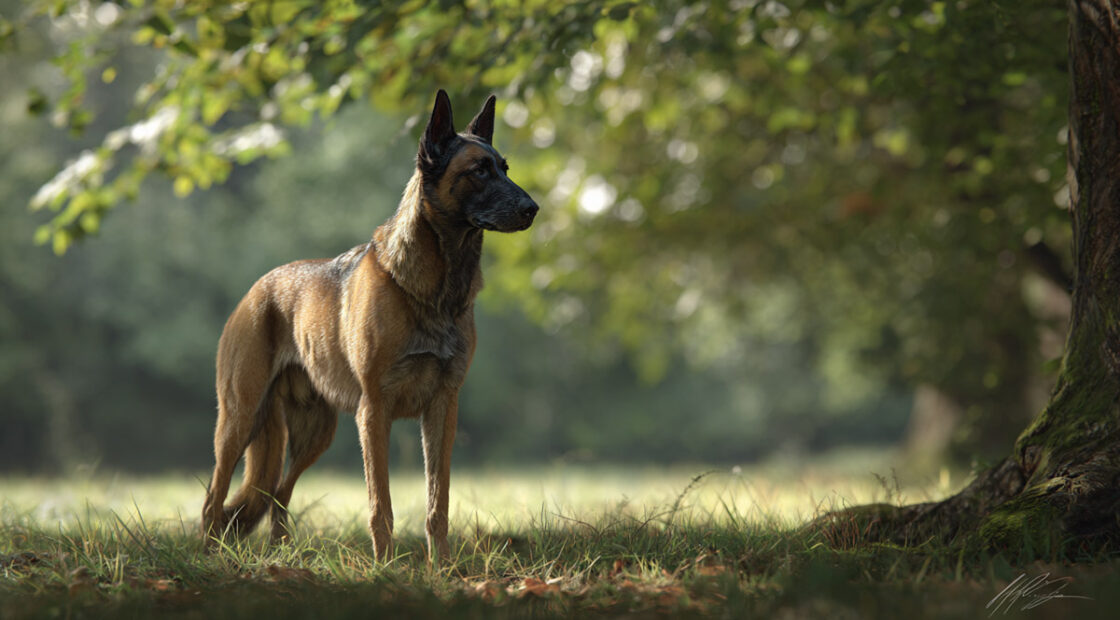
Police and military units, and detection teams too, keep choosing the Belgian Malinois, a short-coated Belgian Shepherd herding dog with plenty of stamina and speed and a strong drive to work. The German Shepherd is the breed it gets measured against most often.
That working role is written into the paperwork. The FCI breed nomenclature lists the Belgian Shepherd Dog, with the Malinois as one of four varieties, as subject to a working trial (standard published 2001).
The AKC treats the same dog as a separate breed, so a Malinois counts as a breed in the United States and a coat variety across FCI countries.
What Is a Belgian Malinois?
The name comes from Malines (Mechelen), the Belgian city around which the variety took shape. Owners just say Mal.
It’s the short-coated one of the four Belgian Shepherd varieties, a herding dog that police and military units use for its stamina and drive, plus an eagerness to work.
The Four Belgian Shepherd Varieties
| Variety | Coat | Color |
|---|---|---|
| Malinois | Short, straight | Fawn to mahogany, black overlay and mask |
| Tervuren | Long | Fawn with black overlay |
| Groenendael | Long | Black |
| Laekenois | Rough, wiry | Fawn |
Registries disagree on whether these are four breeds or one.
The AKC split the Belgians into separate breeds in 1959, registering the Malinois and the long-coated Tervuren on their own. The Sheepdog got its own registration too, and since July 2020 the Laekenois has been fully recognized, so all four now compete in its Herding Group (AKC, 2020).
The FCI sees it the other way around. Its Standard No. 15 treats all four as coat varieties of a single Belgian Shepherd Dog, and the long black one it calls the Groenendael is what Americans know as the Belgian Sheepdog.
Origin in Malines
The story starts in late 1891, when veterinary professor Adolphe Reul gathered shepherd dogs near Brussels to decide whether a true Belgian type existed (VCA Animal Hospitals).

- Reul’s gathering in 1891 concluded that a square, medium-sized Belgian shepherd exists.
- The first written standard arrived in 1892 and covered long, short, and rough coats.
- In 1959 the AKC separated the Belgians into three breeds.
- By 2020 it had fully recognized the Laekenois, which brought its Belgian breeds to four.
The AKC credits Belgian farmers, who worked from local shepherd stock and selected for working ability over looks. That history explains the breed’s temperament better than any show-ring description does.
How Big Does a Belgian Malinois Get?
Adult males stand 24 to 26 inches at the withers and females 22 to 24 inches, according to the American Belgian Malinois Club standard.
Some popular breed pages print smaller numbers. Purina’s breed page lists males at 21 to 22 inches and females at 20 to 21, which sits two to four inches under the club figures.
Treat the club standard as the benchmark, since judges measure dogs against it.
- Males measure 24 to 26 inches at the withers and females 22 to 24 (American Belgian Malinois Club standard).
- The FCI average is 62 cm for males and 58 cm for females, with a tolerance of 2 cm under to 4 cm over (FCI Standard No. 15, 2001).
- Weight runs 60 to 80 pounds for males and 40 to 60 for females (AKC breed page).
The FCI average of 62 cm is about 24.4 inches, so the American and international standards agree.
Male and Female Size
Males run larger, but the ranges meet at 24 inches. A male and a female of the same height can still differ in frame and weight, and the standard asks for a clear sex distinction without exaggeration (Petful).
Is a Malinois Medium or Large?
The standard calls it medium-sized and square, with body length from breastbone to rump equal to height. Bone is moderate, so the dog is neither spindly nor bulky.
At 60 to 80 pounds, though, it handles like a large dog. Crate size and leash strength follow the weight, and so does the room it takes up in a car, no matter what the label says.
When Does a Malinois Stop Growing?
Guides disagree on the timing, and Petful points out that month-by-month growth charts are estimates. The adult height in the breed standard is the firmer benchmark.
Height arrives before weight. A tall, lean adolescent is normal, according to iHeartDogs.
Belgian Malinois Coat, Colors, and Shedding
Fawn to mahogany, with black-tipped hairs and a black mask, on a short, straight, weather-resistant double coat.
The black tips form an overlay across the body, not patches or stripes (American Belgian Malinois Club standard).
The base color runs fawn to mahogany. The mask and ears are black, the underparts, tail, and breeches are a lighter fawn, and white is allowed only on the toe tips and as a small spot on the breastbone.
Washed-out fawn on the body is a fault, and so is any other white marking. A color or combination the standard does not describe is a disqualification.
Black, brindle, cream, and liver dogs do turn up in listings. None match the standard, per Dogster.
The FCI is stricter still. For the Malinois it allows only fawn with black overlay and a black mask.
Hill’s describes a double coat that generally sheds twice a year, and Dogster adds that it sheds regularly in between. The club standard calls it a natural breed with no need for excessive grooming.
The Malinois has the shortest coat of the four varieties (Wood Green), so grooming stays simpler than with the rough-coated Laekenois.
What Is the Belgian Malinois Temperament Like?
A Malinois tends to be confident and watchful, with a strong urge to work and a protective streak toward its people. It stays reserved around strangers.
The club standard calls it an exceptional watchdog, and Britannica notes it is not generally gregarious toward unfamiliar dogs or people. Hill’s adds that temperament and aggressiveness vary widely across the breed, so the individual dog and its upbringing matter as much as the label.
Prey Drive and Herding Instinct
A 2019 multi-breed study by MacLean, Snyder-Mackler, vonHoldt, and Serpell found chasing behavior and stranger-directed aggression among the traits most influenced by genetics. The authors stress these are breed averages, not predictions for one dog.
In a Malinois that shows up as the herding behavior Hill’s describes. Chasing and circling come naturally, heel nipping too, and it will keep going for hours without tiring.
A cat that runs will be chased (Dogster).
Work changes the picture. Britannica says a Malinois with sufficient exercise can become a well-mannered, calm house dog, so the calm indoors depends on the work done outdoors.
With Children and Other Pets

Orvis calls the breed loving and patient with children in its own family. Hill’s says it suits households without small, erratic children, and that a Malinois will keep trying to hold a toddler in one spot.
Britannica reports that many get along fairly well with other dogs and pets, though Pango Vet warns of aggression toward dogs and other animals when socialization starts late.
Small pets are a toss-up that depends on socialization and the individual dog, per Dogster.
The sources are not contradicting each other. They describe the same fast, driven herding dog in homes with very different setups.
How Much Exercise Does a Belgian Malinois Need?
Plan on an hour of hard exercise a day at the very least. Most sources land at two hours or more once training and mental work are counted.
Canine Journal sets the floor at 60 to 90 minutes of intense exercise, while Wood Green puts it at two to three hours of activity and training. The numbers look far apart, but Canine Journal adds hours of play and mental stimulation on top of its floor, so the two end up close.
Physical Exercise
- Running alongside a bike or on a long route
- Half-day hikes
- Swimming, which Orvis says they do strongly
- Fetch and agility
Fencing matters as much as mileage. Britannica notes that the breed’s athleticism can call for a very high fence.
Mental Work
Mileage alone does not tire a Malinois. Lemonade rates its mental stimulation need at the top of the scale and says purposeful training counts, not just exercise.
Wood Green’s breed guide asks for regular problem-solving and new things to learn. Scent games and short obedience drills fit that description.
Can a Malinois Live in an Apartment?
Yes, if the exercise actually happens.
Hill’s says the breed can live in an apartment when sufficiently exercised, while Pango Vet says it adapts poorly to small spaces without multiple walks a day. Pango also notes these dogs cannot simply be left home all day.
A fenced yard with no one using it is no better than a flat with a daily routine. Hours delivered beat square footage.
How to Train a Belgian Malinois

The socialization window narrows within the first few months of life (AVSAB), so training starts there and builds up.
- Start puppy classes at 7 to 8 weeks, with one round of vaccines at least seven days earlier and a first deworming (AVSAB position statement, reported by the AVMA, 2008). The society puts the primary window in the first three months.
- Teach impulse control next. Waiting at doors and for the food bowl, settling on a mat. Those repetitions are what later give a high-drive dog the ability to settle.
- Core obedience comes after that: sit, down, stay, and come, taught with firm but not harsh handling (Hill’s).
- The AKC Canine Good Citizen test gives a measurable target for public manners. Items such as accepting a friendly stranger and reacting calmly to another dog map directly onto this breed’s weak spots.
- Then give the dog a job with scent games, obedience trials, or a sport. One person leads the training while the whole household follows the same rules (Dogster).
Handler experience decides more than technique does. Britannica advises against the breed for first-time owners, and Hill’s describes a working breed whose needs only an experienced owner can meet.
Dogster notes an independent streak in the breed. That is why consistency beats intensity.
Belgian Malinois Health Problems and Lifespan

Malinois are generally healthy dogs. Vets still list hip and elbow dysplasia, inherited eye disease, gastric bloat, hemangiosarcoma, epilepsy, and thyroid dysfunction most often (Hepper veterinary review).
Joint and Eye Conditions
- Hip dysplasia is a malformed hip joint. Signs are lower activity, trouble standing up, and reluctance to run, jump, or climb stairs (Dogster).
- Abnormal elbow development, called elbow dysplasia, is the most common cause of elbow pain and lameness, and it usually shows first as forelimb lameness in young dogs (Dogster).
- Progressive retinal atrophy, an inherited retinal degeneration, takes night vision first because rod cells fail first (Hepper).
The BVA/Kennel Club Elbow Dysplasia Scheme’s 2025 statistics list 369 Malinois graded since 1999, with 89% at grade 0 and 9% at grade 1. Nine dogs were grade 2 and one was grade 3.
Treat that as a best-case picture, because voluntary registries skew healthy. A 2013 PLOS ONE analysis of the OFA database found its reporting biased against dogs with problems.
The same caution applies to a 2021 Turkish study that found Malinois hips outside the at-risk group. It covered a small sample of young working dogs.
Bloat and Other Conditions
Bloat is the emergency on this list.
In gastric dilatation-volvulus the stomach flips on itself, and Dogster notes that at-risk breeds including the Malinois can have a preventive gastropexy before any episode.
The rest of the vet-reviewed list is hemangiosarcoma (a blood-vessel cancer), epilepsy, and thyroid dysfunction.
Health Testing
| Test | Screens for | Note |
|---|---|---|
| OFA hip evaluation or PennHIP | Hip dysplasia, hip laxity | PennHIP is a screening method for hip dysplasia and osteoarthritis risk (Dogster) |
| Elbow evaluation | Elbow dysplasia | OFA in the US, BVA/Kennel Club scheme (grades 0 to 3) in the UK |
| CAER eye exam | Inherited eye disease, including PRA | Done by a board-certified ophthalmologist; OFA recommends annual repeats for breeding dogs |
| PRA DNA panel | Genetic PRA variants | Variants differ by breed, so confirm the panel covers the Malinois (Embark) |
Ask any breeder for parent results on hips, elbows, and eyes. A breeder who cannot show them has skipped the screening.
How Long Do Malinois Live?
A Dogs Trust study of UK dogs (McMillan et al., Scientific Reports, 2024) lists a median lifespan of 12 years for the Malinois, as published by Dog News.
Breed guides print higher numbers. Hepper says 12 to 14 years and Dogster says 14 to 16.
The median sits at the bottom of those ranges. It counts every dog in the dataset, which is why it runs below the figures guides quote, and the authors state their results represent UK dogs only.
Why Are Belgian Malinois Used for Police and Military Work?
Police and military units pick the Belgian Malinois for its stamina, dexterity, loyalty, and eagerness to please (Britannica). The short coat copes well with heat, and a Secret Service spokesman cited the small size and short hair as the reasons for its choice (CNN).
Roles in Service
- Patrol and apprehension
- Explosives and narcotics detection
- Search and rescue
- Tracking
Hill’s lists the same roles and adds gas detection.
Documented Service Records
Cairo, a Belgian Malinois, was among the first US military personnel on the ground in Pakistan during Operation Neptune Spear in May 2011, according to handler Will Chesney’s 2020 book No Ordinary Dog.
Hurricane joined the Secret Service’s Emergency Response Team tactical canine unit in 2012 and neutralized a White House fence jumper in October 2014 (U.S. Secret Service).
The Department of Defense buys mostly German Shepherds and Malinois, and the 341st Training Squadron at JBSA-Lackland, the department’s only military working dog training site, breeds primarily Malinois (JBSA; KENS 5).
The Air Force has begun shifting from German Shepherds toward the smaller, sturdier Malinois (JBSA).
Sport Lineage
Protection sports tested the breed long before it entered service work.
| Sport | Origin | Format |
|---|---|---|
| KNPV | Netherlands | Police dog trials and certificates from the Koninklijke Nederlandse Politiehond Vereniging |
| Ringsport | Belgium, France | Obedience, agility, and protection phases |
| Mondioring | Belgium, 1987 | Blends Belgian Ring, French Ring, KNPV, and Schutzhund elements |
| IGP | Germany | Formerly Schutzhund and IPO; tracking, obedience, and protection |
Mondioring began as a breed survey test, a way to decide whether a dog was good enough to breed, and the Malinois has dominated it since its start (Fox 13 Salt Lake City, 2015).
Why a Working Dog Is Not a Pet Dog
JBSA says dogs go through a thorough assessment before selection, and only 50% of those make it through training.
Volunteer families raise the Lackland-bred puppies before formal training begins (KENS 5), so even service dogs get a deliberate socialization phase.
The Secret Service used only Malinois until its 2014 White House patrol program, which adds other breeds for work among crowds (AP, 2014).
A pet Malinois gets none of that selection or structure.
Belgian Malinois vs German Shepherd and Dutch Shepherd
The Malinois is the lean, high-drive choice and the German Shepherd the heavier, better-established one. The Dutch Shepherd is rarer, and it only comes in brindle. Build and the time you can give each day do most of the deciding.
| Feature | Malinois | German Shepherd | Dutch Shepherd |
|---|---|---|---|
| Build | Square, moderate bone | Longer than tall, deep-bodied | Medium-sized, not square |
| Coat | Short double coat | Medium double coat | Short, long, or rough |
| Color | Fawn to mahogany, black mask | Most colors except white | Brindle only |
| Suits | Experienced handler with daily hours to spare | Owners wanting a trainable, widely available working breed | Active owners who can keep a rare breed busy |
Malinois vs German Shepherd
The standards confirm the build gap. The Malinois is square, while the German Shepherd is longer than tall with a deep body (ABMC and GSDCA standards).
VCA Animal Hospitals adds that a Malinois has a shorter back and smaller ears than a German Shepherd, with lighter bone overall.
Hill’s calls the German Shepherd smart and easy to train, while Britannica advises against the Malinois for first-time owners.
If this is your first working breed, the German Shepherd is the better fit. The Malinois belongs with a handler who has proven experience and daily hours to give.
Where the Dutch Shepherd Fits
The Dutch Shepherd accepts only brindle, in short, long, or rough coats, and its AKC standard says explicitly that it is not square (Showsight).
The short-haired variety has gained popularity as a police dog (Showsight).
Chewy describes the breed as relatively rare even today, and finding a breeder is the main practical hurdle.
When a Belgian Malinois Is the Wrong Dog
Households that cannot give a Malinois real work, training, and secure containment, along with an experienced handler, should pick another breed.
Documented Failure Modes

The AKC ranked the Malinois 43rd in 2018 and 32nd in its 2025 list.
The American Belgian Malinois Club saw the risk coming. Before the 2015 film Max, club officials said they were bracing for a large influx of surrendered Malinois because most viewers would not be equipped for the breed’s energy (Fox 9, 2015).
The club’s rescue page reports that owner turn-ins skyrocketed in 2021 and 2022 as people returned to work after COVID restrictions, many of the dogs with severe behavior issues.
Neglect shows up too. In May 2025, Animal Care Centers of NYC and the ASPCA removed more than 40 Malinois from a Queens apartment (the Queens District Attorney put the count at 48), many fearful, undersocialized, and in need of long-term behavioral support (ACC).
That case is extreme neglect, not typical ownership. It still shows what an undersocialized Malinois looks like.
A Readiness Check
- Someone home, or a real plan for the workday
- Secure, high fencing
- Prior experience with a high-drive working breed
- Access to a trainer who knows working dogs
If two or more of those are missing, a different breed will serve you better.
Belgian Malinois FAQ
How do you pronounce Belgian Malinois?
Say mal-in-wah, with the stress on the last syllable, per Merriam-Webster. Owners shorten it to Mal.
When does a Belgian Malinois calm down?
There is no set age. Hepper puts sexual maturity between 10 and 18 months, but the breed stays high-energy for life.
A calmer dog comes from delivering the daily work, not from waiting for adulthood.
What should a Belgian Malinois eat?
Feed a large-breed puppy food until about 12 to 18 months, according to Healthy Paws, then an adult food matched to the dog’s activity.
Dogster advises watching body condition, since an active breed can still gain weight on oversized portions.
How much does a Belgian Malinois puppy cost?

Prices vary with bloodline, health testing, and region, and no reliable standard price exists. Get a written quote and compare what each includes before comparing totals.
Should you buy from a breeder or adopt from a rescue?

Either works when the source is responsible. The American Belgian Malinois Club notes that responsible breeders and rescues both take a dog back if you can no longer keep it.
American Belgian Malinois Rescue has experienced Malinois owners evaluate each foster before adoption, and one March 2025 listing showed a 450 dollar adoption fee.
Can a Belgian Malinois stay home alone during the workday?
Only with a plan. Hard exercise before you leave and a midday dog walker or daycare make an eight-hour gap workable.
Without that structure, a bored Malinois is the profile that ends up in rescue.
Testing Your Fit With a Belgian Malinois Before Committing
Fostering an adult Belgian Malinois through a breed rescue is the lowest-risk way to test fit, because the dog arrives with an observable temperament and the arrangement ends if the match fails.
American Belgian Malinois Rescue runs a foster program (verified October 2026), and its president advised first-time owners in 2015 to consider an older dog with known traits (Fox 9).
Order the steps by how easily each one reverses.
- Meet working and sport Malinois owners
- Foster an adult through a breed rescue
- Adopt or buy only after the foster ends
The test only counts when the foster home runs the full daily schedule of exercise, training, and containment. A gentler trial proves nothing.
The trade-off is history. A fostered adult brings habits formed before arrival, and the puppy-stage socialization you would have shaped yourself is gone.