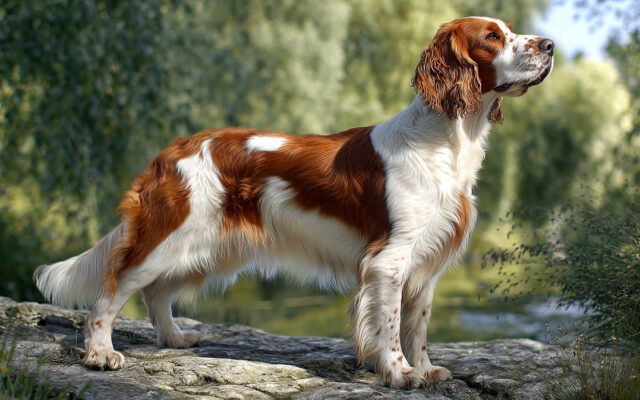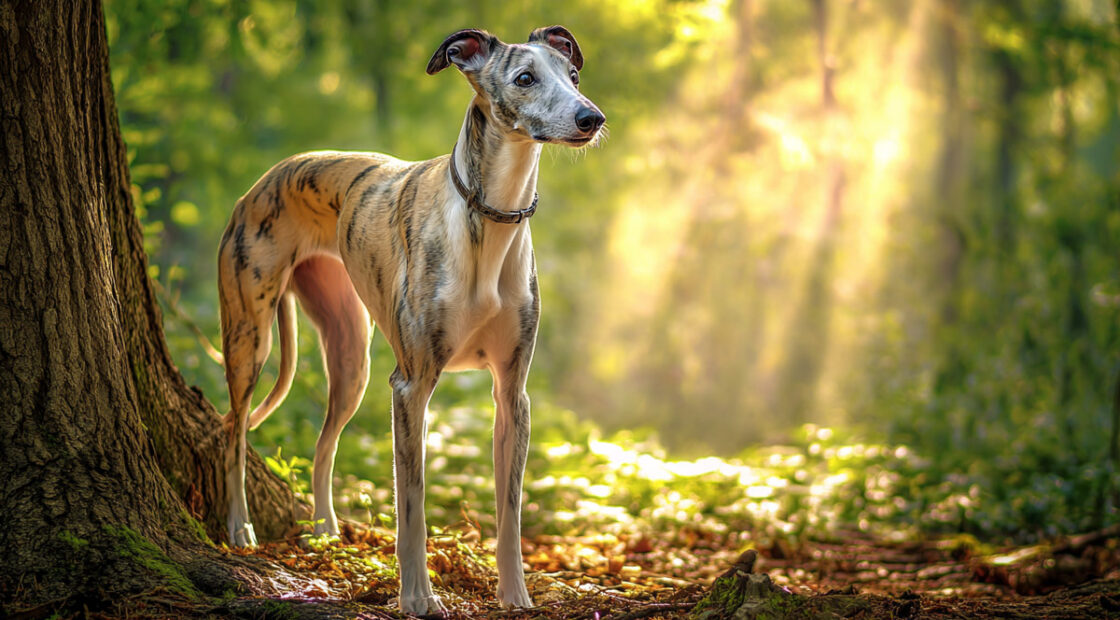
Whippets sleep a lot. Ask an owner what the breed is like and that usually comes up well before the speed does.
The speed is real, though. Breeders and sports clubs still run whippets in lure coursing, straight racing and oval track racing, while most owners just want a short-coated dog that stays quiet in the house.
A 2007 study in PLoS Genetics traced part of that speed to a two-base-pair deletion in the myostatin (MSTN) gene. Dogs with one copy were more muscular and raced faster than dogs with none.
Dogs with two copies develop the double-muscled “bully” type.
What Is a Whippet?

Northern England bred it for sprint racing and rabbit coursing, and it’s a medium-sized sighthound. Once the running stops it’s a quiet dog with a short coat that takes little looking after.
Sighthounds track prey by sight and chase it down on speed, not scent. A whippet does the same job in a body small enough for a regular house.
The AKC and the Royal Kennel Club in the UK (also known as The Kennel Club) both file the whippet in the Hound Group. FCI (Federation Cynologique Internationale) puts it in Group 10, Sighthounds, Section 3, short-haired sighthounds, standard No. 162.
All three describe the same dog, more or less. The AKC wording leans on elegance and fitness, with great speed, power and balance. The Royal Kennel Club calls the breed adaptable in domestic and sporting settings.
People still mistake it for a young or undersized greyhound. It isn’t one. The whippet has its own standard, and adult size differs, as does ancestry.

Where Did the Whippet Come From?
Miners and mill workers in the working towns of northern England bred small, fast sighthounds in the 19th century, mostly for rabbit coursing and rag racing.
Rag racing was a straight sprint, with owners waving cloth at the finish line to pull their dogs in. The AKC’s breed history puts the course at 200 yards and says no comparably sized breed could keep up.
That’s where the nickname came from, the poor man’s racehorse.
English workers took their dogs to Pennsylvania, Massachusetts and other states, and the AKC’s own timeline lists the whippet’s first recognition in 1888.
What Is and Isn’t Known About Whippet Ancestry
Nobody holds a pedigree record for the first whippets. The AKC calls the exact recipe for scaling the greyhound down to racing size lost.
In the AKC’s telling, the toy-sized Italian greyhound may be a source of the whippet’s compact curves.
Terriers are the likelier contributors. The AKC points to the racy outline of the Bedlington Terrier as evidence that sighthound-terrier crosses happened, and VCA Animal Hospitals likewise says whippets descend from greyhound roots mixed with ratting terriers.
Sources agree on a greyhound base and terrier crosses, and on northern English working-class origins. The Italian greyhound contribution, the crossing proportions and the dates are all unconfirmed.
How Big Does a Whippet Get?
Under the AKC standard, dogs stand 19 to 22 inches at the withers and bitches 18 to 21 inches, and a dog more than half an inch outside those limits is disqualified from the ring.
The UK ideal runs smaller. The Royal Kennel Club standard (last updated 1 April 2025) gives 47 to 51 cm (18.5 to 20 in) for dogs and 44 to 47 cm (17.5 to 18.5 in) for bitches.
So the top of the AKC range sits 2 inches above the UK ideal for dogs and 2.5 inches above it for bitches. The UK standard also warns buyers that an individual dog can fall outside its stated measurements.
Side by side, all measured at the withers.
- AKC standard, dogs: 19 to 22 inches
- AKC standard, bitches: 18 to 21 inches
- Royal Kennel Club standard, dogs: 47 to 51 cm (18.5 to 20 in)
- Royal Kennel Club standard, bitches: 44 to 47 cm (17.5 to 18.5 in)
Weight is where sources split. The AKC standard sets height limits only, PDSA lists 11 to 18 kg, and The Kennel Club’s breed profile lists 8 to 18 kg.
The lower floor in the UK range matches the smaller UK height ideal. A whippet at a healthy weight looks lean to anyone used to stockier breeds, and that is normal.
Whippet vs Greyhound vs Italian Greyhound
The whippet sits between its two relatives.
A greyhound stands about 1.5 times taller than a whippet and weighs roughly twice as much, while an Italian greyhound is a toy-group dog at about a quarter of a whippet’s weight.
| Breed | Height | Weight | Lifespan | Kennel Club group |
|---|---|---|---|---|
| Whippet | 44-51 cm | 11-18 kg | Over 12 years | Hound |
| Greyhound | 69-76 cm | 25-35 kg | Over 10 years | Hound |
| Italian greyhound | 32-38 cm | 3-4.5 kg | Over 12 years | Toy |
Height, weight and lifespan come from PDSA breed guides, and group placement from The Kennel Club.
The whippet is the one to pick if you want sighthound speed without the greyhound’s size. If a toy-sized dog suits your home better, look at the Italian greyhound instead.
Whippet Coat, Colors and Cold Tolerance
The coat is fine and short and lies close to the body, and it can be any color or mix of colors.
Neither major standard restricts color. The AKC standard calls color immaterial, and the Royal Kennel Club accepts any color or mixture except merle, which is unacceptable.
That openness goes back to the job. Early breeders cared about speed, so no color got bred out, which is how the AKC’s breed history tells it.
Nose color follows coat color under the Royal Kennel Club standard. It’s black or blue depending on the coat, liver on creams, and a butterfly nose is allowed on whites and parti-colors.
VCA Animal Hospitals describes the coat as short and thin, and says it needs weekly brushing and the odd bath. Shedding is below average. Grooming is about as light as it gets.
The weak point is the cold. Animal Friends Insurance points to the breed’s naturally low body fat as the reason a coat helps on cold or wet outings.
Heat loss is fast in cold or wet weather, and skin lacerations are a recognized breed problem, per Petfinder.
Keep a fitted dog coat by the door from the first autumn.
What Is a Whippet’s Temperament?

The Royal Kennel Club standard words it as gentle and affectionate, with an even temper. The Canadian Kennel Club standard adds a limit, great intensity during sporting pursuits.
Indoors the dog is quiet and settled, and according to the AKC it’s back on the couch within hours of a race. Outdoors, it fixes on anything that moves.
With people, the breed rates well. The Kennel Club’s breed profile marks the whippet as good with children and not a guard dog.
With other pets, it depends on the owner. The AKC says whippets can live with cats and other small animals when owners take care not to set off the chase instinct, while Animal Friends takes a harder line and does not recommend adding a whippet to a home with small pets such as rabbits, guinea pigs or hamsters.
PDSA notes that whippets can be a bit nervous without early socialization, and Orvis lists sensitivity and anxiety in poorly socialized dogs among its specific concerns.
The calm is genuine. So is the chase instinct, and you’ll need to plan around both.
How Fast Is a Whippet, and Which Sports Use That Speed?
PDSA reports whippets reaching 35 mph, and Purina’s breed profile calls the whippet the fastest breed of its size.
The standards describe the build behind it. The Royal Kennel Club standard asks for a very deep chest with plenty of heart room, and a broad, well-muscled back that arches over the loin with a definite tuck-up beneath. Hind legs sit well under the body for propelling power, and the long, easy stride holds the topline.
The gait itself is the double suspension gallop, where the dog is airborne twice in each stride. AKC judges’ education material adds that loin length is a speed adaptation, because the trunk bends sharply at speed.
Lure Coursing, Straight Racing and Oval Track Racing
Whippets run lure coursing, straight racing and oval track racing against their own breed, and Fast CAT times each dog alone.
| Event | How it runs | Sanctioning body |
|---|---|---|
| Lure coursing | Chase of a mechanical lure over a looped field course | AKC, ASFA |
| Straight racing | Box start, sprint to a faux-fur lure at the finish | WRA, CWA |
| Oval track racing | Mechanical lure on an oval course | NOTRA |
| Fast CAT | Timed solo sprint on a straight lure course | AKC |
Whippet-only straight racing runs through the Whippet Racing Association (WRA) and the Continental Whippet Alliance (CWA). NOTRA is the National Oval Track Racing Association, and ASFA is the American Sighthound Field Association.
VCA Animal Hospitals calls the whippet the most successful breed in lure coursing.
The AKC’s Coursing Ability Test and Fast CAT are the low-pressure entry points, since both are open to purebred and mixed-breed dogs that are at least 12 months old and have an AKC number.
How Much Exercise Does a Whippet Need?

Sources disagree on the daily amount. The Kennel Club’s breed profile says up to 1 hour a day, PDSA sets a minimum of 1 hour, and Orvis puts it at an hour or two of vigorous exercise.
Read 1 hour as the floor, and make part of it a proper run.
PDSA’s split works fine as a template. A shorter walk in the morning, a longer one later with time to sniff and explore, a run off-lead in a secure area, some play and short training sessions with you, and garden space to explore alone.
A whippet that spots something to chase will go. PDSA’s advice is to run it off-lead only where fencing holds and to keep a tight grip on the lead everywhere else.
Recall work is worth doing, but PDSA notes the breed has a reputation for learning slowly. Treat recall as a backup, never as the plan.
Check the ground before an off-lead session. PDSA warns that whippets can damage their bones running over uneven terrain.
How Long Do Whippets Live, and What Health Problems Do They Have?

Breed guides such as VCA Animal Hospitals give a lifespan of 12 to 15 years. Dogwell’s whippet health profile, which cites Agria insurance data, reports a median age at death of 9.8 years, against 7.4 for all breeds.
Both figures hold. The guides describe a healthy dog’s potential, while the insurance median counts every death, and the same profile lists car and vehicle accidents among the most common specified causes.
The breed guides keep returning to a few conditions.
- Mitral valve disease is a weakened heart valve, often first found as a heart murmur and confirmed with an echocardiogram (PDSA, AKC Canine Health Foundation).
- Progressive retinal atrophy brings gradual sight loss over months or years, which is why parents need eye screening (PDSA).
- Immune-mediated problems, where the body reacts against its own cells, also turn up (PDSA).
- Petfinder flags sensitivity to barbiturate anesthesia, so name the breed to any new vet.
- Thin skin tears easily, and WebMD advises checking the coat after outings for cuts and scrapes.
Excess weight is the one risk owners control. PDSA says to feed a complete, balanced dog food to keep a whippet slim and healthy.
The Kennel Club’s current breed page places the whippet in Breed Watch Category 1, meaning no breed-specific points of concern have been flagged for judges.
What Is a Bully Whippet?
Two copies of a mutation in the myostatin (MSTN) gene produce what people call a bully whippet, a double-muscled dog.
Dogs with one copy are carriers. They’re more muscular than a normal whippet and faster in competitive racing. Two copies is a different story, with a broad chest, heavily developed neck and leg muscles, and cramping in the shoulder and thigh.
A 2007 study led by NHGRI researchers and published in PLoS Genetics found carriers concentrated among the fastest racing whippets, because breeders had selected for the trait without knowing it.
The authors also cautioned that little is known about the long-term health of carriers.
Health Tests for Breeding Whippets
The Whippet Health Foundation’s pre-breeding screening page, dated June 18, 2026, separates required tests from recommended ones.
| Test | Frequency | Status |
|---|---|---|
| CAER eye exam | Yearly | Required |
| Echocardiogram by a board certified cardiologist | Every 2 years | Required |
| BAER hearing test | Once | Required |
| Thyroid test at an approved lab | Every 2 years | Recommended |
| Myostatin deficiency test | Once | Recommended |
| OFA hips or PennHIP | Once | Recommended |
The foundation strongly encourages owners to submit results to its open database. CHIC does not accept results straight from that database, so echocardiogram, BAER, thyroid and hip results go to OFA.
A CHIC number means the required tests were done and the results made public, according to OFA. It does not mean every result was normal.
When Is a Whippet the Wrong Dog?

Whippets do badly in homes without company and fencing, or without room for a daily sprint.
An empty house is the biggest problem. PDSA only recommends a whippet if someone is around all day, since separation anxiety can end in destroyed furniture.
- PDSA advises against keeping whippets with smaller pets.
- Very young children are a poor match, and PDSA suggests slightly older ones who understand when to give a sensitive dog space.
- Anyone after a guard dog should look elsewhere, since The Kennel Club’s breed profile marks the whippet as not a good guard dog.
Flats are a gray area. Animal Friends says the breed needs a garden but can suit a flat if exercised properly, which puts the weight on the daily run.
On the plus side, whippets are calm and quiet indoors, and PDSA says they’re not known for barking. Grooming is light, shedding is below average, and the breed is gentle with children.
Against that, you get separation anxiety, a strong prey drive, delicate skin with a thin coat, and a reputation for being slow to learn basic commands.
A whippet suits a quiet home with a fenced yard and someone around. It fits badly anywhere the plan depends on leaving the dog alone.
How Much Does a Whippet Cost, and How Do You Choose One?

PDSA puts the minimum running cost of a whippet at 65 pounds a month after purchase and set-up, and over 11,000 pounds across its lifetime.
Owning any dog is expensive once vet bills, insurance and boarding add up, and a whippet’s low grooming bill trims only part of that.
PDSA’s list of costs beyond the purchase price runs long.
- Vaccinations and neutering
- Equipment and bedding
- Food
- Routine vet care or insurance
- Training classes
- Boarding or day care
PDSA gives no single puppy price and warns that unusually cheap puppies can come from puppy farms. Adopting an adult from a rescue centre can cost less, and breed-specific whippet rescues exist.
In the UK, PDSA recommends Kennel Club Assured Breeders, who must complete extra health tests.
Steps to Choose a Healthy Whippet

- Start from the breed club’s health recommendations, meaning the American Whippet Club and Whippet Health Foundation in the US, or a Kennel Club Assured Breeder in the UK.
- Ask for both parents’ eye, echocardiogram and BAER results, and check them against the Whippet Health Foundation database.
- Ask whether the parents were tested for myostatin and what the results were.
- Ask how the breeder socializes puppies, because PDSA says whippets can be nervous without it.
- Confirm vaccinations and health checks are documented before collection.
- For a rescue adult, ask for the dog’s full history, including any health or behavior problems.
Walk away from any breeder who cannot show the results.
Whippet FAQ
Why is a whippet called a snap dog?
English handlers nicknamed early whippets snap dogs for the speed at which they grabbed prey.
The AKC says the formal name reportedly comes from “wappet,” an English word for a small yapping cur, reinforced by racers that yapped at waving cloth.
Are whippets hypoallergenic?
No. The AKC says no dog is 100% hypoallergenic, and its guidance blames dander and saliva, not hair, for most pet allergies.
Low shedding keeps less loose hair around the house, but an allergic owner should spend time with the dog before committing.
Are whippets a good choice for first-time owners?

Yes, with patience. PDSA calls the breed a good fit for first-time owners who stay consistent, though whippets have a reputation for learning slowly.
Start reward-based training early, and consider accredited classes.
How long can a whippet be left alone?
Not for long. Orvis says an hour or so for errands is fine, preferably with the dog crated.
PDSA recommends a whippet only where someone is home most of the day, and suggests a dog walker or day care when owners are out for more than four hours.
What should a whippet eat, and how often?

A complete, balanced dog food, split into two meals a day, according to PDSA.
Keep treats under 10% of daily calories, leave a gap between eating and exercise, and ask your vet for the exact portion.
Preparing Your Home Before a Whippet Arrives
Fencing comes first when preparing a home for a whippet. The breed’s prey drive turns one unfenced off-lead run into the costliest mistake available.
Get the fenced run done before the dog arrives. The fitted coat and thick bedding can wait until week one, and the first vet visit should include naming the breed.
PDSA recommends thick, soft, snug bedding, because prominent elbows, shoulders and hips develop sores on hard surfaces.
Fencing costs money and garden space. Nothing else replaces it for a dog that bolts, and a lead-only whippet never gets the sprint its build exists for.
The Whippet Health Foundation’s screening list is dated June 18, 2026 and was checked in October 2026. Confirm the current required tests with the breeder before paying a deposit.