Almost every Beagle fact sheet gives a lifespan of 10 to 15 years. The 2025 VetCompass study from the Royal Veterinary College looked at 322 deaths in UK clinics and landed on a median age at death of 11.28 years.
Obesity was the most commonly diagnosed disorder in that same study, affecting 24.27% of the Beagles whose records were reviewed. Its authors describe the breed as predisposed to it, so weight is the one big lever an owner actually holds.
Most Beagles are family pets. Some get shown in the AKC ring, and a few sniff out prohibited food in luggage at U.S. airports.
What Is a Beagle?
Scent hound, in short. The AKC places the breed in its Hound Group, and it was bred to follow a ground trail after hare and rabbit for hours at a stretch.
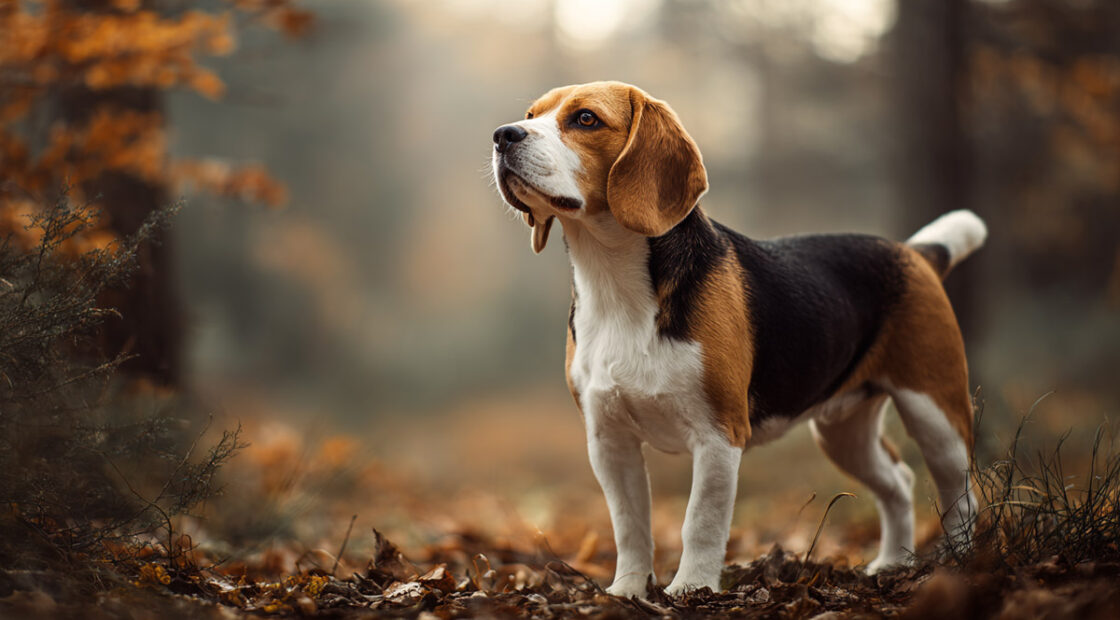
It looks like a Foxhound scaled down, with shorter legs, a slightly domed skull and long, soft ears that hang close to the cheeks.
Oddly, the National Beagle Club of America turns to the standard of the larger English Foxhound to explain the preferred bite, because the Beagle standard never mentions one.
The 2025 AKC registration rankings put the Beagle at No. 7 in the United States, the same spot it held the year before.
Today most of them live as companions in family homes. Others compete in conformation and field trials, and a smaller group does detection work on agricultural inspections.
Everything here is about the purebred Beagle. Mixes vary too much to profile as one thing.

How Big Do Beagles Get, and What Does the Breed Standard Say?
Fifteen inches at the shoulder is the ceiling, and the AKC splits the breed into a 13 inch variety and a 15 inch variety.
The 13 inch variety covers hounds not exceeding 13 inches (AKC standard, effective July 30, 2024). The 15 inch variety takes hounds over 13 but not exceeding 15 inches, and any hound measuring more than 15 inches is disqualified.
Weight runs under 20 lb for the smaller variety and 20 to 30 lb for the larger one (Britannica). The AKC recognized the breed in 1885.
How height works in the show ring
Height is the only disqualification in the AKC standard, according to the National Beagle Club of America.
The standard asks for a hound that is “big for its inches,” which means plenty of bone for its height, not simply a larger dog.
The standards disagree at the top end. The Kennel Club standard, reproduced under FCI Standard No. 161, sets a desirable height of 33 to 40 cm (13 to 16 inches), so a 15.5 inch hound that would be disqualified under the AKC standard sits comfortably inside the UK range.
Why the Pocket Beagle is not an official variety
Pocket Beagle is a name from history, not a variety.
Queen Elizabeth I kept small hounds known as Pocket Beagles, small enough to ride in a saddlebag on the hunt, and the writer Stonehenge was still listing a dwarf or lapdog Beagle among four varieties in 1856 (Wikipedia’s breed history).
Today the AKC recognizes only the two height varieties above. Treat a Pocket Beagle listing as a marketing label for a small Beagle, and ask for the parents’ AKC registration papers.
Beagle Coat Types, Colors and Shedding
The coat is close, hard and medium in length, and the AKC standard accepts any true hound color.
Tricolor (black, tan and white) is the best-known pattern, usually a black saddle with tan and white markings. Lemon and white means pale golden patches on a white base, and red and white is the same layout in a deeper orange-red. The National Beagle Club of America says color and markings matter little in the ring as long as the coat is a true hound color.
Short hair still sheds, so expect some on the sofa. Weekly brushing handles most of it, and Hill’s Pet rates the breed’s overall grooming needs as low.
Ears need more attention than the coat. The long, heavy ears trap moisture, and otitis externa appears among the most commonly diagnosed disorders in the 2025 VetCompass study of UK Beagles.
Check the ears weekly, and wipe them with a gentle ear wipe made for dogs after baths and swims.
What Is a Beagle’s Temperament Like?

Friendly and curious, with no aggression or timidity written into the breed standards. Loud, though, whenever it follows a scent or gets left alone.
Breed descriptions are tendencies, not guarantees. A 2022 study in Science (Morrill et al.), covering 18,385 dogs, found that breed explains just 9% of behavioral variation in individual dogs.
Still, the Beagle’s working history shows. Hill’s Pet describes a pack animal that wants company and makes a poor guard dog because it greets strangers.
Baying and howling come with the breed, and WebMD calls the howling bark very loud. A Beagle that locks onto a scent can follow it far from home (WebMD).
Dogs Queensland adds that the breed is independent enough that some owners find it hard to train.
Food motivation is high too. The 2025 VetCompass study of UK Beagles concluded the breed appears predisposed to obesity.
Measure meals against a feeding chart for adult Beagles instead of filling the bowl by eye.
How to Exercise and Train a Beagle

Somewhere between 20 minutes and an hour a day, depending on who you ask, and food rewards for training, because a Beagle’s nose overrides most commands.
Hill’s Pet says 20 to 40 minutes a day. PDSA, a UK veterinary charity, says a minimum of 1 hour.
That gap is wide. Since the breed is predisposed to obesity, I’d plan for the hour.
Splitting it into two walks plus some play works well. Outside fenced areas, keep the dog on a leash or long line, because a strong scent can override recall. And fence below ground level too, since Beagles dig under barriers (WebMD).
Training works when the reward beats the smell. Use small, healthy dog treats so training calories do not add up.
A sensible teaching order:
- Crate habits
- Loose-leash walking
- Recall on a long line
- Scent games, such as hiding treats in the grass
Scent games give the nose a job, so the dog spends less effort inventing its own.
Separation anxiety and destructive behavior
Hill’s Pet notes that a Beagle left alone can turn destructive and bark excessively, and rates the breed’s need for attention as high.
Build absences up in minutes, not hours, and exercise before you leave. A chew or food puzzle helps. So can a second dog, since the breed is happiest in a pack (Dogs Queensland).
A Beagle that stays destructive after exercise and gradual absences needs a vet or a behaviorist. Anxiety and boredom look the same from the couch.
Beagle Health Problems and Real Lifespan Data

The authors of the 2025 VetCompass study of UK Beagles, run by the Royal Veterinary College, describe a breed whose lifespan and disorder profile are similar to dogs overall. The median age at death of 11.28 years does sit slightly below the 12.0 years reported for dogs overall in England.
Most of the conditions that do show up are preventable or screenable, so owner and breeder choices carry real weight.
Lifespan numbers vary by source because each one measures something different.
| Source | Figure | What it measures |
|---|---|---|
| Britannica | 10 to 15 years | Breed fact-sheet range |
| Hill’s Pet | 12 to 15 years | Breed guide longevity range |
| VetCompass (RVC, 2025) | 11.28 years | Median age at death, 322 deaths in UK clinics |
The ranges describe what a Beagle can reach. The VetCompass median describes what happened to a real population, and the middle half of those deaths fell between 9.32 and 13.08 years.
Plan around 11 to 13 years and treat 15 as a bonus.
Everyday disorders get less attention than inherited ones, which seems backwards. The same study lists periodontal disease, overgrown nails, anal sac impaction, lipoma and conjunctivitis among the most commonly diagnosed problems.
Dental care and nail trims earn their place in the routine.
Inherited conditions and screening tests
About 18% of Beagle hip X-rays submitted to OFA are evaluated as dysplastic, according to the National Beagle Club of America’s screening page.
- Hip dysplasia is a joint disease that leads to arthritis and pain. An OFA or PennHIP evaluation screens for it.
- Musladin-Lueke syndrome is an autosomal recessive connective tissue disorder that shows at birth as stiff joints, tight skin and a tiptoe gait. A DNA test detects the ADAMTSL2 mutation.
- The club’s April 2022 health statement names epilepsy among the most common problems, next to allergies, hypothyroidism, hip dysplasia and back problems.
- Steroid responsive meningitis-arteritis used to be called Beagle pain syndrome. A 2014 case-control study in the Journal of Veterinary Internal Medicine found significantly higher odds in Beagles, and steroids treat it (MSPCA-Angell).
A CHIC number certifies that the tests were done and made public, not that the dog passed them. OFA’s own program rules allow abnormal results.
To earn a CHIC number through the National Beagle Club, a dog needs all of these on record:
- Hip evaluation (OFA or PennHIP)
- Eye exam by a boarded ophthalmologist
- Musladin-Lueke syndrome DNA test
- Cardiac evaluation
- Autoimmune thyroiditis test
Weight management and feeding
Weight is the health factor an owner controls most.
Extra pounds load the joints and spine, and a UK breed health report on Dogwell notes that excess weight raises the risk of intervertebral disease, which Beagles are prone to.
Puppies can eat roughly twice what an adult does, so the formula has to match the growth stage, as WebMD advises. Comparing puppy food formulas from established brands narrows the choice before the first bag.
Weigh the dog monthly and cut portions when the number creeps up. Review portions after desexing too, since that is when weight problems often start (Dogs Queensland). And keep chocolate and onions out of reach, because both are toxic to dogs and Beagles scavenge (Healthy Paws).
How Much Does a Beagle Cost?
Insurify’s 2026 figures put a Beagle at $1,000 to $1,500 from a certified breeder and $1,716 to $3,900 a year to keep.
Its wider purchase range starts at $100 and runs to $1,500, depending on whether the dog comes from an adoption center or a breeder.
A breeder puppy’s price reflects health testing, pedigree and location. Rescue adoption costs less, and Healthy Paws lists groups such as SOS (Save Our Snoopies) Beagle Rescue in New Jersey, Southeast Beagle Rescue in Florida and Beagles and Buddies in California.
Annual upkeep depends on lifestyle, health, pet insurance and the savings tactics you use, per Insurify.
The purchase price is the small number. Over a dozen or more years, how fast a dog’s costs add up over a lifetime depends mostly on insurance and vet care. Boarding adds to it.
Budget for the whole life, not the pickup day.
When a Beagle Is the Wrong Dog

Homes that need quiet, keep small pets or cannot secure their food should look elsewhere.
If two or more of these describe your household, look at a quieter breed.
- You share walls with neighbors
- Rabbits, hamsters or guinea pigs live in the house
- Nobody is home for most of the day
- Food sits within reach, in open bins or on low counters
Great Pet Care calls the breed poorly suited to apartment living because it is noisy. Hill’s Pet lists rabbit and hare hunting as what the breed was bred for, so a small pet in the house is a poor match.
The other two conditions echo earlier points. Long solo hours feed the destructive behavior described above, and a scavenger raids any bin it can reach.
On the plus side, Dogs Queensland calls Beagles great with children and people of all ages. They’re small enough for most homes that have a yard, and the 2025 VetCompass data puts their health profile close to dogs overall.
The downsides run longer, and most of them come down to noise and appetite.
- Loud enough to strain shared-wall living
- Prey instinct toward small pets
- Scavenges food and needs secured bins
- Training takes patience, and expecting instant obedience sets owners up for frustration
Where Did the Beagle Breed Come From?
Britain in the 1830s, from older hare hounds. The breed was then refined in the United States after English imports in the 1870s.
Breed histories point to the Talbot Hound and the North Country Beagle, plus the Southern Hound and possibly the Harrier.
| Date | Milestone | Place |
|---|---|---|
| 1830s | Phillip Honeywood’s pack becomes the base of the modern breed | Essex, England |
| 1840s | A standard type starts to form, though packs still vary widely | England |
| 1870s | Richard Rowett imports English hounds and begins breeding | Illinois |
| 1890 | The Beagle Club forms and drafts a first standard | England |
| 2008 | Uno wins Best in Show at Westminster | New York |
Honeywood’s hounds were small and pure white, per Wikipedia’s breed history. A rough-coated variety survived into the 20th century and is now extinct, probably absorbed into the standard bloodline.
Sources disagree on a couple of dates. Rowett’s first imports show up as around 1870 (National Beagle Club of America), the early 1870s (Wikipedia) and 1876 (Showsight Magazine). The first American standard is 1884 according to the National Beagle Club of America and Showsight Magazine, but 1887 according to Wikipedia and a separate Showsight history.
Treat these dates as approximate. The height cap was already contested by 1892, when a National Beagle Club officer wrote in Forest and Stream against raising the 15 inch limit to 16.
Uno, a 15 inch Beagle from Belleville, Illinois, became the first of his breed to win Best in Show at Westminster in 2008, and the first Beagle to win the hound group there since 1939 (Associated Press, 2008).
What Jobs Do Beagles Do Besides Hunting?
Beagles hunt in packs and check luggage at airports, and laboratories use them more than any other breed. The strong nose and food-driven temperament sit behind every role.
Pack hunting
Beagling is hare hunting on foot with a pack, and it is still practiced.
The breed standard includes a section on packs, and the National Beagle Club runs pack hunting from its home grounds at Institute Farm in Aldie, Virginia.
Airport detection work
USDA’s APHIS started a detector dog program at Los Angeles International Airport in 1984 and chose Beagles, which became known as the Beagle Brigade (CBP timeline).
CBP cites a keen nose, a non-threatening size, high food drive and a gentle manner with the public. A dog that catches a restricted scent sits beside the bag to signal its handler (Wikipedia).
Dogs train at the USDA National Detector Dog Training Center in Newnan, Georgia, and many come from shelters or private donations. USDA moved its teams under CBP in 2003.
Flash, a rescue Beagle from a Humane Society in Blue Ridge, Georgia, started at Atlanta’s Hartsfield-Jackson airport in spring 2024. On May 10 he alerted CBP to luggage holding infested beans, cow skin and other prohibited items (Georgia Public Broadcasting).
Research and rehoming
Beagles remain the dog breed most often used in research, according to the National Anti-Vivisection Society. Size and temperament are the usual reasons given (Foundation for Biomedical Research).
Beagle Freedom Project rehomes dogs from laboratories, and its model legislation, the Beagle Freedom Bill, requires labs to offer healthy dogs for adoption once testing ends. The group says it has passed in multiple states.
The project’s founder told CBS Los Angeles that lab staff said the dogs had never been outside or had a toy. Adopters should plan on teaching basics such as stairs and leash walking.
Whether research use is justified is a policy debate I won’t try to settle here. The practical point for owners is that former research Beagles are available for adoption.
Beagle FAQ
Where does the name Beagle come from?
Nobody has settled the word’s origin. One theory traces it to a French word for the sound hounds make on the hunt (WebMD), and the UKC breed standard notes literary mentions of the breed as early as 1475.
What separates a Beagle from a Basset Hound or an English Foxhound?
Weight and build. The Basset Hound is a short-legged hound that weighs 40 to 65 pounds, while the English Foxhound stands about 24 inches and weighs 55 to 75 pounds (Showsight and Purina breed profiles).
The Beagle is the lightest of the three.
Is pet insurance worth it for a Beagle?
Yes, if you buy it while the Beagle is young and healthy. Insurers exclude pre-existing conditions and often impose six-month to one-year waiting periods on orthopedic claims (NerdWallet), which is where hip problems land.
Are Beagle mixes such as the Puggle worth considering?
Yes, with realistic expectations. The Puggle, a Pug and Beagle cross developed in the 1980s, has no AKC recognition or official size classes, and its traits vary from dog to dog depending on which parent’s genes dominate (Basepaws).
Do male and female Beagles differ in health risks?
Yes, slightly. In the 2025 VetCompass study, females had a higher risk of periodontal disease, anal sac impaction and urinary tract infection, while males had a higher risk of seizure disorders.
How long does it take to house train a Beagle puppy?
From a few weeks to several months, since the AKC says timing varies widely between puppies. A puppy can hold its bladder for about its age in months plus one hour, so schedule outings by that rule.
A vet check is warranted if accidents persist well past the first few months.
Choosing a Healthy Beagle from a Breeder or Rescue
Parental screening that can be verified in OFA’s public CHIC database, not taken on a breeder’s word, is where a healthy Beagle starts.
Three of the five problems the National Beagle Club names as most common (epilepsy, allergies and back problems) have, as of October 2026, no required CHIC screen.
Order matters here. A deposit commits money, and a condition found at the first vet visit is excluded as pre-existing if the policy starts afterward.
- Verify the parents’ CHIC records before paying a deposit
- Ask about seizures, allergies and spinal disease in the lines
- Start insurance before the first vet visit
Adopting an adult trades parental screening data for behavior that is already visible, so a rescue Beagle needs a full vet exam in place of a CHIC lookup.