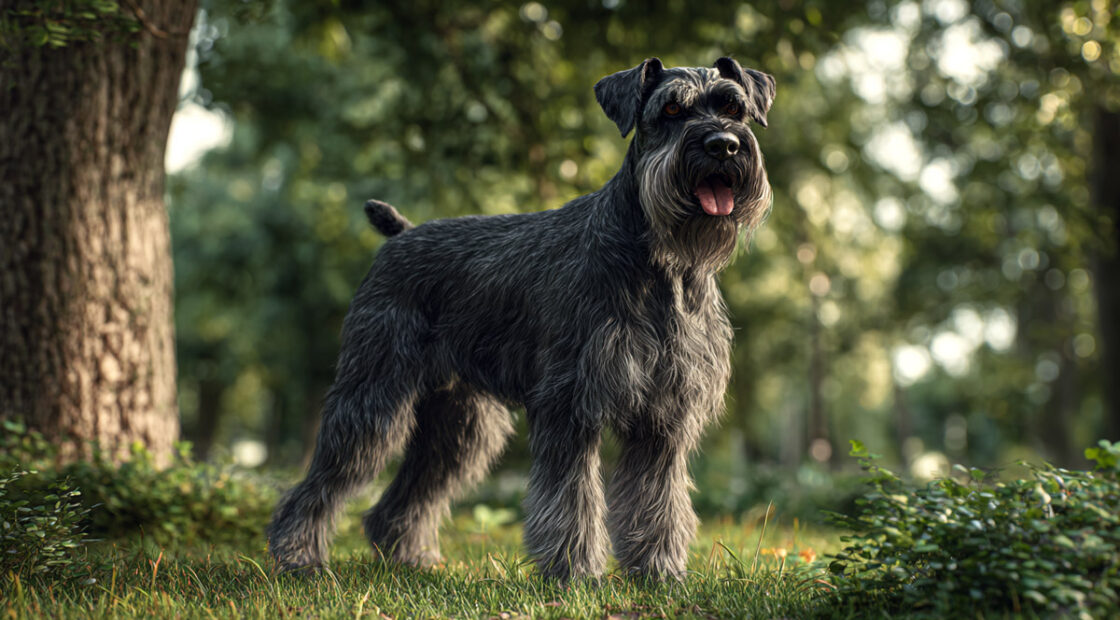
German farmers wanted something that would kill rats, guard the property and drive stock, and the Standard Schnauzer is what they ended up with. It’s a medium-sized dog with a wiry pepper-and-salt or black coat. It also came first, ahead of the Miniature and the Giant, and these days it works as a family companion, a watchdog and a performance dog.
Buying one comes down to a short list of health tests. The SSCA, the breed’s national club, wants an OFA hip evaluation and a board-certified eye exam done before any dog is bred, plus a DNA test for dilated cardiomyopathy (SSCA, 2023).
The heart test comes with a hard rule. The Kennel Club classes the disease as autosomal recessive, and the SSCA doesn’t allow two carriers to be bred together.
What Is a Standard Schnauzer, and Where Does the Breed Come From?

Germans call it the Mittelschnauzer, which means middle schnauzer (AKC, 2025).
That makes it the oldest of the 3 schnauzers. The Miniature and the Giant were both developed from it, though the AKC registers all 3 as separate breeds and not as size varieties of one dog.
The breed comes from Bavaria, in southern Germany. The Westminster Kennel Club dates it to the 15th century, and the UKC also puts its ancestry in the 1400s. According to the UKC standard, it’s probably a cross of the black German Poodle and the gray Wolfspitz with wirehaired pinscher stock.
It went by Wirehaired Pinscher at first. Schnauzer, from the German word for snout, took over by the early 1900s (AKC, 2025).
The show records are younger than the bloodline. Wikipedia’s breed entry says a dog entered as Schnautzer won the wire-haired pinscher class at the 1879 Hanover show.
The breed shares that pinscher lineage with the German Pinscher. German breed-society records, as summarized by Wikipedia, show rough-haired and smooth-haired puppies turning up in the same litter.

Size mattered for the job. The dog was small enough to ride in a farmer’s cart and big enough to guard it (AKC, 2025).
The matted whiskers weren’t just untidy, either. They shielded the face from rat bites.
In World War I the German army used the breed as guard dogs, and the Red Cross used it to carry dispatches.
The work list is longer now. The Westminster Kennel Club names agility, obedience and tracking, along with bomb detection, search and rescue and therapy work, and the breed can enter AKC herding tests.
In Germany itself it’s scarce. The German conservation society GEH classed the pepper-and-salt variety as endangered in 2022.
How Kennel Clubs Classify the Standard Schnauzer
Group placement differs by registry, and the AKC has changed its own once.
The AKC recognized the breed in 1904 and put it in the Terrier Group. The Standard Schnauzer Club of America pushed for a change, and in 1945 the dog moved to the Working Group (AKC, 2025; Showsight, 2024).
The Kennel Club in the UK files it under Utility. The FCI lists it as standard number 182, in the Pinscher and Schnauzer group, accepted in 1955. The UKC recognized it in 1948 and uses the Guardian Dog Group, while the Canadian Kennel Club calls it a Working Dog.
So the same dog competes in a Working Group ring in the US and a Utility Group ring in the UK. The Miniature Schnauzer stays in the AKC Terrier Group.
How Big Does a Standard Schnauzer Get?

Expect 17.5 to 19.5 inches at the withers and 30 to 50 pounds (Britannica). Even the tallest Standard falls 4 inches short of the shortest Giant.
Height alone sorts the schnauzers, since the ranges never overlap.
| Attribute | Miniature | Standard | Giant |
|---|---|---|---|
| Height at withers | 12 to 14 in | 17.5 to 19.5 in | 23.5 to 27.5 in |
| Weight | 11 to 20 lb | 30 to 50 lb | 55 to 85 lb |
| AKC group | Terrier | Working | Working |
| AKC recognition | 1926 | 1904 | 1930 |
Heights, weights and groups come from Britannica. Recognition years come from the AKC (2025).
The gap is 3.5 inches from Miniature to Standard and 4 inches from Standard to Giant. A tape measure settles which size a dog is.
The Miniature Schnauzer is not a scaled-down Standard. Purina makes the same point, saying each of the 3 is a distinct breed developed to resemble the others.
The Giant Schnauzer reaches 85 pounds against the Standard’s 50, so the difference shows up on the scale even more than on the tape.
Registries set slightly different ideal heights. The UKC (2009) wants 18.5 to 19.5 in for males and 17.5 to 18.5 in for females, and males under 18 or over 20 in, and females under 17 or over 19 in, carry an eliminating fault.
The Kennel Club in the UK asks for 48 cm (19 in) for dogs and 45.7 cm (18 in) for bitches, with variations beyond 2.5 cm (1 in) undesirable. Canada’s club says 18 to 20 in (46 to 51 cm) for males and 17 to 19 in (43 to 48 cm) for females.
Weight is where sources split. The UKC and Kennel Club standards give a height and no weight.
Britannica says 30 to 50 pounds, VCA Animal Hospitals says 35 to 45, and Wikipedia reports 14 to 20 kg (about 31 to 44 pounds) from the FCI standard. Treat 30 to 50 pounds as the outer limits and judge an individual dog by body condition, with your vet setting the target. I’d trust that over any number on a chart.
What Does the Standard Schnauzer’s Coat Look Like, and Which Colors Are Accepted?
The coat is wiry and harsh, dense over a thick undercoat, and only 2 colors are accepted, pepper and salt or solid black (UKC standard, 2009).
The topcoat lies close to the body and isn’t bristly or wavy.
Hair on the legs is less harsh than on the body, and the forehead and ears carry short hair. The muzzle has a beard, and the eyebrows partly shade the eyes.
Arched eyebrows and a bristly mustache with profuse whiskers mark the breed.
Pepper and salt coats mix black and white hairs with white hairs banded in black. Every shade from dark iron gray to silver gray is acceptable, a gray undercoat is preferred (tan or fawn is allowed), and a darker facial mask is desirable.
Black should be a true, rich color with a solid black undercoat. Age and sun fade it, and a small white smudge on the chest is not a fault.
Some profiles, PetMD among them, list silver-gray as an extra color. In the UKC standard it’s the light end of pepper and salt, not a third option.
Ears and tails are where the registries really disagree.
The UKC says cropped ears stand erect, while uncropped ears are V-shaped and drop close to the cheeks. Tails are docked to 1 to 2 inches, or left natural with a saber or sickle carriage. The FCI wants high-set, V-shaped ears hanging close to the face, per Wikipedia’s summary of standard 182.
The UKC notes that cropping and docking are legal in the US and left to the owner, but forbidden in some countries. No dog in a UKC event is penalized for natural ears or a full tail.
How Do You Groom a Standard Schnauzer, and Does It Shed?
It sheds very little, but the wire coat still needs regular work. The Westminster Kennel Club rates shedding 1 out of 5, and The Kennel Club lists moulting as low.
Comb the coat once or twice a week (VCA Animal Hospitals). The beard gets dirty quickly and needs cleaning, and the hair around the eyes and mouth needs regular trimming (WebMD).
Hand-Stripping vs Clipping
The method changes how the coat feels, and it can change how the color reads too.
Hand-stripping pulls out dead outer hair to keep the wiry texture. It’s the standard for the show ring, where the body coat is plucked, the legs trimmed, and parts of the head and rear plucked or clipped (Showsight, 2024). Combing between sessions removes some dead hair and makes stripping easier (WebMD).
Clipping is easier and it’s the usual pet choice. The coat turns softer, and a salt-and-pepper coat can fade to gray (WebMD). A pet trim repeats every 2 to 3 months (VCA Animal Hospitals), and the texture change keeps the dog out of the breed ring (Showsight, 2024).
That last point comes from Arden Coe Holst, a longtime Standard Schnauzer breeder and former Standard Schnauzer Club of America president.
Pet owners who clip still pick a pattern. This rundown of haircut styles for the breed shows what a trim can look like.
A Groomer to Groomer column notes that schnauzers sit on the hand-strip list yet rarely get stripped in pet salons. Call ahead and ask before booking.
Hand-stripping makes sense if you show the dog or want the original texture. For a manageable pet coat, clipping works fine, as long as you accept the softer feel.
What Is the Standard Schnauzer’s Temperament Like?

Expect a bold, alert dog with a loyal streak. It’s high-spirited, and it stays composed once it knows its people. The AKC describes a farm dog that can be willful but is dependable (AKC, 2025).
The UKC wording runs lively but composed, loyal and devoted, plus intelligent, trainable and fearless. The Westminster Kennel Club tags it friendly, courageous, smart and playful.
The UKC disqualifies viciousness and extreme shyness. Neither belongs to the breed type.
Children, Strangers and Other Pets
Sources disagree on children. The Westminster Kennel Club scores the breed 5 out of 5, VCA Animal Hospitals scores it 3 out of 5, and Healthy Paws rates it medium.
The common thread is supervision. Orvis calls the breed boisterous and bossy, and advises teaching older kids how to handle it while always watching young ones.
With strangers it’s reserved at first, per VCA and Westminster. Other dogs get a mid-scale rating at Westminster, while VCA warns of aggression toward unfamiliar dogs, so dog parks suit some individuals and not others.
Household pets are usually fine, per VCA, though Orvis cites a strong prey drive and calls the breed a poor housemate for small animals.
How Much Exercise and Training Does a Standard Schnauzer Need?

Plan on about an hour of exercise a day, plus daily mental work, and start training the day the puppy comes home. This is a working farm breed, and a short walk around the block doesn’t cover it.
Daily Exercise Targets

Sources disagree on the number, and the spread is wide.
The Kennel Club (now styled The Royal Kennel Club) says up to 1 hour per day. Hill’s Pet Nutrition says more than 30 minutes. Orvis goes much further, with several hours of vigorous activity per day.
Behavior is the better gauge. Hill’s describes a bored Standard Schnauzer as one that runs through the house with toys, chases the kids and turns into a pest.
If that sounds familiar, the number is too low, whatever the chart says.
Exercise is only half of it. VetStreet treats daily training practice as work for this dog, and so are greeting visitors and helping in the yard. Dogster adds nose work as a mental outlet.
Training and Early Socialization

Training starts at 8 weeks. A puppy that young can already learn manners, according to VetStreet.
Sources split on how easy the dog is to train. The Westminster Kennel Club scores trainability 5 out of 5, Healthy Paws rates it medium, and Orvis calls the breed strong-willed.
Both readings hold. The dog learns fast and tests whoever is teaching it.
Canine Journal recommends short, fun sessions with a firm but gentle hand, and says to expose the puppy to many dogs, people, sounds and places while it’s young. Orvis stresses consistent boundaries from day one.
Socialization has a specific job here. Orvis reports the breed can turn aggressive toward unfamiliar people and dogs when socialization was thin, and VetStreet says the guarding instinct needs frequent early exposure so the dog learns to tell a threat from a normal event.
Keep rewards small. Pick healthy dog treats so a daily training habit doesn’t add weight.
How Long Do Standard Schnauzers Live, and What Health Problems Do They Get?
Standard Schnauzers are long-lived and generally healthy. The documented concerns are hip dysplasia and eye disease, plus dilated cardiomyopathy (DCM), a heart condition the Standard Schnauzer Club of America (SSCA) tests for.
Lifespan is quoted as 13 to 16 years (Orvis, WebMD), against 12 to 14 years (VCA Animal Hospitals). Median longevity is 13 years, against 12.5 for all dogs in the dataset (McMillan et al., Scientific Reports, 2024).
On the breeding side, the SSCA requires 3 pre-breeding tests (hip, eye, DCM DNA), and the eye exam has to fall within 12 months before breeding for dogs under 7 (SSCA, 2023). The Kennel Club puts the breed in Breed Watch Category 1, meaning no breed-specific points of concern for judges.
Lifespan
A range and a median answer different questions.
The median is the age by which half the dogs have died, so a range that starts at 13 years describes the longer-lived half of the breed. Treat 13 to 16 as the good-outcome band, not a promise.
One caveat on the median. The study covers UK dogs only (Science News, 2024), and the breed-level figure comes from Wikipedia’s summary of it.
Documented Health Conditions
Hip dysplasia means the joint parts grind instead of gliding. It shows up in young dogs or appears with age, and WebMD lists surgery or medical management as the options.
Eye disease shows up as cataracts in older dogs, and dry eye is common (WebMD).
In DCM the lower heart chambers swell and the heart pumps weakly. The Kennel Club describes it as autosomal recessive, so a dog needs two copies of the abnormal gene to be affected, while a carrier shows no signs and can pass the gene on.
Signs include collapse, lethargy, appetite loss, gradual abdominal swelling, and coughing and gasping. In Schnauzers the onset is reported as typically much younger than in other breeds.
Orvis also lists follicular dermatitis, and VCA Animal Hospitals lists cancer.
Sources disagree on how worried to be. WebMD reports that SSCA owner surveys describe the breed as very healthy, while Canine Bible flags a high proclivity to health issues.
Both name the same short list. They differ on tone.
Screening Before Breeding
The SSCA requires 3 tests for every dog used in breeding, per its best-practices document (revised December 2023, approved February 2024). Breeders must also post results in the Orthopedic Foundation for Animals (OFA) database.
| Test | Timing | Rule |
|---|---|---|
| Hip radiograph (OFA) | Preliminary grade under 2 years, OFA number after | Preliminary grades are excellent, good or fair |
| Eye exam, board-certified ophthalmologist | Within 12 months before breeding, under age 7 | At 7 or older, the exam must be done at 7 or later |
| DCM DNA test | Before breeding | Never breed two carriers |
The AKC’s recommended list for the Standard Schnauzer matches those 3 tests. The Kennel Club names the DCM DNA test and the BVA/KC hip scheme as best practice.
Thyroid testing appears on the AKC’s Giant Schnauzer list but not on the Standard’s. Neither the SSCA nor Kennel Club pages give a breed-wide DCM prevalence figure.
When Is the Standard Schnauzer the Wrong Choice?
Skip this breed if you can’t give a daily hour of exercise plus mental work. Homes with cats or other small animals are a poor fit too, and so is an owner who wants an easy first dog. The sources back each of these up.
Long workdays away from home are the biggest problem. Orvis says the breed gets bored quickly and may turn to barking and chewing when left alone, and VCA Animal Hospitals says it bores quickly and can be mischievous without enough exercise.
Cats and small pets are a separate issue, since Orvis calls the strong prey drive a poor match for small housemates. First-time owners get a warning as well, because Orvis says the breed needs experienced owners who set firm, consistent boundaries.
And if you want a lap dog, VCA rates the breed 1 out of 5 for that.
Hair is a mixed signal. The Kennel Club’s breed page answers “sheds” with yes, while the Your Dog profile it publishes rates moulting low.
Read that as low-shedding, not non-shedding.
What works in its favor
- Versatile in dog sports and working roles
- Watchdog instincts (VetStreet)
- Trainable with a consistent handler
- Long-lived relative to the all-dog median
What counts against it
- Daily exercise and mental work, every day
- Strong-willed, so training needs firm boundaries
- Prey drive, plus reserve with unfamiliar dogs and people
- Coat upkeep by stripping or clipping
- Least popular of the 3 schnauzers in the US (VCA), which narrows the choice of breeders
Count the conflicts with your household. One is workable with planning, and 3 or more points to a different breed.
How Do You Find a Healthy Standard Schnauzer Puppy?
Start with the SSCA, the AKC’s national breed club for the Standard Schnauzer. Ask the breeder for 3 results on both parents, OFA hips, a board-certified eye exam and the DCM DNA test.
- Search the SSCA litter and breeder listings (Healthy Paws describes the club’s site as the place to see available litters).
- Ask for hip, eye and DCM results on both parents, and ask what “preliminary” means if a parent is under 2 years old.
- Look the results up in the OFA database yourself. The SSCA requires breeders to post them there, so a screenshot is not needed.
- Check the DCM pairing. One carrier parent is acceptable only with a negative mate, and two carriers should never be bred (SSCA).
- Meet the dam, see the litter and see where the puppies are raised. Dogster says to be wary of breeders who cannot show health results or arrange visits.
- In the UK, use The Kennel Club’s Health Test Results Finder to check hip and DNA results for any dog on its Breed Register.
No registry publishes puppy prices. Public price guides disagree with each other, so compare what each breeder’s quote includes, not just the total.
The purchase price is only the first bill, and a dog is expensive across its whole life.
Adults are the alternative. Healthy Paws describes a volunteer-led Standard Schnauzer Rescue Program run by the SSCA, and The Kennel Club operates a Find a Rescue service for UK buyers.
Standard Schnauzer FAQ
Are Standard Schnauzers hypoallergenic?
No. A 2011 study in the American Journal of Rhinology and Allergy found the same Can f 1 allergen levels in homes with dogs promoted as hypoallergenic, schnauzers among them, as in homes with other dogs.
The AKC still lists the breed among low-shedding options for allergy sufferers, so spend time with an individual dog before committing.
Do Standard Schnauzers bark a lot?
Moderately, though sources differ. The Westminster Kennel Club and VCA Animal Hospitals both score barking 3 out of 5, and Healthy Paws rates it low.
PangoVet notes the breed tends to bark at anything unexpected or out of place, and Orvis says it barks vehemently when it senses something is amiss.
Why is the Standard Schnauzer less popular in the US than the Miniature and Giant?
No registry names a single cause, but the gap is large. The AKC’s 2025 registration rankings place the Miniature Schnauzer 17th, the Giant Schnauzer 52nd and the Standard Schnauzer 93rd.
Britannica calls the Miniature by far the most popular of the 3.
Can a Standard Schnauzer live in an apartment?

Yes, with enough exercise. WebMD says the breed can adapt to apartment living when its exercise needs are met, while The Kennel Club suggests a small house with a small to medium garden.
Barking is the apartment risk, since the breed alerts at unexpected sounds (PangoVet).
How much should a Standard Schnauzer eat per day?
Plan on 1 to 2 cups of good-quality dry food a day, split into 2 meals, according to Orvis. Adjust for age and activity level.
Puppies need high-calorie food until about 1 year (PetMD), and a comparison of puppy food brands helps narrow the choice.
How to Test the Fit Before You Commit
Start with a 2-week trial routine. Get a groomer’s quote for hand-stripping and for clipping, then go meet adult dogs at a club event.
That order runs from the cheapest and most reversible step to the costliest, so a poor fit shows up before a deposit changes hands.
The trial fails if the schedule holds only on easy days. Count the busiest week of the month, because the dog’s needs do not shrink then.
For the club event, the Standard Schnauzer Club of America runs licensed specialty shows under AKC rules and lists a 2027 National Specialty on its home page. The trade-off is time, since this sequence pushes the first breeder call back by at least 2 weeks.