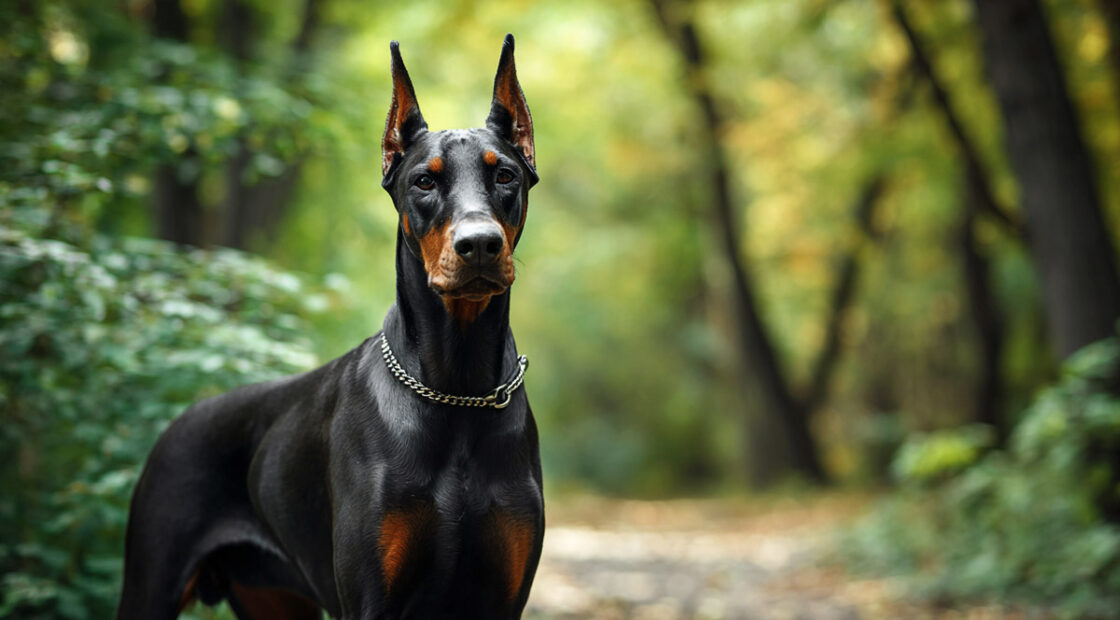
Louis Dobermann collected taxes in Apolda, Germany, and in the late 1800s he bred the dog that now carries his name. He wanted something that would guard and still take orders. The Doberman Pinscher still works that way. Police units and militaries use it, and plenty of families just keep one on the couch.
The AKC standard describes a square, muscular dog, with males standing 26 to 28 inches at the withers.
The hard part is how long they live. The Kennel Club’s 2014 survey covered 5,663 UK dog deaths, and among the 25 breeds with at least 50 reported deaths, this one had the shortest median lifespan, at 7.67 years (Lewis et al., Canine Genetics and Epidemiology, 2018). Most of that comes back to the heart. Inherited dilated cardiomyopathy, a disease of the heart muscle, is the breed’s best-documented health risk.
Where Does the Doberman Pinscher Come From?
Germany, around 1890, according to Britannica.
Dobermann wasn’t only a tax collector. He also worked as a night watchman and ran the local dog pound, so he had a steady supply of dogs to cross. The AKC says he was after a medium-sized dog that could guard and still live as a companion. What he ended up with was a short-coated working breed with strong guarding instinct that also happens to be very trainable.
The exact year isn’t settled. Britannica says about 1890 and the AKC says around 1900. Dobermann died in 1894, though, which makes the earlier date the more believable one.
He kept no breeding records either, so any ancestry list is educated guessing. The AKC points to the old shorthaired shepherd, the Black and Tan Terrier, the German Pinscher and the Rottweiler. Britannica adds the Weimaraner. Other lists name the Manchester Terrier and the Greyhound.
The German Pinscher and the Rottweiler are the two that show up on every list.
Outside the US and Canada it’s spelled Dobermann. North American owners mostly just say Dobe or Dobie.
After Dobermann died in 1894, Otto Goeller kept refining the breed. The German Kennel Club recognized it in 1899 (Canine Medicine and Genetics, 2023), and the AKC followed in 1908 with a spot in the Working Group. The Doberman Pinscher Club of America was founded in Michigan in 1921.

In World War II the US Marine Corps used the breed as a war dog, alongside the German Shepherd. A bronze Doberman called Always Faithful stands over the war dog cemetery in Guam.
Britannica’s record of the breed’s jobs also includes police work, message delivery, scouting and guide dog service.
How Big Does a Doberman Pinscher Get?
Under the AKC standard adopted February 6, 1982, males stand 26 to 28 inches at the withers, with about 27.5 as the ideal. Females run 24 to 26 inches, ideal about 25.5.
That’s taller than where the breed started in America. The first standard the DPCA wrote, in 1935, asked for 24 to 27 inches in males and 23 to 25 inches in females. So the modern ideal sits higher at both ends.
Height alone doesn’t make a correct Doberman. The standard wants a square body, with height at the withers equal to the length from the forechest to the rear of the upper thigh.
Weight is messier. The AKC standard’s size paragraph covers height and proportion and says nothing about weight, so the figures you see come from other places. And they don’t match.
The FCI standard used in Europe gives 40 to 45 kg (about 88 to 99 pounds) for males and 32 to 35 kg (about 71 to 77 pounds) for females. Purina’s breed profile lists males at 85 to 100 pounds and females at 65 to 75.
Height is the number the sources agree on. If you’re checking a dog against the standard, check that.
What Colors Do Dobermans Come In?
Black, red, blue and fawn (Isabella), each with rust markings. That’s the full list the AKC standard allows.
Any other color counts as a disqualifying fault, which means a dog of another color can’t earn championship points.
| Color | AKC standard | Notes |
|---|---|---|
| Black and rust | Allowed | Common, dominant over red |
| Red and rust | Allowed | Common |
| Blue and rust | Allowed | Dilute of black, skin risk |
| Fawn and rust (Isabella) | Allowed | Dilute of red, skin risk |
| White | Not allowed | Albinism, tracked on the AKC Z-list |
Blue and fawn are the ones to think twice about. Both come from a recessive dilution gene, and dilute pinschers show a higher rate of color dilution alopecia, also called Blue Doberman syndrome (BMC Genetics, 2005).
The coat thins only in the diluted areas, usually between 3 months and 3 years of age, according to the University of Minnesota’s veterinary dermatology text. Apart from the skin, affected dogs seem to be in good health (Canadian Veterinary Journal, 2009).
How often it happens depends on who you ask. Perego et al. (Canadian Veterinary Journal, 2009), citing Miller, put it at 57.9% of blue and 89.5% of fawn Dobermans. The University of Minnesota dermatology text has it the other way around, at about 93% of blue and 73% of fawn Dobermans.
These come from different studies. I wouldn’t read either pair as the odds for one particular puppy. What they agree on is that most dilute dogs are at risk.
Fawn hasn’t always been accepted, by the way. A German standard reproduced in the DPCA archive from a 1929 book listed light yellow (fawn) among colors not recognized.
The first recorded albino Doberman, Padula’s Queen Sheba, was born on November 10, 1976, according to the DPCA’s policy page. The DPCA classes the white coat as albinism. Albino Dobermans are disqualified from AKC shows, so there is no white AKC champion.
What Is the Doberman Pinscher Temperament Like?

Energetic, watchful, determined, alert, fearless, loyal and obedient. That’s how the AKC standard puts it. Judges are also told to dismiss any Doberman that is shy or vicious.
The wording used to be harsher. The 1935 standard, the first the DPCA wrote, described the temperament as energetic, watchful, determined and alert; loyal and obedient, fearless and aggressive. “Aggressive” came out in the 1948 revision, and the current standard from 1982 keeps fearless, loyal and obedient.
The DPCA’s public education page backs up the change. It says the earliest Dobermans were very sharp, close to vicious, and that the temperament has shifted since.
With Children and Other Pets

Socialization makes the difference here. Purina’s breed profile says a well-socialized Doberman does well with children and other pets, and also says children need to learn how to handle the dog safely.
Dogster adds that a socialized Doberman can share a home with a cat.
Where people get caught out is time. The DPCA describes the breed as perceptive, intuitive and sensitive, and warns that owners who are away for long stretches should look at another breed. That’s a blunt thing for a breed club to say, and I’d take it seriously.
With Strangers and as a Guard Dog

The AKC lists the Doberman’s job as guardian and family companion. The standard also defines shyness, which tells you what judges are screening out:
- Refusing to stand for examination and shrinking from the judge
- Fearing an approach from behind
- Shying markedly at sudden, unusual noises
So a nervous Doberman isn’t a quieter version of normal. Under the standard, fear is grounds for dismissal.
How Long Do Dobermans Live, and What Shortens Their Lives?
Not as long as most people expect. In the UK Kennel Club’s 2014 owner survey, the Doberman Pinscher had the shortest median lifespan of the 25 breeds with at least 50 reported deaths (Lewis et al., Canine Genetics and Epidemiology, 2018).
That median rests on about 90 Dobermann deaths, which is not a big sample. A 2023 analysis of 1,738 owner-reported Doberman deaths from several continents put life expectancy at birth at about 9.1 years (Wade et al., Canine Medicine and Genetics, 2023).
Many consumer breed pages still quote 10 to 13 years. A range like that describes dogs that reach old age. A median counts every death, young dogs included.
Two numbers worth keeping in mind:
- Median age at death: 7.67 years for the Dobermann Pinscher, against 10.33 years across all breeds (Lewis et al., Canine Genetics and Epidemiology, 2018, analyzing 5,663 deaths from the Kennel Club’s 2014 survey)
- Cumulative prevalence of dilated cardiomyopathy (DCM), an inherited heart muscle disease, in Dobermans examined in Europe: 58.2% (Wess et al., Journal of Veterinary Internal Medicine, 2010)
Lifespan Range and Longevity Certification
The DPCA Longevity Program certifies Dobermans that reach 10 years, or dogs whose parents did. Over 4,500 longevity certificates have been issued to Dobermans aged 10 or older (DPCA Longevity Program, reported in Purina’s Doberman Update, Fall 2021).
That sounds like plenty. It’s roughly 0.5 percent of the registered population, according to the program’s chair.
Breeders use the database to find lines that last. The same issue of the Doberman Update notes that some of the breed’s worst conditions have no genetic test, so how long a dog’s relatives lived is one of the few signals left.
It also advises breeders to test breeding candidates against the OFA CHIC requirements. CHIC is the Canine Health Information Center database run by the Orthopedic Foundation for Animals with the AKC Canine Health Foundation.
Wobbler Syndrome, von Willebrand Disease, Bloat and Hypothyroidism
Wobbler Syndrome
The formal name is cervical spondylomyelopathy. The spinal cord gets compressed in the neck, and affected dogs walk with a wobbly gait, mostly in the back legs (Ohio State University veterinary program).
A New Zealand study of 170 Dobermanns (138 adults and 32 puppies) found abnormal radiographs in 48.8% and neurological signs in 32.0% (Burbidge et al., New Zealand Veterinary Journal, 1994).
The spinal changes show up early. A Massey University thesis found vertebral malformation in puppies as young as 6 weeks, while neurological signs tended to appear later in life.
And a normal gait doesn’t mean much on its own. A 2006 MRI study in the American Journal of Veterinary Research found cord compression in some clinically normal Dobermans.
Whether it’s inherited is still an open question. The New Zealand study couldn’t confirm it, and Ohio State lists the genetics of wobbler syndrome in Dobermans as ongoing research.
von Willebrand Disease
This is an inherited bleeding disorder that slows clotting. The DPCA lists it among the conditions you can identify by testing, using either a von Willebrand factor blood assay or a DNA test.
The blood assay has limits. The DPCA considers it unreliable for carrier status when the dog is ill, was medicated or vaccinated within 14 days, is pregnant, or is in heat or lactating.
Bloat
Gastric dilatation-volvulus (GDV), or bloat, fills the stomach with gas and can twist it. The Washington State University veterinary hospital lists Doberman pinschers among the breeds at increased risk.
Prophylactic gastropexy tacks the stomach to the body wall. It greatly reduces the risk of twisting, though it does not prevent bloat itself. It can be done during a routine procedure such as spaying or neutering (Washington State University).
The advice on feeding speed is split. Today’s Veterinary Practice (2017) lists eating a meal quickly as a risk factor, but a Veterinary Evidence knowledge summary found most evidence shows no effect from eating rate.
Hypothyroidism
According to the DPCA, hypothyroidism is probably inherited and can be treated with daily thyroid replacement pills. The club calls for annual thyroid testing (T3, T4, TSH and autoantibodies).
Why Is Dilated Cardiomyopathy So Common in Dobermans?
Mostly because it’s inherited and shows incomplete penetrance, so it keeps passing through lines without every carrier getting sick. It can also stay silent until the moment it turns fatal.
No single gene explains it. No single normal exam clears a dog for life, either.
Prevalence and Course of the Disease
Estimates vary. A dvm360 journal scan puts lifetime DCM at 25% to 50% of purebred Dobermans, and the DPCA-backed Doberman Update (Fall 2018) puts lifetime risk at around 50%. Both sit below the European cohort figure.
Early on, in what cardiologists call the occult phase, there are no outward signs. Sudden cardiac death is already possible at that point (LMU Munich cardiology clinic).
The overt phase is when it becomes visible: weak contraction, an enlarged heart, then congestive heart failure.
Some dogs start with ventricular arrhythmias and others with weakened contraction. A 2023 Genome Medicine paper found separate genetic causes behind the two.
What the Genetic Tests Show, and Where Studies Disagree
You can buy DNA tests for DCM markers. The trouble is that they don’t behave the same way in every Doberman population.
DCM1 (PDK4) and DCM2 (TTN) were linked to DCM in American Dobermans in the original studies, with no link in European cohorts. DCM3 (PRKAA2) and DCM4 (RNF207) are two chromosome 5 loci found in European Dobermans.
RNF207, the candidate gene behind DCM4, keeps coming up. It was flagged in the European and UK studies and, in 2026, in North American dogs.
Niskanen et al. (Genome Medicine, 2023) studied 540 European Dobermanns and found no association for PDK4 or TTN. Dutton et al. (PLOS ONE, 2025) reached the same result in 74 UK dogs while tying RNF207 to the disease.
The US markers fall short even at home. In an AKC breeder-education article, 6 of 48 American Dobermans with DCM carried neither variant (Meurs et al., JAVMA, 2020).
Wisdom Panel sells the DCM3 and DCM4 tests and says dogs with no copies still carry some risk. Its October 2023 notice listed a North American validation study as planned, which means those markers were unproven in US dogs at that point.
A 2026 cross-population study has since tested them there. Hulsman et al. (Animal Genetics, September 2026) found the RNF207 (DCM4) signal in both European and North American Dobermans, including 127 North American dogs with known heart status, but the DCM3 signal faded once North American dogs were added. SNPs near PDK4 and TTN showed no association in either population, though the two variants themselves were not directly genotyped.
Put it together and a negative result clears no dog. The 2026 authors advise using DCM3 and DCM4 alongside clinical screening, not in its place. The DPCA builds its breeding advice on echocardiogram and Holter results, not DNA variants (AKC).
Echocardiogram and Holter Screening Schedule
When to start depends on whose guidance you follow.
| Source | Start age | Tests | Repeat |
|---|---|---|---|
| ESVC guidelines (2017) | 3 years | Holter and echocardiogram | Yearly for life |
| DPCA, via Purina Pro Club | 2 years | Echocardiogram, baseline Holter | Yearly until about age 5; breeding dogs every 6 months |
| LMU Munich cardiology clinic | About 2 to 3 years | Holter and echocardiogram | Usually yearly |
The ESVC task force asks for yearly repeats because a one-time normal result cannot rule out later DCM. It also publishes Holter cut-offs:
- Fewer than 50 ventricular premature complexes (VPCs) in 24 hours is normal, though any VPC is a concern
- More than 300 VPCs in 24 hours, or two recordings within a year showing 50 to 300, diagnoses occult DCM whatever the echocardiogram shows
If yearly Holter and echocardiogram aren’t possible, the guidelines allow cardiac biomarkers (troponin I, NT-proBNP) and a 5-minute resting ECG as stopgaps.
Catching it before symptoms actually changes outcomes. In the PROTECT trial, 76 Dobermans with echocardiographic evidence of preclinical DCM received pimobendan or placebo.
Median time to heart failure or sudden death was 718 days on pimobendan against 441 days on placebo (Summerfield et al., Journal of Veterinary Internal Medicine, 2012).
How Much Exercise and Training Does a Doberman Need?

A lot, every day, plus something to think about. Dogster puts the exercise at about two hours. VCA Hospitals describes a long daily walk or, better, a jog.
Hill’s Pet warns that an under-exercised Doberman is likely to turn irritable or even aggressive.
Start socializing early. The AVSAB position statement lets puppies start classes at 7 to 8 weeks, after one set of vaccines and a first deworming, and the sensitive period runs until about 3 to 4 months of age (reported by JAVMA News).
Hill’s Pet says the breed responds very well to positive reinforcement. VCA calls the Doberman sensitive and best matched with a firm but gentle owner who pairs reward-based training with control.
Protection work is where sources split. Purina lists Schutzhund among the breed’s activities. Hill’s Pet, on the other hand, reports that experts often advise against special guard training, because it can lead to over-guarding and aggression.
Activities that suit the breed:
- Obedience
- Tracking
- Rally
- Agility (VCA)
- Search and rescue
- Therapy work
Consistency is the part people let slide. Dogster says a Doberman without steady reward-based training can become unmanageable and reactive.
Should You Crop a Doberman’s Ears and Dock the Tail?
You don’t have to do either to own a Doberman. Both are banned in the UK, Australia and much of Europe. The AKC standard still describes ears as normally cropped and carried erect, and docking remains in use in the US and Canada.
| Region | Ear cropping | Tail docking |
|---|---|---|
| United Kingdom | Illegal | Banned, working-breed exceptions |
| Australia | Prohibited | Prohibited |
| Most of Europe (Convention states) | Prohibited | Prohibited, some state exceptions |
| United States and Canada | Legal | Legal |
This table reflects the AVMA’s 2008 policy report and a 2020 Acta Veterinaria Brno review, so check current local law before relying on it. The European Convention for the Protection of Pet Animals, in force since May 1, 1992, bars surgery done to change a pet’s appearance and names tail docking specifically (Revue Scientifique et Technique, 2007).
The AVMA opposes both procedures when they’re done only for looks and asks breed organizations to drop them from their standards. Its committee found little scientific evidence of benefit. The earlier policy told veterinarians to warn clients about anesthesia, blood loss and infection.
Standards are shifting too. FCI and UK Kennel Club standards have moved away from docking since 2015 (Canine Medicine and Genetics, 2023), and the DPCA education page says uncropped ears are equally recognized where cropping is banned.
- Check the law where you live and where you plan to travel
- Ask the breeder whether the litter was docked, because docking happens in the first days of life
Unless the dog is going to compete in US or Canadian conformation, the sources give no reason to crop.
How Much Does a Doberman Cost, and Where Should You Get One?
Rescue is cheapest up front and a breeder puppy costs the most. Either way, heart screening shows up as a bill every year.
Purchase Price and Yearly Costs
Breeders set their own prices and no registry publishes them. Published price guides disagree by thousands of dollars, and the ones that show a sample pull it from online ads.
If you’re going to pay more, pay it for documented testing. Not for coat color, and not for a champion label.
Recurring costs that come with the breed:
- Echocardiogram and Holter each year
- Thyroid blood work
- Prophylactic gastropexy, which can be paired with spaying or neutering
- Large-breed growth food for the first year (VCA)
Food scales with size, and a feeding chart made for Dobermans shows how daily amounts shift from puppy to adult. The DPCA site also has a Holters for Rent page for owners who need access to a monitor.
Adopting from a Rescue
Desert Harbor Doberman Rescue of Arizona charges a standard $350 adoption fee and hasn’t raised it in over 15 years. Doberman Rescue Unlimited in New Hampshire asks for a $250 to $600 donation.
You’ll be screened before you meet a dog. Doberman Rescue Minnesota requires a volunteer home visit first. Doberman Rescue Unlimited interviews first-time applicants at home and calls after the adoption to help the dog settle.
Both ask adopters to sign a contract, and the dog goes back to the rescue if the adoption fails. The DPCA Rescue committee doesn’t perform rescue itself. It funds qualified groups with quarterly grants and keeps a directory by state.
The downside is that a rescue dog’s parents usually weren’t tested. That puts all the weight on the dog’s own yearly screening.
How to Verify a Breeder

- Ask for both parents’ echocardiogram and Holter results from a cardiologist, and confirm neither has a DCM diagnosis, since the DPCA says affected dogs should not be bred.
- Ask for each parent’s von Willebrand disease (vWD) DNA result (clear, carrier or affected), which stress does not distort the way it can the blood assay.
- Ask for the thyroid blood panel results.
- Look both parents up in the OFA CHIC listing and read the results, because a CHIC number records completed testing, not normal findings.
- Ask how long the grandparents lived and whether any hold a DPCA Longevity Certification.
- Treat any DCM DNA result as extra data, never as clearance.
If a breeder can’t show these records, walk away.
When Is a Doberman Pinscher the Wrong Dog?
When the household can’t manage daily exercise or a yearly cardiac exam, or hasn’t checked local breed rules. Apartment living, which people worry about a lot, isn’t really the issue. VCA calls the breed a calm yet alert housedog given adequate exercise.
Look up local law before you buy. VCA notes that Dobermans have been the target of breed-specific legislation in some communities.
On the plus side, the breed:
- Responds well to reward-based training
- Guards without special training
- Stays calm indoors once exercised
- Handles tracking, rally and agility
And the costs:
- Daily vigorous exercise
- Lifelong cardiac screening
- Breed-specific rules in some communities
- Size and strength that call for supervision around young children (MetLife Pet Insurance)
If you can pay for yearly screening and give the dog real exercise every day, and the breed is legal where you live, a Doberman is a reasonable pick. If any one of those doesn’t hold, I’d look at a different breed.
Doberman Pinscher FAQ
How does a Doberman compare with a Rottweiler?
The Doberman is taller and leaner. The Rottweiler is shorter, heavier and thicker through the body, and Petful, citing AKC profiles, lists it at 22 to 27 inches and 80 to 135 pounds.
The Rottweiler is also one of the Doberman’s probable ancestors. It has an undercoat, which the single-coated Doberman doesn’t.
How much do Dobermans shed, and how often do they need brushing?
Moderately. Weekly brushing covers most coats.
VCA Hospitals calls the shedding average. Dogster rates it moderate to heavy and suggests brushing a few times a week.
What should a Doberman puppy eat?

A large-breed puppy formula. VCA Hospitals says it slows the growth rate without changing final size.
Portions depend on age and weight, so go by the label and your veterinarian. GA Pet Food Partners calls overfeeding the key issue with large-breed puppies.
Are male or female Dobermans easier to live with?
Neither sex is consistently easier. Dogster describes males as boisterous and easily distracted in training, and females as more serious with better off-leash skills.
The same comparison says individual temperament matters more than sex. Keep in mind it’s a breed profile, not a controlled study.
Do Dobermans get cold easily?
Yes. The coat is a single layer with no insulating undercoat, so cold tolerance is low (PetsRadar).
Dogster notes that dogs without an undercoat usually cope fine with short trips outside but need a coat or sweater for long ones.
What is the difference between a European and an American Doberman?
European-line dogs are larger, more uniform in size and heavier boned, while American-line dogs vary more in size, according to the UC Davis Veterinary Genetics Laboratory.
The split comes from different breeding goals and standards. The FCI standard governs the European type and the AKC standard governs the American one.
What an Abnormal Heart Screen Means for a Doberman Owner
The first call is to a veterinary cardiologist, before anything else. Treatment trials enrolled dogs by heart measurements, not by DNA marker, so the scan results are what drive the next decision.
From there, the usual path looks like this:
- Confirm the finding with the cardiologist
- Discuss pimobendan if echocardiography shows preclinical DCM
- Recheck sooner than the next annual exam
That last point matters more than it looks. Placebo-group dogs in the PROTECT trial reached heart failure or sudden death at a median of 441 days, only 76 days beyond a yearly interval. An annual recheck leaves very little room.
It does mean a lifelong medication and recheck bill for a dog that still looks healthy.
North American data on the DCM3 and DCM4 markers now exist. Hulsman et al. (Animal Genetics, September 9, 2026) confirmed the DCM4 (RNF207) association in North American Dobermans but not DCM3. Their North American cases rested largely on owner-reported diagnoses, and the authors still recommend using DNA results alongside clinical screening. Echocardiogram and Holter records remain the baseline.