Adult male Boerboels stand 24 to 27 inches at the shoulder and females 22 to 25 inches. The AKC puts the breed in its Working Group, and it started out guarding farms and families in South Africa. It’s a mastiff-type dog, heavy-boned and strong, and it suits someone who has handled large breeds before and owns fencing that actually holds.
Hips come first. A 2023 review in the Nigerian Veterinary Journal found 57.8 percent of 64 Boerboels dysplastic at the hip. Those dogs had been presented for hip certification, so any puppy buyer should ask about the parents’ test results before asking about anything else.
What is a Boerboel?
The name is Afrikaans. “Boer” means farmer, and “boel” is short for “boelhond,” which means bulldog, according to Wikipedia. Wisdom Panel traces it to the same sound, with Dutch ears hearing “bull” as “boel.”
Behind the name is a large, muscular dog with a short coat, bred in South Africa to guard farms and families. The AKC lists it in the Working Group and the UKC files it under Guardian Dog Group. You’ll also hear South African Mastiff, which is informal. The UKC’s listing is South African Boerboel.
Pronunciation depends on who you ask. Chewy gives BOHR-buhl, while Wikipedia’s phonetic transcription points to a longer vowel, closer to BOOR-bull.
Breed insiders are firm about where the Boerboel stops and its bulkier relatives start. Kyle Tomkinson, who has served as president of the American Boerboel Club, told Showsight that a Boerboel should look like a Boerboel, not like a Bullmastiff or an English Mastiff.
The Italian Cane Corso gets compared to it just as often. The AKC standard calls the Boerboel the “most agile of the molosser breeds,” and breeders point to the head as the feature that separates it from similar Working breeds.
Where does the Boerboel come from?
South Africa, and the need goes back to the 1600s, when settlers wanted a farm guardian. Breeding of the Boerboel began in the 1950s, and the first breed association, the South African Boerboel Breeders Association, formed in 1983 (Wikipedia, citing the Kennel Union of Southern Africa).
The AKC standard describes the early dogs as a first line of defense against predators. They were also useful for tracking wounded game and holding it down.

The Kennel Union of Southern Africa, founded in 1891, lists the Boerboel and the Rhodesian Ridgeback as its two national breeds, according to Canine Chronicle.
Nobody has documented the Boerboel’s exact ancestry. A Showsight history essay lists the suspected contributors, and the evidence for each is thinner than most breed profiles suggest.
| Candidate | Documentary evidence | Standing |
|---|---|---|
| Africanis (Khoikhoi dog) | Remains dated to 570 AD near the Botswana border | Often named, unproven |
| Bullenbitjer | On the manifest for the voyage under Jan van Riebeeck that reached the Cape in 1652 (it left Holland in December 1651), absent from the landing record | Unknown if it survived the voyage |
| Mastiff and Bulldog cross | Described in a 1909 Cape agricultural journal as a leopard and baboon hunter | A documented type, not a proven parent |
| Bullmastiff | Several imported in 1928 to guard the Kimberley diamond mines (Showsight) | Possible later contributor |
| Rhodesian Ridgeback | Shared traits only | Assumed |
The strongest paper trail points to Bullmastiff imports in 1928, and Canine Chronicle says farmers later used English Bullmastiffs on their local dogs. Sources differ on the details. Some date the import to 1938, and Wikipedia names De Beers as the company that brought the dogs in.
They also disagree about native dogs. Wisdom Panel and Basepaws credit native African dogs, while the Showsight essay says no truly indigenous domestic dog exists in Southern Africa, because the Africanis arrived with the migrating Khoikhoi.
In South Africa itself, the Animal Improvement Act (Act 62 of 1998) defines a breed developed in the country as a landrace, and the Boerboel counts as one.
The South African Boerboel Breeders’ Society (SABBS) is the breeders’ society on record, registered with the Department of Agriculture, Forestry and Fisheries in 2014 (Wikipedia, citing the Government Gazette).
Boerboel size, coat and colors
Under the AKC standard, males stand 24 to 27 inches and females 22 to 25 inches. That’s the preferred range in the standard effective September 30, 2020. The coat is short, dense, smooth and shiny, in red, brown, fawn, cream or brindle shades. Weight is where the sources disagree.
Height and weight
The AKC standard doesn’t state a weight at all. Purina lists 110 to 200 lb, and Orvis gives 143 to 176 lb for males and 110 to 143 lb for females. Hill’s Pet Nutrition says full adult size arrives between 18 and 24 months.
The standard ranks balance, proportion and sound movement above size. Chest depth reaches the point of the elbow, roughly half the dog’s height at the withers, and males carry a larger frame and heavier bone than females.
Treat the 200 lb ceiling on profile pages as a warning rather than a goal. Two breeders interviewed by Showsight say dogs at that weight have drifted from the breed’s working design, and one adds that the extra bulk contributes to joint problems.
Growth timeline
That long growth window changes how a puppy should eat. Hill’s recommends large-breed puppy food during growth, and Dogster warns that the same food is too rich for an adult.
Hill’s also notes that extra weight stresses a Boerboel’s joints, which feeds directly into the dysplasia risk covered under health.
Coat and colors
- Red, brown, reddish brown, fawn and cream are accepted, along with brindle in any accepted color and Irish marked.
- A black mask is preferred but optional. Limited white on the legs and fore chest is allowed, and piebald is allowed only within a set limit on white.
- Dark skin, black nose leather and pads, and dark brown eyes are preferred.
- Blue (powder coat), any base color not listed, long coat, and nose leather in any color but black are disqualifying.
Black is the sticking point between registries. The Kennel Union of Southern Africa does not accept a black coat, while SABBS does (Wikipedia, citing both standards), and the AKC’s list of recognized colors leaves black out.
What is the Boerboel temperament like?
Calm and confident with its family, reserved around strangers. The AKC standard calls the breed dominant and intelligent, with strong protective instincts and a willingness to please.
The standard also expects the dog to tell a real threat from a harmless visitor. That judgment is what separates a stable guardian from a nervous one.
Guarding behavior

The breed was built to watch a homestead, so suspicion of outsiders is normal and not a training failure.
The trouble starts at adolescence. Morgan Jacoby, a Boerboel breeder interviewed by Showsight, says dogs coming of age turn suspicious and “guardy,” and owners who miss the change risk a bite or dog aggression away from home.
Hill’s makes the same point from the other side. Without guidance, the dog becomes protective at the wrong moments or suspicious of ordinary events.
Giant Paws Boerboel Rescue reports that surrender requests cluster around males between about 1.5 and 2.5 years old as they test boundaries, with “too aggressive” and “too protective” among the stated reasons.
Children and strangers
Sources split on how well the breed fits family life.
The AKC standard calls the Boerboel loving with children and family. Purina says it gets along well with children and other pets, and WebMD calls it surprisingly good with young children for its size. Zooplus is less sure and rates it only somewhat suitable as a family dog, while Hill’s limits the fit to households experienced with the breed.
Both camps back supervised play, and Dogster ties that advice to the dog’s size.
The standard allows a self-assured aloofness with newcomers, so a reserved first meeting is normal.
Other dogs and pets
The AKC standard states that “An aggressive or belligerent attitude towards other dogs should not be faulted.”
That line describes what judges tolerate in the ring, not what owners should accept at home, and it reflects a breed built to confront intruders. Purina says the Boerboel gets along with other pets, while Dogster calls it only mildly tolerant of them.
- Skip dog parks, which PangoVet advises against because of the breed’s size.
- Supervise every introduction to a resident dog (Hill’s).
Giant Paws Boerboel Rescue lists trouble with another household dog among its surrender reasons.
What health problems do Boerboels have, and how long do they live?
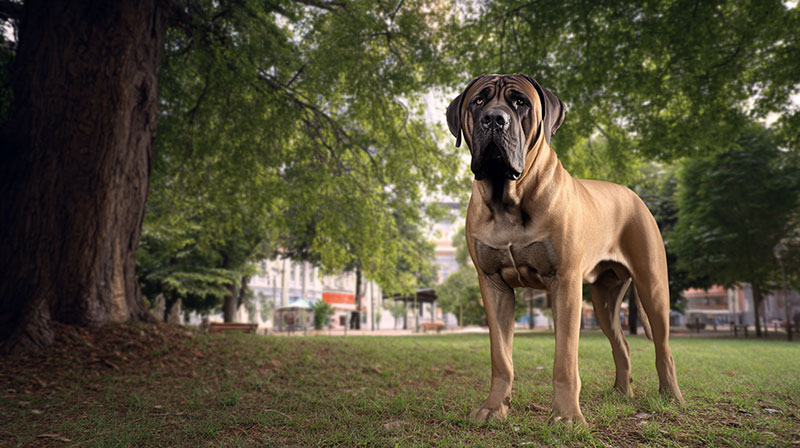
Hip and elbow dysplasia, eyelid defects, heart disease and bloat are the main worries, and most breed profiles give a lifespan of 9 to 11 years. Published Boerboel data is thin, and much of it comes from Nigeria and the Netherlands.
Common conditions
A retrospective review of Boerboel hip radiographs in Nigeria (Nigerian Veterinary Journal, 2023) found 37 of 64 dogs dysplastic, or 57.8 percent, with higher prevalence in females.
A smaller 2019 study of 20 dogs in the Sokoto Journal of Veterinary Sciences put hip dysplasia at 65 percent and elbow dysplasia at 25 percent. Both samples are small and come from one country, so read them as a warning signal and not a breed-wide rate.
Bloat (GDV) has no Boerboel-specific rate that turned up. For large breeds in general, about one in four dogs develops it in a lifetime, according to Purdue research led by Larry Glickman (2000).
Entropion and ectropion are disqualifying faults in the AKC standard, which shows how seriously the breed club treats eyelid problems.
On the neurological side, a 2019 Journal of Veterinary Internal Medicine report described a newly recognized focal epilepsy in Boerboel littermates, with sudden fear-related episodes. It’s hereditary.
Profiles such as PangoVet’s call the Boerboel a very healthy breed, which sits awkwardly beside the radiograph data above. Radiographs outrank reputation.
Health testing for breeding dogs
Parent testing is the most practical screening a buyer can check before purchase.
PangoVet and Furry Critter both list hip, elbow and heart evaluations for breeding dogs. Furry Critter adds patella and eye exams, and attributes the orthopedic and cardiac work to Orthopedic Foundation for Animals (OFA) evaluations.
- Hip radiographs
- Elbow radiographs
- Cardiac exam with an echocardiogram
- Patella evaluation
- Eye exam by a veterinary ophthalmologist
Ask whether the results are registered with OFA or came from an informal vet check. These lists come from breed profiles, not a published American Boerboel Club health statement, so confirm current requirements with the club.
Lifespan
Chewy’s veterinarian-reviewed profile (updated December 2025) gives 9 to 11 years, and Dogster and Dutch agree.
Some sources run higher. Wamiz says 10 to 12 years, and Canine Chronicle puts it at about 12.
These ranges are breed-profile estimates rather than published longevity data.
Weight control protects the joints (Hill’s). For bloat, the Purdue findings point toward smaller, split meals and a conversation with your vet about preventive gastropexy. And a breeder who tests parents lowers the odds of inherited joint and heart disease.
How much exercise, training and care does a Boerboel need?
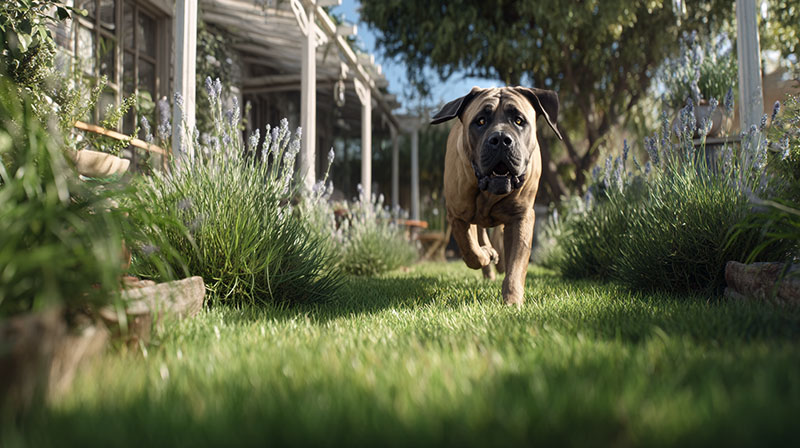
An adult Boerboel needs one to two hours of exercise and training a day, split into sessions with rest in between (Orvis). Training stays firm and consistent without punishment, socialization never really stops, and the short coat needs brushing about once a week.
Orvis suggests a large enclosed yard for play and training, plus puzzle toys so the dog doesn’t turn bored and destructive. Hill’s calls for mental work every day, which is why the breed fits owners who enjoy training. On grooming, Orvis says weekly brushing, and Purina calls it minimal.
Orvis wants training that is never punishing and calls advanced obedience a must for a strong-willed, powerful dog. The payoff is a smart breed that wants to please, so consistency works.
The AKC standard sets a practical benchmark: a dog shown in competition should be trained to allow examination. Calm handling by a vet or a stranger is the real test of the training, and it is worth practicing before the dog reaches full size.
Socialization matters as much as obedience. The Westminster Kennel Club calls early, frequent and ongoing socialization a must for this strong-willed dog, and Wisdom Panel advises exposing young dogs to varied sights, sounds, species and experiences.
WebMD’s warning is blunt: without early training and socialization, the dog can become unmanageable.
Alone time has a ceiling. Orvis says a crate-trained Boerboel stays content for an hour or two, and beyond that the dog will likely act out.
Who should own a Boerboel, and who should skip the breed?

Experienced owners who enjoy training, keep secure fencing, and want a guardian that lives inside the home (Hill’s). Everyone else should look at other breeds, and a handful of countries do not allow the dog at all.
Pros and cons
On the plus side, the AKC describes strong protective instincts and real devotion to family. Purina adds that the breed has range in dog sports, from conformation and rally to weight pull, stock work and therapy work.
The costs are less flattering.
- Size and strength that only experienced, confident owners should take on (Orvis)
- Travel that takes planning, because the dog is hard to transport (WebMD)
- Legal exposure in places that restrict the breed
The trade is simple. You get a capable guardian, and you pay for it in handling skill and logistics.
Wrong-fit conditions
The sources are unusually consistent about who shouldn’t get one.
A first-time owner is the obvious case. The AKC’s recognition notice says the breed is not for first-time owners, and Orvis and WebMD say the same. Apartments are out too. Basepaws rules them out because of size and energy, and Dutch flags limited space as a problem.
Hill’s wants the dog living in the home, not the yard, and a guard instinct is not a reason to keep it outside. Cold climates make that worse. Manitoba cattle producers Deb and Willy Malcolm told the Western Producer in 2016 that the short coat rules out living outdoors through Canadian winters.
Legal restrictions
Denmark lists the Boerboel among 13 prohibited breeds, according to the Danish Veterinary and Food Authority.
The ban covers owning, breeding and importing, and it applies to tourists too. Dogs kept under the transitional rules may stay, and transit through the country is exempt when the trip makes no unnecessary stops.
- Older Wikipedia text on Romania described an import ban since 2002, with ownership only under a court permit. That claim is not confirmed by a current source, so verify it with the Romanian authorities before relying on it.
- Wikipedia’s earlier claim of an “especially dangerous breed” designation in Russia in 2011 could not be confirmed, and Russia’s 2019 federal list of 12 potentially dangerous breeds does not name the Boerboel. Treat Russian status as unconfirmed and check with the authorities.
- Wikipedia also lists Bermuda, the Faroe Islands, France, Mauritius, Qatar, Tunisia and the Turks and Caicos as banning or restricting the breed.
The United States has no federal breed-specific legislation, but cities and counties can restrict breeds they classify as dangerous (Furry Critter). Wikipedia’s list does not separate bans from restrictions by country, so confirm the category with the national or local authority before importing or buying.
Which kennel clubs recognize the Boerboel?
The AKC and UKC recognize the Boerboel, the Kennel Union of Southern Africa lists it, and the FCI shows no entry for it. Sources disagree on several details, mostly dates and FCI status.
| Registry | Status | Key date | Practical effect |
|---|---|---|---|
| AKC | Full recognition | Event eligibility from January 1, 2015 | Imported dogs need American Boerboel Club pedigree approval |
| UKC | Recognized | January 1, 2016 | Standard weighs working structure and temperament first |
| KUSA and SABBS | KUSA lists legacy dogs, SABBS registers new ones | SABBS in charge since 2014 | Dogs earn full papers through a scored appraisal |
| FCI | No Boerboel entry | Checked October 2026 | An FCI logo on papers says nothing about the breed |
Chewy dates the AKC recognition to 2014, while Hill’s, Orvis and the AKC’s own history article say 2015. The AKC’s recognition notice set January 1, 2015 as the start of event eligibility, which likely explains the split.
That history article also describes the path to recognition: Foundation Stock Service in 2006, the Miscellaneous Class in 2010, and full recognition in 2015.
The FCI is the bigger conflict. Furry Critter lists the breed in FCI Group 2, but Wikipedia, Zooplus and the iDog database say it is not recognized, and the FCI’s own nomenclature list for the letter B has no Boerboel entry as of October 2026.
Furry Critter also lists the Canadian Kennel Club and The Kennel Club (UK) as recognizing the breed. Wamiz disagrees about the UK club, and neither source cites the clubs’ own registers, so treat both claims as unconfirmed.
South African appraisal is stricter than a show-ring placing. Furry Critter says SABBS scores each dog against the standard on its own, with temperament part of the grade, and breeder Deb Malcolm told the Western Producer in 2016 that a dog needs 75 percent or higher to receive full registration papers.
Papers do not mean the same thing everywhere.
- The American Boerboel Club must approve imported pedigrees for AKC papers, and the AKC says dogs whose pedigrees include a Boerboel documented to have produced black dogs cannot be registered.
- The FCI does not accept SABBS papers, because KUSA is the FCI-recognized national club (Modern Molosser).
- Zooplus says it cannot vouch for a Boerboel breeder with an FCI logo, since the FCI does not recognize the breed.
- In the US, the American Boerboel Club does not accept registrations from the North American Boerboel Breeders Association (Modern Molosser).
Modern Molosser reported in 2019 that the AKC stud book would close on January 1, 2020, and Showsight (December 2020) said the AKC registry had been kept open until early 2020. Imported dogs may no longer be registrable, so confirm current registration rules with the American Boerboel Club before buying an imported dog.
How much does a Boerboel puppy cost, and how do you choose a breeder?
Chewy’s veterinarian-reviewed profile (updated December 2025) puts a Boerboel puppy at $1,500 to $2,000, while Paction’s 2026 guide gives $1,900 to $4,300 for Canada. Breeder reputation, parent health testing, lineage and breeding rights drive the spread.
A price tells you nothing about quality until the screening results and pedigree papers are in your hands, so treat both ranges as a starting point for questions, not as proof of what the puppy comes with.
The purchase price is also only the first bill, and dogs get expensive over a lifetime. Paction makes the same point: the real cost of a dog goes well beyond the puppy price.
Choosing the breeder matters more than negotiating the price.
- Start with the national breed club. Cornell’s Riney Canine Health Center says club-listed breeders follow a code of ethics, and Healthy Paws notes the American Boerboel Club keeps an approved breeder list.
- Ask for each parent’s health results, and whether they are registered with OFA or came from an informal vet check.
- Get a written health guarantee (Paction, Cornell).
- Expect questions back, since Cornell says a reputable breeder wants to know about your lifestyle and living situation.
- Visit in person or by video call, which Paction says reputable breeders welcome.
AKC registration is not a quality signal on its own. Cornell notes that the AKC is a registry and does not necessarily ensure health quality.
The AKC Bred with H.E.A.R.T. program asks breeders to certify the health screens their parent club recommends and to supply proof on request. Enrollment is a useful question to ask, not a guarantee.
Paction warns that puppy scams are common for popular breeds like the Boerboel. BBB Scam Tracker reports (2022) tie the risk to buying a pet unseen, paying through hard-to-track payment apps, and accepting extra charges such as shipping insurance or special cages.
Walk away from a seller who can’t produce parent health results on request, or who won’t allow a visit or a video call. Payment by app before you’ve met the dog is another reason to leave.
Boerboel FAQ
Does a Boerboel need its tail docked?
No, the AKC standard treats docked and undocked tails as equivalent, and it puts tail set ahead of tail length.
WebMD says docking is unnecessary and not recommended by veterinarians.
Are male or female Boerboels easier to handle?
Many owners find females easier, according to Dogster, and size is the main reason.
The AKC standard gives males the larger frame and heavier bone, and PangoVet calls size the first significant difference between the sexes.
How does a Boerboel differ from a Cane Corso?
Mostly in origin, coat color and purpose. The two molosser breeds have similar, overlapping heights, but the Cane Corso is an Italian property watchdog and boar hunter whose AKC standard accepts black and gray coats.
The Boerboel standard disqualifies black and powder-coat blue dogs.
Is a Boerboel the same as an English Mastiff?
No, the English Mastiff is a separate, larger breed.
The AKC sets its minimum at 30 inches for dogs and 27.5 inches for bitches, above the Boerboel’s preferred ceiling of 27 inches. “Mastiff-type” describes the Boerboel’s category, not its breed.
Can you adopt a Boerboel instead of buying one?
Yes. Giant Paws Boerboel Rescue, a foster-based group started in 2014, rehomes the breed, and Chewy points adopters to a giant-breed rescue, Save the Giants, and its adoptable-dogs database.
The rescue sees mostly dogs around 18 months to two years old, plus seniors, and it cannot take dogs with true aggression issues.
Can a Boerboel swim?
Not naturally. Orvis says the stocky, dense physique is not suited to swimming.
Introduce water gradually, stay within reach, and keep pool access fenced.
What to Settle Before Contacting a Boerboel Breeder
Confirm local breed law and secure fencing before contacting any Boerboel breeder, because a ban or an unsecured yard cannot be fixed after the puppy is bought.
Start with local breed law and import rules, move on to fencing and indoor living space, and only then get to pedigree and parent health results. The order follows what each step can undo. Law decides where the dog may live, housing decides whether it can live there safely, and a breeder’s paperwork only matters after both.
Pedigree review belongs before the deposit, since the AKC advises having the American Boerboel Club review an imported dog’s papers beforehand.
The cost is time, since the first breeder conversation waits on two checks. This sequence holds as of October 2026, and a new local ban, a change to AKC stud-book rules, or an FCI listing would reorder it.