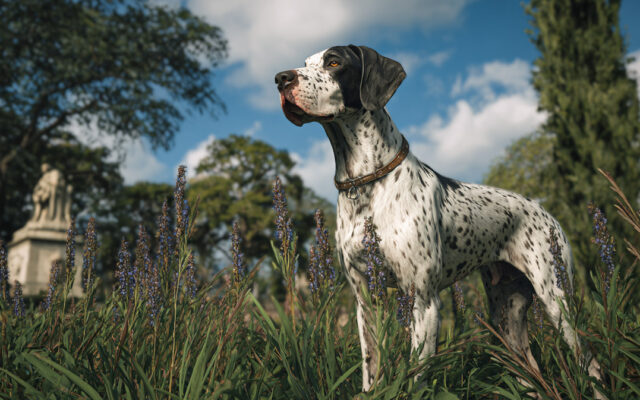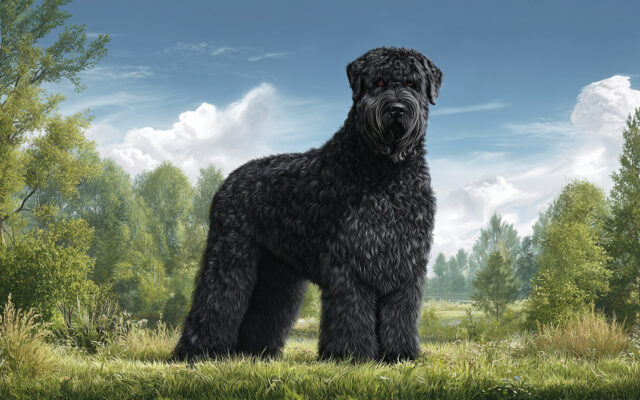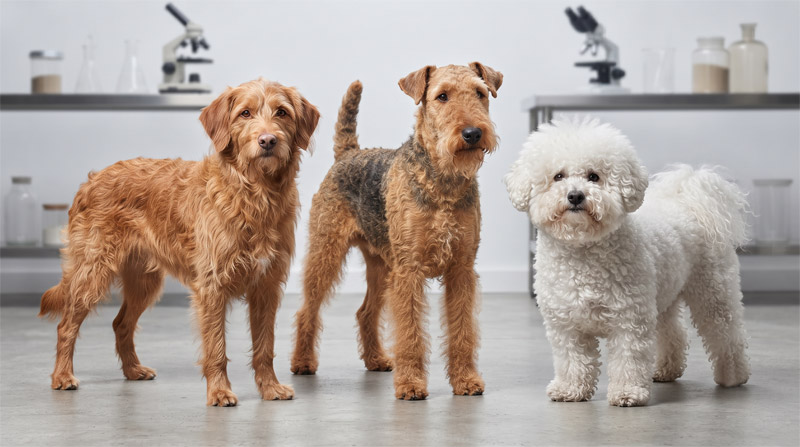
Wavy hair dog breeds include the Havanese, Portuguese Water Dog, Soft Coated Wheaten Terrier, Kerry Blue Terrier, Chesapeake Bay Retriever and Golden Retriever, each with a coat that bends in loose S-shapes instead of tight curls.
Each coat is wavy by its breed standard, which excludes breeds that only look wavy, such as the Irish Setter, whose AKC standard calls for a coat free of curl or wave.
Three genes, KRT71, FGF5 and RSPO2, explain most purebred coats, according to a Science study of more than 1,000 dogs from 80 breeds (Cadieu et al., 2009).
Waves and curls also need length, because very short hair is too short to bend.
Which Dog Breeds Have Wavy Hair?
Havanese, Portuguese Water Dogs, Soft Coated Wheaten Terriers, Kerry Blue Terriers, Chesapeake Bay Retrievers and Golden Retrievers all carry wavy coats, in sizes from lap dog to 80-pound retriever.
The table sorts the clearest cases by size. Each coat description comes from a breed standard, not from photos.
| Breed | Coat | Size |
|---|---|---|
| Havanese | Long, abundant, wavy double coat | Small, 8.5 to 11.5 in tall |
| Portuguese Water Dog | Wavy or curly single coat | Medium, 35 to 60 lb |
| Soft Coated Wheaten Terrier | Soft, silky, gentle wave, single coat | Medium, 30 to 45 lb |
| Kerry Blue Terrier | Soft, dense, wavy single coat | Medium, 33 to 40 lb |
| Chesapeake Bay Retriever | Short, harsh, wavy outer coat over an oily wooly undercoat | Large, 55 to 80 lb |
Sizes come from the AKC standards for the Havanese and Kerry Blue Terrier, plus breed profiles from Hill’s Pet Nutrition and Petco.
Small Wavy-Haired Breeds

Two small breeds carry true waves, the Havanese and the Bolognese.
The AKC standard for the Havanese (effective September 28, 2011) asks for a long, abundant, wavy double coat. It faults a coat that is flat, frizzy or curly.
The Bolognese has long, wavy white locks and needs brushing a few times a week plus a trim every few months, according to Betterpet.
Medium Wavy-Haired Breeds

- Portuguese Water Dog: wavy or curly single coat, energetic and intelligent, bred to work beside fishermen and happiest near water
- Soft Coated Wheaten Terrier: gentle wave, friendly and energetic, and a Wheaten under two years old usually has not grown into the mature wavy coat yet (UKC standard)
- Kerry Blue Terrier: soft, dense wave, active, and a better match for an owner who has raised a dog before (Chewy)
Some roundups call the Kerry Blue curly. The AKC standard says wavy, and the standard settles it.
Large Wavy-Haired Breeds
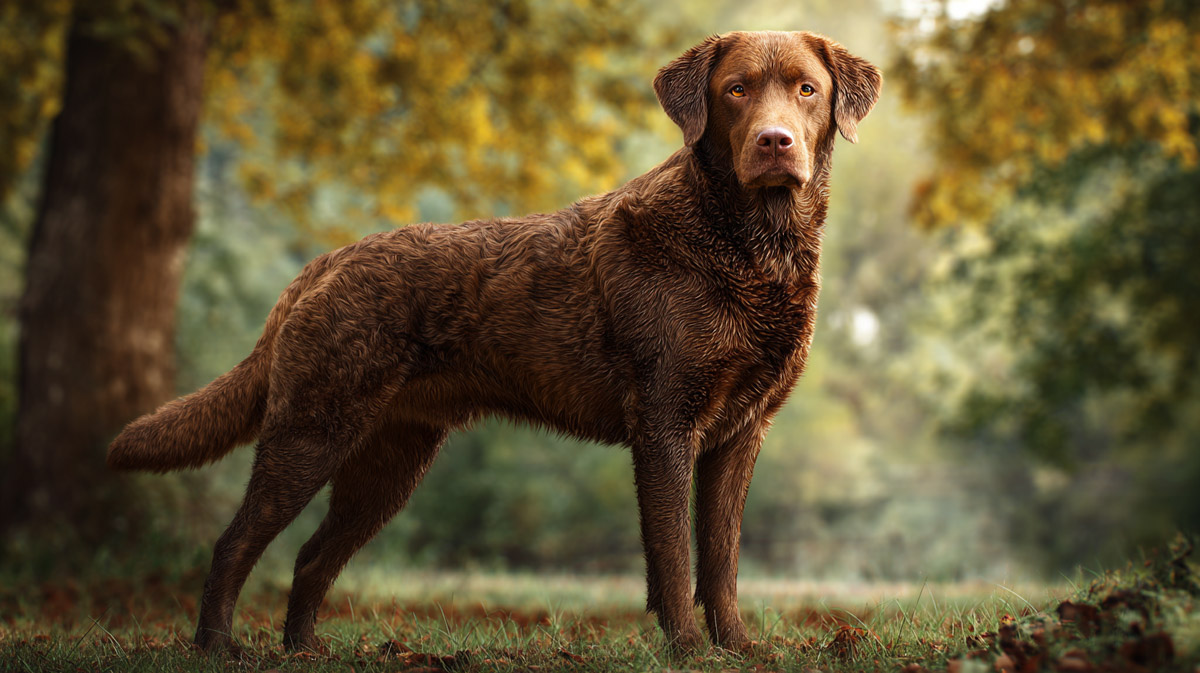
Three large breeds carry waves, each for a different job.
The Chesapeake Bay Retriever was bred for icy waterfowl work. Its oily coat repels water, and the American Chesapeake Club advises bathing only every 3 to 4 months to keep that oil in place.
The AKC Sporting Group standards, amended January 1, 2024, describe the Golden Retriever coat as dense, flat or wavy, never curly.
The borzoi, a sighthound bred to hunt wolves, has a long coat that waves, mostly white or cream (Cuteness).
How Is a Wavy Coat Different From a Curly or Straight Coat?
A wavy coat bends in loose S-shapes, a curly coat coils into tight spirals, and a straight coat lies flat.
The three sit on one spectrum, and one dog can show two of them at once.
The Portuguese Water Dog is the cleanest example. Its breed club standard lists a curly type with compact, cylindrical curls and a wavy type that falls in gentle waves with a slight sheen.
The standard gives neither type a preference, and plenty of dogs mix them, curly on the body and wavy on the ears and tail.
Single and Double Wavy Coats
- Single coat: Portuguese Water Dog, Soft Coated Wheaten Terrier, Kerry Blue Terrier
- Double coat: Havanese, Chesapeake Bay Retriever, Golden Retriever
Both builds need regular brushing to prevent mats, per Cuteness. Double coats also hold loose undercoat hair that a slicker or pin brush has to lift out.
Breeds Often Listed as Wavy That Are Not
Two breeds show how loosely the word wavy gets used.
The Irish Setter turns up on wavy-dog lists, yet the AKC standard for the Irish Setter calls for a coat as free of curl or wave as possible. Hill’s Pet Nutrition allows that some dogs show a little wave, which keeps the confusion alive.
The Kerry Blue runs the other way. Petfinder’s curly-breed list says curls, the AKC standard says wavy.
Coat Genetics: What KRT71, FGF5 and RSPO2 Control
KRT71 sets curl, FGF5 sets hair length, and RSPO2 sets furnishings (the eyebrows and beard on wire-coated and doodle-type dogs).
Together they explain most coats in US purebreds, according to the 2009 Science study by Cadieu and colleagues. The team mapped the curl gene using Portuguese Water Dog data.
Key figures from that study:
- More than 1,000 dogs tested
- 80 breeds sampled
- 3 genes behind most purebred coats
- 7 coat types from allele combinations
Why a Wave Needs Length
Every curly-haired dog in the study carried two copies of the FGF5 long-hair variant.
Short-haired breeds sit at the ancestral state for all three genes, and the AKC notes that very short hair is too short to curl. So a wave is a long-hair trait first.
Gene Combinations in Named Breeds
Long and curly: the Irish Water Spaniel carries the long-hair and curl variants (FGF5 plus KRT71), which gives a long curly coat without facial furnishings.
Curly and wiry: add RSPO2 to curl and you get the curly-wire coat of the Airedale Terrier.
What the Research Does Not Cover
- The findings apply to purebred dogs
- Co-author K. Gordon Lark told ABC News that mixed-breed genetics is poorly understood
Why Doodle and Crossbred Coats Vary From Wavy to Curly

Crossbred puppies inherit curl, length and furnishing variants from each parent in different combinations, so one litter can hold straight, wavy and curly coats.
The Goldendoodle shows it best. Wavy is the most common coat in the cross, a blend of Poodle curl and Golden Retriever straightness.
How KRT71 Copy Count Sets the Wave
UC Davis Veterinary Genetics Laboratory offers a KRT71 test, and breeder guides report that one copy of the curl variant usually gives waves while two copies usually give curls.
By that logic, an F1 puppy from a Poodle with two curl copies and a Golden with none gets exactly one copy. That is why F1 litters usually come out wavy.
- F1: 50% Poodle, usually wavy, less predictable
- F1B: 75% Poodle after a backcross, curlier and more consistent in breeders’ reports
- Multigen: doodle to doodle, so the coat depends on what the parents carry
Furnishings and Flat Coats
RSPO2 decides whether a doodle gets the beard and eyebrows. A doodle without the furnishing variant has a flat, or “improper,” coat and resembles a Golden Retriever.
Curl and shedding are separate traits. Breeder guides citing UC Davis work name MC5R and RSPO2 as shedding genes, so a wavy coat does not predict low shedding.
When Generation Labels Stop Helping
No major kennel club recognizes the Goldendoodle (AKC, FCI and The Kennel Club in the UK all decline), so no breed standard defines a correct coat.
Generation labels are a guess. KRT71 and RSPO2 DNA results on the parents are the better check.
Do Wavy-Haired Dogs Shed, and Are Any Hypoallergenic?
Most wavy-haired breeds shed little to moderately, and none is hypoallergenic.
Shedding depends on the coat build. Allergy depends on proteins in skin cells, saliva and urine, not on hair, according to the American Academy of Allergy, Asthma and Immunology (as reported by NPR).
Shedding by Breed
- Soft Coated Wheaten Terrier: no undercoat and no spring or fall shed, and a well-groomed dog sheds very little (DogBreedInfo)
- Kerry Blue Terrier: sheds little to none (DogBreedInfo)
- Portuguese Water Dog: sheds little, with the loose hair staying tangled inside the coat (Cindra)
Breed pages disagree on that last one. Some call the Portuguese Water Dog non-shedding, while Orvis’s breed guide says it sheds minimally but does shed.
The Cocker Spaniel is the usual surprise. Betterpet notes its coat is more wavy than curly, and that shedding is not unusual.
What the Allergen Studies Found
Hair and coat samples from so-called hypoallergenic dogs held more Can f 1, the major dog allergen, than samples from control breeds (Vredegoor et al., Journal of Allergy and Clinical Immunology, 2012).
Airborne levels did not differ between breeds. The study compared the Labradoodle, Poodle, Spanish Water Dog and Airedale Terrier against Labrador Retrievers and a mixed control group.
Key limit: differences between breeds were small next to the variation inside each breed, so the individual dog matters more than the label.
A Labradoodle breeder quoted by Time reports allergic buyers doing well with her puppies. The researchers measured allergen levels, not owners’ symptoms, so both findings can hold (NBC News, 2012).
How to Groom a Wavy Coat at Home
Brush on a fixed schedule, comb to the skin to catch mats, bathe only when needed, dry fully, and trim on a cycle set by clip length.
Brushing runs from weekly to daily depending on the breed.
Step by Step
- Mist the coat lightly with water or a detangling spray.
- Brush section by section in the direction of hair growth with a slicker brush.
- Comb through to the skin, checking behind the ears, under the legs and in any feathering.
- Bathe when needed, then dry the coat fully.
- Trim on a schedule that matches the clip.
The mist-and-section method comes from Dog-Learn’s grooming guide. Dogster adds that a pin brush also works on long, wavy coats.
Brushing Frequency by Breed
- Portuguese Water Dog: daily brushing and combing, per the Portuguese Water Dog Club of America
- Soft Coated Wheaten Terrier: brushing or combing every other day (VCA Animal Hospitals)
- Kerry Blue Terrier: at least weekly at home, plus professional grooming about every 6 weeks (PetMD, 2026)
The Soft Coated Wheaten Terrier breaks the brush rule. DogBreedInfo advises a medium-toothed comb instead, because brushing makes the soft coat fuzzy.
Mats: Where They Form and What to Do
Isolated mats: work them out at home when they sit behind the ears (Preventive Vet, 2025).
Widespread mats: book a groomer for a full-body trim instead of pulling at them.
Comb mats out before the bath. Water tightens them, according to Woof Gang Bakery & Grooming.
Trim Cycles and Clip Styles
Clip length sets the schedule.
A short clip can go 4 to 6 weeks without brushing between grooms, while a long coat needs daily work (Pampered Pups by Jamie).
That explains why sources disagree on Portuguese Water Dog haircuts. The breed club says every 4 to 6 weeks, and Preventive Vet (2025) gives 6 to 8 weeks for high-maintenance coats in general.
Two clips dominate on the breed, the retriever clip and the lion clip. The full set of Portuguese Water Dog haircut styles shows how each one changes upkeep.
Kerry Blue coats are scissored, not stripped, and air-drying the back keeps the wave (Groomer to Groomer, 2024).
Choosing a Wavy-Haired Breed by Household Fit
Pick by grooming time first, energy second, size third.
| Grooming time | Breeds | Watch for |
|---|---|---|
| Daily sessions | Portuguese Water Dog | Continuous hair growth, fast mats |
| Several days a week | Soft Coated Wheaten Terrier, Kerry Blue Terrier | Professional trims every 6 to 8 weeks |
| Weekly brushing | Chesapeake Bay Retriever, Golden Retriever | Shedding, daily exercise |
Energy and Temperament
The Chesapeake Bay Retriever thrives with consistent training and space to roam, per Petco (2026). Low-energy homes fit the Bolognese better, according to Betterpet.
The AKC standard describes the Havanese as a friendly, intelligent and playful companion.
Family and First-Time Owners
The Golden Retriever pairs its flat-or-wavy coat with an eager-to-please temperament and needs brushing once or twice a week, according to Pawlicy.
The Wheaten is friendly and adapts to many households, but Chewy flags daily exercise and close companionship as requirements.
What It Costs to Keep a Wavy Coat
A medium dog groomed every 6 weeks costs $750 to $1,300 a year, and a large dog $1,000 to $2,000 (QC Pet Studies, 2025).
The Kerry Blue Terrier sits in the medium band, since PetMD puts its professional trims at about every 6 weeks.
If low upkeep is the goal, skip the doodle. Coat type varies within a litter, so the grooming budget varies with it.
When a Wavy-Coated Dog Is the Wrong Fit
A wavy-coated dog is the wrong fit when the owner cannot brush on schedule, cannot exercise the dog daily, or expects a low-shedding coat to fix a dog allergy.
- Little time to brush: mats form fast in coats that hold loose hair
- Low-activity homes: water breeds and retrievers need daily exercise
- Severe dog allergy: no wavy breed removes the allergen, so see an allergist first
- Tight budget: professional grooming recurs every 4 to 8 weeks for life
The mat risk is concrete. Tight mats pull on the skin, trap moisture, hide parasites and can lead to sores or infection, according to Spectrum Pet Care (2026).
Severe mats usually end in a shave-down. Rainbow Pet Salon says manual dematting is stressful for the dog and labor intensive for the groomer.
Hair around a Portuguese Water Dog’s eyes can grow long enough to block vision, so eye trimming cannot wait for the groomer (Dog-Learn).
Heat is the last trap. Do not shave a double-coated wavy breed to cool it, because Preventive Vet (2025) says brushing out the loose undercoat works better.
Wavy Hair Dog Breeds FAQ
Does a wavy coat change as a puppy grows up?
Yes. Puppy coats are softer and often shorter than adult coats, per the AKC Havanese standard.
Poodle puppies start with soft, wavy hair that turns curlier and coarser with age (Hepper), so judge the adult coat, not the puppy coat.
How often should I bathe a wavy-coated dog?
Every 4 to 6 weeks suits most wavy coats, according to Cuteness.
Swimmers need more. The Portuguese Water Dog Club of America lists bathing every 2 to 3 weeks or as needed.
Can you clip a wavy coat short to cut the upkeep?
Yes, for pets. VCA Animal Hospitals says a Soft Coated Wheaten Terrier is easier to maintain when clipped to about 3 inches.
Show dogs are the exception, since the UKC standard says the Wheaten coat must never be clipped.
Are wavy coats waterproof?
Only in breeds built for water work. The Continental Kennel Club standard for the Golden Retriever calls for a dense, water-repellent outer coat that may be flat or wavy.
Chewy describes the Portuguese Water Dog coat as waterproof too.
Does flat ironing or blow-drying change a wavy coat?
Yes. Show Sight Magazine notes that flat ironing changes the texture of a Havanese coat, which the breed standard wants soft and wavy.
Natural drying keeps the coat closest to standard.
Verifying a Breeder’s Coat Claims Before You Buy
Breeders of wavy hair dog breeds can back a coat claim with three checks, run in this order.
- Read the breed standard’s coat description
- Request KRT71 and RSPO2 results for both parents
- Handle adult relatives’ coats and spend time with the dog
The standard comes first because it is free and defines what a correct wavy coat looks like. DNA results come second because they separate testing breeders from guessing ones before any deposit changes hands.
Meeting the dog comes last because it is the only check that tests your own allergic response, which no breed label or coat test predicts.
The trade-off is time. Results and visits come before pickup, not after.