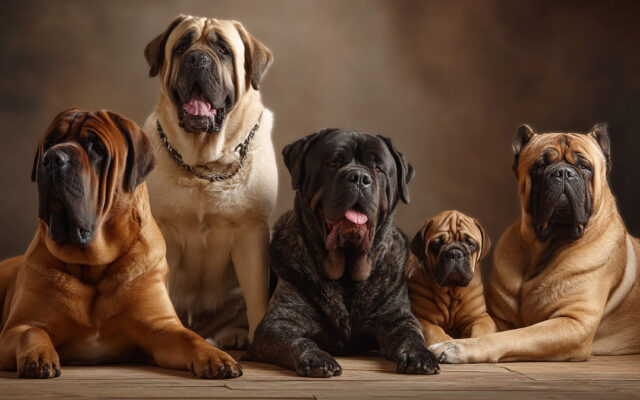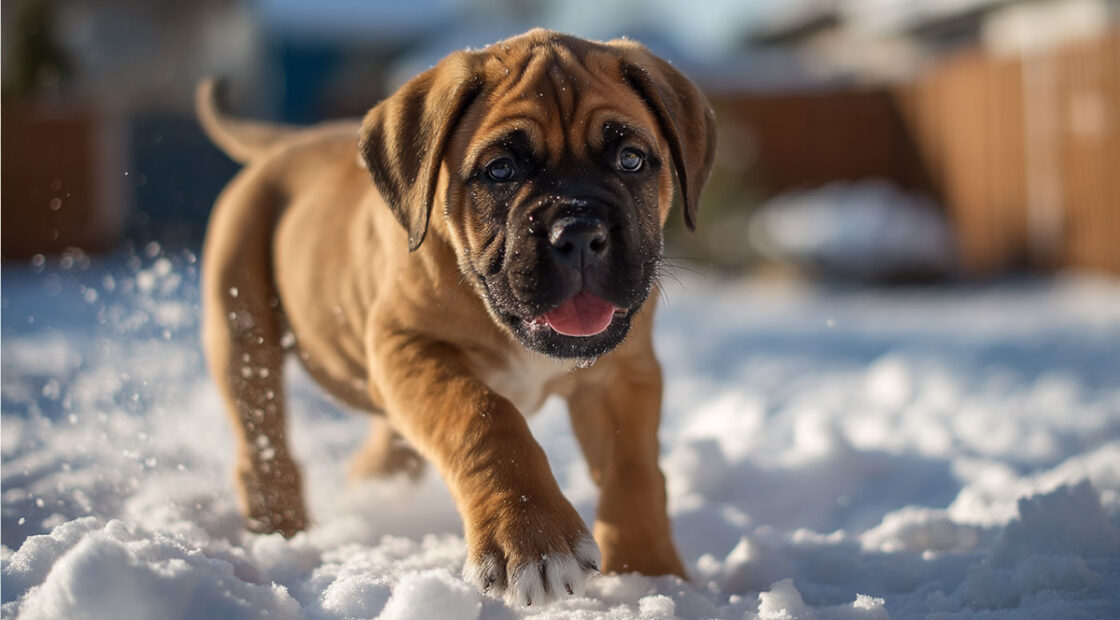
Bullmastiff puppy training is a structured program of early bite inhibition, socialization, and calm handling that prepares a guardian breed puppy for an adult body that can reach 130 pounds.
Breeders, certified trainers, and first time owners of this Working Group breed apply it between eight weeks and roughly eighteen months, the stretch when temperament and joint development are both still forming.
The breed’s official AKC recognition dates to 1934, according to the AKC’s own breed-recognition records (the American Bullmastiff Association’s materials cite October 1933 for the same event), and that guidance still shapes how owners plan a training and exercise timeline around this puppy’s slow physical maturity.
Bullmastiff Puppy Training
Bullmastiff puppy training manages a guardian breed’s rapid growth, natural wariness of strangers, and eventual adult weight of up to 130 pounds through early bite inhibition, structured exposure, and calm, consistent handling.
It differs from generic puppy obedience work in one way that matters more than any other: the stakes rise every week the puppy grows.
A method that works fine on a 20 pound spaniel puppy can leave permanent gaps in a dog that will eventually weigh six times as much.
Three pillars carry the work:
- Bite inhibition, taught before adult jaw strength develops
- Socialization during the narrow early window when curiosity still outweighs fear
- Calm authority handling that avoids the physical corrections this breed tends to push back against
The breed’s natural temperament already leans protective and independent, closer to a working partner than a dog that automatically defers to whatever an owner asks.
That mindset traces back to the breed’s origin as a gamekeeper’s night dog, bred at roughly 60 percent Mastiff and 40 percent Bulldog.
The differences between this breed and its closest relative, covered in a full Bullmastiff versus Mastiff comparison, change what a training program actually needs to prioritize.
The Socialization Window for a Bullmastiff Puppy

The socialization window for a Bullmastiff puppy runs from roughly 3 to 14 weeks of age, the period when a puppy absorbs new experiences with curiosity rather than fear.
Missing it does not produce a shy adult dog. It produces a guardian breed that treats normal daily life as a threat.
Behavioral problems, not infectious disease, are the leading cause of death in dogs under three years old (American Veterinary Society of Animal Behavior, 2008).
The Primary Socialization Window (3 to 14 Weeks)
Exposure categories worth covering:
- People: children, adults in hats or uniforms, a range of ages and body types
- Other animals: vaccinated adult dogs, cats, common household pets
- Surfaces and sounds: metal grates, gravel, vacuum cleaners, recorded thunder
- Handling: paws, ears, mouth, collar grabs, nail trims
A full socialization plan built for this breed spreads these exposures across every week of the window, not crammed into a single weekend before the vaccine schedule finishes.
Structured programs like Puppy Culture organize this work into a weekly checklist rather than leaving it to chance.
The Secondary Fear Period (8 to 11 Weeks)
A short fear period lands inside the socialization window, usually between 8 and 11 weeks.
New experiences during this stretch need a lighter touch: shorter sessions, more distance from the trigger, no forced interactions.
One bad experience here can imprint longer than the same event would at 6 weeks or at 16 weeks.
Bite Inhibition Training for a Bullmastiff Puppy
Bite inhibition training teaches a puppy to control the force of its mouth before the jaw strength behind that bite becomes a genuine hazard.
An adult Bullmastiff was originally bred to knock down and hold a grown man, and that jaw pressure does not disappear just because the dog is now a family pet.
The mechanism works in two steps:
- Yelp and withdraw attention the instant teeth press too hard on skin
- Redirect immediately to an acceptable chew item
The staged approach traces back to veterinarian and trainer Ian Dunbar, who popularized bite inhibition work long before it became standard puppy class curriculum.
Start this the day the puppy comes home, typically around 8 weeks old.
The window tightens after 18 weeks, once adult teeth are in and the forgiving puppy mouth is gone.
An adult dog with incomplete bite inhibition does not necessarily bite more often. It bites harder when it does, and that distinction is what makes early work non-negotiable for this breed.
Growth Rate and Joint Protection During Training
A Bullmastiff’s growth rate dictates what training and exercise are safe at each stage, more than any other single factor in the program.
Pushing hard exercise before the skeleton catches up is where most avoidable joint damage in this breed starts.
Key figures:
- Adult males reach 110 to 130 pounds and 25 to 27 inches at the withers, per the AKC breed standard (American Kennel Club)
- Adult females reach 100 to 120 pounds and 24 to 26 inches at the withers, per the same standard
- Growth plates in large and giant breeds can stay open until 14 to 18 months of age (American Kennel Club)
- Roughly 25 percent of evaluated Bullmastiffs show hip dysplasia, one of the highest rates recorded across any breed in OFA data, a pattern echoed in the Bullmastiff’s inclusion among the high-prevalence breeds analyzed by Oberbauer et al. (PLoS One, 2017)
Weight and Growth Benchmarks by Age
| Growth Stage | Typical Age | Training Focus |
|---|---|---|
| Rapid growth | 2 to 6 months | Socialization, bite inhibition, no forced exercise |
| Adolescent growth | 6 to 14 months | Structured leash walks, no jumping or hard turns |
| Skeletal maturity | 14 to 24 months | Gradual increase toward adult exercise levels |
Most puppies stop growing in height by 12 months, but large and giant breeds keep developing until 18 to 24 months (American Kennel Club).
Exercise Restrictions by Growth Stage

Restrictions worth putting in writing:
- No jogging or road work before 14 to 18 months, per AKC veterinary guidance
- No repeated jumping on and off furniture or vehicles
- No forced long walks on pavement during the rapid growth phase
The American Bullmastiff Association’s own guidance tells owners to hold off on high impact activity until the dog is well past 18 months old, which lines up with the growth plate data above.
The full exercise guidelines for this breed scale activity up gradually as the skeleton finishes developing, not on a fixed calendar date picked in advance.
Owners chasing a diagnosis after the fact should know that hip dysplasia screening through OFA or PennHIP is the only way to confirm joint status. A visual guess is not a substitute.
Managing Guarding Instincts and Territorial Behavior
Guarding instincts in this breed activate around unfamiliar people and unfamiliar spaces, driven by genetics that training then has to shape rather than install from scratch.
The goal is not removing the instinct. It is keeping the dog’s judgment sound enough that the instinct only fires when it should.
Normal Guarding Behavior vs Problem Aggression
Normal: alert barking at a stranger, a stiff posture that relaxes once the owner calmly greets the visitor.
Problem: barking or lunging that does not de-escalate after introduction, or guarding food and space against family members.
The line between the two usually comes down to recovery time, not the initial reaction itself.
Introducing Visitors and Strangers Safely
A simple sequence keeps introductions calm and predictable.
- Keep the puppy on leash for the first approach
- Let the visitor ignore the puppy until it chooses to approach
- Reward calm behavior, not excitement or barking
- End the interaction before the puppy gets overstimulated
This groundwork is what specialists mean by a stable working guard dog, since a well raised adult tells the difference between a real threat and a visitor at the door.
Owners who see escalation past normal alert behavior typically get referred to a behavior consultant through the International Association of Animal Behavior Consultants, rather than a general obedience instructor.
Skipping this groundwork is one of the more common paths toward aggression prevention failing later, once the dog has the size and confidence the puppy never had.
What Age to Start Bullmastiff Puppy Training

Training starts the day the puppy comes home, typically around 8 weeks old, not on some later date once the puppy has “settled in.”
Formal obedience classes usually wait until 12 to 16 weeks, once the puppy has at least one round of vaccines and a first deworming behind it.
Two tracks run in parallel:
- Informal handling and bite inhibition, starting immediately at home
- Structured group classes, starting once the vet clears the puppy for public spaces
Delaying past the socialization window does not reset later.
It leaves permanent gaps that adult training has to work around instead of prevent.
Choosing a Training Method for a Bullmastiff Puppy

Positive reinforcement fits this breed better than balanced or dominance based methods, and the reason comes down to temperament rather than trend.
A guardian breed built for independent judgment tends to shut down or push back against heavy correction, rather than comply the way a more biddable working breed might.
| Method | Approach | Typical Cost | Fit for a Guardian Breed |
|---|---|---|---|
| Positive reinforcement | Reward based, marker or clicker driven | Group class range, budget friendly | Strong, builds trust without confrontation |
| Balanced training | Mixes rewards with corrections | Mid to high, trainer dependent | Mixed, depends heavily on execution |
| Dominance based | Relies on physical correction and control | Varies, often private sessions | Weak, risks shutdown or defensive aggression |
Trainers certified through the Certification Council for Professional Dog Trainers or affiliated with the Association of Professional Dog Trainers generally default to reward based methods for exactly this reason.
A puppy that looks compliant out of fear can still grow into an adult that reacts unpredictably once its full size and confidence arrive.
That outcome shows up often enough in breed specific behavioral issues that trainers experienced with the breed treat method choice as a temperament decision, not a preference.
Professional Trainer vs Training at Home
A professional trainer earns the cost when guarding behavior escalates past a normal alert response, or when this is the owner’s first large guardian breed.
A capable owner with a structured plan can handle the rest solo, provided the plan actually gets followed on the hard days too.
Professional trainer:
- Faster correction of guarding or leash reactivity before it becomes a habit
- Objective read on whether behavior is normal breed temperament or an actual problem
- Costs stack up fast across multiple private sessions
Training at home:
- Lower cost, flexible schedule around the owner’s routine
- Full control over consistency, assuming the owner stays consistent
- Easy to miss early warning signs a trainer would catch immediately
Trainers who follow the Pet Professional Guild’s LIMA standard (least intrusive, minimally aversive) default to the same reward based approach a careful owner would use at home.
Multiple private sessions with a certified trainer add up fast, another reminder that a dog is expensive well beyond the adoption fee.
Crate Training a Bullmastiff Puppy
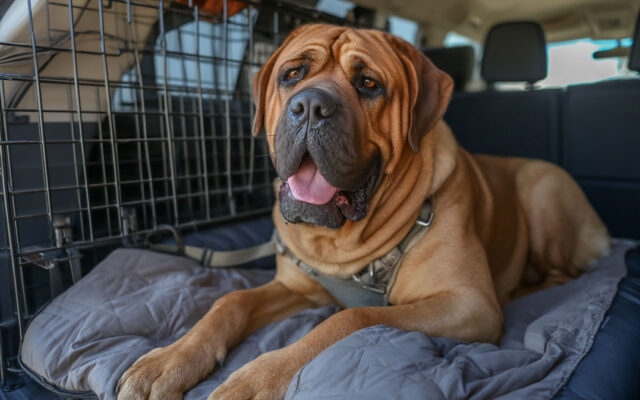
Crate training works by using a dog’s instinct not to soil its own sleeping space, turned into a structured routine of gradual duration and consistent scheduling.
Size the crate for the adult dog this puppy will become, then use a divider panel to shrink the usable space while the puppy is small.
- Buy a crate sized for the adult dog, with a divider for the puppy stage
- Leave the door open at first and toss treats inside to build a positive association
- Feed meals inside the crate with the door open, then closed for short stretches
- Extend duration in small increments across each week
- Set an overnight schedule and hold it, even through whining
Puppies can typically be crated for their age in months plus one hour, and no puppy or dog should be crated past 10 hours total, even with breaks (Humane Society of Western Montana).
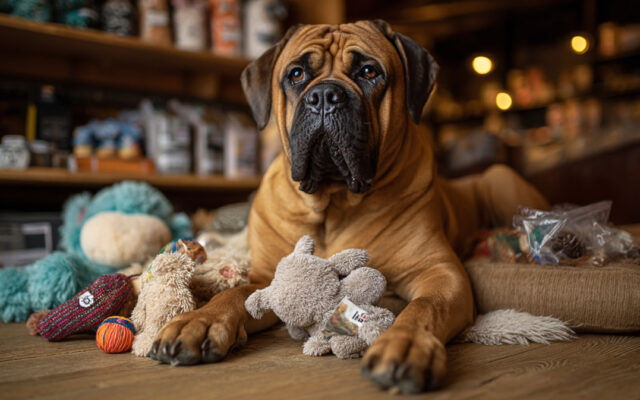
A stuffed Kong or a chew pulled from the breed’s usual toy and accessory rotation keeps early sessions calm instead of stressful.
The most common crate training error in a fast growing breed is buying a crate too small at 10 weeks, then having to size up again at 5 months.
House Training Timeline and Schedule
House training timelines run on bladder control, which develops on a predictable curve tied to age rather than intelligence or stubbornness.
A puppy can generally hold its bladder for about one hour per month of age (American Kennel Club).
| Age | Typical Interval Between Breaks |
|---|---|
| 8 to 10 weeks | Every 2 hours, plus after meals and naps |
| 3 to 4 months | Every 3 to 4 hours |
| 5 to 6 months | Every 5 to 6 hours |
Most Bullmastiff puppies reach reliable house training later than small breeds do, simply because the breed’s growth timeline stretches longer.
Indoor pads work as a bridge for very young puppies who cannot yet make it outside in time, and understanding how puppy pads actually work helps decide whether they belong in this particular plan.
Reward the moment the puppy finishes outside, not after walking back inside. Timing is what makes the association stick.
Basic Obedience Commands and Leash Training
Basic obedience commands give a Bullmastiff puppy a shared vocabulary with its owner before the dog has the size to make disagreements physical.
Leash training matters even more here than in smaller breeds, since a fully grown dog pulling at full strength can drag an adult off balance.
Core Commands and Introduction Age
| Command | Introduce At | Purpose |
|---|---|---|
| Sit | 8 weeks | Default calm position, foundation for everything else |
| Come | 8 to 10 weeks | Recall, critical given the breed’s prey drive |
| Leave it | 10 to 12 weeks | Impulse control around food, other dogs, guests |
| Place | 12 to 16 weeks | Settling on command during visitors or chaos |
Recall reliability matters more in a guardian breed than in most others, since a dog that will not come back is also a dog that decides on its own when an interaction ends.
Loose-Leash Walking Before Adult Strength Develops
Start before pulling becomes a habit:
- Reward position at the handler’s side, not just forward movement
- Stop walking the instant the leash goes tight, resume once it slackens
- Practice on a flat collar or harness, not a slip lead, while the puppy is still learning
A sturdy rope leash holds up better once real pulling strength shows up around 5 to 6 months.
Waiting until the dog is already 90 pounds to start this work turns a training problem into a physical one.
Common Bullmastiff Puppy Training Mistakes
Most training failures in this breed trace back to a short list of repeatable mistakes, not to the dog being unusually difficult.
The recurring ones:
- Under-socializing out of caution, since a guarding breed puppy “seems fine” without much exposure
- Inconsistent household rules, where one family member allows what another corrects
- Physical correction that damages trust faster than it builds compliance
- Over-exercising before growth plates close, treating a puppy like a finished adult
Owners often lose track of treat calories against the day’s regular meals, which is where a dedicated feeding plan for this breed helps keep portions in check during heavy training weeks.
Behavioral problems are the leading cause of dogs being surrendered to shelters (American Veterinary Society of Animal Behavior, 2008).
Every mistake on this list is a socialization, consistency, or exercise problem. None of them require more punishment to fix.
When Bullmastiff Puppy Training Does Not Work
Standard training methods stop working when the problem sitting underneath them is not behavioral at all.
Two conditions account for most of these cases: a socialization window that closed before it opened, and a medical or genetic issue standard training was never built to fix.
Missed Socialization Window
A puppy that missed the 3 to 14 week window does not simply “catch up” once formal classes start.
Fear based reactions that set in during that period tend to resurface under stress for the rest of the dog’s life.
Management and counter-conditioning can improve the picture substantially. They rarely produce the same baseline confidence early exposure would have built in the first place.
Underlying Medical or Genetic Factors

Hypothyroidism has been associated in veterinary literature with sudden aggression, irritability, and anxiety in dogs with no prior history of behavioral issues, though the evidence base is largely made up of case reports rather than large controlled studies (Beaver and Haug, Journal of the American Animal Hospital Association, 2003).
Rule these out before blaming the training plan:
- Thyroid panel, especially if the change in behavior was sudden rather than gradual
- Pain from joints or spine, which can present as irritability or resistance to handling
- Genetic temperament instability, which traces back to breeding decisions rather than anything the owner did
A full breakdown of health issues in this breed helps separate a medical cause from a training gap before more obedience work gets thrown at the wrong problem.
Genetic temperament instability is exactly why vetting a responsible breeder matters before the puppy ever comes home, not after training has already stalled.
FAQ on Bullmastiff Puppy Training
What Makes a Bullmastiff Different From Other Guardian Breeds During Training?
A Bullmastiff relies on independent judgment rather than the handler-driven drive seen in a Rottweiler or Doberman Pinscher. Training leans on calm authority instead of high-energy obedience drilling, since this breed reads situations on its own terms.
How Much Does Professional Bullmastiff Puppy Training Cost?
Group classes run cheaper than private sessions, and private sessions cost more than either once a trainer specializes in guardian breed behavior. Board and train programs sit at the top of that range. Location and trainer experience swing the price further than breed does.
What Credentials Should a Bullmastiff Trainer Have?
Look for certification through a recognized body, experience with large guardian breeds specifically, and a stated commitment to positive reinforcement over correction based methods. A trainer unfamiliar with breed specific guarding instincts often misreads normal behavior as a problem.
What Tools or Equipment Does Training Actually Require?
A properly sized crate, a flat collar or front clip harness, a sturdy leash, treat pouch, and a handful of durable chew toys cover the basics. Clickers help some owners mark behavior precisely, though they are optional rather than required.
Is It Harder to Train a Bullmastiff Than a Smaller Breed?
Not harder exactly, but less forgiving of mistakes. A small breed’s poor habits stay manageable through sheer size. The same gaps in a Bullmastiff become safety issues once the dog reaches full adult weight and strength.
Can You Still Crate Train or Socialize a Bullmastiff That Missed the Early Window?
Yes, through slower counter-conditioning and often with a behavior consultant’s help. Older dogs learn new associations at a different pace than puppies do. Expect more repetition and patience, not a faster version of the same early puppy method.
What Should You Prioritize First in Bullmastiff Puppy Training?
Bullmastiff puppy training prioritizes bite inhibition and early socialization ahead of formal obedience commands, since jaw strength compounds weekly and the socialization window closes well before a puppy is ready for structured command work.
The order matters more than the total hours invested.
- Bite inhibition and calm handling, starting day one
- Socialization exposure, completed inside the 14 week window
- Structured obedience and leash work, once trust is established
The same 14 to 18 month stretch when growth plates stay open is also when adolescent testing behavior peaks, a dangerous overlap in a breed already carrying one of the highest hip dysplasia rates recorded, at roughly 25 percent of evaluated dogs.
Owners who follow this sequence accept slower command progress at first, a fair trade for a temperament that stays sound into adulthood.
Once basic handling holds, the next planning question becomes space and daily routine, covered in a full guide to suitable living environments for this breed.