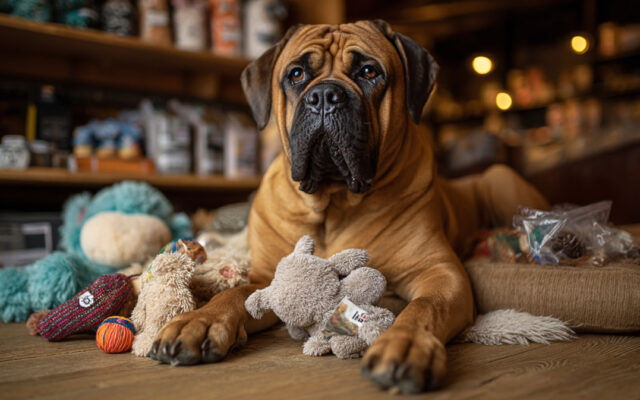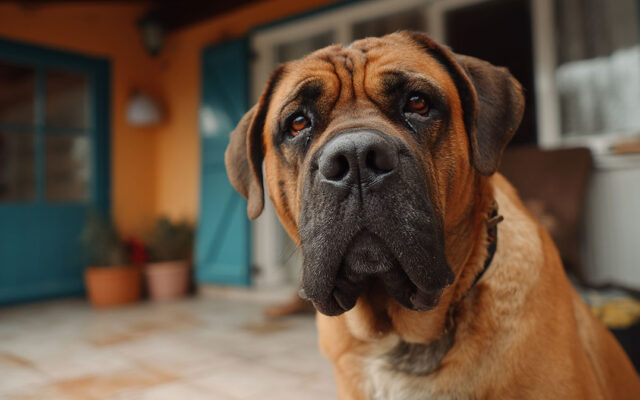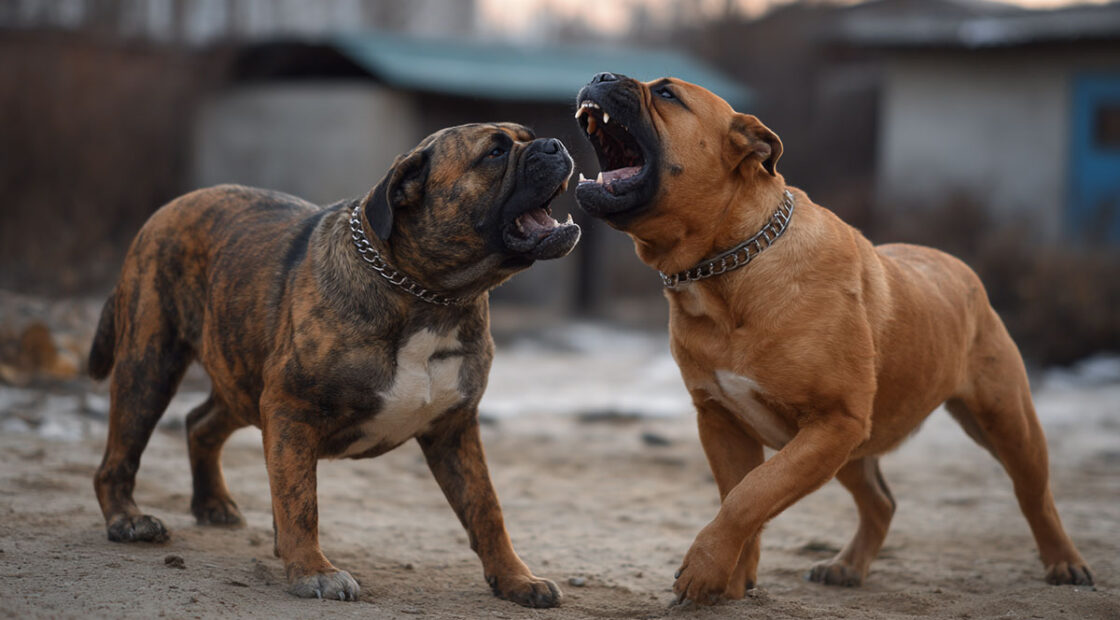
A bullmastiff that plants itself between a stranger and its family isn’t malfunctioning. It’s doing roughly what English gamekeepers bred it to do back in the 1800s: physically intercept an intruder and hold him there without tearing him apart. Aggression prevention in this breed comes down to keeping that instinct from sliding past a warning and into an actual bite.
That working history, a cross of roughly Mastiff and Old English Bulldog, still shapes how a modern dog escalates. Vets, certified trainers, and breeders track it from the earliest socialization weeks straight through adult guarding behavior, and most lean on the same reference point when something goes wrong: the six-level Dunbar bite scale.
One number is worth sitting with before anything else. A 2019 genomic analysis published in Proceedings of the Royal Society B looked at fourteen canine behavioral traits and found stranger-directed aggression had one of the highest heritability estimates in the group, at 0.68. Genetics play a bigger role here than in most companion breeds.
Bullmastiff Aggression Prevention

Managing this instinct so it never turns into a bite is really the whole job. That means catching warning signals early, shaping how the dog responds to strangers and to resources like food or toys, and knowing the exact point where watchfulness stops being normal and becomes a real safety risk.
A dog that plants itself between you and a stranger is simply displaying the watchful, protective nature typical of the breed, not a behavior problem on its own.
The line gets crossed when that watchfulness turns into stiff-legged charging, snapping without a warning growl, or biting that continues after the person has already backed away.
Normal guarding looks like an alert posture, a dog planting itself between the family and whoever just arrived, maybe a deep bark that cuts off the second the visitor gets acknowledged. Problem aggression is a different animal entirely. A fixed stare that turns into a lunge, a bite with zero build-up, or a dog that won’t disengage once the trigger is already gone.
None of this is new behavior the dog invented. It was built to pin and hold, not maul, and that history still shows up in how it escalates today.
This piece stays narrow on purpose. For chewing, house-training slips, or leash pulling that has nothing to do with aggression, a separate guide walks through the full range of bullmastiff behavior problems.

Why Bullmastiffs Are Prone to Aggression
Bullmastiffs carry a higher aggression risk than most companion breeds because they were bred to physically intercept a person. Most dogs were never asked to do that job.
English gamekeepers in the 1800s needed something heavy enough to knock a poacher down and hold him there until help showed up.
That job came out of a deliberate cross, roughly 60 percent Mastiff and 40 percent Old English Bulldog, a lineage a closer look at how bullmastiffs compare to full-size Mastiffs breaks down in more depth.
The English Mastiff side brought the size, the bulk, the territorial watchfulness. The Old English Bulldog side is where the grip strength and fast closing speed come from, along with a lower bite inhibition once stress kicks in.
Combine those two temperaments and you end up with a dog built to guard on command. Territorial triggers sit closer to the surface here than they do in a retriever or a spaniel.
Size raises the stakes too. An adult typically runs 100 to 130 pounds, so a threshold response most small dogs get away with turns into a genuine safety event in this breed.
Recognizing the Warning Signs of Bullmastiff Aggression
Warning signs show up well before a bite happens. A fixed stare, a stiff spine, a low sustained growl, a sudden freeze, these are the dog asking for space.
Reading these signals early matters more than anything else on this list. Catch them soon enough and most escalation never actually happens.
The numbers back this up. Levels 1 and 2 on Dr. Ian Dunbar’s bite scale, meaning no puncture at all, cover well over 99 percent of dog bite incidents (Association of Pet Dog Trainers, Dunbar Bite Scale). A level 3 bite involves one to four punctures no deeper than half the length of a canine tooth. Level 4 or higher means at least one puncture deeper than that, and that’s usually where behaviorists want to see the dog right away.
Territorial and Resource Guarding Signals
Territorial buildup usually starts at a boundary: the yard line, the front door, the car window.
The dog stiffens, plants its weight low, and locks eyes on the approaching person or dog without blinking.
- Stiff, forward-leaning posture
- Ears pinned or locked forward
- A low, sustained growl that doesn’t stop when the visitor speaks calmly
Resource guarding follows a similar pattern around food, toys, or a resting spot. It’s one of the more commonly reported triggers in guardian breeds generally.
Predatory Drift and Redirected Aggression
Predatory drift happens when fast movement or a sudden yelp flips a bullmastiff from social mode into chase mode, even toward a housemate it has lived with for years.
Redirected aggression is different. The dog gets aroused by one trigger, say a person at the fence, then bites whichever body happens to be closest once it can’t reach the original target.
Neither of these is about dominance or spite. Both are arousal states that shut down normal bite inhibition for a few seconds.
Trainers call it trigger stacking when several minor stressors pile up faster than the dog can recover between them. A doorbell followed by a toddler grabbing a toy is a classic example. Worth watching for calming signals too: a yawn, a slow blink, a turned head. They sit at the opposite end of the spectrum from a warning growl, and they’re easy to miss if you’re not looking.
The Critical Socialization Window for Bullmastiff Puppies

The socialization window for a bullmastiff puppy runs from roughly three to fourteen weeks of age, and what happens inside it shapes temperament more than anything that comes after.
The American Veterinary Society of Animal Behavior calls this the primary and most important period for socialization, and recommends starting before vaccinations are fully complete (AVSAB, 2008).
Behavioral problems, not infectious disease, are actually the leading cause of death in dogs under three years old, according to that same position statement.
A structured plan to socialize a bullmastiff puppy matters more for a guardian breed than it does for a retriever, since the instinct to challenge strangers is already loaded into the genetics before the puppy ever meets a stranger.
A basic exposure sequence tends to run like this:
- Weeks 3 to 7: gentle handling, novel sounds and surfaces, supervised contact with vaccinated adult dogs
- Weeks 8 to 10: first outings by car or carrier, calm introductions to unfamiliar but healthy people
- Weeks 10 to 12: enrollment in a puppy class requiring proof of a first vaccine round
- Weeks 12 to 14: exposure to children, bicycles, wheelchairs, and other fast or unusual movement, always at the puppy’s own pace
Formal obedience work can run alongside this. A dedicated routine for training a bullmastiff puppy keeps the two tracks moving together instead of competing for the puppy’s attention.
Training Methods That Prevent Bullmastiff Aggression

Positive reinforcement is the go-to method here, and for good reason. It builds trust instead of piling fear on top of a temperament that’s already fairly assertive to begin with.
Confrontational methods tend to backfire. A 2009 study found that several punishment-based techniques, including hitting or kicking, growling at the dog, alpha rolls, and grabbing the jowls and shaking, each triggered an aggressive response in 25 percent or more of the dogs on which they were attempted (Herron et al., 2009).
That single number is why most modern trainers default to reward-based work with a breed this size instead of reaching for aversive correction.
Reward-based doesn’t mean permissive, and that’s worth saying clearly. The dog still learns where the boundaries are. It just learns them without stacking fear onto an already high-stakes temperament.
Counter-Conditioning for Fear Triggers

Counter-conditioning changes the dog’s emotional response to a trigger by pairing it with something the dog already loves. Usually food.
A bullmastiff that stiffens at the mail carrier learns, over repeated short sessions, that the mail carrier’s arrival predicts chicken, not conflict.
- Keep the dog below its reaction threshold at every session
- Pair the trigger’s appearance with high-value food, not praise alone
- End the session before any stress signal shows up
Desensitization Protocols
Desensitization works alongside counter-conditioning by breaking the trigger into smaller pieces the dog can actually handle without reacting.
Distance, duration, and intensity are what a trainer adjusts, one at a time. Never all three together, that’s usually how a dog gets flooded and progress stalls out.
Progress that looks slow on paper, a few feet of distance closed per week, tends to hold up better long-term than a fast fix built on suppression rather than genuine comfort.
Choosing Management Equipment for a Bullmastiff

Management tools don’t fix aggression on their own. They buy safety and time while training changes the behavior underneath.
Which tool makes sense depends on the trigger, the setting, and how far along the dog already is in its training plan.
| Tool | Best For | Control Level | Limitation |
|---|---|---|---|
| Basket muzzle | High-risk situations, vet visits, unfamiliar dogs | High, prevents bite contact | Needs conditioning so the dog accepts it calmly |
| Head halter | Leash reactivity, pulling toward a trigger | Moderate, redirects the head | Uncomfortable if fitted wrong, needs slow introduction |
| Crate | Decompression, guest arrivals, resource guarding | Moderate, removes the dog from the trigger | Not a punishment tool, misuse increases stress |
Muzzle training should start long before the muzzle is ever needed for real.
A puppy that learns to push its nose into a basket muzzle for treats grows into an adult that accepts it calmly. A dog that first meets a muzzle mid-crisis fights it, which just piles more stress onto whatever triggered the situation in the first place.
When to Call a Professional Trainer or Veterinary Behaviorist
A certified trainer is usually the right first call for early-stage reactivity. Once a bite has actually happened, or fear is clearly running the show, that job shifts to a veterinary behaviorist. The credential matters here because the two professions are solving genuinely different problems.
A certified trainer, look for CCPDT or IAABC credentials, costs less and gets you an appointment faster. They’re good with mild reactivity, sloppy leash manners, and resource guarding that hasn’t escalated yet. What they can’t do is diagnose a medical cause, and they’re not really equipped for a dog that already has a bite history.
Veterinary behaviorists work from a different toolbox entirely. Since they’re licensed vets first, they can rule out pain or thyroid dysfunction and prescribe behavior medication alongside a modification plan, something a trainer simply isn’t able to do. The catch is availability. The American Veterinary Medical Association counted just 99 board-certified diplomates nationwide by the end of 2025, up from 86 in 2020 (AVMA, Veterinary Specialists in the U.S.). Expect a waitlist, possibly travel for that first appointment, and a higher bill.
A general practice veterinarian can also serve as the first stop, since they can rule out pain or illness before referring out to either specialist.
Evaluating a Breeder’s Temperament Screening Before You Buy
Temperament screening starts with the parents, not the puppy. A breeder willing to test the sire and dam before pairing them is already filtering out a chunk of future risk.
The American Temperament Test Society’s most recently published breed data puts the Bullmastiff pass rate at roughly 81 percent (120 of 148 dogs tested), and that figure shifts slightly as more dogs get evaluated, so check atts.org/breed-statistics for the current running total. ATTS itself notes the pass-fail result measures a dog’s ability to handle novel people and situations, not aggression directly.
Finding someone breeding with this level of screening filters out real risk before a puppy ever goes home.
A few questions worth asking before a deposit changes hands. Have the sire and dam been temperament tested, and can you actually see the results? What socialization happened during the litter’s first eight weeks? How does the breeder handle a puppy that shows early fear or reactivity? Is there a health clearance for hips and elbows alongside any behavior screening?
Buying from a screened litter isn’t the only route into the breed. Going through a rescue organization that specializes in placing the breed often comes with documented behavior history already attached.
A breeder who dodges these questions, or who lets buyers take a puppy home before eight weeks, is skipping the exact window that shapes lifelong temperament.
Legal and Financial Risks of Bullmastiff Aggression
An aggression incident doesn’t stay a training problem once it actually happens. It turns into a legal and financial one too, usually fast.
Bullmastiffs appear on 24 percent of homeowners insurance banned-breed lists, based on a 2025 analysis of 42 insurer filings (Forbes Advisor). U.S. insurers paid out $1.86 billion across 28,450 dog-related injury claims in 2025, averaging $65,450 per claim, up from $1.57 billion across 22,658 claims in 2024 (Insurance Information Institute). Vermont is one of the few states that doesn’t allow insurers to exclude entire breeds from coverage, which says something about how much this varies state to state.
Coverage gaps matter because a dog bite claim can include medical bills, lost wages, and legal fees, and all of that lands on the homeowner once insurance won’t pay.
Breed-specific legislation adds a second layer on top. Some cities and counties restrict or ban ownership of breeds they classify as dangerous, regardless of that particular dog’s actual history.
Check both the insurer’s breed list and the local ordinance before an incident happens. Not after.
What to Do When an Adult Bullmastiff Already Shows Aggression

The first move is management, not training. Get the dog out of situations that trigger the behavior while an actual plan gets built.
In practice, a realistic response follows a few concrete steps:
- Stop rehearsal immediately: crate, leash, or separate the dog from the trigger until a professional has assessed the situation
- Get a veterinary exam to rule out pain, thyroid dysfunction, or another medical driver
- Bring in a veterinary behaviorist or certified trainer to build a structured modification plan
- Track incidents in writing, including what happened right before each one
Improvement is usually measured in fewer and milder incidents, not some full switch-off of the underlying instinct. An owner expecting a complete cure often gives up right when the real, achievable goal, a manageable and safer dog, was actually within reach.
Rehoming or, in the most severe cases, euthanasia becomes part of the conversation when a dog has a documented bite history and management has already failed more than once. That’s a decision for a veterinary behaviorist to weigh, not a general trainer.
When Bullmastiff Aggression Prevention Does Not Work
Prevention has limits. Some of what drives aggression in this breed sits in genetics, and no amount of early socialization erases that completely.
As already noted, the heritability estimate for stranger-directed aggression sits at 0.68 among fourteen canine traits studied, one of the highest in the group (MacLean et al., 2019).
Prevention is unlikely to fully resolve the behavior in a few specific situations. Aggression with a clear medical driver, chronic pain, a thyroid condition, an untreated neurological issue. A dog that’s already progressed to level 4 or higher on the bite scale despite consistent training. A fear response that predates any identifiable training gap, which usually points to a strong genetic component. Or an owner who simply can’t apply the management plan a professional laid out, consistently, over time.
In these cases the realistic goal shifts from prevention to lifelong management, and that call should come from a veterinary behaviorist, not from an owner guessing alone.
A dog that reaches this point isn’t a training failure. It’s a dog whose genetics and history outweighed what environment alone could change.
FAQ on Bullmastiff Aggression Prevention
Does neutering reduce aggression in bullmastiffs?
Not reliably, no. A 2018 PLOS ONE study of 6,235 male dogs actually found earlier desexing correlated with more reported problem behaviors, not fewer.
Aggression rooted in fear or poor socialization needs training to resolve. Surgery isn’t going to touch it.
Is it safe to keep a bullmastiff with young children?

Bullmastiffs can live safely with children when socialization starts early and supervision stays constant throughout. Size is really the underlying risk here, since even a friendly nudge can knock a toddler flat.
Never leave a bullmastiff alone with a young child, regardless of how gentle the dog has always been.
How much exercise does a bullmastiff need to stay calm?
Most do fine with 30 to 60 minutes of daily activity, split across two or three short walks.
The breed carries a fairly low overall energy level, so mental stimulation and calm structure end up mattering more than raw distance covered.
What should an owner do in the moment if a bullmastiff growls or lunges?
Stop moving, avoid direct eye contact, and calmly increase distance from whatever triggered it.
Don’t punish the growl itself. It’s a warning that’s actually preventing a bite. Remove the dog from the situation first, then deal with the trigger through training later.
Are bullmastiffs more aggressive than other mastiff breeds?
Not according to temperament testing, no. On ATTS’s most recently published figures, Mastiffs post a pass rate in the mid-80s percent range against roughly 81 percent for Bullmastiffs. That’s a modest gap, not a dramatic one.
ATTS attributes gaps like this to individual variation rather than any breed-wide difference in aggression.
What Should You Prioritize First in Bullmastiff Aggression Prevention?
Bullmastiff aggression prevention works best front-loaded. Socialization finished before week fourteen carries more weight than any correction applied later in adulthood, mostly because early exposure closes a window that punishment can’t reopen once it’s gone.
In practical terms, a handful of things matter more than everything else combined: finishing socialization before week fourteen, learning the warning signs before a first real incident happens, and calling a professional the week a bite happens rather than after a second one.
A level 4 bite is the threshold that changes everything. Past that point, management stops being optional and turns into a referral, not a home project.
Owners who close out that fourteen-week window early rarely end up competing for one of the nation’s fewer than 100 board-certified specialists. Front-loaded work is basically what keeps a dog off that list in the first place.
Aggression that resists both training and management often traces back to unresolved pain, which is exactly why recognizing early illness signs in the breed is worth reading next.