Search “are great danes good apartment dogs” enough times and a pattern shows up fast: landlords answer the question before the dog ever gets a chance to. Weight limit, size cap, done. Looked at through actual daily behavior instead of a lease clause, though, the honest answer leans closer to yes. A Great Dane is a giant working breed, one of the tallest dogs recognized by the AKC, and past puppyhood its temperament settles into something closer to a couch fixture than a hazard.
Most renters never get that far. A floor plan gets compared to a weight limit, the Dane gets crossed off the list, and nobody checks how the dog actually behaves indoors. Apartment operators measure square feet and pounds. They don’t measure temperament.
Royal Canin’s own breed profile backs that bias up, in a way: it scores the Great Dane one out of five for suitability to apartment living, a number built from size and space needs rather than a full behavioral read.
Is a Great Dane a Good Apartment Dog?
Yes, with conditions attached. Nobody’s giving a blanket answer here.
Size is the thing everyone assumes matters, and it’s mostly a red herring. What actually decides whether a Dane works in a small unit is how the dog behaves once it’s inside: energy level once it hits adulthood, how much noise it makes near shared walls, and how much floor space it wants while resting. Weight and height barely factor into that on their own, which is a little counterintuitive given how the breed gets marketed.
Here’s the part that surprises most people. A dog with one of the largest bodies in the entire species spends the bulk of its adult life lying flat on the floor, not moving.
Puppyhood is a different story. Loud, clumsy, hard on furniture. Adulthood looks more like living with an oversized, extremely calm roommate, and whether that roommate fits a one-bedroom depends on daily exercise, how much floor is actually free, and how much hallway a person is willing to give up to a dog that takes up more of it than they’d like.
For background on where the breed came from and what it was originally bred to do, the Great Dane breed profile covers more ground than apartment living alone.
How Big Do Great Danes Get?

Adult Great Danes stand roughly 28 to 32 inches at the shoulder and typically weigh 110 to 175 pounds, with males running toward the top of both ranges.
The AKC’s written breed standard sets minimum heights rather than averages, so a well-built Dane often clears these numbers instead of sitting right at the floor. One clarification worth making here: the formal AKC conformation standard only specifies height. The weight ranges everyone cites, including the ones below, come from AKC’s breed-profile material rather than the judged standard itself.
The numbers most people actually look for break down like this:
- Adult male height (AKC standard): 30 inches minimum, 32 inches or more preferred
- Adult male weight (typical, per AKC breed profile): 140 to 175 pounds
- Adult female height (AKC standard): 28 inches minimum, 30 inches or more preferred
- Adult female weight (typical, per AKC breed profile): 110 to 140 pounds
- Average lifespan: 8 to 10 years (AKC)
Male vs Female Weight and Height Differences
The standard calls for males to look more massive throughout, with a larger frame and heavier bone.
| Trait | Male | Female |
|---|---|---|
| Minimum height | 30 inches | 28 inches |
| Typical weight | 140 to 175 lbs | 110 to 140 lbs |
| Body proportion | Square, substantial | Square, slightly longer body allowed |
Females are described in the standard as more refined, though the same square proportion applies to both sexes.
Life Expectancy and Growth Timeline
Great Danes live 8 to 10 years on average, according to the American Kennel Club. Some fall short at 6 or 7, and a smaller number reach 12.
That’s a short run for an animal this size, and it ties directly into the health risks covered further down this page.
- Rapid growth phase: birth to roughly 12 months
- Full height typically reached: around 18 months
- Muscle and bulk continue filling in: through the second year
Puppies should never be allowed to jump repeatedly during this window. The bones and joints are still growing, and they take the impact directly.
What Is a Great Dane’s Temperament Like Indoors?
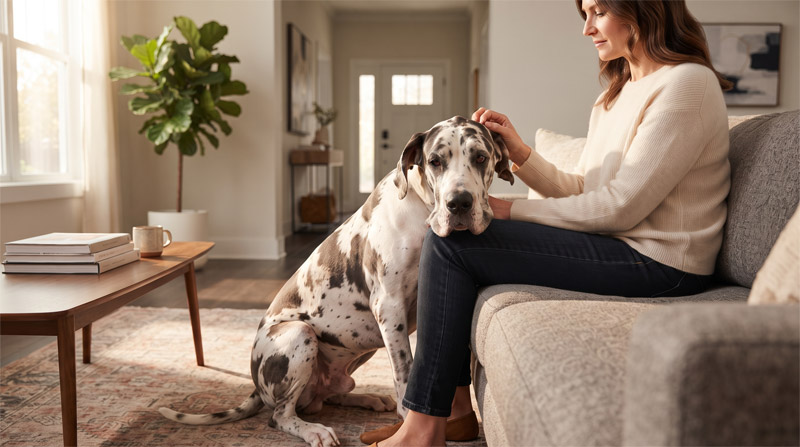
Most people expect a dog this size to feel like a liability indoors. In practice, adult Danes are some of the calmest, most affectionate dogs around, and the size mostly just makes the affection more physical.
The nickname “gentle giant” didn’t come from nowhere. An adult Dane wants proximity, not activity, and that distinction matters a lot inside four walls.
This is a dog that will lean its entire body weight against someone’s leg and consider that a job well done. It will also attempt to fit itself into a lap sized for something a quarter its size, seemingly without noticing the math doesn’t work.
Strangers tend to get curiosity rather than suspicion, though early socialization still shapes how a Dane greets hallway neighbors and whoever’s delivering packages that afternoon.
Barking and Vocalization Habits
Great Danes bark far less than small terriers or the classic vocal guard breeds. Most of what noise there is happens at the door, not scattered throughout the day, and the dog’s size does more to deter a stranger than its bark ever could.
This matters more in an apartment than almost anything else on this page. Shared walls punish frequent barking, and it’s just not something this breed does much of.
How Much Exercise Does a Great Dane Need in an Apartment?
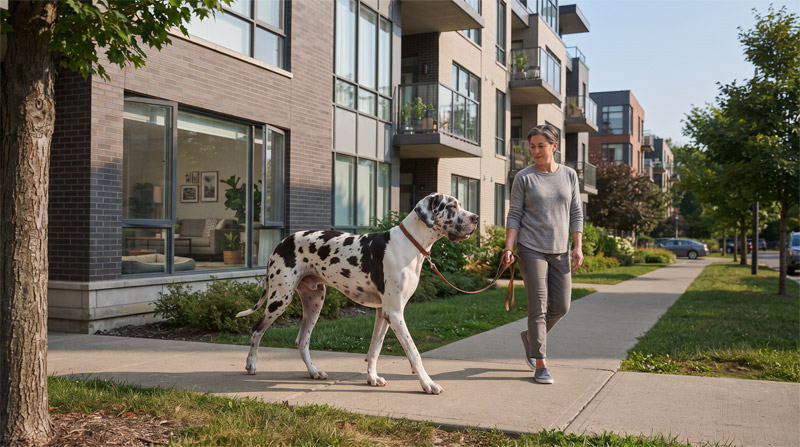
Adult Great Danes need about 30 to 60 minutes of exercise daily, and it works better split across two walks than crammed into one long one.
That’s a moderate ask for a dog this size, well below what a working or herding breed would demand.
Indoor play has a ceiling most owners find out about the hard way. A dog that can clear a coffee table with a single wag of its tail is not a dog you play fetch with inside a one-bedroom.
And skipping the walk doesn’t buy a calmer dog. It buys a restless one that puts that energy into furniture, doors, and whatever’s left on the counter.
Exercise Limits for Great Dane Puppies vs Adults
Great Dane Puppies
Walks should stay short and frequent rather than long. No forced running, no jumping, no repeated stairs. Growth plates stay open into the second year, and impact stress during that stretch raises joint risk later on.
Adult Great Danes
Two structured walks a day cover most of what’s needed. Off-leash time in a fenced area is a nice bonus when it’s available, though not required. Activity tends to drop off noticeably after the two-year mark, which is roughly when the couch-potato reputation actually becomes accurate.
How Much Space Does a Great Dane Need Indoors?
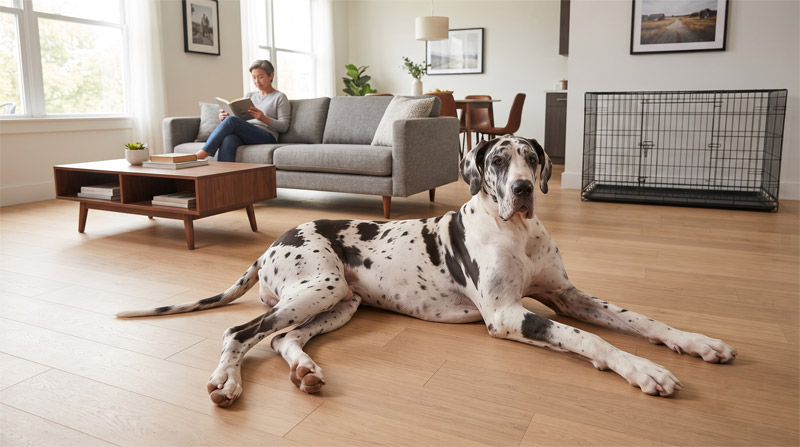
A Great Dane needs enough floor space to lie down fully stretched out, turn around without hitting furniture, and stand without its tail sweeping a coffee table clean.
That’s a space requirement, not a square footage minimum written into any code. In practice, it rules out the smallest studio layouts.
| Area | Practical Minimum |
|---|---|
| Crate size (adult) | 48 inches long or larger |
| Turning and stretching radius | Roughly 6 to 7 feet of clear floor |
| Tail clearance from low tables | At least 2 feet on each side |
Ask anyone who owns one: the tail is not a joke. A relaxed wag at this size can clear a coffee table in one pass, and narrow hallways make the problem worse.
Open floor plans handle a Great Dane far better than apartments chopped into small, separate rooms.
What Health Risks Are Elevated in Great Danes Living in Small Spaces?
Great Danes carry a handful of breed-specific health risks. Apartment living doesn’t cause any of them, but a small space can make them harder to catch or manage. Bloat is the big one. Hip dysplasia and dilated cardiomyopathy both show up in this breed more than in most, and each is worth its own look.
Bloat (Gastric Dilatation-Volvulus)
Great Danes carry the highest average lifetime bloat risk of any breed studied, at roughly 42.4 percent, based on a Purdue University-led study by Dr. Larry Glickman, as cited by Tufts University’s veterinary genetics program.
A separate 2020 genome-wide association study published in the journal Genes (and indexed on NCBI) found that Great Danes accounted for a 14.0 percent share of the GDV-affected dogs across the breeds it examined. That number describes the breed’s representation within that particular study’s case group. It’s not the same thing as an individual dog’s lifetime odds, which is the 42.4 percent figure above.
Bloat is a twisting of the stomach that cuts off blood flow, and it can kill within hours without emergency surgery.
- Feed two or three smaller meals instead of one large one
- Avoid vigorous exercise for an hour before and after eating
- Use a slow-feed bowl if the dog eats too fast
Following a consistent portion routine, like the one laid out in this Great Dane feeding chart, takes at least one variable out of the guesswork tied to this risk.
Hip Dysplasia and Joint Problems
A handful of things push the risk up: rapid growth during the first year, too much calcium during puppyhood, and forced exercise or repeated jumping before the growth plates close.
The Orthopedic Foundation for Animals screens breeding dogs for hip and elbow conformation, and reputable Great Dane breeders test for it before pairing dogs.
Apartment living does not cause hip dysplasia. It can, however, make a dysplastic adult Dane’s daily life harder on stairs and slick flooring.
Dilated Cardiomyopathy
Dilated cardiomyopathy weakens the heart muscle’s ability to pump blood, and it turns up in Great Danes more often than in most breeds.
Early signs are easy to miss in a dog that’s already large and generally low-energy, since lethargy just looks like a normal Tuesday for this breed.
Cardiac screening through a veterinary cardiologist, following the health-testing protocols tracked by the Canine Health Information Center, catches most cases before symptoms become obvious.
How Does a Great Dane Compare to Other Apartment-Considered Breeds?
A Great Dane beats most small, vocal breeds on noise, holds its own against other giant breeds on calm indoor behavior, and loses ground on floor space and food cost.
| Breed | Adult Weight | Daily Exercise | Barking Level |
|---|---|---|---|
| Great Dane | 110 to 175 lbs | 30 to 60 min | Low |
| Labrador Retriever | 55 to 80 lbs | 60+ min | Moderate |
| Great Pyrenees | 85 to 160 lbs | 30 to 45 min | High |
| French Bulldog | 16 to 28 lbs | 20 to 30 min | Low to moderate |
Compare it to a Labrador Retriever and the Dane comes out ahead on quiet indoor manners. Exercise is where it falls apart, though. Labs need more daily activity, and they handle being under-exercised in a small space worse than a Dane does.
A Great Pyrenees matches the Dane on size but is a far heavier barker, bred specifically to alert on livestock at night. That instinct doesn’t switch off in a hallway.
The comparison flips completely with a French Bulldog. Space and lease approval go to the Frenchie without much argument. What it carries instead is a set of breathing-related health issues that make the whole trade-off a lot messier than it first looks.
What Are the Pros and Cons of Keeping a Great Dane in an Apartment?
A Great Dane trades physical bulk for a genuinely low-drama indoor presence, and the honest answer depends on which trade-off an owner can live with.
What Works in Its Favor
- Quiet by nature, which counts for more than size in a building with shared walls
- Strong attachment behavior, more leaning against you than jumping on you
- Low grooming needs, thanks to a short, single-layer coat
- A calm adult temperament that settles in once the dog passes two years old
Where It Gets Harder
- A short lifespan relative to the emotional investment a giant breed asks for
- Elevated bloat and joint risk that needs ongoing attention, not a one-time check
- Cost: food, veterinary care, and pet insurance all scale with body weight, and the full lifetime cost of owning a dog this size adds up faster than the adoption fee ever suggests
- Frequent lease friction tied to weight limits rather than actual behavior
None of this rules out apartment living on its own. It just means the decision rests on space and money as much as on how the dog behaves.
What Lease, HOA, and Insurance Restrictions Apply to Great Danes?
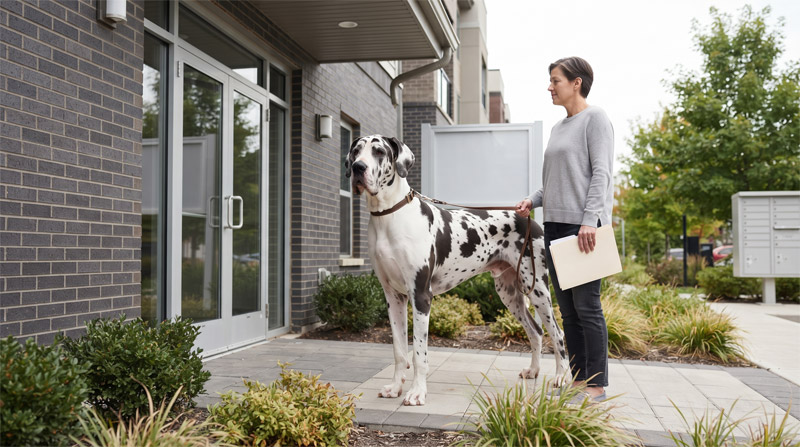
A Great Dane’s weight, not its temperament, is what most often disqualifies it from a lease.
Property policies and insurance underwriting rarely ask how calm the dog is indoors. They ask how much it weighs and what breed it is on paper.
Breed Weight Limits and HOA Rules
Real Property Management notes that many landlords welcome dogs weighing under 40 pounds and won’t allow anything heavier. That’s well under half of what an adult Great Dane weighs.
HOA pet clauses often mirror this same ceiling, separate from anything written into the lease itself.
- Weight caps typically sit between 25 and 50 pounds in standard leases
- Some HOAs enforce a hard breed list instead of a weight number
- A written breed exception from a landlord does not override an HOA’s own rule
A signed lease that allows the dog is not the same as HOA approval, and both need checking before move-in.
Renters Insurance and Pet Deposits
Stacey Giulianti, chief legal officer at Florida Peninsula Insurance Company, has named the Great Dane among the breeds commonly listed on homeowner insurance “dangerous breed” exclusion lists.
Not every insurer works this way. State Farm has said publicly that it does not maintain a breed restriction list and instead bases its underwriting on a dog’s individual bite history.
| Fee Type | Typical Range | Refundable |
|---|---|---|
| Pet deposit | $287 to $311 (RentCafe, 2025) | Usually yes |
| Monthly pet rent | $34 to $37 (RentCafe, 2025) | No |
| One-time pet fee | $200 to $500 | No |
Large-breed owners routinely land at the top of these ranges, since many properties charge more once a dog crosses a size threshold.
Should You Adopt a Great Dane Puppy or an Adult for Apartment Living?
An adult Great Dane is the easier apartment fit. A puppy is the harder, messier, more rewarding one.
Adopting a Great Dane Puppy in an Apartment
A Great Dane puppy grows fast, and an apartment magnifies every stage of that growth.
- Constant supervision is needed until house training is solid
- Furniture and floors take real damage during the chewing phase
- Energy levels stay unpredictable until somewhere past the one-year mark
- Neighbors meet the loud, clumsy version of the dog before they meet the calm one
Training has to start immediately in a small space. There is no backyard to burn off the extra energy while manners catch up.
Adopting an Adult or Rescue Great Dane
An adult Dane comes with a temperament you can actually observe before committing to it, rather than one you’re hoping for.
| Factor | Puppy | Adult or Rescue |
|---|---|---|
| Temperament | Unknown, still forming | Already observable |
| Training needed | Extensive, from scratch | Often already housebroken |
| Energy level | High and inconsistent | Settled, closer to adult baseline |
The Great Dane Club of America maintains a network of regional rescue groups that place adult Danes whose temperament is already documented.
How Do You Prepare an Apartment for a Great Dane?
Preparing a unit for a Great Dane is less about buying gear and more about clearing the floor plan the dog will actually use.
- Measure the largest open room and confirm it fits a 48-inch or larger adult crate with clearance on every side
- Move low coffee tables and breakable items out of tail-sweep range near seating areas
- Set a fixed feeding schedule with two or three smaller meals to reduce bloat risk
- Block off stairwells or slick flooring the dog will use daily until footing and joints are assessed by a vet
- Introduce the dog to elevators, hallways, and neighbors gradually, on a short leash and outside of peak building traffic
- Confirm the lease weight limit and HOA breed rule in writing before move-in, not after
Most of this preparation happens before the dog ever arrives. Skipping it doesn’t save time, it just moves the same work to week one.
When Is an Apartment Not Suitable for a Great Dane?
An apartment stops being a fair option at a fairly specific point, usually when space runs out, exercise time isn’t there, or bloat risk isn’t being managed at all.
None of these failure points are about the dog’s personality. They’re about what the living situation can physically support.
- The unit has no room for a 48-inch crate or a clear path to turn and stretch
- The lease weight limit sits well under the dog’s adult weight with no documented exception
- The owner cannot commit to daily walks, regardless of how calm the dog seems indoors
- Meals cannot be split and monitored, raising bloat risk with no way to manage it
- No backup plan exists for veterinary emergencies given the higher cost of treating a giant breed
Signs a Great Dane Is Not Adjusting Well
Destructive chewing that shows up only when the dog is left alone points to under-exercise, not defiance.
Pacing in tight circles, repeated bumping into furniture, or reluctance to lie down fully are physical signs the space is too small.
Persistent low appetite or a visibly distended abdomen after meals needs same-day veterinary attention, since both can signal early bloat rather than ordinary settling-in stress.
FAQ on Great Danes As Apartment Dogs
Is a Great Dane a Giant Breed or a Working Breed?
Both, and neither cancels the other. The American Kennel Club places the Great Dane in the Working Group, a classification based on original job, not size.
“Giant breed” is an informal size category, not an official classification.
How Long Can a Great Dane Be Left Alone in an Apartment?
Four to six hours is a reasonable ceiling for a healthy adult, shorter for puppies still building bladder control.
This breed forms strong attachments, and separation anxiety shows up as chewing or howling rather than aggression.
What Mistakes Do First-Time Great Dane Owners Make in Apartments?
New owners often let puppies free-roam a small unit before house training holds, and skip a fixed feeding schedule tied to bloat prevention.
Underestimating tail clearance around furniture is the most common, and most avoidable, oversight.
What Are Better Apartment Breed Alternatives if a Great Dane Doesn’t Fit?
A Basset Hound trades size for low exercise needs, though its own vocal habits and scent-driven wandering bring different trade-offs.
A Greyhound matches that same low-key indoor energy in a fraction of the floor space a Great Dane needs.
What Should You Check First
The first thing to check for a Great Dane in an apartment is the lease weight limit. Not floor space, not temperament. A cap under 140 pounds ends the decision before any exercise or feeding plan even gets discussed.
Space comes second, since a compliant lease with no turning room still fails within a month.
- Confirm the lease and HOA weight cap
- Measure floor space for crate and turning radius
- Commit to a split-meal feeding routine
Combining a roughly 42 percent lifetime bloat risk with an 8 to 10 year lifespan means a Great Dane owner faces real odds of one costly stomach emergency at some point during ownership, a risk few apartment-approved breeds carry.
Owners whose unit fails on space before the lease even matters tend to look next at a Basset Hound, built for the same low-key life at a fraction of the footprint.