A husky and a golden retriever can sit in the same backyard at ten degrees and have completely different afternoons. One of them is built for it, double coat, a layer of fat under the skin, ears and a muzzle shaped to hold heat instead of losing it. The other is shivering by the door in twenty minutes.
The breeds that fall into the “winter dog” category didn’t come from one shared bloodline. Arctic sled lines, alpine guardians that spent their working lives watching over flocks, small Scandinavian companions bred more for the house than the pasture, each region solved the cold problem on its own terms.
The Samoyed is one of the oldest of these working lines, and the American Kennel Club still credits the breed with hauling one and a half times its own body weight across snow, which says a lot about what these dogs were actually built to do before anyone was breeding them to be fluffy and photogenic.
What Are Winter Dog Breeds?
Cold tolerance here isn’t a matter of taste. These are dogs whose bodies were shaped, generation after generation, to keep working once the temperature drops well below freezing, not dogs that simply put up with cold better than most.
The lineages trace back to a small number of brutal climates: Siberia, Scandinavia, the Alps, the northern edge of North America.
Fur length is a bit of a red herring. What actually matters is the double coat working alongside a fat layer and short, compact extremities, all of it built for one job: hold onto body heat.
- Bred for real outdoor labor in snow, not just tolerating a cold afternoon better than average
- Traced back to spitz-type or mountain-type ancestors
- Not the same thing as a long-haired breed that looks the part but overheats outside fast
What Physical Traits Let Winter Dog Breeds Survive Cold?
None of this comes down to one thick coat doing all the work. It’s a handful of adaptations stacked on top of each other.
The undercoat is dense and traps warm air close to the skin, while the longer guard hairs on top handle moisture and wind. Ears tend to be small and rounded, muzzles shorter than average, both of which cut down the surface area available for heat loss. Paw pads run thick, and fur grows in between the toes to stop ice from cutting into the skin directly.
Then there’s the fat layer sitting under the skin, doing what the coat alone can’t manage, and a tail that curls tight enough for a resting dog to tuck its nose and face against it.

Strip the undercoat out through bad grooming (shaving a husky in summer, for instance) and the fat layer and tail posture aren’t enough to make up the difference on their own.
How Cold Can Winter Dog Breeds Tolerate Before Health Risks Rise?
Even the most cold-adapted dog has a ceiling, and it sits lower than most owners assume.
- Mild hypothermia sets in once a dog’s body temperature drops below 99°F, and the American Kennel Club classifies anything below 82°F as severe
- Washington State University’s veterinary hospital tells owners to keep outdoor time under 10 to 15 minutes once it’s below freezing, since frostbite goes for the ears, tail, and paw pads first as the body pulls blood away from the extremities to protect the organs that matter more (WSU)
- For short-coated dogs, frostbite can start in as little as 30 minutes at or below 32°F, worse in wind or wet conditions (American Kennel Club)
Double-coated breeds buy themselves more time than these numbers suggest, but the ceiling is still there. Wind and wet weather push even a heavy Arctic coat toward that same danger zone faster than dry, still air does.
What Jobs Were Winter Dog Breeds Originally Bred to Perform?
Temperament in these breeds still traces back to whatever job they were bred for, sometimes annoyingly so if you’re the one trying to get a Great Pyrenees to come when it’s called.
Sled and freight breeds, developed by the Chukchi people and other Siberian tribes, were built around endurance rather than speed, moving modest loads across long distances on very little food. Livestock guardians from mountain and alpine regions worked alone with a flock for days at a stretch, and that same independence reads as pure stubbornness once the dog is living in someone’s house instead of a pasture.
A smaller group existed to pull people out of snow and icy water, and that job called for calm nerves more than raw speed. The Saint Bernard’s monastery-rescue history is probably the clearest example of that. The cold-water instinct still visible in the Newfoundland actually comes from Canadian fishing communities rather than mountain passes, which tends to surprise people who assume every big winter dog has an Alpine backstory.
The Iditarod Trail Sled Dog Race, established in 1973 and run roughly 1,000 miles from Anchorage to Nome, exists because of this working history (Iditarod.com). Only northern sled breeds are allowed to compete, which tells you how narrow this physical adaptation actually is.
Which Dog Breeds Are Considered Winter Dog Breeds?
This category covers everything from serious sled dogs to mountain guardians to small northern companions bred more for company than for work.
| Breed | Origin | Coat Type | Size |
|---|---|---|---|
| Siberian Husky | Siberia | Medium double coat | Medium |
| Alaskan Malamute | Alaska | Dense double coat | Large |
| Great Pyrenees | French-Spanish Pyrenees | Thick weatherproof coat | Large |
| Samoyed | Siberia | Dense white double coat | Medium |
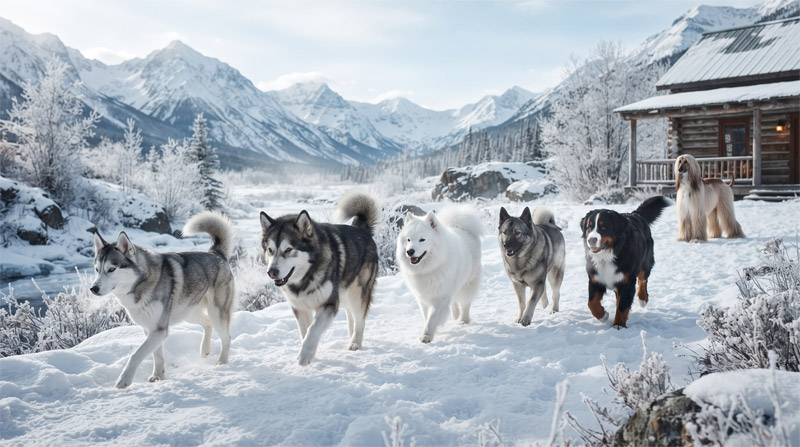
The Siberian Husky is usually the first image that comes up in a search like this, built for covering long, cold distances rather than muscling through short heavy pulls.
The Alaskan Malamute is the heavier-boned cousin, built to haul freight, not race.
Beyond these two, the category widens quickly:
- Tibetan Mastiff and Norwegian Elkhound for mountain and hunting lines
- Chow Chow and Akita for dense-coated companion lines developed in East Asia
- Icelandic Sheepdog and Swedish Vallhund for smaller northern spitz types
Winter Dog Breeds Compared by Size, Coat, and Temperament
Picking among these breeds mostly comes down to weighing size against how much grooming you’re willing to do and how independent a dog you can actually live with day to day.
Large working breeds like huskies and malamutes tolerate cold well and bring the stamina and guarding instinct to match. The tradeoff shows up fast though: heavy shedding, real space and exercise requirements, and an independent streak that makes obedience training slower than a lot of first-time owners expect going in.
Mountain and livestock guardian breeds are a different animal entirely. Calm around family, bred to work without supervision, they handle isolation better than almost any other type of dog. The Great Pyrenees is the clearest example, built to guard flocks alone through Pyrenean winters for days at a stretch. What that same independence costs you: a large adult dog, protective instincts that need early socializing, and a dog that stays slow to warm up to strangers no matter how patient you are about it.
Then there are the small northern companions, cold-hardy despite their size, cheaper to feed, and easier to fit into a colder apartment than either of the groups above. The Keeshond fits this profile well, a Dutch barge dog with a full double coat scaled down to something manageable. Shedding is still heavy relative to the dog’s size, some lines are vocal, and heat remains the enemy no matter how small the dog is.
Why Do Winter Dog Breeds Shed So Heavily?
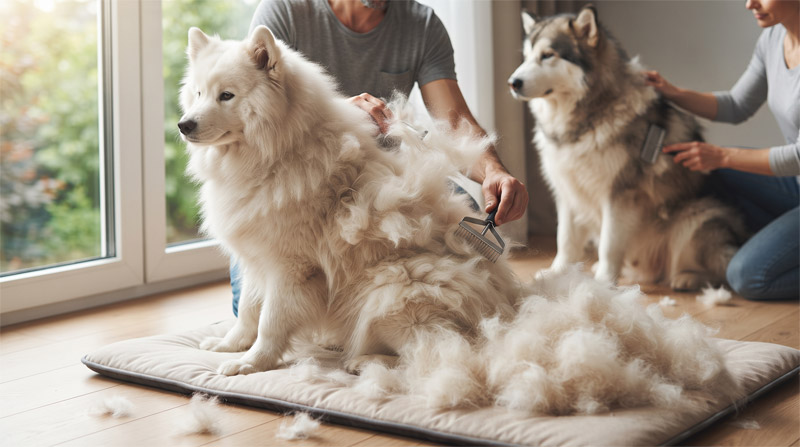
Heavy shedding here isn’t a sign you’re doing something wrong with grooming. It’s a seasonal process called coat blow, and daylight change triggers it more than temperature does.
Coat blow happens twice a year in most double-coated breeds, once heading into summer and once heading into winter. The undercoat comes out in dense clumps rather than shedding evenly the way a short-haired dog’s does.
How dramatic the shed looks depends on undercoat density, not the length of the guard hairs. A properly blown coat comes out in mats and tufts, not a light daily dusting on the floor, and skipping brush-outs during this stretch traps loose fur against the skin, which raises the risk of hot spots.
The Samoyed is probably the breed owners underestimate most here. That dense white undercoat sheds in volumes that catch first-time owners completely off guard.
Heavy shedding on its own isn’t a red flag. A dog that isn’t shedding at all during its expected season is the one actually worth a vet visit.
When Do Winter Dog Breeds Struggle or Fail to Thrive?
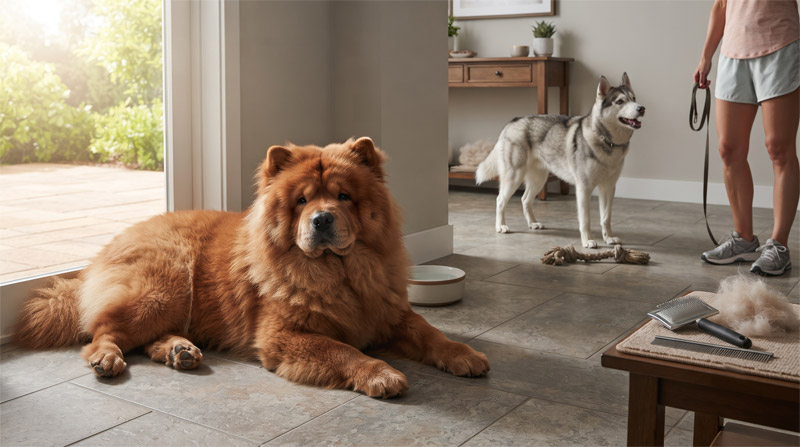
Cold tolerance comes at a cost, and that cost is heat tolerance, which drops just about as sharply as the cold tolerance rises.
The same double coat that traps warmth in January does exactly the same thing in July. A dog built for the Arctic can react to a mild heatwave roughly the way a Labrador reacts to an actual scorcher.
Vets diagnose heatstroke in dogs once core body temperature hits 105°F or higher, and Cornell University’s College of Veterinary Medicine flags that threshold as a medical emergency regardless of breed (Cornell). A UK primary veterinary care study found the Chow Chow carried the highest heat-related illness risk of any breed studied, a result the researchers tied directly to its dense double coat (Hall, Carter & O’Neill, Scientific Reports, 2020).
The Chow Chow illustrates this well. The coat that once handled Mongolian winters needs active management the moment summer shows up.
Apartment living without a real outlet is another common failure point. Sled and working lines carry exercise needs sized for hauling and herding, not a studio apartment and two short walks a day.
Coat neglect causes its own separate set of problems: skipped brushing during coat blow leads to matting, trapped moisture, and skin infections hiding underneath a coat that looks perfectly fine from the outside.
None of this means a winter breed can’t live somewhere warm. It means the climate mismatch has to be actively managed, not waved away because the dog technically “has fur.”
How Do You Care for a Winter Dog Breed Through the Cold Season?
Winter care roughly follows a sequence, from the first cold snap through the deepest part of the season.
- Book a fall wellness check before temperatures drop, since cold weather tends to make arthritis and similar conditions worse
- Step up brushing as the undercoat starts thickening for winter
- Introduce booties or paw wax gradually, before the first hard freeze, so the dog actually tolerates them on a real walk instead of just standing there
- Shorten walks during extreme cold snaps rather than cutting out exercise entirely
- Stock a cold-weather emergency kit with food, water, and any medication before the season’s first storm hits
The American Veterinary Medical Association recommends keeping a pet emergency kit stocked with 3 to 7 days of food, at least 7 days of water, and a two-week supply of any medication on hand, in case winter brings a power outage or a bad storm (AVMA).
Grooming During Coat Blow
Brushing needs to ramp up to several sessions a week once the undercoat starts releasing, rather than waiting until visible tufts show up.
- An undercoat rake gets down to the dense layer that a slicker brush just skates over
- Bathing helps loosen dead undercoat too, but it has to be followed by a full dry, since a damp undercoat holds cold against the skin instead of insulating against it
Shaving a double coat for convenience backfires here every time. The guard hairs that grow back come in slower than the undercoat does, leaving a patchy coat that’s noticeably less weatherproof than before.
Cold-Weather Gear and Equipment
Gear matters more for exposed extremities than for the torso, which the coat already protects on its own.
| Gear | Purpose | Best For |
|---|---|---|
| Paw wax | Blocks salt and ice contact | Short walks, mild cold |
| Booties | Physical barrier against salt and ice | Salted sidewalks, long walks |
| Weatherproof coat | Extra insulation for thin-coated dogs | Senior dogs, short-haired breeds |
Most double-coated winter breeds don’t need a coat or sweater at all. It’s thin-coated breeds and senior dogs that actually benefit from the extra layer.
Exercise in Snow and Ice
Deep, fresh snow is harder work than it looks. Short bursts of play in it will tire a winter breed out faster than a long walk on cleared pavement would.
Ice balls tend to form between the toes on longer coats. A slower gait or limping is a common sign of paw pad irritation from salt or ice. Excessive panting even in cold air can point to overexertion rather than heat, which catches some owners off guard since they assume panting only ever means a dog is too hot.
Frozen ponds and lakes deserve caution no matter how confidently a sled-breed dog crosses them. Thin ice doesn’t care how thick the coat is.
What Health Risks Should Winter Dog Breed Owners Watch For?
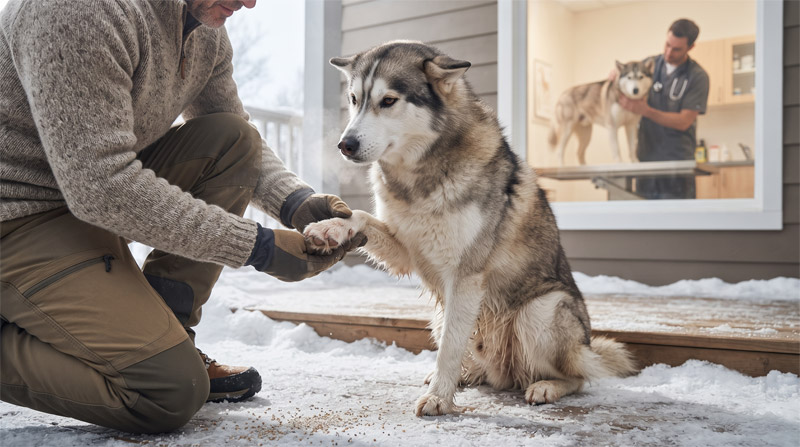
Cold-adapted doesn’t mean cold-proof. These breeds run into the same core risks as any other dog once exposure crosses their particular threshold.
Frostbitten skin often turns pale or grayish before pain becomes obvious at all, and the real extent of the tissue damage might not show up for several days after the exposure happened.
Hypothermia tends to progress in stages. Shivering and curling up mark the early phase. Moderate hypothermia comes next, classified between 82°F and 90°F body temperature and marked by a slowing heart rate and breathing that gets shallower by the hour (American Kennel Club). Severe cases push past that into a genuine emergency that needs a vet right away.
- Ice and rock salt exposure shows up as cracked, dry, or bleeding paw pads, sometimes with drooling or vomiting if the dog licks salt off its own feet
- Sudden lameness after a walk is often the first visible sign of an ice-related paw injury
- Lethargy or reluctance to walk on a surface the dog normally handles without a second thought is worth paying attention to as well
Any of these signs after time outside in freezing conditions is a reason to call a vet, not wait and see what happens. Frostbite in particular tends to look worse than it first appeared, so a same-day visit beats hoping it clears up on its own.
FAQ on Winter Dog Breeds
What Separates a True Winter Dog Breed From a Dog That Just Has Long Fur?
Coat length by itself doesn’t create cold tolerance, no matter how thick it looks from across the room.
A true winter dog breed carries a dense double coat, a fat layer, and compact ears built specifically for holding heat in. Long, single-coated fur looks warm but doesn’t actually do much insulating.
Are Mixed-Breed Dogs Ever Classified as Winter Dog Breeds?
Classification here tracks physical traits, not a pedigree certificate.
A mixed-breed dog with a heavy double coat, dense undercoat, and a compact build from Arctic or mountain ancestry functions as a winter dog breed in practice, whether or not the AKC or FCI ever put their name on it.
Are Winter Dog Breeds a Good Fit for Warm Climates With Extra Care?
Some manage it, but it takes real adjustments: air conditioning, shaded yards, exercise limited to early morning or evening.
Regular brushing to clear out trapped undercoat matters more than clipping does. Skip that management and heat intolerance and skin problems follow fast.
Do Winter Dog Breeds Need More Veterinary Attention Than Other Breeds?
Not across the board, but coat and joint issues do show up more often than average.
Dense double coats are good at hiding skin infections and hot spots underneath them, and large sled and guardian breeds carry higher rates of hip dysplasia, so routine skin and joint checks catch problems while they’re still small.
What Mistakes Do New Owners Make With Winter Dog Breeds?
Underestimating exercise needs is the big one. These dogs were built for hauling or herding, not apartment living, and a lot of owners find that out the hard way.
Some also assume every double-coated dog shares the same cold tolerance as a Malamute, then leave a smaller or older dog outside too long because of it.
What Should You Prioritize Before Choosing a Winter Dog Breed?
Climate should come first when picking one of these breeds, coat commitment second, and exercise capacity a close third. Getting that order wrong is the most common reason these dogs end up rehomed or sitting bored in homes that don’t actually fit them.
Make sure the local climate supports real, sustained cold, not just an occasional cold snap in January. Commit to heavy grooming twice a year during coat blow before falling for the breed itself. And match daily exercise to what the breed was originally bred to do rather than to its size, since a compact dog bred for pulling sleds can still need more exercise than a much bigger, couch-oriented breed.
That order still costs something. Putting climate and coat suitability ahead of temperament means accepting a dog engineered for self-directed work, the kind that treats commands as suggestions rather than rules.
The Akita profile is a logical next stop for anyone narrowing in on a compact, independent guardian breed with the same double-coat demands.