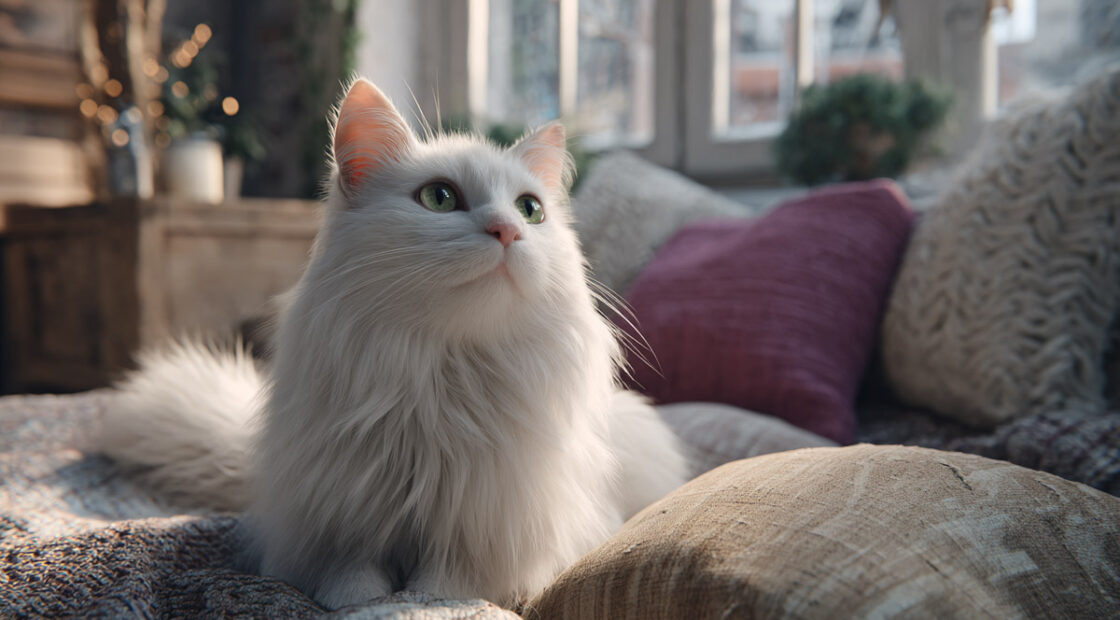
That elegant white cat perched on the highest shelf, watching your every move with striking blue eyes? Probably a Turkish Angora.
Turkish Angora cats rank among the oldest natural cat breeds, originating from the mountains of Turkey centuries ago. Their silky coat, athletic build, and dog-like personality make them unforgettable companions.
But this ancient breed needs more than admiration. They demand interaction, climb everything, and open doors like furry burglars.
This guide covers everything about Turkish Angora cats, from their playful temperament and grooming needs to health concerns and whether this intelligent breed fits your lifestyle. You’ll learn what makes these cats different from similar longhaired breeds, how much they actually cost, and what daily life looks like with one of these water-loving felines in your home.
Turkish Angora Cat Breed Statistics
| Characteristic | Details |
|---|---|
| Weight | Males: 8-12 lbs / Females: 5-9 lbs |
| Height | 8-10 inches at shoulder |
| Lifespan | 15-20 years |
| Coat Length | Semi-long |
| Coat Texture | Silky, fine, single layer (no undercoat) |
| Colors | White, black, blue, red, cream, tabby, tortoiseshell, bicolor, smoke |
| Eye Colors | Blue, green, gold, amber, odd-eyed |
| Shedding Level | Moderate |
| Grooming Needs | Low to moderate (weekly brushing) |
| Energy Level | Very high |
| Exercise Needs | 60-90 minutes daily |
| Playfulness | Very high |
| Affection Level | Very high |
| Intelligence | Very high |
| Trainability | High |
| Vocalization | Moderate to high |
| Good with Children | Yes (ages 6+) |
| Good with Dogs | Yes |
| Good with Other Cats | Yes |
| Stranger Friendly | Moderate to high |
| Apartment Suitable | Yes |
| Indoor/Outdoor | Indoor recommended |
| Climate Tolerance | Moderate heat / Good cold tolerance |
| Health Issues | Deafness (white/blue-eyed), HCM, ataxia |
| Hypoallergenic | No |
| Origin | Ankara, Turkey |
| Breed Type | Natural breed |
| Recognition | CFA (1972), TICA (1979) |
| Price Range | $1,000-$3,000 |
| Care Level | Intermediate |
| Best For | Active owners, experienced cat owners, families with older children |
What Is a Turkish Angora Cat?

The Turkish Angora is a natural cat breed from Turkey known for its silky white coat, elegant build, and intelligent personality.
This ancient breed originated in Ankara (formerly Angora), Turkey, where it developed naturally over centuries.
The Cat Fanciers Association (CFA) recognized white Turkish Angoras in 1972 and expanded recognition to colored cats in 1978.
TICA, GCCF, and FIFe all recognize the breed today.
Turkish Angoras are classified as a natural breed, meaning they evolved through natural selection rather than deliberate human crossbreeding.
White cats with blue or odd-colored eyes represent the traditional look, but the breed comes in virtually every color and pattern except chocolate, lavender, and colorpoint.
Physical Characteristics
How Big Do Turkish Angora Cats Get?
Males weigh 8-12 pounds while females weigh 5-9 pounds.
Both sexes reach 8-10 inches in height at the shoulder.
Turkish Angoras have a foreign body type with long, slender, fine-boned frames that give them a ballerina-like appearance.
Don’t let their delicate look fool you. These cats pack surprising muscle beneath that silky coat.
They reach full physical maturity between 3-5 years old, growing more slowly than many other breeds.
Males are consistently larger and heavier than females.
What Does a Turkish Angora Cat’s Coat Look Like?
Semi-long coat with a single layer and no undercoat.
The texture feels silky, fine, and flows when the cat moves.
Traditional colors include:
- White (most common and historically preferred)
- Black
- Blue
- Red
- Cream
- Tortoiseshell
- Tabby patterns (classic, mackerel, spotted)
- Bicolor combinations
- Smoke variations
- Silver
Chocolate, lavender, and pointed patterns are not recognized by breed standards.
The coat varies by season, growing fuller and longer in winter months.
Shedding level: Moderate. The lack of undercoat means less matting and easier grooming than other longhaired breeds.
Coat appears shorter in summer but maintains its silky texture year-round.
Distinctive Physical Features
Eyes: Almond-shaped in colors including blue, green, gold, amber, or odd-eyed (one blue, one amber/green).
Odd-eyed cats are particularly prized in Turkey and considered special.
Ears: Large, wide at the base, pointed at the tips, and set high on the head with tufts.
Head: Small to medium wedge shape with smooth lines.
Tail: Long, tapering, and fully plumed like a feather.
Legs: Long and slender with the hind legs noticeably taller than the front legs.
Paws: Small, oval, and dainty with tufts between the toes.
Body: Long, tubular, and graceful with visible muscle definition despite fine bone structure.
Their ruff (neck fur) and britches (upper hind leg fur) become more prominent in winter.
Turkish Angora Personality and Temperament

Are Turkish Angora Cats Affectionate?
Extremely affectionate and people-oriented.
These cats form intense bonds with their favorite person but remain friendly with all family members.
They’re not lap cats in the traditional sense but prefer perching on shoulders or sitting next to you.
Turkish Angoras follow their owners from room to room, supervising all activities.
Stranger reaction: Cautiously friendly to gregarious. Most warm up quickly to visitors.
Attention requirements run high. This breed doesn’t do well when ignored or left alone for long periods.
They demand interaction and will create their own entertainment (often destructively) if bored.
How Active Are Turkish Angora Cats?
Energy level: Very high.
Think race car, not sedan.
Turkish Angoras require 60-90 minutes of active play daily.
Play drive remains intense well into adulthood and senior years.
Favorite activities include:
- Climbing to the highest point in any room
- Fetch (yes, really)
- Water play (faucets, bowls, even bathtubs)
- Hunting toys with laser precision
- Opening doors and cabinets
Intelligence: Exceptionally high. These cats solve problems, learn tricks, and figure out how to manipulate their environment.
Trainability rivals some dog breeds.
They excel at feline agility and can learn to walk on a leash.
Do Turkish Angora Cats Get Along with Others?

Children compatibility: Good with kids aged 6 and older who respect boundaries.
Younger children may pull the long coat or tail, which Turkish Angoras won’t tolerate.
Dog compatibility: Excellent when properly introduced. Many Turkish Angoras enjoy Siberian dog-like play.
Other cats: Usually good. Turkish Angoras like having a feline companion but will establish dominance.
Multi-pet households work well if the Turkish Angora isn’t the newest addition.
Territorial tendencies exist but aren’t extreme.
These cats prefer being the center of attention and may become jealous if other pets receive more focus.
How Vocal Are Turkish Angora Cats?
Vocalization frequency: Moderate to very vocal.
Voice characteristics: Soft, melodic, and chirpy rather than loud or demanding.
Turkish Angoras communicate constantly through trills, chirps, and soft meows.
Deaf white cats with blue eyes vocalize more loudly because they can’t hear themselves.
They’ll “talk” throughout the day, commenting on activities and requesting interaction.
Health and Lifespan
How Long Do Turkish Angora Cats Live?.

15-20 years on average.
This lifespan exceeds the average domestic cat (13-17 years) by several years.
Some Turkish Angoras live into their early 20s with proper care.
Factors affecting longevity:
- Indoor vs. outdoor lifestyle (indoor cats live significantly longer)
- Diet quality
- Regular veterinary care
- Genetic health screening
- Weight management
Common Health Issues in Turkish Angora Cats
Hereditary Deafness
White Turkish Angoras with blue eyes face the highest risk.
Prevalence: 65-85% of white cats with two blue eyes are deaf.
Symptoms: No response to sounds, louder than normal vocalizations, startle easily when approached.
Age of onset: Present from birth.
Treatment: None available, but deaf cats adapt well and live normal lifespans.
Prevention: Deaf cats should not be bred. BAER testing identifies hearing ability.
Hypertrophic Cardiomyopathy (HCM)
The most common heart disease in cats.
Prevalence: Higher in males, typically appears between ages 2-6.
Symptoms: Rapid breathing, lethargy, decreased appetite, weakness in hind legs.
Treatment: Medication to control heart rate and prevent blood clots.
Prevention: Echocardiogram screening of breeding cats. Genetic testing available.
Prognosis: Varies widely. Some cats show no symptoms for years; others decline rapidly.
Hereditary Ataxia
Rare neurological disorder affecting coordination.
Prevalence: Uncommon but specific to the breed.
Symptoms: Tremors, unsteady gait, lack of coordination appearing at 2-4 weeks of age.
Age of onset: Early kittenhood.
Treatment: Supportive care only. Most affected kittens do not survive to adulthood.
Prevention: Genetic screening of breeding cats. Autosomal recessive inheritance means carriers can be identified.
Chronic Kidney Disease (CKD)
Age-related condition affecting kidney function.
Symptoms: Increased thirst, weight loss, lethargy, changes in urination.
Treatment: Diet modifications, medications, fluid therapy.
Prevention: Regular screening in senior cats, high-quality protein diet.
MDR1 Medication Sensitivity
Genetic mutation affecting drug metabolism.
Symptoms: Severe adverse reactions to common medications including ivermectin.
Treatment: Avoid specific drugs, inform all veterinarians of status.
Prevention: DNA testing identifies carriers.
What Health Testing Should Turkish Angora Cats Have?
For breeding cats:
- HCM echocardiogram screening annually
- BAER hearing test (especially for white cats)
- Genetic testing for ataxia
- MDR1 testing
Regular veterinary checks:
- Kittens: Monthly until 6 months for vaccinations and growth monitoring
- Adults (1-7 years): Annual wellness exams
- Seniors (8+ years): Twice-yearly exams with bloodwork
Age-specific monitoring:
- Kittens: Watch for ataxia symptoms
- Young adults: Cardiac screening
- Seniors: Kidney function tests, dental health
Caring for a Turkish Angora Cat

What Do Turkish Angora Cats Eat?
Protein requirements: 35-45% of diet from high-quality animal sources.
Turkish Angoras thrive on high-protein, low-carbohydrate diets.
Feeding frequency:
- Kittens (8-16 weeks): 4 meals daily
- Kittens (4-6 months): 3 meals daily
- Adults: 2 meals daily
Portion sizes based on weight:
- 5-pound cat: 1/4 to 1/3 cup dry food daily (or equivalent wet food)
- 8-pound cat: 1/3 to 1/2 cup daily
- 10-pound cat: 1/2 to 2/3 cup daily
Wet vs. dry food: Both work well. Wet food provides hydration; dry food supports dental health. Many owners feed both.
Special dietary needs: High protein from real meat or fish as the first ingredient. Omega fatty acids support coat health.
Foods to avoid:
- Excessive carbohydrates
- Grain-heavy foods
- Human food (especially onions, garlic, chocolate)
- Low-quality fillers
Weight management matters. This elegant breed should never become overweight as excess weight strains their fine bone structure.
How Do You Groom a Turkish Angora Cat?
Brushing frequency: Once or twice weekly.
Increase to daily during seasonal coat changes (spring and fall).
Bathing requirements: Rarely needed, perhaps 2-3 times yearly.
Many Turkish Angoras enjoy water and tolerate baths better than most cats.
Nail trimming schedule: Every 2-3 weeks.
Dental care: Brush teeth 3-4 times weekly, ideally daily.
Professional cleanings as recommended by vet (typically annually).
Eye cleaning: Check and wipe as needed, especially in white cats.
Ear cleaning: Monthly inspection and cleaning with vet-approved solution.
Professional grooming needs are minimal to none for most owners.
The single coat without undercoat rarely mats or tangles, making Turkish Angoras one of the easiest longhaired breeds to maintain.
Seasonal shedding occurs but isn’t excessive compared to double-coated breeds like Maine Coon or Norwegian Forest Cat.
How Much Exercise Does a Turkish Angora Cat Need?
Daily activity requirements: 60-90 minutes of active play.
Indoor vs. outdoor: Best kept indoors or with supervised outdoor access through catios or leash walking.
Outdoor exposure increases risks of injury, disease, and shortened lifespan.
Recommended toys:
- Interactive wand toys
- Puzzle feeders
- Motorized toys
- Laser pointers (with tangible toy to “catch”)
- Balls for fetch
- Water toys and fountains
Mental stimulation needs: High. Turkish Angoras bore easily and need novelty.
Rotate toys weekly and introduce new challenges regularly.
Climbing/vertical space: Critical. Install multiple cat trees, wall shelves, and perches.
Turkish Angoras gravitate to the highest point in every room.
Interactive play frequency: Two 20-30 minute sessions minimum, ideally three.
These cats retain kitten-like playfulness throughout their lives.
Living with a Turkish Angora Cat

Are Turkish Angora Cats Good for Apartments?
Yes, Turkish Angoras adapt well to apartments.
Space requirements focus more on vertical territory than square footage.
Noise level stays reasonable despite their vocal nature. Their soft voices won’t disturb neighbors.
Neighbor compatibility is generally good.
Indoor-only suitability is excellent. Turkish Angoras thrive as house cats.
Vertical space becomes non-negotiable in smaller homes. Provide floor-to-ceiling cat trees and wall-mounted shelving.
What Environment Do Turkish Angora Cats Need?
Temperature tolerance:
- Heat: Moderate sensitivity due to coat
- Cold: Good tolerance thanks to natural adaptation to Turkish winters
Ideal temperature range: 65-75°F.
Humidity preferences: Standard indoor humidity works fine. No special requirements.
Safe outdoor access options:
- Enclosed catios
- Window perches with secure screens
- Leash walking with harness training
Environmental enrichment specifics:
- Multiple climbing levels
- Window perches for bird watching
- Puzzle feeders
- Hiding spots
- Cat-safe plants (cat grass, catnip)
Window perch importance rates high. Turkish Angoras spend hours surveying their domain from elevated positions.
Scratching post requirements: Multiple posts in different textures (sisal, cardboard, carpet) and orientations (vertical and horizontal).
Are Turkish Angora Cats Good for First-Time Owners?
Care difficulty level: Intermediate.
The grooming stays easy, but the high intelligence and energy level challenge inexperienced owners.
Time commitment: 2-3 hours daily for play, interaction, and enrichment.
Experience level needed: Moderate. First-time owners can succeed with research and commitment.
Common challenges:
- Meeting high activity needs
- Preventing boredom-related destructive behavior
- Managing their strong-willed personality
- Providing adequate mental stimulation
Turkish Angoras work best for first-time owners who:
- Work from home or have flexible schedules
- Enjoy highly interactive pets
- Don’t mind a cat that acts more like a dog
- Can commit to daily play sessions
Turkish Angora Kittens
What Are Turkish Angora Kittens Like?

Tiny tornadoes with fur.
Turkish Angora kittens display high energy from the moment they can walk.
Personality development timeline:
- 2-7 weeks: Socialization with littermates critical
- 8-12 weeks: Personality emerges, human bonding intensifies
- 3-6 months: Peak energy and mischief
- 6-12 months: Adolescence, testing boundaries
Early socialization needs: Exposure to various people, sounds, and experiences between 2-7 weeks shapes adult temperament.
Kitten energy levels exceed most breeds. Prepare for chaos.
Training windows:
- Litter training: 3-4 weeks
- Basic commands: 8-16 weeks
- Leash training: 12-20 weeks
When Can Turkish Angora Kittens Leave Their Mother?
Minimum age: 12-16 weeks.
Never before 12 weeks, preferably 14-16 weeks for optimal socialization and development.
Developmental milestones before adoption:
- 8 weeks: Basic socialization complete
- 12 weeks: First vaccinations received, litter trained, eating solid food
- 16 weeks: Personality fully developed, ready for new home
Vaccination schedule before adoption:
- 6-8 weeks: First FVRCP (feline distemper combo)
- 10-12 weeks: Second FVRCP
- 14-16 weeks: Third FVRCP, rabies vaccine
Spay/neuter timing: Most vets recommend 5-6 months, though some breeders perform early spay/neuter at 12-16 weeks before kittens leave.
Breeding and Genetics
Turkish Angora Breed Standards

CFA standards:
- Body: Medium size, lithe, graceful
- Head: Small to medium wedge
- Ears: Large, wide-set, pointed
- Eyes: Large, almond-shaped, slightly slanted
- Coat: Medium-long, fine, silky
- Colors: All traditional colors accepted
Disqualifying faults:
- Cobby body type
- Short tail
- Kinked tail
- Cross-eyes
- Any indication of hybridization with another breed
Show quality vs. pet quality:
Show cats must conform precisely to standards in proportion, coat quality, and eye placement.
Pet quality Turkish Angoras may have minor faults like slightly small ears or less-than-perfect coat but make equally wonderful companions.
Genetics of Turkish Angora Cats
Hereditary traits:
The dominant white (W) gene creates the classic white coat and links to deafness.
Blue eye color connects to the dominant white gene.
Coat color genetics:
White coats result from epistatic gene suppressing all other colors.
Colored Turkish Angoras carry recessive color genes.
Breed-specific mutations:
- Ataxia gene (autosomal recessive)
- HCM susceptibility
- White coat/deafness linkage
Outcross breeds: None permitted. All registered Turkish Angoras must trace ancestry to cats from Turkey.
Genetic diversity concerns: Limited gene pool in some countries. Importing cats from Turkey helps maintain diversity.
DNA testing recommendations:
- Ataxia screening for all breeding cats
- HCM genetic testing where available
- Blood type testing (Turkish Angoras can be Type A or B)
History of the Turkish Angora Cat
Where Do Turkish Angora Cats Come From?

Geographic origins: Ankara region of central Turkey (formerly called Angora).
Natural breed: Developed through centuries of natural selection in mountainous Turkish climate.
The long coat evolved as protection against harsh winters.
Historical context traces back to at least the 15th century, possibly earlier.
Original purpose: Companion cats treasured for beauty. Not bred as working cats.
Legend claims the prophet Mohammed owned a Turkish Angora named Muezza.
How Did the Turkish Angora Breed Develop?
Development timeline:
- 1500s: Long-haired cats from Turkey arrive in France and Britain
- 1600s: Turkish Angoras recognized as distinct breed in Europe
- 1800s-early 1900s: Used to improve Persian coat quality, nearly disappearing as distinct breed
- 1917: Turkish government and Ankara Zoo establish preservation program
- 1954: First Turkish Angoras brought to United States
- 1962: Colonel and Mrs. Walter Grant import breeding pair from Ankara Zoo
- 1963: Additional imports by Sergeant and Mrs. Ivan Leinbach
- 1968: CFA begins registering Turkish Angoras
- 1972: CFA grants championship status to white Turkish Angoras
- 1978: Colored Turkish Angoras accepted by CFA
Key breeding programs: Ankara Zoo breeding program saved the breed from extinction.
Important foundation cats: All CFA-registered Turkish Angoras must trace lineage to Turkey.
The zoo’s breeding program focused on white cats with blue, gold, or odd eyes.
Odd-eyed cats received special status due to cultural significance.
Breed evolution: Initially only white cats recognized, later expanded to all traditional colors.
Related breeds: Turkish Angoras likely contributed to Persian, Balinese, and other longhaired breeds.
When Was the Turkish Angora Recognized?
CFA recognition: 1968 (registration), 1972 (championship status for whites), 1978 (colored cats accepted).
TICA recognition: 1979 for all colors.
GCCF recognition: Accepted in UK.
FIFe recognition: Recognized internationally.
The 10-year gap between white and colored recognition reflects historical preference for the traditional white coat.
Cost of Owning a Turkish Angora Cat
How Much Does a Turkish Angora Cat Cost?
Purchase price ranges:
- Pet quality: $1,000-$2,000
- Show quality: $2,000-$3,000
- Breeding rights: $2,500-$4,000+
Price factors:
- Lineage and pedigree
- Coat color (whites sometimes command premium)
- Gender (females often cost more)
- Breeder location and reputation
- Show potential
- Odd-eyed vs. same-colored eyes
Adoption costs: $75-$300 from shelters or rescues (rare but possible).
Additional initial costs:
- Spay/neuter: $200-$500
- Microchipping: $45-$75
- Initial vaccinations: $75-$150
- Supplies (litter box, bowls, toys, scratching posts): $200-$600
- Carrier: $30-$60
Total first-year cost: $1,570-$3,745 depending on acquisition method.
What Are the Ongoing Costs?
Annual veterinary care: $200-$500 for routine wellness exams and vaccinations.
Senior cats or those with health issues may require $500-$1,500+ annually.
Food expenses: $30-$60 monthly ($360-$720 annually) for high-quality cat food.
Litter and supplies: $25-$40 monthly ($300-$480 annually).
Grooming costs: $0 if DIY grooming, $50-$100+ monthly if professional grooming (rarely needed).
Pet insurance: $25-$50 monthly ($300-$600 annually).
Policies vary based on deductible, coverage level, and cat’s age.
Unexpected emergency fund recommendation: Keep $1,000-$3,000 available for emergencies.
HCM treatment, injury, or serious illness can cost $2,000-$5,000+.
Total annual ongoing costs: $1,200-$3,300 for healthy adult cats.
Where Can You Get a Turkish Angora Cat?
Reputable breeders:
Look for:
- CFA, TICA, or other registry membership
- Health testing documentation (HCM screening, BAER testing for white cats)
- Written health guarantee (typically 1-2 years for genetic conditions)
- Contract requiring spay/neuter for pet-quality kittens
- Willingness to take cat back if circumstances change
- Clean, home-based cattery (not cages)
- Multiple generations of health history
Questions to ask:
- What health testing do you perform on breeding cats?
- Can I meet the kitten’s parents?
- What genetic conditions do you screen for?
- What’s included in the purchase price?
- Do you require references from my veterinarian?
Red flags to avoid:
- No health testing
- Won’t let you visit cattery
- Multiple litters available year-round
- Selling kittens before 12 weeks
- No contract or health guarantee
- Pressure to buy immediately
- Unusually low prices
Breed-specific rescues:
- Turkish Angora Rescue (various regional chapters)
- Purebred Cat Rescue organizations
- Contact CFA or TICA breed clubs for rescue referrals
General rescue/shelter considerations:
Turkish Angoras rarely appear in shelters but occasionally surface in rescue networks.
Adoption costs vs. breeder costs:
Rescue/shelter: $75-$300 (cat likely already spayed/neutered and vaccinated).
Breeder: $1,000-$4,000+ (medical procedures and supplies additional).
Adult cat vs. kitten:
Adult cats cost less, personality known, often already trained.
Kittens require more time, training, and socialization but bond closely from the start.
Turkish Angora vs. Similar Breeds

Turkish Angora vs. Turkish Van
Physical differences:
- Size: Turkish Van cats are significantly larger (10-20 pounds vs. 5-12 pounds)
- Coat: Vans have semi-longhair coats but different texture, less flowing
- Pattern: Vans typically have colored head and tail with white body; Angoras come in all colors
Temperament differences:
- Both breeds love water
- Vans are more assertive and dominant
- Angoras are more refined and graceful
- Energy level similar in both breeds
Care requirements:
Similar grooming needs, both relatively easy.
Health concerns:
Both can have white coat deafness.
Vans have different breed-specific health issues.
Cost differences:
Similar price range $1,000-$2,500.
Lifespan:
Turkish Van: 13-17 years.
Turkish Angora: 15-20 years (slightly longer).
Turkish Angora vs. Persian
Physical differences:
- Body type: Angoras are lithe and athletic; Persians are cobby and stocky
- Face: Angoras have wedge-shaped faces; Persians have flat faces
- Coat: Both longhaired but Persian coat is much denser with thick undercoat
- Size: Similar weight range but different body composition
Temperament differences:
- Energy: Angoras very active; Persians laid-back and calm
- Playfulness: Angoras playful throughout life; Persians less active
- Vocalization: Angoras more vocal; Persians quieter
Care requirements:
- Grooming: Angoras need weekly brushing; Persians require daily grooming
- Exercise: Angoras need 60-90 minutes; Persians need minimal exercise
- Time commitment: Angoras demand more interaction
Health concerns:
- Both can have HCM
- Persians have brachycephalic (flat-face) related issues
- Angoras have ataxia risk; Persians don’t
Cost differences:
Persians often cost slightly more: $1,200-$3,000.
Lifespan:
Both breeds 15-20 years with proper care.
Turkish Angora vs. Balinese
Physical differences:
- Body type: Both slender but Balinese have more oriental body type
- Face: Angoras have modified wedge; Balinese have long, triangular wedge
- Coat: Angoras have flowing coat; Balinese have silky coat lying close to body
- Ears: Balinese have larger, more prominent ears
Temperament differences:
- Both highly intelligent and active
- Balinese tend to be more demanding of attention
- Both very vocal
- Energy levels similar
Care requirements:
Similar grooming needs (weekly brushing).
Both need high levels of interaction and play.
Health concerns:
- Angoras: Deafness, ataxia, HCM
- Balinese: Progressive retinal atrophy, nystagmus
Cost differences:
Similar price range $800-$2,000.
Lifespan:
Balinese: 12-20 years.
Turkish Angora: 15-20 years.
How to Choose Between Turkish Angora and Similar Breeds
Lifestyle considerations:
Choose Turkish Angora if you want:
- Highly active, athletic cat
- Water-loving companion
- Elegant appearance with easy grooming
- Strong bond with one person
- Cat that acts dog-like
Choose Turkish Van if you want:
- Larger, more substantial cat
- Even more water obsession
- More assertive personality
Choose Persian if you want:
- Calm, laid-back companion
- Less active cat
- Don’t mind extensive daily grooming
- Quieter personality
Choose Balinese if you want:
- Siamese personality with long coat
- Extremely vocal cat
- More oriental appearance
Decision factors:
- Activity level preference
- Grooming time available
- Apartment vs. house
- Alone time tolerance
- Vocal vs. quiet preference
- Other pets in household
Which breed for which owner type:
Turkish Angora suits:
- Active owners who enjoy interactive play
- People who work from home
- First-time owners willing to meet high activity needs
- Those wanting elegant, intelligent companion
Fun Facts About Turkish Angora Cats
National treasure status: Turkish Angoras remain protected as national treasures in Turkey.
The Ankara Zoo still maintains breeding stock of traditional white Turkish Angoras.
Swimming ability: Turkish Angoras are one of few cat breeds that genuinely enjoy swimming.
Many will jump into bathtubs, showers, or even swimming pools with their humans.
Faucet fascination: Almost every Turkish Angora becomes obsessed with running water.
Prepare for your cat to turn on faucets and play in sinks.
Intelligence ranking: Turkish Angoras rank among the most intelligent cat breeds, comparable to Abyssinian and Siamese cats.
They can learn complex tricks, open doors, and solve puzzle toys quickly.
Famous Turkish Angoras:
- Duchess from Disney’s “The Aristocats” movie
- Legend claims the prophet Mohammed’s cat Muezza was a Turkish Angora
Heterochromia prevalence: Turkish Angoras have one of the highest rates of odd-colored eyes (heterochromia) among cat breeds.
This trait is culturally revered in Turkey.
Historical significance: Some historians believe Turkish Angoras were the first longhaired cats introduced to Europe in the 1500s.
They may have contributed genes to many modern longhaired breeds.
Zoo preservation: Turkish Angoras may be the only domestic cat breed that was preserved and bred in a zoo setting (Ankara Zoo).
Unique vocalizations: Turkish Angoras produce unusual chirps and trills rarely heard in other breeds.
They “talk” constantly throughout the day.
Door opening skills: Nearly every Turkish Angora figures out how to open doors, cabinets, and drawers.
Childproof locks become necessary in Turkish Angora households.
Record longevity: While not officially recorded, some Turkish Angoras have lived past 22 years.
Cultural symbolism: In Turkish culture, odd-eyed white cats are believed to be blessed and bring good fortune.
Is a Turkish Angora Cat Right for You?
Best Homes for Turkish Angora Cats

Ideal owner personality types:
- Active and energetic people who enjoy playtime
- Patient owners willing to redirect mischief
- Those who appreciate intelligent, problem-solving pets
- People who want a cat involved in all daily activities
Lifestyle compatibility:
- Work-from-home professionals or retirees
- Families with older children (6+ years)
- Active singles or couples
- Multi-pet households
Home environment requirements:
- Vertical space for climbing
- Secure environment (these cats are escape artists)
- Space for multiple cat trees and enrichment
- Cat-proofed cabinets and doors
Time availability needs:
- 2-3 hours daily for interaction and play
- Time for daily interactive sessions
- Willingness to engage with a demanding companion
Who Should Avoid Turkish Angora Cats?
Incompatible lifestyles:
- People away from home 10+ hours daily
- Those wanting low-maintenance, independent cats
- Anyone seeking a calm, quiet companion
- Very tidy people bothered by active, curious cats
Allergy considerations:
Turkish Angoras are NOT hypoallergenic despite single-coat myths.
They produce normal levels of Fel d 1 protein (primary cat allergen).
Light shedding doesn’t equal low allergen production.
Challenge factors:
- High energy can be overwhelming
- Constant need for interaction
- Vocal nature may disturb some people
- Mischievous behavior requires patience
- Can be destructive when bored
Better breed alternatives:
- Want calmer cat: Ragdoll or British Shorthair
- Want independent cat: Russian Blue or Scottish Fold
- Want quieter cat: Chartreux or Birman
- Want lower maintenance: American Shorthair or Exotic Shorthair
Questions to Ask Before Getting a Turkish Angora Cat
Financial readiness:
- Can I afford $1,000-$2,500 initial purchase plus setup costs?
- Do I have $1,500-$3,500 annually for routine care?
- Can I cover $2,000-$5,000 emergency veterinary expenses?
- Will I purchase pet insurance ($300-$600 yearly)?
Time commitment:
- Can I dedicate 2-3 hours daily to interaction and play?
- Will I be home enough to prevent loneliness?
- Do I have time for twice-daily play sessions?
- Can I commit to weekly grooming sessions?
Living situation stability:
- Will I live in the same place for 15-20 years?
- Does my housing allow cats?
- Can I provide stable environment through life changes?
- Do I have backup care if I travel?
Family agreement:
- Does everyone in the household want a cat?
- Will family members share care responsibilities?
- Do all household members understand the breed’s needs?
- Is anyone allergic to cats?
Long-term planning:
- Who will care for my cat if I become unable?
- Can I afford potential age-related health costs?
- Will I maintain commitment through behavior challenges?
- Do I understand this is a 15-20 year commitment?
Travel considerations:
- Do I travel frequently for work?
- Can I arrange quality pet sitting or boarding?
- Will my cat adjust to my travel schedule?
- Am I prepared for vacation planning around cat care?
Other pet considerations:
- Will my current pets accept a new cat?
- Can I manage multiple pet dynamics?
- Do I have space and resources for multiple pets?
- Will the Turkish Angora’s dominant personality work with existing pets?
FAQ on Turkish Angora
Are Turkish Angora cats rare?
Yes, Turkish Angoras are relatively rare outside Turkey. Few breeders exist in North America compared to popular breeds like Persians or Maine Coons. Finding a kitten often requires waiting lists and traveling to reputable breeders. Shelters rarely have purebred Turkish Angoras available.
Do Turkish Angora cats like water?
Turkish Angoras love water more than most cat breeds. They’ll play in running faucets, join you in the shower, and some even swim. This water fascination comes from their natural Turkish heritage. Expect your cat to turn on sinks regularly.
Are all Turkish Angora cats white?
No, Turkish Angoras come in virtually every color including black, blue, red, cream, tabby, tortoiseshell, and bicolor patterns. White cats with blue eyes remain most famous and traditionally preferred. CFA recognizes all traditional colors except chocolate, lavender, and colorpoint patterns.
Are Turkish Angora cats hypoallergenic?
No, Turkish Angoras produce normal levels of Fel d 1 protein, the primary cat allergen. Their single coat without undercoat creates less shedding but doesn’t reduce allergic reactions. People with cat allergies will still react to this breed despite grooming myths.
How much does a Turkish Angora cat cost?
Pet quality Turkish Angoras cost $1,000-$2,000 from reputable breeders. Show quality cats range $2,000-$3,000. Breeding rights add $500-$1,000 more. Adoption from shelters costs $75-$300 but finding one proves extremely difficult due to breed rarity.
Do Turkish Angora cats shed a lot?
Turkish Angoras shed moderately, less than double-coated breeds. Their single coat without undercoat means easier grooming and less matting. Seasonal shedding increases in spring when winter coat transitions. Weekly brushing manages shedding effectively for most owners.
Are Turkish Angora cats good with dogs?
Yes, Turkish Angoras typically get along well with dogs when properly introduced. Their confident, playful nature suits dog-like interactions. Many enjoy fetch and rougher play than typical cats. Early socialization produces the best results for multi-pet households.
Why are Turkish Angora cats deaf?
White Turkish Angoras with blue eyes carry a genetic mutation causing congenital deafness. The dominant white gene suppressing coat color also affects inner ear development. About 65-85% of white cats with two blue eyes are deaf. Odd-eyed cats may be deaf on the blue-eye side.
Can Turkish Angora cats be left alone?
Turkish Angoras tolerate being alone poorly compared to independent breeds. They need 2-3 hours daily interaction and become destructive when bored. These intelligent cats require mental stimulation and companionship. Consider getting two cats if you work long hours away from home.
How long do Turkish Angora cats live?
Turkish Angoras live 15-20 years on average, longer than typical domestic cats. Some reach their early 20s with proper care. Indoor lifestyle, quality diet, regular veterinary care, and genetic health screening maximize lifespan. Their natural breed status contributes to longevity.
Conclusion
Turkish Angora cats bring centuries of elegance and intelligence into modern homes. Their athletic build, silky coat, and playful temperament make them captivating companions for active families.
But this ancient breed from Ankara demands commitment. They need daily interaction, mental stimulation, and owners who appreciate their water-loving antics and door-opening skills.
If you want a graceful feline that acts more like a dog, thrives on companionship, and keeps you entertained for 15-20 years, the Turkish Angora delivers. Their affectionate nature and striking appearance justify the investment.
Just remember that these intelligent cats don’t do well alone. They require proper veterinary care including HCM screening, especially for breeding cats with blue eyes prone to hereditary deafness.
The right owner gets an unforgettable companion. The wrong owner gets a bored, destructive cat.