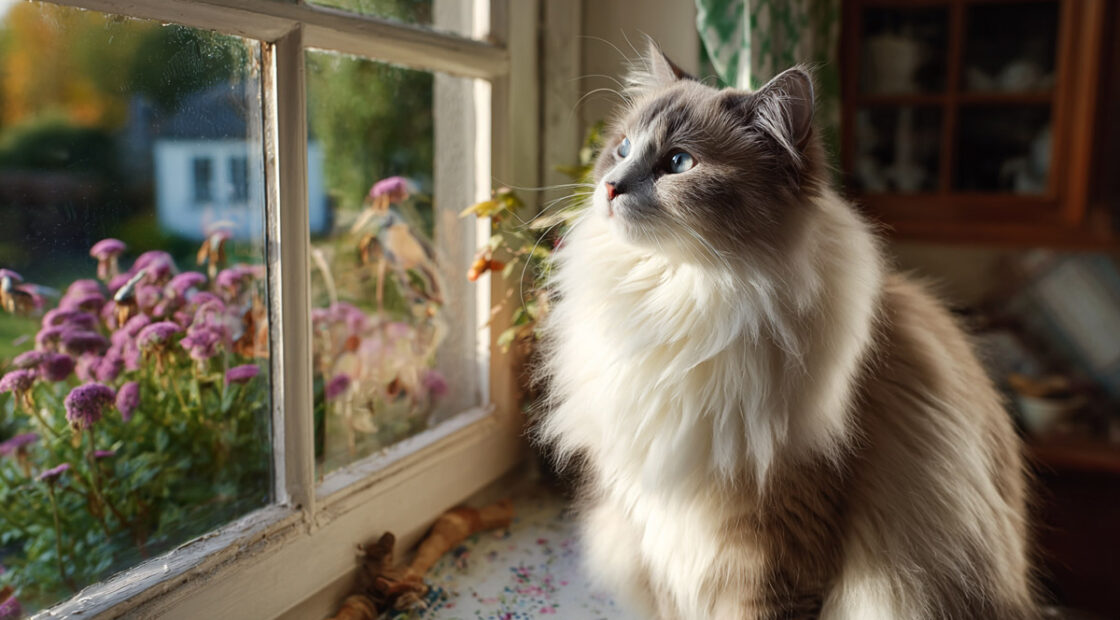
Josephine was a white longhaired queen, and in 1960s Riverside, California, Ann Baker developed the Ragdoll from her offspring. The result is a large, semi-longhaired pointed cat with vivid blue eyes and a placid, affectionate temperament.
Plenty of people assume the name means the cats go floppy the second you pick them up. The Cat Fanciers’ Association (CFA, 2026) states that this trait is not typical of most of today’s cats, so docile is accurate and floppy is not.
Hypertrophic cardiomyopathy (HCM) is the main heritable health concern. A cheek-swab DNA test screens for it through a single linked mutation.
What Is a Ragdoll Cat?
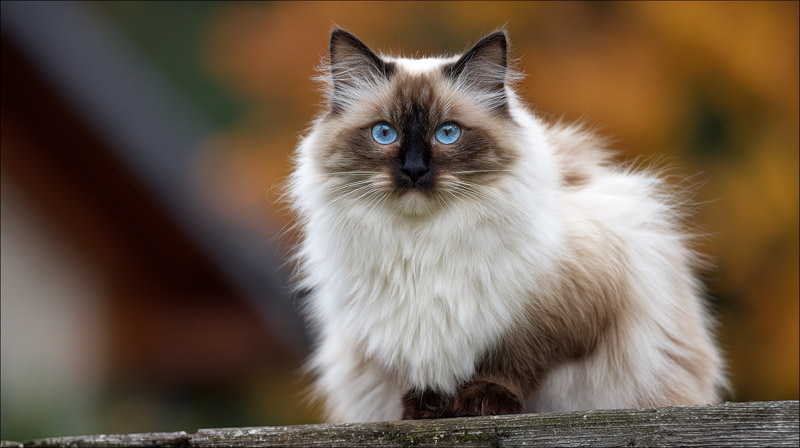
The pointed coat is what most people notice first. Pointed means the body is always lighter than the face, ears, legs and tail, and the Cat Fanciers’ Association’s standard (CFA, 2026) pairs that coloring with blue eyes and a long, heavily boned body.
Next to other longhaired cats, the Ragdoll has mostly guard hairs and very little woolly undercoat, so the fur lies flat and silky. The body is rectangular, with a full chest and a long plumed tail. The temperament was part of the plan too, since the breed’s founder selected for docile, affectionate cats.
The name refers to the rag doll toy. It comes from the limp, relaxed response that Ann Baker attributed to the founding queen, Josephine.
Where the Ragdoll Breed Came From
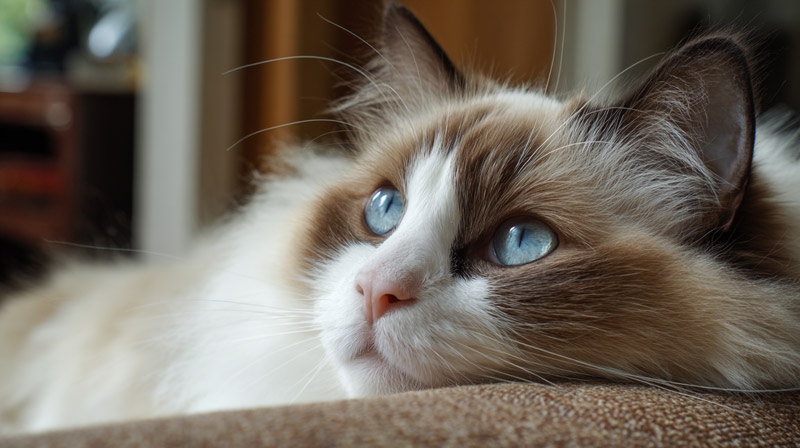
Baker’s stock is the only root of the breed. PetPlace reports that all genuine Ragdolls descend from it, which makes the early history short.
Ann Baker, Josephine and the IRCA
CFA’s breed history describes Josephine as a white domestic longhair carrying the colorpoint gene. Baker bred her offspring to other domestic longhairs and kept the cats with the look and temperament she wanted.
The Royal Veterinary College authors (2025) summarize the foundation as a white Angora-type longhair, a seal mitted male and a solid black cat.
Some accounts credit a Persian and Birman contribution, but CFA’s history names only domestic longhairs.
Hill’s Pet calls the popular origin legend impossible and says only the 1960s California start can be verified.
Baker protected the name and founded the International Ragdoll Cat Association (IRCA) in 1971, according to PetPlace. The IRCA has dwindled since her death in 1997.
Which Registries Recognize the Ragdoll?
CFA, GCCF and WCF all publish a Ragdoll standard, and the milestones differ from one to the next.
| Registry | Documented fact | Date |
|---|---|---|
| CFA | Accepted for registration, then advanced to championship; no outcross breeds allowed | 1993, then 2000 |
| GCCF (UK) | Breed imported, then recognized nine years later (Your Cat) | 1981, then 1990 |
| WCF | Standard describes a medium to large, muscular, heavy cat | Updated April 2026 |
Other registries, including TICA and FIFe, publish their own standards, and their pattern lists differ from CFA’s.
Older guides still say colorpoint and mitted cats can be registered with CFA but not shown (VCA Animal Hospitals). CFA’s current standard lists show classes for all four of its patterns, so that advice is out of date.
Ragdoll Size and Growth
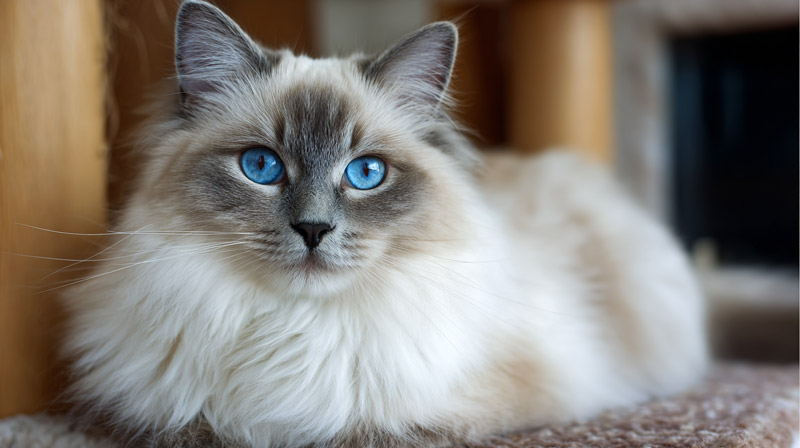
Published weights for Ragdolls disagree because they measure different things. A breed standard describes the heavy end of the range, and veterinary records describe the typical cat on the exam table.
Mature males can reach or exceed 20 lb, and females are usually smaller (CFA, 2026). The clinic numbers sit lower, with a median of 4.46 kg for adults, 4.97 kg for males and 3.83 kg for females (O’Neill et al., Companion Animal Health and Genetics, 2025).
Growth timing splits the same way. CFA puts full size at four years, while the VetCompass weight curves stop climbing around two years.
Neither source is wrong. VetCompass averaged every recorded weight for cats older than nine months, which includes neutered cats and young adults still filling out.
Treat 20 lb as a ceiling, not a target. CFA’s standard asks for a firm, muscular body and not a fat one, and it allows for slow maturation in young adults.
Weight control is where owners slip. CFA flags the breed’s love of food as an obesity risk, and obesity was the third most common disorder in the UK clinic data, with males diagnosed significantly more often than females.
Ragdoll Coat Patterns, Colors and Eye Color
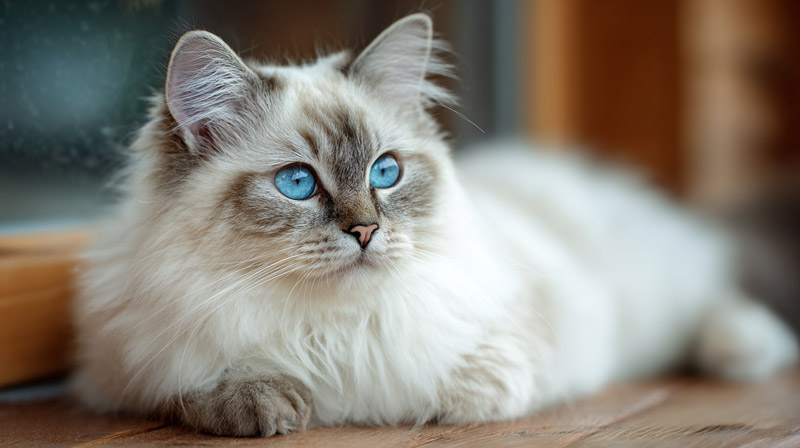
Every Ragdoll is pointed and blue-eyed, so the variation comes from how much white overlays the points. CFA’s standard sorts that variation into four patterns and six point colors.
The coat is moderately long and silky, built mostly from guard hairs. CFA prefers a ruff but accepts shorter coats in unaltered adults and through the seasons.
Patterns
The four CFA patterns differ by where the white sits.
- Colorpoint cats have darker ears, mask, feet and tail, with no white anywhere on the body.
- Mitted cats have white front mittens and a white chin that runs into a belly stripe. Some also carry a blaze on the face.
- A bi-color shows an inverted white V on the mask, plus a white chest, underside and legs. The ears and tail stay colored.
- Van cats are white except for color on the ears, tail and mask.
Many guides count three patterns and fold van into bicolor. Hill’s Pet, for example, lists bicolor, points and mitted, so check which count a breeder’s registry uses before comparing kittens.
Point Colors
CFA recognizes six point colors, and each one is judged by the contrast between body and points.
- Seal points are deep brown on a pale fawn to cream body.
- Blue means deep blue points against a cold, bluish white body.
- Chocolate points are milk-chocolate on ivory.
- Lilac points are a frosty grey with a pink tinge, on a white body.
- Red and cream are separate colors, with apricot-to-red or pale cream points on a clear white body.
Each color can appear solid, as lynx (tabby barring) or as tortie, mottled with red or cream.
Ragdolls generally darken with age. A pale kitten and a deeper adult are normal, provided body and points keep definite contrast.
Eye Color
The standard calls for large, vivid blue ovals that are wide set and moderately slanted. Small or round eyes get penalized, and so does blue that is either so pale it looks washed out or so dark it reads as black.
Any eye color other than blue is a disqualification, and so are crossed eyes. Eye color is the one trait with no exceptions across patterns and colors.
Ragdoll Temperament: Why They Go Limp and How Active They Are
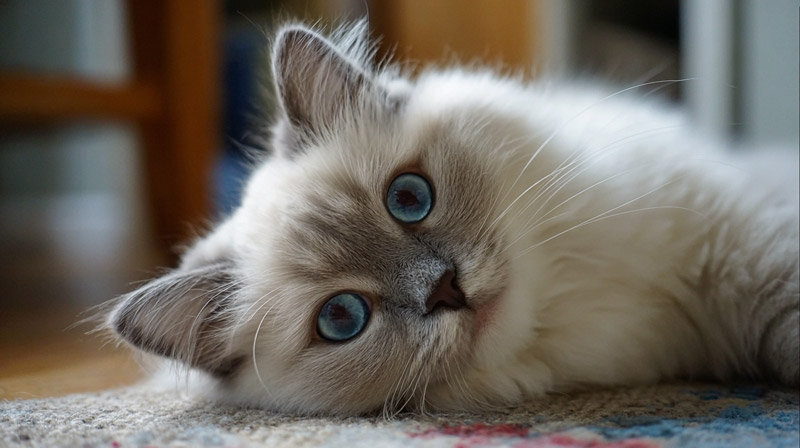
Ragdolls are docile and affectionate, and only moderately active. Limpness is the part of the reputation that the breed’s own registry downplays.
CFA says Ann Baker claimed Josephine went limp when held, and adds that this is not typical of most of today’s Ragdolls. The name stuck anyway.
CFA describes a cat that is loving without being demanding, greets owners at the door and stays close once they are home. Many are playful and trainable, and some learn to fetch or come when called. They are quiet, with an occasional soft mew, and content with play sessions without insisting on them. Space is not a big issue, because the breed adapts to most homes.
Clinic data adds a caveat. Aggression still appears among the 32 most commonly recorded diagnoses in the Royal Veterinary College’s 2025 VetCompass study, at 2.17% of Ragdolls (44 cats). Docile describes the average cat, not every cat.
The same trusting nature has a practical side. CFA recommends introducing a Ragdoll carefully to resident cats or dogs, which may not be as gentle.
Health Problems in Ragdolls and Lifespan
HCM is the breed’s main heritable concern, but UK clinic records show that dental disease and digestive upset are what vets diagnose most often, with obesity close behind.
The R820W allele frequency was 0.17 in a University of Milan multi-breed study (Longeri et al., 2013). The Langford Vets Molecular Diagnostic Unit puts R820W prevalence in the Ragdoll population at around 13%. Those two numbers come from different samples and different measures, allele frequency in one and prevalence in the other, so they should not be averaged. Neither describes a rare mutation.
For lifespan, the median age at death was 12.85 years (O’Neill et al., Companion Animal Health and Genetics, 2025).
Hypertrophic Cardiomyopathy
HCM thickens the left ventricular wall and raises the risk of sudden cardiac death. The UC Davis Veterinary Genetics Laboratory ties the Ragdoll form to a single mutation in the MYBPC3 gene, called R820W. It is autosomal dominant with incomplete penetrance, and the highest risk falls on cats carrying two copies.
Cats with one copy are not likely to show signs and may live a normal lifespan, according to the same lab. The Milan study found that one copy does not fully predict disease, which points to other mechanisms at work.
CFA reports that breeders now test routinely and are working to remove carrier cats from the gene pool.
Bladder and Kidney Stones
A Royal Veterinary College VetCompass study (2023) placed the Ragdoll among five breeds at higher risk of kidney and ureter stones than non-purebred cats. The others were the British Shorthair, Burmese, Persian and Tonkinese.
Bladder stones are a separate matter. The Merck Veterinary Manual, as relayed by Hill’s Pet, lists the Ragdoll among the breeds more likely to form calcium oxalate stones.
Kidney disorder was the most common recorded cause of death in the Ragdoll cohort, which matches the pattern in cats overall (RVC, 2025).
How Long Ragdolls Live
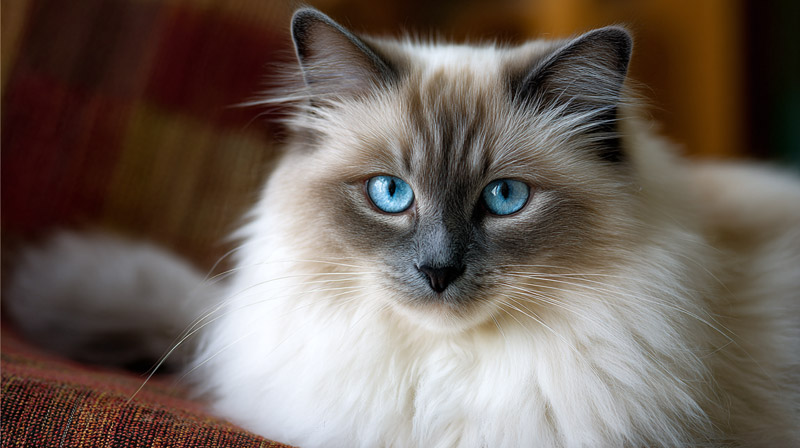
The best current figure is the 12.85-year median age at death from the 2025 VetCompass study of UK Ragdolls.
An earlier RVC mortality study reported a far shorter Ragdoll median. The 2025 authors attribute that to a young study population with too few old cats to contribute deaths, and Swedish insurance data showed the same downward bias.
The authors conclude that Ragdoll lifespan is largely typical for purebred cats, and crossbreds in the earlier study outlived purebreds overall. The shortfall tracks pedigree status more than anything specific to Ragdolls.
Risk of almost all disorders climbed sharply in senior Ragdolls (RVC, 2025). Breed guides publish lifespans that differ by several years and rarely name a dataset, so anchor on the VetCompass median.
How Does Ragdoll HCM Genetic Testing Work?
The lab looks for the Ragdoll HCM mutation in a cheek swab and reports zero, one or two copies. The result describes genotype only and does not replace a heart scan.
Collecting and Submitting the Sample
- The UC Davis Veterinary Genetics Laboratory (VGL) asks owners to create a MyVGL account, place the order and print the submission form, because kits are not mailed.
- Buy ordinary cotton swabs from a pharmacy, and make sure the cat has not eaten or drunk for at least an hour.
- Rotate each swab against the cheek and gum for 15 seconds, four swabs in total, and avoid saliva, the tongue and the teeth.
- Tape the swabs to the form and ship them. The test costs $44 per cat at VGL.
- For a UK negative register, a vet has to be involved. Langford Vets, the University of Bristol lab that runs the same test, requires the vet to take the sample and confirm identity from the microchip number for GCCF and ICC registers.
What Each Result Means
| Result | Copies of mutation | Breeding consequence |
|---|---|---|
| Normal (N/N) | None | Cannot pass the mutation on (VGL) |
| Heterozygous (N/HCMrd) | One | Mate only to a negative cat, then screen the kittens (Langford Vets) |
| Homozygous (HCMrd/HCMrd) | Two | High risk, generally not bred (Langford Vets) |
Labs read the one-copy result differently. VGL’s wording is more reassuring than Langford Vets, which counts a single copy as raised risk.
The two-copy result carries real weight. Over half of homozygous Ragdolls did not survive five years in the Royal Veterinary College and Langford Vets survey, though some were still alive at 12 (Borgeat et al., Journal of Veterinary Cardiology, 2014).
What the Test Does Not Cover
The gene test looks for one mutation. A normal result does not rule out other, unidentified mutations (Langford Vets), and UFAW notes that some Ragdolls develop HCM despite testing negative.
Only an echocardiogram shows the disease itself. The ACVIM consensus statement (2020) defines HCM by ultrasound findings, namely diffuse or regional thickening of the left ventricular wall with a non-dilated chamber.
In practice the two get used together. Langford Vets recommends a scan for positive cats to establish disease status, and UFAW suggests scanning breeding animals even when they test negative.
Ragdoll Grooming and Shedding
A steel comb, worked through the coat once or twice a week, covers most of it, and shedding gets heavier when the seasons change. CFA calls the time commitment minimal.
Fur knots under the front and hind legs, according to the British Ragdoll Cat Club, so those spots deserve extra attention. For baths, CFA suggests asking the breeder which products and technique suit the coat.
Yes, Ragdolls shed. CFA ties the breed’s reduced shedding and matting to the lack of a thick, insulating undercoat, with the heaviest loss at the change of seasons.
CFA’s standard calls the fur naturally non-matting. The 2025 VetCompass study still recorded haircoat disorders such as matting in 4.00% of Ragdolls, more often than in UK cats overall.
Non-matting describes the coat type and guarantees nothing. A coat that resists tangles still knots when grooming lapses.
Ragdoll vs Maine Coon, Birman and Ragamuffin
Color range is the main split from the Maine Coon, head and eye shape separate the Birman, and the Ragamuffin comes down to lineage and breeding rules.
| Breed | Coat and color | Easiest tell-apart trait |
|---|---|---|
| Ragdoll | Always pointed | Wedge head, blue oval eyes |
| Maine Coon | Most colors, never colorpoint | Rectangular frame, flowing coat |
| Birman | Pointed, white gloves on all four paws | Round blue eyes, small ears |
| Ragamuffin | All colors and patterns | Ragdoll lineage, outcrosses permitted |
Maine Coon
A Maine Coon is the pick when you want a large cat that is not pointed. The GCCF profile lists most colors but excludes chocolate, lilac and colourpoint.
It also carries its own heart mutation. VGL offers a separate test for the Maine Coon A31P mutation, and the Ragdoll assay does not detect it.
Birman
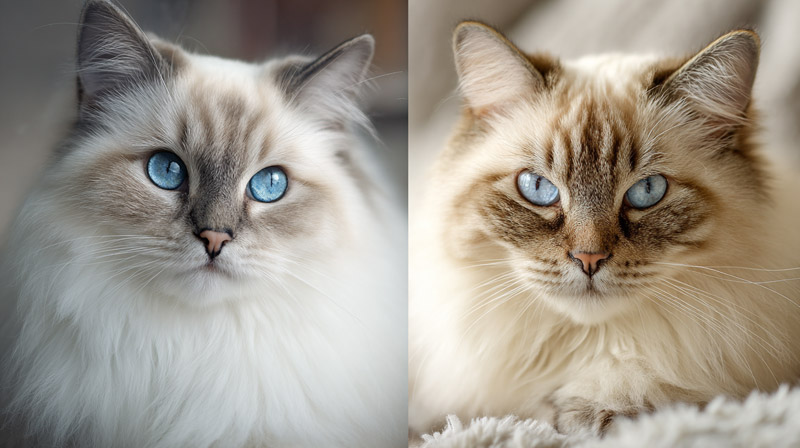
The Birman shares the pointed, blue-eyed look and often gets mistaken for a mitted Ragdoll. GCCF describes four pure white feet, with front gloves and rear gauntlets, produced by the Birman gloving allele, a KIT gene variant distinct from the white spotting variant behind bi-colour cats.
The chin and the eyes settle it. A mitted Ragdoll must have a white chin (CFA standard), while Birman standards treat a white chin spot as a defect (a disqualification under CFA, a fault under GCCF), and VCA Animal Hospitals describes Birman eyes as round and always deep blue.
Ragamuffin
Breeders who split from Ann Baker’s IRCA built the Ragamuffin from Ragdoll lines. Sources date the split anywhere from the 1970s to 1994, but the CFA milestones agree: miscellaneous class in 2003, championship in 2011 (Wikipedia, WebMD).
Ragamuffin breeders kept more breeding freedom, and the CFA standard lists the long-haired Selkirk Rex as an allowed outcross. Pointed Ragamuffins can be registered with CFA but not shown in championship classes (WebMD).
The Ragdoll HCM test also applies to the Ragamuffin, according to VGL.
If you are stuck choosing, go by the trait you will not trade away. Points and blue eyes point to the Ragdoll or Birman, white gloves point to the Birman, and non-pointed colors point to the Maine Coon or Ragamuffin.
When a Ragdoll Is the Wrong Cat
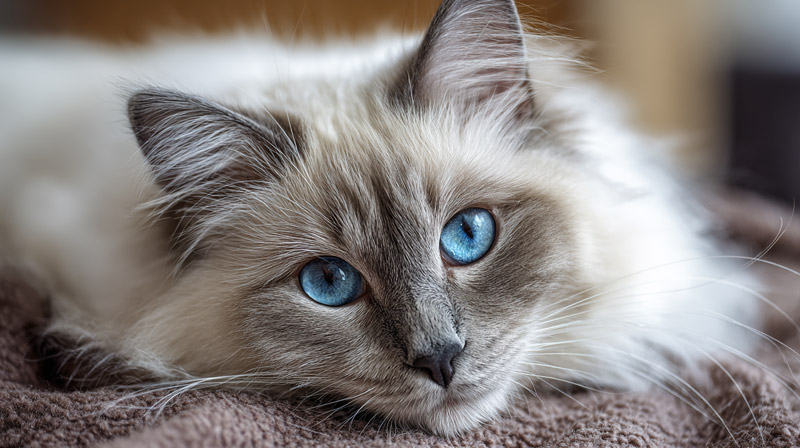
Anyone who wants a low-upkeep, low-risk purebred should probably look elsewhere. The vet records, the dental picture and the heart screening all ask for ongoing attention.
The breed does have real points in its favor. A DNA test exists for the main heritable heart problem. A pedigree brings family history, and sometimes genetic results, that random-bred cats usually lack (CFA, 2025). The breeder also becomes a lifelong advisor on the cat and the breed (CFA, 2025).
Against that, 61.28% of reviewed Ragdolls had at least one disorder recorded in 2019, including minor items such as fleas and overgrown nails (O’Neill et al., 2025). Dental disease is the bigger worry. The Royal Veterinary College calls it a priority welfare issue and tells owners to seek veterinary advice on dental care.
Supply is the smaller annoyance. Finding a Ragdoll kitten generally should not be hard, but a particular color or sex means a wait, and some breeders run small programs with one or two litters and waiting lists (CFA, 2025).
CFA calls the breed relatively healthy. The clinic data show how much routine care that still involves.
The breed is a bad fit if you cannot budget for routine dental care, if you expect the coat to look after itself, or if the kitten you are looking at comes from parents with no HCM results.
If screening and care costs are the sticking point, a domestic longhair is the sensible alternative. CFA registers non-pedigree companion cats through its Companion Cat World program.
Ragdoll Kitten Price and How to Choose a Breeder
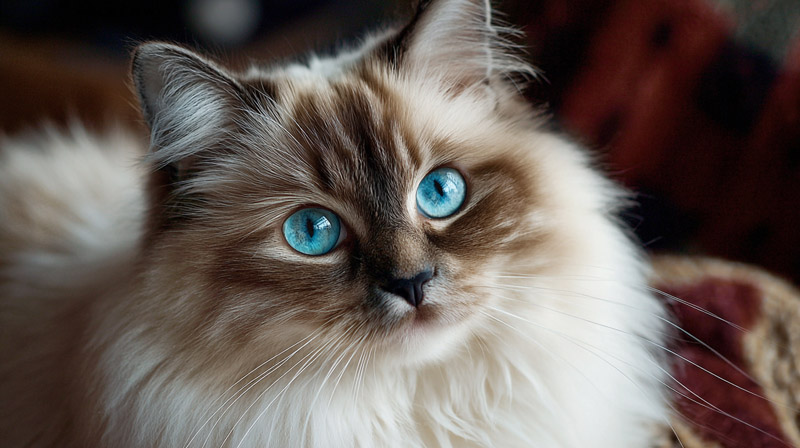
Price depends on country and on what the price includes. In Australia, Catster’s buyer guide gives a range of AU$1,000 to AU$2,500 for a Ragdoll kitten, and a Perfect Pets listing, an Australian breeder marketplace, quotes AU$2,500 for a pedigreed kitten.
US and UK guides quote different ranges, and many are written by sellers or insurers. Local registry-listed breeders are a better benchmark than any single guide.
What the Price Should Include
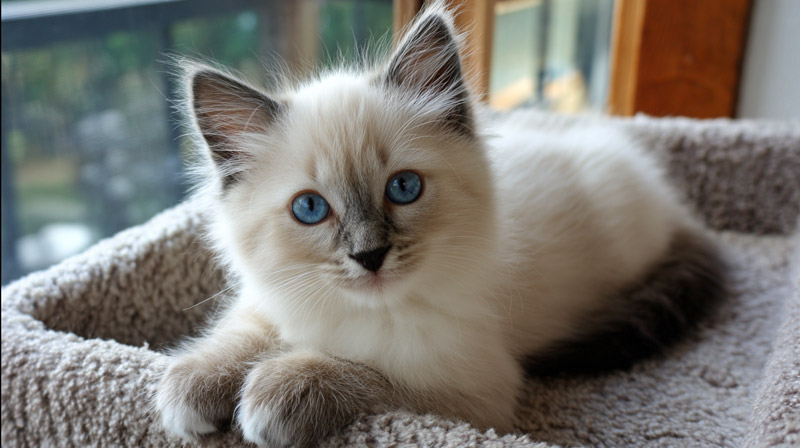
Lapdolls Ragdoll Cattery sells every kitten at one flat price of $2,700 regardless of color, pattern or sex. The price includes spay or neuter, a microchip, vaccinations, TICA/CFA registration and a three-year genetic health guarantee (Lapdolls, 2026).
Not every breeder packages it that way, so it is worth asking what comes with the kitten.
- Some breeders withhold registration papers until proof of spay or neuter (CFA, 2025).
- Vaccinations should cover at least the FVR-CP series before the kitten leaves.
- Some health guarantees cover genetic conditions and offer compensation, and others do not.
- Many breeders offer a rehoming guarantee or a right of first refusal.
Breeder Checks Before You Commit
Ask for HCM certificates for both parents. Two normal parents cannot pass the mutation on, so their results settle more than a single certificate for one kitten.
A verifiable registry listing, such as CFA’s Find-A-Breeder directory, is a reasonable starting point. References from other breeders, exhibitors and previous buyers tell you more, and so does how the kittens were socialized to dogs, children and household noise.
A cat show visit is what CFA calls the best way to meet breeders and see their cats. Many breeders no longer accept cattery visitors, and CFA notes that a phone call reveals a lot.
CFA advises against taking a pedigreed kitten home before 14 weeks except in very special circumstances (CFA, 2025).
Ragdoll FAQ
Are Ragdolls hypoallergenic?
No. Hill’s Pet rates the breed as not less allergenic.
CFA names undiagnosed allergies among the most common reasons a placement fails, so spend time around adult Ragdolls before you commit.
Are Ragdolls good with children and other pets?
Yes. CFA reports that aggression is rare in the breed and that Ragdolls get along well with children and other animals.
Temperament still varies by kitten. CFA says a breeder can act as matchmaker and place a properly socialized cat that fits your household.
Can a Ragdoll be left alone while I work?
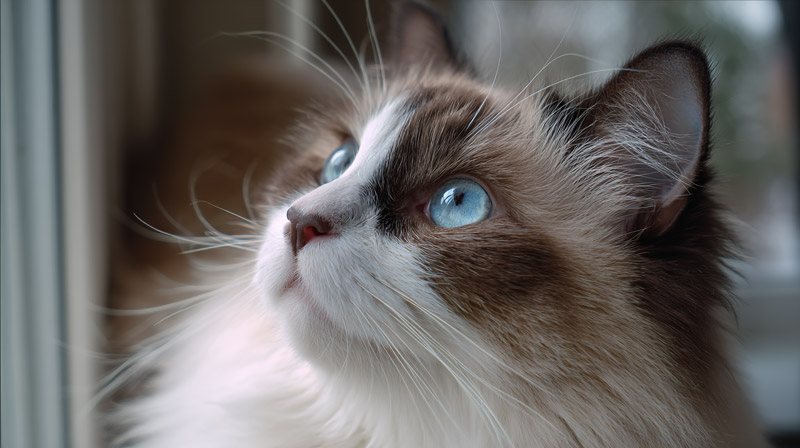
Short workdays are likely fine, but no source sets a safe absence limit. CFA calls the breed loving without being demanding and only moderately active.
The same registry says every cat needs daily attention, and some breeds cope better with a second pet.
Are Ragdolls a common breed?
Yes, and the breed keeps gaining ground. VetCompass found Ragdolls made up 3.72% of UK cats born in 2019, up from 0.70% in 2005 (O’Neill et al., 2025).
CFA’s breed page still calls the Ragdoll the most popular breed worldwide, citing its registration statistics. CFA’s 2025 ranking, based on 2024 registrations, put the Maine Coon first.
How Often Does a Ragdoll Need a Heart Scan?
A breeding Ragdoll should have its first echocardiogram at age two. The Veterinary Cardiovascular Society schedule then repeats the scan every two years for a breeding female and every year for a breeding male. EveryCat Health Foundation and iCatCare advise yearly scans for breeding cats.
The interval offers no guarantee. EveryCat Health Foundation breeder advice states that HCM appears at any age, so one normal scan does not clear a cat.
Order matters here, because each step sets how closely the next one needs watching. Parents’ genotype certificates come before purchase, an earlier scan makes sense for any kitten with two copies, and scheduled rescans continue for life.
Negative parents and grandparents let screening start with more confidence (Veterinary Cardiovascular Society). A two-copy kitten should not wait until two, since the UC Davis Veterinary Genetics Laboratory reports that cats with two copies usually show severe signs between 1 and 2 years of age.
The trade-off is a recurring cardiology bill for a result that holds only until the next scan. A validated test for a second Ragdoll mutation would change this advice, which was checked on 1 November 2026.