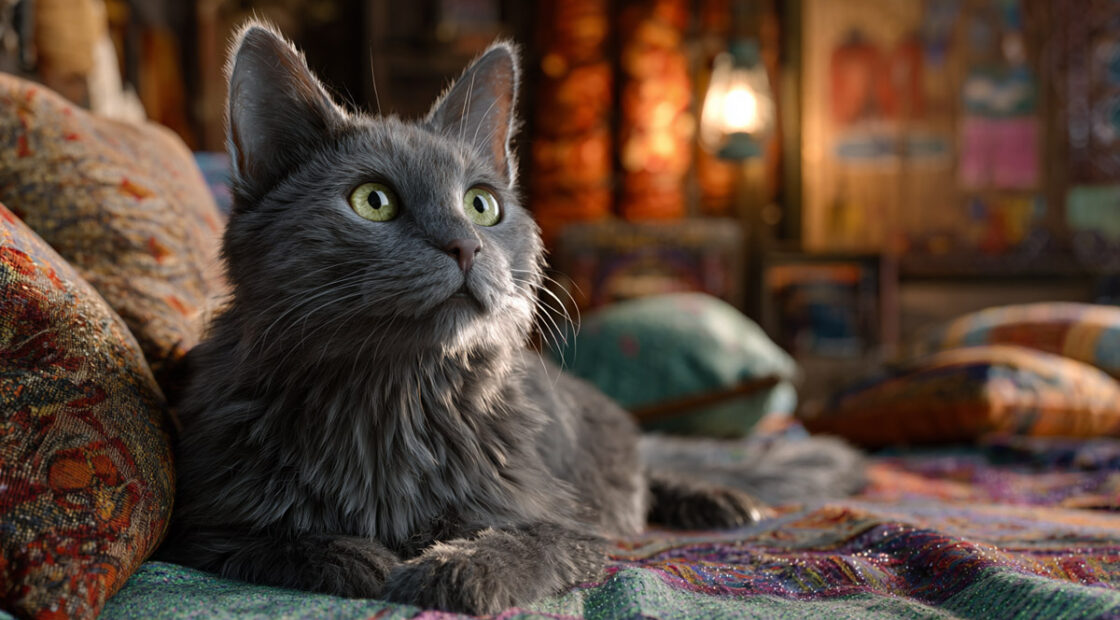
Those piercing emerald eyes and shimmering silver-blue coat catch your attention across the room. Russian Blue cats combine elegance with intelligence in a package that’s captivated cat lovers for centuries.
But there’s more to these reserved felines than stunning looks.
From their mysterious origins in northern Russia to their reputation as one of the healthiest purebred cats, Russian Blues offer unique characteristics that separate them from other gray-coated breeds. Their low-shedding double coat, devoted personality, and impressive 15-20 year lifespan make them compelling choices for the right owners.
This guide covers everything you need to know about Russian Blues. You’ll discover their physical traits, temperament quirks, health considerations, care requirements, and whether this intelligent breed matches your lifestyle.
Whether you’re considering adoption or simply curious about these silver-coated aristocrats, you’ll find practical insights to understand what makes Russian Blues so special.
Russian Blue Cat Breed Statistics
| Characteristic | Details |
|---|---|
| Weight | Males: 10-12 lbs / Females: 7-10 lbs |
| Height | 9-11 inches |
| Length | 15-18 inches |
| Lifespan | 15-20 years |
| Coat Type | Short, dense double coat |
| Coat Color | Blue-gray with silver tipping |
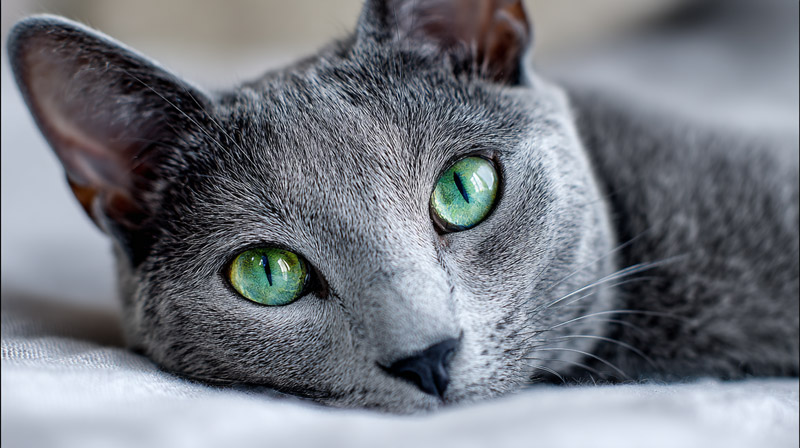
| Eye Color | Emerald green |
| Shedding Level | Low to moderate |
| Energy Level | Moderate to high |
| Temperament | Gentle, intelligent, reserved, loyal |
| Affection Level | Moderate (bonds deeply but not clingy) |
| Friendliness with Kids | Good (best with older children 8+) |
| Friendliness with Dogs | Good (with proper introductions) |
| Friendliness with Cats | Good |
| Vocalization | Moderate (soft, quiet voice) |
| Intelligence | Very high |
| Trainability | High |
| Playfulness | High (especially when young) |
| Exercise Needs | 60-90 minutes daily |
| Grooming Needs | Low (brush 2-3 times weekly) |
| Health Issues | Obesity, HCM, urinary tract issues, diabetes |
| Hypoallergenic | More tolerable (produces less Fel d 1) |
| Good for Apartments | Yes |
| Good for First-Time Owners | Yes |
| Adaptability to Change | Low (prefers routine) |
| Tendency to Gain Weight | High |
| Price Range | $400-$3,000 |
| Origin | Russia (Arkhangelsk) |
| Breed Recognition | CFA, TICA, GCCF, FIFe |
What Is a Russian Blue Cat?
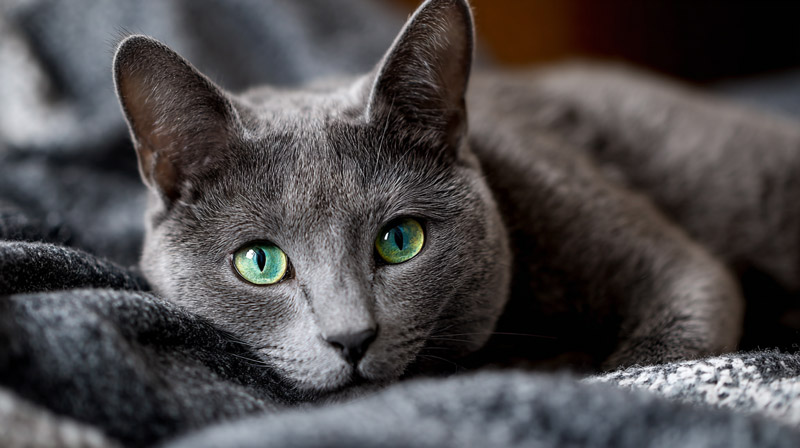
A Russian Blue cat is a naturally occurring breed with a distinctive blue-gray double coat, striking emerald green eyes, and a refined, muscular build.
These cats originated in northern Russia, specifically near the port of Arkhangelsk (Archangel Isles).
The breed earned recognition from major cat registries including CFA, TICA, GCCF, and FIFe.
As a natural breed rather than a man-made hybrid, Russian Blues developed their unique characteristics over centuries in the cold Russian climate.
Their plush coat and calm temperament made them favorites among Russian nobility and eventually cat fanciers worldwide.
The breed competed in early English cat shows starting in 1872, initially called “Archangel Cats.”
They received their own classification separate from other blue cats in 1912.
Physical Characteristics
How Big Do Russian Blue Cats Get?
Males typically weigh 10-12 pounds, while females weigh 7-10 pounds.
Height ranges from 9-11 inches at the shoulder, with a body length of 15-18 inches.
These medium-sized cats have a semi-foreign body type. Fine-boned but muscular underneath their dense coat.
Russian Blues reach full size slowly. They continue growing until 3-4 years old, longer than most breeds.
Their slender appearance disguises surprising strength.
What Does a Russian Blue Cat’s Coat Look Like?
The coat is short to medium length with an incredibly dense, plush double-layer texture.
It stands out from the body due to thick guard hairs, creating a pampered, fluffy look.
Texture: Soft, silky undercoat with even-colored guard hairs tipped in silver. This creates the breed’s signature shimmering effect.
Pattern: Solid blue-gray only. No tabby markings, points, or other patterns accepted.
Color variations: Ranges from light silver-blue to darker slate-gray. Lighter shades preferred in show standards.
Each hair shaft carries silver tipping, producing a luminous sheen especially visible under sunlight.
Shedding level: Low to moderate. They shed less than many breeds despite the double coat.
The dense fur protected ancestors from harsh northern Russian winters near the Arctic Circle.
Distinctive Physical Features
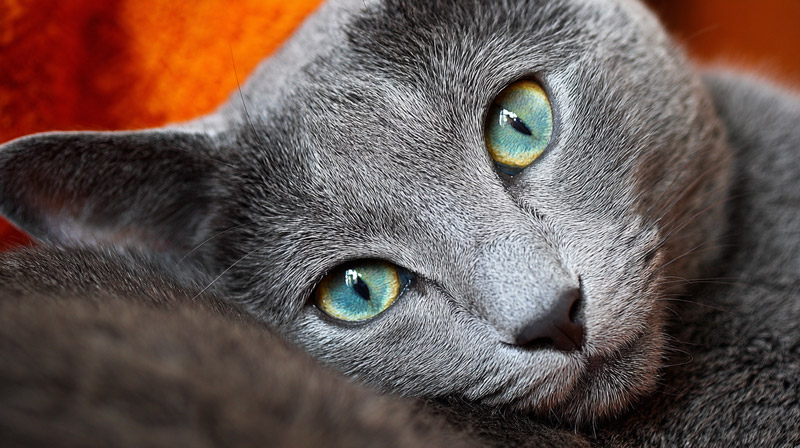
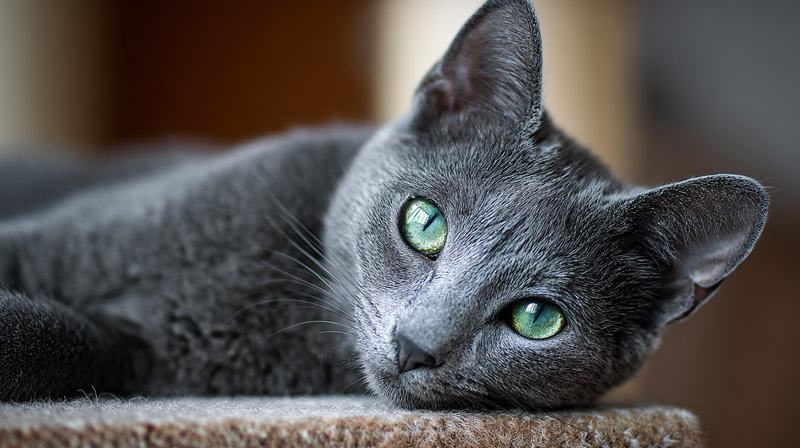
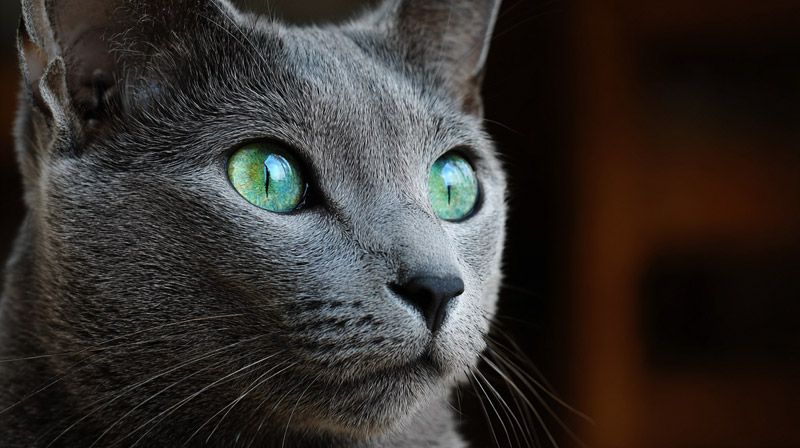
Eyes: Large, round, and wide-set. Start as yellow with green rims in kittens, maturing to vivid emerald green by adulthood.
Ears: Large, wide at the base, and slightly pointed. Set well apart on the head.
Head structure: Wedge-shaped with a broad skull. The forehead is flat and long in profile, descending gently to a straight nose.
Muzzle: Blunt and part of the overall wedge shape. No exaggerated pinch or whisker break.
Unique marker: Natural “smile” created by the slight upturn at the corners of the mouth.
Tail: Long, straight, and proportionate to body length. Medium thickness with a tapered end.
Legs: Long, slim, and fine-boned. Create an elegant, graceful appearance.
Paws: Small and rounded. Paw pads are lavender-pink or mauve in color.
Nose leather: Slate gray, matching the coat tone.
Russian Blue Personality and Temperament
Are Russian Blue Cats Affectionate?
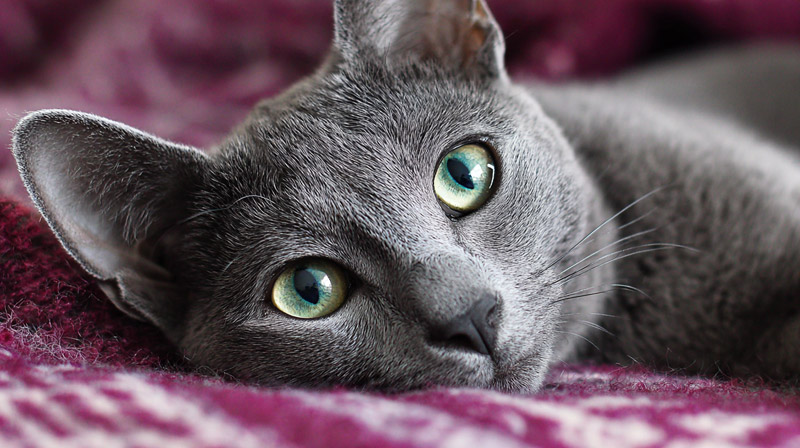
Russian Blues bond deeply with their families but show reserved behavior with strangers.
They’re not velcro cats demanding constant attention. Instead, they observe from a distance before engaging.
Once comfortable, they become devoted companions who follow owners room to room (yes, even the bathroom).
Attention requirements: Moderate to high. They need 2-3 hours of daily interaction but can entertain themselves when alone.
Stranger reaction: Cautious and shy initially. They evaluate new people carefully before warming up.
These cats pick favorite family members and show them particular devotion.
They’ll sit nearby rather than on laps, maintaining independence while staying close.
How Active Are Russian Blue Cats?
Energy level: Moderate to high, especially as kittens and young adults.
Play drive: Strong hunting instinct. They love interactive toys that mimic prey.
Exercise requirements: 60-90 minutes of daily activity through play sessions.
Favorite activities:
- Playing fetch (genuinely retrieving toys like dogs)
- Climbing cat trees and seeking high perches
- Puzzle toys and food puzzles
- Observing from elevated spots
- Interactive play with feather wands
Intelligence level: Extremely high. They rank among the smartest cat breeds.
Their mechanical aptitude is legendary. Expect open cabinets, drawers, and containers.
These cats solve problems and learn to manipulate latches, doors, and even jars.
Training them for tricks, leash walking, or using puzzle toys comes naturally.
Do Russian Blue Cats Get Along with Others?
Children compatibility: Best with older children (8+ years) who understand gentle handling. They tolerate younger kids if properly socialized but prefer calm environments.
Dog compatibility: Good, especially with calm, cat-friendly dogs. Early socialization helps.
Other cats: Generally good, but they can be territorial. Gradual introductions work best.
Multi-pet households: Suitable, though they may claim favorite spots and routines.
Territorial tendencies: Moderate. They establish territories but aren’t aggressive about them.
They thrive in stable households without frequent changes or visitors.
How Vocal Are Russian Blue Cats?
Vocalization frequency: Moderate. Not silent but nowhere near Siamese levels.
Voice characteristics: Soft, quiet meows. Pleasant and melodic rather than loud or demanding.
Communication style: They “talk” to communicate needs like hunger or attention. Expect louder protests if meals are late or litter boxes aren’t clean.
Russian Blues use vocalizations purposefully rather than constantly chattering.
Health and Lifespan
How Long Do Russian Blue Cats Live?
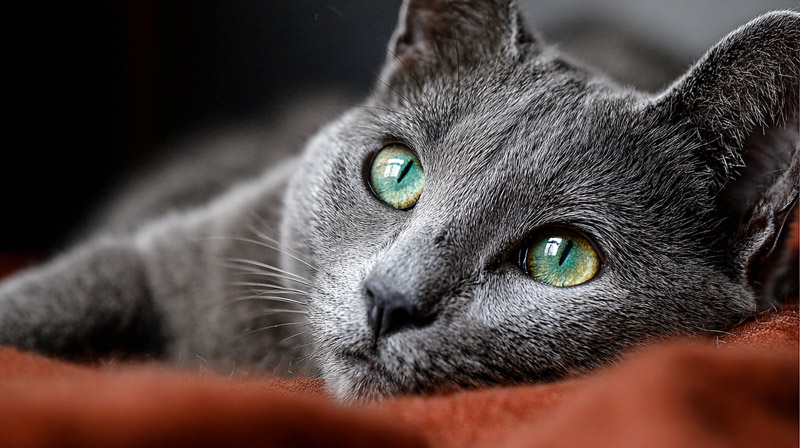
Average lifespan: 15-20 years, significantly longer than average domestic cats.
Some Russian Blues have reached their early twenties with proper care.
Factors affecting longevity:
- Quality diet and weight management
- Regular veterinary care
- Indoor-only lifestyle
- Early disease detection
- Stress-free environment
Compared to the average 12-15 year lifespan of domestic cats, Russian Blues are exceptionally long-lived.
Common Health Issues in Russian Blue Cats
Russian Blues are remarkably healthy as naturally occurring breeds go. But watch for these conditions.
Obesity
The number one health issue for this breed.
Russian Blues love food and will beg for seconds and thirds.
Without portion control, they gain weight quickly.
Age of onset: Any age, but most common in adults 3+ years
Symptoms: Weight gain, decreased activity, difficulty grooming
Treatment: Measured feeding, high-protein diet, increased exercise
Prevention: Scheduled mealtimes (no free-feeding), measured portions, daily play sessions
Obesity leads to diabetes, heart disease, joint problems, and shortened lifespan.
Hypertrophic Cardiomyopathy (HCM)
Heart muscle walls thicken, reducing cardiac function.
Age of onset: Young adulthood, rarely as early as 3 months
Prevalence: Not breed-specific but occurs in Russian Blues
Symptoms: Often asymptomatic until advanced. May show lethargy, rapid breathing, loss of appetite, or sudden paralysis of hind legs
Treatment: No cure. Managed with medication and dietary changes
Prevention: Cardiac screening, especially for breeding cats. Reputable breeders test parents.
Complications: Can lead to congestive heart failure, blood clots (FATE), irregular heartbeats
Polycystic Kidney Disease (PKD)
Genetic condition causing multiple cysts on kidneys, progressively impacting function.
Symptoms: Increased thirst and urination, weight loss, vomiting, lethargy
Age of onset: Typically develops in older cats
Treatment: Supportive care, special diet, hydration management
Prevention: Genetic screening of breeding stock
Urinary Tract Issues
Russian Blues may be prone to bladder stones and Feline Lower Urinary Tract Disease (FLUTD).
Causes: Stress, infections, bladder stones, infrequent urination
Symptoms: Frequent urination, straining, blood in urine, inappropriate urination
Treatment: Depends on cause. May include antibiotics, diet changes, stress reduction
Prevention: Proper hydration, stress management, clean litter boxes
Diabetes
More common in overweight Russian Blues.
Symptoms: Weight loss despite good appetite, excessive thirst, increased urination
Treatment: Weight loss, high-protein/low-carbohydrate diet, possibly insulin
Prevention: Weight management through diet and exercise
Periodontal Disease
Like most cats, dental issues are common.
Symptoms: Bad breath, red gums, difficulty eating, tooth loss
Treatment: Professional dental cleanings, tooth extractions if severe
Prevention: Daily tooth brushing with cat-safe toothpaste, dental treats
Progressive Retinal Atrophy (PRA)
Group of degenerative eye diseases affecting photoreceptors.
Symptoms: Night blindness progressing to complete vision loss
Age of onset: Varies
Treatment: No cure. Cats adapt well to blindness.
Prevention: Genetic testing
Skin Allergies (Atopy)
Environmental allergies causing itchy skin.
Symptoms: Itching, redness, hair loss, sores on legs, belly, face, and ears
Treatment: Allergy management, medicated baths, diet changes
Hyperthyroidism
Overactive thyroid gland, more common in older cats.
Symptoms: Increased hunger with weight loss, increased thirst, frequent urination, hyperactivity
Treatment: Medication, radioactive iodine therapy, or surgery
What Health Testing Should Russian Blue Cats Have?
Genetic screening:
- HCM genetic testing (if available)
- PKD screening
- DNA profile for breeding cats
Regular veterinary checks: Twice yearly exams, especially for cats over 7 years
Annual testing:
- Blood work (kidney function, thyroid levels, glucose)
- Urinalysis
- Blood pressure monitoring in senior cats
Dental exams: Annual professional evaluation, cleanings as needed
Cardiac screening: Echocardiograms for breeding cats and those with heart murmurs
Age-specific monitoring:
- Kittens: Growth tracking, vaccinations
- Adults: Weight monitoring, dental health
- Seniors (10+ years): More frequent blood work, kidney function tests
Caring for a Russian Blue Cat
What Do Russian Blue Cats Eat?
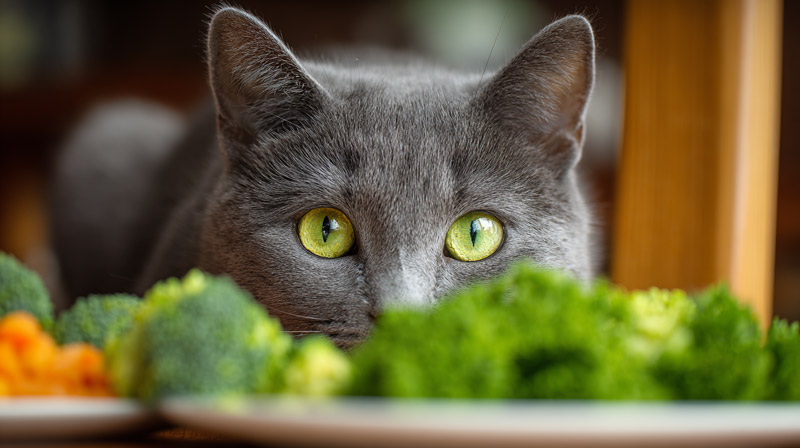
Protein requirements: 35-45% minimum. High animal protein supports muscle mass.
Feeding frequency:
- Kittens (under 6 months): 3-4 measured meals daily
- Adults: 2 measured meals daily
- Seniors: 2 meals, possibly adjusted portions
Portion sizes: Based on weight and activity level. Typically 1/4 to 1/2 cup per meal for adults.
Follow food packaging guidelines and adjust based on body condition.
Wet vs. dry food: High-quality options of either work. Many owners feed a combination.
Wet food adds hydration. Dry food supports dental health.
Special dietary needs:
- High protein, moderate fat
- Low carbohydrate (especially for obesity-prone cats)
- Quality animal protein as first ingredients
- Grain-free options if allergies present
Foods to avoid:
- Low-quality foods with fillers and by-products
- Excessive treats (max 10% of daily calories)
- Human foods toxic to cats (onions, garlic, chocolate, etc.)
Weight management: Critical for this breed. Measure food precisely. Avoid free-feeding.
How Do You Groom a Russian Blue Cat?
Brushing frequency: 2-3 times weekly with a medium-toothed comb. Daily during spring shedding season.
Their dense double coat benefits from regular combing to remove loose hair and distribute skin oils.
Bathing requirements: Rarely needed. Maybe 2-3 times per year or as needed.
Russian Blues are fastidiously clean self-groomers.
Nail trimming: Every 2-3 weeks using cat nail clippers.
Dental care: Daily tooth brushing is ideal. Minimum 3-4 times weekly with veterinarian-approved cat toothpaste.
Use water additives or dental treats as supplements.
Ear cleaning: Check weekly. Clean only if wax buildup present, typically monthly or less.
Use vet-approved ear cleaner and cotton balls (never Q-tips deep in ear canal).
Eye cleaning: Generally not needed unless discharge present. Wipe gently with damp cloth if needed.
Professional grooming: Not required. This is a low-maintenance breed.
Keep their litter box spotless. These cats are particular about cleanliness and may refuse dirty boxes.
How Much Exercise Does a Russian Blue Cat Need?
Daily activity requirements: 60-90 minutes of active play and movement.
Indoor vs. outdoor considerations: Best kept indoors only for safety and longevity.
If outdoor access desired, provide secure catios or leashed walks.
Recommended toys and enrichment:
- Feather wands and fishing pole toys (high prey drive)
- Balls and mice for solo fetch play
- Puzzle feeders for mental stimulation
- Laser pointers (always end with catchable toy)
- Cardboard boxes and paper bags
- Automated toys for independent play
Mental stimulation needs: High. This intelligent breed needs problem-solving activities.
Rotate toys weekly to maintain interest.
Climbing/vertical space importance: Critical. Provide multiple cat trees, wall shelves, and window perches.
Russian Blues love observing from elevated positions.
Interactive play frequency: 2-3 dedicated play sessions daily, 15-30 minutes each.
Living with a Russian Blue Cat
Are Russian Blue Cats Good for Apartments?
Space requirements: Well-suited to apartments. Don’t need excessive square footage.
Noise level: Low. Their soft voices won’t disturb neighbors.
Neighbor compatibility: Excellent. Quiet and unobtrusive.
Indoor-only suitability: Perfect. They adapt well to indoor life.
Vertical space needs: More important than floor space. Add cat trees and shelves.
Provide multiple levels for climbing and perching.
What Environment Do Russian Blue Cats Need?
Temperature tolerance: Moderate. Their double coat protects against cold but they’re comfortable at room temperature.
Not particularly heat-sensitive but appreciate cool spots in summer.
Humidity preferences: Adaptable to normal household humidity levels.
Safe outdoor access: Secure catios, enclosed patios, or harness training for supervised outdoor time.
Never allow free-roaming outdoor access due to safety risks.
Environmental enrichment specifics:
- Multiple window perches for bird-watching
- Variety of scratching posts (vertical and horizontal)
- Quiet spaces for retreat
- Interactive elements like treat puzzles
Window perch importance: High. They spend hours observing outdoor activity.
Scratching post requirements: At least 2-3 posts in different locations. Must be sturdy and tall enough for full-body stretching.
Russian Blues prefer routine and predictability. Maintain consistent feeding times, play schedules, and household routines.
They don’t adapt well to frequent changes or disruptions.
Are Russian Blue Cats Good for First-Time Owners?
Care difficulty level: Beginner to intermediate.
Time commitment required: 2-3 hours daily for interaction, play, and feeding.
Experience level needed: Minimal. Their straightforward care needs suit novice cat owners.
Common challenges for new owners:
- Managing food obsession and preventing obesity
- Understanding their reserved nature (not rejection)
- Providing sufficient mental stimulation
- Adapting to their routine-oriented preferences
- Managing initial shyness with strangers
Their intelligence and playful nature make training easy.
Low-maintenance grooming reduces workload.
The main challenge is respecting their need for gradual relationship building.
Russian Blue Kittens
What Are Russian Blue Kittens Like?
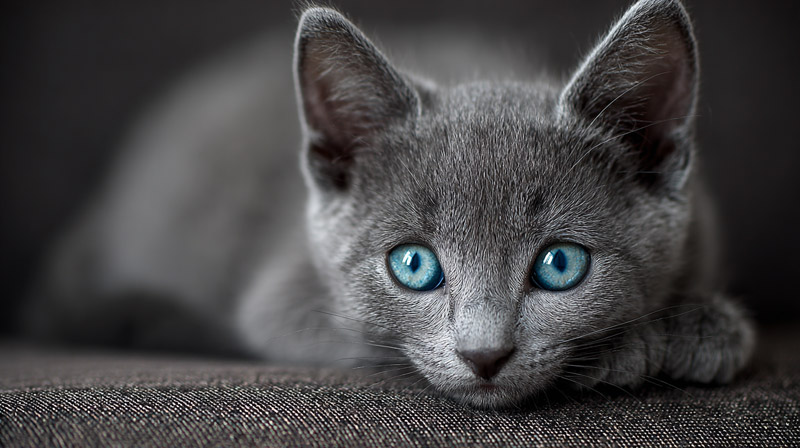
Personality development: Start cautious but grow more confident with socialization.
Eyes transition from yellow to green between 4-12 months.
Early socialization needs: Critical between 3-14 weeks. Expose to various people, sounds, and experiences.
Kitten energy levels: Very high. Expect constant play, climbing, and exploration.
They mellow considerably by age 3-4 years.
Training windows: Most receptive to training between 8-16 weeks.
Introduce litter boxes, scratching posts, and basic commands early.
When Can Russian Blue Kittens Leave Their Mother?
Minimum age: 12-16 weeks is ideal, though some breeders release at 12 weeks.
Never before 8 weeks minimum.
Developmental milestones:
- 8 weeks: Weaned, litter trained, basic socialization
- 12 weeks: Fully independent, multiple vaccinations completed
- 16 weeks: Fully socialized, strong immune system
Vaccination schedule before adoption:
- First FVRCP at 6-8 weeks
- Second FVRCP at 10-12 weeks
- Third FVRCP at 14-16 weeks
- Rabies vaccine at 12-16 weeks
Spay/neuter timing: Most breeders spay/neuter before adoption, typically around 12-16 weeks.
Some wait until 5-6 months if releasing earlier.
Breeding and Genetics
Russian Blue Breed Standards
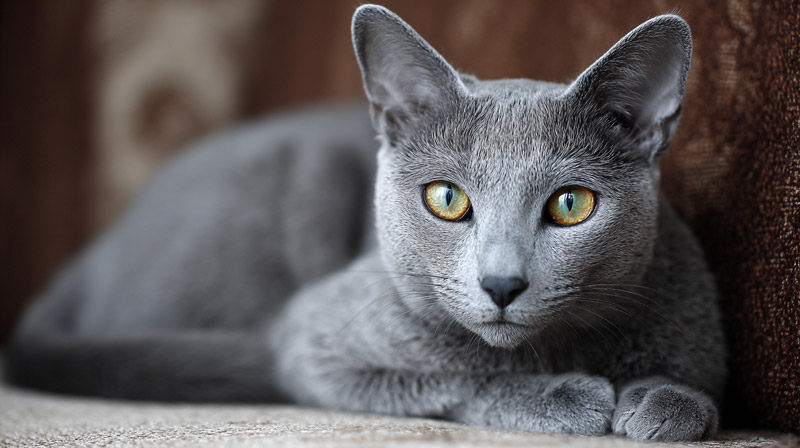
CFA standards: Smooth medium wedge head, bright blue coat with silver tipping, vivid green eyes.
Body is fine-boned but muscular. Long and graceful.
TICA standards: Similar to CFA with emphasis on double coat texture and green eye color.
GCCF standards: Recognizes Russian Whites and Russian Blacks as varieties (not recognized by CFA).
Show quality vs. pet quality distinctions:
- Show quality: Exact breed standard, perfect coat color, vivid green eyes, proper proportions
- Pet quality: May have slight coat variations, good temperament, healthy but minor cosmetic deviations
Disqualifying faults:
- Incorrect eye color (other than green in adults)
- White spots or markings
- Tabby markings
- Incorrect coat texture
- Kinked or abnormal tail
- Incorrect head structure
Genetics of Russian Blue Cats
Hereditary traits: Blue-gray coat results from dilute black gene (recessive “d” allele).
Both parents must carry dilute genes (dd) to produce blue offspring.
Coat color genetics: Blue is the dilute expression of black. Each hair has silver tipping created by specific gene interactions.
Breed-specific mutations: Generally free from harmful mutations due to natural breed development.
Outcross breeds: After WWII, bred with Siamese and British Shorthair to preserve breed.
Modern breeding has largely removed Siamese traits.
Used to create Nebelung (longhaired version) and contribute to Havana Brown development.
Genetic diversity concerns: Relatively good genetic diversity compared to some pedigree breeds.
DNA testing recommendations: HCM testing, PKD screening, general health profiles before breeding.
History of the Russian Blue Cat
Where Do Russian Blue Cats Come From?
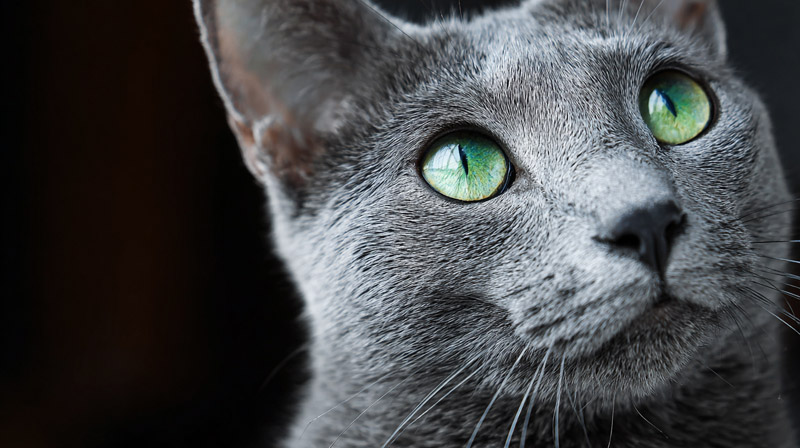
Geographic origins: Believed to originate from Arkhangelsk (Archangel Isles) in northern Russia.
Located about 150 miles south of the Arctic Circle.
Natural breed status: Naturally occurring, not man-made.
Historical context: Russian folklore describes these cats as good-luck charms and healing influences.
Stories claim they were beloved pets of Russian Czars and nobility, though documentation is limited.
Original purpose: Likely companions and possibly ship cats for controlling rodents.
Their dense coats suggest natural adaptation to harsh northern climates.
How Did the Russian Blue Breed Develop?
Development timeline:
- Pre-1860s: Lived in northern Russia with uncertain documented history
- 1860s: Russian sailors brought cats aboard ships to British and Northern European ports
- 1872: First recorded appearance at Crystal Palace cat show in England as “Archangel Cat”
- 1875: Shown at major London cat shows, creating significant impression
- 1895: Harrison Weir noted early show cats were British-bred gray tabbies, distinct from true Archangel cats
- 1912: Given separate classification as “Foreign Blues” or “Russian Blues”
- Early 1900s: Arrived in United States
- 1920s-1940s: Scandinavian breeders developed breed standards
- Post-WWII: Near extinction; outcrossed with Siamese and British Blues for survival
- 1950s-1960s: American breeders combined English and Scandinavian bloodlines
- 1970s-present: Continued refinement to breed standard, removal of Siamese traits
Key breeders: British and Scandinavian breeders preserved the breed during early development.
American breeders post-WWII created modern Russian Blue standard.
Important foundation cats: Specific individual cats not widely documented due to historical gaps.
Breed evolution: Originally stockier in Britain, more angular in Scandinavia.
Modern cats balance both types with elegant build, large ears, and brilliant green eyes.
Related breeds: Nebelung (longhaired), influenced Havana Brown and Oriental Shorthair development.
When Was the Russian Blue Recognized?
CFA recognition: 1949 (though competed in shows since early 1900s)
TICA recognition: 1979 (when TICA was established)
Championship status: Granted separate class status in 1912 in British cat fancy
Other recognition dates:
- GCCF (UK): Early 20th century
- FIFe (Europe): Recognized with European show system development
Cost of Owning a Russian Blue Cat
How Much Does a Russian Blue Cat Cost?
Purchase price ranges:
Pet quality: $400-$1,200 average
Lower-end breeders or less established bloodlines: $400-$600
Mid-range reputable breeders: $800-$1,200
Show quality: $1,500-$3,000
Champion bloodlines: $2,000-$3,500+
Breeding rights: $2,500-$4,000+
Price factors:
- Pedigree and lineage (champion bloodlines command premiums)
- Breeder reputation and experience
- Geographic location (higher in Northeast and West Coast)
- Age (kittens more expensive than adults)
- Gender (sometimes males cost slightly more)
- Coat quality and eye color intensity
- Health testing and guarantees included
Regional variations:
- Southern US: $900-$2,200
- Northeastern US: $1,500-$4,000
- Midwestern US: $900-$2,400
- Western US: $1,400-$3,800
Additional initial costs:
- Initial vet visit: $50-$100
- Vaccinations (if not completed): $75-$150
- Spay/neuter (if not done): $150-$300
- Supplies (litter box, bowls, carrier, toys, scratching posts): $200-$500
- Microchip: $25-$50
Total initial investment: $600-$1,700 beyond purchase price
What Are the Ongoing Costs?
Annual veterinary care: $200-$500
Includes twice-yearly wellness exams, vaccinations, fecal tests.
Food expenses: $30-$75 monthly ($360-$900 annually)
High-quality cat food with real meat protein.
Litter and supplies: $25-$50 monthly ($300-$600 annually)
Litter, replacement toys, scratching post maintenance.
Grooming costs: Minimal. Mostly DIY.
Occasional professional grooming (if desired): $30-$50 per visit
Grooming tools one-time purchase: $30-$60
Pet insurance: $25-$50 monthly ($300-$600 annually)
Highly recommended given long lifespan.
Dental care: $200-$400 annually
Professional cleanings every 1-2 years: $150-$300 each
Dental supplies: Toothbrush, paste, treats: $50-$100 yearly
Unexpected costs: Budget $500-$1,000 emergency fund minimum
Total annual costs: $1,500-$3,000+
Lifetime costs (15-20 years): $22,500-$60,000+
Where Can You Get a Russian Blue Cat?
Reputable breeders
What to look for:
- CFA, TICA, or GCCF registration
- Health testing of breeding cats (HCM, PKD screening)
- Clean, home-based or professional cattery environment
- Socialized kittens raised underfoot
- Multiple references from previous buyers
- Active show involvement or breed club membership
Breeder certifications: Look for registered catteries with breed club affiliations.
Health guarantees: Should include minimum 1-year genetic health guarantee.
Some offer 15-day to 3-month FIP warranties.
Contract elements:
- Spay/neuter requirements (for pet quality)
- Return policy if unable to keep cat
- Health guarantee terms
- Registration papers transfer
- Breeding restrictions
Red flags to avoid:
- No health testing or documentation
- Multiple breeds available (puppy/kitten mill indicator)
- Unwilling to show facilities or parent cats
- No contract or health guarantee
- Unusually low prices
- Pressure to buy immediately
- Kittens released before 8 weeks
Questions to ask:
- What health testing do parent cats receive?
- Can I meet the kitten’s parents?
- What vaccinations and deworming have been done?
- What does the health guarantee cover?
- Do you provide references from previous buyers?
- What support do you offer after adoption?
Breed-specific rescues:
- Russian Blue Rescue groups (search by state)
- Breed-specific Facebook rescue groups
- Specialty Purebred Cat Rescue
Adoption organizations:
- Russian Blue Rescue & Referral (national)
- Local all-breed cat rescues occasionally have Russian Blues
Adoption costs vs. breeder costs: Rescue adoption $100-$300 vs. breeder $400-$3,000+
Adult cat vs. kitten considerations:
Adult cats are often:
- Less expensive
- Calmer and mellower
- Personality fully developed
- May come from breeding retirement
- Already spayed/neutered and fully vaccinated
Kittens offer:
- Full lifespan ahead
- Moldable socialization
- Playful energy
- Experience of all life stages
Russian Blue vs. Similar Breeds
Russian Blue vs. Chartreux
Physical differences:
Size: Chartreux is larger and stockier (10-16 lbs) vs. Russian Blue’s fine-boned build (7-12 lbs).
Coat: Both blue-gray, but Chartreux has woolly texture vs. Russian Blue’s silky double coat with silver tipping.
Chartreux lacks the shimmering silver effect.
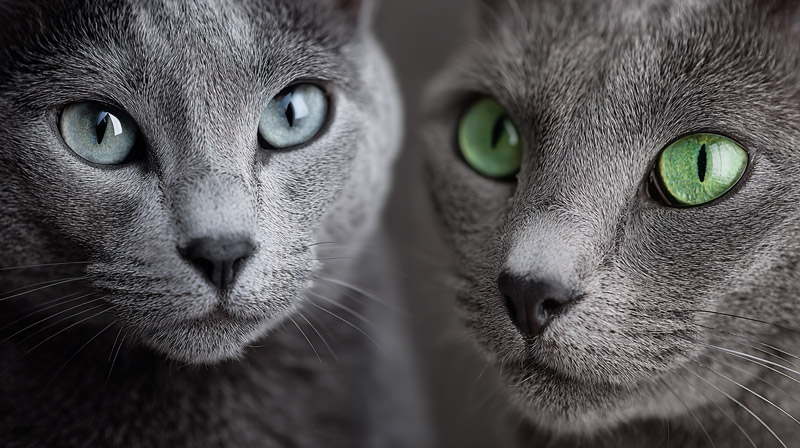
Features: Chartreux has rounder face and copper/gold eyes vs. Russian Blue’s wedge-shaped head and green eyes.
Temperament differences:
Chartreux: More dog-like, playful throughout life, less reserved with strangers.
Russian Blue: More cautious initially, bonds deeply with family, mellows with age.
Care requirements:
Both low-maintenance grooming. Chartreux slightly more adaptable to change.
Health concerns:
Chartreux: Patellar luxation risk. Russian Blues: Obesity and urinary issues more common.
Cost: Similar range, $800-$2,000 typically.
Lifespan: Both 15-20 years with proper care.
Russian Blue vs. Korat
Physical differences:
Size: Korat slightly smaller and more compact (6-10 lbs) vs. Russian Blue (7-12 lbs).
Coat: Both blue-gray, but Korat has single coat with silver sheen. Russian Blue has denser double coat.
Korat’s blue is slightly different shade.
Features: Korat has heart-shaped face and large, luminous green eyes. Russian Blue has wedge-shaped head.
Temperament differences:
Korat: More assertive and opinionated, bonds to one person intensely, can be possessive.
Russian Blue: More diplomatic with family members, less territorial.
Both reserved with strangers.
Care requirements:
Korat needs more stimulation and doesn’t tolerate being alone as well.
Health concerns:
Korat: GM1 and GM2 gangliosidosis risk (genetic testing available).
Russian Blue: Generally healthier genetic profile.
Cost: Korat often more expensive ($800-$2,500) due to rarity.
Lifespan: Both 15-18 years typically.
Russian Blue vs. British Shorthair
Physical differences:
Size: British Shorthair significantly larger and stockier (9-18 lbs) vs. Russian Blue’s slender build (7-12 lbs).
Coat: British Blue has plush but not as dense as Russian Blue. Comes in many colors beyond blue.
Russian Blue only in blue-gray with silver tipping.
Features: British Shorthair has round face, chubby cheeks, copper/gold eyes. Russian Blue has angular wedge face and green eyes.
Temperament differences:
British Shorthair: More laid-back and less active. Independent and less demanding of attention.
Russian Blue: More playful and interactive. Needs more mental stimulation.
Care requirements:
British Shorthair easier for truly hands-off owners. Russian Blue needs more engagement.
Health concerns:
British Shorthair: HCM risk, obesity, PKD more common.
Russian Blue: Similar obesity risk but generally healthier.
Cost: British Shorthair $800-$2,000. Russian Blue $400-$1,500. Comparable ranges.
Lifespan: British Shorthair 12-17 years vs. Russian Blue 15-20 years.
How to Choose Between Russian Blue and Similar Breeds
Lifestyle considerations:
Choose Russian Blue if:
- You want an interactive, intelligent companion
- You appreciate routine and predictability
- You have time for daily play sessions
- You want a long-lived, healthy breed
- You prefer quieter, reserved cats
- Allergies are a concern (lower allergen production)
Choose Chartreux if:
- You want a more outgoing, dog-like cat
- You need adaptability to changes
- You prefer stockier, robust build
Choose Korat if:
- You want an intensely bonded one-person cat
- You’re home often and want constant companionship
- You appreciate more assertive personality
Choose British Shorthair if:
- You want a truly low-maintenance, independent cat
- You prefer laid-back energy levels
- You like rounder, teddy-bear appearance
- You’re away from home more frequently
Decision factors:
- Energy level needs
- Time available for interaction
- Tolerance for change in household
- Preference for independence vs. bonding intensity
- Physical appearance preference
- Budget for potential health issues
Which breed for which owner:
- Active families: Russian Blue or Chartreux
- Singles or couples: Russian Blue or Korat
- Busy professionals: British Shorthair
- First-time owners: Russian Blue (balanced needs)
- Allergy sufferers: Russian Blue (lowest allergen production)
Fun Facts About Russian Blue Cats
Royal connections: Legends claim they were favorites of Russian Czars, though historical proof is limited.
Queen Victoria reportedly owned Russian Blues.
Famous Russian Blues: While not as common as celebrity Persian or Ragdoll cats, Russian Blues have appeared in various media.
Natural “smile”: The upturn at the corners of their mouth creates a permanent Mona Lisa-like expression.
Ship cats heritage: Sailors from Arkhangelsk brought them on voyages as companions and rodent control.
Cold climate adaptation: Their dense double coat developed naturally to survive temperatures near the Arctic Circle.
Hypoallergenic qualities: They produce lower levels of Fel d 1 protein (the primary cat allergen) than most breeds.
Not truly hypoallergenic, but better tolerated by some allergy sufferers.
Mechanical genius: They’re famous for figuring out how to open cabinets, drawers, and even jars.
Owners report finding food containers mysteriously opened.
Fetch champions: Unlike most cats, many Russian Blues naturally retrieve thrown toys like dogs.
Slow maturation: One of the few breeds that continues growing until 3-4 years old.
Crystal Palace debut: Among the first cat breeds exhibited at the historic 1872 Crystal Palace cat show in London.
Name changes: Called “Archangel Cats,” “Foreign Blues,” “Maltese Cats” before settling on Russian Blue.
WWII survival story: The breed nearly went extinct during the World Wars but was saved through careful outcrossing.
Color point genetics: Some Russian Blues carry recessive color-point genes from Siamese outcrossing, though these cats cannot be shown.
Litter box fussiness: Known as neat freaks who refuse dirty litter boxes more than other breeds.
Routine obsession: They memorize schedules and will vocally remind you if meals or playtime is delayed.
Window watchers: Spend hours observing outdoor activity from favorite window perches.
Silent hunters: Despite vocal about needs, they hunt toys in complete silence with intense focus.
Is a Russian Blue Cat Right for You?
Best Homes for Russian Blue Cats
Ideal owner personality types:
- Appreciates intelligent, observant cats
- Values routine and consistency
- Patient with initially shy cats
- Enjoys interactive play and mental challenges
- Prefers quieter, reserved companions over demanding cats
- Committed to long-term care (15-20 years)
Lifestyle compatibility:
- Works regular hours (can tolerate alone time but needs interaction)
- Maintains predictable daily schedules
- Has quiet, stable household
- Limited frequent visitors or house guests
- Indoor-only environment commitment
Home environment requirements:
- Calm, low-stress atmosphere
- Space for vertical climbing structures
- Secure indoor space (apartments fine)
- Areas for retreat and observation
- Minimal household disruptions
Time availability needs:
- 2-3 hours daily for interaction and play
- Consistent feeding schedules
- Regular grooming sessions (2-3 times weekly)
- Mental stimulation through puzzle toys and games
Who Should Avoid Russian Blue Cats?
Incompatible lifestyles:
- Frequent travelers without reliable pet care
- Chaotic households with constant visitors
- Families with very young children (under 6 years)
- Those wanting immediately affectionate, cuddly cats
- Owners who free-feed and can’t maintain strict meal schedules
- People who frequently move or change environments
Challenge factors:
- Initial shyness requires patience (weeks to months to fully warm up)
- Food obsession makes weight management constant work
- Routine dependency means they struggle with changes
- Intelligence means they need more mental stimulation than average cats
- Reserved nature means less overt affection displays
Allergy considerations: While they produce less Fel d 1 protein, no cat is truly hypoallergenic.
Spend time with Russian Blues before adopting if allergies are a concern.
Some people with mild allergies tolerate them, others don’t.
Better breed alternatives:
- Want more affectionate/cuddly: Ragdoll or Birman
- Want more adaptable: American Shorthair or Maine Coon
- Want more independent: British Shorthair
- Want lower intelligence/maintenance: Exotic Shorthair or Persian
Questions to Ask Before Getting a Russian Blue Cat
Financial readiness:
- Can I afford $400-$3,000 upfront purchase cost?
- Do I have $1,500-$3,000 annually for ongoing care?
- Can I maintain a $1,000+ emergency fund for unexpected vet bills?
- Is pet insurance ($25-$50/month) in my budget?
Time commitment:
- Can I commit to 2-3 hours daily interaction for 15-20 years?
- Do I have time for twice-daily feeding on a consistent schedule?
- Can I provide regular play sessions and mental stimulation?
- Will I maintain grooming routines 2-3 times weekly?
Living situation stability:
- Will my housing situation remain stable long-term?
- Does my lease allow cats? (If renting)
- Is my home safe for an indoor cat?
- Can I provide vertical space with cat trees and shelves?
Family agreement:
- Do all household members want a cat?
- Is everyone prepared for the initial shy period?
- Does anyone have severe allergies? (Spend time with breed first)
- Are children old enough (8+ years) to handle gently?
Long-term planning:
- What happens to the cat if I move? Travel? Have life changes?
- Who will care for the cat during vacations?
- Can I afford potential senior cat health issues?
- Am I prepared for a 15-20 year commitment?
Travel considerations:
- Do I travel frequently for work or pleasure?
- Do I have reliable pet sitters or boarding options?
- Can I afford pet care costs during absences?
- Will disruption to routine stress my cat excessively?
Other pet considerations:
- Do I have other pets? Will they accept a new cat?
- Is my dog cat-friendly? (If applicable)
- Can I do gradual, proper introductions?
- Do I have space for separate territories if needed?
Personality match:
- Am I patient enough for a shy cat to warm up?
- Do I want a quieter companion rather than a vocal, demanding cat?
- Can I respect their need for independence while providing interaction?
- Will I appreciate their intelligence or find it challenging?
Routine lifestyle:
- Do I maintain relatively consistent daily schedules?
- Can I feed at the same times each day?
- Am I willing to adapt to their routine preferences?
- Can I minimize household disruptions and changes?
Health management:
- Am I prepared to monitor food intake strictly to prevent obesity?
- Will I brush their teeth regularly for dental health?
- Can I commit to twice-yearly vet visits?
- Am I prepared for potential senior health issues like kidney disease?
Answer honestly. Russian Blues are wonderful companions for the right owners but struggle in incompatible homes.
Their long lifespan means mistakes in matching impact both cat and owner for decades.
Take time to evaluate if your lifestyle truly suits this breed’s specific needs.
FAQ on Russian Blue
Are Russian Blue cats hypoallergenic?
Russian Blues produce lower levels of Fel d 1 protein than most breeds, making them better tolerated by some allergy sufferers. However, no cat is truly hypoallergenic. Their minimal shedding and lower allergen production help reduce reactions in people with mild allergies.
How much do Russian Blue cats cost?
Pet-quality Russian Blues typically cost $400-$1,200 from reputable breeders. Show-quality kittens with champion bloodlines range from $1,500-$3,000. Adoption from shelters costs $100-$300 but purebred availability is rare. Prices vary by region, breeder reputation, and pedigree.
Do Russian Blue cats shed a lot?
Russian Blues shed minimally despite their dense double coat. They’re considered low-shedding cats compared to other breeds. Brushing 2-3 times weekly removes loose hair and reduces shedding further. Expect slightly increased shedding during spring season.
Are Russian Blue cats friendly?
Russian Blues bond deeply with their families but act reserved with strangers. They’re affectionate on their own terms rather than constantly cuddly. Once comfortable, they follow owners everywhere and enjoy interactive play. Patience during their initial shy period builds strong loyalty.
How long do Russian Blue cats live?
Russian Blues live 15-20 years on average, significantly longer than most breeds. Some reach their early twenties with proper care. Their naturally occurring breed status contributes to excellent health and longevity. Quality diet, regular vet care, and indoor lifestyle maximize lifespan.
Are Russian Blue cats rare?
Russian Blues are relatively rare compared to common breeds like domestic shorthairs. Finding reputable breeders requires research as fewer catteries specialize in this breed. Their distinctive silver-tipped coat and emerald green eyes result from careful breeding practices that limit availability.
Do Russian Blue cats like to be held?
Russian Blues prefer sitting near you rather than being held for extended periods. They enjoy head scratches and interactive play more than cuddling. Each cat’s personality varies, but most show affection through proximity and following rather than lap-sitting. Respect their independent nature.
What do Russian Blue cats eat?
Russian Blues need high-protein diets with 35-45% animal protein to support their muscular build. Feed measured portions twice daily to prevent obesity, which this breed is prone to. Quality wet or dry food with real meat as primary ingredients works best. Avoid free-feeding.
Are Russian Blue cats good with dogs?
Russian Blues typically get along well with calm, cat-friendly dogs, especially with proper introductions. Their reserved nature means they need gradual socialization. They coexist peacefully with respectful dogs but may retreat from overly energetic or aggressive canines. Early exposure helps.
Do Russian Blue cats meow a lot?
Russian Blues are moderately vocal but soft-spoken. They communicate needs like hunger or attention with quiet, pleasant meows. Expect louder protests if meals are delayed or litter boxes aren’t clean. They’re conversational without being constantly chatty like Siamese cats.
Conclusion
Russian Blue cats reward patient owners with decades of loyal companionship. Their distinctive silvery coat, brilliant green eyes, and gentle nature create lasting bonds with families who respect their reserved personality.
These naturally occurring cats from Arkhangelsk bring impressive longevity and robust health to households willing to maintain consistent routines.
Their intelligence demands mental stimulation through puzzle toys and interactive play. Weight management requires discipline since their hearty appetites can lead to obesity without measured feeding schedules.
The initial shyness fades into devoted attachment for owners who earn their trust gradually.
For allergy-sensitive households seeking a quiet, elegant feline companion with minimal grooming needs, this breed offers compelling advantages. Their 15-20 year lifespan means choosing a Russian Blue is committing to a long friendship with one of the cat world’s most captivating aristocrats.