Picture a cat stepping out of Norse mythology with a coat thick enough to survive Scandinavian winters and a presence that commands attention. That’s the Norwegian Forest Cat.
These gentle giants, affectionately called Wegies, combine wild beauty with surprisingly mellow temperaments. Their water-resistant double coats, tufted ears, and bushy tails make them look like they belong in ancient forests rather than modern homes.
But looks can be deceiving. Despite their rugged appearance, Norwegian Forest Cat cats adapt remarkably well to family life, offering years of companionship without the high-maintenance drama some longhaired breeds demand.
This guide covers everything from their Viking-era origins to daily care requirements, health concerns, costs, and whether this majestic Skogkatt breed fits your lifestyle. You’ll learn what makes them different from Maine Coons and Siberians, plus the realities of living with a cat that takes five years to reach full size.
Norwegian Forest Cat Breed Statistics
| Characteristic | Details |
|---|---|
| Weight | Males: 12-20 lbs, Females: 8-16 lbs |
| Height | Males: 13-16 inches, Females: 9-12 inches |
| Lifespan | 14-16 years (up to 20 years) |
| Coat Type | Semi-long, double coat, water-resistant |
| Coat Colors | Black, white, blue, red, cream, silver, golden, brown |
| Coat Patterns | Solid, tabby, bicolor, tortoiseshell, calico |
| Shedding | Moderate to high, heavy seasonal shedding |
| Energy Level | Moderate to high |
| Exercise Needs | 30-60 minutes daily |
| Temperament | Gentle, friendly, independent, intelligent |
| Affection Level | Moderate (not lap cats, but loyal companions) |
| Good with Children | Yes, especially ages 5+ |
| Good with Dogs | Yes, when properly introduced |
| Good with Other Cats | Yes |
| Vocalization | Low to moderate (quiet, chirps and trills) |
| Intelligence | High (trainable, problem-solvers) |
| Grooming Needs | 2-3 times weekly, daily during shedding season |
| Apartment Friendly | Yes, with adequate vertical space |
| Cold Tolerance | Excellent (comfortable to 20°F) |
| Heat Tolerance | Moderate (sensitive above 85°F) |
| First-Time Owner | Suitable for dedicated beginners |
| Purchase Price | $800-$1,500 (pet quality) |
| Annual Cost | $1,500-$3,000 |
| Common Health Issues | HCM, hip dysplasia, GSD IV, PKD |
| Origin | Norway (Scandinavia) |
| Breed Type | Natural breed |
| Recognition | CFA, TICA, FIFe, GCCF |
| Full Maturity | 4-5 years |
| Climbing Ability | Excellent (strong claws, loves heights) |
| Hypoallergenic | No |
What Is a Norwegian Forest Cat?
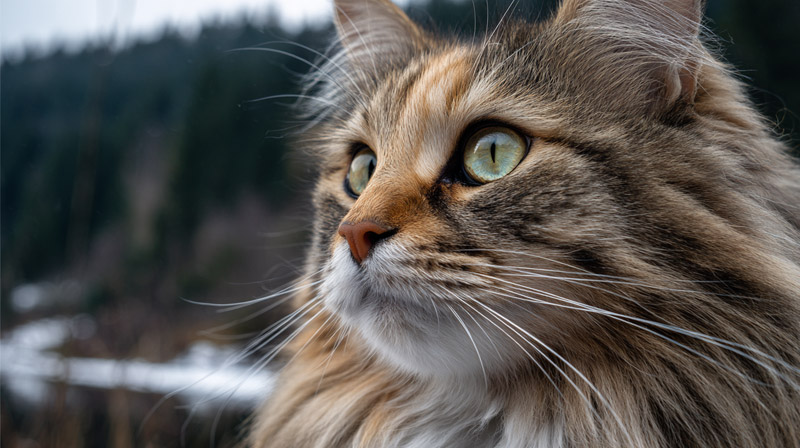
The Norwegian Forest Cat is a large, semi-longhaired natural breed that originated in Northern Europe, specifically adapted to survive harsh Scandinavian winters with its water-resistant double coat.
This muscular breed weighs 8-20 pounds and features a distinctive triangular head, almond-shaped eyes, tufted ears, and a bushy tail as long as its body.
Norse legends describe these cats as magical mountain-dwelling felines capable of climbing sheer rock faces. Vikings likely brought them on ships as mousers around 1000 AD.
The breed nearly became extinct during World War II but recovered through breeding programs established by the Norwegian Forest Cat Club in 1938.
King Olav V declared them Norway’s official cat in the 1950s. The Fédération Internationale Féline (FIFe) recognized the breed in 1977, followed by The International Cat Association (TICA) and the Cat Fanciers Association (CFA) in the 1980s and 1990s.
Often called “Wegie” or “Skogkatt” (which translates to “forest cat” in Norwegian), these cats are classified as a natural breed rather than one developed through selective breeding programs.
Physical Characteristics
How Big Do Norwegian Forest Cats Get?
Males weigh 12-20 pounds and stand 13-16 inches tall at the shoulder.
Females are smaller at 8-16 pounds and 9-12 inches tall.
Body length can reach 30-46 inches from nose to tail tip, making them one of the largest domestic cat breeds.
The breed has a substantial, heavily-boned body type with a broad chest and sturdy muscular build. Their hind legs are notably longer than their front legs, which aids in climbing and running through vegetation.
Growth happens slowly. Norwegian Forest cats don’t reach full size until 4-5 years old, much longer than most breeds that mature by 1-2 years.
This extended kittenhood means owners get to enjoy playful kitten behavior well into adulthood.
What Does a Norwegian Forest Cat’s Coat Look Like?
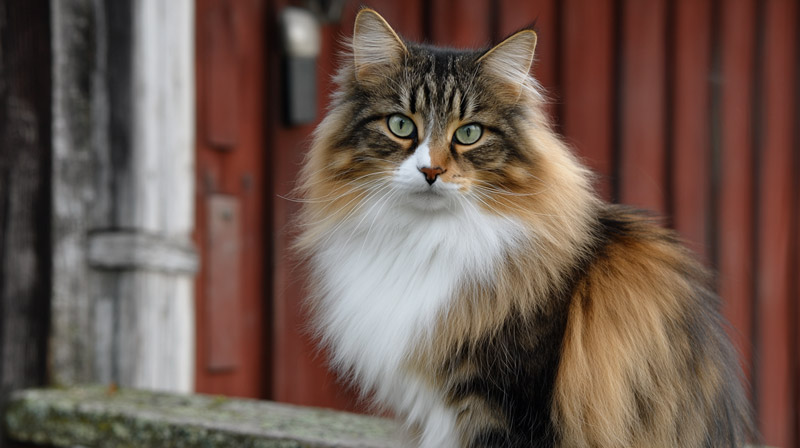
The coat consists of two layers: a long, glossy, water-repellent topcoat and a dense woolly undercoat.
This double coat provides excellent insulation against cold weather and actually sheds water. The topcoat has a silky texture despite its thickness.
Coat length varies by season. During winter, the full coat develops with a prominent ruff around the neck and chest, thick britches on the hind legs, and fur tufts between the toes.
Summer shedding removes much of the undercoat, sometimes leaving only ear tufts, toe tufts, and the bushy tail to distinguish them as longhaired cats.
Recognized colors include:
- Black
- White
- Blue (gray)
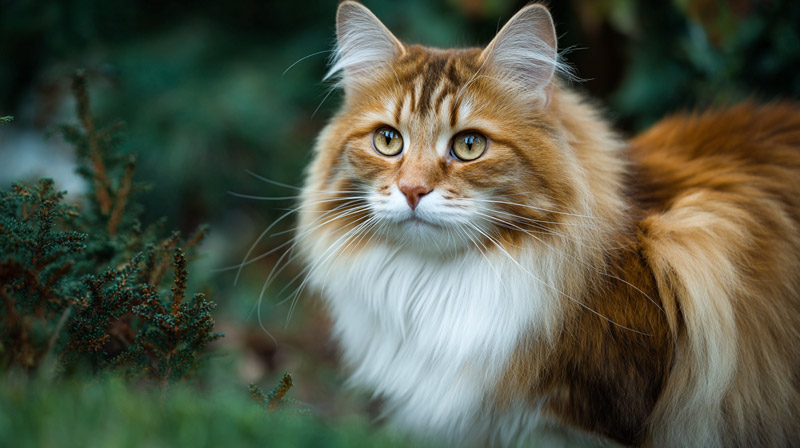
- Red (orange)
- Cream
- Silver
- Golden
- Brown
Pattern variations:
- Solid
- Tabby (most common is brown tabby)
- Bicolor
- Tortoiseshell
- Calico
Colorpoint patterns (like those seen in Siamese cats) are not accepted in breed standards.
Shedding is moderate to high, with heavy seasonal shedding in spring and fall as the coat adjusts to temperature changes.
Distinctive Physical Features
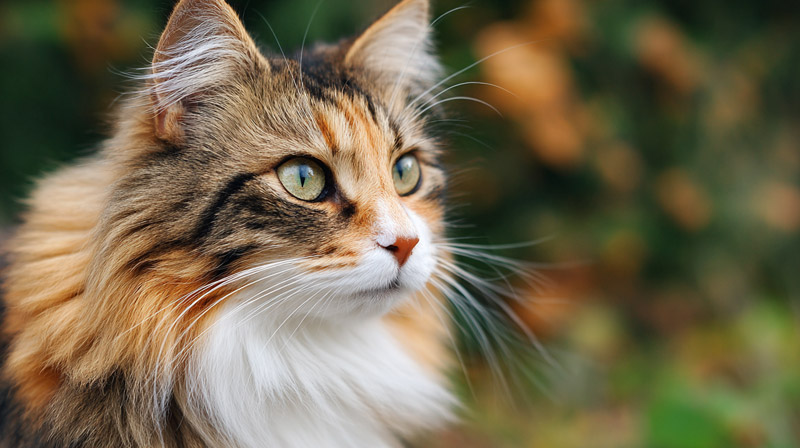
Eyes are large, almond-shaped, and set at a slight angle. Colors include green, gold, copper, or a combination. White cats may have blue eyes or odd eyes (one blue, one green or gold).
Ears are medium to large, wide at the base, and set high on the head with a slight outward tilt. Most have tufts at the tips (lynx tips) and thick fur inside.
The head forms an equilateral triangle when you draw lines from the nose tip to each ear tip. The profile is straight with no nose break, sloping smoothly from the brow bone to the nose tip.
The tail is long and heavily plumed, typically as long as the body from shoulder to rump. Cats carry it high when walking.
Paws are large and round with thick fur growing between the pads, providing traction on snow and ice. The fur makes them look even bigger, like natural snowshoes.
Strong, curved claws make them exceptional climbers capable of scaling vertical surfaces that other cats cannot manage.
Norwegian Forest Cat Personality and Temperament
Are Norwegian Forest Cats Affectionate?
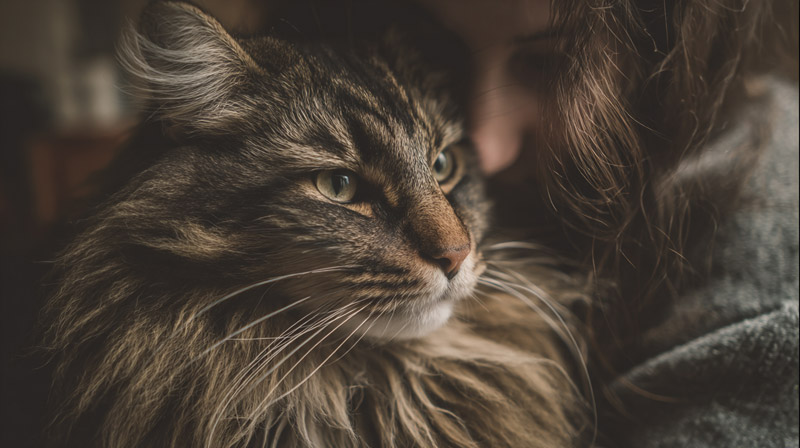
These cats bond closely with their families but show affection on their own terms rather than demanding constant attention.
They typically choose one favorite person while remaining friendly with all household members. Don’t expect a lap cat though.
Most prefer sitting beside you or following you around rather than being held. They enjoy being in the same room and will often position themselves nearby to keep an eye on activities.
Strangers receive cautious but friendly greetings. After initial assessment, most Wegies warm up to visitors and may accept pets or engage in play.
Attention requirements are moderate. They appreciate daily interaction but won’t pester you constantly like some breeds.
How Active Are Norwegian Forest Cats?
Energy level is moderate to high with bursts of intense playfulness followed by calm periods.
Daily exercise needs range from 30-60 minutes of active play spread throughout the day. They particularly enjoy activities that mimic hunting behaviors.
Favorite activities:
- Climbing to high perches
- Chasing feather toys
- Puzzle feeders
- Interactive play with wand toys
- Exploring new spaces
Intelligence is high. They learn quickly and can be trained to walk on leashes, perform tricks, or respond to commands using positive reinforcement.
These cats retain kitten-like enthusiasm well into adulthood, often playing energetically past 3-4 years old.
Do Norwegian Forest Cats Get Along with Others?
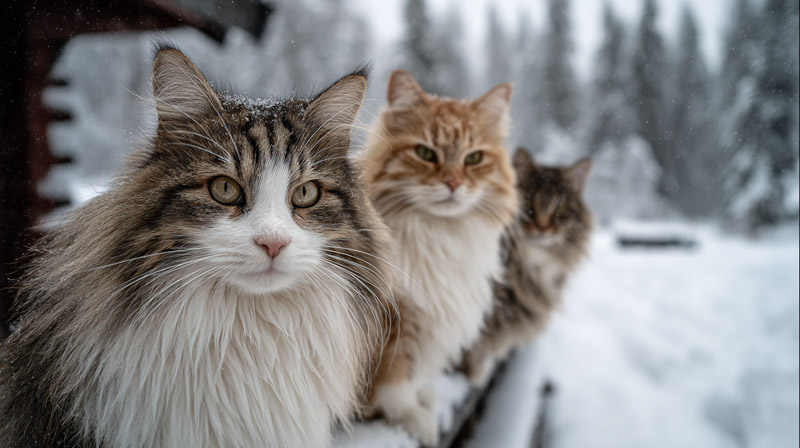
Children compatibility is excellent, especially with kids aged 5 and up who understand gentle handling.
Their patient, tolerant nature makes them forgiving of occasional rough play, though supervision is always recommended with very young children.
Dog compatibility is good when introduced properly. Their size and confident temperament prevent them from being intimidated by most dogs.
Other cats are generally accepted well. Multiple Norwegian Forest cats in one household often form strong bonds and play together.
Multi-pet households suit them fine as long as proper introductions are made. Their adaptable nature helps them adjust to various household dynamics.
Territorial tendencies are mild. They patrol their space but rarely show aggression toward other pets unless provoked.
How Vocal Are Norwegian Forest Cats?
Vocalization frequency is low to moderate. They’re considered a quiet breed compared to Siamese or Oriental Shorthair cats.
Voice characteristics are soft and melodic. Instead of loud meows, they produce chirps, trills, and quiet “conversations.”
These sounds typically occur when greeting family members, requesting food, or expressing excitement during play.
They communicate more through body language than vocalization, using tail position, ear movement, and eye contact to convey their moods.
Health and Lifespan
How Long Do Norwegian Forest Cats Live?
Average lifespan is 14-16 years, though many live 18-20 years with proper care.
This is slightly above the 12-15 year average for most domestic cats.
Factors affecting longevity include diet quality, exercise levels, indoor vs outdoor lifestyle, genetic health, and regular veterinary care.
Common Health Issues in Norwegian Forest Cats
Hypertrophic Cardiomyopathy (HCM)
The most common heart disease in cats, HCM causes thickening of the heart muscle walls.
Symptoms include lethargy, difficulty breathing, loss of appetite, and sudden hind leg paralysis from blood clots.
Age of onset typically occurs in middle to senior years (5+ years old). Prevalence estimates suggest 10-15% of the breed may develop this condition.
Treatment includes medications to manage heart function and prevent blood clots. Regular cardiac screenings with ultrasound are recommended starting at age 2-3.
Prevention isn’t possible for inherited forms, but maintaining healthy weight reduces strain on the heart.
Glycogen Storage Disease Type IV (GSD IV)
A rare inherited metabolic disorder preventing proper glucose metabolism.
Most affected kittens are stillborn or die within hours of birth. Rare survivors show signs by 5 months including fever, muscle tremors, weakness, and progressive muscle loss.
Prevalence is very low due to breeder genetic testing programs. The condition is fatal with no treatment available.
Responsible breeders screen breeding cats and avoid pairing carriers. Genetic testing identifies carriers who may be healthy but can pass the gene to offspring.
Hip Dysplasia
Malformation of the hip socket joint causing pain, stiffness, and arthritis.
Symptoms include limping, difficulty jumping, reluctance to climb stairs, and sensitivity when the hip area is touched.
Onset can occur in kittens or develop gradually with age. A Czech study found 46.7% of pedigree cats (including Norwegian Forest cats) showed some degree of hip dysplasia.
Treatment ranges from weight management and pain medication to surgical intervention in severe cases.
Prevention includes maintaining healthy weight and ensuring proper nutrition during growth years.
Polycystic Kidney Disease (PKD)
Fluid-filled cysts develop in the kidneys, gradually reducing kidney function.
Symptoms appear in middle age or later and include increased thirst, frequent urination, weight loss, and decreased appetite.
Prevalence is lower in Norwegian Forest cats than in Persian cats but still occurs occasionally.
Treatment focuses on managing symptoms through special diets and medications to slow disease progression. Regular kidney function monitoring is recommended for affected cats.
Pyruvate Kinase Deficiency
An enzyme deficiency affecting red blood cells, causing anemia.
Symptoms develop gradually in most cases, allowing cats to adapt. Rapid onset is rare but life-threatening.
Diagnosis requires a complete biochemistry profile. Bone marrow transplant is the only treatment option.
Retinal Dysplasia
Abnormal retinal development causing small blind spots.
Most cases are mild and require no treatment. Severe cases may lead to cataracts or retinal detachment.
Dental Disease
Gingivitis and periodontal disease become more common with age, especially without preventive care.
Symptoms include bad breath, drooling, inflamed gums, and difficulty eating.
Prevention includes weekly tooth brushing, dental treats, and regular veterinary dental checkups.
What Health Testing Should Norwegian Forest Cats Have?
Genetic screening:
- GSD IV testing (DNA test)
- HCM genetic markers (though not all HCM cases are detectable genetically)
- Hip dysplasia screening (X-rays)
Regular veterinary checks:
- Annual exams for cats under 7 years
- Bi-annual exams for senior cats (7+ years)
- Cardiac ultrasound screening every 1-2 years starting at age 2-3
- Annual bloodwork to monitor kidney and liver function
Breed-specific certifications:
Responsible breeders obtain health clearances from the Orthopedic Foundation for Animals (OFA) for hips and cardiac screening.
Age-specific monitoring:
- Kittens: Monitor growth rate and development
- Adults (1-7 years): Focus on cardiac and hip health
- Seniors (7+ years): Increase monitoring for kidney disease, dental issues, and diabetes
Caring for a Norwegian Forest Cat
What Do Norwegian Forest Cats Eat?
Protein requirements should be 35-45% of their diet, primarily from animal sources like chicken, turkey, fish, or beef.
Feeding frequency varies by age. Kittens need 3-4 meals daily until 6 months, then 2-3 meals until one year. Adults do well on 2 meals per day.
Portion sizes depend on weight and activity level. A 15-pound adult typically needs 250-300 calories daily, roughly 3/4 to 1 cup of dry food or 5-6 ounces of wet food.
Wet food is generally preferable due to higher moisture content (70-80% water) which supports kidney health and helps prevent urinary issues.
Dry food can be mixed in but should not be the sole diet. If feeding dry food exclusively, ensure constant access to fresh water.
Special dietary considerations:
High protein supports their muscular build. Look for named meat sources (chicken, salmon) as the first ingredients.
Moderate fat (15-20%) provides energy without contributing to obesity. Omega-3 and omega-6 fatty acids support coat health.
Low carbohydrates are best. Cats are obligate carnivores with limited ability to process grains and starches.
Foods to avoid:
- Grains as primary ingredients (corn, wheat, rice)
- Dairy products (many cats are lactose intolerant)
- Raw fish (can cause thiamine deficiency)
- Onions, garlic, grapes, chocolate (toxic to cats)
Weight management is important as this breed can become overweight, especially if neutered or spayed. Monitor body condition and adjust portions accordingly.
How Do You Groom a Norwegian Forest Cat?
Brushing frequency needs to be 2-3 times weekly during most of the year, increasing to daily during spring and fall shedding seasons.
Use a stainless steel comb to work through the coat starting at the head and moving toward the tail. Follow with a slicker brush to remove loose undercoat.
Pay special attention to areas prone to matting: behind the ears, under the front legs, and the britches on the hind legs.
Bathing is rarely needed (every 3-4 months or less) due to their water-resistant coat which naturally repels dirt. Overbathing strips protective oils.
When bathing is necessary, use lukewarm water and cat-specific shampoo. The coat takes considerable time to dry thoroughly.
Nail trimming should occur every 2-3 weeks. Trim only the sharp tip, avoiding the pink quick which contains blood vessels.
Dental care needs attention 2-3 times weekly minimum, daily if possible. Use cat toothpaste (never human toothpaste) and a soft brush or finger brush.
Eye cleaning is usually unnecessary unless discharge appears. Wipe gently with a damp cloth from inner to outer corner.
Ear cleaning every 2-3 weeks prevents wax buildup. Use vet-approved ear cleaner on a cotton ball. Never insert anything into the ear canal.
Professional grooming is typically unnecessary unless severe matting occurs. Most owners can handle routine maintenance at home.
How Much Exercise Does a Norwegian Forest Cat Need?
Daily activity requirements are 30-60 minutes of active play split into multiple sessions throughout the day.
Indoor vs outdoor is a personal choice, but indoor-only cats live longer on average (12-18 years vs 2-5 years for outdoor cats).
If keeping indoors, provide adequate enrichment to satisfy their natural instincts.
Recommended toys and enrichment:
- Tall cat trees (6+ feet) for climbing
- Window perches for bird watching
- Feather wands and fishing pole toys
- Battery-operated mice or balls
- Cardboard boxes and paper bags
- Puzzle feeders for mental stimulation
Mental stimulation needs are high. These intelligent cats become bored easily without variety.
Rotate toys weekly to maintain interest. Introduce new challenges like treat-dispensing toys or hide-and-seek games.
Climbing and vertical space importance cannot be overstated. In their natural habitat, Norwegian Forest cats spent significant time in trees.
Install cat shelves, provide tall furniture access, or invest in multi-level cat trees.
Interactive play frequency should happen 2-3 times daily for 10-15 minutes per session. This mimics their natural hunting patterns of short, intense bursts of activity.
Living with a Norwegian Forest Cat
Are Norwegian Forest Cats Good for Apartments?
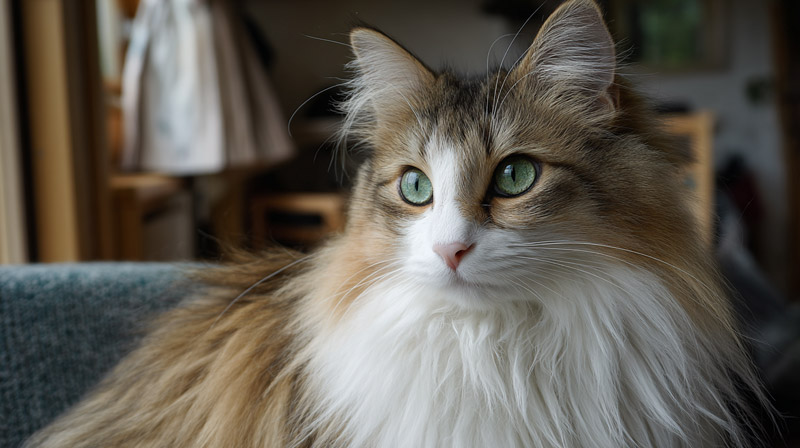
Space requirements are moderate. While they can adapt to apartments, they need sufficient vertical space more than floor space.
A small apartment with tall cat furniture works better than a large space with no climbing options.
Minimum recommendations suggest at least 500-700 square feet with adequate vertical territory (cat trees, shelves, furniture access).
Noise level is low. Their quiet nature makes them suitable for apartments with noise-sensitive neighbors.
Neighbor compatibility is excellent. They rarely disturb others with excessive vocalization or destructive behavior.
Indoor-only suitability is high. They adapt well to indoor life as long as environmental enrichment is provided.
Vertical space needs are critical in apartments. Install floor-to-ceiling cat trees or wall-mounted shelves to create vertical territory.
What Environment Do Norwegian Forest Cats Need?
Temperature tolerance shows they handle cold extremely well, comfortable down to 20-30°F with their thick coat.
Heat sensitivity is moderate. They can overheat in temperatures above 85-90°F, especially with their full winter coat.
Provide cool spaces, fans, and fresh water during hot weather. Some may need a summer trim in very hot climates.
Humidity preferences are neutral. They adapt to various humidity levels without issues.
Safe outdoor access options include:
- Screened catios (outdoor enclosures)
- Leash walking with harness training
- Supervised backyard time in secure areas
- Window boxes for fresh air access
Environmental enrichment specifics should include multiple climbing options, hiding spots, scratching posts, and interactive toys.
Window perch importance is high. They spend hours watching outdoor activity, which provides mental stimulation even without outdoor access.
Scratching post requirements need tall, sturdy posts (32+ inches) covered in sisal rope. Place them near favorite napping spots and entryways.
Are Norwegian Forest Cats Good for First-Time Owners?
Care difficulty level is intermediate. They’re easier than high-maintenance breeds but need more attention than American Shorthairs.
Time commitment required is 1-2 hours daily for play, grooming, feeding, and general interaction.
Experience level needed is minimal for basic care, though understanding cat body language and behavior helps prevent problems.
Common challenges for new owners:
- Managing seasonal shedding and preventing mats
- Providing sufficient exercise and mental stimulation
- Understanding their need for both social time and independence
- Initial cost and ongoing expenses
- Long-term commitment (15+ years)
They’re generally patient with first-time owner mistakes and forgiving of learning curves, making them suitable for dedicated beginners.
Norwegian Forest Kittens
What Are Norwegian Forest Kittens Like?
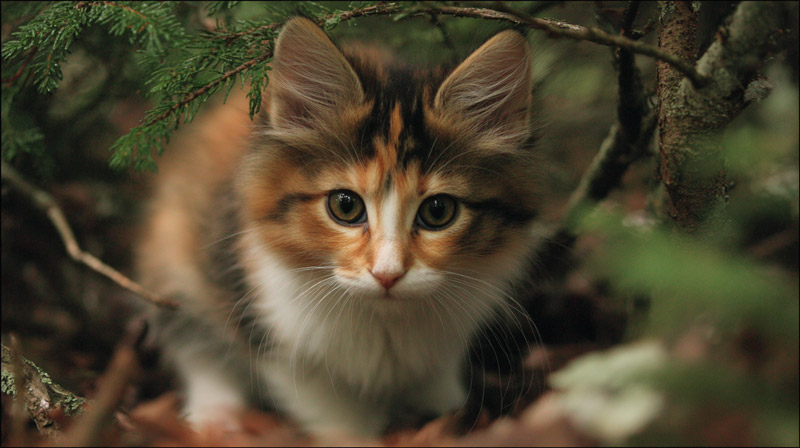
Personality development happens gradually. Kittens are initially shy (2-7 weeks), become extremely playful (8 weeks-6 months), then settle into adult temperament by 1-2 years.
Early socialization needs are critical during the 3-9 week window. Exposure to various people, sounds, and experiences during this period shapes adult behavior.
Kitten energy levels are very high. Expect constant play, climbing, and exploration during waking hours.
Training windows for litter box use occur naturally at 3-4 weeks. For tricks and leash training, start around 8-12 weeks when they’re most receptive.
When Can Norwegian Forest Kittens Leave Their Mother?
Minimum age is 12-14 weeks, longer than the 8-week standard for many breeds.
Reputable breeders keep kittens until 14-16 weeks to ensure proper socialization and complete vaccination series.
Developmental milestones:
- 3-4 weeks: Eyes open, begin walking
- 4-5 weeks: Start eating solid food
- 6-8 weeks: Weaning complete, full play behavior emerges
- 8-12 weeks: First and second vaccinations
- 12-14 weeks: Third vaccination, ready for adoption
Vaccination schedule before adoption should include three rounds of FVRCP (feline viral rhinotracheitis, calicivirus, panleukopenia) at 8, 12, and 16 weeks, plus rabies at 12-16 weeks.
Spay/neuter timing typically occurs at 4-6 months. Some breeders spay/neuter before kittens go home, while others require buyers to complete the procedure.
Breeding and Genetics
Norwegian Forest Cat Breed Standards
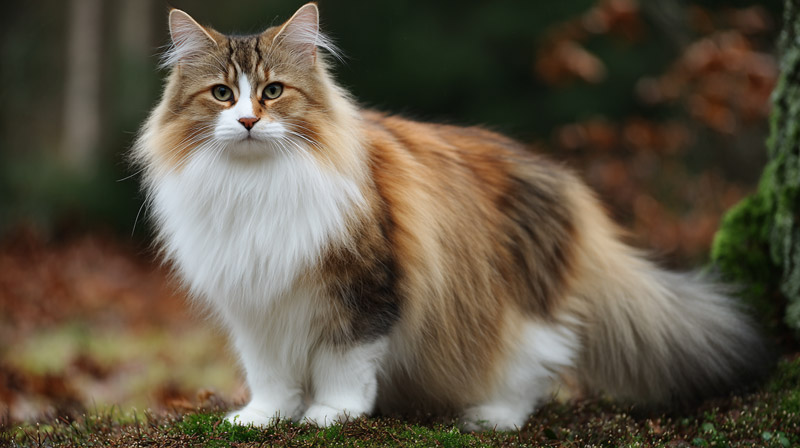
CFA standards describe an athletic cat with substantial bone structure, medium-to-large size, and a well-proportioned body.
The head must form an equilateral triangle. The profile should be straight from brow to nose tip without a break.
Eyes are large, almond-shaped, and slightly oblique. Ears are medium to large, wide at the base, set high and well apart.
TICA standards emphasize the breed’s natural appearance and robust health. They note the coat should look natural, not overly groomed or stylized.
FIFe standards (European) tend to favor slightly larger, more robust cats than North American standards.
Show quality cats must meet precise measurements and proportions. Any deviation from the standard reduces show scores.
Pet quality cats may have minor faults like a slight nose break, round eyes, or small ears. These don’t affect health or temperament.
Disqualifying faults:
- Colorpoint markings
- Delicate bone structure
- Cobby body type
- Round head
- Short legs of equal length front and back
Genetics of Norwegian Forest Cats
Hereditary traits include the semi-longhaired coat (recessive gene), water-resistant coat texture, and large size.
Coat color genetics follow standard feline color genetics. The tabby pattern gene is dominant, which explains why brown tabby is the most common color.
White spotting genes create bicolor patterns. The amount of white varies from a small locket to nearly all-white with colored patches.
Breed-specific mutations include the GSD IV mutation affecting glycogen metabolism. This is a recessive gene, meaning both parents must be carriers for kittens to be affected.
Outcross breeds are not currently allowed in most registries to maintain breed purity. Historical outcrosses may have included farm cats or Maine Coons, though this is debated.
Genetic diversity concerns are moderate. The breed has a relatively large gene pool in Scandinavia but more limited diversity in North America.
DNA testing recommendations include GSD IV testing for all breeding cats and prospective breeding stock. HCM genetic testing is also recommended though not all HCM cases are genetically detectable.
History of the Norwegian Forest Cat
Where Do Norwegian Forest Cats Come From?
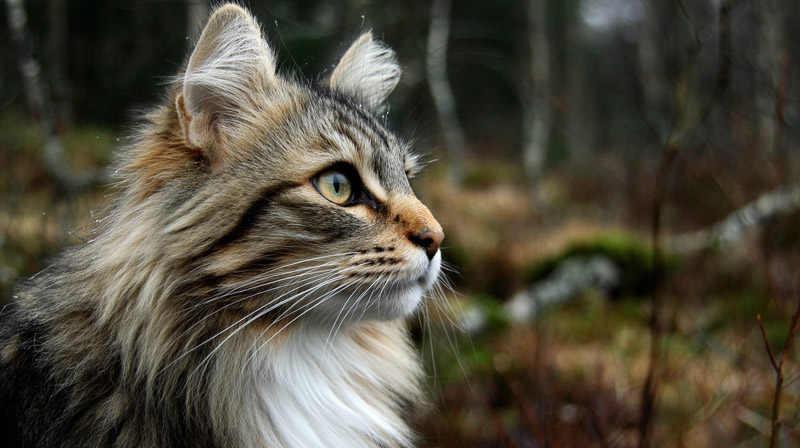
Geographic origins trace to Norway and surrounding Scandinavian regions.
This is a natural breed that developed through environmental adaptation rather than human selective breeding.
Historical context suggests these cats lived in Norwegian forests for centuries, possibly arriving with Vikings around 1000 AD.
Original purpose was as working cats on farms and ships, controlling rodent populations. Their hunting abilities made them valuable.
How Did the Norwegian Forest Breed Develop?
Development timeline spans centuries in relative isolation before formal recognition efforts began.
The breed lived semi-wild in Norwegian forests, adapting to harsh winters through natural selection favoring thick coats, large size, and hunting prowess.
Early 1900s: Cat fanciers in Norway began noticing these distinctive forest cats and recognizing them as a unique type.
1938: The Norwegian Forest Cat Club formed in Oslo to preserve and promote the breed.
World War II interrupted breed development efforts, and the cats nearly became extinct due to crossbreeding with free-ranging domestic cats.
1950s: King Olav V declared the Norwegian Forest Cat Norway’s official cat, spurring renewed interest.
1970s: Serious breeding programs resumed with Carl-Fredrik Nordane leading efforts to establish breed standards and gain international recognition.
1975: The breed received preliminary recognition from FIFe.
1977: FIFe granted full championship status.
1980s: Norwegian Forest cats were imported to the United States and United Kingdom.
1987: TICA recognized the breed.
1993: CFA granted championship status.
Important foundation cats:
“Pans Truls” was one of the first registered Norwegian Forest cats and appears in many pedigrees.
Early breeders focused on cats from rural areas with the most traditional appearance.
Breed evolution has remained relatively stable. Modern show cats look similar to working farm cats from the 1900s, though size has increased slightly through selective breeding.
Related breeds include the Siberian (similar cold-climate adaptation), Maine Coon (convergent evolution to large, longhaired type), and Turkish Angora (possible ancient ancestor).
When Was the Norwegian Forest Recognized?
FIFe recognition: Preliminary 1975, Championship 1977
TICA recognition: 1987
CFA recognition: Championship 1993
GCCF (UK) recognition: 1989 through the Norwegian Cat Club of Britain
Other registries including Australia, South Africa, and Asian cat associations recognized the breed throughout the 1990s and 2000s.
Cost of Owning a Norwegian Forest Cat
How Much Does a Norwegian Forest Cat Cost?
Purchase price ranges:
- Pet quality: $800-$1,500 from reputable breeders
- Show quality: $1,500-$2,500 for cats with championship potential
- Breeding rights: $2,000-$4,000+ for cats from exceptional bloodlines
Price factors include pedigree (champion bloodlines command premiums), color and pattern rarity (some colors are less common), gender (females often cost slightly more), breeder reputation, geographic location, and whether the cat is already spayed/neutered.
Initial costs:
- Supplies (litter box, food bowls, carrier, toys, scratching post): $200-$400
- First veterinary visit: $100-$200
- Initial vaccinations (if needed): $50-$100
- Spay/neuter (if needed): $200-$500
- Microchip: $40-$60
- Total initial investment: $1,400-$3,000+
What Are the Ongoing Costs?
Annual veterinary care including wellness exams, vaccinations, and preventive medications: $300-$600
Food expenses are $40-$80 monthly ($480-$960 annually) for quality food appropriate for their size.
Litter and supplies run $30-$50 monthly ($360-$600 annually) depending on litter type and usage.
Grooming costs are typically $0-$200 annually if you groom at home. Professional grooming for mat removal may cost $50-$100 per session if needed.
Pet insurance averages $30-$60 monthly ($360-$720 annually) depending on coverage level and deductibles.
Unexpected expenses and emergency fund recommendations suggest keeping $1,000-$3,000 available for potential health emergencies.
Total annual cost: $1,500-$3,000+
Where Can You Get a Norwegian Forest Cat?
Reputable breeders are the most common source for purebred kittens.
What to look for:
- Registration with CFA, TICA, or other recognized cat registry
- Health testing for GSD IV, HCM, and hip dysplasia
- Kittens raised in home environment with socialization
- Multiple opportunities to meet breeding cats and see facilities
- References from previous buyers
- Contract with health guarantee (typically 1-2 years)
Breeder certifications should include membership in breed clubs and registry standing in good order.
Health guarantees typically cover genetic disorders for 1-2 years and offer replacement or refund if serious health issues appear.
Contract elements should specify spay/neuter requirements, return policy if things don’t work out, and health certification details.
Red flags to avoid:
- Prices significantly below $600
- Multiple litters available at once
- No health testing documentation
- Unwillingness to show breeding cats or facilities
- Pressure to buy immediately
- Shipping kittens under 12 weeks old
- No contract or health guarantee
Questions to ask:
- What health testing have you done?
- Can I see the parents?
- What’s included in the purchase price?
- What support do you provide after purchase?
- What are the contract terms?
Breed-specific rescues exist but are relatively rare in the United States due to the breed’s scarcity outside Scandinavia.
Norwegian Forest Cat rescue organizations occasionally have adults available for adoption, typically $200-$400.
General rescue/shelter considerations make finding purebred Norwegian Forest cats challenging. Most cats in shelters are mixed breeds, though occasionally purebred cats are surrendered.
Adoption costs from shelters range $50-$200, typically including spay/neuter, initial vaccinations, and microchip.
Adult cat vs kitten considerations include knowing the adult’s personality, avoiding the destructive kitten phase, and often lower cost. But you miss the bonding experience of kittenhood.
Norwegian Forest Cat vs Similar Breeds
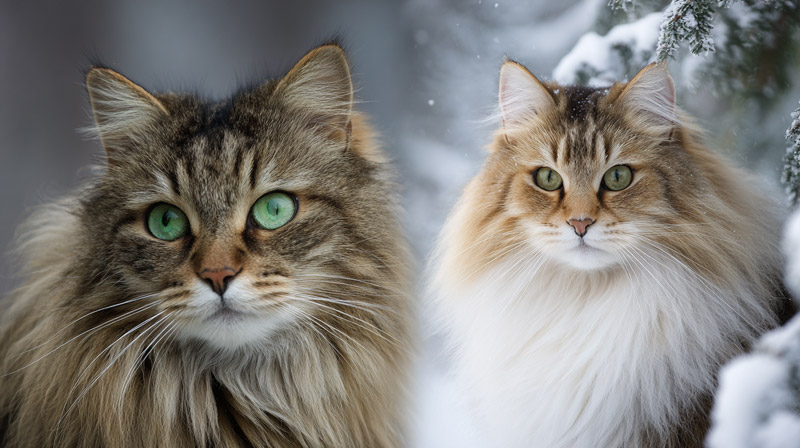
Norwegian Forest Cat vs Maine Coon
Physical differences:
Maine Coons are slightly larger, with males reaching 25+ pounds compared to Norwegian Forest cats’ 20-pound maximum.
Maine Coons have a shaggy coat of variable length while Norwegian Forest cats have more even coat length.
Head shape differs significantly. Maine Coons have a square muzzle and boxy head, while Norwegian Forest cats have a triangular head with a straight profile.
Eye shape: Maine Coons have rounder eyes, Norwegian Forest cats have almond-shaped eyes.
Leg proportions: Maine Coon legs are equal length front and back. Norwegian Forest cat hind legs are longer.
Temperament differences:
Maine Coons tend to be more dog-like and outgoing with strangers. Norwegian Forest cats are friendly but more reserved initially.
Both breeds are intelligent and trainable. Maine Coons may be slightly more vocal.
Care requirements:
Both need similar grooming (2-3 times weekly). Maine Coons may mat more easily due to their shaggy coat texture.
Exercise needs are comparable, though Maine Coons may have slightly higher energy levels.
Health concerns:
Both breeds are prone to HCM and hip dysplasia. Maine Coons also face spinal muscular atrophy. Norwegian Forest cats have the unique risk of GSD IV.
Cost differences:
Maine Coons typically cost $1,000-$2,000. Norwegian Forest cats cost $800-$1,500 for pet quality.
Both breeds have similar ongoing costs due to comparable size and needs.
Lifespan:
Maine Coons average 12-15 years. Norwegian Forest cats average 14-16 years, slightly longer.
Norwegian Forest Cat vs Siberian
Physical differences:
Siberians weigh 8-17 pounds, slightly lighter than Norwegian Forest cats’ 8-20 pounds.
Both have water-resistant double coats adapted for cold climates. The texture is very similar.
Siberians have a rounder head with a gentle curve to the profile. Norwegian Forest cats have a triangular head with a straight profile.
Both breeds have substantial builds, though Norwegian Forest cats often appear larger due to their height advantage.
Temperament differences:
Siberians are more openly affectionate and clingy. Norwegian Forest cats are affectionate but more independent.
Siberians tend to be more playful and high-energy. Norwegian Forest cats have moderate energy.
Both breeds are good with children and other pets.
Care requirements:
Grooming needs are identical: 2-3 times weekly, daily during shedding season.
Siberians may require slightly more daily play and interaction due to higher energy levels.
Health concerns:
Both breeds can develop HCM. Siberians don’t typically have hip dysplasia or GSD IV issues that affect Norwegian Forest cats.
Siberians may have a slightly higher incidence of kidney disease.
Cost differences:
Siberians typically cost $1,200-$2,000, slightly more than Norwegian Forest cats.
Ongoing costs are similar due to comparable size and care needs.
Lifespan:
Both breeds average 14-16 years with proper care.
How to Choose Between Norwegian Forest Cat and Similar Breeds
Lifestyle considerations:
If you want a larger, more robust cat, choose Maine Coon or Norwegian Forest Cat over Siberian.
If you prefer a more independent cat, Norwegian Forest Cat is better than the clingy Siberian or dog-like Maine Coon.
For apartment living, Norwegian Forest Cat or Siberian work better than the extra-large Maine Coon.
Decision factors:
Available space (Maine Coons need the most room)
Desired activity level (Siberians are most active, Norwegian Forest cats are moderate)
Grooming tolerance (all three require similar maintenance)
Budget (Siberians typically cost most, Norwegian Forest cats least)
Which breed for which owner type:
Active families with children: Maine Coon (most outgoing and playful)
Couples or individuals wanting affection: Siberian (most cuddly)
First-time cat owners wanting something manageable: Norwegian Forest Cat (balanced temperament)
Those seeking a majestic, low-maintenance companion: Norwegian Forest Cat (quieter and more independent)
Fun Facts About Norwegian Forest Cats
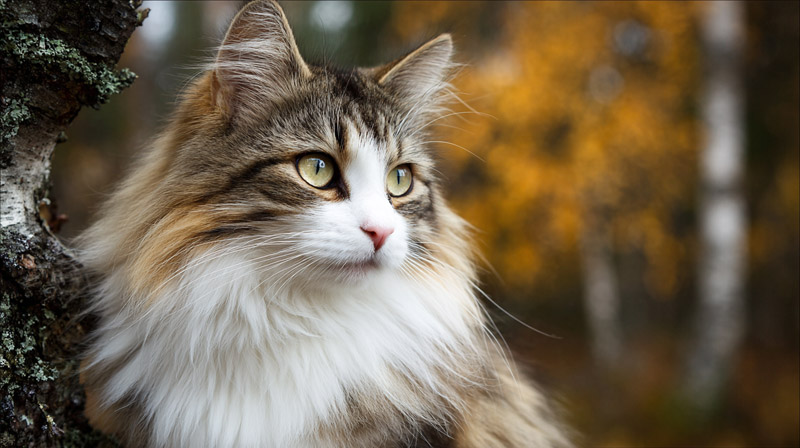
Norwegian Forest cats can weigh up to 22 pounds, making some males larger than small dog breeds.
Their water-resistant coat is so effective that bathing them can take 30+ minutes to fully saturate the fur.
In Norse mythology, these cats were supposedly strong enough that even Thor, the god of thunder, couldn’t lift one. The story describes Thor attempting to lift what appeared to be a cat but was actually the world serpent Jörmungandr in disguise.
The goddess Freya’s chariot was said to be pulled by two large, long-haired cats resembling Norwegian Forest cats.
They’re one of the few cat breeds that naturally climb down trees headfirst, thanks to their strong claws and unique body structure with longer hind legs.
Norwegian Forest cats can jump up to 6 feet vertically from a standing position.
The breed almost went extinct during World War II but was saved by dedicated breeders in the 1970s.
They’re the 5th most popular cat breed in France, despite being native to Norway.
Their thick coat means they can comfortably spend time outdoors in temperatures as low as 20°F without discomfort.
Some Norwegian Forest cats are polydactyl (have extra toes), though this isn’t accepted in show cats.
The longest Norwegian Forest cat on record measured over 40 inches from nose to tail tip.
They’re sometimes called “Wegies” by enthusiasts, a shortened form of the Norwegian pronunciation.
Is a Norwegian Forest Cat Right for You?
Best Homes for Norwegian Forest Cats
Ideal owner personality types include patient individuals who respect a cat’s need for independence while providing daily interaction.
People who enjoy grooming and don’t mind regular maintenance sessions do well with this breed.
Active households that can provide climbing opportunities and interactive play suit their energy levels.
Lifestyle compatibility:
Works well for: Working professionals who are home evenings and weekends, families with school-age children, retirees with time for daily interaction
Less suitable for: People away from home 12+ hours daily, those wanting a velcro lap cat, individuals with minimal patience for grooming
Home environment requirements:
Space for tall cat trees or climbing shelves is non-negotiable. They need vertical territory.
Secure windows or screened outdoor access provides mental stimulation.
Homes with stable temperatures (avoiding extreme heat) are best.
Time availability needs:
Minimum 1-2 hours daily for feeding, play, grooming, and interaction.
More time needed during shedding season (spring and fall) for daily grooming.
Who Should Avoid Norwegian Forest Cats?
Incompatible lifestyles:
Frequent travelers without reliable pet sitters should avoid this breed. They don’t do well alone for extended periods.
People living in very hot climates without air conditioning may struggle with their heat sensitivity.
Those wanting a cat that demands constant attention will be disappointed by their independent nature.
Allergy considerations:
Norwegian Forest cats are NOT hypoallergenic despite some internet claims. Their long coat and dander can trigger allergies.
People with cat allergies should spend time with the breed before committing. Some individuals tolerate certain breeds better than others, but Norwegian Forest cats produce normal allergen levels.
Challenge factors:
Seasonal shedding creates significant fur accumulation requiring daily vacuuming during peak periods.
Their size means they need larger litter boxes, eat more food, and take up more space than average cats.
Initial cost and ongoing expenses are higher than mixed-breed cats.
Better breed alternatives:
For apartment dwellers with limited space: Russian Blue or British Shorthair
For those wanting lap cats: Ragdoll or Birman
For hot climates: Cornish Rex or Devon Rex
For minimal grooming: American Shorthair or Burmese
Questions to Ask Before Getting a Norwegian Forest Cat
Financial readiness:
Can I afford $1,500-$3,000 initially plus $1,500-$3,000 annually for 15+ years?
Do I have emergency savings for unexpected veterinary expenses ($2,000-$5,000)?
Can I afford pet insurance or self-insure for potential health issues?
Time commitment:
Am I home enough to provide 1-2 hours of daily interaction and play?
Can I commit to 2-3 grooming sessions weekly, more during shedding season?
Do I have time for regular veterinary appointments and health monitoring?
Living situation stability:
Will I be in my current home for the next 15+ years, or can I find pet-friendly housing if I move?
Does my lease allow cats? Are there breed or weight restrictions?
Is my home safe for a large, climbing cat?
Family agreement:
Do all household members want a cat and agree on care responsibilities?
Is anyone in the household allergic to cats?
Who will care for the cat during vacations or emergencies?
Long-term planning:
What happens to the cat if my circumstances change (job relocation, relationship changes, health issues)?
Do I have a backup caretaker if I can no longer care for the cat?
Am I prepared for potential behavioral issues, health problems, or personality quirks?
Travel considerations:
How often do I travel? Do I have reliable pet sitters or boarding options?
Can I afford pet care during absences ($25-$50 daily for professional sitting)?
Is my cat’s temperament suitable for boarding, or will in-home care be necessary?
Other pet considerations:
Do my current pets get along with other animals?
Am I prepared to do slow, proper introductions that may take weeks?
Can I provide separate resources (food bowls, litter boxes, sleeping areas) if needed?
Do I have space for multiple cats if they don’t bond and prefer separate territories?
Realistic expectations:
Do I understand this breed’s independent nature and moderate (not extreme) affection level?
Am I prepared for a cat that may not enjoy being held or lap-sitting?
Can I accept that individual personality varies and my cat may not match all breed descriptions?
The Norwegian Forest cat offers a unique combination of wild appearance, gentle temperament, and manageable care needs. Their history as working cats gives them resilience and adaptability that suits many households.
But their size, grooming requirements, and 15+ year lifespan mean getting one shouldn’t be an impulse decision. Research thoroughly, meet the breed in person if possible, and honestly assess whether your lifestyle matches their needs.
For the right owner, a Norwegian Forest cat becomes a loyal companion that brings years of quiet affection, entertaining antics, and majestic beauty to daily life.
FAQ on Norwegian Forest Cat
Are Norwegian Forest Cats good pets?
Yes, they make excellent pets for families and individuals. Their gentle temperament, patience with children, and adaptability to various households make them reliable companions. They bond closely with families while maintaining independent personalities that don’t demand constant attention.
How much does a Norwegian Forest Cat cost?
Pet quality Wegies from reputable breeders cost $800-$1,500. Show quality cats run $1,500-$2,500, while breeding rights cats cost $2,000-$4,000. Adoption from shelters costs $50-$200. Initial supplies and veterinary care add another $400-$800 to your first-year expenses.
Do Norwegian Forest Cats shed a lot?
Yes, moderate to high shedding occurs year-round with heavy seasonal molting in spring and fall. Their thick double coat requires brushing 2-3 times weekly, increasing to daily during shedding seasons. Regular grooming prevents mats and reduces loose fur around your home.
Are Norwegian Forest Cats bigger than Maine Coons?
No, Maine Coons are typically larger. Male Norwegian Forest cats weigh 12-20 pounds while Maine Coons reach 25+ pounds. Both breeds have substantial builds, but Maine Coons have greater overall mass and length despite similar height ranges.
How long do Norwegian Forest Cats live?
They live 14-16 years on average, with many reaching 18-20 years with proper care. This exceeds the 12-15 year average for most domestic cats. Indoor lifestyle, quality nutrition, regular veterinary care, and genetic health significantly influence lifespan.
Are Norwegian Forest Cats affectionate?
Yes, but on their own terms. They bond closely with families and enjoy being near you without demanding constant holding or lap time. Most prefer sitting beside you rather than on you. Their affection shows through following you around and quiet companionship.
Do Norwegian Forest Cats like water?
They tolerate water better than most breeds due to their water-resistant coat. Some enjoy playing with running water or dipping paws in bowls. But they’re not water-loving like Turkish Vans. Bathing is still challenging despite their waterproof fur.
Can Norwegian Forest Cats live in apartments?
Yes, if you provide sufficient vertical space. They need tall cat trees and climbing shelves more than floor space. Their quiet nature suits apartment living well. A small apartment with adequate vertical territory works better than a large space without climbing options.
Are Norwegian Forest Cats hypoallergenic?
No, they produce normal levels of allergens despite claims otherwise. Their long coat and dander can trigger allergies. People with cat allergies should spend time with the breed before committing. Individual tolerance varies, but Wegies aren’t considered low-allergen cats.
What health problems do Norwegian Forest Cats have?
They’re prone to hypertrophic cardiomyopathy (heart disease), hip dysplasia, and glycogen storage disease type IV. Polycystic kidney disease and dental issues also occur. Reputable breeders screen for genetic conditions. Regular veterinary checkups and genetic testing help manage breed-specific health risks.
Conclusion
Norwegian Forest Cat cats bring a unique blend of rugged beauty and gentle companionship to the right households. Their Skogkatt heritage shows in every climbing leap and winter-ready coat.
These natural breed felines need space to climb, regular grooming sessions, and patience with their independent streaks. They reward that care with 14-16 years of loyal friendship.
The upfront cost of $800-$1,500 plus ongoing expenses suits committed owners willing to invest in quality care. Genetic testing for conditions like hypertrophic cardiomyopathy and hip dysplasia matters when selecting a breeder.
Their semi-longhaired coat, substantial build, and moderate energy level make them manageable for first-time owners who’ve done their homework. Not every household needs a Wegie, but those seeking a majestic, low-maintenance feline companion often find their perfect match in this Scandinavian treasure.