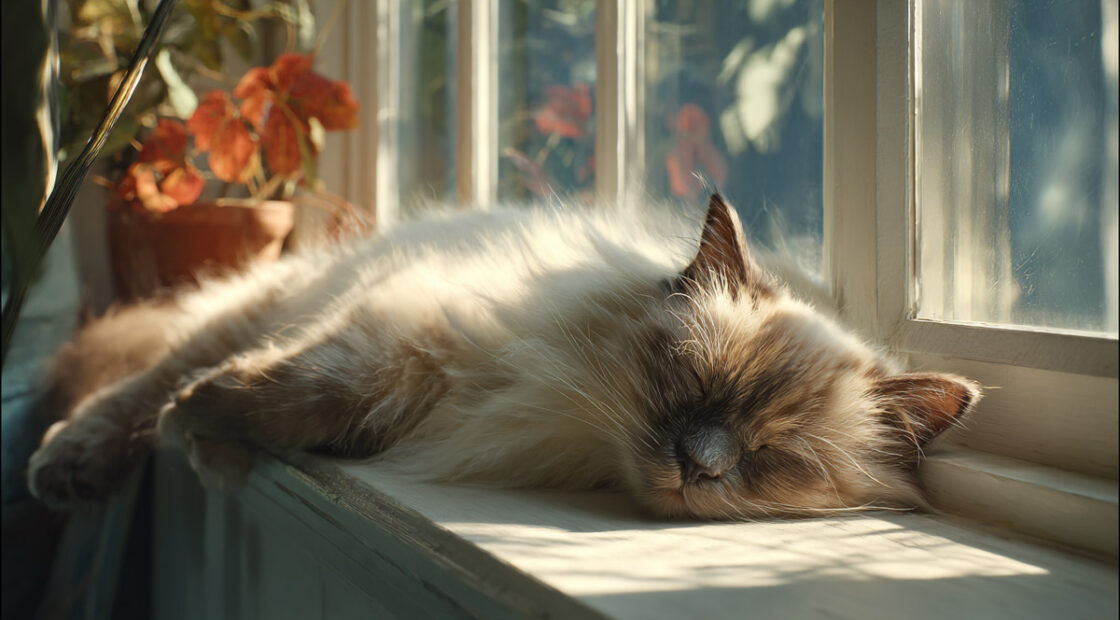
Four white paws are the first thing anyone notices on a Birman, and a silky coat that doesn’t mat comes second. Underneath is a semi-longhair, color point cat, also known as the Sacred Cat of Burma.
France recognized the breed in 1925. CFA, GCCF, and FIFe each judge it against a written standard today.
The gloves get all the attention, yet CFA’s breed standard (2026) gives them only 20 of 100 points. The head is worth 30 and the body 25. Blue eyes and a medium-length Roman nose are what the head points reward.
What Is a Birman?
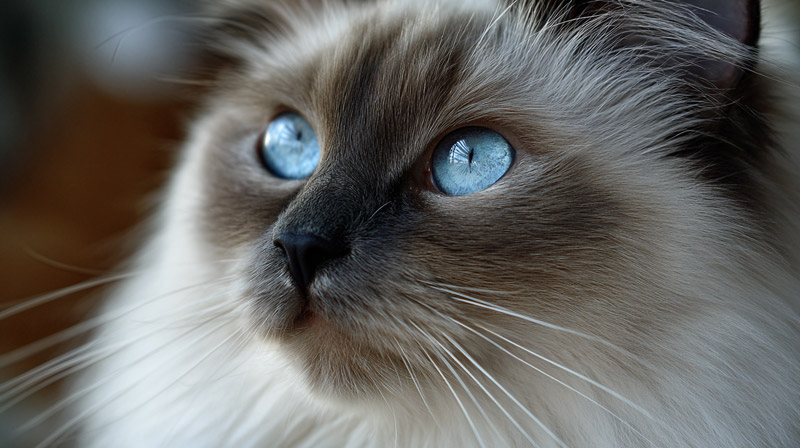
Expect deep blue eyes, white gloves on every paw, and a silky semi-longhair coat that resists matting. That’s the short version.
Breeders also call it the Sacred Birman. The name comes from Birmanie, the French word for Burma (Cat Fanciers’ Association).
People mix it up with the Burmese, which it is not. Separate breeds, separate standards.
Looks cause more trouble than the name does. A mitted Ragdoll also has white feet on a pointed body, so the two get swapped constantly.
| Feature | Birman | Ragdoll | Siamese |
|---|---|---|---|
| Coat | Medium-long to long, silken, no undercoat | Moderately long, plush | Short, fine, glossy |
| White on paws | Four white gloves required | Only in mitted, bicolor and van patterns | No white allowed |
| Head | Broad and rounded, Roman nose | Modified wedge, straight nose | Long wedge, flat profile |
| Eyes | Almost round, blue | Large, oval, vivid blue | Almond-shaped, deep blue |
Table entries follow the CFA breed standard for each breed.
Next to a Siamese, build gives it away. CFA’s breed article describes the Birman as stockier and more heavily boned, with a broader, rounder head.
Against a Ragdoll, look at the nose. CFA requires a Roman nose on a Birman and penalizes one on a Ragdoll.
Birman Origins, From Temple Legend to Documented History
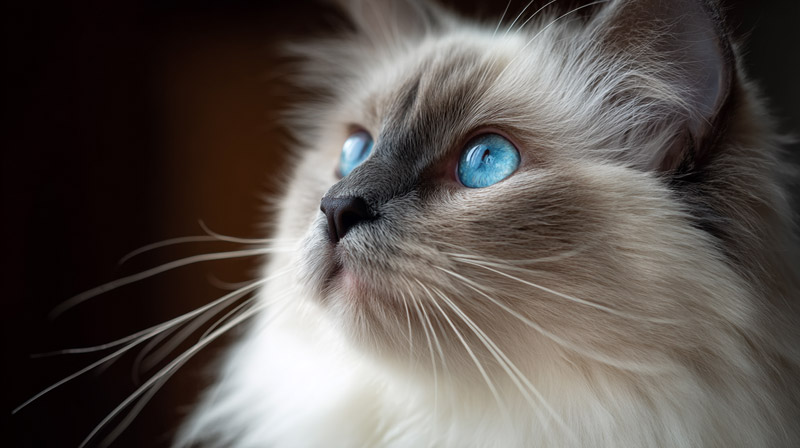
CFA’s breed article says no clear record exists of where the Birman began. The temple story is legend. The paper trail starts in France, where the breed was recognized in 1925.
The temple legend
A priest named Mun-Ha, his white temple cat Sinh, and a golden goddess with sapphire eyes sit at the center of it. Raiders mortally wounded the priest, and Sinh’s coat turned golden and his eyes blue. His paws stayed white where they touched his master.
Tellings differ on the setting. CFA’s version puts the temple on Mount Lugh, and GCCF’s names the Temple of Lao-Tsun.
The documented chain of events
- In 1919 a pair of cats travels from Burma to France. The male dies on the voyage, but the pregnant female, Sita, survives (CFA).
- The breed is recognized in France in 1925.
- By World War II only one breeding pair remains in Europe (CFA), and GCCF traces the French line to Orloff and Xenia de Kaabaa.
- Pure Birman litters are produced again in the early 1950s, after outcrossing.
- The first Birmans of record reach the United States in 1959 (CFA).
Sources don’t agree on the starting point. CFA and GCCF date the pair’s arrival in France to 1919, while the American Cat Fanciers Association says Birmans reached Europe in 1916.
CFA’s retelling also includes a third account, in which an American named Vanderbilt sent smuggled temple cats to a Mme. Thadde Hadisch in France.
After the war, French breeders rebuilt the line with outcrosses. GCCF notes that Persian lines introduced the dilute gene for blue.
CFA adds that Poupee, a kitten from the first litter, was bred to a cat of another breed, perhaps a Siamese. The Birman standard still penalizes Persian or Siamese head types today.
Recognition dates by registry
FIFe recognized the Sacred Birman in 1949, its founding year, according to FIFe’s own standard. Some retail guides give 1964, which FIFe’s documents do not support.
GCCF recognized the breed in 1966. CFA’s dates are split because its registration rules record several steps. Registration came in September 1966, provisional status in June 1967, and championship status in 1967.
The CFA breed profile squeezes those steps into a single 1967 registration date. You’ll see both 1966 and 1967 in print, and both trace back to real CFA events.
Birman Size, Build, and Facial Features
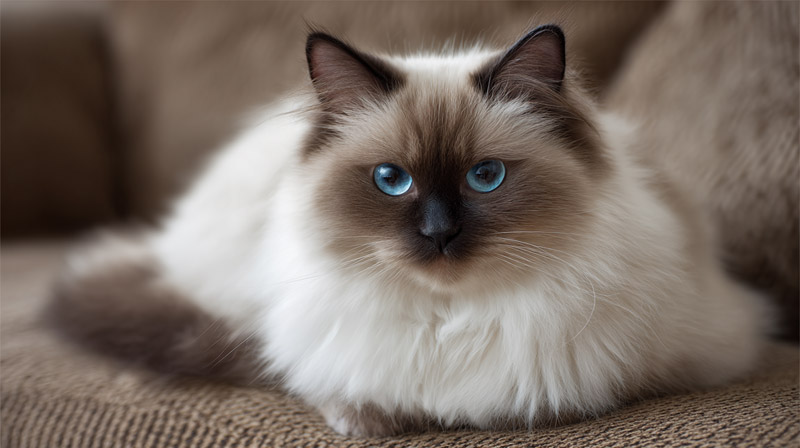
Medium to large, long in the body and stocky, with a broad rounded head and a medium-length Roman nose (CFA).
The skull is broad and rounded, with full cheeks, a heavy jaw, and a strong chin. The nose curves slightly outward and the nostrils sit low.
Eyes are almost round and set well apart, with the outer corners tilted very slightly upward. They are blue and only blue, and the deeper and more vivid the shade, the better.
Ears are medium, nearly as wide at the base as they are tall, with a rounded tip.
The body is elongated and stocky on heavy legs of medium length. Paws are large and round, with five toes in front and four behind.
Eye color is a hard line in CFA’s standard, since any color other than blue disqualifies. The same standard penalizes a Persian or Siamese head type and delicate bone structure.
Males weigh 10 to 15 lb and females 6 to 10 lb (GCCF). Full maturity arrives at about 3 years (CFA).
CFA gives no weight numbers in its profile or its standard, so GCCF’s ranges are the only registry weights available. Both registries say females run smaller than males.
Growth is slow. A kitten’s adult look, including how deep the color gets, isn’t settled until around the third birthday.
Birman Colors, Gloves, and Laces
The body is pale. The face, ears, legs, and tail carry the darker points, and every paw wears a white glove.
Point colors and patterns
CFA’s current standard lists seal, blue, chocolate, and lilac points, plus red, cream, tabby-point, and tortie classes. GCCF counts 20 colors in total.
Older text still says CFA accepts only four colors. That line comes from a CFA breed article written in 1998, while CFA’s breed profile, last updated in October 2026, covers red, cream, tabby, and tortie points as well.
The standard also prizes golden mist, a faint golden beige cast on the back and sides. It runs deeper in seal points and can be absent in kittens.
Gloves and laces
The gloves are the breed’s signature, and they’re also the hardest feature to breed. CFA’s standard says faultlessly gloved cats are a rare exception.
| Feature | CFA standard | GCCF standard |
|---|---|---|
| Front gloves | Even line across the paw at or between the second and third joints | Even line across the paw, not past the angle of paw and leg |
| Back gloves | Cover all toes, may reach higher than the front gloves | Socks cover the entire paw |
| Laces or gauntlets | Rise up the hock, ideally ending in a point or inverted V, half to three quarters of the way up | Taper up the back of the leg to just below the point of the hock |
CFA disqualifies a Birman that lacks white on any paw. White on the back legs beyond the hock, white tail tips, and white chin spots disqualify too.
The two registries disagree on the genetics. CFA credits the bicolor gene for the gloves, while GCCF says a separate gloving gene produces them, unrelated to the white spotting gene found in bicolor cats.
How kitten color develops
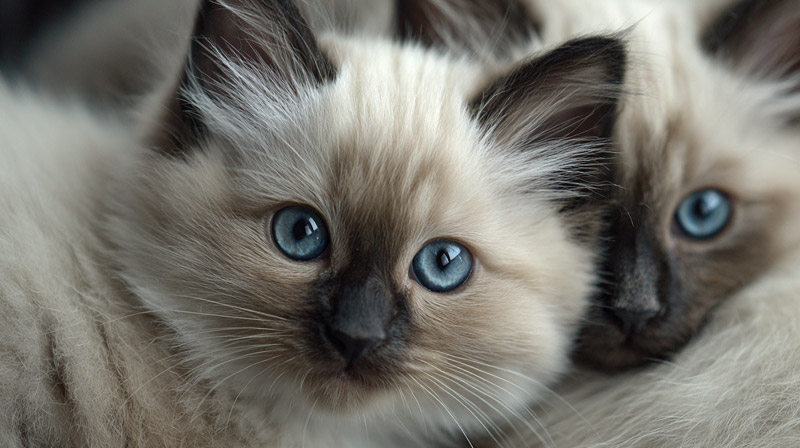
Birman kittens are born white.
Pointing in cats traces to a temperature-sensitive mutation in the tyrosinase gene, which limits pigment to the cooler parts of the body (Imes and colleagues, Animal Genetics, 2006).
Seal points show within a few days, and other colors take a few more. Gloves and laces appear within days on darker colors but can take several weeks on lighter ones.
Final color depth keeps settling until maturity.
Breeders have tried to predict glove placement on newborns by placing them in shadow. CFA’s breed article reports that only time reveals the markings, so buyers who want show-quality gloves should wait until they show.
What Is a Birman’s Temperament Like?
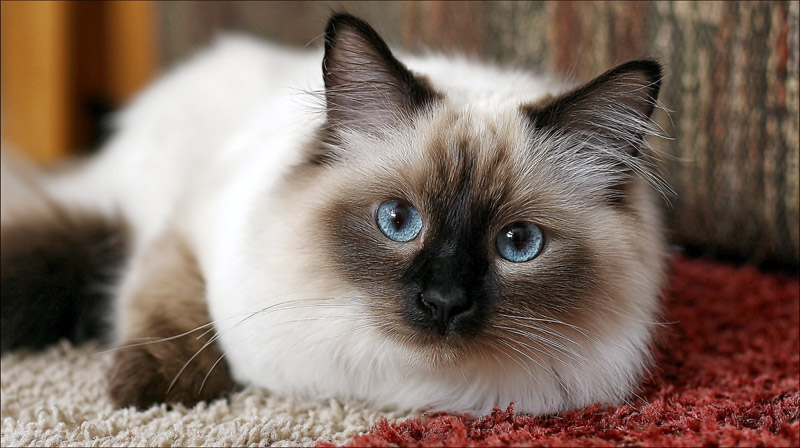
Sweet and even-tempered, mostly. Moderate energy, a quiet voice, and a strong preference for being near people.
CFA’s breed article places the Birman in the middle of the range. It is less active than the shorthaired breeds and less laid back than some other longhairs.
Birmans are moderately active, and they’re likely to “help” with household tasks by sitting in the middle of them. CFA says they enjoy learning and respond well to training.
The voice is soft and chirp-like, but a Birman gets chattier when its owner answers every meow. GCCF says it is nowhere near as vocal as a Siamese, and also less inclined to hunt than many breeds.
Children and other pets
CFA calls the breed patient, even-tempered, and tolerant, and recommends it for families with children and other pets. GCCF adds that Birmans share a home with other cats and dogs without trouble.
Why a Birman does poorly alone
Birmans are social and do not handle long stretches alone, per CFA. If no one is home during the workday and there are no other pets, CFA suggests considering a pair.
A breeder quoted in CFA’s breed article noticed a pattern while placing kittens. Several adopters came back a few months later to add a second one.
A Birman left alone all day is the main way this temperament goes wrong.
How Much Grooming Does a Birman Need?
Weekly combing covers most of the year. Spring needs more.
With no undercoat to knot, CFA’s breed profile says weekly combing keeps a Birman looking its best, and it adds that the breed sheds less than most longhaired cats.
Comb through the whole coat to lift loose hair and spread skin oils (GCCF). When the winter coat comes out in spring, comb more often, and a warm bath helps loosen it (GCCF). Baths aren’t needed on a schedule, though an occasional one suits the coat.
The heavy ruff around the neck and the slightly curly fur on the stomach (CFA standard) are the spots to check first. CFA suggests asking the breeder which shampoo suits the line, since every coat differs slightly.
General advice and breed advice disagree here. CFA’s guide to choosing a kitten tells owners of any longhaired cat to plan on daily combing, while its Birman profile calls weekly enough.
A workable rule is weekly as the baseline. Move to daily only when loose hair starts piling up during the spring coat change.
Birman Health Problems and Lifespan
The list of documented inherited conditions is short, and a small gene pool sits behind most of it.
GCCF’s Birman breeding policy, citing Lipinski and colleagues (Genomics, 2008), puts the breed’s heterozygosity at 0.42 against an all-breed average of 0.58. The same policy says the gene pool has passed through two population bottlenecks, with outcrossing used each time to rebuild the breed.
The study also places the Birman in the Asian group of breeds, and it ranks the Korat as the closest relative.
WebMD’s breed profile says Birmans have no unique health issues. The research below shows several conditions that cluster in the breed, even if none is unique in the strict sense.
HCM and screening
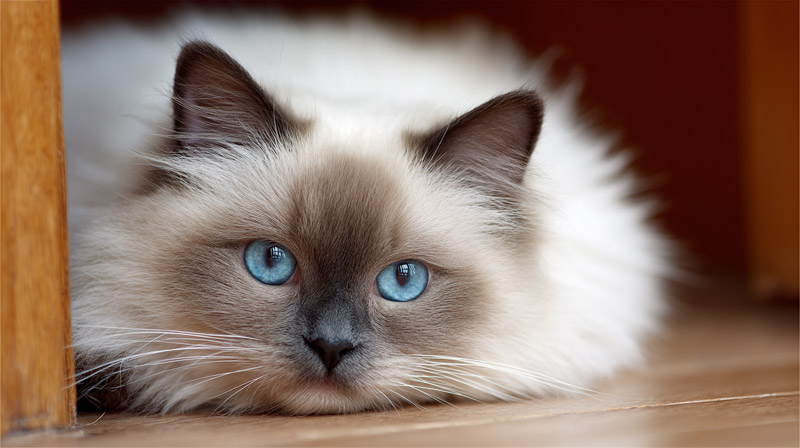
Hypertrophic cardiomyopathy (HCM) is the most common heart disease in cats, and GCCF says it is thought to be inherited as an autosomal dominant trait in Birmans. It progresses over time and can end in heart failure or sudden death.
Breeders screen with echocardiography, which a Royal Veterinary College cardiology synopsis calls the gold standard diagnostic test. Listening for murmurs is a poor substitute, because murmur intensity does not track severity and many high-risk cats have none. Borderline mild thickening is best read by a specialist.
The best-known HCM gene test was built around a variant found in the Maine Coon, and Pawpeds advises against using it on cats without Maine Coon ancestry. None of the CFA or GCCF Birman documents names a breed-specific HCM gene test, so scan results are what to ask for.
CFA says breeder testing for HCM and other conditions has helped keep the gene pool healthy and diverse. Ask for scan dates as well as results, because a scan covers only the age at which it was done.
Conditions seen in kittens
Congenital hypotrichosis
An autosomal recessive deletion in the FOXN1 gene leaves kittens hairless, without a thymus, and prone to infection.
In the reported cases, affected kittens died or were euthanized before eight months (Abitbol and colleagues, PLOS ONE, 2015). DNA tests identify carriers, and a carrier can be mated safely to a clear cat, but carrier-to-carrier matings are not advised (Wisdom Panel).
Neonatal isoerythrolysis
Both blood type A and type B occur in Birmans, according to GCCF’s breeding policy. When a type B queen is mated to a type A tom, the kittens can absorb antibodies from her milk and fade, often fatally.
GCCF recommends the DNA blood test over the blood-draw version, because only DNA shows whether a type A cat carries B. Giger and colleagues’ 1991 US survey listed the Birman among the breeds with a notable share of type B cats.
Trembling kittens
GCCF’s policy, quoting Feline Advisory Bureau notes, describes litters that shake from about 10 days old and recover fully from 12 weeks. The cause is unknown.
Eye, kidney, and other conditions
40% of 50 healthy Birmans had serum creatinine above the usual reference range, according to Paltrinieri and colleagues (Journal of Feline Medicine and Surgery, 2018).
Symmetric dimethylarginine (SDMA) tracks kidney function more reliably in the breed, and the authors proposed a breed-specific reference interval. A vet working from general ranges can overestimate chronic kidney disease in a healthy Birman.
- Young Birmans occasionally develop renal failure shortly after neutering, so tell the vet the breed before anesthesia (Feline Advisory Bureau notes in GCCF’s policy).
- Sound-triggered seizures in older cats, called audiogenic reflex seizures, show Birmans over-represented among pedigrees (Lowrie and colleagues, 2015).
- GCCF rates the risk of polycystic kidney disease as very low, though a UK pet insurer’s breed guide lists it anyway. GCCF requires PKD clearance for the Persian outcross cats that can appear in a pedigree, which accounts for the gap.
- Corneal dermoids and congenital cataracts have each been seen at least once, and both are rare (GCCF).
How long Birmans live
| Source | Figure | Basis |
|---|---|---|
| GCCF breed page | 12 to 16 years | Registry statement |
| CFA breed article | 15 or more is not unusual | Breeder experience |
| VetCompass life tables (Teng and colleagues, 2024) | 14.39 years at birth (95% CI 12.87 to 15.91) | Veterinary clinic records |
The VetCompass figure sits level with the Burmese at the top of the 12 breeds analyzed (crossbred included). The 2015 VetCompass paper (O’Neill and colleagues) also ranked Birmans first, but only 12 Birmans were in that sample, so the life-table number carries more weight.
Pet sites that quote 15 to 20 years describe the best case, not the expectation.
How Much Does a Birman Cost?
Somewhere between 450 and 790 pounds for a registered-breeder kitten in the UK, depending on which source you trust.
The charity PDSA lists an average purchase cost of 450 pounds, while a TheMoneyPig.com price survey reported in UK regional papers put the average at 790 pounds. That survey covered the most sought-after kittens, and its authors warn that some colors and bloodlines cost much more.
No registry publishes a Birman-specific US price. CFA’s kitten guide gives only a broad range for all pedigreed breeds, and it tells buyers to add spay or neuter surgery, vaccinations, and routine care.
Part of the price is paperwork, since GCCF tracks registration by generation. Part is the health testing the breeder pays for, like parental echocardiograms and DNA tests. Show prospects cost more than pet kittens, and CFA says a particular color or sex usually means a wait.
A kitten priced far below these averages deserves questions about which tests were skipped.
Some price guides call the breed rare. CFA says it is unusual to find a cat show without Birmans and that finding a kitten should not be a challenge, so rarity is no reason to pay more.
PDSA estimates the lifetime cost of a Birman at 13,600 to 18,000 pounds. The purchase price is the small part of that bill.
Rescue is the cheapest route. Birman Welfare and Rescue, a UK registered charity linked to the Birman Cat Club, rehomes Birmans of all colors and ages and neuters every cat before it goes to a new home.
How to Choose a Birman Breeder and Kitten
Go with a registered breeder who shows you parent health results and lets you meet the mother, then check the paperwork before any money moves.
- Start with registry and breed club listings. CFA runs a Find-a-Breeder directory, GCCF publishes a breeder scheme map, and cat shows let you meet several breeders in one day.
- Ask for parental HCM echocardiogram results with the scan dates.
- Ask for DNA results on hypotrichosis carrier status and on blood type.
- Read the pedigree for outcross cats. If a Persian outcross appears within three generations, ask for the PKD clearance GCCF requires for those cats.
- Meet the mother and see where the kittens are raised. CFA’s ten questions also cover vaccinations, parental feline leukemia tests, and a stool sample result.
- Read the contract for the health guarantee, the return policy, and the spay or neuter agreement. GCCF discourages placing kittens on breeding terms.
CFA notes that kittens at shows are at least four months old, so a younger kitten means visiting the breeder’s home.
Skip pet stores. CFA warns that reputable breeders of pedigreed cats do not sell through them, and that store prices often run higher than breeder prices.
A DNA test for the gloving gene can confirm a kitten is homozygous when parentage is in doubt (GCCF policy). GCCF’s own documents disagree on that gene. The breed page calls it unrelated to the white spotting gene found in bicolor cats, while the breeding policy describes gloving as an allele at the white spotting locus, a KIT mutation studied by Gandolfi and colleagues.
When a Birman Is the Wrong Fit
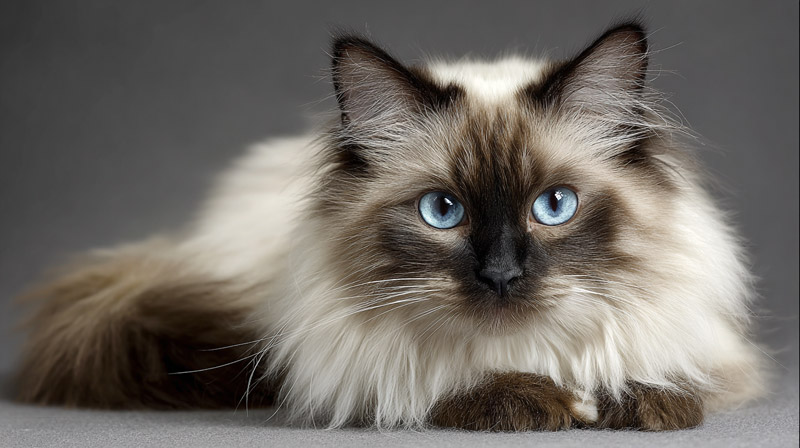
Most households suit a Birman fine. A few don’t.
Allergy sufferers top that list. A 2024 review cited by the University of Southern Queensland found no scientific evidence for a hypoallergenic breed, and Fel d 1 comes from saliva and skin glands, with output varying mostly by sex and by individual cat.
If nobody is home most of the day, budget for a pair or choose a different breed.
Buyers whose budget stops at the price tag will struggle too, since screening, kidney monitoring, and heart scans add up. The same goes for anyone with a low tolerance for genetic risk. HCM, hypotrichosis carriers, and a small gene pool come with the breed.
A rescue domestic cat is the better pick for a buyer who wants a companion without breed-level health planning. CFA says mixed-breed kittens vary in personality, so spend time with the individual cat.
In its favor
CFA describes the breed as even-tempered with children and other pets. Coat care stays light. VetCompass data puts it among the longest-lived breeds, and breeder networks are well established in the US and UK.
Against it
The purchase price sits well above a shelter cat. HCM and hypotrichosis screening is needed. Lab values can mislead a vet on kidney health, and the breed is not hypoallergenic.
Pick a Birman for the temperament, and budget for the health checks that come with it.
Birman FAQ
Do Birmans meow a lot?
No, not by default. CFA describes most Birmans as soft-spoken, with chirp-like voices, and GCCF says they are nowhere near as vocal as a Siamese.
Both registries add one caveat. Answering every meow teaches a Birman to talk more.
Are Birmans good apartment cats?
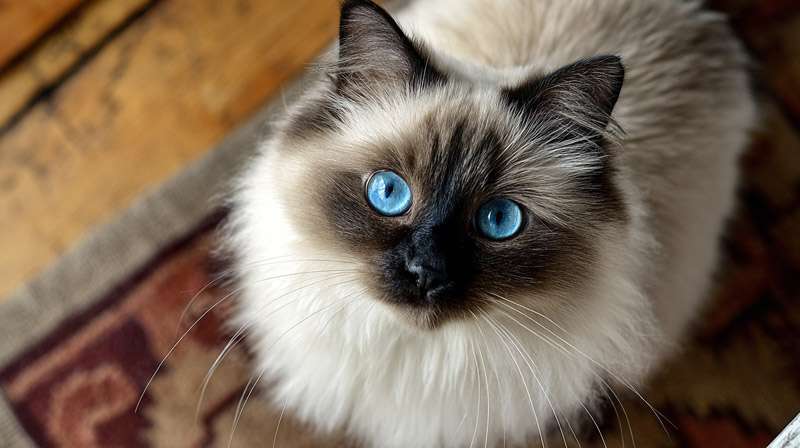
Yes. CFA’s kitten guide says cats adapt well to apartments and condos, and the Birman is a moderately active breed that GCCF calls less inclined to hunt.
Plan on daily play and company, because Birmans follow their people from room to room.
What should I feed a Birman, and do they gain weight easily?
No registry document names a breed-specific diet or a Birman weight problem, so feed a complete diet matched to age.
Veterinary nutrition guidance in Today’s Veterinary Practice (2021) flags indoor cats as being at greater risk of becoming overweight. Excess weight raises the risk of diabetes and urinary tract disease, so ask the vet to score body condition at each visit.
How popular is the Birman breed?
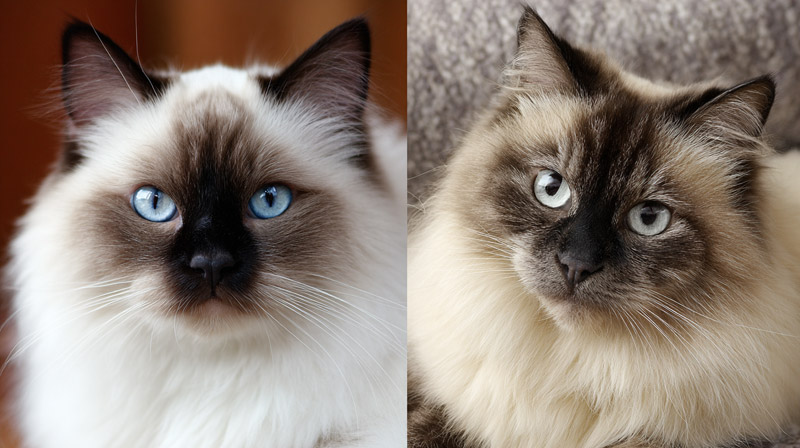
Fairly popular. GCCF’s 2025 registration table ranks the Birman twelfth, at 260 registrations, down from tenth place and 362 registrations in 2023.
CFA’s own breed profile also cites the breed’s popularity.
What the First Year With a Birman Involves
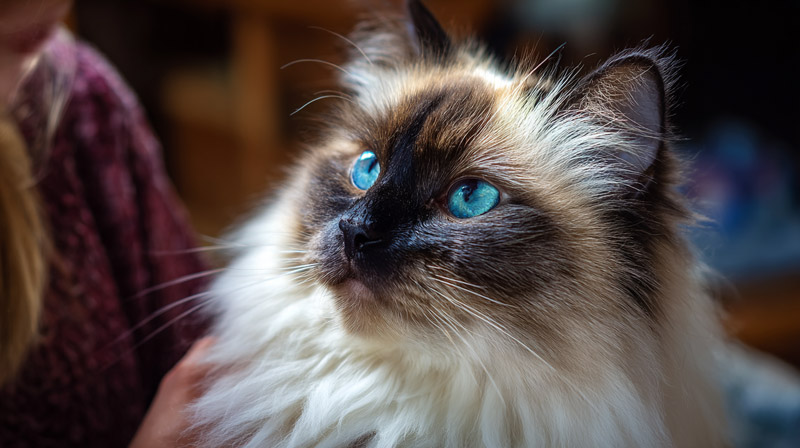
Get the written HCM scan and DNA results from the breeder before buying. Book a vet exam soon after pickup and name the breed up front. Before any surgery, get a urea, creatinine, and SDMA baseline.
The order follows reversibility. Paperwork can be corrected before money changes hands, while anesthesia cannot be undone.
Each check is paid for while the kitten still looks healthy, and none of them guarantees a clean result later. That’s the annoying part.
Verified on October 27, 2026: no CFA or GCCF Birman document names a Birman-specific HCM gene test. A validated test would change the first step above.