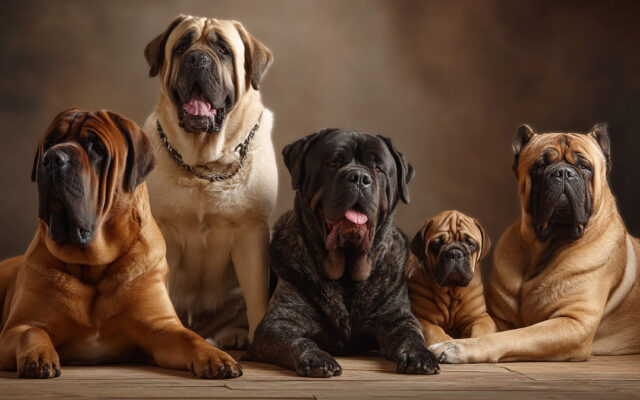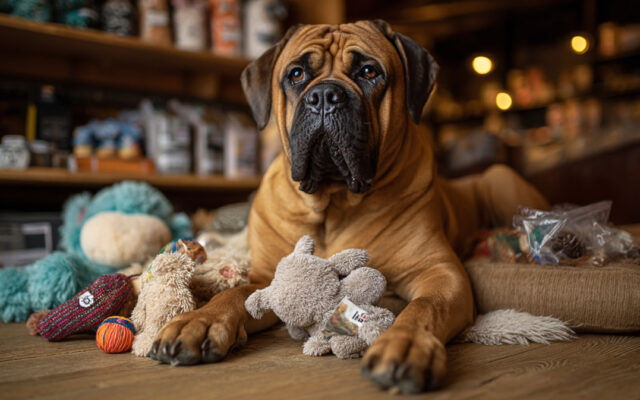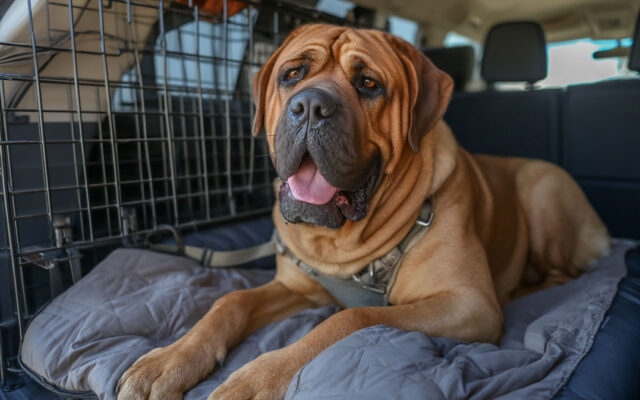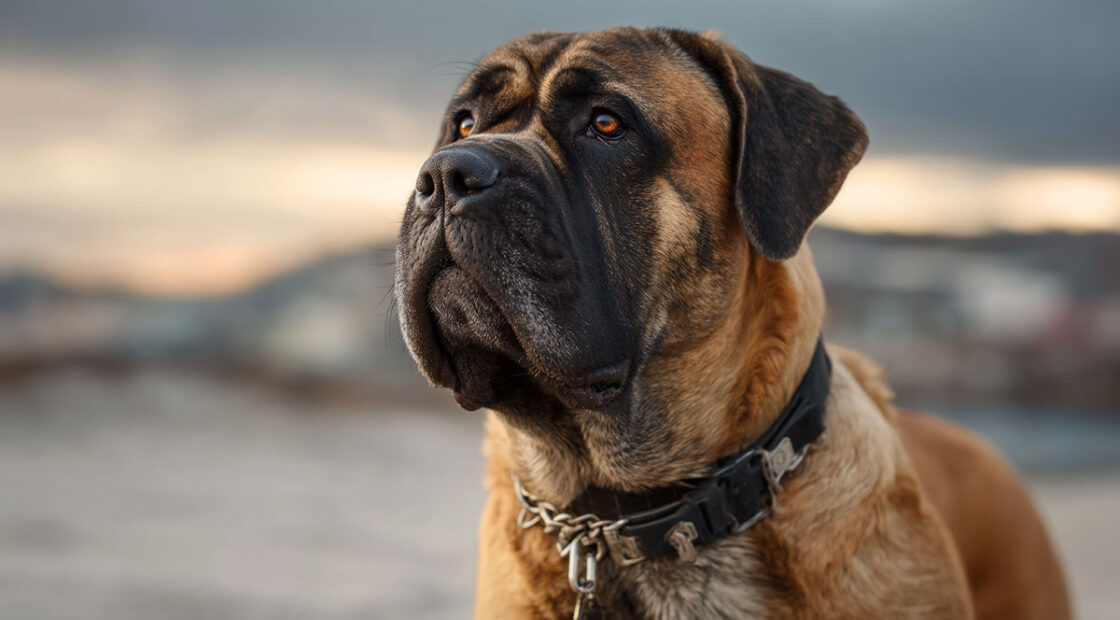
A Bullmastiff was built to grab a man and hold him still, not maul him, and that single design choice explains almost everything about how the breed acts around people it doesn’t know.
The American Kennel Club spells this out in its official breed standard, the document breeders and temperament evaluators actually use when judging whether a given dog fits the type.
Adult males run 110 to 130 pounds and stand 25 to 27 inches at the withers under that 1992 standard, and the AKC ties that bulk directly to one job: the dog needs enough mass to catch and hold a struggling assailant without mauling him.
Reserve with strangers, and near-total devotion to the family. Both come out of that same restraint-first blueprint.
What Is Bullmastiff Temperament?
What the AKC Breed Standard Says
Ask a longtime breeder what makes this dog tick and you’ll usually get some version of the same answer: it reads a room before it does anything else. Who gets a wag and who gets watched gets decided well before any command comes from the owner.
The AKC’s breed standard, approved back in 1992, boils the whole thing down to five words, calling the breed “fearless and confident yet docile.”
That’s a lot packed into one line. Reliability and intelligence, plus a genuine wish to please, wrapped around one job: family companion and protector.
What Bullmastiff Temperament Is Not
None of that reads as unpredictable, at least not by design.
The American Bullmastiff Association puts it plainly: this is a dog that stays loyal to its people and protective of its property. It also tends to clock who belongs and who doesn’t almost immediately, which is a different animal entirely from being trigger-happy.
Unprovoked aggression toward a stranger who’s just standing there calmly isn’t typical for this breed. A startle followed by a quick recovery is normal dog behavior, honestly, across pretty much any breed. Growling paired with stiff, frozen body language is the one worth actually paying attention to, that’s a warning sign, not a personality trait.
Bob Dylan reportedly owned one of these dogs, a Bullmastiff named Brutus, sometime back in the 1960s. It’s a small trivia point, but it says more about how long this breed has lived quietly inside households than anything about celebrity ownership.
How the Bullmastiff Guarding Instinct Works

The 60/40 Mastiff-Bulldog Cross
This breed was built on purpose. Nobody stumbled into it.
English gamekeepers crossed roughly 60 percent Mastiff and 40 percent Bulldog, per the AKC breed standard, aiming for something heavy enough to stop a grown man but still quick enough to catch him first.
The Mastiff side is where the size and raw stopping power came from. The Bulldog side (the old-style English Bulldog, leaner and considerably more athletic than the wrinkly companion breed we know today) is what gave the cross its grip, its gameness, and the close-range agility a Mastiff alone doesn’t really have.
Seeing that size gap next to an actual Mastiff makes the difference click faster than any number on a page. how Bullmastiff and Mastiff temperaments actually compare gets into that in more depth, and it’s not just about who’s heavier on a scale.
Restraint Over Attack: the Catch-and-Hold Method
Catch, hold, wait.
That was the whole job description for what used to be called a Gamekeeper’s Night Dog. You can still see the instinct playing out in dogs living on suburban couches today.
| Trait | Bullmastiff (restraint guarding) | Attack-trained guard breed |
|---|---|---|
| Primary goal | Pin and hold | Bite and subdue |
| Approach style | Silent tracking | Often vocal warning first |
| Release cue | Waits for handler | Command-dependent release |
That restraint-first approach is really what separates a Bullmastiff guard dog from a breed trained to bite and hold strictly on command.
It’s also part of why the breed sits toward the calmer end of the molosser group generally. The job was never about constant vigilance. It was about getting the one moment right when it actually mattered.
Why Bullmastiffs Are Reserved With Strangers

Reserved does not mean unfriendly.
A healthy version of that reserve looks like this: a calm read of whoever just walked in, the dog positioning itself between the stranger and the family, then settling once everyone else in the house seems fine with the person.
The version worth worrying about looks different. Stiff, frozen body language that doesn’t soften even after introductions, or growling with no clear trigger anyone can point to, that’s the line between normal wariness and something that needs attention.
This wariness is territorial, not fear-based, and it traces straight back to a job that depended on telling owner from poacher on a dark estate.
It’s also why the next stage of development matters so much. Without early exposure, that same territorial instinct can drift into suspicion of anyone unfamiliar, guests included.
How Socialization Shapes Bullmastiff Temperament
The Critical Socialization Window
The first three months matter more than any other stretch of a Bullmastiff’s early life. That’s not an opinion, it’s what the American Veterinary Society of Animal Behavior’s 2008 position statement lays out.
The finding is blunt: behavioral issues, not infectious disease, are the number one cause of death for dogs under three years of age, and behavior problems are also the leading reason dogs end up surrendered to shelters.
For a breed that comes with a strong guarding instinct already wired in from birth, skipping that window is a bigger gamble than it would be for a naturally easygoing dog.
Our full guide to Bullmastiff socialization walks through exactly what to expose a puppy to during these weeks, worth reading well before that window starts closing.
Puppy Socialization Steps
Breeders and trainers who’ve done this a hundred times tend to follow roughly the same sequence.
- Start exposure at seven to eight weeks, once the first vaccine round has cleared, in controlled settings rather than a crowded dog park
- Introduce one new person, sound, or surface per session instead of stacking several new things at once
- Let the puppy approach strangers on its own terms, never force contact
- Rotate locations weekly, a friend’s porch, a quiet parking lot, a vet clinic lobby, so calm behavior generalizes past one single street
- Get into a reward-based puppy class before four months old, while the window’s still open
Socialization and early obedience overlap so much at this age that most breeders just fold both into one early puppy training plan instead of treating them as separate tracks.
Bullmastiff Temperament With Family, Children and Other Pets
Behavior With Children
Teach kids to actually respect the dog rather than treat it like furniture, and keep an eye on leaning or sitting-on behavior since a dog this size can knock a small child flat without meaning a bit of harm by it.
Teasing, ear-pulling, cornering it in a hallway, none of that is fine, no matter how tolerant the dog seems to be acting in the moment.
The American Bullmastiff Association is direct on this point: the dog’s job is to look after children, not tolerate being provoked by them.
Get that balance right and the family loyalty runs deep.
Behavior With Other Pets
How this goes depends on a handful of things. The dog’s age at first introduction matters, slow supervised meetings beat one big dramatic introduction every time, and individual prey drive varies a surprising amount, even between two puppies from the same litter.
Tolerance toward cats, smaller dogs, and other household animals is trained, not automatic, no matter how calm the adult dog looks at rest.
Skip that early work and the same territorial instinct covered earlier can extend to resources inside the house, not just the property line.
How Trainable Is a Bullmastiff?
Why Bullmastiffs Seem Stubborn
Psychologist Stanley Coren ranked working and obedience intelligence across roughly 130 breeds, and the Bullmastiff landed in the lower half of that list.
That ranking is really measuring how fast a dog complies with a command, not how smart it actually is, and it misses the point of what this breed was bred to do in the first place.
Tracking a poacher’s scent across a dark estate at night was part of the original job. So was deciding, on its own, whether something actually counted as a threat, without waiting on a cue from a handler. Judgment calls happened in the moment, not on command.
A dog built to think for itself during a guarding job will always look less obedient than a dog built to wait for instructions.
What Training Methods Work Best

Short sessions work. So does keeping the rules consistent across every single person in the household, and using rewards the dog actually cares about rather than whatever happened to be sitting in the treat bag.
Harsh physical correction backfires badly with this breed, and so does the whole alpha-roll approach, along with repetition for its own sake with no variety thrown in.
The American Veterinary Society of Animal Behavior specifically discourages training built around dominance theory and aversive, pain- or fear-based methods for exactly this kind of independent-minded breed.
A Bullmastiff that can pass the AKC’s Canine Good Citizen evaluation has, in practice, already cleared the impulse-control bar that matters most for this breed day to day.
Bullmastiff Energy Levels and Exercise Behavior
Vets and breed clubs agree on this one across the board: skip high-impact stuff, running on hard surfaces, jumping, forced endurance work, until a puppy’s growth plates have actually closed. For a breed this size that’s usually somewhere between 18 and 24 months old.
The reasoning is straightforward. Joints that are still forming take real damage from repeated stress, and that raises the odds of hip dysplasia showing up later in life.
Puppy stage exercise should stay short and slow, walks that get a little longer as the dog ages, nothing more ambitious than that.
Adult dogs need moderate daily activity, and honestly, mental stimulation counts for about as much as the actual mileage does.
Bullmastiffs are not lazy, despite the size, and despite how happily they’ll sprawl across the entire couch given half a chance.
Under-exercised dogs tend to show it through restlessness, mouthy behavior, or a shorter fuse around normal household noise, rather than the destructive chewing some breeds default to.
A full breakdown of safe activity by age and season lives in our Bullmastiff exercise guide.
Heat is the other factor worth flagging. A heavy-bodied dog with a short muzzle overheats faster than its calm demeanor might suggest, so hot-weather sessions need shortening well before the dog shows obvious distress.
Bullmastiff Temperament Compared to Other Guardian Breeds
Not every guardian breed handles the job the same way.
| Breed | Guarding style | Stranger response | Family affection |
|---|---|---|---|
| Bullmastiff | Restraint, pin and hold | Reserved, territorial | High, devoted to the household |
| English Mastiff | Presence-based deterrent | Calm, often tolerant | High, notably gentle |
| Cane Corso | Active, more assertive guarding | Highly suspicious of strangers | High, but demands consistent leadership |
| Boerboel | Territorial, physically dominant | Very wary, needs firm socialization | High, strongly bonded to family |
The English Mastiff shares that same family loyalty, but leans more on sheer presence than active pursuit, a calmer style we get into fully in the Mastiff breed profile.
Cane Corsos run hotter with strangers, noticeably so, and anyone weighing that breed instead should read the full Cane Corso profile before assuming the two are interchangeable, because they really aren’t.
The Boerboel lands closest to the Bullmastiff in raw physical guarding drive. It typically needs even more consistent socialization to stay level-headed around visitors, though.
Are Bullmastiffs Dangerous? What Temperament Test Data Shows
What the Pass Rate Numbers Actually Measure
The American Temperament Test Society has been running these evaluations since 1977, and the group’s cumulative Bullmastiff numbers tell a fairly specific story.
- Roughly 79% pass rate for Bullmastiffs (around 130 dogs tested, with roughly 103 passing and 27 failing), per ATTS breed statistics
- 83.4% pass rate across all breeds combined, ATTS cumulative data through April 2016
- 2019: the year the AKC launched its own AKC Temperament Test (ATT) as a separate evaluation option
To pass, a dog can’t panic without recovering, and it can’t show strong avoidance or turn unprovoked aggressive, not at any point across the scripted 12-minute walk through neutral, friendly, and startling scenarios.
What the Numbers Don’t Show
A below-average pass rate doesn’t automatically mean dangerous breed.
ATTS says outright that its raw data carries no statistical significance, since the sample is just whoever happened to bring a dog in for testing that day, not any kind of random sample of the whole breed population.
The test also skips dog-to-dog aggression entirely, so a Bullmastiff can walk away with a clean pass and still need careful management around other dogs. That gap gets covered in our guide to preventing aggression in the breed.
Bite statistics and shelter incident reports paint a messier picture than any single pass rate, honestly, since they tangle training, management, and individual history together in ways a temperament test just can’t capture.
Is Bullmastiff Temperament Right for a First-Time Owner?
Docile doesn’t mean easy. That distinction trips up a lot of first-time buyers.
Where this breed makes sense for a beginner
- Low barking tendency, which plays well with close neighbors or apartment-adjacent living
- Deep, settled affection once the bond is actually established
- Generally prefers calm indoor time over nonstop activity
Where it gets harder
Full adult size and strength turn leash control into an actual skill you need to learn, not something you can assume you already have. The independent streak means any inconsistency in handling gets tested fast, and the territorial instinct needs active management around guests. Hoping for the best doesn’t really work here.
The American Bullmastiff Association is blunt about the mismatch risk. This isn’t the breed for an owner unwilling, or unable, to lead the household consistently.
A reputable Bullmastiff breeder screening for both health and temperament changes this calculation considerably for someone new to the breed.
Total cost of ownership is worth factoring in too. A dog is expensive over its full lifetime in ways a lot of first-time buyers underestimate back at the puppy stage.
Common Bullmastiff Behavior Problems and Training Mistakes

Behavior Problems to Watch For
| Problem | What it looks like | Typical root cause |
|---|---|---|
| Resource guarding | Stiffening or growling over food, toys, or a favorite spot | Missed early exposure to hands near valued items |
| Leash reactivity | Lunging or stiffening at other dogs on walks | Under-socialization paired with a naturally territorial instinct |
| Over-guarding of guests | Refusing to settle even after the owner accepts a visitor | Guarding instinct never given a clear off signal |
None of these are rare oddities. They sit close to the breed’s core wiring, which is exactly why they surface more in Bullmastiffs than in breeds without a built-in guarding instinct.
A closer breakdown of each pattern, including what early escalation looks like, lives in our full guide to Bullmastiff behavioral issues.
Training Mistakes That Make Them Worse
A 2024 study out of the Royal Veterinary College, tracking so-called pandemic puppies, found that 82% of owners had used at least one aversive training method by the time their dog hit 21 months old. Owners who leaned harder on aversive techniques reported more problem behaviors, not fewer, which is worth sitting with for a second.
Almost every dog in that same study, 97%, showed at least one problem behavior by 21 months regardless of which method the owner used, with a median of five problem behaviors reported per dog.
Skipping the socialization window covered earlier and trying to fix the resulting wariness later with correction only compounds the original gap.
Punishing a guarding response after the fact teaches the dog to hide the warning signs, not to stop guarding.
When Bullmastiff Temperament Does Not Apply
Genetic and Individual Outliers
The standard describes an ideal. It’s not a guarantee stamped on every dog.
Unscreened breeding, unknown pairings between dogs whose temperaments were never evaluated, can produce dogs that turn out shy, reactive, or unpredictable well outside what the standard describes. A dog picked up through rescue adoption often comes with a history nobody can fully account for, which complicates things in a different way.
Either case deserves a longer, slower evaluation period before anyone applies typical Bullmastiff temperament assumptions to that specific dog.
Poor Socialization or Isolation
This is widely considered a leading cause of an atypical adult temperament, and it often outweighs genetics in individual cases.
A dog isolated from people, novel environments, or other animals during the early window covered earlier does not simply catch up once grown.
The territorial reserve that’s healthy in a well-socialized dog turns into blanket suspicion in one that never got the exposure.
Confinement to a yard or kennel with minimal human contact produces the same result, regardless of how good the dog’s genetics actually are.
Pain, Illness and Age-Related Change
A normally docile Bullmastiff that suddenly snaps, or suddenly withdraws, is usually telling you something’s wrong physically. That’s rarely a personality change out of nowhere.
Orthopedic Foundation for Animals data puts Bullmastiff hip dysplasia prevalence at roughly 25 percent, on the higher end for large breeds generally.
Chronic joint pain from that, or from age-related arthritis, makes a dog less tolerant of being touched, jostled, or approached too quickly, even by people it knows well.
Ruling out pain first, and catching early illness signs, keeps a medical problem from getting mislabeled as a temperament failure.
Senior dogs show a similar pattern as hearing and vision decline. They’re reacting to being startled, mostly, not to any real threat.
FAQ on Bullmastiff Temperament
Does Bullmastiff Temperament Differ Between Males and Females?
Males typically carry more territorial weight and a more presence-driven guarding instinct, while females tend to settle into steady watchfulness with less posturing involved. Both sexes share the same core docility underneath it all. Socialization shapes the difference more than sex ever does.
How Does Bullmastiff Temperament Change From Puppy to Senior?
Puppies test boundaries constantly, mouthing, pushiness, the usual. The guarding instinct itself doesn’t fully mature until somewhere around two to three years old. Adolescence, roughly six to eighteen months, is where most of the testing behavior shows up, and seniors mellow out considerably as mobility starts to decline.
Can a Bullmastiff Be Left Alone Without Developing Separation Anxiety?
Short absences are manageable once a dog’s had proper alone-time training starting in puppyhood, ideally in short blocks before six months old. Skip that training and the strong family attachment can tip into real distress, though true separation anxiety shows up less here than it does in some of the higher-strung breeds.
Do Bullmastiffs Bark a Lot?
Rarely, and that’s actually part of the design. A Bullmastiff usually stays quiet through normal household noise and saves its deep, loud bark for a genuine perceived threat, not just a passing stranger on the sidewalk.
Are Bullmastiffs Prone to Overheating During Exercise?
Yes, more than the calm demeanor might suggest. The heavy frame and shortened muzzle limit airflow, so hot-weather sessions belong in early morning or evening instead. Panting that won’t slow down is the clearest warning sign to stop right there.
What Should You Prioritize First With Bullmastiff Temperament?
Get the order wrong here and you’ll spend years working around problems that early socialization would have prevented outright. Socialization exposure needs to happen during the critical window, structured reward-based obedience builds on top of that, and active management of the guarding instinct continues for the rest of the dog’s life. Skip that order and every later stage gets harder to fix.
That sequence stops working the moment a dog passes the critical window without exposure work. Past that point, management replaces prevention as the realistic goal, not some shortcut back to where you’d have been otherwise.
Front-loading socialization also compresses obedience training into a shorter, later window, trading early social ease for a genuinely steeper climb during adolescence.
That guarding-instinct work looks different depending on the home itself, something we get into fully in our guide to matching living environments to this breed’s temperament.