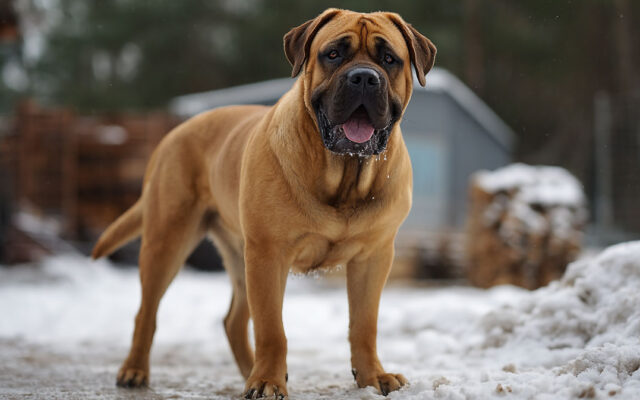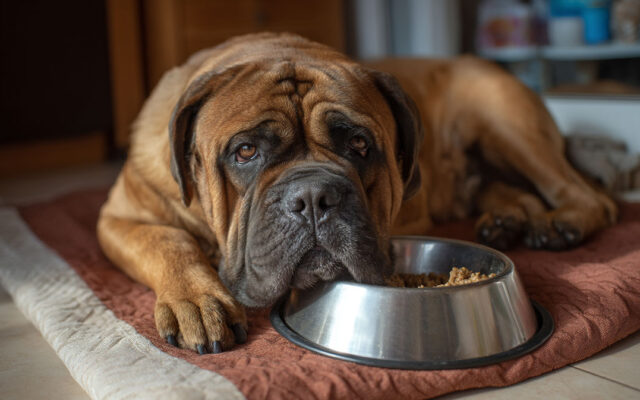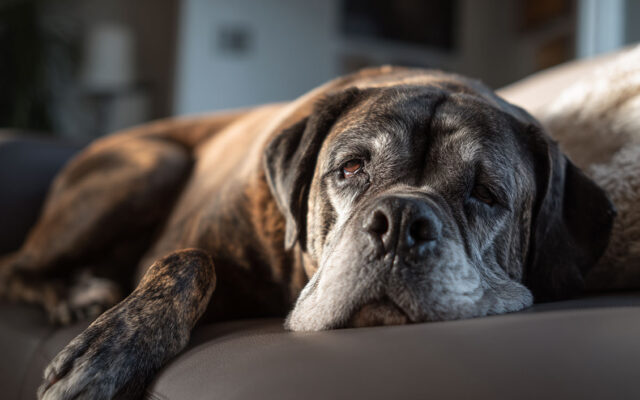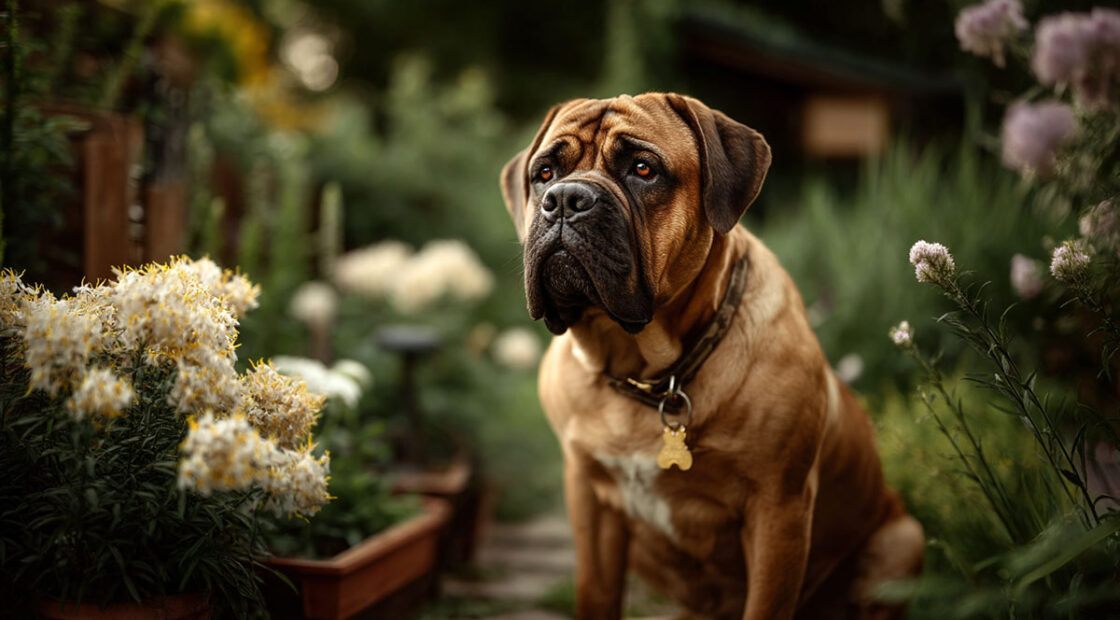
A Bullmastiff doesn’t need much of a temperature swing before something goes wrong. Core body temperature only has to climb a handful of degrees past normal before heatstroke sets in, and the AKC puts that threshold at 105.8°F, a number a heavy-bodied, short-coated dog reaches faster than most large breeds once the air conditioning cuts out (AKC, 2026).
That’s really the whole argument for taking this breed’s living space seriously. Indoor square footage, yard containment, climate control, none of it is optional trim sitting on top of a good diet and regular vet visits. Get one piece wrong and the rest stops mattering much.
Breeders measure adequate space one way, animal welfare regulators measure it another, and fencing professionals have their own rulebook entirely. None of the three standards get met by accident, either, not with this much body weight and territorial drive built into the breed.
What Is a Bullmastiff Living Environment?
Indoor floor space, a yard the dog can’t test its way out of, and climate control that actually works all have to hold at the same time. Miss one and it doesn’t matter how well the other two are handled. The setup fails the dog, not just whoever built it.
Generic large-breed housing guides don’t hold up here. A Labrador wants room to move around. Give a Bullmastiff the same room and it’s still not enough, because now there’s also a perimeter it will actively probe and a household that has to plan around natural guarding instinct shaping nearly every decision that follows.
The breed itself comes out of nineteenth-century England, a cross between the English Mastiff and the now-extinct Old English Bulldog, mixed at roughly 60 percent Mastiff and 40 percent Bulldog. The goal was a dog quiet enough to track a poacher through the dark and heavy enough to pin one down without much of a fight.
Official numbers, per the American Bullmastiff Association:
- Males: 25 to 27 inches at the withers, 110 to 130 pounds
- Females: 24 to 26 inches at the withers, 100 to 120 pounds
- Coat: short, weather resistant, offering no insulation against cold or heat
That’s well under true Mastiff-sized housing needs, where males can top 200 pounds, but it’s still squarely giant-breed territory once space and containment come into play.
A living environment missing secure fencing, indoor climate control, or a defined guarding boundary isn’t a scaled-down version of the ideal setup. It’s a different situation, and a riskier one, treated here as a failure condition rather than a variation worth working around.

How Much Indoor Space Does a Bullmastiff Need?

Turning a full circle without clipping a wall. Lying down fully stretched out, not curled up because there’s no other option. Crossing a room without navigating around furniture at every step. That’s the baseline for indoor space, and it’s a lower bar than most owners assume, right up until they’re actually living with a dog this size.
No breed standard writes a square footage number into the rulebook. The closest thing is a legal floor, not a comfort standard: the federal Animal Welfare Act, enforced by USDA APHIS, calculates minimum enclosure space as nose-to-tail length plus six inches, squared.
Run that formula for an adult male around 30 inches long and it lands close to 9 square feet, which is the absolute legal minimum for a kennel enclosure. A living room is not a kennel enclosure. Comfortable indoor space runs well past that number, usually by a wide margin.
A dog this size needs roughly a body length of clearance in every direction just to lie down without bumping into a wall or a table leg. Standard 30-inch interior doors are usually fine width-wise, but narrow galley kitchens and tight stair landings turn into daily friction points fast. And low coffee tables, floor clutter, anything left in a low travel path, a 120-pound dog walks straight through it, not around it.
Multi-story homes bring a separate issue. Stairs put real stress on a joint structure that’s already carrying a lot of body weight, so a single-level layout, or at least limited stair use during the puppy growth phase, tends to be the more forgiving setup.
Apartment or House: Where Can a Bullmastiff Live?

Apartment living is possible for a Bullmastiff, but the list of conditions is short and non-negotiable: ground floor or reliable elevator access, somewhere nearby for daily outdoor time, and neighbors willing to live with drool marks on the hallway wall. A house with a secured yard skips past most of that, and it’s the setup this breed adapts to with the least friction, by a wide margin.
| Factor | Apartment | Townhouse | House with Yard |
|---|---|---|---|
| Daily exercise access | Depends on a nearby park | Small patio, short walks | Yard available on demand |
| Guarding behavior risk | High, shared halls and walls | Moderate, shared fence lines | Lower, defined perimeter |
| Space for a 120-pound dog to stretch out | Tight in most units | Workable in larger units | Rarely a constraint |
| Best fit for the breed | Only with ground floor or elevator | Workable with discipline | Closest to ideal |
Whether a giant breed can handle apartment living comes up all the time for dogs this size, and honestly the same logic behind whether Great Danes do well in apartments applies here almost point for point. Low indoor energy works in the dog’s favor. Sheer mass and guarding behavior in shared hallways do not.
Pros and Cons of Apartment Living

Life in a shared building isn’t automatically a bad fit. A couple of things genuinely work in the dog’s favor.
- Bullmastiffs are indoor-calm and low-drive by nature, so they’re not pacing the apartment or shredding furniture out of boredom the way a working breed might
- No yard means no yard maintenance, and no fence to install, budget for, or inspect every spring
The downsides show up fast, though.
- A guarding bark aimed at every footstep in the hallway is a fast route to a noise complaint from the neighbors
- No private outdoor space means every bathroom break and every exercise session runs on the owner’s schedule, not the dog’s
- An elevator that breaks turns into a real problem when the dog weighs more than most adults can carry down four flights of stairs
Pros and Cons of a House With a Yard

A house solves the space problem outright. What’s left is mostly about fence quality, not square footage, so the downsides are worth naming first this time, if only because there are fewer of them: yard maintenance, fencing costs, and the upfront work of securing the whole perimeter before the dog is ever out there unsupervised.
- A defined perimeter cuts down on the guarding triggers that come from shared walls and hallways
- The dog gets outdoor access on its own schedule instead of waiting on the owner’s
- Room to stretch out, indoors and outdoors both, removes the space pressure apartment living creates
What Size Yard Does a Bullmastiff Need?
Running laps isn’t really the point. A Bullmastiff needs outdoor square footage for slow patrol movement, a shaded spot to lie down, and short bursts of play, nothing more, because this is a low-drive breed built for guarding, not distance work.
Compare it to a herding or sporting breed and the daily activity number tells the story on its own: closer to 30 to 45 minutes of combined walking and yard time, not hours of open-field running.
That changes the yard math. A modest yard with real shade beats a sprawling, sun-baked one for this breed, every single time.
- Shade cover for at least part of the day. Non-negotiable, given the short coat
- A dry, sheltered spot to lie down outdoors, away from direct sun on hot pavement
- Enough open ground to patrol the fence line, which most Bullmastiffs will do out of instinct no matter the yard’s size
A cramped concrete patio technically counts as outdoor access. It doesn’t count as an adequate yard. No shade, no soft ground for a heavy-boned dog to actually rest on, and that matters more than the square footage number does.
Fence Height and Material for a Bullmastiff
Six feet is the floor for a secure fence with this breed, and that climbs toward seven or eight feet fast if the dog shows any real interest in climbing or standing up against the fence line to look over it.
Height only solves half the equation, though. Material and visibility handle the rest.
| Material | Strength | Visibility Control | Best For |
|---|---|---|---|
| Wood privacy fence | High | Blocks sightlines, reduces reactivity | Territorial guarding breeds |
| Chain-link | Moderate | Full visibility, can increase barking at passersby | Budget setups, lower guarding drive dogs |
| Vinyl | Moderate to high | Blocks sightlines | Low-maintenance owners |
Visibility matters more here than it does for most breeds. A Bullmastiff’s guarding drive reacts to whatever it can see moving past the fence line, which is why a solid privacy fence often settles a dog that a chain-link fence would keep agitated all day long.
Electronic or invisible fencing alone doesn’t hold up well here. A breed with this much pain tolerance and territorial drive will cross a mild static correction the moment something on the other side grabs its attention, and once the dog’s out, the containment system has nothing left to offer. It won’t bring the dog back.
Gate hardware needs the same scrutiny as the fence itself, maybe more. A standard spring latch won’t hold up against a 120-pound dog leaning into it over and over, so a secondary carabiner clip or a slide bolt mounted above nose height closes the gap a determined nose will otherwise find eventually.
How to Set Up a Secure Bullmastiff Yard

Skip the order here and the weak point in a fence tends to surface only after the dog has already found it. Working through it properly means walking the ground yourself before the dog ever gets the chance to test it.
- Walk the entire perimeter on foot. Look for gaps under the fence line, loose boards, and any low spots where runoff has eroded the soil near the base.
- Check every gate and latch by hand. Push against it the way a 120-pound dog would lean into it, not the way a person casually tests a latch.
- Reinforce the base of the fence. Bury wire mesh, add a buried barrier board, or run a line of pavers along known digging spots. A bored Bullmastiff digs at a weak base long before it ever tries to climb.
- Identify sightline triggers before the dog roams free. A fence line facing a sidewalk, a mail route, or a neighboring dog’s yard needs a visual barrier handled in advance, not after the barking has already started.
- Run a supervised trial period. Watch the dog in the yard across several sessions before leaving it unattended. The first few visits usually reveal which part of the perimeter actually gets tested.
Most yard failures trace back to one of two spots. A gate that looked secure until real weight leaned on it, or a fence base that looked solid until a paw found the one soft patch of ground it needed.
Temperature Sensitivity and Climate Control for a Bullmastiff
A Bullmastiff overheats faster than most large breeds for a pretty simple reason: a heavy, muscular body generates more internal heat, and a short coat combined with a shortened muzzle limits how efficiently that heat actually escapes through panting.
The numbers make the risk concrete:
- Normal canine body temperature runs 100.5 to 102.5°F (PetMD)
- Heatstroke sets in around 106°F, only about four degrees above normal (PetMD)
- Giant breed dogs over 50 kilograms are roughly three times more likely to develop heatstroke than smaller dogs, according to VetCompass research reported by The Conversation in 2025
Panting cools a dog by evaporating moisture off the tongue and airway. A heavier dog with a shorter muzzle gets less cooling out of that same amount of panting than a leaner, longer-nosed breed would, which is basically why this breed overheats at temperatures a Border Collie would shrug off without a second thought.
Indoor air conditioning during warm months isn’t a comfort upgrade for this breed. It’s closer to a baseline requirement, the same way a secure fence isn’t optional either.
Cold tolerance runs the other direction, and it gets a lot less attention than it probably should.
- The short coat offers almost no insulation, so extended time outdoors in freezing temperatures turns uncomfortable well before it turns dangerous
- A dog house or covered shelter with a windbreak matters more here than it would for a double-coated breed built for snow
- Indoor heating during winter closes the loop the same way air conditioning does in summer. A coat this thin was never built to handle either extreme on its own
Flooring and Joint Safety in a Bullmastiff’s Home
Hardwood and polished tile put a heavy-boned dog at real risk of slipping, and every slip loads extra stress onto joints that are already carrying a lot of weight.
Stairs load the joints once in a while. Flooring loads them every single time the dog crosses a room, which honestly makes it the more constant risk of the two.
A couple of surfaces cause most of the trouble: polished hardwood and laminate near turns and doorways, and tile that gets slick once it’s wet near a water bowl or an entryway.
Rugs with rubber backing along the dog’s normal walking paths fix a lot of it. So do textured interlocking mats in high-traffic rooms and carpet runners on stairs and landings.
This isn’t a cosmetic choice. Flooring is one of the few environmental factors an owner fully controls, and it sits directly upstream of hip dysplasia risk in a breed that’s already predisposed to joint disease.
Ramps, or even just a set of low steps at the sofa, the bed, or the car door, remove the repeated jumping motion that hard landings put through the hips and elbows. A dog that jumps down from height fifteen times a day is taking on a lot more joint stress than one that walks down a ramp the same fifteen times.
Crate and Sleeping Setup for a Bullmastiff
An adult Bullmastiff needs one of the largest crate sizes sold, and it has to be sized to the dog’s actual shoulder height and body length, not just whatever’s labeled “large breed” on the box.
| Life Stage | Sizing Approach | Notes |
|---|---|---|
| Puppy | Divided crate, expanded as the dog grows | Prevents using the far end as a bathroom |
| Adult | Full nose-to-tail length plus turning room | Undersized crates cause pacing and reluctance to enter |
| Senior | Same footprint, lower entry threshold | Easier on joints that have started to stiffen |
Placement matters almost as much as size. Push a crate into a sunny window, or set it right beside a radiator, and it undoes all the climate control work covered earlier.
- Keep the crate away from direct sun and heating vents
- Choose orthopedic, high-density foam bedding over thin padding. Standard bedding compresses fast under this much weight
- Look for bedding and crate accessories rated for large or giant breeds, not just generic “large dog” sizing
A crate that fits a Labrador just fine will usually start feeling cramped for a Bullmastiff within a few months of hitting adult size.
Household Fit: Children, Other Dogs, and Guarding Behavior

American Temperament Test Society numbers put bullmastiffs at 82 of 108 dogs tested passing, a 75.9 percent pass rate built mostly on stability and confidence around unfamiliar people and situations.
That number describes the breed on average. It says nothing about any one dog in particular, and it doesn’t replace an actual, deliberate introduction process for kids, other pets, or visitors who show up more than once a month.
With family kids, most Bullmastiffs are patient, genuinely tolerant, more so than people expect going in. The bigger practical risk isn’t aggression. It’s just size: an accidental knockdown from a hundred-plus pounds of dog happens a lot more often than a bite ever does.
Other dogs are a different story, at least between two of the same sex. Same-sex introductions need slower, more structured handling than opposite-sex pairings do, and behavioral friction between two dominant dogs shows up more often than most owners expect.
Strangers are where the guarding instinct runs strongest. A dog that hasn’t been actively worked through structured socialization tends to treat every doorbell like a threat assessment instead of a routine interruption.
A living environment that puts this breed in daily contact with strangers, a busy front porch, a shared building entrance, works against the dog’s temperament instead of with it.
Health Conditions That Shape a Bullmastiff’s Living Space

Hip dysplasia and bloat (gastric dilatation-volvulus, if you want the clinical name) drive most of the environmental decisions covered in this piece, more than any other health factor.
The numbers explain why both get so much attention:
- OFA breed statistics place hip dysplasia in roughly 25 percent of evaluated bullmastiffs, one of the higher rates among large breeds
- A Purdue University study led by Dr. Larry Glickman found bloat risk in giant breeds rises 20 percent for every year of age past three
- The same Purdue research found dogs with a first-degree relative that bloated face a 63 percent greater risk themselves
The flooring and crate choices covered earlier aren’t incidental to that first number. Non-slip surfaces and supportive bedding are direct, practical responses to a breed that’s already carrying meaningfully elevated dysplasia odds.
Feeding habits connect just as directly to the bloat figures above. Fast eating and single large meals are established risk contributors, and there’s more detail on that on the bloat prevention page.
A restless, pacing dog that can’t get comfortable, a swollen abdomen, unproductive retching, none of that is something to watch overnight and see how it goes. Recognizing early illness signs and getting to a vet within the hour is usually what separates a survivable bloat episode from a fatal one.
When a Living Environment Does Not Work for a Bullmastiff
A living environment fails this breed the moment secure containment, functioning climate control, or realistic space goes missing, no matter how well the other two are handled.
| Condition | Why It Fails |
|---|---|
| Upper-floor apartment, no elevator | A 120-pound dog cannot be carried down daily, and mobility issues make stairs worse with age |
| No air conditioning in a hot climate | Heat intolerance covered earlier becomes a medical emergency, not a discomfort |
| Yard under six feet with no reinforcement | Fence height alone does not stop a determined, motivated dog |
| Constant stranger contact at the front door | Guarding instinct has no chance to settle between triggers |
Money is part of this equation whether owners want it to be or not. Reinforced fencing, climate control, orthopedic bedding, routine veterinary screening, it all adds up fast, and the full picture of what this breed actually costs catches a lot of first-time owners off guard when they’ve only budgeted for food and a leash.
Sometimes a living situation genuinely can’t be fixed. A lease that bans large breeds, a household that can’t safely manage the guarding drive, a climate with no real path to indoor cooling, whatever the reason, forcing the fit isn’t the responsible move. Reaching out to a breed-specific rescue and adoption group gets the dog into a home that’s already solved the problem the current one can’t.
FAQ on Bullmastiff Living Environments
What Was the Bullmastiff Originally Bred For, and Does That Affect Housing?
Nineteenth-century English gamekeepers crossed the Mastiff with the now-extinct Old English Bulldog specifically to track and hold poachers.
That guarding purpose still shapes housing decisions today. Containment and a defined perimeter matter more for this breed than they do for most others.
Is a Bullmastiff Cold-Tolerant?
Not particularly. The short, dense coat offers minimal insulation, so extended time in freezing conditions turns uncomfortable fast.
A windbreak, a dry shelter, and limited outdoor exposure during winter matter more here than they do for double-coated breeds built for snow.
What Mistakes Do New Owners Make Setting Up a Bullmastiff’s Space?
Undersized crates. Chain-link fencing that ends up fueling reactivity instead of preventing it. Skipping a supervised yard trial before leaving the dog unattended. All of it comes up constantly.
Owners also underestimate drool, shedding, and how much force a 120-pound body puts on furniture and doors.
What Organizations Set the Standards Referenced in Bullmastiff Care?
The American Bullmastiff Association and the AKC define the breed standard in the United States. The Kennel Club handles it in the UK.
OFA screens for joint disease. USDA APHIS sets the minimum legal housing space under the Animal Welfare Act.
How Much Does Setting Up a Proper Bullmastiff Living Space Cost?
Reinforced fencing, a giant-breed crate, orthopedic bedding, working air conditioning, it adds up fast, often outpacing food and veterinary costs in year one.
First-time owners are frequently surprised by how a dog is expensive well beyond whatever the puppy itself cost.
What Should You Prioritize First in Bullmastiff Living Environments?
Sequence matters more than most owners assume. Containment and climate control come before comfort. Comfort comes before optimization. Skip that order and a properly sized yard, or a perfectly good crate, still won’t help a dog that never actually settles into it.
Get the fence and the climate control right before anything else. Non-slip flooring and joint-safe furniture access come next. Crate placement, bedding, and a consistent household routine round it out.
A solid privacy fence calms a territorial dog by blocking sightlines, but it also takes away the visual patrol range that lets a dog self-regulate instead of only reacting right at the gate.
None of this holds up without matching activity level to temperament, and a dedicated exercise routine built around the breed’s actual drive level is the next thing worth getting right.