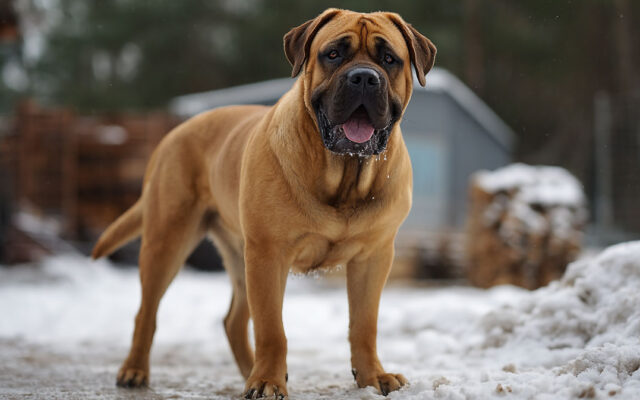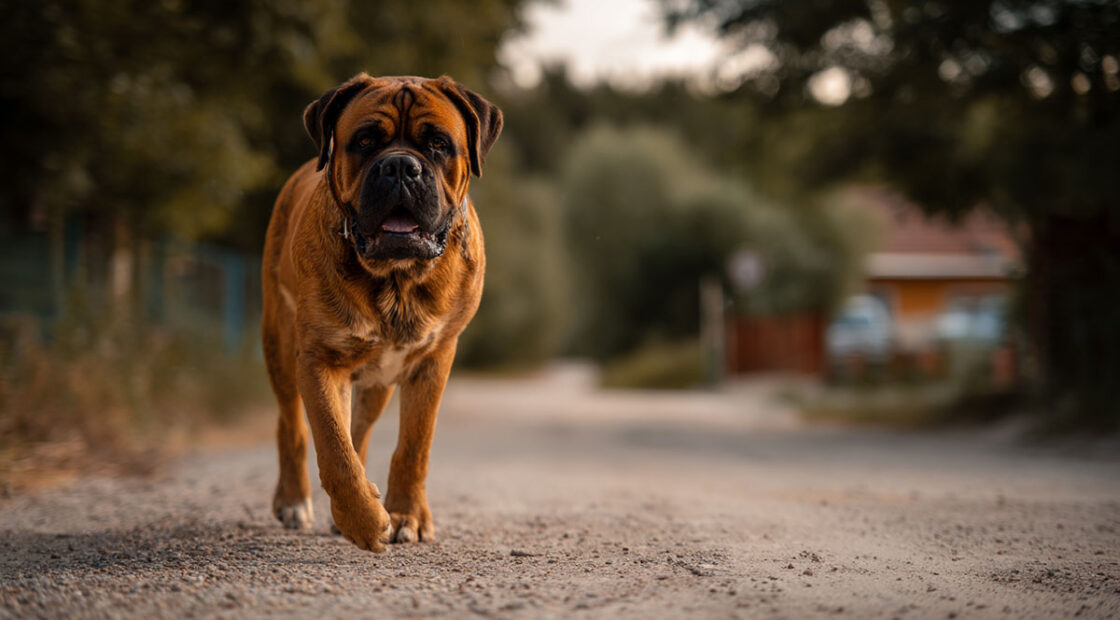
Generic large-breed exercise advice does not work for a Bullmastiff, and treating it like one causes real problems down the line.
This dog was built for short bursts of power, not miles on the road. Its face is shorter than most working breeds, which cuts into how well it cools itself once things get hot. And the growth period runs long enough that joints stay vulnerable well past the one-year mark most owners assume is the finish line.
None of that shows up in the standard “large dog needs an hour a day” advice floating around online.
The American Kennel Club ranked the Bullmastiff 78th among 202 recognized breeds in its 2025 registration count. That’s a lot of owners working from advice that doesn’t actually fit the dog in their living room.
What Makes Bullmastiff Exercise Different From Other Large Breeds
The breed comes from a deliberate cross, roughly 60 percent Mastiff and 40 percent Bulldog, put together to produce raw power without the bulk that would have slowed the dog down on the job.
English gamekeepers bred the dog in the 1800s as a gamekeeper’s night dog, built to track and pin poachers on estate grounds after dark. That job shaped the breed’s guard dog instincts far more than it shaped any need for endurance.
That history still shapes how the breed moves today. A Bullmastiff sprints hard, holds ground, then rests. It does not log miles the way a working retriever does.
A few things set Bullmastiff exercise apart from what you’d plan for a generic large breed:
- short-burst muscle build over endurance capacity
- a fast growth curve that leaves joints vulnerable well past a year old
- a shortened muzzle that limits airflow during exertion
- a deep chest that raises the stakes around feeding and activity timing
Its own ancestor makes a good comparison. The English Mastiff runs taller, heavier, and slower to mature, while the Bullmastiff was bred smaller and more athletic for work that needed agility as much as raw size, something covered in more depth in the Bullmastiff vs Mastiff breeds comparison.
The AKC breed standard puts adult males at 110 to 130 pounds and adult females at 100 to 120 pounds. That mass, combined with a nearly square frame, means every exercise decision carries more weight, literally, than it would for a mid-size dog.

How Much Daily Exercise Does a Bullmastiff Need
An adult Bullmastiff needs about 30 to 60 minutes of exercise a day, split into two or three shorter sessions instead of one long outing. Puppies and seniors need quite a bit less, and the numbers shift again once growth or joint wear enters the picture.
Broken down by age, it looks something like this:
- Puppies under a year: five minutes of exercise per month of age, up to twice daily
- Adolescents (12 to 18 months): 30 to 45 minutes, kept low-impact
- Adults: 30 to 60 minutes, split into two or three sessions
- Seniors (8+ years): 20 to 30 minutes, spread across several short outings
Puppy duration
The five-minute rule is a widely used starting point among trainers and canine rehabilitation professionals: five minutes of structured walking per month of age, twice a day, until the growth plates close.
- 4 months old: about 20 minutes total, split into two walks
- 8 months old: about 40 minutes total, split into two walks
Free play in the yard doesn’t count the same way. Off-leash sniffing and short bursts of movement put less repetitive strain on the body than a forced, continuous walk does.
Adult duration
Most healthy adults do fine on a morning walk and an evening walk, with a short play session somewhere in between.
- 15 to 20 minute leash walk, morning
- 10 to 15 minutes of yard play or training drills, midday
- 15 to 20 minute leash walk, evening
Some owners track sessions with wearables like Fitbark or Whistle to catch a gradual drop in activity before it becomes obvious. That early flag matters more with this breed than with a dog that visibly bounces off the walls when it’s bored. A Bullmastiff can quietly do less and less for weeks before anyone notices.
Senior duration
Shorter, more frequent sessions beat one long walk once a Bullmastiff passes eight or nine years old.
- two to three 10-minute walks on flat ground
- reduced pace, more sniffing time
- swimming instead of walking on bad-joint days
Swimming, where it’s available, keeps muscle tone up without loading the joints, a trade worth making once stairs start looking optional to your dog.
Why Bullmastiff Puppies Need Restricted Exercise Until Growth Plates Close
Bullmastiff puppies carry open growth plates, soft cartilage zones at the ends of the long bones, until roughly 12 to 18 months of age, sometimes later depending on the dog.
Impact and repetitive strain on an open growth plate can cause uneven bone growth, joint misalignment, and a head start on arthritis that no amount of adult conditioning fixes later.
The American Bullmastiff Association is direct about this: puppies get very slow, short walks, and owners hold off on high-impact activity until the dog is well over 18 months of age.
Folding these short walks into a puppy’s early training routine keeps sessions structured instead of random, which matters when the goal is controlled movement rather than just a tired-out puppy.
Panosteitis, a growth pain condition common in large-breed puppies, sometimes gets mistaken for an injury at this stage. It causes shifting-leg lameness and usually resolves on its own as the puppy matures.
A few activities are worth skipping entirely until the growth plates close:
- forced jogging or running alongside a bike
- jumping on and off furniture, or down stairs
- repetitive fetch on hard surfaces
- off-leash sprinting with bigger, faster dogs
None of this means a puppy has to sit still. Sniffing walks, gentle leash time, and supervised play with calm playmates all support development without the jarring impact that damages an open growth plate.
How Hip and Elbow Dysplasia Risk Shapes Bullmastiff Exercise Choices
Bullmastiffs carry above-average genetic risk for hip dysplasia, a malformation of the hip socket that leads to pain, lameness, and early arthritis.
OFA breed statistics put the rate at roughly 25 percent of evaluated Bullmastiffs, among the higher figures recorded for large working breeds.
Elbow dysplasia follows a similar pattern and shares the same root cause: joints that didn’t form cleanly, made worse by repetitive high-impact loading during growth.
Breeders can screen breeding stock through OFA hip and elbow evaluations or a PennHIP assessment, both of which score joint conformation before a dog is bred.
Exercise doesn’t cause dysplasia. It’s inherited. But hip dysplasia in a genetically predisposed dog worsens faster under repeated hard-surface impact, jumping, and forced running.
A few low-impact options do the same conditioning work without the risk:
- swimming
- controlled leash walking on grass or dirt
- slow incline walking
- flat-ground sniffing walks
Joint disease sits alongside a short list of other inherited conditions covered on the Bullmastiff health problems page. Owners buying or breeding a puppy do well to ask for both hip and elbow clearances up front.
Can Bullmastiffs Run Long Distances or Go Jogging
No, not as a matter of course. Bullmastiffs are built for short-burst power, not the sustained aerobic effort that distance running demands.
The mismatch comes down to temperament as much as build. This is a breed wired for short, explosive effort and long recovery, not steady mile-after-mile output.
A young, lean, healthy adult can handle a slow jog on soft ground in cool weather. That’s a different thing entirely from training for a 5K.
A slow jog can work under fairly specific conditions: lean, mature adults past 18 months with clear joint clearances, short distances on soft ground (a mile or under), and cool mornings or evenings, never peak heat.
It falls apart just as fast outside those conditions, though. Puppies and adolescents with open growth plates shouldn’t be jogging at all, and neither should an overweight or out-of-condition adult. Hot, humid, or high-altitude days push even a healthy dog past its limit, and any dog already showing stiffness or carrying a hip dysplasia diagnosis needs a different plan.
Distance running, the kind measured in multiple miles at a sustained pace, is a different question entirely. Most Bullmastiffs simply aren’t built for it, and pushing one into that role tends to show up later as joint pain rather than better fitness.
How Heat and Breathing Limits Affect Bullmastiff Exercise
Heat is a harder limit on Bullmastiff exercise than most owners expect, driven by a shortened muzzle that doesn’t move air as efficiently as a longer-nosed breed’s does.
This isn’t the extreme flat-faced anatomy of a Bulldog or a Pug, but the moderate brachycephalic structure still cuts into the breed’s ability to cool itself through panting.
A 2020 RVC VetCompass study of over 900,000 UK dogs found that dogs over 50 kilograms and dogs with a brachycephalic skull shape both carried greater risk of heat-related illness, a combination that describes most adult Bullmastiffs.
The same study found an event fatality rate of just over 14 percent, roughly one in seven dogs treated for heat-related illness died from it.
Watch for a few specific signs once the temperature climbs:
- excessive panting that doesn’t slow with rest
- bright red or purple gums
- heavy drooling
- wobbling, stumbling, or refusal to keep moving
Early morning and evening walks avoid peak heat.
Cool pavement matters too. If concrete feels hot to a bare hand for more than five seconds, it’s too hot for paw pads.
Keeping close tabs on hydration and cutting sessions short at the first sign of distress does more for a Bullmastiff’s safety than any amount of conditioning ever will. Recognizing these symptoms early ties directly into broader illness signs worth learning as a Bullmastiff owner.
Climate also factors into where a Bullmastiff lives day to day, not just how it exercises. A humid, high-heat region asks more of this breed than a temperate one does, worth weighing as part of general living environments planning.
Best Types of Exercise for a Bullmastiff

Impact level matters more than duration or intensity when picking exercise for this breed. Leash walking and swimming cover most of the daily need, with short structured play sessions filling in the rest.
| Activity | Impact level | Best life stage | Session length |
|---|---|---|---|
| Leash walking | low | all stages | 15 to 20 minutes |
| Swimming | very low | adult, senior, recovering | 10 to 20 minutes |
| Flirt pole play | moderate, short bursts | lean, mature adults | 5 to 10 minutes |
| Fetch on grass | moderate | adult, occasional | 10 to 15 minutes |
| Scent or puzzle games | none, mental only | all stages | 10 to 15 minutes |
Structured leash walking does the most work for the least risk. It lets a dog sniff, pace itself, and cover ground without the jarring stop-start of fetch or off-leash chasing.
Swimming is close to ideal for a breed this heavy. Water supports the joints while still working the muscles, exactly the trade-off older or dysplasia-prone Bullmastiffs need.
A flirt pole, one of the simpler toys and accessories worth owning for this breed, channels its short-burst drive into a few controlled minutes instead of an unstructured, drawn-out session.
Mental stimulation earns its place here too. Obedience drills, scent work, and food puzzles tire this breed out in ways a longer walk simply can’t.
Skip it and the restlessness has to go somewhere. Boredom in a guarding breed tends to surface as barking, destructive chewing, or anxious pacing, patterns covered in more depth on the behavioral issues page.
How to Time Exercise Around Feeding to Prevent Bloat
A Bullmastiff’s deep, narrow chest leaves extra room for the stomach to shift after a meal, the mechanical setup behind gastric dilatation-volvulus, better known as bloat.
VCA Animal Hospitals puts the lifetime bloat risk at roughly 20 percent for dogs over 100 pounds, a weight class every adult Bullmastiff falls into.
Bloat starts as gas or fluid buildup in the stomach. In the more dangerous version, the stomach twists on itself, cutting off blood flow, and a bloated belly becomes a surgical emergency within hours.
A few feeding and exercise habits reduce the risk:
- Feed two or three smaller meals instead of one large one
- Wait at least an hour after a full meal before any brisk walk or play
- Wait roughly 30 to 60 minutes after exercise before feeding, letting breathing and heart rate settle first
- Serve water in small amounts during and after exercise instead of a full bowl to gulp
- Feed from a bowl at floor level, not an elevated stand
Cornell’s Riney Canine Health Center lists eating too quickly, a raised food bowl, and exercising soon after a meal among the recognized risk factors for the condition, alongside genetics and age.
Get to a vet immediately if you notice:
- a visibly swollen or tight abdomen
- retching with nothing coming up
- restlessness or an inability to get comfortable
- heavy drooling with rapid, shallow breathing
None of this is something to wait out at home. A deeper walkthrough of prevention lives on the bloat prevention page.
Feeding structure matters just as much as exercise timing, covered separately under Bullmastiff feeding.
How to Manage a Bullmastiff’s Weight Through Exercise
Extra weight on a Bullmastiff doesn’t just look soft. It adds direct load to joints already carrying genetic dysplasia risk, and it raises the odds of heat stress during any activity at all.
The Association for Pet Obesity Prevention’s 2022 clinical survey found 59 percent of dogs evaluated in the US were overweight or living with obesity, split roughly between 37 percent overweight and 22 percent obese.
Large, food-motivated breeds tend to sit on the higher end of that range, and a Bullmastiff’s naturally low activity drive doesn’t help the odds.
Vets check weight using the body condition score, a 9-point scale from the World Small Animal Veterinary Association that relies on feel, not just a number on a bathroom scale.
| BCS range | What you feel and see | What it means |
|---|---|---|
| 1 to 3 | ribs, spine, and hip bones visible | underweight |
| 4 to 5 | ribs easily felt, visible waist from above | ideal |
| 6 to 9 | ribs hard to feel, no waist, rounded abdomen | overweight to obese |
A Bullmastiff scoring 6 or higher benefits from a change in exercise structure, not just less food.
A few adjustments help more than others:
- increase frequency of short sessions before increasing intensity
- add a third short walk rather than lengthening the existing two
- swap one walk for swimming to raise effort without joint strain
- track weight every two weeks, not daily, to see a real trend
Portion control does most of the heavy lifting for weight loss, but movement compounds the benefit once weight actually starts coming off.
A University of Glasgow study found dogs with osteoarthritis showed meaningfully less lameness after losing just 6.1 percent of body weight, roughly 6 to 8 pounds on an average adult Bullmastiff.
When Bullmastiff Exercise Should Be Modified or Stopped

Sometimes the right amount of exercise is none at all.
Every duration and activity guideline here assumes a healthy dog in ordinary conditions. Those assumptions break down often enough that owners need a clear line for when to change course.
| Situation | What changes |
|---|---|
| Heat index above 90F or high humidity | skip outdoor exercise, move activity indoors |
| Recovering from surgery or injury | crate rest, vet-directed reintroduction only |
| Diagnosed osteoarthritis or advanced dysplasia | shorter, more frequent, low-impact sessions |
| Fever, vomiting, or recent illness | rest until a vet clears activity |
Anderson et al.’s VetCompass study of over 455,000 UK dogs found that osteoarthritis risk rose sharply with higher bodyweight and age past eight years, the exact profile of most senior Bullmastiffs.
That risk doesn’t mean stopping exercise altogether. It means shifting the goal from calorie burn to joint mobility, and accepting that a stiff dog on a cold morning needs five minutes indoors before any leash time.
Stop right away if you notice:
- sudden collapse or refusal to stand back up
- a leg that will not bear weight
- disorientation or unsteady, drunken movement
- gums that turn pale, blue, or brick red
Recovery rest matters as much as the workout itself. A Bullmastiff that seems unusually stiff or reluctant the morning after exercise was likely pushed past what that session should have been, a signal to scale back before the next outing rather than repeat it.
FAQ on Bullmastiff Exercise
Is swimming good exercise for a Bullmastiff?
Yes, though not automatically. Bullmastiffs carry dense muscle over a short, heavy frame, so many are not natural swimmers and need a life vest and a slow introduction. Once comfortable, swimming ranks among the safest options for aging or dysplasia-prone joints.
Do Bullmastiffs need mental stimulation along with physical exercise?
Yes. A tired body doesn’t always mean a settled mind, especially in a breed originally bred to problem-solve while guarding. Ten minutes of obedience work or a scent-based game after a walk reaches mental energy a leash walk alone just can’t touch.
How much exercise does a Bullmastiff need in an apartment?
Apartment living doesn’t change the numbers. It’s still roughly 30 to 60 minutes daily for a healthy adult. What changes is how those minutes get filled. Hallway walks, short indoor games, and two or three brief outdoor sessions replace the yard a house would provide.
Is crate rest ever needed after a Bullmastiff joint injury?
Yes, and it’s common practice after cruciate repair, dysplasia surgery, or a significant sprain. Vets typically prescribe two to six weeks of confined rest, with leash-only bathroom breaks, before a slow, supervised return to walking and eventual off-leash movement.
What Should You Fix First in Bullmastiff Exercise
Bullmastiff exercise breaks down fastest at two points: duration mismatched to a growing dog’s age, and exertion pushed through heat the breed’s shortened muzzle can’t handle. Fixing those two variables first prevents most downstream problems.
Duration matched to life stage matters most, not breed size alone. After that, heat and timing safeguards come before anything about intensity. Body condition checks round it out, catching weight drift before it turns into a bigger problem.
The five-minute-per-month puppy guideline and the 30-to-60-minute adult target both assume undamaged joints. Once osteoarthritis or advanced dysplasia enters the picture, those duration numbers stop applying, and mobility-based session limits take over instead.
Owners who get those fixes right early tend to see the difference show up over years rather than weeks, which is exactly where exercise and weight management intersect with how long a Bullmastiff typically lives.