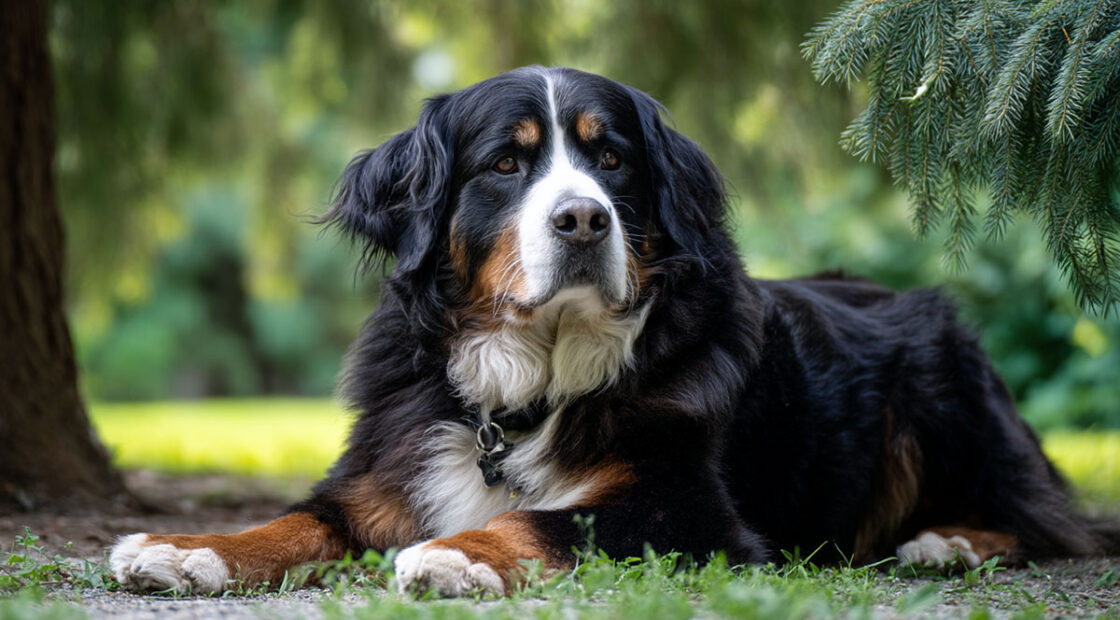
Bernese Mountain Dogs, usually called Berners, are large Swiss working dogs developed in the canton of Bern to guard farms and pull carts. They drove cattle as well.
Males stand 25 to 27.5 inches and weigh 80 to 115 pounds. The coat is tricolor and the temperament is calm and family-oriented (AKC).
Lifespan is where the breed falls short. A Swiss club study of 389 dogs reported a median lifespan of 8.4 years, with cancer behind 58.3% of deaths (Klopfenstein et al., BMC Veterinary Research, 2016).
Responsible breeders screen hips, elbows, eyes, heart and degenerative myelopathy status before breeding.
What Is a Bernese Mountain Dog?
Durrbachler was the early name, taken from the Durrbach inn near Riggisberg, where the long-haired, tricolor farm dog was especially common (FCI Standard No. 45).
You’ll see it listed under a few other names too.
- Berner Sennenhund
- Berner
- Bernese Cattle Dog
- Durrbachler
Bern points to the region, and Sennenhund points to the Senn, the alpine herdsmen and dairymen the dogs worked beside.
The AKC places the breed in the Working Group, while the Federation Cynologique Internationale lists it as Standard No. 45 in Group 2 (Swiss Mountain and Cattle Dogs), Section 3, Swiss Cattle Dogs.
It is one of four tricolor Sennenhund breeds, and the only one with a long, silky coat (AKC).

Second largest, as it happens. The Greater Swiss Mountain Dog, the group’s other large breed, is taller and heavier, with males reaching 25.5 to 28.5 inches and 115 to 140 pounds (AKC), and it wears a short coat.
At the small end sits the Entlebucher Mountain Dog, which the AKC files under Herding instead of Working. The Appenzeller Sennenhund is medium-sized.
History of the Bernese Mountain Dog
The modern breed dates to November 1907, when breeders from the Burgdorf region founded the Swiss Durrbach Club to keep a fading farm dog pure (FCI Standard No. 45).
Industrial farming had replaced canine labor, Bernese numbers fell, and the Saint Bernard eventually became known as the Swiss national breed (AKC).
Dog fancier Franz Schertenleib of Burgdorf began searching for good specimens in 1892, and Professor Albert Heim later led the hunt for breeding stock (AKC).
The club’s work fixed the breed’s characteristic traits. A Burgdorf show in 1910 drew 107 dogs, and the breed took the name Berner Sennenhund. Kansas farmer Isaac Schliess is believed to have made the first import to the US in 1926, and the AKC recognized the breed in 1937. The Bernese Mountain Dog Club of America (BMDCA) followed in 1968 (AKC).
Britannica and several breed profiles say invading Romans brought the ancestors to Switzerland. The FCI standard calls the dog only a farm dog of ancient origin and cites no record before the first shows in 1902, so the Roman line stays unproven.
Size, Coat and Colors of the Bernese Mountain Dog
Males stand 25 to 27.5 inches at the withers and females 23 to 26 inches, according to the AKC breed standard. Weight runs 80 to 115 pounds for males and 70 to 95 pounds for females (AKC). The FCI ideal height is 66 to 68 cm for males and 60 to 63 cm for females (FCI Standard No. 45).
The frame reaches full height around 12 months, and the body keeps filling out for years afterward (Burke’s Backyard).
The tricolor coat is black, with rust above the eyes, at the sides of the mouth and on the forelegs, and white on the chest, nose and tail tip (Britannica; AKC standard). The standard asks for a natural coat, so undue trimming is discouraged.
The double coat is thick and moderately long, straight or slightly wavy, and it sheds heavily. The Westminster Kennel Club profile gives the breed its top shedding score.
What Is the Bernese Mountain Dog’s Temperament Like?
Berners tend to be calm and self-assured, and they’re closely attached to their families. Around strangers they hold back instead of greeting everyone.
The breed standard allows that aloofness but rules out shyness, though the Bernese Mountain Dog Club of America notes that shy tendencies do run in the breed.
Maturity comes late. Wood Green, The Animals Charity, describes Berners as playful and silly until at least age three, with full maturity at four.
Children and Family
Adults are easygoing and tolerant once socialized and trained, but puppies are mouthy and rambunctious, so an adult can suit a home with small children better (Vetstreet). Supervise every interaction with small children and give the dog a child-free retreat (PDSA).
The breed wants to live indoors near its people, not alone in a backyard (Burke’s Backyard).
Strangers and Other Pets
With strangers the dog is aloof, not hostile, and the BMDCA recommends a puppy socialization class between four and six months of age. A well-socialized Berner gets along with other dogs (PDSA).
When someone unfamiliar turns up, it’s watchful but gentle, so it works as a watchdog and not as a guard dog (Burke’s Backyard).
Aggression is not a breed trait. The breed standard treats aggressive, anxious and distinctly shy dogs as faulty.
How Long Do Bernese Mountain Dogs Live?
Breed profiles usually quote 7 to 10 years (AKC). The studies put the median at 8.0, 8.4 and 10.1 years, depending on whose data you use.
| Source | Data behind it | Median lifespan |
|---|---|---|
| Swiss Bernese club study (Klopfenstein et al., 2016) | 389 dogs born 2001 to 2002, followed to death | 8.4 years |
| UK Kennel Club survey (Lewis et al., 2018) | 78 Bernese deaths reported by owners, 2005 to 2014 | 8.0 years |
| Dogs Trust analysis (McMillan et al., 2024) | 584,734 UK dogs of all breeds, living and dead, including 1,116 Bernese | 10.1 years |
The 10.1-year Bernese figure comes from the breed life-expectancy table published by Dogs Trust from the same study.
The BMDCA calls the typical lifespan too short for a large breed, which fits the lower studies better than the highest one.
One pattern holds wherever a comparison group exists. Measured against the all-breed median in the same data, the Bernese trails by about 2.3 years in the UK Kennel Club survey and 2.4 years in the Dogs Trust analysis.
The gap between 8.0 and 10.1 comes mostly from method.
The Swiss study follows one birth cohort to death, though only a minority of owners returned the questionnaire. Owners in the UK Kennel Club survey had to recall deaths from the previous decade, and the authors warn that rising breed popularity pulls medians down. Dogs Trust counted living dogs too, through survival statistics. The catch there is that insurers lose older dogs from their books, and the authors say the results apply to the UK only.
Cancer drives the shortfall. Neoplasia accounted for 58.3% of deaths in the Swiss cohort, although many tumors were never confirmed by histology or cytology (Klopfenstein et al., 2016).
The UK Kennel Club survey points the same way. Of the 25 breeds it analyzed, the Bernese had the smallest share of deaths attributed to old age, and lymphoma carried a raised share.
A median is a midpoint, so half of all Bernese die younger than the figure.
Health Problems in the Bernese Mountain Dog

Cancer, joint disease, bloat and inherited disorders of the spine and blood cause most of the trouble. Screening tests exist for the joints and the inherited conditions. Cancer and bloat come down to managing risk.
Cancer
Histiocytic sarcoma is the breed’s signature cancer. The BMDCA 2005 health survey listed these cancers as causes of death, most frequent first.
- Malignant histiocytosis
- Lymphoma
- Osteosarcoma
- Hemangiosarcoma
- Mast cell tumor
Breeders cannot eliminate it by favoring certain family lines. A Swiss retrospective of 51 histologically confirmed cases (Voegeli et al., 2006) found the disease in every family it analyzed.
The inheritance is polygenic. Hedan and colleagues (PLOS Genetics, 2021) showed that risk adds up across several chromosomal regions, and some of those regions also raise lymphoma and mast cell tumor risk.
Joint Disease
The club’s 2005 survey found hip dysplasia in 14% of evaluated dogs and an elbow abnormality in 24.5%.
Elbows are the bigger problem, but the figures carry a caveat. Owners chose which dogs to X-ray, and not every surveyed dog was evaluated.
Both conditions lead to arthritis, and PDSA also lists cruciate ligament disease among the breed’s orthopedic risks.
Bloat
Bloat is an emergency.
Gastric dilatation-volvulus means the stomach fills with gas, fluid or food and twists on itself, according to Cornell University’s Riney Canine Health Center. In the club’s survey, 4% of dogs had suffered it.
Cornell adds that preventive gastropexy greatly lowers the risk of the twist but does not stop bloating. Worth raising with a vet well before any emergency.
Inherited Disorders
Degenerative myelopathy is a painless spinal cord disease that starts with hind-leg weakness and ends in paralysis over about six months to a year, with onset typically between 8 and 14 years of age (Orthopedic Foundation for Animals, OFA).
Von Willebrand disease, an inherited bleeding disorder, is tested by DNA and listed as an optional test in the club’s health requirements.
Berners carry a second SOD1 variant that has only been found in this breed (Journal of Veterinary Internal Medicine, 2014), so a clear result for the common variant does not clear the dog. OFA says the breed needs both tests.
Screening Resources
The BMDCA’s current test list, which made DM testing a requirement, took effect in December 2017. It feeds the Canine Health Information Center (CHIC), the database the OFA runs.
| Test | Condition | Accepted route |
|---|---|---|
| Hip evaluation | Hip dysplasia | OFA, PennHIP or OVC |
| Elbow evaluation | Elbow dysplasia | OFA or OVC |
| Eye examination | Eye disease | Board-certified ophthalmologist (ACVO) |
| Cardiac evaluation | Cardiac disease | Board-certified cardiologist (ACVIM) |
| DM DNA tests | Degenerative myelopathy | SOD1A and SOD1B variants |
Breeders also choose one optional test, either von Willebrand DNA, a thyroid profile or a histiocytic sarcoma risk test. The sarcoma test measures risk. It doesn’t diagnose anything.
The Berner-Garde Foundation, incorporated in 1995, keeps a free public health database for the breed. The parent club encourages every owner to report results to it.
How to Care for a Bernese Mountain Dog
Most of the work is exercise, brushing, early training and feeding. Heat is the one climate limit.
Exercise, Drafting and Heat Limits

The BMDCA says 30 minutes of moderately vigorous exercise a day is enough for some Berners, and others need considerably more. PDSA’s guidance is higher, at least an hour a day, split into walks with off-lead time in secure areas.
A practical reading is to start near an hour and adjust to the individual dog, since the club itself notes how much needs vary. A small fenced yard is a convenience, not exercise.
Carting draws on the breed’s draft heritage. The AKC advises keeping all weight out of the cart until the dog is two.
Berners love cold and snow, but size and a heavy black coat make them susceptible to heat stroke, per the BMDCA. Walk in the coolest part of the day and keep a climate-controlled space available in hot weather. If the dog isn’t used to warmth, build up exposure gradually.
Grooming and Shedding

Brush several times a week year-round, and daily in spring and autumn when the coat sheds hardest. Intact females shed extra after heat cycles.
Baths are periodic, according to the BMDCA, and a decent comb or shedding tool does most of the work (PDSA).
The club calls the coat relatively easy to maintain, while PDSA calls it fairly high maintenance. Technique isn’t hard. The volume of hair is the issue.
Training and Socialization
Berners are intelligent and eager to please, but their size turns early training into a safety question (PDSA).
The BMDCA recommends a first-level obedience program before the dog turns one, with positive techniques throughout. PDSA calls the breed sensitive, which is one more reason to keep sessions reward-based.
Treats should stay under 10% of daily calories (PDSA), so reach for small, healthy treats as rewards.
Feeding a Large-Breed Dog
Split the daily allowance into two meals (PDSA), since feeding once daily or a large volume per meal is a listed bloat risk factor (Cornell). Leave a gap between eating and exercise. Eating too quickly is another listed risk factor.
Evidence on eating speed is mixed. A Veterinary Evidence knowledge summary found most studies show no effect, but where an effect appears it points to fast eating, and none links slow eating to higher risk.
For a dog that bolts its food, a slow feeder bowl costs little and carries no documented bloat risk.
Raised bowls are the other disputed point. Cornell advises against them, citing a large-breed study (Glickman et al., JAVMA, 2000) that found higher risk with raised feeders, while a separate review found only two studies with conflicting results and none showing a benefit, so the floor is the safe default.
How Much Does a Bernese Mountain Dog Cost?
The BMDCA puts the price of a pet or show-potential puppy at $3,000 to $5,000 (BMDCA info series, 2024).
PDSA, the UK veterinary charity, sets the minimum running cost at GBP 105 per month after purchase and set-up. It also warns that unusually cheap puppies can come from puppy farms.
The puppy itself was the largest one-time expense in a 2024 survey of 164 Polish owners and breeders (Cichosz et al.), and food was the largest recurring one. Set-up adds vaccines, neutering and equipment (PDSA), plus a sturdy fence if the yard needs one (BMDCA).
After that come preventive care and insurance, meaning check-ups, boosters, and flea and worm treatment (PDSA). Training classes, boarding and dog walkers are extras.
Large dogs are expensive to own across a lifetime, and this breed adds a tail risk. The club warns that treatment and hospitalization for a critically ill dog can run many times the purchase price, which is why it says insurance deserves consideration.
Sex makes no difference to cost, at least in the Polish survey, which found no statistically significant difference between keeping male and female dogs.
Buying or Adopting a Bernese Mountain Dog
Start with the parent club, then verify the parents’ health results yourself. Demand exceeds supply, so a good litter means a wait.
Vetting a Breeder
- Contact the BMDCA Online Breeder Directory, a Breed Ambassador or a regional club for referrals.
- Look up the sire, dam and close relatives in the free Berner-Garde database and read their health entries.
- Ask for each parent’s CHIC number or Berner Recommended Testing (BRT) designation, then open the results.
- Confirm hip, elbow and DM results in the OFA database.
- Meet the dam, and read the contract before paying a deposit.
- Accept the wait. The club says a puppy from a well-planned litter can take many months.
A CHIC number or BRT designation only proves the tests were completed and shared. It doesn’t prove the dog is clear, which is why the third step ends with opening the results.
A responsible breeder, the BMDCA says, verifies health testing and provides a contract covering requirements such as neutering and genetic screening. The breeder also stays interested in the dog for life.
Skip pet stores and brokers, and treat “designer” crosses such as Bernerdoodles sold on health claims with suspicion. UK buyers can use the Kennel Club Assured Breeder scheme, which adds health screening requirements (PDSA).
Rescue and Rehoming
A rescue Berner is a purebred that came from a shelter or as a stray, and the Bernese Auction Rescue Coalition rehabilitates Berners from brokers and auctions. Rehomed dogs are purebreds whose owners could no longer keep them.
Either way, expect an adoption application through a regional club, and expect to return the dog to the placing club if you can no longer keep it.
PDSA notes that adopting an adult can cost less than buying a puppy. Ask any rescue for the dog’s history, since good ones disclose known health and behavior problems.
Who Should Not Get a Bernese Mountain Dog?

Hot homes, empty houses, no secure fencing and a dislike of dog hair are the main dealbreakers.
A hot home is a bad match. The breed needs a cooled indoor space and does not do well as a kennel dog, and the BMDCA says it should never be tied outside and left alone.
PDSA says no dog should be left more than four hours and calls the breed prone to separation anxiety. The club adds that behavior problems develop when Berners are deprived of interaction.
The club wants a sturdy fence of four or five feet, notes that Berners dig, and says many breeders will not place a dog without suitable fencing. Burke’s Backyard calls the breed unsuited to a flat or unit.
The BMDCA is blunt that owners who mind hair in the home should choose another breed.
Sources disagree on small children. PDSA goes further than supervision advice and does not recommend the breed for families with smaller children because of its size and strength, while AKC-based breed profiles call it a family dog.
Breeds to Consider Instead
The Golden Retriever is the lower-risk pick on longevity. It outlived both the Bernese and the Newfoundland in the UK Kennel Club’s 2018 survey, and the Westminster Kennel Club profile rates it higher for friendliness with strangers.
If temperament matters more, the Newfoundland is the closer match, a gentle giant. It weighs more, though, drools heavily and shares the bloat and hip dysplasia risks (Britannica). In that same UK survey its lifespan fell between the Golden’s and the Bernese’s.
Bernese Mountain Dog FAQ
Do Bernese Mountain Dogs drool a lot?
Not typically, but individual dogs differ. The AKC standard describes a dry-mouthed breed with only slightly developed flews, while PDSA warns that some Berners drool heavily and advises carrying something to mop up.
How much do Bernese Mountain Dogs bark?
Not excessively, though the bark is deep and loud. PDSA says volume depends on the individual dog, and the BMDCA says Berners bark excessively mainly when left alone too long.
Can a Bernese Mountain Dog come in a color other than tricolor?
No. The standard requires a tricolor coat on a black ground color, and the AKC lists any other ground color, along with blue eyes, as a disqualification, so a dog with a different ground color falls outside the breed standard.
Is a male or female Bernese Mountain Dog the better choice?
Neither is clearly better, but females live longer on average. The Swiss cohort study reported medians of 8.8 years for females and 7.7 for males (Klopfenstein et al., 2016), and the BMDCA’s 2005 survey showed average ages at death of 8.2 and 7.5 years.
Group averages do not predict one dog’s lifespan. The Polish cost survey found no significant difference in keeping costs between the sexes.
How much weight can a Bernese Mountain Dog pull?
Up to 10 times its own body weight, according to PDSA and several breed profiles. That is a repeated claim without a stated test, so treat it as a sign of strength, not a load limit.
Are Bernese Mountain Dog mixes like the Bernerdoodle a healthier choice?
Not by default. The BMDCA warns against claims that crosses such as the Bernerdoodle (Bernese and Poodle) or the Golden Mountain Dog (Bernese and Golden Retriever) offer the best of both breeds.
A cross has no breed standard to predict size, coat or temperament.
Planning for the Bernese Mountain Dog’s Later Years
The health budget should be in place by age five, because the costly events arrive years before the median lifespan.
The BMDCA’s 2005 survey recorded average ages of 59.9 months for bloat, 67.4 months for arthritis diagnosis and 82.4 months for death from malignant histiocytosis. That is roughly 5.0, 5.6 and 6.9 years, each below the lowest published median.
That sets the order of spending. Insurance or a savings fund should start in puppyhood. The gastropexy discussion and joint monitoring come by age five, and closer cancer screening exams from age six.
Degenerative myelopathy starts from age eight (OFA), later than any of those, so it does not set the early budget.
You pay for years of coverage before the average first major event. The 2005 survey is still the latest age-at-event data retrieved as of October 2026, and a newer breed-wide survey would shift these ages.