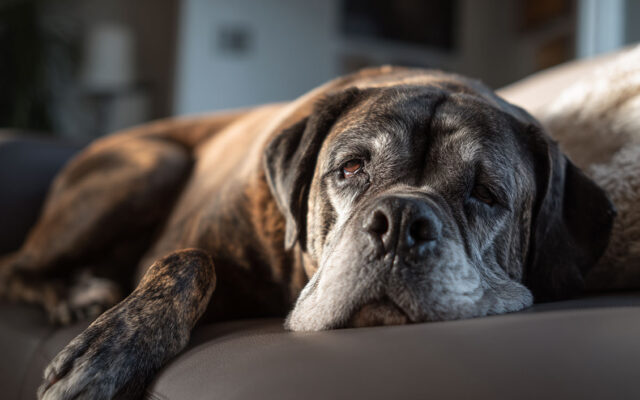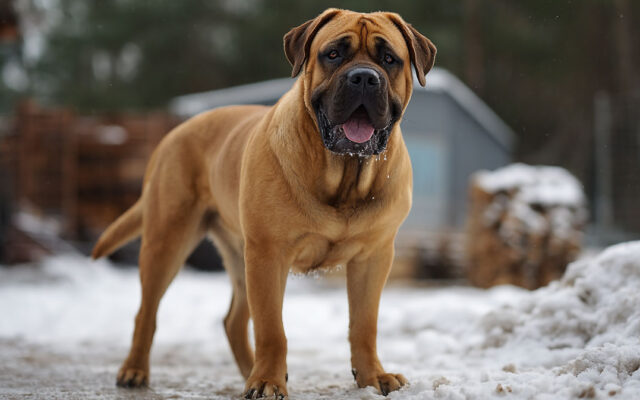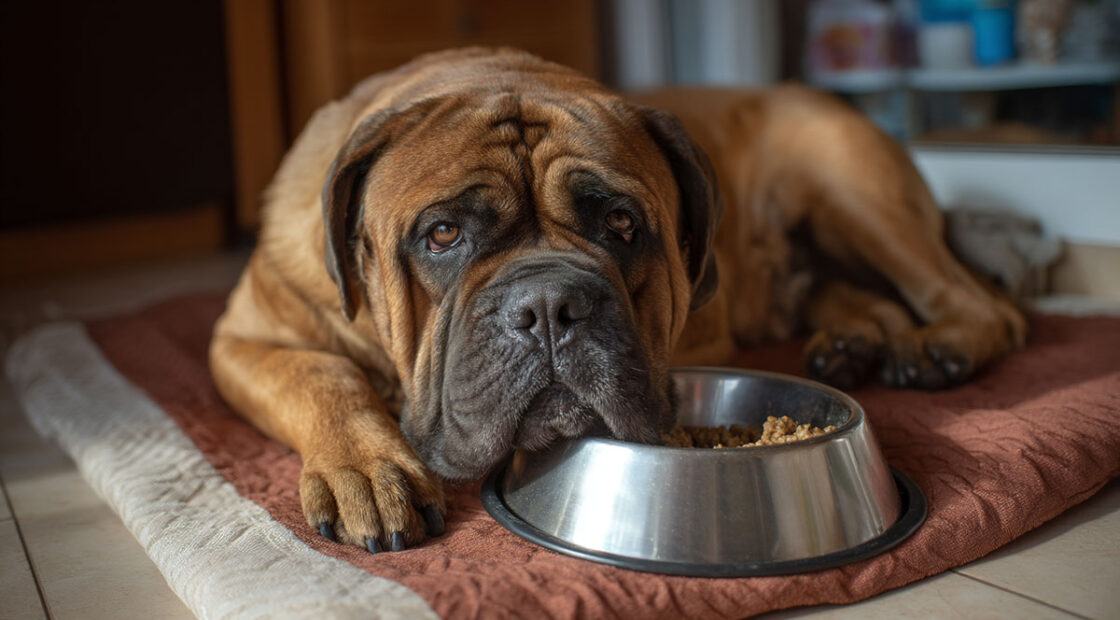
A Bullmastiff‘s chest runs deep and narrow, built more like a barrel with the top cut off than a typical dog’s ribcage, and that shape explains a lot about why bloat shows up so often on this breed’s list of concerns. Prevention isn’t one single fix. It’s a mix of prophylactic gastropexy surgery, feeding schedules vets have refined over decades of watching this go wrong, and paying real attention to family history and temperament, since a fearful or anxious dog carries more risk than a calm one.
Gastric problems, including GDV, accounted for 7% of recorded deaths in a 2021 international mortality survey of Mastiff-type breeds published on ScienceDirect, behind cancer at 47 percent and old age at 16 percent. Early signs include a distended abdomen, non-productive retching, and restlessness, and separate veterinary research on GDV more broadly links elevated risk to age and a documented family history of the condition.
What Bloat Means for a Bullmastiff
Owners mix up the vocabulary constantly, and it’s worth sorting out before anything else. Bloat, in casual conversation, usually just means gas after a big meal, the kind that settles on its own within an hour or two. Gastric dilatation-volvulus, the medical term everyone’s actually worried about, is the version that doesn’t settle.
It starts as gas. In the worst cases it ends with the stomach twisted enough to cut off its own blood supply, and that’s the stage that turns into emergency surgery within hours, not days.
There are technically two stages happening in sequence. First the stomach dilates, stretching well past its normal size as it fills with swallowed air, fluid, or food. Then, in the cases that go badly, it rotates on its own axis, sealing off both the entrance and the exit at once. That second part, the volvulus, is why bloat sits near the top of every list of serious Bullmastiff health problems. It can move from stage one to stage two with almost no warning.
Why Bullmastiffs Develop Bloat More Than Other Breeds
Body shape does most of the explaining here. Bullmastiffs are molossers, built deep through the chest the same way Great Danes and Mastiffs are, and that particular conformation keeps showing up in the bloat research, breed after breed.
Chest Conformation and the Depth-to-Width Ratio
Purdue University’s prospective study, led by epidemiologist Dr. Larry Glickman, tracked large and giant breeds for GDV incidence starting in 1994. Vets still lean on the same basic measurement today, the chest depth-to-width ratio, dividing chest depth by chest width to get a sense of how much room the stomach actually has to shift around.
His team ranked eleven breeds by incidence per 1000 dog-years, and three sat well above the rest:
- Great Dane, 53 cases
- Bloodhound, 39 cases
- Irish Wolfhound, 26 cases
Bullmastiffs and Mastiffs weren’t among the eleven breeds Glickman’s team actually tracked, so there’s no equivalent per-1000-dog-years figure for either breed from that study. Other veterinary literature does list Bullmastiffs among the deep-chested breeds where GDV has been documented, though, and the build overlap with Mastiffs is worth understanding through a closer look at Bullmastiff and Mastiff conformation differences.
Hereditary Risk and Age of First Episode
A first-degree relative with GDV raises a dog’s own odds meaningfully, and that family link is one of the more consistent findings across the research. Temperament plays a role too, oddly enough. Fearful or anxious dogs bloat more often than calm ones, which is the kind of finding that sounds soft until you see how often it repeats across separate studies.
Age follows its own pattern. First episodes cluster in middle-aged to older dogs, with studies putting the median age at first diagnosis or death somewhere between roughly five and eight years.
That temperament link deserves its own read, not just as a bloat risk factor, and it’s covered in full detail in this guide to Bullmastiff temperament.
None of these factors act alone. A lean, older, anxious Bullmastiff with a bloat history in the family carries meaningfully more risk than a calm dog without one.
How Gastric Dilatation-Volvulus Progresses
Once the stomach starts filling with gas, food, or fluid, it stretches well past its normal size, and it does this within a short window, not gradually over a day.
If it then rotates on its own axis, both the entrance and exit seal shut, trapping everything inside.
The twist cuts blood flow to the stomach wall and often the spleen. Tissue starts dying from lack of oxygen, a process vets call gastric necrosis.
In advanced cases, surgeons remove the dead tissue or the spleen entirely, a splenectomy performed in the same operation as the gastropexy. Blood pressure crashes next as the body slides into hypovolemic shock, the point where every hour without treatment counts against survival.
The survival numbers vary a lot depending on timing:
- 36% of dogs with GDV did not survive, per a 2020 study out of Tufts University’s Cummings School of Veterinary Medicine (Sharp et al., Journal of Veterinary Emergency and Critical Care)
- 90 to 95% of dogs survive when GDV is caught and treated with surgery early, according to BluePearl Pet Hospital
- That survival rate drops to about 50% once stomach tissue has already died before surgery, per the same source
The AKC Canine Health Foundation continues to fund research aimed at predicting GDV before it starts, rather than only treating it after.
Early Signs That Signal Bloat
A bloating Bullmastiff rarely looks calm, and vets rank it among the more urgent canine emergencies they see.
A handful of signs mean stop what you’re doing and call:
- Visibly swollen, tight abdomen
- Retching or heaving with nothing coming up
- Restlessness, pacing, inability to get comfortable
- Excessive drooling
- Standing in a hunched, prayer-like position, front legs down and rear end up
- Weakness or collapse in advanced cases
These symptoms sit inside the wider set of Bullmastiff illness signs owners are trained to catch early, and bloat is the one where hours, not days decide the outcome.
Deep-chested dogs sometimes show less visible swelling than the textbook picture suggests, so a flat-looking belly doesn’t rule bloat out on its own.
Deciding on Prophylactic Gastropexy for a Bullmastiff
Stitching the stomach to the inside of the abdominal wall so it can’t flip is the whole idea behind a gastropexy.
It doesn’t stop gas from building up. It stops that gas-filled stomach from twisting, which is the part that actually kills.
A few reasons vets push for it early:
- Cuts GDV recurrence to under 5%, compared with recurrence rates as high as 80% without it, according to Veterinary Partner (VIN)
- Can be scheduled alongside a spay or neuter, avoiding a second anesthesia event, a combination vets including the Animal Medical Center in New York routinely offer
There’s a practical upside too: it removes the guesswork during a future bloat episode, since the stomach can’t rotate even if it fills with gas.
The case against moving fast is thinner, but it exists. It’s still surgery, with anesthesia risk and a recovery period, and a Bullmastiff with no family history and a calm temperament starts from a lower baseline risk anyway. Cost is part of it too, running into the hundreds of dollars even when it’s bundled with another procedure.
Family history matters enough here that it’s worth asking a Bullmastiff breeder directly whether GDV has shown up in the litter’s background before deciding either way.
For owners already thinking ahead about a Bullmastiff’s lifespan, gastropexy removes one of the few risks on that list that surgery can neutralize almost completely.
Comparing Gastropexy Techniques
Vets have several ways to tack the stomach in place, and they trade off invasiveness against recovery time.
| Technique | Invasiveness | Typical recovery |
|---|---|---|
| Incisional gastropexy | Open abdominal incision | 7 to 14 days |
| Belt-loop gastropexy | Open, higher tensile strength | 7 to 14 days |
| Laparoscopic gastropexy | Minimally invasive, small ports | Generally shorter than open techniques |
Incisional gastropexy remains the default technique most general surgical practices perform, mostly because it doesn’t call for specialty equipment.
Laparoscopic gastropexy needs specialty equipment that isn’t available at every clinic, which is why it stays less common despite the generally faster recovery.
Circumcostal and tube gastropexy exist too, though they see less everyday use outside specialty referral centers staffed by board-certified surgeons recognized by the American College of Veterinary Surgeons.
Feeding and Activity Habits That Lower Bloat Risk

None of these habits are proven to prevent bloat outright, since the exact cause is still unknown. Combined, they’re the standard advice most vets give Bullmastiff owners anyway.
Meal Frequency and Bowl Placement
A few feeding habits come up again and again in vet recommendations:
- Two to three smaller meals beats one large one, most vets agree
- Floor-level bowl placement is the more cautious default (elevated bowls remain contested, more on that further down)
- Slower eating helps too, whether that means larger kibble pieces or a slow-feed bowl
The American Bullmastiff Association recommends three to five small meals a day as part of its general bloat-prevention advice, spacing intake out further than a standard twice-daily schedule.
A full breakdown of portions and schedules by age and weight lives in this Bullmastiff feeding guide, worth a look before locking in a routine.
Exercise Timing Around Meals
Exercise right after a full meal is one of the most consistent pieces of advice across bloat guidance, even though, as the later section on contested evidence explains, the research behind it is thinner than it’s often assumed to be. The same timing rules apply on long drives, which is why the meal plan matters when traveling with a Bullmastiff.
Light activity before a meal is fine. Sprinting or excited play right beforehand isn’t ideal. After eating, most vets suggest keeping a Bullmastiff calm and resting for at least an hour.
That hour matters more for a breed already prone to overheating and joint strain during exertion, both covered in a broader look at Bullmastiff exercise needs.
What to Do in a Bloat Emergency

Every minute matters once bloat symptoms start, and hesitation is the biggest risk factor an owner actually controls.
There’s no home remedy that fixes GDV, so skip anything that delays the drive to a vet.
- Stop food, water, and exercise the moment symptoms appear.
- Call the emergency vet before leaving, so the team can prepare.
- Note the time symptoms started. The vet will ask.
- Drive directly there. Don’t wait to see if it passes.
- Let the vet handle decompression once you arrive.
- Expect surgery to follow once the dog is stable enough for anesthesia.
Vets choose between a couple of decompression methods depending on the dog’s condition on arrival.
| Method | How it works | Notes |
|---|---|---|
| Orogastric intubation | Tube passed down the esophagus into the stomach | Often done without sedation |
| Trocarization | Large needle inserted through the skin into the stomach | Used when a tube won’t pass |
| Percutaneous gastropexy and catheter (“G-cath”) | Temporary tacking plus a small catheter for sustained decompression | Newer method, tested at the University of Florida |
A University of Florida emergency and critical care team tested this newer temporary-gastropexy-and-catheter method against standard trocarization in a small randomized trial.
All sixteen dogs in the trial survived at least two weeks after treatment, split evenly across both groups, eight per group, though the sample was too small to prove one method saves more lives than the other.
The method matters less than the owner’s speed getting the dog through the door. That part isn’t up to the vet.
When Bloat Prevention Does Not Work
No prevention method here is airtight, gastropexy included.
Veterinary Partner (VIN) puts the residual risk of the stomach still twisting at about 6% even after a prophylactic gastropexy, since the surgery stops rotation, not the gas buildup that starts everything.
The feeding advice itself doesn’t have consensus behind it. Glickman’s 2000 paper in the Journal of the American Veterinary Medical Association attributed roughly 20% of GDV cases in large breeds, and 52% in giant breeds, to feeding from a raised bowl. That’s a sizeable number, and it’s a big part of why raised-bowl advice stuck around as long as it did.
A later study by Pipan and colleagues in 2012, covering over 1,100 GDV cases, a much bigger sample than Glickman’s original work, found no significant link between bowl height and risk. A systematic review published through Veterinary Evidence (Buckley, RCVS Knowledge) later concluded the evidence is too thin to settle it either way, though floor feeding stays the cautious default since no study has actually found raised bowls to be safer.
Eating speed carries a similar asterisk. A 2000 Purdue study found fast eaters at higher GDV risk, but a separate RCVS Knowledge evidence review found that most later studies, including a large subset of Glickman’s own later data and Pipan’s 2012 study, found no significant effect of eating speed on GDV risk. The review’s conclusion was that the evidence is mixed and inconclusive, not that fast eating is a settled risk factor.
A slow feeder dog bowl may still help by slowing consumption and reducing air swallowed, independent of where the eating-speed evidence eventually lands.
Exercise timing carries its own asterisk. Purdue’s prospective study found no correlation between bloat risk and activity before or after eating, since most dogs in that cohort actually bloated overnight on an empty stomach.
That doesn’t cancel the general advice to rest a dog after meals. It does mean the science behind that specific rule is thinner than the science behind gastropexy itself.
A calm, well-fed Bullmastiff with no family history can still bloat. GDV has never been tied to one single cause, so no combination of precautions brings the risk down to zero.
FAQ on Bullmastiff Bloat Prevention
How much does a prophylactic gastropexy cost for a Bullmastiff?
A prophylactic gastropexy typically costs less than an emergency version, and bundled with a spay or neuter, the price stays modest by comparison.
An emergency gastropexy performed during a GDV crisis often reaches $1,500 or more, according to PetMD, before stabilization and hospitalization get added on.
Does spaying or neutering change the timing of a gastropexy?
Not fundamentally. Vets commonly schedule a prophylactic gastropexy alongside a spay or neuter appointment to avoid a second anesthesia event.
A Bullmastiff outside that window can still have the procedure done on its own, once past six months old.
Can a Bullmastiff with a gastropexy still compete in agility or working trials?
Yes. Veterinary Partner, part of VIN, reports no studies or patient case reports linking agility activity to a gastropexy breaking down.
The tacked stomach holds under normal exertion, and strenuous work or breeding doesn’t loosen the attachment over time.
What does recovery from a gastropexy actually involve?
Expect a leashed, calm routine for about a week. No jumping, running, or off-leash play during that stretch.
Keep the incision dry, watch for swelling or discharge, and follow the same aftercare typically given after a standard spay procedure.
What Should You Prioritize First in Bullmastiff Bloat Prevention?
Surgery goes first, if an owner is only going to prioritize one thing. Gastropexy is the only piece of this whole protocol with confirmed effectiveness against the actual twisting that kills fast. Everything else, the feeding schedule, the emergency plan, matters, but not save-the-dog-in-two-hours matters.
The order matters more than the completeness of the list.
- Prophylactic gastropexy, scheduled with a spay or neuter
- Feeding and bowl-height adjustments, once surgery is booked
- A written emergency plan, saved before symptoms appear
Veterinary Partner (VIN) sets the surgical threshold at dogs expected to reach an adult weight of 99 pounds, or 45 kilograms, a bar the great majority of Bullmastiffs clear well before adulthood.
That threshold puts Bullmastiff bloat prevention ahead of most other breed-specific screening on a puppy’s calendar, though joint health deserves comparably early attention, covered in a dedicated look at Bullmastiff hip dysplasia.