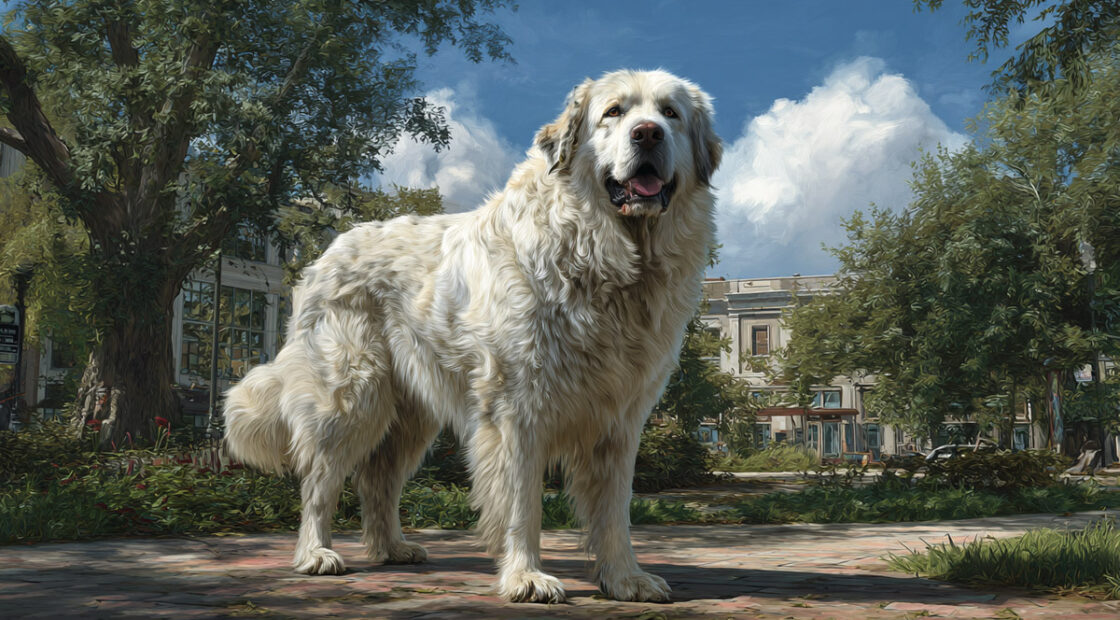
A Great Pyrenees guards livestock on its own, with no shepherd directing the work. The breed was developed in the Pyrenees mountains of France for that job.
The white, double-coated dog now lives mostly as a family companion, and the AKC places it in the Working Group.
Weight is where a lot of pet-site guides slip. The AKC standard (effective August 1, 1990) ties weight to height, so a 27-inch dog weighs about 100 pounds and a 25-inch female about 85. Guides often present those two weights as minimums, but the standard sets no weight floor.
Independence runs through the temperament. It’s behind the night barking and the roaming, and those two shape daily life with the breed.
What Is the Great Pyrenees?
France is the country of origin, and the FCI lists the breed’s use as pastoral guardian in the mountains.
A guardian of this type stays with the stock and deters predators. It does not move the flock the way a herding dog does.
Most Pyrs now live as family companions and still guard home and family, according to the AKC.
People also mix the breed up with the Pyrenean Shepherd, a small herding dog from the same mountains.
Names Around the World
Americans say Great Pyrenees. In the United Kingdom it’s the Pyrenean Mountain Dog, which is also the English title of the FCI standard.

Breed club histories give the French name as Chien de Montagne des Pyrenees, sometimes shortened to Le Chien des Pyrenees. Owners just say Pyr.
How the Major Registries Classify It
| Registry | Group | Name in the standard |
|---|---|---|
| AKC | Working Group | Great Pyrenees |
| UKC | Guardian Dog Group | Great Pyrenees |
| FCI | Group 2, Section 2.2 (Molossoid, mountain type) | Pyrenean Mountain Dog (Standard 137) |
Same dog, three classification systems. Only the FCI files it with the Molossoid mountain types.
Where Does the Great Pyrenees Come From?
The Pyrenees mountains of France, where it developed as a flock guardian. The FCI records France as the country of origin.
The dated record starts in the Middle Ages, when the dog guarded castles and earned a mention from Gaston Phoebus in the 14th century. By the 17th century it was kept as a companion at the court of Louis XIV (FCI Standard 137).
Mountain Origins and Selection for Guarding
The FCI says selection favored the ability to guard and dissuade predators as much as attachment to the flock. The dog worked alone, so it had to make its own calls.
The UKC standard goes further back. It traces the breed to Tibetan Mastiff ancestors and Molossian hounds brought to Spain by the Romans, followed by about 1,000 years of near isolation in the Pyrenees.
That is the UKC’s account. The earliest dated reference in the FCI summary is the 14th century.
From Standard to Registry Recognition
The first detailed description of the breed appeared in 1897, in a book by Count de Bylandt. In 1923 the Reunion des Amateurs de Chiens Pyrenees, led by Bernard Senac-Lagrange, registered the official standard with the Societe Centrale Canine (FCI).
Imports for breeding began in the United States in 1931. Basquaerie, the Massachusetts kennel of Francis and Mary Crane, became the foundation kennel for American stock, according to the Great Pyrenees Club of America (GPCA).
The base was thin. By January 1, 1936, the GPCA counted 41 living Great Pyrenees in the United States, 17 of them imported.
| Date | Milestone | Source |
|---|---|---|
| February 1933 | AKC recognizes the breed | GPCA breed history |
| February 1935 | AKC accepts the breed standard | GPCA club history |
| 1949 | UKC recognizes the breed | UKC standard |
| January 25, 1955 | FCI accepts the breed on a definitive basis | FCI |
| June 12, 1990 | Revised AKC standard approved, effective August 1 | AKC standard |
Sources disagree on a few dates. The AKC’s own breed-history article lists Working Group membership as 1934, while the GPCA text puts recognition in February 1933.
The French standard splits the same way. The AKC’s breed-history article says the Pyr breed standard was first published in 1927, while the FCI says the French clubs registered theirs in 1923.
How Big Does a Great Pyrenees Get?
Under the AKC standard (effective August 1, 1990), males stand 27 to 32 inches at the withers and females 25 to 29 inches. The same standard puts a 27-inch dog at about 100 pounds and a 25-inch female at about 85.
The UKC is close but not identical, with dogs at 27.5 to 31.5 inches and bitches at 25.5 to 29.5 (revised May 1, 2008). The FCI works in centimeters, 70 to 80 for dogs and 65 to 75 for bitches, with a 2 cm tolerance for perfectly typed specimens.
Neither the UKC nor the FCI standard gives a weight.
What the Standards Say About Weight
The AKC standard says weight follows overall size and structure, so 100 and 85 pounds are reference points tied to the minimum heights.
Commercial sources run heavier. Purina lists males at 100 to 130 pounds and females at 85 to 120, and Dogster stretches the range to 85 to 160 pounds.
Treat the standard’s two weights as reference points, not floors. A tall male will run well past them.
How Fast They Grow
Purina Canada advises large-breed puppy food for the first two years of life, because the breed matures more slowly than most.
The AKC standard calls the Pyr a dog of medium substance, with a coat that hides the actual bone and muscle. Judge size with your hands and a measuring stick, not by eye.
Rear Double Dewclaws
All three standards call for double dewclaws on each rear leg. None of them says what the extra toes do, and the registries penalize their absence differently.
| Registry | Missing rear double dewclaws |
|---|---|
| AKC | Fault |
| UKC | Disqualification |
| FCI | Eliminating fault (none, a single dewclaw, or atrophied doubles) |
Great Pyrenees Coat, Colors and Shedding
The AKC standard describes a weather-resistant double coat. The outer layer is long, flat and coarse, and under it sits a dense, fine, woolly undercoat.
It sheds all year and blows out seasonally, so plan on weekly brushing at minimum.
Coat Type and Where the Fur Is Longest
Hair length changes a lot from one part of the body to another.
- A ruff or mane around the neck and shoulders, heavier on males
- A plume on the tail
- Feathering down the back of the front legs and thighs
- Shorter, finer hair on the face and ears
The AKC standard ranks correct coat above abundant coat and lists curly and stand-off coats as faults.
Accepted Colors
The AKC accepts white, or white with gray, badger, reddish brown or tan markings. Markings covering more than one third of the body are a fault.
The UKC wording is a little wider on the patches. It allows solid white, or white with grey (badger or wolf), pale yellow or orange patches on the head, ears, base of the tail and sometimes the body, and any other color is a disqualification.
The FCI uses the same white base with patches, and says badger grey patches are the most appreciated.
Shedding and Brushing
Purina says the double coat sheds heavily year round. The AKC’s ownership guide adds that a seasonal shed, usually once or twice a year, calls for more frequent brushing on top of a weekly baseline.
In a normal week, brush once, all the way down to the skin. During a coat blow, brush more often and in shorter sessions, because dead undercoat comes out in clumps.
Why Not to Shave a Great Pyrenees
Don’t shave a healthy double coat.
Wahl’s grooming guide says the coat insulates in hot and cold weather, so there is no need to clip a Pyr short for summer. Petful’s grooming guide calls routine shaving for shedding control inappropriate.
Owners who want a tidier look can read up on how to trim a Pyr’s coat without shaving it.
Great Pyrenees Temperament and Guardian Instinct

The AKC standard describes the breed as confident, gentle and affectionate, but also territorial, strong willed, independent and somewhat reserved.
The same standard treats excessive shyness, nervousness or aggression toward people as an extremely serious fault.
Why the Breed Is Independent
Independence is the breed’s job description, not a training failure.
The UKC standard says the dog was historically left alone to protect the flocks, which produced independence and a sense of authority. The FCI adds that this initiative demands a certain degree of authority from the owner.
In a house, that reads as stubbornness. Commands get weighed before they get obeyed.
Children, Strangers and Other Animals

The AKC standard calls the dog patient and tolerant, and loyal to its human and animal charges.
With children it’s gentle. Still, a dog near 100 pounds can knock over a toddler without meaning to, so supervise play.
Strangers get a reserved reception, not a hostile one. In a 1999 Journal of Range Management study in Norway, none of 13 Great Pyrenees showed aggression toward unfamiliar people, and the same study found low aggression toward dogs and livestock.
How Well It Works as a Livestock Guardian
Ontario’s 2022 livestock guardian dog factsheet reports that producers rated 71% of 437 Great Pyrenees as very effective.
The factsheet also says the breed tends to be calmer than other common guardian breeds, chases stock less at early ages, and injures stock less often.
Raymond Coppinger’s research describes an effective guardian as one that is trustworthy with the stock, meaning it doesn’t injure or disrupt it, and attentive enough to stay close. It also has to be protective, which means interrupting a potential attack.
Bonding happens early. The Ontario factsheet puts the critical window for social attachment at roughly 8 to 16 weeks, which is why guardian pups are raised with the flock.
The Norway study shows where it breaks down. Dogs raised mostly around people bonded more with people than with sheep, and 91% of the dogs tested chased reindeer.
Training a Great Pyrenees: Barking, Roaming and Containment
Night barking and roaming come with the breed, and so does the independence. Training manages them. It doesn’t remove them.
A secure, visible fence matters most. A controlled night routine and short positive sessions started early come after that.
Why They Bark at Night

The barking is the job.
Oregon State University Extension’s guide to raising a livestock guardian dog says these dogs are selected for the ability to bark at new or strange activity. Ontario’s Ministry of Agriculture, Food and Agribusiness lists leaving the flock unprotected from dusk to dawn, when predators are most active, as a trait that makes a guardian less effective.
Neither source describes a way to train the instinct out. Management is environmental, so bring the dog inside after dark and block its sightlines to the street and neighboring yards.
Roaming and Fences
Ontario’s 2022 livestock guardian dog factsheet calls roaming one of the most common problems producers manage.
It cites a Livestock Guardian Dog Project study in which 48% of deaths among farm-managed dogs were accidents such as disappearing or being hit by vehicles. Many of those causes likely trace back to roaming.
Fencing comes first. National Great Pyrenees Rescue (NGPR) requires secure, visible fencing and says invisible fencing will not contain the breed. Its adoption listings for individual dogs ask for fenced yards of 4 feet and 5 feet.
Habits form early. A pup that never learns to jump a fence may never become a jumper, but an established jumper is hard to correct (Oregon State University Extension). Ontario adds that regular walks around the property line teach the dog where the boundary is.
NGPR’s listing for Casper shows how the problem ends for dogs that get out. He is an adult whose owner surrendered him to a Tennessee shelter for wandering.
Training an Independent Dog
For a pet Pyr, the AKC says the breed learns fast but bores easily. Short, varied sessions with consistency, patience and positive reinforcement work best.
Working guardians are a different case. Oregon State University Extension says obedience training is not appropriate for livestock guardians, because it tends to increase bonding to people instead of stock.
The advice splits because the jobs differ. A house dog needs cues, while a flock dog is better off keeping some distance from people.
First-Year Setup Steps
- Fence the yard before the puppy arrives, with a visible, solid barrier in good repair.
- Walk the property line with the dog on a leash until the boundary is familiar.
- Introduce new people, places and situations early and often, since the AKC notes the breed can be sensitive to new environments.
- Keep sessions short and varied, and reward with treats or praise.
- Book a class or trainer with large guardian breed experience (AKC).
- Settle the night routine before barking becomes habit, because an established routine is hard to change (Oregon State University Extension).
- Ask your vet about neutering timing. Oregon State University Extension says neutering between 6 and 12 months can prevent wandering tied to sexual behavior.
Great Pyrenees Lifespan and Common Health Problems

Breed profiles put the lifespan at 10 to 12 years, and the largest UK dataset gives a median of 10.9 years.
Hip dysplasia and patellar luxation are the joint concerns, and hip and patella screening is required under the breed club’s CHIC program. Bloat is the emergency.
Lifespan
Dogs Trust researchers analyzed 584,734 UK dogs for a 2024 Scientific Reports paper. Median survival was 12.5 years across all dogs and 11.9 years for large purebreds, and Dog News’s summary of the study’s breed list puts the Great Pyrenees at 10.9.
That sits inside the 10 to 12 range but about a year below the large-breed median.
The authors say the results represent UK dogs only. Their dataset also does not record cause of death, so the figure shows how long dogs live, not why.
Conditions to Know
Hip dysplasia is screened by OFA or PennHIP evaluation, and that test is required under CHIC. Patellar luxation is screened by OFA patella evaluation, also required.
Bloat, or gastric dilatation-volvulus, hits large deep-chested breeds. The Great Pyrenees appears on Bell’s 2014 list of susceptible breeds in Topics in Companion Animal Medicine.
Elbow dysplasia is an elective CHIC screen, not a required one. Bone cancer and eye disorders get named in breed guides, though published incidence figures are thin.
Pet sites often list elbow dysplasia as a Pyr concern. An analysis of Orthopedic Foundation for Animals records published in PLOS ONE (2017) put the breed among the 15 with the lowest prevalence, at 1.5%.
Electives vary between summaries of the GPCA protocol, so confirm the current list in the OFA database before relying on a breeder’s paperwork.
Bloat Warning Signs
Bloat is an emergency.
Cornell’s emergency and critical care service describes gastric dilatation-volvulus as needing immediate medical and surgical intervention. Go to an emergency vet at the first sign of any of these:
- A swollen or tight belly
- Unproductive retching
- Drooling and restlessness
- Collapse
Splitting daily food into two meals is standard advice, and a slow feeder bowl that stretches out mealtime helps a dog that gulps.
The evidence on eating speed is mixed. A Veterinary Evidence review (RCVS Knowledge, 2016) found most studies show no effect, and the one significant result in the Glickman 2000 study appeared in large breeds but not giant ones.
How Much Does a Great Pyrenees Cost?
The purchase price is the smallest and least predictable part of the cost.
No authoritative dataset publishes breeder prices for the breed, and pet-site roundups disagree without stating a method. Rescue fees are easier to pin down, and fencing is the line item specific to this breed.
The sticker price is a small piece of what a dog costs over its lifetime, and a giant breed raises most of the other lines.
Buying From a Breeder

Ontario’s factsheet says the reputation of the breeder matters more than the breed, sex or age of the dog.
For a pet, ask for verifiable proof of health testing. That means the OFA hip result (or PennHIP) and the OFA patella result, plus any elective screens and the lifespan of relatives.
Adopting From a Rescue
NGPR lists adoption fees that start at $400 for locally adopted dogs and run up to $700 for puppies under six months, with transport included.
Puppies placed on spay or neuter contracts get $100 back after surgery, and fees for senior dogs are adjusted. The rescue also requires secure visible fencing before it places a dog.
Costs That Keep Running
| Line item | Why it runs high | Planning note |
|---|---|---|
| Fencing | Visible, solid barrier required | Budget for repairs |
| Food | Scales with body weight | Giant-breed portions |
| Emergency care | Bloat needs surgery | Insurance or reserve fund |
| Joint care | Hip and patella conditions | Screen early, monitor |
How Does the Great Pyrenees Compare With Other Guardian Breeds?
The Great Pyrenees, Anatolian Shepherd and Maremma all guard livestock, and Ontario’s factsheet says there is little evidence that any breed cuts predation more effectively than another.
They differ mostly in coat and color, and in how they treat other animals.
| Attribute | Great Pyrenees | Anatolian Shepherd | Maremma Sheepdog |
|---|---|---|---|
| Coat | Long double coat | Short to rough | Thick, long double coat |
| Color | White, limited markings | Any color accepted | Solid white (pale ivory, orange or lemon shades tolerated) |
| Aggressive to dogs | 67% | 86% | 94% |
| Aggressive to sheep | 7% | 14% | 20% |
The aggression figures come from a 1988 producer survey (Green and Woodruff) reproduced in the Ontario factsheet. They are producer reports, not behavior tests, and the Maremma sample is small.
Versus the Anatolian Shepherd Dog
The AKC standard asks for males from 29 inches and 110 to 150 pounds, measured at age two or older.
The coat runs short (one inch minimum) to rough, around 4 inches, in any color pattern.
On temperament, the Anatolian Shepherd standard calls it highly territorial and says overhandling is discouraged. That’s a more guarded read than the Pyr’s.
Versus the Maremma Sheepdog
The Maremma is smaller and stricter on color. The UKC standard (revised May 1, 2017) puts males at 25.5 to 28.75 inches and 77 to 100 pounds.
The coat is solid white, with shades of pale ivory, orange or lemon tolerated, and black shading is a disqualification. Dogs NSW calls the breed aloof and independent, with training a challenge.
Which One to Pick
The Pyr has the lowest reported aggression toward other dogs and sheep of the three, which is the main argument for it.
If you’d rather have a shorter coat and a more territorial dog, the Anatolian fits. The Maremma is the smaller white option, though the evidence behind it is thinner.
When Is a Great Pyrenees the Wrong Dog?

It’s the wrong dog if you can’t fence it. It’s also the wrong dog if you can’t put up with night barking, if you can’t keep it cool in summer, or if you want quick obedience from a first dog.
Conditions That Rule It Out
Without a secure fence, a Pyr roams, and Ontario says roaming dogs create conflicts with neighbors and motorists.
Close neighbors are a problem for a related reason. Ontario says dogs with defensive responses toward humans may not be tolerated near populated areas.
Heat matters too. Oregon State University Extension says large dogs that have not shed winter coats can struggle to dissipate heat and retreat under buildings or dig into cool dirt.
As for a first dog, the AKC says the breed suits experienced owners, because it resists classic obedience training.
A Quick Fit Check
Start with the property. Is there a visible, solid fence around every area the dog will use? Can the neighbors live with a dog that patrols and barks after dark? And can the dog stay cool from late spring through early autumn?
A no on any one is fixable only by changing the property, not the dog.
The best fit is someone who has handled large independent dogs before, on fenced property in a cool climate.
Great Pyrenees FAQ
How much exercise does a Great Pyrenees need?

About 20 to 40 minutes a day, according to Hill’s Pet breed profile, which rates the energy level as laid back.
A secure yard and a daily walk cover it, and the dog patrols its own territory between outings.
What should you feed a Great Pyrenees?
A giant- or large-breed formula, per Purina, because the breed’s size changes its nutritional needs.
Set portions by body weight and condition, and check with your vet before adding joint supplements.
What are common Great Pyrenees mixes?
Chewy’s breed guide lists crosses with the German Shepherd, Labrador Retriever, Australian Shepherd, Husky, Poodle and Golden Retriever.
These are mixed breeds, so size, coat and guarding drive vary from dog to dog.
Are Great Pyrenees hypoallergenic?
No. Purina says the double coat sheds heavily year round, which leaves plenty of hair in the home.
Anyone with dog allergies should spend time with an adult Pyr before committing.
Can a Great Pyrenees live in an apartment?
Rarely. The breed barks at new or strange activity, and rescue groups such as National Great Pyrenees Rescue require secure visible fencing, which apartment living cannot provide.
A large fenced property suits the dog far better.
What to Do First After Choosing a Great Pyrenees
Build the fence first. Every later step assumes a dog that stays on the property, so a visible, solid barrier goes up before the puppy arrives.
Health records come next, and they carry a timing limit. OFA rules require a dog to be at least 24 months old for a hip evaluation, so a puppy’s own hips cannot be certified yet. Ask the breeder for the parents’ verified OFA hip and patella results instead, and confirm them in the OFA database.
The night routine is last, and it’s the one people put off. Get the dog indoors after dark from the start, before the barking turns into a habit.
It does delay the homecoming. Building the fence and checking records first pushes it back, and that wait protects both the dog and the neighbors.