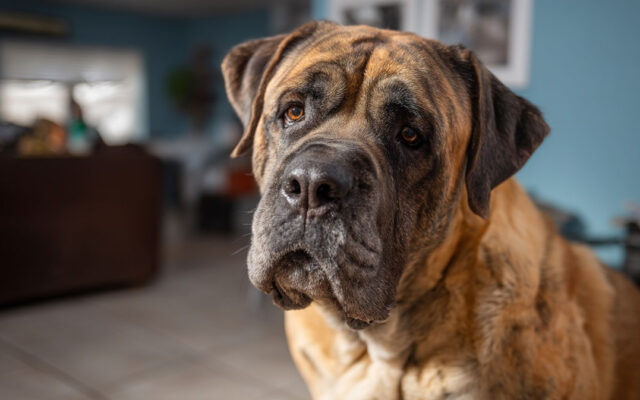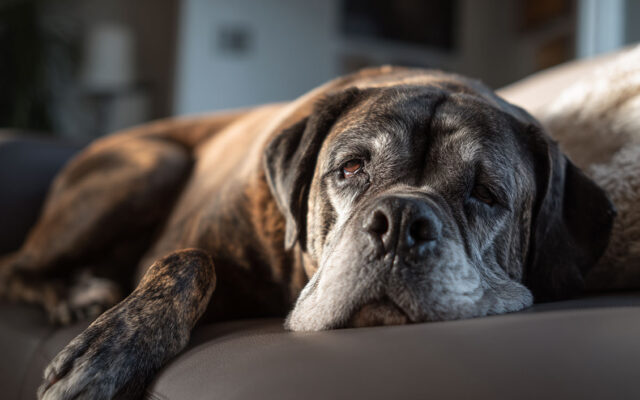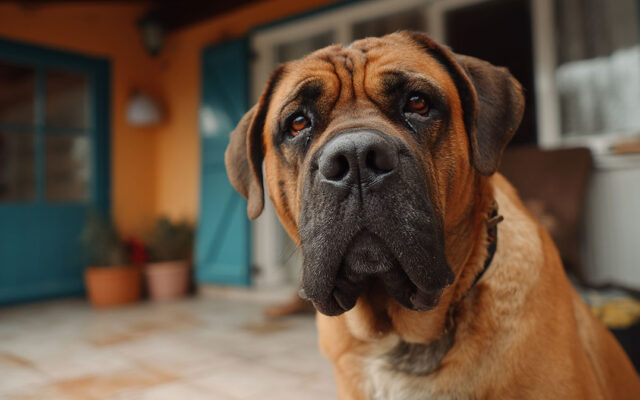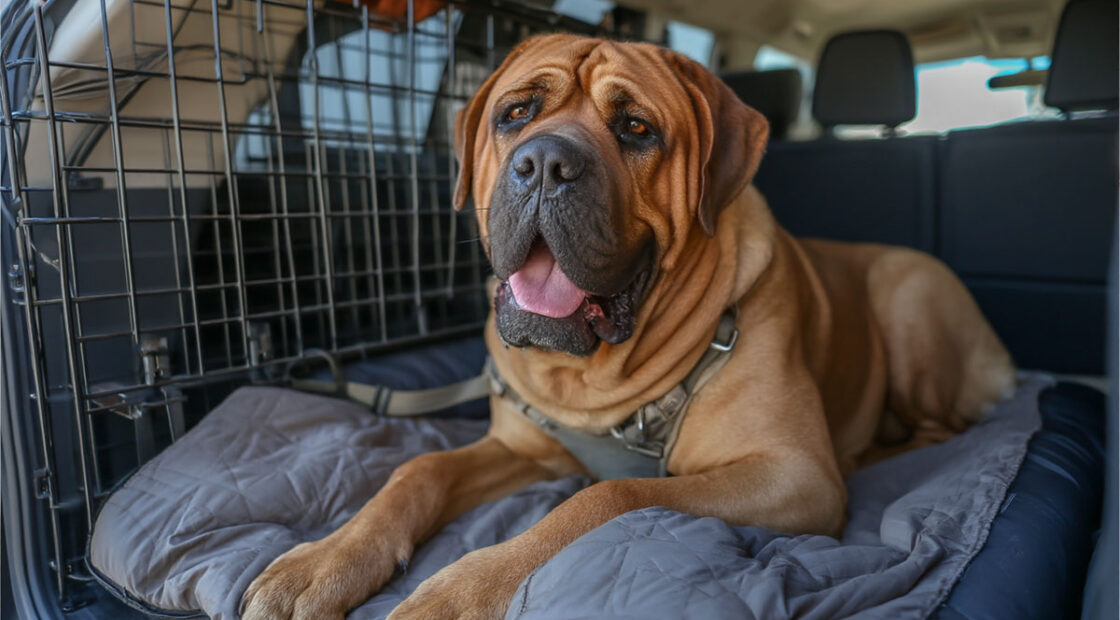
A crate rated for a Labrador won’t pass inspection for a Bullmastiff, and that catches a lot of first-time owners off guard. Standard pet travel advice assumes a dog under 50 pounds and a soft-sided carrier someone can lift with one hand. None of that applies once a dog clears 100 pounds before it’s even fully grown. Vehicle restraints need a higher weight rating. Paperwork gets more involved once a state line or a border enters the picture. And airline crate rules start ruling out a Bullmastiff long before cargo weight caps even become the deciding factor.
International Air Transport Association rules require ventilation across at least 16 percent of a crate’s four vertical sides, and most giant-breed crates bought off the shelf don’t clear that bar without extra mesh panels added on, according to the IATA Live Animals Regulations (2026).
What Traveling with a Bullmastiff Involves
The breed standard puts males at 110 to 130 pounds and females at 100 to 120 pounds, according to the American Kennel Club. That number alone knocks out most pet travel advice out there, since it’s written for dogs that fit under an airplane seat, not a guardian breed built for close protection work.
Owners end up planning around stuff smaller-dog guidance skips over entirely. Chest depth matters more than most people expect, since it changes which crates and harnesses even fit properly. Heat tolerance is its own separate issue for a dog this size and coat type. And raw size is the factor that touches basically everything else, from harness stitching to airline weight caps.
People sizing up the breed sometimes confuse it with the larger Mastiff, and the mix-up matters once crate planning starts. A side-by-side look at how the Bullmastiff compares against a full Mastiff shows the Mastiff running 40 to 70 pounds heavier in most cases, which changes the math on airline weight caps fast.
Most Bullmastiffs settle into new environments without much fuss. The steady, watchful Bullmastiff temperament is a big part of why the breed travels calmer than its size would suggest. Heavy drooling in a warm car, though, is just standard for the breed, temperament aside.
What Health Documentation a Bullmastiff Needs to Travel
A few numbers decide whether paperwork actually holds up at the border or falls apart.
- EU-bound certificates must be endorsed by USDA APHIS within 10 days of arrival, and the dog must arrive within that same 10-day window (USDA APHIS, 2026)
- FAVN rabies titer blood draws happen no earlier than 21 to 30 days after the rabies vaccine (Kansas State University Rabies Laboratory)
- Hawaii enforces a 120 day wait after the titer sample is received before entry clears (Kansas State University Rabies Laboratory)
Domestic travel across state lines usually just needs a basic health certificate, signed by a licensed vet within about 10 days of departure.
International travel gets more involved fast. A USDA-accredited veterinarian has to do the exam, and for a lot of destinations USDA APHIS then endorses the certificate through the VEHCS system afterward.
Rabies vaccination timing gets checked closely at this stage. Some countries tack a rabies titer test on top of it too.

A rabies titer test doesn’t replace the vaccine. It just confirms the vaccine actually produced an immune response, and it’s required by countries like Australia, Japan, and Hawaii for dogs coming from the US.
Owners flying into the EU or UK are working with a tighter clock than owners headed to Hawaii, since the EU calculates off arrival date instead of a fixed wait after the test.
Missing paperwork trips up more Bullmastiffs at check-in than crate size does, and honestly more than raw weight too.
How Heat Sensitivity Changes Bullmastiff Travel Planning
USDA-APHIS rules under the Animal Welfare Act bar dogs from exposure above 85°F or below 45°F for more than 45 minutes while being moved to or from the airplane or animal holding areas during ground handling.
That ceiling matters more for a Bullmastiff than it does for a lot of other breeds. The coat’s heavy, the chest is broad, and the muzzle is moderately shortened, and none of that helps once temperatures climb.
A few signs show up before things get serious on a hot travel day.
- Heavy panting that does not slow down after rest
- Bright red or purple gums
- Wobbling, disorientation, or refusal to move
- Excess drool that turns thick and ropey
Catching these early matters more than most owners assume. The guide to Bullmastiff illness signs goes into how to tell ordinary summer panting apart from a dog that’s already in trouble.
Road trips shift toward early morning or late evening departures once the forecast sits near or above 80°F.
A parked car with the engine off turns into a heat trap within minutes, no matter the season, and a Bullmastiff heats up just as fast as a much smaller dog despite looking tougher.
How Bloat Risk Shapes a Bullmastiff’s Travel Schedule
Peer-reviewed research puts the lifetime gastric dilatation-volvulus risk for large and giant breeds between 3.9% and 36.7% (National Center for Biotechnology Information, 2020).
Bloat is what happens when the stomach fills with gas and, in bad cases, twists on itself and cuts off blood flow.
Deep-chested giant breeds land at the high end of that range, and travel stress is a known trigger, right alongside eating too fast or exercising hard right after a meal.
Feeding times end up shaping the whole travel schedule, not just the drive itself.
- Feed at least 2 hours before loading the dog into a car or crate
- Skip vigorous play or exercise in the hour before and after travel
- Offer small amounts of water on the road rather than one large bowl
- Keep meals at the same time each day, even mid-trip
Getting the feeding rhythm right before a trip matters almost as much as what’s in the bowl. The full Bullmastiff feeding guide covers portion sizes and meal timing in more depth than any travel checklist can.
Owners who’ve already had a scare tend to read the Bullmastiff bloat prevention page before booking anything at all, since the prevention steps taken at home carry straight into how a trip gets planned.
A firm, swollen abdomen combined with unproductive retching is an emergency. That means finding the nearest vet immediately, not finishing the drive.
Which Car Restraint Works Best for a Bullmastiff

Weight is the deciding factor here, and most harnesses on the market were never tested at it.
The Center for Pet Safety ran a crash test study in 2013, sponsored by Subaru. Of the 11 harness brands tested, only the Sleepypod Clickit Utility passed crash safety testing, and it was named the top performer.
That test used dogs well under Bullmastiff weight, which says a lot about how thin the options get once a dog crosses 100 pounds.
| Restraint type | Weight suitability | Crash-test status | Cost tier |
|---|---|---|---|
| Sleepypod Clickit Utility | Rated for large dogs | CPS top performer | Premium |
| Kurgo tether harness | Large breed sizing available | Not independently crash-certified at giant-breed weights | Mid-range |
| Vehicle crate secured with straps | Fits most giant breeds | Depends on crate material and anchor points | Mid-range to premium |
| Fixed vehicle barrier | Cargo area only | Not a restraint, just containment | Budget |
A standard mid-size harness built for a 40-pound dog fails on a Bullmastiff for a pretty simple reason. The chest strap sits too narrow for a girth this deep, and the stitching was never engineered for the force a 120-pound body generates in a sudden stop.
Crash-tested harnesses cost more than an ordinary walking harness with a seatbelt loop sewn on. Worth the extra money, for a dog this size.
What Crate Size and Cargo Rules Apply to a Bullmastiff
| Carrier | Combined pet plus crate cap | Notes |
|---|---|---|
| United Airlines | 99.9 pounds | United suspended its general-public PetSafe cargo program in 2018. As of 2026, cargo/checked-baggage transport is limited to active-duty U.S. military and State Department personnel on official orders flying between Guam and Honolulu. It is not a booking option for most Bullmastiff owners |
| Alaska Airlines (Pet Connect) | 150 pounds | Higher ceiling, still ground-temperature restricted (45°F to 85°F) |
| American Airlines Cargo (PetEmbark) | Set by aircraft type | Accepts pets when ground temperature runs 45°F to 85°F, though it classifies all Mastiff breeds as brachycephalic and will not accept them regardless of temperature (see below) |
| Delta Cargo | Largely closed to the general public | Domestic pet-in-hold shipments are under an ongoing embargo except for active-duty military and State Department personnel on official orders; international shipments must go through an IPATA-accredited pet shipper |
IATA crate sizing rules require enough room for a dog to stand, turn around, and lie down without touching the sides.
For a Bullmastiff, that usually means a crate rated for extra-large or giant breeds, well beyond what most pet stores stock.
United’s own pet policy caps the combined pet-and-crate weight at 99.9 pounds, and that’s just for the narrow military and State Department program it still runs. A fully grown male Bullmastiff clears that ceiling on his own before the crate even adds anything. For everyday civilian bookings, United’s cargo hold isn’t on the table at all, since the general-public PetSafe program has been suspended since 2018.
That reality pushes most Bullmastiff owners toward Alaska’s or American’s cargo programs, an IPATA-accredited relocation agent, or ground transport entirely.
The same weight and eligibility math applies to other giant breeds booking cargo space. A Great Dane or a Saint Bernard owner runs into pretty much the identical wall, which is why relocation agents treat giant-breed cargo bookings as their own separate category.
Ventilation on all four sides, covering at least 16 percent of total surface area, and a leak-proof floor are non-negotiable under IATA’s Live Animals Regulations. Airlines will reject a crate missing either one right at check-in.
Should a Bullmastiff Fly in Cabin or Cargo

Cabin travel isn’t realistic for this breed on almost any carrier. No under-seat carrier comes close to fitting a 110-pound dog.
That leaves two real choices: cargo hold or ground transport by vehicle.
A cargo hold flight covers long distances in hours instead of days, and modern aircraft holds are pressurized and climate-controlled once the plane’s actually in the air. The real risk sits on the ground. Ground temperature restrictions can cancel a booking with little notice, and the most dangerous window for a dog is time spent on the tarmac during loading and unloading, not the flight itself.
Driving gives an owner full control over temperature, rest stops, and feeding schedule, and there’s no crate weight cap to negotiate with anyone. It just takes longer. A cross-country move by car adds days a flight wouldn’t need, and the same bloat and heat risks a flight carries are still there, just stretched over more hours.
USDA-APHIS regulation under the Animal Welfare Act requires the animal cargo hold to be pressurized in flight, and requires part of the hold to stay within that same 45°F to 85°F range that governs ground handling. So the risk on a flight concentrates almost entirely in loading and unloading, not the time in the air.
Owners moving overseas rarely get to choose between the two. Owners driving to a pet-friendly coastal town for two weeks almost always pick the car instead.
Where Breed-Specific Legislation Restricts Bullmastiff Travel
Breed-specific legislation targets a dog’s classification, not how that particular dog actually behaves.
Bullmastiffs land on more restricted lists than most owners expect. They’re usually grouped in with other guardian and molosser-type breeds rather than named alone.
Most of the friction sits in municipal ordinances, not federal law. There’s no US federal dog breed ban.
| Restriction type | Where it applies | Effect on a Bullmastiff |
|---|---|---|
| Municipal breed ban | Specific cities and counties | Entry, residence, or transit through the area may be prohibited |
| Insurance or muzzle requirement | Varies by city ordinance | Dog may enter but only under added conditions |
| State preemption law | 22 US states | Blocks local governments from passing breed bans at all |
| International entry ban | Select countries | Full denial of entry regardless of documentation |
22 US states currently stop their own cities and counties from passing breed-specific ordinances at all, according to Best Friends Animal Society.
That leaves a patchwork everywhere else, since the remaining states let local governments write their own rules.
The confusion gets worse because ordinance language rarely spells out “Bullmastiff.” Most bans use broad category language covering any Mastiff-type or bully-type dog, which sweeps in a Bullmastiff right along with breeds like the Cane Corso.
A dog that passes every health and paperwork requirement can still get turned away at a city line if that city’s ordinance names its general type.
Checking the specific municipality, not just the state, is really the only way to know for certain before booking.
Which Hotels and Rentals Accept a Bullmastiff’s Size

Weight caps, not breed bans, are usually what blocks a Bullmastiff from a hotel room.
Kimpton Hotels publishes a chain-wide policy with no weight, size, or breed restriction, and no cap on the number of pets per room either.
Chains vary a lot on this once you actually compare them side by side.
- Kimpton: no published weight or breed limit chain-wide
- Courtyard by Marriott: many properties cap pets around 50 pounds per room
- La Quinta: standard chain policy allows up to two pets per room at a typical 75-pound weight limit, though individual properties may set their own limit
- Vacation rental platforms: policy set per host, disclosed in the individual listing
A Bullmastiff clears La Quinta’s commonly cited chain-wide cap, but goes over the typical Courtyard ceiling on its own, before even factoring in a second pet.
Calling the specific property ahead of booking still beats trusting a brand-wide policy page. Individual franchise locations set their own exceptions more often than people expect.
What Identification Keeps a Bullmastiff Safe During Travel
A microchip is the one identification method that survives a lost collar, a broken clasp, or a dog slipping its harness at a rest stop.
Dogs with a registered microchip were returned to their owners in 52.2 percent of shelter intake cases, compared with 21.9 percent for dogs without one, in a study published in the Journal of the American Veterinary Medical Association (2009).
Identification works best layered, not relying on just one method.
- ISO 11784/11785 microchip, implanted and registered with current contact information before departure
- Physical ID tag on the collar, still required at check-in by some airlines and border agents regardless of chip status
- GPS tracker such as a Whistle collar attachment, useful for real-time location during rest stops and hotel stays
A chip that’s never been registered with a database does almost nothing. A scanner reads the number fine, but a shelter or airport worker has no way to reach the owner without that registration step behind it.
Updating contact details before a trip matters more than the chip itself. A disconnected phone number breaks the entire system, no matter which registry holds the file.
How to Prepare a Bullmastiff for a Road Trip

Prepping a Bullmastiff for a road trip works better with a fixed order than a loose checklist.
- Schedule a veterinary check two to three weeks before departure to confirm the dog is fit to travel and to update any vaccinations
- Gather health certificates, rabies records, and ID tag information into one folder or app before packing anything else
- Begin short practice sessions in the car harness or travel crate at least a week ahead, building up to full trip-length durations
- Pack familiar bedding, a water jug, and a few worn toys rather than new ones, since familiar scent lowers stress in a new environment
- Plan rest stops every two to three hours with time for a short walk, keeping to the breed’s moderate exercise needs rather than pushing distance
- Confirm the feeding schedule stays fixed for the entire trip, adjusting departure times around meals rather than the reverse
Ruffwear and similar gear makers sell travel-specific harnesses built for this kind of daily in-and-out-of-the-car use, and they hold up better than a walking harness pressed into travel duty out of convenience.
A dog that’s never worn its harness before the first travel day is the most common setup for a bad first trip. Ask anyone who’s done it.
Packing the right gear matters almost as much as the schedule itself. The full rundown of Bullmastiff toys and accessories covers which items travel well and which fall apart after one long car ride.
Exercise needs don’t pause during a multi-day drive either. The guide to Bullmastiff exercise lays out how much activity the breed actually needs at each rest stop to keep it from getting restless in the car.
When a Bullmastiff Should Not Travel
Some conditions rule out travel completely, no matter how well the paperwork and gear are handled.
Federal rule under the Animal Welfare Act, administered by USDA-APHIS, bars puppies under 8 weeks old and dogs not weaned at least 5 days from flying at all.
The same rule extends that caution to dogs that are very old, pregnant, ill, or recently injured, regardless of species or breed.
A few specific situations take travel off the table entirely.
- A diagnosed cardiac condition or recent cardiac event
- Recent surgery, including a gastropexy performed within the prior recovery window set by the surgeon
- An active episode of bloat symptoms, which is an emergency vet visit, not a delayed departure
- A destination municipality with an active breed ban covering mastiff-type dogs
Cargo eligibility has its own separate failure point beyond ground temperature, covered earlier in the flight discussion above.
American Airlines Cargo’s own breed verification policy classifies Mastiff, all breeds, as brachycephalic, and doesn’t accept them as cargo or checked baggage under any circumstance, regardless of the weather.
Airline breed lists and cargo access change without much public notice. United’s general-public cargo program itself disappeared in 2018, and Delta’s has been under an embargo for domestic pet shipments in the years since. A fresh check of each carrier’s current breed and cargo policy before booking is essential, not optional.
That gap between carriers means the same dog can get flatly refused on one airline and accepted, temperature permitting, on another.
Confirming a specific carrier’s breed list and current cargo availability before booking beats finding this out at the cargo counter. The full breakdown of Bullmastiff health problems covers the conditions most likely to disqualify a dog from any form of travel, not just flying.
FAQ on Traveling With Bullmastiff
How much does it cost to fly a Bullmastiff in cargo compared to cabin-eligible breeds?
Cabin travel isn’t available to a Bullmastiff, since no under-seat carrier fits a dog this size. Cargo fees for a giant breed commonly run $300 to $1,000+ each way once crate surcharges and a health certificate get added in, and access is limited to airlines currently taking general-public cargo bookings, like Alaska and American (CitizenShipper, 2026).
Do trains and ferries allow Bullmastiffs on board?

Amtrak caps its carry-on pet program at 20 pounds combined weight of pet and carrier, a limit a Bullmastiff clears before boarding even starts (Amtrak, 2026). Ferry policy varies by operator, though most car-deck crossings let a leashed dog stay inside the vehicle.
Is a Bullmastiff’s temperament suited to frequent travel or service work?
The breed’s steady, watchful temperament handles new environments calmly enough, but its size and independent streak make it a poor fit for formal service work. Most working Bullmastiffs end up as home guardians, not task-trained assistance dogs suited to public access settings.
What should be done if a Bullmastiff shows car sickness during a trip?
Pull over and let the dog stand on solid ground for a few minutes. Withhold food for the next stretch and crack a window for airflow. Repeated vomiting across multiple trips warrants a vet visit before the next drive.
How long can a Bullmastiff safely stay crated during transport?
IATA Live Animals Regulations require feeding every 24 hours and water every 12 hours for crated dogs 16 weeks old or older. In practice, a Bullmastiff does best with a break under 8 hours crated, for water and a bathroom stop.
What vaccinations does a Bullmastiff need before international travel, beyond rabies?
Core vaccines, meaning distemper, hepatitis, parvovirus, and parainfluenza, are strongly recommended before international travel. The UK, Ireland, Finland, Malta, and Norway also require a tapeworm treatment given 24 to 120 hours before arrival, recorded directly on the health certificate.
What Should You Fix First in Traveling With Bullmastiff?
Traveling with a Bullmastiff really comes down to one decision made before packing even begins: confirming the carrier’s current breed policy and cargo availability alongside the destination’s paperwork window. Gear problems are recoverable. A flat breed exclusion or a suspended cargo program is not.
Getting the order right lowers that risk quite a bit.
- Confirm the carrier’s breed classification and whether its cargo program is even open to general-public bookings
- Lock in the health certificate and vaccination timeline next
- Buy the crash-tested restraint and crate last
An owner who buys gear first risks a nonrefundable crate and harness for a trip the carrier refuses outright, regardless of temperature or weight.
This holds as of August 2026, and airline breed lists and cargo eligibility change without public notice, so a fresh check before booking stays part of the routine.
Once logistics are settled, the full cost of keeping a Bullmastiff is the natural next figure to work out, since crate fees and cargo surcharges are just one line in a longer budget.