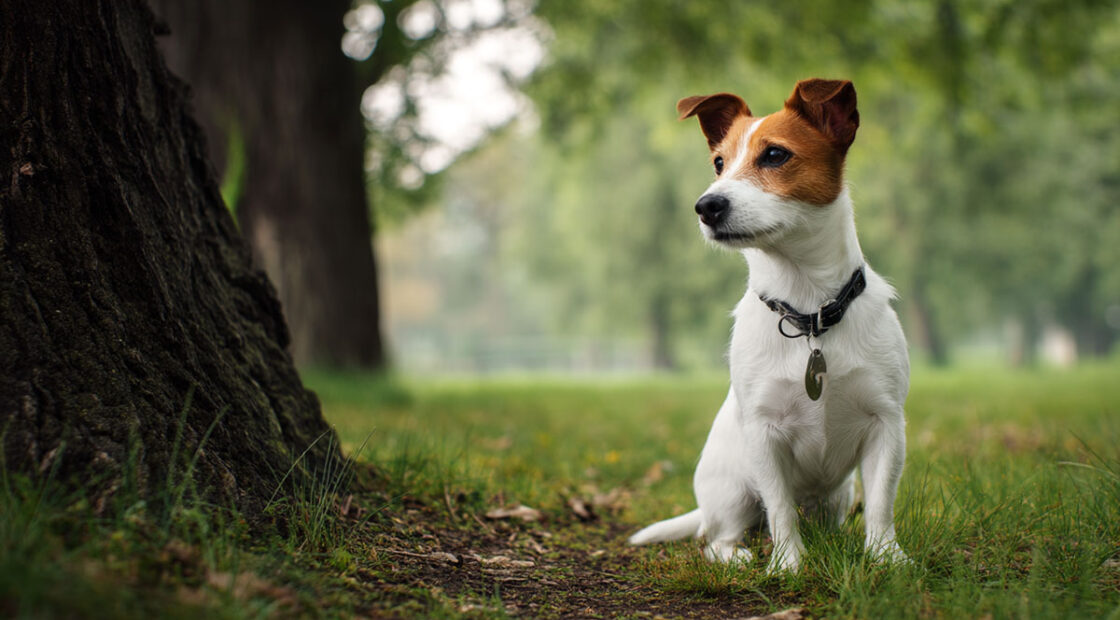
Depending on which registry you ask, a Jack Russell Terrier stands anywhere from 10 to 15 inches, and the coat is mostly white. The dog was bred in 19th-century England to follow foxhounds and bolt foxes out of underground dens, which accounts for the high prey drive and for the fact that a short walk barely registers.
The breed does hold one record. It has the longest life expectancy of 18 UK breeds in the VetCompass life tables, at 12.72 years from birth (Teng et al., Scientific Reports, 2022).
The name doesn’t point to the same registered breed everywhere. The AKC lists the taller Parson Russell Terrier and the shorter Russell Terrier, while The Kennel Club registered the dog as its own breed only in 2016.
What Is a Jack Russell Terrier?
The build follows the job. The chest has to fit a den entrance, so judges test it by spanning, closing both hands around the chest behind the shoulders (The Kennel Club).
Naming is where it gets messy.
“Jack Russell Terrier” is not a breed name the AKC uses. It lists the taller Parson Russell Terrier and the shorter Russell Terrier instead, while The Kennel Club, the UKC and the FCI register the Jack Russell Terrier as its own breed.
| Name | Height standard | Body proportion | Recognized by |
|---|---|---|---|
| Jack Russell Terrier | 10 to 12 in ideal (UKC, FCI); 10 to 15 in (JRTCA) | Slightly longer than tall | The Kennel Club, UKC, FCI, JRTCA registry |
| Parson Russell Terrier | 12 to 15 in (AKC limits); ideal 13 to 14 in | Approximately square | AKC, The Kennel Club, UKC, FCI |
| Russell Terrier | 10 to 12 in (AKC, disqualified outside) | Marginally longer than tall | AKC (full recognition 2012) |
Sources can’t agree on whether this is one breed or several. Britannica treats the Jack Russell and the Parson Russell as the same dog. The JRTCA goes further and calls both the Parson and the Russell variants of its own breed, while Wikipedia and the UKC list them as separate breeds.
If you’re buying, match the name to the paperwork. AKC papers say Parson Russell Terrier or Russell Terrier, so a seller advertising a plain “Jack Russell” should be asked which registry the parents belong to.
Where Did the Jack Russell Terrier Come From?
Reverend John Russell, a Devon parson and fox hunter, built a strain of white working terriers in the 1800s. Over the next century that strain pulled in different directions, and every split left a registry behind.

Reverend Russell and the foundation terrier
Russell was born in 1795 in Dartmouth, Devon, and bought his first terrier while studying at Oxford, a small white bitch with tan markings named Trump.
Trump is credited as the mother of the breed. Russell is believed to have mated her to a black-and-tan terrier.
By the mid-1850s, the fashionable foxhound packs in England were buying Russell’s terriers.
What else went into the dogs is disputed.
The FCI standard history says Russell’s outcrosses to other breeds disappointed him and were abandoned. Britannica says the crosses are unknown but believes Bull Terriers and Beagles were among the breeds used.
Wikipedia places Bull Terrier stock later, in the badger-digging era, and says it likely produced the shorter-legged variety.
How one terrier became several
By 1900 the show ring and the hunt kennel were producing different dogs.
The Fox Terrier Club formed in 1875 with Russell as a founder member, and the Fox Terrier moved toward the modern show type (Wikipedia). Meanwhile the old style of Russell’s terriers survived in parts of the country, and the modern Jack Russell type descends from those dogs. A shorter-legged variety showed up along the way, which left two types of white terrier carrying Russell’s name.
Arthur Blake Heinemann pulled the working type together. He wrote the first breed standard and founded the Devon and Somerset Badger Club in 1894, later renamed the Parson Jack Russell Terrier Club (Wikipedia).
The short-legged dog got a second life in Australia. Exports from the UK in the 1960s and 1970s led to the Jack Russell Terrier Club of Australia in 1972, and the type that developed there differs from the one UK breeders kept (The Kennel Club).
That type got a written standard in 1983, which the Australian National Kennel Council approved in 1991 (Showsight).
Registry timeline
- In 1976 the JRTCA formed in the US, and it has opposed kennel club recognition from day one.
- The Kennel Club recognized the Parson Jack Russell Terrier in 1990, then renamed it Parson Russell Terrier in 1999 (Shooting UK).
- The AKC admitted the breed as the Jack Russell Terrier in 1997 and renamed it Parson Russell Terrier in 2003 (PRTAA and WebMD; some sources give 2001 for the admission).
- In 2001 the UKC recognized the short-legged dogs as Russell Terriers, and it revised the name to Jack Russell Terrier in 2009.
- The AKC gave the Russell Terrier full recognition in 2012.
- The Kennel Club recognized the Jack Russell Terrier in 2016.
The JRTCA calls itself the largest Jack Russell registry in the world. It still argues that kennel club recognition damages the working terrier.
How Big Is a Jack Russell Terrier, and What Do the Coats Look Like?

Under the UKC and FCI standards the dog stands 10 to 12 inches and weighs 11 to 13 pounds. The JRTCA allows up to 15 inches. The coat is mostly white and comes in smooth, broken or rough.
Size and weight
The wider JRTCA range is deliberate. It sorts show dogs into two classes, 10 to 12.5 inches and over 12.5 up to 15 inches, and defends the spread as the point of a working terrier (Hill’s Pet Nutrition).
The FCI standard sets weight at 1 kg per 5 cm of height, and the old terrier-man rule is a pound to an inch (Shooting UK). Both land a 12-inch dog at roughly 12 to 13 pounds.
By standard, the UKC puts weight at about 11 to 13 pounds and the FCI at 5 to 6 kg for the ideal 25 to 30 cm. The AKC Parson Russell Terrier runs heavier, at 13 to 17 pounds (Britannica).
Coat types and colors
A smooth coat is short and flat. Rough is a dense, wiry outer coat over an undercoat, and broken sits in between, lying closer to the body than rough but with longer guard hairs than smooth.
The ground color is solid white or predominantly white, with black or tan markings, or brown ones (UKC).
A silky or woolly coat counts as a serious fault in the same standard.
Shedding and grooming

Britannica describes a harsh, weatherproof double coat. It sheds hardest at seasonal changes.
The AKC Russell Terrier standard calls for showing the dog in its natural coat with minimal grooming.
A firm-bristled brush handles most of it, and baths are for when the dog is actually dirty. Add tooth brushing to the routine.
Grooming is the easy part of owning one.
What Is a Jack Russell Terrier’s Temperament Like?
Bold, friendly, active and alert is how the UKC standard sums up the dog, and it still calls it a hunting terrier. The prey drive is the part training manages but never removes.
Prey drive and intelligence
Prey drive shapes daily life more than any other trait. The chase response comes from the job, since this dog was bred to find quarry and stay on it.
Hill’s Pet Nutrition states that training cannot eliminate the hunting instinct. Off-leash recall around squirrels or cats, or a rabbit in the yard, is the usual failure point.
The AKC Russell Terrier standard describes a keen terrier, alert and lively, with a very intelligent expression. An under-worked one puts that intelligence to use in ways owners dislike.
Barking and digging
Hill’s Pet Nutrition calls it a baying terrier, so barking is built in by design. Digging comes from the same place. Going to ground was the job, and a yard turns into a den.
Both come from work underground, where a terrier has to announce quarry and dig to it.
A dig box and daily work give the instinct an outlet, which does more than trying to suppress it.
Aggression and reactivity
Duffy, Hsu and Serpell (Applied Animal Behaviour Science, 2008) found Jack Russell Terriers among the breeds with the highest share of dogs showing serious aggression, meaning bites or bite attempts, toward strangers and owners.
More than 20% of Jack Russell Terriers in that survey were reported as seriously aggressive toward unfamiliar dogs.
The figures come from owner-reported surveys, not bite records, and describe a breed tendency. One dog can sit far from the average.
Across all breeds in the study, aggression was most severe toward other dogs. Leash manners and early socialization with unfamiliar dogs matter more here than manners with guests.
How Much Exercise and Training Does a Jack Russell Terrier Need?

Sources put the floor at 30 minutes a day (Burke’s Backyard) and the ceiling at several hours (Orvis, writing about the Russell Terrier). Plan for the high end and add daily mental work on top. Socialization starts in puppyhood.
The gap between those two numbers matters. A walk that satisfies most small dogs does not tire one bred to work a den.
Daily exercise
Judge by behavior, not the clock. A Jack Russell Terrier that keeps digging after the walk, or shreds cushions, had a short day.
Off-leash running in a fenced area, fetch and hiking cover the physical side. For the brain, puzzle feeders and scent games work, along with short training sessions. Beyond that, a task with a purpose, such as retrieving or earthdog practice, gives the dog real work.
Two or three sessions spread across the day beat one long outing.
Training basics
WeRescue’s breed guidance recommends consistent, positive reinforcement. Harsh correction works against a dog this bold.
Preloved’s breed guide says a Jack Russell Terrier needs socializing with both dogs and people, and has to learn how to behave around smaller pets.
- Socialize with people, dogs and household animals while the dog is still a puppy.
- Crate train, so the dog has a settled place and a safe spot for alone time.
- Teach recall on a long line before any off-leash freedom.
- Once the basics hold, add structured work such as sport or scent games.
Dog sports and earthdog trials
The AKC’s own advice is to channel go-to-ground instincts into earthdog work instead of trying to stop them.
AKC earthdog tests are non-competitive and step up from Junior to Senior to Master Earthdog.
| Activity | What it uses | Entry note |
|---|---|---|
| Earthdog tests | Go-to-ground instinct | AKC: dogs 6 months or older, AKC, PAL or FSS registered |
| Terrier racing | Speed and chase drive | Sanctioned by the JRTCA |
| Agility | Speed and handler focus | Orvis calls the Russell Terrier a natural at it |
Check the paperwork before entering. The AKC eligible list names the Parson Russell Terrier and the Russell Terrier, not the Jack Russell Terrier, while Dogs Australia’s rules name Jack Russell Terriers directly.
How Long Do Jack Russell Terriers Live, and What Health Problems Affect Them?
In UK veterinary records the breed averages 12.72 years from birth, the longest of the 18 breeds studied. Breed profiles quote 13 to 15 years. A handful of inherited conditions can be screened for before breeding, though not all of them.
Lifespan data
The VetCompass life tables (Teng et al., Scientific Reports, 2022) built their estimates from UK veterinary records of dog deaths.
The Jack Russell came out on top at 12.72 years from birth, with the Yorkshire Terrier second at 12.54 years. At group level, the Terrier group’s 12.03 years was the longest of the seven Kennel Club breed groups.
The study and the breed profiles do not conflict. Life expectancy at birth averages in every puppy that dies young, while profiles such as Hill’s Pet Nutrition (13 to 15 years) describe a healthy adult.
Use 12.72 as the measured average and 13 to 15 as the range reported for dogs that stay healthy.
Inherited conditions and screening
A few inherited conditions are worth knowing about before you look at puppies.
- The OFA lists the Jack Russell Terrier among breeds affected by primary lens luxation (PLL), a heritable dislocation of the lens that can lead to glaucoma.
- A VetCompass study of English primary-care dogs (O’Neill et al., 2016) found 1.3% prevalence of patellar luxation across all dogs, and Jack Russell Terriers had 1.5 times the odds of a diagnosis compared with crossbred dogs.
- Hereditary ataxia, a progressive loss of coordination, shows up from about 2 to 12 months of age depending on the form (Gast et al., BMC Veterinary Research, 2016).
- Legg-Calve-Perthes disease degenerates the hip joint in young small-breed dogs and gets surgery when severe.
- Congenital deafness is linked to the mostly white coat, and a BAER hearing test checks puppies.
Sources disagree on how healthy the breed is. Burke’s Backyard calls it very hardy with few genetic problems, while the Parson Russell Terrier Association of America lists patellar luxation and lens luxation as hereditary issues to research before buying.
Screening has limits. Gast et al. found that the ataxia DNA tests for the Parson and Jack Russell Terrier do not capture every case, and at least one further form has no identified mutation.
| Source | Tests named | Status |
|---|---|---|
| AKC terrier group list | Parson Russell: patella evaluation, ophthalmologist evaluation, BAER testing. Russell Terrier: patella evaluation, ophthalmologist evaluation, BAER testing and PLL DNA test | Recommended by the national breed club |
| Dogs NZ accredited breeders (Parson Russell Terrier) | PLL DNA, DNA profile, yearly eye and patella certificates | Mandatory; BAER, ataxia DNA and hip optional |
| UK (Jack Russell Terrier) | None named | No compulsory tests (Your Dog) |
| OFA | Spinocerebellar ataxia DNA test | Recommended for Jack Russell, Parson Russell and Russell Terriers |
Results registered with the OFA’s Canine Health Information Center (CHIC) are checkable. Ask for the certificates instead of taking the breeder’s word.
Is a Jack Russell Terrier the Right Dog for Your Home?

It suits an active household with a secure yard and time to work the dog every day. It fails with owners who want a low-effort pet, and Burke’s Backyard notes that many new owners realize the breed is unsuitable and surrender or abandon the dog.
On the plus side, the dog is compact and needs little grooming, and the life expectancy is long by VetCompass measures. It learns quickly, takes to sport, and is bold and friendly with a family that matches its energy.
The downsides are mostly about energy. It needs hours of activity, not minutes, and without an outlet it digs and barks and chases anything that runs. It is also risky around small pets.
Children and other pets
Preloved’s breed guide rates the Jack Russell Terrier an excellent companion for older children. Toddlers and a dog this wound up are a poor mix.
Dogster warns never to trust the breed around small cage animals. Hamsters or rabbits in the house mean a different dog is the better pick.
Apartments and work schedules
Size makes an apartment possible, but energy is what decides whether it works.
It works with a flexible schedule and daily outdoor sessions, plus a fenced space for off-leash runs. Long solo days with exercise squeezed in at night are where destructive behavior starts.
Who should look elsewhere
- Anyone who wants a calm lapdog
- Homes without a secure fence
- Households with small caged pets
- People who cannot commit to daily exercise and training
Russell Rescue, Inc., a US volunteer network, exists to place unwanted or abandoned Jack Russell Terriers through foster homes. Its existence says something about how often the match goes wrong.
How Much Does a Jack Russell Terrier Cost, and Where Should You Get One?
Puppy price follows breeder reputation, region, lineage and health testing. Published price guides vary by country and lean on marketplace listings rather than surveys, so treat any single number as a rough signal and compare what each price includes.
Breeder or rescue
| Route | Strength | Watch for |
|---|---|---|
| Breeder with health-tested parents | Documented testing, early socialization, support after sale | Highest price, and testing is optional in some countries |
| Breed rescue | Foster-matched adult dogs | Fewer puppies, adoption fees |
| Marketplace listing | Lowest sticker price | Unverified parents, no test records |
Russell Rescue, Inc. places dogs in foster homes first and gathers information to match each terrier to a permanent home.
What to ask a breeder
Put these to a breeder before any deposit changes hands.
- Written results for the tests covered above, starting with PLL and patella testing, plus hearing
- Which registry the parents belong to, and whether they work or show
- How the puppies were socialized before leaving
- Whether the breeder takes a dog back if the home fails
Costs after the purchase
The purchase price is the smaller part of the first year. Budget for vaccinations, neutering, training classes and food.
Purina’s Russell Terrier profile recommends small-breed puppy food for the first year, so compare puppy food brands before the dog comes home.
Jack Russell Terrier FAQ
Are Jack Russell Terriers hypoallergenic?
No. The coat sheds, hardest during seasonal changes, and no breed is free of allergens.
Spend time around an adult dog before committing to a puppy if allergies run in the household.
Why do so many Jack Russell Terriers end up overweight?
Owners often treat the dog as a companion instead of a working terrier, according to Wamiz, and feed it accordingly.
Measure portions against the food label, then adjust with a vet. A dog bred to work all day burns far less on the sofa.
What is a Jack Russell mix?
Cross a Jack Russell Terrier with another breed and you get a mix. Size, coat and temperament shift from litter to litter, and the energy level rarely drops with them.
There’s one practical catch, though. The AKC earthdog program excludes mixed breeds altogether, per Wikipedia’s summary of the sport.
Do Jack Russell Terriers have their tails docked?
Some do. Britannica says docking is optional under the breed standard and occurs mainly in dogs bred for foxhunting.
The AKC Russell Terrier standard also allows a docked tail.
Which famous dogs were Jack Russell Terriers?

Wishbone led the children’s TV series of the same name, and Eddie played Martin Crane’s dog on Frasier.
Uggie, the dog from The Artist, became the first dog to leave his paw prints in cement outside Grauman’s Chinese Theatre in 2012, the Associated Press reported.
How to Test Whether a Jack Russell Terrier Fits Your Routine
Fostering an adult Jack Russell Terrier through a breed rescue tests household fit better than any breed profile. The trial costs weeks and ends cleanly if the match fails.
A weekend with an adult dog is the cheapest step. A month of fostering through a breed rescue comes after that, and a puppy only once you’ve seen the parents’ health paperwork.
That order runs from the cheapest, most reversible step to the most binding one, so the expensive decision comes last.
The stakes scale with the dog’s lifespan. At the 30-minute exercise floor, the VetCompass average of 12.72 years adds up to roughly 2,300 hours of walking and play, before any training or sport.
The trade-off is time. A trial delays the purchase and starts with an adult dog, which skips the puppy stage.
This advice holds as of October 2026. A revised breed standard or new VetCompass life tables would change the figures.