Once a Bullmastiff passes the 100 pound mark, grooming stops being a five minute brush and turns into an actual routine. Wrinkle cleaning, coat care, nail and ear maintenance, all of it scales up once you’re dealing with a dog this size and this strong.
Most owners handle the everyday parts themselves. Brushing and wiping out the wrinkles fold pretty easily into a weekly rhythm. Nail grinding and gland checks tend to go to a professional groomer instead, mostly because holding a 130 pound dog still for either one takes more strength and confidence than most people have sitting around.
Even nail care, which sounds like the simplest job on the list, regularly ends up outsourced. A 2025 study in the Journal of Small Animal Practice recorded nail clipping for 5.64 percent of dogs under UK primary veterinary care in 2019, so a fair number of these “at home” tasks are actually happening in a vet’s office instead.
What Is Bullmastiff Grooming
Nothing about a Bullmastiff’s coat needs scissoring or shaping. It’s short, flat, and by design already low maintenance in the traditional grooming sense. What actually takes time is everything else: brushing, wrinkle cleaning, nail trims, ear checks, gland checks, drool control, bathing, and keeping the tools themselves in decent shape.
Each of those runs on its own timer, set by how fast that particular area actually gets dirty, not by some fixed grooming calendar.
Here’s what actually falls under the label:
- Weekly brushing, more during coat blow
- Wrinkle and muzzle fold cleaning
- Nail trims every few weeks
- Ear checks and cleaning
- Anal gland monitoring
- Bathing every four to eight weeks
- Daily drool and jowl wipes
- Basic tool maintenance
Handling a dog this size only works if the temperament cooperates, and thankfully it usually does. Bullmastiffs are bred to be biddable at home despite the guard dog job description, something the breed’s temperament profile gets into in more depth.
The coat and structure info here follows the American Kennel Club, United Kennel Club, and Kennel Club UK standards. All three describe a correct Bullmastiff coat in almost identical terms, so there’s not much disagreement to sort through.
Grooming is one piece of ownership, not the whole picture. Feeding, exercise, and the full breed profile are worth a separate read if this is a new dog in the house.
Bullmastiff Coat Type and Shedding Pattern


Short, dense, and flat to the body, the Bullmastiff coat is built more for weather resistance than warmth. Weekly brushing keeps loose hair manageable most of the year. During the spring and fall coat blow, that jumps to several short sessions a week, sometimes daily if the shedding is heavy that particular year.
Breed baseline numbers, per the AKC and American Bullmastiff Association:
| Trait | Detail |
|---|---|
| Height | Males 25 to 27 inches at the withers, females 24 to 26 inches |
| Weight | Males 110 to 130 pounds, females 100 to 120 pounds |
| Coat | Short and dense, lying flat to the body |
| Recognized colors | Red, fawn, or brindle |
Underneath the topcoat sits a soft undercoat that thickens up in the cold months and sheds out hard once things warm up. That undercoat, not the visible top layer, is what causes most of the mess during a blow.
A rubber curry brush works fine for lifting loose top hair day to day. Once the undercoat actually starts coming out, an undercoat rake or something like a FURminator or Hertzko slicker gets down deep enough to do the job properly.
A bristle brush like Safari handles the quick passes in between the bigger sessions, and dogs that get fussy about longer grooming tend to tolerate it better than a rake.
Dogs kept mostly indoors, under heat and air conditioning, often shed lightly all year instead of in two sharp bursts. That has more to do with living conditions than the actual calendar.
Coat blow can catch a first time owner off guard. It looks alarming, clumps of undercoat everywhere, but it’s completely normal.
Bullmastiff Wrinkle and Skin Fold Care
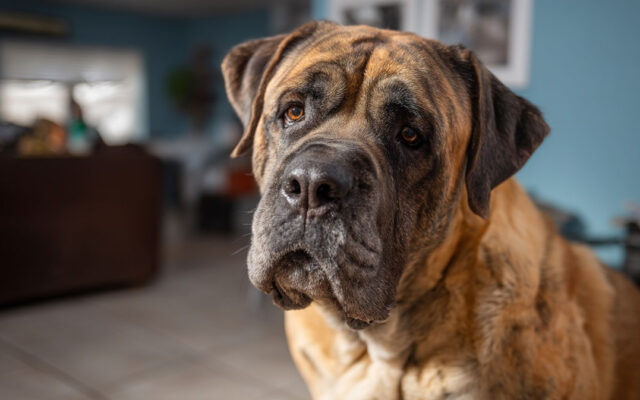
The muzzle, brow, and jowl folds are where the real attention needs to go, several times a week at minimum, because folded skin traps moisture, food debris, and drool in a warm pocket with basically no airflow.
That’s exactly the setup bacteria and yeast like Malassezia need to take hold, and it’s how ordinary buildup in the folds turns into skin fold pyoderma if it gets ignored long enough.
A 2022 VetCompass study published in Scientific Reports followed 905,553 dogs and found skin fold dermatitis carried a one-year prevalence of 0.37 percent across the general dog population, with the most extreme wrinkled breeds like English Bulldogs facing nearly 49 times the odds of a crossbred dog. Bullmastiffs aren’t anywhere near that extreme end of the wrinkle spectrum, but the same trapped moisture mechanism still applies, just at a smaller scale, to the muzzle and brow folds.
You’ll know a fold has crossed from normal to infected when the smell comes back within a day of cleaning, when the skin inside feels red or slick instead of dry, or when a cleaning wipe comes away with brown or yellow residue on it.
Chlorhexidine wipes cover routine cleaning without much fuss. If there’s already an active infection, a medicated shampoo like Malaseb or Douxo S3 gets at the bacteria and yeast directly instead of just wiping surface residue around.
Catching these signs early ties into the wider list of illness signs worth knowing for this breed in general.
How to Clean a Bullmastiff’s Wrinkles Step by Step
- Grab a chlorhexidine wipe (or a damp, unscented cloth) and a dry towel before you start.
- Open each fold instead of just wiping across the visible surface, that’s the part people skip.
- Wipe the full depth of the fold, including the skin that never actually sees air.
- Dry it completely. A damp fold that gets closed back up is worse off than a dirty one left open.
- While the fold’s still open, check for smell, redness, or discharge.
Bullmastiff Nail Trimming

Nail trims need to happen roughly every three to four weeks on a Bullmastiff. This breed’s thick nail plate and heavy frame just don’t wear nails down naturally the way a lighter, more active dog’s would. Left too long, overgrown nails change how the foot strikes the ground, and eventually that can push the toe joints out of position.
An estimated 5.52 percent of dogs under UK veterinary care were diagnosed with overgrown nails in a single year, according to VetCompass data reported by O’Neill and colleagues in 2021. That makes it one of the more common, and more preventable, conditions vets actually see.
Dogs that get regular road or pavement exercise wear the nail tip down some between trims, which stretches out how often a full clip is needed. A dog that mostly walks on grass or carpet needs a stricter schedule no matter how active it otherwise is.
Guillotine or scissor-style clippers handle the initial cut, a dremel-style grinder smooths the edge afterward, and it’s worth keeping styptic powder within reach in case the quick gets nicked.
How to Trim a Bullmastiff’s Nails Step by Step
- Spend a few seconds just handling the paw before any tool comes out. It sounds unnecessary, but it lowers resistance a lot.
- Look for the quick. On light nails it shows up as a pink line; on black nails, take thin shavings off and stop the moment you hit a chalky white dot in the center.
- Cut at a slight angle instead of straight across so you don’t pinch anything.
- Run the grinder over the edge afterward to round off any sharp point the clippers left behind.
- If it bleeds, press styptic powder straight onto the tip and hold it there for thirty seconds.
Dewclaws get missed all the time because they never touch the ground, but they still need the same schedule as the weight bearing nails.
Bullmastiff Ear Cleaning and Infection Prevention
The Bullmastiff’s ears are V-shaped and sit close to the head, dropped rather than erect, which blocks airflow into the canal. That’s the same setup that leads to infection in most drop-eared breeds, and it’s why a cleaning every one to two weeks (more if the dog swims, or the weather’s humid) keeps the risk down.
Otitis externa carried a one-year prevalence of 7.30 percent across the general UK dog population in VetCompass data published by O’Neill and colleagues, and breeds with V-shaped drop ear carriage like the Bullmastiff showed 1.84 times the odds of infection compared with erect-eared breeds.
Pre-moistened, alcohol-free wipes handle the outer flap and the visible part of the canal opening well enough. Keeping a set of dog ear wipes by the door makes it easy to do a quick pass after a walk through wet grass.
The canal itself needs more than a wipe though. A liquid cleanser does the actual work there.
- Epi-Otic: routine cleaning cleanser for healthy ears
- Zymox: enzymatic formula used when infection is already present
How to Clean a Bullmastiff’s Ears Step by Step
Give it a quick sniff and look before diving in. That tells you whether you’re dealing with routine maintenance or something that needs a vet’s attention first.
- Fill the canal with cleanser per the label, more than feels necessary usually gets closer to correct.
- Massage the base of the ear for about thirty seconds, until you hear a soft squelch.
- Let the dog shake it out, ideally outside or over a towel (bring a towel, you’ll want it).
- Wipe the visible flap and the canal opening with a cotton pad or ear wipe.
- Don’t push a cotton swab down into the canal itself, ever.
Redness, dark discharge, or a head tilt that doesn’t go away are reasons to stop the home cleaning and get the ear checked instead of cleaning through it.
Bullmastiff Anal Gland Care
Non-neoplastic anal sac disorders carried a one-year prevalence of 4.40 percent in VetCompass records covering over 104,000 UK dogs, with impaction accounting for nearly 79 percent of the cases recorded. Bullmastiffs are a large breed that tends to be pretty sedentary at home, and that reduced activity is one of the things that raises impaction risk in the first place.
Both anal glands normally empty a bit of fluid every time a dog has a firm bowel movement. When stool runs soft, or the dog isn’t getting enough exercise, that natural emptying stops happening reliably and the glands just fill up instead.
Scooting across the floor is the most obvious tell. A dog licking constantly at the base of its tail is another. So is a sharp, fishy smell that shows up out of nowhere.
Expressing the glands at home is possible, but it’s not something most owners take on comfortably given the size and strength of the breed. A groomer or vet tech usually handles it instead, often folded into a bath or nail appointment that was already on the calendar.
Bullmastiff Bathing Schedule and Shampoo Selection

A full bath every four to eight weeks is the general rule for a Bullmastiff, closer to four if the dog’s been swimming or rolling in something questionable, closer to eight if the coat and skin have stayed clean in between. Bathing more often than that actually works against the coat instead of for it.
Canine skin sits on a different part of the pH scale than human skin. A 2022 study in Veterinary Dermatology measured skin pH in dogs older than twelve weeks ranging as high as 8.18, well above the roughly 4.5 to 6.0 range typical for human skin. That gap is exactly why human shampoo strips a dog’s protective barrier instead of cleaning it gently.
| Shampoo Type | Best For | Frequency | Example |
|---|---|---|---|
| Oatmeal or moisturizing | Routine baths, sensitive skin | Every 6 to 8 weeks | Earthbath |
| Medicated antibacterial | Active skin fold infection | As directed during a flare | Malaseb |
| Dermatology support | Chronic recurring skin issues | Maintenance use, 1 to 2 times weekly | Douxo S3 |
| Standard pH-balanced | Healthy skin, no history of issues | Every 4 to 6 weeks | Any dog-formulated shampoo |
Drying matters just as much as the wash with a double coat like this. A topcoat that feels dry to the touch can still have a damp undercoat sitting underneath it, and that trapped moisture is its own small invitation to skin problems.
Towel dry first. Then finish with a dryer on a low, cool setting rather than just letting the dog air dry on its own.
Bullmastiff Drool and Jowl Management
Some drool is just part of owning a Bullmastiff, not a flaw to fix. The breed’s loose flews and heavy head structure pretty much guarantee it. What matters is wiping the jowls and chest daily so saliva doesn’t sit on the skin, or on the furniture, long enough to become a problem.
Excitement gets it going. Heat makes it worse. And mealtimes are basically guaranteed to trigger a mess, a short walk on a warm afternoon can double the usual amount within minutes.
Jowls and lip folds take the brunt of it, followed by the chest and front legs, and eventually the edges of any bedding or furniture the dog rests against.
Left unwiped, drool pools in the same lip and jowl folds covered earlier, feeding the same bacteria and yeast that turn ordinary wrinkle buildup into an actual infection.
Keeping a hand towel in every room the dog spends time in solves most of this before it even starts.
Grooming Tools Needed for a Bullmastiff

The full grooming kit for this breed covers brushing, wrinkle cleaning, nail care, ear care, and bathing, and all of it fits in one small bin. None of the scissoring kit, thinning shears, or coat-blowing dryer stand that longer-coated breeds depend on is necessary here.
| Tool | Primary Task | Frequency | Typical Price |
|---|---|---|---|
| Rubber curry brush | Loose hair removal | Weekly | $8 to $15 |
| Undercoat rake or deshedding tool | Coat blow season | 2 to 3 times weekly, seasonal | $15 to $40 |
| Guillotine or scissor nail clippers | Nail trims | Every 3 to 4 weeks | $10 to $25 |
| Nail grinder | Smoothing nail edges | Every 3 to 4 weeks | $20 to $50 |
| Ear cleanser solution | Canal cleaning | Every 1 to 2 weeks | $10 to $20 |
A clipper is optional here, not core. Bullmastiffs occasionally need a light sanitary trim around the paw pads or rear end, and a basic clipper, an Oster, Andis, or Wahl model, handles that in under a minute.
Skip the following, they’re built for coats this breed doesn’t have:
- Thinning shears
- Detangling spray for mats
- A full-size dryer stand
- Styling combs or shaping guides
Not buying tools made for long or curly coats saves money without cutting any corner that actually matters here.
Professional Grooming vs At-Home Grooming for a Bullmastiff

Most owners end up splitting the routine. Brushing and wrinkle wipes stay at home, nail grinding and gland checks go to a professional. That split works because the home tasks are frequent and low risk, while the professional side needs a confident, hands-on approach to a 130 pound dog that not everyone wants to take on themselves.
Grooming, boarding, training, and other pet services in the United States totaled 14.3 billion dollars in 2025, according to the American Pet Products Association’s 2026 State of the Industry Report, and professional grooming makes up a large chunk of that.
A professional visit handles nail grinding and gland checks safely on a dog this size and strong, and a trained eye can catch early skin, ear, or dental issues during what’s otherwise a routine appointment. It’s not free though. Large breed sessions run $50 to $140 per session (Bark, 2026), and that adds up over a year of regular visits.
Staying home costs nothing beyond the initial tools, and the dog stays comfortable with someone familiar handling it. The tradeoff is time and a bit of risk, a nail cut too short, or an early infection that gets missed because nobody was really looking for it.
Even owners who groom at home most of the time still get something out of an occasional professional visit, if only for a second set of trained eyes on the skin and coat once or twice a year.
Professional visits are one recurring line in the broader cost of owning a Bullmastiff, alongside food, insurance, and routine vet care.
Groomers certified through the National Dog Groomers Association of America, founded in 1969, have passed a standardized written and practical exam covering handling, sanitation, and breed-specific technique. Worth asking about before booking with someone new.
Weekly and Monthly Bullmastiff Grooming Schedule
The full schedule runs on layered timers, daily, weekly, and every few weeks, and each task gets slotted into whichever timer matches how fast that particular area actually gets dirty.
When several tasks land on the same session, whether that’s a monthly bath and trim visit or an occasional deep clean, the order actually matters:
- Brush first, this clears loose hair before it ends up wet and matted in the tub.
- Bathe next, working shampoo into the coat and gently into the open wrinkles.
- Dry completely, with extra attention to the undercoat and the inside of each fold.
- Trim nails once the bath has softened them a little, the cut comes out cleaner that way.
- Finish with ears and a gland check while the dog’s still calm from everything else.
Bathing before nail trims isn’t just convenience. Softened nails cut more cleanly and split less often.
| Timing | Tasks |
|---|---|
| Daily | Drool wipe, quick wrinkle check |
| Weekly | Full brush, ear check |
| Every 3 to 4 weeks | Nail trim, gland check |
| Every 4 to 8 weeks | Full bath |
Sticking with this rhythm for a couple months turns grooming into background maintenance instead of a recurring fight.
When Bullmastiff Grooming Does Not Go as Planned

Sometimes the at-home routine stops being enough on its own. A few different things can push it past what wipes and routine handling can manage.
Recurring skin fold pyoderma is one of them, infection that clears up fine with medicated shampoo, then comes right back within a few weeks. At that point it’s past what wipes and routine cleaning can handle alone.
Sometimes what looks like a wrinkle problem is actually an eyelid problem. Entropion and ectropion are eyelids that roll inward or sag outward instead of sitting normally, a structural issue that no amount of wrinkle cleaning is going to correct.
And then there’s the dog that just won’t hold still, resisting the stance a nail trim or a bath requires for the full length of the session. That’s often about more than temperament.
Conformational eyelid disorders carried an annual prevalence of 0.36 percent across the general UK dog population, with entropion alone at 0.33 percent, according to 2019 VetCompass data covering more than 2.2 million dogs.
Entropion and ectropion both involve the eyelid margin itself rather than the surrounding skin fold, and fixing either one is surgical, not something a cleaning routine touches. Once a fold near the eye stays irritated no matter how it’s cleaned, a veterinary dermatologist or ophthalmologist referral is the right next step.
A study using Orthopedic Foundation for Animals hip records on more than 921,000 dogs found the molossoid breed group, which includes the Bullmastiff, carried the highest hip dysplasia risk among all FCI breed groups assessed.
A dog with hip dysplasia may resist the standing posture that both nail trims and bathing require. Shorter sessions split across two sittings, done on non-slip flooring, tend to work better than pushing through one long session a sore dog can’t hold still for.
None of this means the home routine failed. It just means something surfaced that belongs with a vet rather than a groomer, part of the wider set of health problems worth knowing about in this breed.
FAQ on Bullmastiff Grooming
How Much Does Professional Bullmastiff Grooming Cost
Pricing scales with weight bracket. Large-breed sessions average $50 to $140 per visit, according to Bark’s 2026 pricing data, while the extra-large tier above 80 pounds, which is where a full grown Bullmastiff lands, can run $200 or more per MoeGo’s 2026 figures.
Are Bullmastiffs Hypoallergenic or Heavy Shedders
No dog breed is truly hypoallergenic, Bullmastiffs included, since allergens come from dander and saliva rather than hair length itself. Their short double coat sheds moderately year round with two heavier bursts, lighter than long or double coated giants like Newfoundlands or Saint Bernards.
Do Bullmastiff Puppies Need a Different Grooming Routine
Puppy grooming is mostly about handling, not technique. Short sessions that build comfort with paws, ears, and muzzle matter more than any tool early on, since facial wrinkles run shallower and nails stay softer than they will on an adult dog. Full nail and gland care starts once the handling part is easy.
What Are Common Grooming Mistakes Bullmastiff Owners Make
Wiping only the visible surface of a wrinkle and skipping the inside is the most common miss. Using human shampoo is right up there too, it throws off a dog’s skin pH. Cutting nails too short and brushing off early ear odor round out the usual list.
Where Should You Start With Bullmastiff Grooming?
There’s a natural starting order here. Wrinkle and jowl cleaning comes first, since those areas turn into infections fastest. Nail and ear care follow. Coat brushing and bathing can wait until whatever schedule already fits the household.
Infection risk in the folds and ears carries more consequence than loose hair sitting around a day or two longer than ideal, so leaning into that order means accepting a shaggier looking coat for the first two or three weeks of a new routine.
Skin condition and coat quality trace back to diet as much as to any brush or wipe, which makes what a Bullmastiff eats day to day the natural next stop for a full care routine.