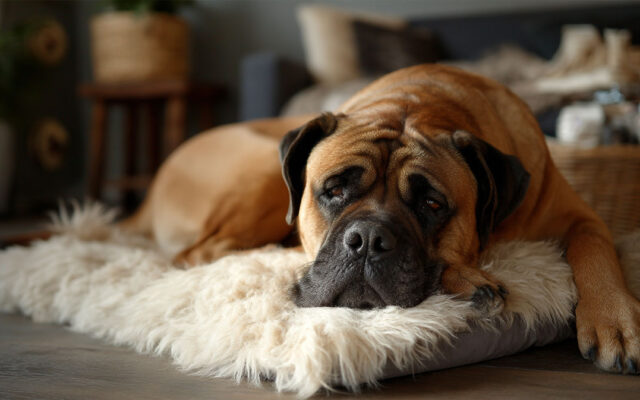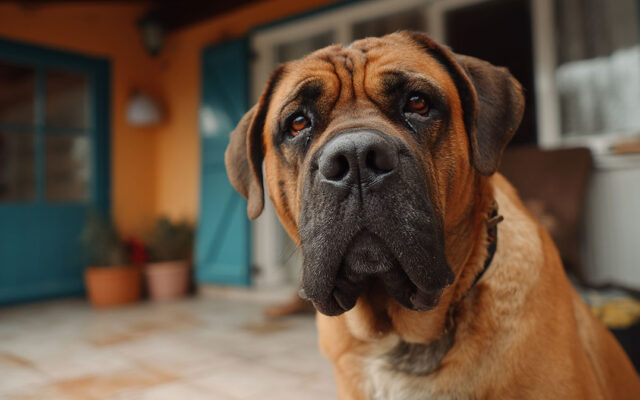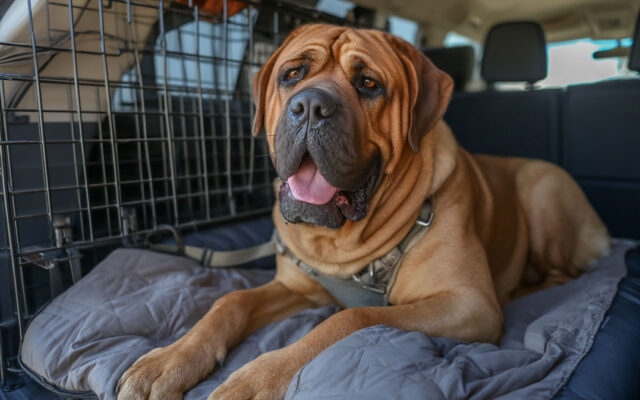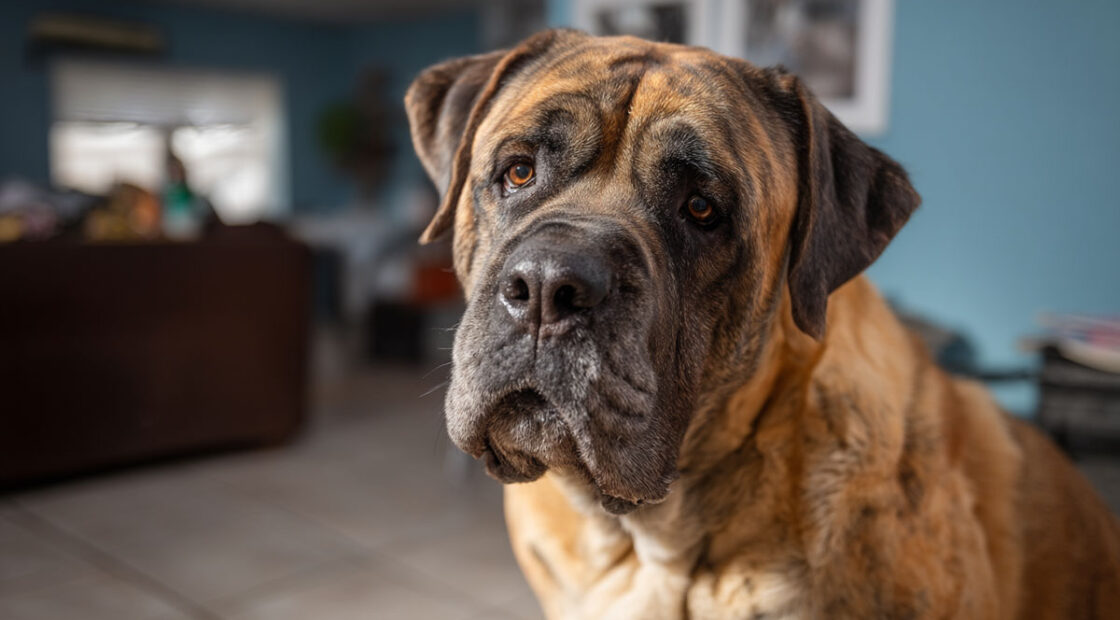
Bullmastiff illness signs range from a distended, drum-tight abdomen to a limb that quietly stops bearing weight.
Bred to track down and hold an intruder without mauling, a Bullmastiff carries a lot of size to do that job, and that size is exactly what drives most of the breed’s health risks.
Breed clubs and screening organizations such as the Orthopedic Foundation for Animals track the joint, eye, and cardiac conditions behind these signs through hereditary health panels required before breeding.
A peer-reviewed South African survey found elbow dysplasia in more than 38% of Bullmastiffs radiographed. The Rottweiler had the single highest incidence at 55%, and the Bullmastiff was grouped with the Chow Chow, Boerboel, and Golden Retriever as the next tier of breeds, all exceeding 38% (Journal of the South African Veterinary Association, 2007).
What Counts as a Bullmastiff Illness Sign

Context matters more than any single symptom. What signals trouble is a shift away from a dog’s normal baseline: how it eats, moves, breathes, or reacts when touched, not any one trait sitting there on its own. Sounds obvious written out. Most owners still only notice it in hindsight, after a vet visit confirms something had been off for days.
Some of what looks alarming is just breed temperament. The breed’s naturally calm Bullmastiff temperament means a dog that sleeps through most of the day isn’t automatically showing a symptom.
The breed carries a fairly well documented list of Bullmastiff health problems, and recognizing the early version of each one is usually what separates a routine vet visit from an emergency trip.
Bullmastiff Bloat: Causes, Early Warning Signs, and Emergency Symptoms
Gastric dilatation-volvulus, or bloat, is the fastest-moving and most fatal condition in the breed. The stomach fills with gas, then twists on itself, cutting off blood flow to the stomach and spleen within a short window.
A Tufts University study cited by the AKC Canine Health Foundation found that 36% of dogs with GDV do not survive, often due to cost or a poor prognosis at the time of presentation (AKC Canine Health Foundation, 2025).

Why the Deep Chest Increases Risk
A deep, narrow chest gives the stomach extra room to move and twist inside the abdomen.
A few things push the odds up: eating one large meal instead of two smaller ones, gulping food fast, exercising hard right after a meal, and simply getting older every year.
Purdue University research found that bloat risk climbs about 20% with each year of age, on top of the anatomical risk the breed already carries.
How a dog is fed factors into this as much as genetics does, which is why Bullmastiff feeding habits get so much attention from breeders and vets alike.
Signs That Require Immediate Emergency Care
Bloat signs escalate fast, usually within an hour or two of onset.
If they show up, this is the order that actually matters:
- Note the time the first sign appeared
- Call the emergency vet or animal hospital before driving over
- Do not let the dog eat, drink, or take any oral medication
- Get the dog into the car and go, even if signs seem to ease slightly
- Describe the abdomen, gum color, and breathing rate to the vet team on arrival
A swollen, drum-tight abdomen is usually what owners notice first, along with unproductive retching, heavy drooling, restlessness, and pale or gray gums. Any of these, alone or together, is reason enough to run through the steps above.
Preventive surgery lowers the odds of ever reaching this point. A procedure called a gastropexy, covered in our guide to Bullmastiff bloat prevention, stitches the stomach to the abdominal wall so it can’t rotate again.
Bullmastiff Hip and Elbow Dysplasia: Symptom Presentation
Hip and elbow dysplasia are joint malformations a dog is born predisposed to, not injuries picked up along the way.
OFA data puts the breed’s hip dysplasia rate at 25%, placing it among the large-breed dogs with the highest recorded incidence, behind the St. Bernard’s roughly 47%.
Both conditions typically show themselves between six months and two years of age, though a milder version can stay hidden until arthritis sets in later.
Hip Dysplasia Signs
A bunny-hopping gait when running is usually the giveaway. Some dogs also get reluctant about stairs or jumping into the car, or seem stiff after resting in a way that works itself out once they’re up and moving. Muscle loss across the hindquarters tends to show up later, once the dog has quietly been favoring the joint for a while.
A veterinarian confirms hip dysplasia through radiographs, part of the standard Bullmastiff hip dysplasia screening process breeders are expected to complete before a dog is bred.
Elbow Dysplasia Signs
Elbow dysplasia is easier to miss than hip dysplasia because the early signs are subtler. Front-leg lameness is usually the first thing owners notice, especially after exercise, and it’s often paired with the dog holding its elbow out slightly and rotating the paw outward to take pressure off the joint. Swelling around the elbow tends to show up later, once secondary arthritis has already set in.
Unlike hip dysplasia, elbow dysplasia doesn’t always show up on both sides at once, so a limp that comes and goes on one leg is still worth an X-ray.
Bullmastiff Cancer Signs: Lymphoma, Mast Cell Tumors, and Osteosarcoma
Large, deep-chested breeds carry a higher cancer burden than smaller dogs, and the Bullmastiff is no exception.
A 2024 study of Bullmastiffs attending veterinary practices in Australia found that mass lesions, the category covering most cancers, accounted for 28.2% of all deaths in the breed, the single largest cause recorded (Animals, MDPI, 2024).
Cancer is the reason routine lump checks matter more in this breed than in most, and why a shortened Bullmastiff lifespan so often traces back to one of the three cancers below.
Lymphoma Signs
Lymphoma is a cancer of the lymphatic system, and it’s usually the easiest of the three to catch early. Swollen lymph nodes under the jaw, in front of the shoulders, or behind the knees are the first thing most owners find, often just running a hand over the dog during a normal petting session. Lethargy and a smaller appetite tend to show up as the disease moves along, and weight loss can happen even while the dog is still eating normally in the early stages.
The nodes are usually firm, movable, and painless, which is exactly why owners mistake them for something minor.
Mast Cell Tumor Signs
VCA Animal Hospitals data shows mast cell tumors make up between 7% and 21% of all skin tumors diagnosed in dogs, making them the most common type of skin tumor in the species.
They show up as raised or ulcerated skin masses that can vary wildly in appearance, size, and growth speed. Some grow slowly for months. Others double in size within a week and start oozing or bleeding when touched.
A biopsy is the only reliable way to tell a mast cell tumor apart from a harmless fatty lump, so any new mass gets checked rather than watched.
Osteosarcoma Signs
Sudden lameness with no obvious injury is the most common first sign owners report. It’s often paired with swelling over a long bone, usually somewhere in the leg, that feels firm rather than soft under the skin. The dog will typically favor that limb even at rest, not just while walking on it.
Osteosarcoma typically strikes older, larger dogs, and a limp that doesn’t improve with rest deserves an X-ray rather than a wait-and-see approach.
Bullmastiff Eye and Skin Symptoms

The same loose, wrinkled skin that gives a Bullmastiff its face also creates most of its eye and skin problems.
Heavy eyelids and folded skin trap moisture and debris, which is the mechanical root of nearly everything in this section.
Eye Conditions
A handful of eye conditions show up again and again in the breed, all tied to loose facial skin rather than actual infection.
| Condition | What Happens | Fix |
|---|---|---|
| Entropion | Eyelid rolls inward, lashes rub the cornea | Surgical correction |
| Ectropion | Lower lid rolls outward, eye stays exposed | Surgical correction |
| Cherry eye | Third eyelid gland prolapses into view | Surgical repositioning |
All three are structural problems, not infections, so they need surgery rather than drops.
Persistent squinting, redness, or discharge that doesn’t clear in a day or two is the signal to book a vet visit.
Skin Conditions
Skin folds around the face and neck trap heat and moisture, setting up the same irritation cycle again and again. Hot spots tend to recur, especially after swimming or in humid weather, and the deeper facial folds can get red and start to smell before anything looks visibly wrong. Chronic itching or licking at one spot is usually the tell that something’s brewing under the surface.
Regular grooming sessions double as an early-warning check, since a lot of these signs show up first as a smell or a texture change before they’re visible. Staying on top of Bullmastiff grooming makes it far easier to catch a fold infection before it spreads.
Most of these skin issues are treatable early, but chronic hot spots that keep coming back can point to an underlying allergy that needs its own diagnosis.
Bullmastiff Weight Gain and Body Condition Warning Signs
Extra weight on a heavy-boned breed doesn’t distribute evenly. It lands directly on joints and a heart that are already working harder than average.
A dog that’s crossed from solid to overweight usually loses its waist when viewed from above, and the ribs get harder to feel under a layer of fat. Breathing gets labored after minimal activity, and walks or play sessions the dog used to handle easily start getting cut short.
Vets track this with a nine-point body condition score rather than weight alone, since two dogs at the same weight can carry it very differently depending on frame size.
A drop in Bullmastiff exercise tolerance is often the first sign owners notice, well before the scale confirms anything has changed.
Weight gain can also mask early joint disease. A heavier dog naturally moves less, and a slowing dog gets written off as simply lazy instead of examined for pain.
Bullmastiff Health Screening Tests and Schedule

A short set of screening tests catches most of the conditions above before symptoms ever show up, each one run by a specific organization with its own recommended starting age.
| Test | Screens For | Recommended Age | Administered By |
|---|---|---|---|
| Hip radiograph | Hip dysplasia | 24 months | OFA or PennHIP |
| Elbow radiograph | Elbow dysplasia | 24 months | OFA |
| Eye exam | Entropion, ectropion, cherry eye | 12 months, then annually | Board-certified veterinary ophthalmologist |
| Cardiac exam | Subaortic stenosis, DCM | 12 months | Veterinary cardiologist |
Results from all four tests get logged with the Canine Health Information Center, which issues a CHIC number once a dog clears the breed’s required panel.
A passing result doesn’t rule out future disease. It lowers the odds and gives a documented baseline to compare against if something changes later.
PennHIP can be done as early as 16 weeks and gives a laxity score, while the standard OFA hip radiograph needs the dog sedated and fully grown to get an accurate read.
The American Bullmastiff Association publishes the exact panel breeders are expected to complete, and a puppy buyer can ask to see those results before a purchase.
Bullmastiff Lifespan and Leading Causes of Early Death
Average lifespan estimates for the breed range from roughly 7 to 10 years across veterinary sources. The most rigorous figure comes from a peer-reviewed study of veterinary records, which is worth trusting over rounder estimates.
A 2024 study published in Animals (MDPI), tracking Bullmastiffs through veterinary practices in Australia over a ten-year period, found a median longevity of 8.5 years.
A few numbers from that study stand out.
- Median longevity: 8.5 years
- Mass lesions (mostly cancers): 28.2% of deaths
- Musculoskeletal-related disease: 9.9% of deaths
- Old age recorded as the cause: 9.9% of deaths
- Neurological disorders: 5.3% of deaths
- Behavioural disorders: 4.8% of deaths
Placed next to other giant breeds, the Bullmastiff’s numbers land in the middle of the pack rather than at either extreme.
| Breed | Typical Lifespan |
|---|---|
| Bullmastiff | 7 to 10 years (8.5 median) |
| Great Dane | 7 to 10 years |
| Mastiff | 6 to 10 years |
| Dogue de Bordeaux | 5 to 8 years |
The Great Dane figure is consistent with American Kennel Club and veterinary breed data, and the pattern holds across nearly all giant breeds: size and skull shape are among the strongest predictors of a shorter dog lifespan.
The Mastiff, one of the two founding breeds behind the Bullmastiff, tracks closely on the low end of that same range.
Musculoskeletal disease and old age combined account for roughly one in five recorded deaths in the study, which lines up with the joint and mobility signs covered earlier.
Emergency Vet Signs Versus Signs That Can Wait for a Scheduled Visit
Every symptom in this guide falls into one of two buckets: go now, or book an appointment.
Head straight to emergency care for any of these:
- A distended, drum-tight abdomen
- Unproductive retching or heavy drooling paired with restlessness
- Pale, gray, or blue-tinged gums
- Sudden collapse or inability to stand
- A limb that’s suddenly non-weight-bearing with visible swelling
A scheduled visit works fine for a single soft lump that hasn’t changed in a week, mild stiffness after rest that resolves within minutes, gradual weight gain without breathing changes, or a skin fold that’s slightly red but not oozing.
Going in tonight catches a fast-moving condition like GDV before it turns fatal, and imaging plus bloodwork rule out the worst case immediately. That certainty costs something though: emergency pricing runs well above a scheduled appointment. Waiting and monitoring overnight avoids an unnecessary bill for something that turns out to be minor, but a genuine emergency doesn’t have hours to spare, and signs that seem to ease off can still be getting worse underneath.
Great Pet Care pricing data shows the price gap is real: emergency gastropexy surgery runs $3,000 to $6,000, compared to $800 to $2,500 for the same procedure done as scheduled prevention (Great Pet Care, 2026).
That gap is one more reminder that a dog is expensive in ways that show up long after the adoption fee, especially in a breed already prone to gastric emergencies.
Uncertainty is itself a reason to call. A vet team can talk through symptoms over the phone and tell an owner whether to come in now or watch and wait, which beats guessing at midnight with a dog that’s clearly in distress.
When Bullmastiff Symptoms Are Normal Breed Traits, Not Illness
Some of what reads as a red flag in a smaller breed is just how a Bullmastiff is built.
Loud snoring, heavy drooling, a low activity drive, and slow rising from rest are all normal for this breed at baseline.
What actually separates normal from illness is degree and speed of onset, not the trait itself.
| Normal Baseline | Illness-Level Version |
|---|---|
| Occasional snoring when sleeping deeply | New wheezing or labored breathing while awake |
| Steady drooling around mealtimes | Sudden, excessive drooling paired with restlessness |
| Sleeping most of the day | Sudden withdrawal from a normally social dog |
| Slow to rise after a long nap | Refusing to rise at all, or crying out when moving |
A trait becomes a sign the moment it shows up suddenly, worsens over hours instead of years, or arrives alongside a second symptom.
A dog that’s always been a slow riser and stays that way isn’t declining. A dog that rose normally last week and now won’t get up at all fits the emergency list above, not this one.
FAQ on Bullmastiff Illness Signs
Does degenerative myelopathy affect Bullmastiffs?

It can, though it’s far better documented in breeds like the German Shepherd and Pembroke Welsh Corgi. Degenerative myelopathy is a progressive spinal cord disease that causes hind-limb weakness and loss of coordination, typically after age eight, and the American Kennel Club lists the DM DNA test among the recommended health tests for the breed.
A DNA test for the SOD1 mutation, the gene variant most strongly linked to the disease, can flag risk before symptoms appear.
Is pet insurance worth it for a Bullmastiff?
Pet insurance often pays for itself in this breed, given what GDV surgery, cancer treatment, and joint repair actually cost. Premiums run higher for giant breeds because of that elevated risk.
Buying coverage before age two avoids pre-existing exclusions on hereditary joint disease.
Should a Bullmastiff get preventive gastropexy without symptoms?
Preventive gastropexy is recommended for the breed even without a bloat episode, often performed alongside a spay or neuter. It tacks the stomach to the abdominal wall so it can’t twist.
Vets frame it as risk reduction, not a guarantee.
What does an OFA or CHIC screening appointment involve?
A hip or elbow radiograph requires general anesthesia or heavy sedation so the joints can be positioned precisely. The films are graded and submitted to the Orthopedic Foundation for Animals.
Results get logged under the dog’s CHIC number for public reference.
What should an owner do immediately after finding a lump?
Note the size, shape, and location, then check again within 48 hours rather than weeks. Avoid squeezing or lancing it at home.
A vet can perform a fine needle aspirate to check for a mast cell tumor before it grows.
What Should You Prioritize First With Bullmastiff Illness Signs?
Bullmastiff illness signs split into two speeds: the ones that kill within hours and the ones that develop over weeks. A dog’s owner has to sort any new symptom into one of those two categories before deciding what happens next.
Abdominal swelling, retching, or collapse means emergency care within the hour. A new lump, limp, or swollen joint means a vet visit within the week. Weight gain or a shift in energy is worth two weeks of tracking before making a call.
That order exists because a twisted stomach has an hours-wide window, while a mast cell tumor or a stiff hip has weeks to spare. It does mean an occasional gas bubble sometimes gets treated as an emergency rather than risking a missed bloat, and that’s a trade worth making.
Budgeting ahead matters too. What a Bullmastiff costs to raise folds these procedures into one number, not a surprise absorbed emergency by emergency.