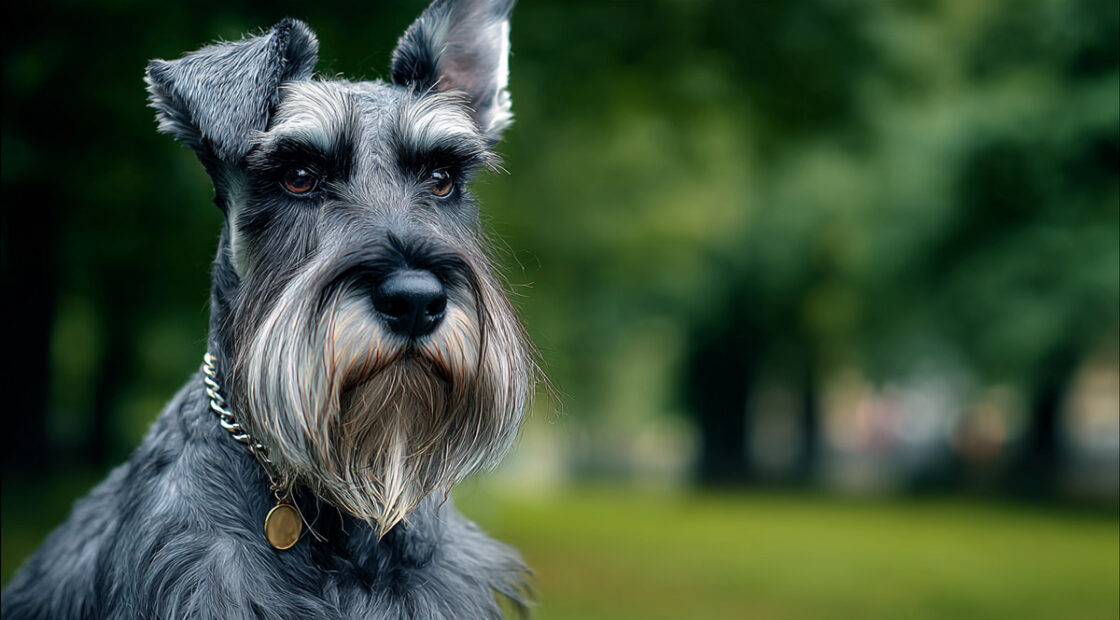
German breeders developed the Miniature Schnauzer to kill rats on farms. It’s a small, wire-coated, terrier-type dog, and these days most families keep one for the low-shedding coat and the watchdog habits.
Adults stand 12 to 14 inches at the withers. The American Kennel Club puts the breed in its Terrier Group, but The Kennel Club in the UK lists it under Utility.
Health is the part worth reading up on before you commit. More than 75% of the breed develop hypertriglyceridemia, or high blood triglycerides, by age 10, which predisposes them to pancreatitis (Tate et al., Journal of Veterinary Internal Medicine, 2024).
What Is a Miniature Schnauzer?
Its German name is Zwergschnauzer, and Germany is where it was developed, for killing rats on farms. Most people now want a low-shedding family companion that doubles as a watchdog.
The American Miniature Schnauzer Club’s breed standard describes a sturdy, active dog that resembles the Standard Schnauzer in general appearance, with an alert disposition.
Registry Classification
Registries file the breed under different headings. The AKC says Terrier Group and The Kennel Club (UK) says Utility Group. The Australian National Kennel Council uses Group 6 (Utility), and the Federation Cynologique Internationale puts it in Group 2.
The terrier label comes from the job, since the dog was bred to chase rats. Britannica points out that the Miniature is the only AKC terrier breed that did not originate in the British Isles.
Origin and History

German breeders shrank the farm-working Standard Schnauzer into a rat catcher in the second half of the 1800s.
Sources disagree on how. The AKC’s history credits smaller Standard Schnauzers crossed with Affenpinschers and Miniature Poodles, and its text also mentions Miniature Pinschers. The Kennel Club (UK) and the United Kennel Club cite Affenpinscher crosses, while other accounts describe selection of the smallest Standards alone.

Britannica dates the first showing of the Miniature as a distinct breed to 1899, though it was developed earlier. The American timeline is better documented.
The first two Miniature Schnauzers reached the United States in 1923. The AKC recognized the breed in 1926 and renamed it the Schnauzer. By 1933 the parent club had split into the American Miniature Schnauzer Club and the Standard Schnauzer Club of America.
The coat had a job too. AKC judge John Constantine-Amodei explains that the beard, eyebrows, wiry coat, and long leg hair protected the dog from rodent bites.
Miniature, Standard, and Giant Schnauzer Compared
Miniature, Standard, and Giant Schnauzers each have their own breed standard. They aren’t one dog in different sizes.
| Breed | Height at withers | AKC group | AKC 2025 rank |
|---|---|---|---|
| Miniature Schnauzer | 12 to 14 inches | Terrier | 17 |
| Standard Schnauzer | 17.5 to 19.5 inches | Working | 93 |
| Giant Schnauzer | 23.5 to 27.5 inches | Working | 52 |
Heights come from Britannica. Ranks come from the AKC’s 2025 registration statistics, released in March 2026.
The much larger Giant Schnauzer climbed in those rankings after winning Westminster Best in Show in 2025, per the AKC. The Standard Schnauzer left the Terrier Group for the Working Group in 1945, which explains why it sits apart from the Miniature in AKC listings (American Miniature Schnauzer Club).
Miniature Schnauzer Size and Lifespan
Most adults stand 12 to 14 inches at the withers and average about 22 pounds in UK clinic records. The median lifespan is 11.6 years.
The height range comes from the breed standard, as reported by Britannica. VetCompass at the Royal Veterinary College put mean adult bodyweight at 9.9 kg, about 22 lb (VetCompass, Royal Veterinary College, 2019). It also measured a median longevity of 11.6 years, which is the median age at death among dogs that died in the study year, with the middle half dying at 9.3 to 13.1 years (VetCompass, 2019).
Profile pages quote 12 to 15 years instead (PetMD, Chewy).
Height and Weight

Height is fixed by the standard. Weight is where sources scatter.
Profile pages list anything from 13 to 15 pounds up to 11 to 20 pounds. The Kennel Club (UK) states that the size in its breed standard describes an ideal, not a measurement every dog will match.
Measured weights land at or just above the top of those ranges. VetCompass, the veterinary surveillance programme at the Royal Veterinary College, recorded the 9.9 kg mean in 2013 clinic records published in 2019.
Overweight was the second most common disorder in the same records, behind periodontal disease. Weight is the one measurement an owner controls.
Average Lifespan and What Shortens It
Profile pages quote 12 to 15 years, and VetCompass measured 11.6.
They aren’t measuring the same thing. A quoted range describes a typical healthy dog, while a median age at death across clinic records counts every dog that died, including those lost young (the recorded range runs from 6 months to 17 years).
The study’s authors point owners toward dental care, weight management, anal sac problems, and a healthy diet. Anal sac impaction, overweight, and periodontal disease were the most common disorders in those records, so most of that advice follows directly from what the clinics saw.
Coat Types and Recognized Colors
The coat is double, a hard, wiry outer layer over a close undercoat. The AKC standard allows salt and pepper, black and silver, and solid black.
Salt and pepper means banded hairs predominate, fading to light gray or silver white on the eyebrows, whiskers, cheeks, throat, chest, and leg furnishings. Black and silver dogs have a black body with silver in those same face, chest, and leg areas. Solid black is black throughout.
Registries split on white, though. The AKC standard allows only those three colors and disqualifies any other, which rules out white, parti-color, liver, and merle, while The Kennel Club (UK) lists white as a breed standard colour and FCI countries accept it too.
A white Miniature Schnauzer cannot compete in AKC conformation. Choose the registry before the color if showing is the plan.
Does the Miniature Schnauzer Shed?
Barely. The breed club describes the coat as non-shedding, but allergies are a separate question.
In a study of 173 US homes covering 60 breeds, 94.2% had detectable Can f 1, the main dog allergen, and homes with breeds marketed as hypoallergenic showed no difference (Henry Ford Health System, American Journal of Rhinology and Allergy, 2011). Schnauzers were among the breeds promoted as hypoallergenic in that comparison.
A 2012 Utrecht University study in the Journal of Allergy and Clinical Immunology went further. Hair and coat samples from supposedly hypoallergenic breeds carried more Can f 1 than samples from control breeds, though dust levels in the homes did not rise, and the authors found no evidence for calling any breed hypoallergenic.
Low shedding keeps hair off the furniture, but it moves the work to the grooming schedule.
Ear Cropping and Tail Docking
Breed clubs defend both. The AKC calls cropping and docking, where a breed standard describes them, acceptable practices that define breed character. The American Miniature Schnauzer Club treats the tail as breed type, and the United Kennel Club standard says ears may be natural or cropped.
The AVMA sees it differently. It opposes cropping and docking done solely for cosmetic reasons and urges breed organizations to drop them from their standards (policy revised November 2008, upheld by its House of Delegates in 2009). The UK bans ear cropping and limits tail docking to working-breed exceptions, and Australia and much of Europe prohibit both, according to the AVMA’s 2008 coverage.
The practice began as a working measure, since cropped ears and a docked tail gave rats nothing to grab. Today it is a cosmetic choice made by the breeder in puppyhood, so ask about it before reserving a puppy.
How to Groom a Miniature Schnauzer
Book a professional groom every five to eight weeks, and brush, comb, trim nails, and clean ears at home in between, according to the American Miniature Schnauzer Club.
The club’s reasoning is simple. The coat does not shed, so dead hair stays put until someone removes it.
Hand Stripping or Clipping?
Hand stripping pulls dead outer hair out by hand or with a stripping knife. Clipping cuts it.
| Factor | Hand stripping | Clipping |
|---|---|---|
| Show ring | Required | Pet trim only |
| Outline | Breed show outline | Same outline, kept with clippers |
| Coat texture | Preserves the hard, wiry coat | Softens over repeated trims |
| Time and skill | More of both | Faster and simpler |
| Best for | Show dogs, owners who want true texture | Most pets |
Hand stripping pays off only for show dogs or owners who care about texture.
Clipping works for most pets, and owners who clip can choose among several pet trim styles for the breed.
Home Care Between Appointments
- Frequent brushing and combing keeps the beard and leg hair free of tangles.
- Clean the ears regularly, since ear disorders appear in the VetCompass records for the breed.
- Trim nails when they click on the floor.
- The beard collects food, so wipe or rinse it after meals.
- Brush the teeth. Periodontal disease is the most common recorded disorder in the breed.
Ear cleaning takes a minute. Wipe the visible folds with a dog ear wipe and leave the canal to the vet.
Run a hand along the back while brushing. Crusted bumps there are worth a vet visit.
Temperament, Barking, and Trainability

Miniature Schnauzers are alert, spirited, and friendly, and they learn quickly. They also bark readily and chase small animals.
Breed standards ask for a dog that is alert and spirited yet obedient to command, friendly, intelligent, and willing to please, and never over-aggressive or timid. The United Kennel Club standard adds that it gets along well with other dogs and with people.
Children and Other Pets
The AKC describes an eager-to-please dog that loves family life, and Petplan UK advises supervision around young children. Other dogs are generally fine, though not every dog becomes a friend, per the AKC.
Small animals are the weak point. Wood Green, the UK animal charity, rates the breed low for sociability with pets because of its rat-hunting history and advises early introductions, while Petplan UK calls the prey drive high enough that cats, small mammals, and birds are a poor match.
Barking and Watchdog Instinct
Expect noise.
The breed club says the alert, sometimes vocal nature is what makes the dog an excellent watch dog. Vetstreet’s breed profile says training can curb the barking.
Reward one alert, then send the dog to a mat and reward the quiet.
Training and Socialization

The breed learns fast and holds onto what it learns. The club calls it obedient and quick to learn, and Wood Green rates training as moderately easy.
Sit, stay, and recall are quick wins. Loose-leash walking takes longer because prey drive pulls toward squirrels and cats. House training is reported as tricky (Dogster), and digging is a stubborn habit in some dogs.
Socialize from puppyhood. A Pet Insurance Australia guide warns the breed can grow wary of strangers without it, and Chewy’s breed guide ties early exposure to good manners around small children and other pets.
Which Health Problems Affect Miniature Schnauzers?

The big ones are hyperlipidemia, which can lead to pancreatitis, and calcium oxalate bladder stones. Inherited eye disease also belongs on the list.
Sources disagree on how risky the breed is overall. VetCompass found no predisposition to any of the common disorders among Miniature Schnauzers in UK clinics (Royal Veterinary College, 2019), yet a survey of breed predispositions cited in that same paper lists 44 reported over several decades.
These aren’t measuring the same thing. Clinic records count what vets diagnose most often, while the predisposition list gathers every published breed-linked condition, including ones found only through blood panels and stone analysis.
The Kennel Club’s Breed Watch scheme placed the breed in Category 1 as of that 2019 paper, meaning judges and breed clubs reported no visible health concerns.
Hyperlipidemia and Pancreatitis
More than 75% of Miniature Schnauzers develop hypertriglyceridemia (high blood triglycerides) by age 10 (Tate et al., Journal of Veterinary Internal Medicine, 2024).
It is the main form hyperlipidemia takes in the breed, and it is believed to be genetic, though the contributing genes are unresolved.
The link to pancreatitis is measurable. Dogs with severe hypertriglyceridemia (862 mg/dL or higher) were 4.5 times more likely to have a pancreatic lipase result consistent with pancreatitis than dogs with normal triglycerides (Xenoulis et al., Journal of the American Animal Hospital Association, 2010).
Lethargy, loss of appetite, repeated vomiting, and belly pain all call for a same-day vet visit.
Treatment is not uniform. Dogs with presumed primary hypertriglyceridemia respond differently to low-fat feeding, which is why the 2024 study set out to find subtypes of the condition.
Bladder Stones
Calcium oxalate is the breed’s main stone risk. In University of Minnesota admissions data, the odds that a Miniature Schnauzer’s stone was calcium oxalate ran 11.8 times higher than for other breeds, and males carried more than three times the risk of females (Lulich et al., 1991).
Diet cannot dissolve calcium oxalate stones in dogs, according to the Merck Veterinary Manual. Removal is physical, through lithotripsy or surgery.
Struvite stones are usually driven by infection, and they are the other type seen in the breed. The ACVIM consensus statement (2016) recommends dissolving most struvite stones with a therapeutic diet while the infection is treated.
Straining to urinate, frequent small urinations, blood in the urine, or no urine at all is an emergency. Obstruction is life-threatening.
Eye Disease
Inherited eye disease is the one condition a breeder can screen for before a puppy exists. That covers progressive retinal atrophy, an inherited breakdown of the retina, and inherited cataracts, though diabetes, trauma, and age also cloud the lens.
The American Miniature Schnauzer Club (AMSC) lists a DNA test for PRA type B as optional but recommended for breeding dogs.
Other Conditions Worth Knowing
Breed health guides also name diabetes, allergies, and epilepsy, and the VetCompass paper’s background review lists primary hypothyroidism among the reported predispositions.
Schnauzer comedo syndrome shows up as crusted bumps along the back and needs a vet’s diagnosis.
Health Tests Breeders Should Run
Breeders document screening through registry records, and the AMSC is a member of the Canine Health Information Center (CHIC), the program run with the Orthopedic Foundation for Animals (OFA).
| Test | Listed by | Status |
|---|---|---|
| ACVO eye exam, registered with OFA | AMSC CHIC requirements | Required for CHIC |
| Cardiac evaluation | AMSC CHIC requirements | Required (several accepted methods) |
| PRA type B DNA test | AMSC CHIC requirements | Optional, recommended |
| Myotonia congenita and mycobacterium avium complex (MAC) DNA tests | AMSC CHIC requirements | Optional, recommended |
| BVA/KC/ISDS Eye Scheme, including litter screening | The Kennel Club (UK) breed page | Best Practice test |
| MAC DNA test | The Kennel Club (UK) breed page | Best Practice test |
A CHIC number proves the tests were done and registered. It does not prove the results were clean, so ask to see them.
How Much Exercise and What Diet Does a Miniature Schnauzer Need?
Plan on up to an hour of activity a day and a low-fat diet, with extra attention to water intake for any dog with a bladder stone history.
Daily Exercise

The Kennel Club (UK) lists exercise at up to one hour per day.
Showsight Magazine describes a dog that enjoys long walks but is content with moderate exercise. Jobs that use the ratting instinct work best, so think brisk walks, agility, obedience work, and earthdog trials.
Mental work counts too. Puzzle feeders and trick training burn energy that walks leave over.
Feeding and Fat Control

Adults eat twice a day, while puppies eat three or four smaller meals, according to PetMD’s breed guide.
A feeding chart by age and weight gives starting portions, and the vet adjusts them from body condition.
Low-fat food is the primary dietary approach to hypertriglyceridemia in dogs. Dr. Jörg Steiner of Texas A&M University defines it as generally under 20 g of fat per 1,000 kcal (Veterinary Practice News).
A 2011 trial in Miniature Schnauzers found low-fat food alone kept triglycerides under the treatment threshold, though many dogs stayed above the normal range (Xenoulis et al., Journal of Veterinary Internal Medicine).
| Condition | Dietary lever | Watch-out |
|---|---|---|
| Hyperlipidemia, pancreatitis | Low-fat food, no fatty treats or table scraps | Response varies by dog |
| Calcium oxalate stones | More water, less animal protein, no vitamin C supplements | Diet may delay recurrence but cannot dissolve stones |
| Struvite stones | Therapeutic dissolution diet plus infection treatment | Stop once stones dissolve |
Veterinary nutritionist Cailin Heinze says the biggest management mistake she sees is leaving a dog on a struvite diet after the stones dissolve (Veterinary Practice News).
A dog with both a blood-fat problem and a stone history needs one plan from the vet, because the diets address different risks.
When a Miniature Schnauzer Is a Poor Fit

Some households will struggle with this breed, and a few will struggle more than others.
- Homes that want quiet should know the breed club prizes the alert, sometimes vocal nature, so training turns the volume down without changing the dog.
- Long workdays are a problem. The UK charity Wood Green notes that, like every breed, it needs owners with enough time for it.
- Grooming is a standing appointment, not a seasonal one, so anyone likely to skip it should pick a different dog.
- Calcium oxalate stones recur, and pancreatitis flare-ups mean repeat vet visits, which is hard on a tight budget.
- For allergy households, the Henry Ford Health System researchers advise working with a board-certified allergist case by case.
Start the budget with the fact that any dog is expensive over a lifetime, then add the breed’s urinary and blood-fat monitoring on top.
Most of these problems yield to training or money. Barking and grooming rarely do.
Miniature Schnauzer Puppy Price and How to Choose a Breeder

No registry or breed club publishes a Miniature Schnauzer puppy price, and the ranges quoted online disagree, so judge a breeder by testing and paperwork instead of the number.
The price covers more than the puppy. Parents with an ACVO eye exam and a cardiac evaluation, the screening the AMSC lists for CHIC, cost the breeder money before a litter exists.
Here is the order I’d work through when choosing a healthy puppy.
- Start with the AMSC breeder referral page or the AKC’s parent club breeder referral contact, not a classified listing.
- Ask for the parents’ health records: an ACVO eye exam registered with OFA, a cardiac evaluation, and a CHIC number if they have one.
- Ask for the paperwork AMSC members provide with every puppy: a written health guarantee, a three-generation pedigree, an immunization record, care and feeding instructions, and registration papers.
- Ask the breeder’s veterinarian to confirm that the parents have no history of cardiac or eye problems and that vaccinations are current.
- Ask what the puppy has been eating, how often, and what training and socialization it has had.
- Walk away when records, testing, or a health guarantee are missing.
Rescue is the other route. The AMSC keeps a list of recognized rescue groups, and adopters complete an application, supply veterinary and personal references, and pay an adoption fee.
The New Jersey Schnauzer Rescue Network, established August 31, 1997, serves the Northeast and Mid-Atlantic, while MapleCreek Miniature Schnauzer Rescue serves Idaho, Oregon, and Washington (AMSC recognized rescue groups list, August 2026).
An adult dog shows its size, coat, and temperament up front. A puppy cannot.
Miniature Schnauzer FAQ
Is the Miniature Schnauzer a good apartment dog?
Yes. The Kennel Club (UK) lists a flat or apartment as a suitable home, with a small or medium garden.
Barking is the catch, so the neighbors matter more than the square footage.
Can a Miniature Schnauzer be left alone?
Briefly, yes. Wood Green says the breed will not like being left home alone for long, while other breed guides call a few hours fine.
Build alone time in small steps from puppyhood, and treat barking, toileting, or chewing at the door as signs of distress.
Is pet insurance worth it for a Miniature Schnauzer?
It is worth pricing, because recurring bladder stones and pancreatitis flare-ups produce repeat vet bills.
The NAIC notes that most pet insurers exclude pre-existing conditions and hereditary or congenital ones. Enroll before any diagnosis and read the hereditary clause before signing.
How much does professional grooming cost for a Miniature Schnauzer?
No breed club or registry publishes a rate. The price depends on region, coat condition, and whether the groomer hand strips or clips.
Get a local quote, then multiply it by roughly 7 to 10 visits a year if you follow a schedule of one groom every five to eight weeks.
Screening a Miniature Schnauzer Before Problems Start
Screening should begin before age 9, the mean age at which calcium oxalate stones brought the breed to a University of Minnesota veterinary hospital (Lulich et al., 1991).
More than 75% of the breed develop hypertriglyceridemia by age 10, and the median lifespan is 11.6 years, so stone and pancreatitis risk concentrate in the final years of life.
Here’s how I’d order it.
- Verify the parents’ eye and cardiac records before reserving.
- Set a weight and dental baseline at the first vet visit, then add urine and fasting blood-fat checks before age 9.
Breeder records come first because they cannot be fixed after purchase. The cost is paying for screening while the dog looks healthy.
The sequence reflects AMSC and VetCompass sources checked in October 2026, and it changes if the AMSC makes PRA type B testing a CHIC requirement.