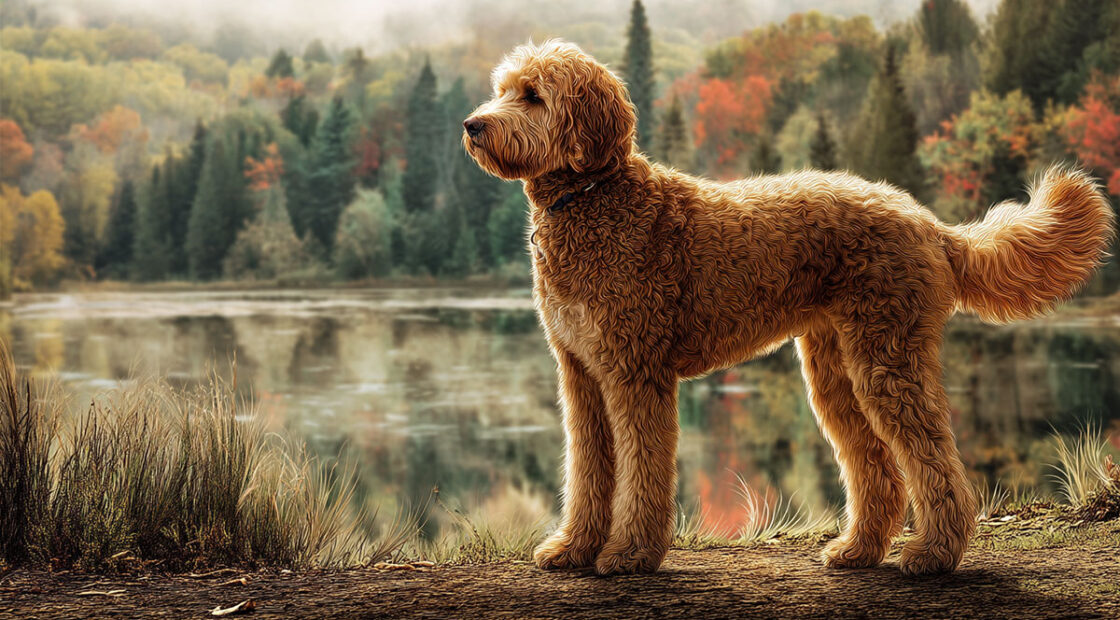
Wally Conron, a breeding manager at the Royal Guide Dog Association of Australia, bred the first Labradoodle litter in 1989. A household that included a dog-allergic husband needed a guide dog, so he paired a Labrador Retriever with a Poodle and hoped for the Labrador’s trainability with the Poodle’s low-shedding coat.
The cross is sold in miniature, medium and standard sizes now. No major kennel club recognizes it as a breed.
The genetics are messier than the name suggests. A 2020 PLOS Genetics study (Ali et al., National Institutes of Health) analyzed 150,106 genetic markers and found that the multigenerational Australian line is predominantly Poodle at the genetic level. Its genome carries an excess of Poodle variants linked to coat type, and other breeds contributed beyond the two named parents.
What Is a Labradoodle?
The usual definition is a Labrador Retriever crossed with a Standard or Miniature Poodle. That makes it a hybrid of two recognized breeds, not a breed in its own right.
Puppies from the early mixed generations do not have consistently predictable traits. That unpredictability is the main reason no major kennel club treats the cross as a breed.
Parent breeds and registry status
The Labrador side supplies trainability and a friendly temperament, plus a short, dense coat that sheds. Guide dog programs picked Labrador Retrievers for the first two.
The Poodle brings the curly, low-shedding coat and the size range. It comes in toy, miniature and standard, though the usual definition of the cross names only the Standard and the Miniature.
The American Kennel Club does not recognize hybrid dogs in its registry, according to a 2022 study in Animals (Hladky-Krage and Hoffman).
Breeder-run groups work on standards instead. The Australian Labradoodle Association of America, the Worldwide Australian Labradoodle Association and the International Australian Labradoodle Association each cover the Australian Labradoodle, a related line with its own registries.

Origin of the Labradoodle
Conron, then breeding manager at the Royal Guide Dog Association of Australia (now Guide Dogs Victoria), got the request from a blind woman in Hawaii whose husband was allergic to dogs, as he told ABC Radio National.
The parents were a Labrador named Brandy and a Poodle named Harley. Of the three puppies in the litter, Sultan showed the best temperament, and he went to Hawaii through Eye of the Pacific as the first Labradoodle guide dog.
The other two puppies found no homes at first, so Conron asked his organization’s publicity department for help. Guide Dogs Victoria then received inquiries from around the world.
Conron later called the result his biggest regret, pointing at breeders who sell the dogs for high prices without care.
Not everyone agrees. John Gosling of Guide Dogs Victoria, who supplied the Poodle Harley, told ABC Radio National he has no regrets. Sultan was a highly regarded guide dog who worked for about ten years.
How Big Does a Labradoodle Get?

Mostly it comes down to the Poodle parent, and breeders sort the dogs into miniature, medium and standard classes.
Published ranges disagree by an inch or two and by several pounds. The table sets the Worldwide Australian Labradoodle Association standard (as reproduced by the breeder Park View) beside the general ranges Dogster publishes.
| Size class | WALA standard | Dogster range |
|---|---|---|
| Miniature | 14 to 16 in, 20 to 30 lb | 13 to 15 in, 15 to 27 lb |
| Medium | 17 to 20 in, 30 to 45 lb | 16 to 20 in, 28 to 50 lb |
| Standard | 21 to 24 in, 45 to 90 lb | 21 to 26 in, 51 to 85 lb |
The WALA figures describe Australian Labradoodles bred to a written standard. A generic cross has no standard to hold it inside those limits.
Labradors vary little in size while Poodles range from toy to standard, so the Poodle parent moves the result more than anything else. Sex plays a smaller part (males measure taller and heavier than females), and dogs from standard-bred lines stay closer to the published ranges.
A Toy Poodle parent produces the smallest crosses. Breeders market them as petite or toy Labradoodles, but neither label is a recognized size class, per Petful.
Growth ends earlier in the smaller classes. Miniatures and mediums reach adult size at 11 to 13 months, standards at 12.5 to 16 months (Oodle Life).
What Coat Types Do Labradoodles Have, and Do They Shed?
Fleece and wool coats shed little. A hair coat sheds the most.
Fleece coat
Soft, free-flowing waves or curls, with very low shedding. It needs regular brushing, and clips whenever the length demands it.
Wool coat
Dense, tight curls, the closest match to a Poodle coat. It is the lowest-shedding type and also the one that tangles fastest once the hair grows long.
Hair coat
Straight or slightly wavy, often close to a Labrador coat. It sheds noticeably more than the other two types. Brushing is minimal, but loose hair builds up on furniture.
What decides the coat
The UC Davis Veterinary Genetics Laboratory describes a dominant variant near the RSPO2 gene that produces “furnishings,” the long hair on the muzzle and eyebrows. A dog without it has an improper coat, with short hair on the head, face and legs.
A second gene, MC5R, carries a variant that lowers shedding. The effects add up. A dog with neither variant sheds most, and one carrying both sheds least.
Grooming schedule

Published advice splits on how often a Labradoodle needs attention. Animal Friends (UK) recommends daily brushing. Healthy Paws puts it at twice a week. Sainsbury’s Bank adds clipping every 6 to 8 weeks for short coats, plus regular brushing.
Match the schedule to the coat. Wool needs the daily end of that range, and a hair coat can sit at the low end.
Skipped brushing turns curls into tight knots, and knots are what send most owners to the groomer. Clip length changes how often brushing is needed, so it helps to compare haircut styles for Labradoodles before the first appointment.
Are Labradoodles Hypoallergenic?
No. No dog breed has been shown to be hypoallergenic, and the Labradoodle is no exception.
In a 2012 study in the Journal of Allergy and Clinical Immunology, Vredegoor and colleagues measured Can f 1, the major dog allergen, in breeds sold as hypoallergenic (Labradoodle, Poodle, Spanish Water Dog, Airedale Terrier). Their hair carried a geometric mean of 2.26 micrograms per gram, against 0.77 in Labradors and other controls.
The same study found a split result. Floor dust in Labradoodle homes held significantly less Can f 1 than dust in homes with other breeds.
A 2011 study from Henry Ford Hospital (Nicholas et al., American Journal of Rhinology and Allergy) tested homes under four different classification schemes. None showed lower allergen levels in homes with so-called hypoallergenic dogs.
Why the claim persists
It goes back to the origin story. Conron wanted a guide dog for an allergic household, and the publicity that followed sold the dog as non-allergenic.
The belief still drives purchases. A Royal Veterinary College survey of 6,293 UK puppies found that 47.1% of designer crossbreed owners cited perceived hypoallergenicity as a reason for their choice, against 7.86% of purebred owners (Burnett et al.).
What to do before buying
Spend time with the individual dog before paying a deposit, and with the parents too if you can. RSPO2 and MC5R test results forecast shedding, not allergens, and no generation or coat type comes with a guarantee.
Genomia, a veterinary genetics lab that sells the shedding test, says even a dog scoring zero for shedding cannot assure that no allergy occurs.
Which Labradoodle Generation Should You Choose?
If shedding matters to you, go with an F1b or multigenerational Labradoodle whose parents have been coat-tested. If it doesn’t, an F1 is a reasonable choice, though temperament varies in every generation.
| Generation | Parentage | Poodle share | Coat outcome |
|---|---|---|---|
| F1 | Labrador x Poodle | 50% | Varies widely |
| F1b | F1 Labradoodle x Poodle | 75% | Curlier, usually lower shedding |
| F2 | F1 x F1 | 50% | Mixed, improper coat possible |
| Multigenerational | F1b or later, bred together | Varies | Selected for coat, most predictable |
Improper coat risk by generation
Paw Print Genetics notes that the Poodle is fixed for the furnishings variant while the Labrador has none. Every F1 puppy therefore carries one copy.
Two F1 carriers bred together (an F2 litter) produce about 25% of puppies without furnishings. An F1b litter cannot, because the Poodle parent passes a furnishings copy to every puppy.
Breeder guides also say F1 litters are likelier to produce straight, shedding coats. That is consistent with shedding sitting on separate genes such as MC5R, so an F1 can have furnishings and still shed.
Backcrossing to a Labrador is unusual, because most breeders backcross to reduce shedding (Animal Friends).
Australian Labradoodle
An Australian Labradoodle is a multigenerational line with its own standard, not just a Labradoodle born in Australia. Cocker Spaniels (English and American) also contributed to the line, and some lines added Irish Water Spaniels and Curly-Coated Retrievers (Ali et al.; Wikipedia).
In 2004 one Australian breeder infused Soft Coated Wheaten Terriers, which led to the separate Australian Cobberdog. The line is developing and is not recognized by independent kennel clubs.
Picking a generation
Anyone with a low tolerance for shedding should look at F1b or multigenerational dogs and ask for RSPO2 and MC5R results on both parents. If shedding doesn’t bother you, an F1 works, but meet the parents first, since temperament varies in any generation.
Whichever generation you pick, confirm the individual puppy’s reaction before buying.
Labradoodle Temperament, Training and Exercise Needs
Expect a friendly dog that learns quickly and has plenty of energy, and one that handles long stretches alone poorly. Both parent breeds are working dogs, and the cross inherits their need for something to do.
In a 2026 PLOS One study of 9,402 UK dogs, Royal Veterinary College researchers (Bryson et al.) ran 24 behaviour comparisons between Labradoodles and their parent breeds. The Labradoodle differed from its parent breeds in 11 of the 24, scoring worse in 5 and better in 6. It showed less owner-directed and dog-directed aggression than purebred Poodles.
Separation-related problems were one of the areas where it scored worse than Labradors, though it did better than Poodles, per the British Small Animal Veterinary Association’s summary of the study.
Trainability and working roles

Trainability is the reason the cross exists, although the 2026 study found Labradoodles scored lower than Labradors on it. Labrador and Poodle parents both rank among the most intelligent breeds, and the guide dog background shows in assistance work. Animal Friends says the Labradoodle fills guide dog and therapy dog roles well, and does agility too.
Owner habits matter as much as genetics. The same RVC study found doodle owners were likelier than purebred owners to be first-time dog owners and to take training advice from non-professional sources.
Exercise requirements
Published targets disagree, and the gap is wide.
Animal Friends says 1 to 2 hours a day, with smaller dogs needing at least 1 hour and larger dogs at least 2. Canine Journal, writing about the Australian Labradoodle, says 30 to 60 minutes, scaled to miniature, medium or standard size.
A standard Labradoodle should aim for the upper end of the Animal Friends range, around 2 hours. A miniature can sit near the bottom of the Canine Journal range, as long as some of that time is mental work such as scent games or training drills.
Alone time, noise and family fit
Build alone time in small steps from the first week. Barking is also a common complaint among doodle owners in a 2022 US survey (Hladky-Krage and Hoffman, Animals), so expect some.
Socialize early, and not only with people. Surfaces and loud noises count, since all three Poodle crosses showed more fear of objects and noises than their non-Poodle parents (RVC).
Family fit depends more on the household than the dog. The same 2022 survey found that first-time owners and owners with children reported worse behaviour, higher perceived costs and lower satisfaction, whatever the type of dog.
What Health Problems Do Labradoodles Have, and How Long Do They Live?

Labradoodles carry about the same health risks as their parent breeds, no more and no fewer. The RVC found no difference in 86.6% of 342 comparisons between three Poodle crosses (Cockapoo, Labradoodle, Cavapoo) and their purebred parents (Bryson et al., PLOS One, 2024).
The clearest exception was ear infections, which all three crosses had at higher odds than their non-Poodle parents. Labradoodles had lower odds of patellar luxation than Poodles.
That survey covered dogs under five years old, so it says nothing about cancers and other diseases of older age.
Documented conditions
Hip and elbow dysplasia are inherited joint diseases that come from the Labrador side, and the Australian Labradoodle Association of America lists both among the problems that do occur.
Ears need regular attention. The Poodle ear canal and heavy ear hair hold moisture, and a weekly check plus routine cleaning with dog ear wipes keeps debris down.
Eye disease is murkier, because two screening studies disagree, as the next block shows.
Eye findings from two screening studies
| Finding | UK survey (2012) | Dutch screening (2014 to 2024) |
|---|---|---|
| Multifocal retinal dysplasia | 4.6% | 0.2% |
| Cataract | 3.7% | 0.5% |
| Persistent pupillary membrane | 1.4% | 4.7% |
The UK figures come from Oliver and Gould (Veterinary Record, 2012). The Dutch figures come from Goossens et al. (Frontiers in Veterinary Science, June 2026), who screened 1,182 Labradoodles and found 7.8% affected by at least one hereditary eye finding.
The Dutch authors attribute the gap to differences in genetic background and breeding practices. The Netherlands has a dense Australian Labradoodle breeder base, and 1,041 of the 1,182 dogs screened were Australian Labradoodles. The authors also caution that their sample skews young and female. Neither study is a clean measure of the whole population.
Lifespan
Published ranges overlap but do not match. Animal Friends says 12 to 15 years and Dogster says 12 to 14. Healthy Paws gives the widest spread, 10 to 15.
All three come from insurers and pet-care sites, and no peer-reviewed Labradoodle longevity figure turned up in the sources checked. Treat 12 years as the planning figure and anything beyond it as a bonus.
Screening tests
For hips and elbows, the Orthopedic Foundation for Animals certifies dogs from 24 months and offers preliminary evaluations from 4 months (OFA FAQ). PennHIP measures hip laxity from 16 weeks of age using three radiographs (Antech Diagnostics).
Eye exams work differently. The OFA Companion Animal Eye Registry has no minimum age, and in Europe breeders use ECVO certificates, repeated when an exam comes back suspicious.
DNA panels from Embark and Wisdom Panel screen for variant diseases, and the UC Davis Veterinary Genetics Laboratory runs Labradoodle-relevant tests. A panel cannot clear hips, because the OFA classes hip dysplasia as polygenic.
How Much Does a Labradoodle Cost?
In the UK, 25.7% of designer crossbreed puppies bought in 2019 and 2020 cost GBP 2,000 to 2,999, against 15.1% of purebred puppies (Burnett et al., Canine Medicine and Genetics, 2022). A breeder-sold Labradoodle puppy sits at the premium end of the market.
What moves the price
- Smaller classes cost more, because pairing a Labrador with a small Poodle is harder to breed (Labrador Training HQ)
- Flat-coated puppies sell at a discount since they shed
- Red, lavender and blue-gray coats carry a markup, according to SpotPet’s breed guide
- Parent health and coat tests add to the breeder’s costs, and so to the price
Costs after the purchase
Owning any dog is expensive over a lifetime, and the Labradoodle bill starts before the puppy comes home.
Up front there’s the microchip, spay or neuter surgery, crate, bed, leash and bowls. After that come food, flea, tick and heartworm prevention, insurance, vet visits and grooming.
Food follows adult size. Pet Circle advises large-breed diets for standards and small-to-medium diets for miniatures and mediums, so comparing puppy food brands is the first decision.
Grooming is where owners underestimate. The 2022 Hladky-Krage and Hoffman survey found doodle owners were far likelier than other owners to say maintenance and grooming took more investment than they expected.
How to Choose a Labradoodle Breeder
A reputable Labradoodle breeder shows written parent health results and lets you meet the dam. They also belong to an association that sets screening rules for breeding dogs.
Buyers often skip that checking. UK designer crossbreed buyers were less likely than purebred buyers to be given parental DNA and veterinary-screening results, largely because they were less likely to ask for them (Burnett et al., 2022).
- Ask which breeder association the kennel belongs to and what screening it requires. Dutch eye researchers note these associations demand eye exams for breeding dogs.
- Request written hip and elbow results (OFA or PennHIP) for both parents.
- Request current eye certificates (OFA CAER or ECVO) for both parents.
- Ask for DNA panel results and the RSPO2 and MC5R coat tests.
- Meet the dam and the litter in person. The RVC advises meeting the parents to judge their behaviour before buying.
- Get the health guarantee in writing before paying a deposit.
Walk away if the breeder pushes a deposit before you visit, always has puppies available, or guarantees an allergy-safe dog. Burnett and colleagues found designer crossbreed buyers were likelier than purebred buyers to pay deposits and less likely to visit the breeder in person (60.4% vs 67.0%).
When a Labradoodle Is the Wrong Fit

It’s the wrong dog for anyone who needs a guaranteed allergy outcome, a predictable adult coat or a dog that copes with long hours alone.
- Severe allergy households should have an allergist guide the decision before any deposit is paid, since no generation or coat type is a guarantee.
- A standard Labradoodle needs up to 2 hours of exercise a day on the higher published targets, which rules out owners who can’t commit to that.
- If everyone in the house is out all day, remember that separation-related problems scored worse than in Labradors (though better than in Poodles) in the 2026 RVC study.
- An F1 litter varies in coat and adult size, and no breed standard backs the puppy up, so owners expecting a fixed outcome will be disappointed.
- Breeder association registration does not carry the same recognition as kennel club papers, which matters if you want those.
Grooming wears owners down. In the 2022 survey, doodle owners were far likelier than other owners to find maintenance heavier than they expected.
Cost is the other trap. If the budget only covers the purchase price, a rescue mixed-breed dog is the better choice.
Labradoodle FAQ
How does a Labradoodle differ from a Goldendoodle?
Mostly the parent. The Goldendoodle crosses a Golden Retriever with a Poodle, while the Labradoodle starts with a Labrador Retriever.
Both rely on the same RSPO2 furnishings variant for a Poodle-style coat, per the UC Davis Veterinary Genetics Laboratory. The Goldendoodle profile covers the Golden Retriever side.
Can a Labradoodle live in an apartment?
Yes, a miniature can. Canine Journal rates the miniature as suited to apartment living, while medium and standard sizes do better with a yard.
Any size still needs daily exercise outside the apartment.
Can you adopt a Labradoodle instead of buying one?

Yes. Rescue groups and shelters list Labradoodles and Poodle mixes, and adopting cuts the purchase cost, as Chewy notes.
Ask the rescue for the dog’s age, history and vet records, because parentage and generation are usually unknown.
How much should a Labradoodle eat?
No single amount fits every dog. Age, weight, metabolism and activity level set the portion, and puppies need more frequent, calorie-dense meals (Basepaws).
Weigh the food instead of scooping it, and follow the label for the dog’s adult size.
What colors do Labradoodles come in?
Nearly every color, plus patterns, because coat color comes from the parents. Chewy lists brown shades as the most typical.
Color does not change shedding. Waggel lists that belief as a myth.
Preparing for the First Year With a Labradoodle
Start the first year with alone-time training, not grooming or screening. In the 2026 RVC study, Labradoodles scored worse than Labradors for separation-related problems (though better than Poodles), so teaching the dog to settle alone comes first.
A workable order for the first twelve months begins with alone-time and socialization practice from week one. Next comes a fixed brushing and clipping routine matched to the coat, and a vet baseline covering ears, joints and eyes follows.
Behaviour habits are the hardest to reverse, so they come first. The cost is weekday evenings, not only money.
As of October 2026, no major kennel club recognizes the cross. Recognition would be the point to replace breeder association paperwork with registry-backed health records.