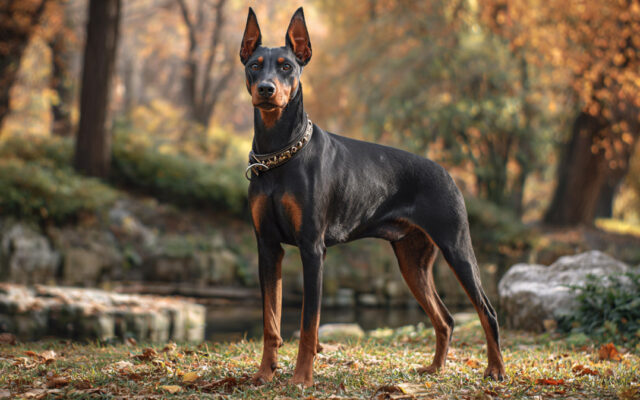
The Black and Tan Coonhound has been on a registry longer than any other coonhound. The United Kennel Club registered it in 1900 as the American Black & Tan Fox and Coonhound, 45 years before the AKC accepted it in 1945 (UKC breed standard, revised 2016). Nothing in either registry came before it.
It’s a large American scent hound. It follows cold trails by scent alone, trees raccoon and holds it at the tree until the hunter arrives. Some hunters also use it on deer and bear, plus other big game.
Nite hunts are still where these hounds get run. Owners who skip the hunting keep them as calm, friendly house dogs, though they need daily walks and a secure fence.
What Is the Black and Tan Coonhound?
Both the AKC and FCI standards say this hound runs its game entirely by scent. Over rough ground, on a cold trail, until the raccoon or other quarry goes up a tree.
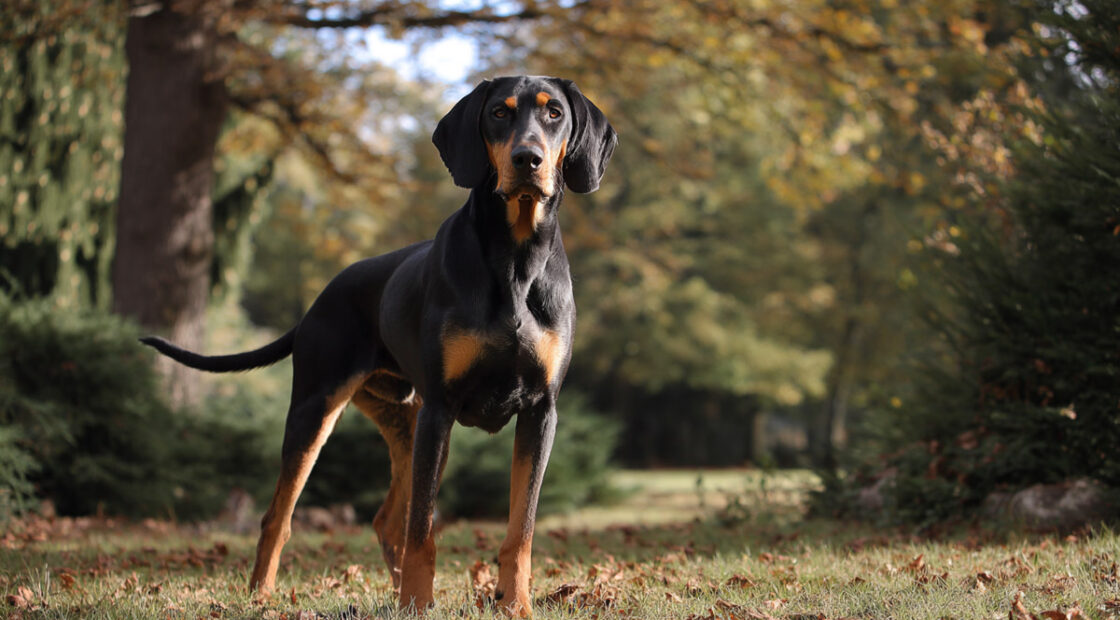
The name is just a description of the coat. Coal black, with tan points above the eyes and on the muzzle, chest and legs.
- The AKC lists it as the Black and Tan Coonhound, in the Hound Group.
- The UKC calls it the American Black & Tan Coonhound and files it under scenthounds.
- The FCI uses Black and Tan Coonhound, Group 6 (scent hounds and related breeds), Section 1.1 large-sized hounds.
- Black and Tan and B&T are the usual nicknames, and older texts say “Old Virginia Black & Tan”.
The long ears and the trailing ability point to Bloodhound bloodlines, which the UKC standard says probably came in through early crosses.
Still, it’s a separate breed. So is the black and tan Virginia Foxhound in its ancestry.
Where Did the Black and Tan Coonhound Come From?
The UKC got there first, in 1900. That’s 45 years ahead of the American Kennel Club, and by the UKC’s own account it was the first coonhound admitted to its registry, listed back then as American Black & Tan Fox and Coonhound.
The UKC standard traces the immediate ancestry to the American Foxhound and the colonial Virginia Foxhound, with probably some Bloodhound stock added. Further back it points to English Foxhounds and the extinct Talbot Hound, an old English hunting hound.

Purina’s breed profile dates the original crosses to the late 1700s in the Southeast.
Breed lore adds “Old Glory,” a large, long-eared black and tan hound that settlers prized. Its type spread through the Ohio Valley, per ShowSight’s breed history. In the years leading up to the Civil War, Col. Trigg of Glasgow, Kentucky, ran a pack of the type on gray fox.
The recognition dates are easier to follow in order.
- 1900 is the UKC registration.
- In 1945 the AKC registers it, the first coonhound in its stud book, and the FCI accepts it definitively on July 10.
- The FCI standard is published on January 30, 1991, and the current text is dated October 4, 2002.
- Between 2006 and 2012 the Plott Hound (2006), Bluetick and Redbone (2009), American English (2011) and Treeing Walker (2012) reach AKC registration.
Some secondary sources print 1946 for the AKC date. The AKC’s own coonhound page says 1945, and the FCI acceptance falls in the same year.
The American Black and Tan Coonhound Club is the AKC parent club for the breed.
The next coonhound to reach the AKC, the Plott Hound, waited 61 years after the Black and Tan. That gap gives this breed the longest AKC record of any coonhound.
Size, Coat and Color of the Black and Tan Coonhound
Males stand 25 to 27 inches at the withers and females 23 to 25 inches. ShowSight’s judging guide quotes those heights from the AKC standard.
The standard asks for a body equal to or slightly longer than the dog is tall, so the hound looks neither leggy nor low to the ground.
- The coat is short, dense and glossy.
- Color is coal black, with rich tan above the eyes, on the sides of the muzzle, on the chest, legs and breeching, and black pencil markings on the toes.
- Ears are long enough to extend beyond the end of the nose (Westminster Kennel Club).
Under the FCI standard, too little or too much tan is a fault, and so is too much black. The AKC standard also calls white on the chest or body highly undesirable, and a solid patch of white that extends more than one inch in any direction is a disqualification.
The UKC standard, revised May 1, 2016, puts a number on markings. Tan trim should cover not more than 10 to 15 percent of the body.
It is a hunting breed, so scars from honorable wounds are not faulted.
Weight is where the sources stop agreeing. The FCI standard sets none, so breed profiles fill the gap, and their figures don’t match.
| Source | Males | Females |
|---|---|---|
| ANKC standard (Victorian Game Management Authority fact sheet) | 55 to 80 lb | 45 to 65 lb |
| Purina breed profile | 80 to 90 lb | 65 to 75 lb |
| Hill’s Pet Nutrition (US breed guide) | 65 to 110 lb, not split by sex | |
| AKC coonhound overview | 65 to 110 lb, not split by sex | |
| FCI standard | No weight given |
For planning, expect a male anywhere from about 55 to 110 pounds. The vet’s body-condition score settles where an individual dog belongs.
What Work Is the Black and Tan Coonhound Bred For?

Trailing and treeing raccoon. The FCI standard says the breed runs its game entirely by scent, and the AKC standard uses the same wording.
On a hunt, the dog strikes a track and follows it until the raccoon climbs. Then it stays at the tree and bays so the hunter can find it. Cold trails are the specialty, since scent hounds of this type follow tracks that are hours or days old (Orvis).
Raccoon isn’t the only quarry. The FCI standard names deer, bear, mountain lion and other big game, and Hill’s regional breed pages add opossum. Hunters in the Northeast also ran the breed on red fox in winter, according to ShowSight.
The AKC’s Raccoon Hound Events program runs Nite Hunts, Hunt Tests, Field Trials, Water Races and Bench Shows. Nite hunts are the most popular, and they take place in natural areas where native game must be trailed and has not been planted.
UKC nite hunt scorecards award strike points and tree points. Spayed and neutered dogs may enter every UKC licensed coonhound event, including bench shows, nite hunts, water races and field trials.
The breed does have a weak spot in competition. ShowSight’s breed history says the older, slower-trailing type lost ground to faster hounds, and some breeders responded by moving toward a smaller, racier dog with a much shorter ear. A group of breeders headed by Don Stringer later approached the AKC with breeding records and documented pedigrees.
Black and Tan Coonhound Temperament at Home and on the Trail

Friendly, outgoing and even-tempered, and never aggressive. The ANKC standard allows some dogs to be reserved with strangers, but not shy or vicious.
With children and other pets

The Westminster Kennel Club rates the breed 5 out of 5 with both children and other dogs, and 3 out of 5 with strangers.
ShowSight advises supervising younger children because of the breed’s size and enthusiasm. A big, bouncy hound can knock a toddler over without meaning to.
Other dogs are usually easy, since hounds work in casts. Cats are possible if the cat is used to dogs (Orvis). Strangers tend to get a reserved welcome more often than a hostile one.
Baying and watchdog behavior
Plan for noise. The same Westminster ratings put barking at 4 out of 5.
The bark is a loud, deep bay, the voice that tells a hunter the quarry is treed. Wisdom Panel notes that a dog left alone too long will wail loudly enough for the neighbors to hear.
Indoors the dog is mellow, amiable and calm, and alert enough to announce visitors (Orvis calls it a watchdog).
Outdoors it’s a different animal. Once a scent starts, the nose runs the dog, and VCA Animal Hospitals warns that off-leash time is risky and never safe near traffic.
How Much Exercise and Training Does the Black and Tan Coonhound Need?

Plan on about an hour of walking a day, with plenty of time to sniff. Orvis gives a range of 30 to 60 minutes, while Hill’s now says at least 60 to 90 minutes of physical and mental activity.
The sources split on intensity. Hill’s calls daily exercise nonnegotiable, while VCA Animal Hospitals and Purina rate the need as moderate.
VCA and Vetstreet agree on the shape of it. A walk that goes somewhere beats laps of the yard, and tracking or search-and-rescue work gives the nose a real job.
Orvis wants the dog on a leash outdoors unless it’s in a fenced area, and Vetstreet adds a securely fenced yard for any time nobody is home. The Whole Dog Journal says to check the fence line before the dog moves in, and to make it tall and solid.
Recall will not beat a scent. The AKC says that once the dog is on a trail it is very hard to get his attention, and Orvis expects him to keep following despite a recall command.
Teach recall anyway, in a fenced area, and treat it as a backup. A GPS collar adds a second layer, and hunters already trust them. UKC’s Coonhound Advisor (August 2018) allows the LAELAPS tracker in a nite hunt only in competition mode, because the tone feature counts as a controlling device.
Training goes best when it’s patient and consistent, with rewards doing the work. Clicker training works well (VCA), and small, healthy treats make a workable reward.
Vetstreet says to start the day the puppy comes home and to book puppy kindergarten at 10 to 12 weeks.
Alone time is manageable after a good workout, according to VCA.
The short coat needs only a quick weekly brushing.
Health Problems and Lifespan of the Black and Tan Coonhound

The breed lives 10 to 12 years, according to Eukanuba and Royal Canin breed profiles. The recurring problems are hip dysplasia, ear infections, bloat and, rarely, a nerve disease called coonhound paralysis.
On screening, the American Black and Tan Coonhound Club takes part in the CHIC program, which the AKC Canine Health Foundation and the Orthopedic Foundation for Animals run together.
For a CHIC number, a dog needs an OFA or PennHIP hip evaluation and an OFA cardiac evaluation, plus a Companion Animal Eye Registry (CAER) eye exam by an ophthalmologist, per Vetstreet. A dog does not have to pass to earn the number, so the number alone does not prove soundness.
Joints and hips
Hip dysplasia is the condition vets name first for this breed (VCA).
PangoVet ties it to the large, active build. Hip evaluation is also the first test on the CHIC list Vetstreet describes.
Ears and eyes
The long, pendulous ears trap moisture and debris, so infections recur (PetMD). Weekly outer-ear checks go faster with the right ear wipes, honestly the cheapest fix in this whole section. Odor, head shaking or discharge means a vet visit, not more wiping.
Eyelid conformation problems turn up too, namely ectropion (lids roll outward) and entropion (lids roll inward), per Embrace and the iDog database.
Some dogs carry hemophilia B, an inherited clotting disorder tied to the F9 gene (iDog database, Vetstreet). Embrace also lists autoimmune thyroiditis.
Bloat and coonhound paralysis
Bloat (GDV)
Feeding height matters more than most owners expect. Raised food bowls were linked to a 110% higher bloat risk in the research summarized by Cornell University’s College of Veterinary Medicine (2020).
Gastric dilatation-volvulus (GDV) is the stomach filling with gas and twisting, and deep-chested dogs carry the most risk. AAHA also lists fast eating among the risk factors, which is where a slow feeder bowl helps by stretching out the meal.
Early signs, per AAHA, include:
- Restlessness
- Drooling
- Unproductive retching
- Looking at the abdomen
A swollen belly, pale gums or collapse means an emergency clinic right now.
The Washington State University veterinary hospital says a gastropexy, which tacks the stomach to the body wall, can be done at spay or neuter. It also advises feeding larger kibble pieces.
The CHIC list covers hips, eyes and heart, not bloat. Feeding habits and a gastropexy conversation with the vet are the main tools.
Coonhound paralysis
The formal name is acute canine idiopathic polyradiculoneuritis (ACIP). It’s a progressive paralysis that can show up 7 to 14 days after a raccoon bite or scratch (VCA).
The University of Illinois College of Veterinary Medicine says the exact mechanism is still unknown, and some affected dogs never met a raccoon.
Most dogs recover fully with good nursing care, though recovery is slow and the condition can recur (VCA). Illinois advises removing food that attracts raccoons to the yard, which lowers contact.
When the Black and Tan Coonhound Is the Wrong Fit
Anyone who wants a quick-obeying dog will be unhappy here. So will anyone without a fence, walking time, or patience for hound noise and smell.
- The AKC says the dog always needs a leash or a securely fenced area, so a home with neither cannot keep him safe.
- VCA prefers owners with hound experience, and says anyone who ranks a hop-to-it obedience dog first should keep looking.
- zooplus tells city-apartment owners who prefer the couch to the woods to choose another breed, and Vetstreet says neighbors will hear him unless the nearest one is about five miles away.
- Vetstreet describes a musty odor, and Orvis expects some drool, especially in hot weather or right after a meal.
If more than one of those sounds like your home, pick another dog.
Petfinder describes the ideal setting as rural, with a large fenced yard.
Black and Tan Coonhound vs Other Coonhounds and the Bloodhound
Pick the Black and Tan Coonhound for steady cold-trail work and a calm house dog. Look at its relatives when pace, competition or a specific hunting style matters more.
| Breed | Trail pace and style | Fits best |
|---|---|---|
| Black and Tan Coonhound | Steady, not especially fast (Vetstreet) | Calm house hound, patient hunting |
| Bluetick | Speedy, bugle or bawl voice (ANKC standard) | Hunters who want pace |
| Redbone | Natural treeing instinct, medium build (UKC standard) | Treeing work on a lighter frame |
| Treeing Walker | Energetic, competitive (AKC standard) | Competitive nite hunts |
| Bloodhound | Relentless tracker, loose skin, drools | Trailing specialist, drool-tolerant owner |
On a trail, the Bluetick is the closest rival. The ANKC standard calls it speedy, with a free tongue and a medium bawl or bugle voice.
For competition, the AKC standard for the Treeing Walker calls it the people’s choice among coonhounds. It says the breed’s competitive spirit makes it an ideal pick for coonhound events.
The Redbone is a medium-sized hound with a natural treeing instinct, and the UKC standard lists foxhounds among its ancestors.
The Bloodhound sits further back. It reached the AKC in 1885 (Purina), 60 years before its descendant, and Hill’s says its independence makes training a challenge and its life span relatively short.
How Much Does a Black and Tan Coonhound Cost, and Where Do You Get One?
Budget for health testing and yearly care, not only the puppy price. Estimates run from the high hundreds into the low thousands depending on the source, and none of them is audited data.
What the dog costs up front
- A US puppy runs $500 to $1,300 depending on region (iHeartDogs, 2026).
- Canadian breeders charge CAD $1,300 to $3,200 (Paction, 2026).
- Annual food and treats come to $700 to $1,200 per Lemonade, but only $250 to $700 per iHeartDogs.
The puppy ranges don’t line up because they describe different markets and breeders. Paction says price reflects health testing, lineage and breeding rights.
Food, insurance and vet visits explain why a dog is expensive long after the puppy price is paid.
Choosing a breeder
- Start with the national parent club, which the AKC calls the first place to find a knowledgeable breeder.
- Ask for written proof that both parents cleared hips, eyes and heart. “Vet checked” is not genetic testing (Vetstreet).
- Get a health guarantee and a contract in writing.
- For a pet, pick a breeder who breeds for the home as well as the field (Embark).
- Expect scams in puppy searches (Paction).
A breeder who says the lines have no health problems is not being straight with you, per Embrace.
Rescue and adoption
American Black and Tan Coonhound Rescue is a volunteer-run national group that places coonhounds and Bloodhounds through foster homes. Dogs are spayed or neutered, vaccinated, wormed and on heartworm preventative before adoption, according to its Petfinder profile.
Adopters complete an application and a screening, and the adoption fee covers part of the vet bill (GuideStar).
The catch with rescue is that dogs usually arrive without parental health records. Many health and behavior problems do not show in puppyhood anyway, and adopting an older dog rules most of them out, per Vetstreet.
Black and Tan Coonhound FAQ
Do Black and Tan Coonhounds shed a lot?
Moderately. The Westminster Kennel Club rates shedding 3 out of 5.
A quick weekly brushing removes loose hair from the short coat.
How much should an adult Black and Tan Coonhound eat?

Orvis suggests 3 to 5 cups of high-quality dry food a day, split into two or three meals.
Smaller, spaced meals also help with bloat risk, according to AAHA. Adjust the amount to weight and activity.
Can the breed handle hot and cold weather?
Yes, both. The breed standard says it withstands the rigors of winter and the heat of summer, thanks to a short, dense coat.
In heat, trim midday exercise and keep shade and water within reach.
Does it do well in dog sports?
Yes. Purina’s breed profile lists field trials, tracking, agility, obedience, search and rescue and conformation among its activities.
Expect agility and obedience to take patience, since Hill’s describes the breed as independent and sometimes headstrong.
Is the breed recognized in the UK?
Partly. The Kennel Club approved an interim breed standard in October 2018.
From 1 November 2018, the breed became eligible for Imported Breed Register classes.
How popular is it?
Uncommon, but rising. The AKC’s 2025 rankings show a climb of 14 spots from 2024.
The same year’s rarest-breeds list puts it 66th rarest among 202 ranked breeds.
Preparing Your Home for a Black and Tan Coonhound
Check the fence before the dog arrives, and find a vet who knows what bloat looks like. The weekly ear routine can start in the first week. Do them in that order, since the cheapest fixes come first.
Cornell’s lecture notes (2020) put the rise in bloat risk at 20% for each added year of age. In the underlying Purdue study, that applied to large breeds after about age 5. Across a life of 10 to 12 years, the spay or neuter visit becomes the practical moment to discuss a gastropexy.
Leashed walks and a fenced yard replace off-leash freedom for the dog’s entire life. That’s the real cost of the breed, and it’s worth admitting up front.
As of October 2026, the CHIC list covers hips, eyes and heart. A bloat test added to the breed protocol would change what to ask a breeder.