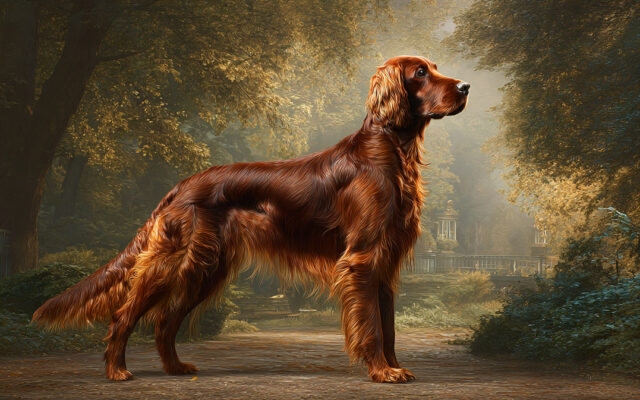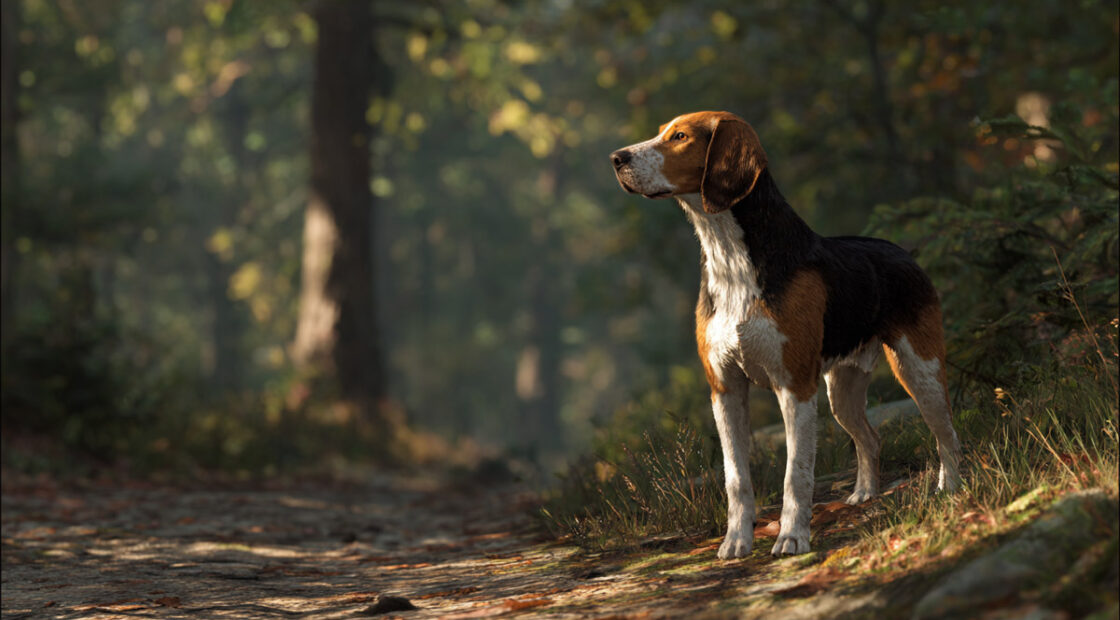
Fox hunting in colonial America called for a hound that could stay on a scent for miles, and the American Foxhound is what came out of it. Breeders worked from English, French and Irish stock. The result is longer in the leg and lighter in bone than the English Foxhound, and whether it hunts alone or in a pack, the Westminster Kennel Club notes the fox is rarely caught.
The AKC credits George Washington as the father of the breed. Robert Brooke got there first, though. He landed a pack in Maryland on June 30, 1650, the earliest recorded importation of hounds in quantity (Showsight; Foxhunting Life).
Adults stand 21 to 25 inches at the withers and belong to the AKC Hound Group. Registrations stay low because most hounds live with hunters who skip the registry (Petfinder).
What Is the American Foxhound?
Virginia huntsmen built the first true American Foxhounds from English, French and Irish stock, according to the Westminster Kennel Club. They wanted a scent hound that could trail fox by nose over long distances. It came out slighter of bone and higher on the leg than the English Foxhound, its closest relative.
The American hunting style differs too. The hound works alone or in a pack, and catching the fox is unusual.
The AKC puts the breed in the Hound Group. The FCI files it under Group 6, Section 1.1 (large-sized scent hounds, subject to a working trial) as standard no. 303, accepted on a definitive basis on 2 November 1979, and the UKC lists it in the Scenthound Group.
Under the one breed name, the AKC describes four working types.
- Field-trial hounds, bred for speed and competition
- Fox-hunting hounds, which work slower and have a musical voice
- Trail hounds that race or hunt following an artificial lure
- Pack hounds, run in large packs behind riders on horseback
It is not a typical companion breed. Vetstreet notes it is rarely thought of as one, though a family that wants a partner for running or cycling, or just long walks, can make it work.
American Foxhound Size, Coat and Colors

Published ranges run from 21 to 25 inches at the withers and from 40 to 70 pounds, and they differ by source. Males come out taller and heavier than females.
| Source | Height at withers | Weight |
|---|---|---|
| Purina | Males 22 to 25 in, females 21 to 24 in | 40 to 65 lb |
| Eukanuba | Males 22 to 25 in, females 21 to 24 in | Males 65 to 70 lb, females 60 to 65 lb |
| Westminster Kennel Club | Maximum 25 in | Maximum 70 lb |
The UKC standard (revised January 1, 2009) sets the same male height range as Purina. Weight is the figure that moves, so judge a given hound by condition and frame, not by one table row.
The AKC and UKC standards describe a close, hard hound coat of medium length. Many consumer profiles, Purina included, call it short, yet a short, thin coat or a soft one counts as a fault in the standards.
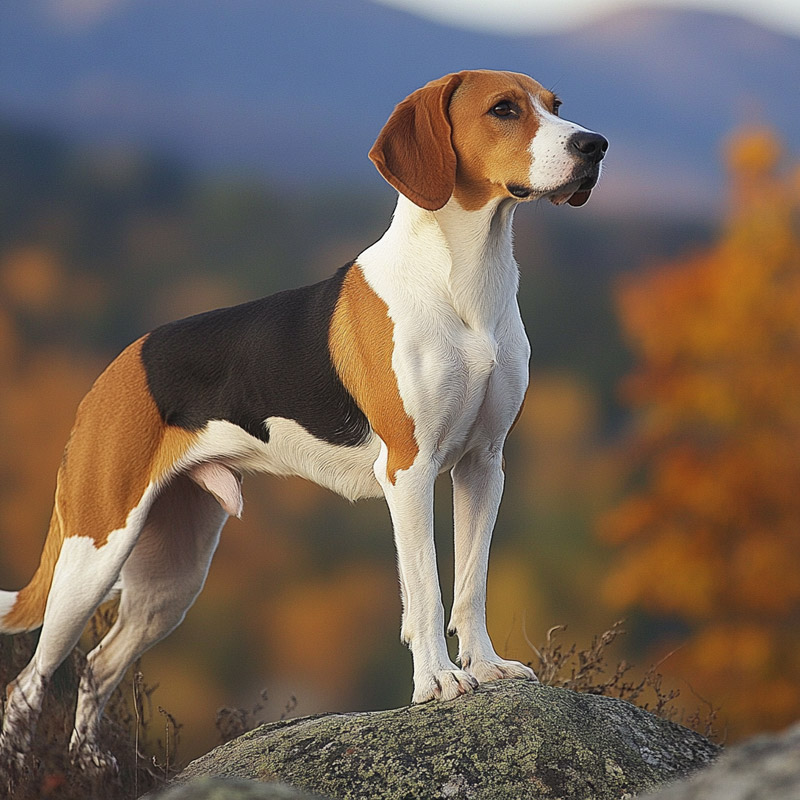
Any color is acceptable under the UKC standard, and the AKC likewise accepts any color. Tricolor (black, white and tan) is the pattern most associated with the breed.
A few build details from the standards:
- Ears set moderately low, fine in texture, reaching nearly to the tip of the nose when drawn forward
- Brown or hazel eyes and a gentle expression
- A deep chest that is narrower in proportion to its depth than the English Foxhound’s
What Is the Temperament of an American Foxhound?
Easygoing, sweet and independent covers most of it, plus a pack hound’s preference for company. The AKC calls the breed good-natured and low-maintenance, then adds that owners face special considerations.
Westminster Kennel Club ratings give it 5 of 5 for good with children and 5 of 5 for good with other dogs.
Children and dogs
Vetstreet calls the typical Foxhound gentle and friendly, especially with children. A breed club member told the AKC she has yet to meet one that would not put up with kids.
Being a pack animal, it does best in a home where it is not the only dog.
Friendliness with strangers is less predictable. Eukanuba reports it varies widely within the breed.
Cats and small pets
The sources split on this one.
The AKC says the breed gets along with kids, dogs and even cats, and Pangovet calls it surprisingly good with other animals. Zooplus sees no chance of it living peacefully with cats or small animals.
Two variables show up in the sources. The AKC says hounds raised with people are easier to train, while those raised only with other dogs bond more with the pack, and Eukanuba says show lines suit a family better than working lines.
So introduce the specific hound to the specific cat before committing, and ask the breeder which line the dog comes from.
How Much Exercise and Space Does an American Foxhound Need?
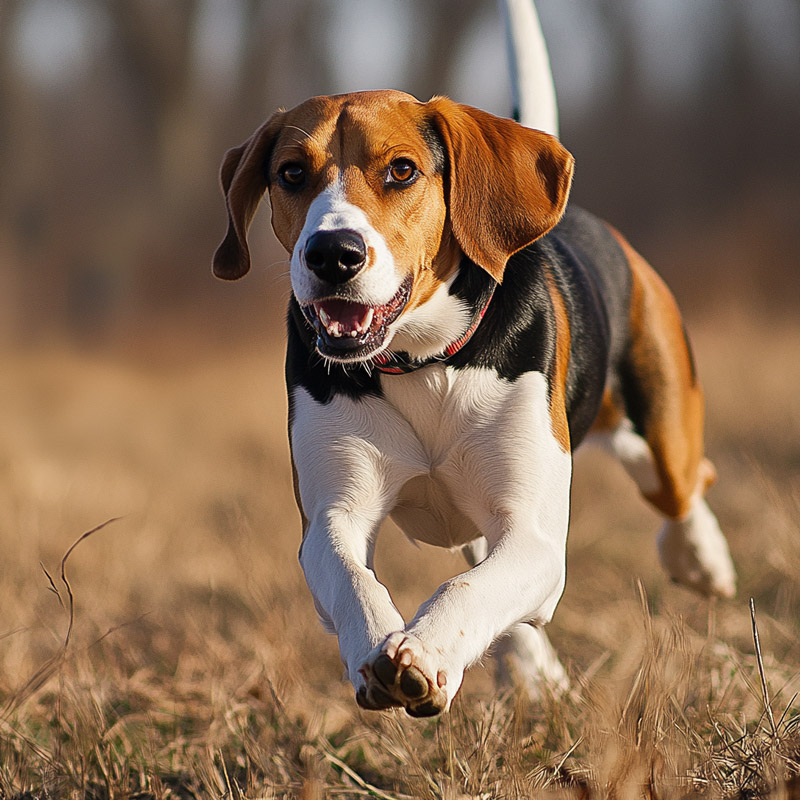
It needs a long daily walk or jog at minimum, plus a securely fenced yard for anything off leash. Petfinder recommends a long walk or jog, and Vetstreet tells owners to be ready for plenty of daily exercise.
Sources disagree on how to rate the energy. Purina labels it medium, while Westminster rates it higher.
A hound that finds a good scent moves at a pace its owner cannot match, per Vetstreet, so off-leash time belongs inside a secure fence. Vetstreet adds that the drive to follow a scent overrides the fear of a brief shock, so electronic containment alone is unreliable.
Apartment living gets mixed answers. Purina calls the breed adaptable to smaller homes when exercise is adequate, while the AKC says it suits country living, where daily baying will not bother neighbors.
An apartment works only if the exercise actually happens and the neighbors tolerate the voice. Vetstreet warns that the bell-like bay carries for miles when a bored hound is left alone.
Under-challenged hounds find their own work, according to Hundeo. It is not a yard dog either. When the family is home, Vetstreet says the hound belongs with them.
How Hard Is It to Train an American Foxhound?
Harder than most family breeds, because scent drive overrides commands once the hound locks onto a trail. Westminster scores trainability at 3 of 5 and barking at 5 of 5.
Recall is the big problem. Petfinder says a hound on a scent follows it heedless of commands, and Wisdom Panel calls getting one back incredibly difficult.
Purina describes the breed as stubborn and independent at times, with early training helping. Pangovet notes scent hounds rank low on canine intelligence charts, so plan for patient repetition. Eukanuba reports house training can be difficult too.
The baying is its own thing. The AKC calls the breed extremely musical, and the voice is a trait to manage, not remove.
Treat rewards work, but Dogster warns that too many treats contribute to obesity in the breed.
Keep the hound on a leash or in a fenced yard unless the area is traffic-free, as Vetstreet advises. Plan on a leash for the dog’s whole life outside fenced ground.
What Health Problems Do American Foxhounds Have, and How Long Do They Live?
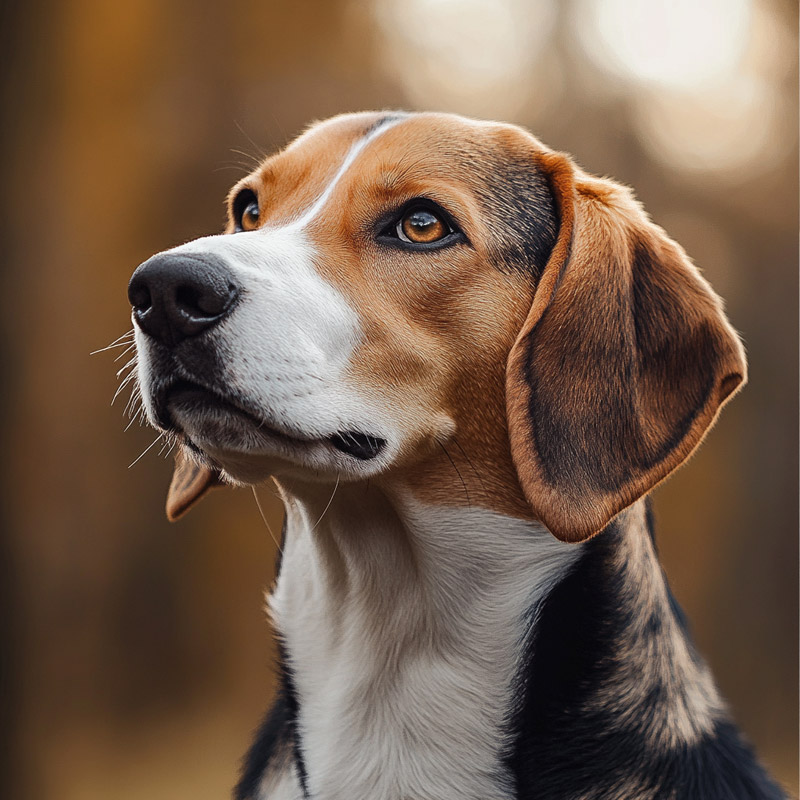
American Foxhounds live about 11 to 13 years and are generally healthy. The documented concerns are a platelet disorder, hip dysplasia and ear infections, though the sources disagree on how much weight those concerns carry.
Lifespan figures run 11 to 13 years (PetMD, Petfinder), 10 to 12 years on average (Eukanuba), and a maximum of 13 (Westminster Kennel Club). Petfinder lists the platelet disorder as occasionally seen, with a platelet count as the suggested test. PetMD and Dogster both name hip dysplasia, and PetMD says long ears are predisposed to infections.
Lifespan
The spread between 10 and 13 years looks like a data gap more than a biological one. None of the retrieved profiles points to a longevity study.
Vetstreet goes further and says a Foxhound can reach 15, which reads as an outlier, not a planning figure.
The one controllable factor the sources name is weight, and Eukanuba flags the breed as prone to gaining it.
Documented conditions and screening
How worried to be depends on who you ask. Petfinder lists no major or minor concerns, only an occasional platelet problem, while Dogster names thrombocytopathy and hip dysplasia as the biggest.
On the platelet disorder, the sources use three near-identical names. Hundeo writes thrombocytopenia (a low platelet count), while Dogster and Petfinder write thrombocytopathy or thrombopathy (platelets that do not work properly).
Hundeo advises checking the pedigree for known cases before buying a hound.
PetMD describes hip dysplasia as a hip joint that develops poorly, leaving it loose and leading to osteoarthritis. Hundeo says the vet x-rays the hips to see how deeply the femoral head sits in the socket.
The Orthopedic Foundation for Animals has run a voluntary hip database for all breeds since 1966. One third-party breed profile (Furry Critter) reports that no CHIC health-testing requirements exist for this breed, so confirm with the American Foxhound Club and ask for the individual dog’s hip results.
Dogster says the ears trap dirt and dust, and PetMD says to see the vet for redness, odor, pain or itching.
Where Does the American Foxhound Come From?
The breed grew from English hounds imported to Maryland in 1650, then crossed with French and Irish hounds in Maryland, Virginia and later Kentucky. Credit is contested. The AKC calls George Washington the father of the breed, yet Brooke’s 1650 pack, the earliest recorded importation of hounds in quantity according to Foxhunting Life, long predates him.
Early imports and Washington
- On June 30, 1650, Robert Brooke lands in what is now Calvert County, Maryland, with his hounds (Showsight)
- Lafayette’s gift of seven French hounds reaches Mount Vernon in 1785, dated August 24 in Washington’s diary
- In 1814, Bolton Jackson brings two Irish Foxhounds, Mountain and Muse, to Maryland (Showsight)
- American foxhound pedigrees are recorded from 1850 on, per Petfinder
Virginia’s 1966 act naming the state dog says Washington imported foxhounds and that all foxhounds descend from them. The Irish imports of 1814, which Foxhunting Life credits as ancestors of the July, Trigg and Walker strains, contradict the “all.”
A faster quarry also changed the breeding goals. Showsight dates the red fox’s arrival on Maryland’s western shore to the winter of 1779-1780, when the Chesapeake Bay froze, and calls the hounds Washington hunted slow and mouthy.
Strains
The strains differ in appearance and use but count as one breed, according to StateSymbolsUSA.
| Strain | Origin | Known for |
|---|---|---|
| Walker | Kentucky, Walker and Maupin families | Speed, rated the fastest strain by Showsight |
| Trigg | Kentucky, Col. Haiden Trigg, from Birdsong, Maupin and Walker lines | Built to chase the faster red fox |
| July | Descended from the Irish hounds Mountain and Muse | A brilliant hunter, with July as foundation sire |
Goodman hounds came from Willis Goodman adding the speed of Maryland hounds in Bourbon County, Kentucky (Showsight). The Masters of Foxhounds Association stud book listed Penn-Marydel hounds as American hounds until 2008, when it began recording them as a separate breed.
Walker blood runs through the Treeing Walker Coonhound too, which traces most directly to the Walker type.
Recognition and breed standards
Recognition came in stages, and the strain breeders wrote the first standard themselves.
- The AKC registered the breed in 1886, making it one of the club’s earliest
- Until the first American standard, drawn up in April 1894 by seven men including W.S. Walker, W.C. Goodman and Col. Trigg, hounds were judged under the English standard
- The UKC recognized the breed in 1905
- Virginia approved its state dog act on April 5, 1966, designating the American Fox Hound the official dog of the Commonwealth
- The American Foxhound Club, Inc. serves as the AKC parent club
How Does the American Foxhound Differ From the English Foxhound?
Head shape, chest proportion and underline separate the two on sight.
| Feature | American Foxhound | English Foxhound |
|---|---|---|
| Head | Slightly wedge-shaped from the front | Rectangular |
| Chest | 28 in (71 cm) girth on a 23 in (58 cm) hound | Over 31 in (79 cm) girth on a 24 in (61 cm) hound |
| Underline | Sloping, from a tapered ribcage | Nearly level, little tuck-up |
The chest figures come from the FCI American standard and the AKC English standard. That is roughly 3 inches more girth for 1 inch more height on the English hound.
Ear set is a weaker tell than most profiles claim. A Chewy breed comparison says English ears sit higher, yet the AKC English standard calls for ears set on low and lying close to the cheek.
On Westminster’s English Foxhound sheet the maxima are 24 inches and 75 pounds, so the American sits an inch taller and 5 pounds lighter at the top of its range.
Hundeo’s comparison rates the English Foxhound lower for children. Westminster puts both breeds at the top of its scale for kids.
The English Foxhound entered the AKC registry in 1909, 23 years after the American, and Showsight says the two were shown together as Foxhounds until then. In the AKC’s 2025 registration statistics, the American Foxhound ranked as the 15th rarest of 202 breeds and the English Foxhound as the 16th rarest.
A third lookalike, the Harrier, was bred down in size from English Foxhounds, Chewy’s comparison notes.
Who Should Not Get an American Foxhound?
Skip it if the fencing, running and noise demands covered above do not fit your household, and skip it if the dog will spend long hours alone. The sources back that from different angles.
They do disagree on one thing. The AKC calls the breed good-natured and low-maintenance, with a place in a family home. Hundeo says the hunting instinct is too strong for a pure companion and that the dog needs an owner who hunts.
StateSymbolsUSA adds that a bored Foxhound turns destructive and should not be left alone indoors for long stretches. Hundeo says the breed is best kept in a pack.
On the plus side, the hard coat does not need regular bathing (Dogster), and PetMD calls it a generally healthy breed.
The downsides pile up faster.
- Home life can be tough when owners and neighbors lack tolerance, warns Wamiz
- Pet-home puppies are scarce, because Petfinder says most Foxhounds belong to hunters who skip AKC registration
- Long stretches alone lead to destructive behavior
- A single-dog home is the weaker fit, since it does best with other hounds around
If no one in the household will run the dog every day, choose a breed with lower drive.
If size is the obstacle rather than the drive, the Beagle is the nearest scent hound. The AKC standard calls it a miniature Foxhound.
American Foxhound FAQ
Do American Foxhounds shed a lot?
They shed a moderate amount. Westminster Kennel Club rates shedding 3 of 5 and grooming needs 1 of 5.
Zooplus says a weekly brushing is enough to keep the coat in order.
How often does an American Foxhound need a bath?
Not on a schedule. Dogster says the breed does not need regular bathing.
Bathe when the hound is muddy or smells, and skip the calendar.
How much does an American Foxhound eat?
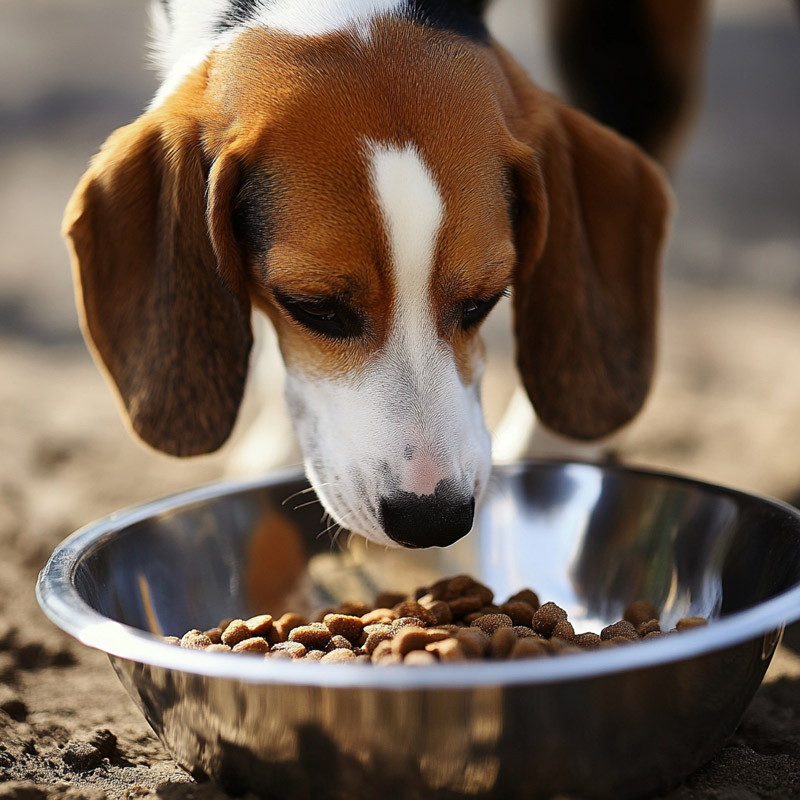
No single figure fits every hound. Hepper says an active Foxhound eats quite a bit, while Eukanuba flags the breed as prone to weight gain.
Set portions with your vet, then adjust to body condition.
Is the American Foxhound a rare breed?
Yes. PetMD calls it very rare, and the AKC’s 2025 registration statistics rank it the 15th rarest of 202 breeds.
That small pool also produces a tight-knit community of owners.
Was the American Foxhound the first dog breed developed in the United States?
Possibly. The AKC says it is one of the oldest American breeds and may even be the first.
Virginia’s 1966 state dog act counts it as one of four breeds of American origin.
Does an American Foxhound make a good watchdog?
Only partly. Westminster rates protectiveness 3 of 5, and the AKC says the watchdog question has pros and cons for owners who want a protective dog.
Can an American Foxhound compete in obedience or Rally?
Yes, with patience. The AKC owner guide calls obedience and AKC Rally a fun challenge for the breed.
Success there feels all the sweeter for a hound that resists commands.
Finding a Healthy American Foxhound
The American Foxhound Club, the AKC parent club for the breed, is the best first stop, because Vetstreet says its website carries the breeder list. Most hounds sit with hunters outside the registry, so the club reaches dogs that open listings miss.
The order that costs least to get wrong:
- Fence and daily running
- Parent club breeder referral
- Breed-verified adult rescue
The fence leads because neither a breeder nor a rescue can supply one.
Rescue saves the purchase price but gives up the pedigree. Adopt-a-Pet listings tagged Foxhound include Beagle, Plott Hound and Labrador crosses, and one rescue there requires an application, 3 referrals, a home visit and a vet referral.